
The history of luxury cars is the story of how engineering ambition, cultural aspiration, and relentless innovation transformed the automobile from a basic mode of transport into a symbol of human achievement. Premium automobiles have evolved across more than a century, and each era redefined what “luxury” means behind the wheel.
This guide covers the origins of early luxury pioneers, technological breakthroughs in comfort and performance, the influence of iconic brands on industry standards, the rise of supercars and ultra-high-end segments, shifting socioeconomic forces in the luxury market, and the future of electrification and sustainability.
The earliest luxury cars emerged in the early 1900s as hand-built, coachwork masterpieces from manufacturers like Duesenberg, Rolls-Royce, Mercedes-Benz, and Cadillac. These vehicles separated themselves from standard cars through bespoke craftsmanship, powerful engines, and prices that placed them firmly in the realm of the ultra-wealthy.
Mid-century innovations then reshaped the luxury experience entirely. Features we now take for granted (air conditioning, automatic transmission, power steering, cruise control) originated as exclusive luxury offerings before trickling down to mass-market vehicles over decades.
Brands like Rolls-Royce, Mercedes-Benz, and Cadillac did more than build cars; they established design languages and engineering philosophies that became industry benchmarks. Meanwhile, the emergence of supercars in the 1960s created an entirely new, performance-driven definition of automotive luxury.
Economic cycles, evolving buyer demographics, and the growing demand for experiential access over ownership continue to reshape the market. Looking ahead, electrification, autonomous driving, and sustainable manufacturing are poised to redefine premium automobiles once again.
What Defined the Earliest Luxury Cars and How Did They Differ From Standard Vehicles?
The earliest luxury cars were defined by hand-built construction, powerful engines, bespoke customization, and prices far beyond standard vehicles. The subsections below explore which brands pioneered this segment and which features created the divide.
Which Brands Were Pioneers in the Early Luxury Car Segment?
The brands that were pioneers in the early luxury car segment include Duesenberg, Rolls-Royce, Mercedes-Benz, and Cadillac. Each manufacturer brought a distinct philosophy to automotive luxury, yet all shared a commitment to engineering excellence and uncompromising quality.
The key specifications of their most iconic early models illustrate how dramatically they differed:
| Feature | Duesenberg Model J | Rolls-Royce Silver Ghost | Mercedes-Benz 540K | Cadillac V-16 |
| Production Years | 1928–1937 | 1907–1926 | 1936–1940 | 1930–1940 |
| Engine | 6.9L I8 | 7.4L I6 | 5.4L I8 (Supercharged) | 7.4L V16 |
| Horsepower | 265 hp (320 hp SJ) | ~50 hp | 115 hp (180 hp supercharged) | 165 hp |
| Top Speed | ~130 mph | ~60 mph | ~110 mph | ~100 mph |
| Units Produced | 481 | 7,874 | 419 | 4,076 |
| 1930s Price (USD) | $13,000–$25,000 | ~$11,750 (chassis) | ~$11,000 | ~$9,200 |
With only 481 Duesenberg Model J units ever built, exclusivity was woven into the brand’s identity from day one. These were not mass-produced machines; they were tailored to the specific desires of affluent clientele, often finished by independent coachbuilders. That level of personalization remains the benchmark for what separates true luxury from premium mass production.
How Did Luxury Car Features Set Them Apart Historically?
Luxury car features set them apart historically through advanced engineering, superior materials, and comfort innovations unavailable in standard vehicles. While ordinary cars of the early 20th century offered basic transportation, luxury models introduced hand-crafted interiors, powerful multi-cylinder engines, and bespoke bodywork commissioned through independent coachbuilders.
Key features that distinguished early luxury cars from standard vehicles include:
- Hand-built bodies tailored to individual owner specifications
- Multi-cylinder engines producing significantly more horsepower than mass-market alternatives
- Premium interior materials, such as fine leather, exotic wood veneers, and polished metal trim
- Supercharging technology, as seen in the Mercedes-Benz 540K’s forced-induction system producing 180 hp
- Extremely limited production runs that ensured exclusivity
According to a 1996 study by M. C. Sonfield in Design Issues, custom automotive coachbuilding between 1900 and 1940 allowed wealthy buyers to commission entirely unique body designs on luxury chassis. This bespoke process created vehicles that functioned as rolling works of art, something no standard automobile could replicate. Understanding these foundational distinctions helps explain why innovation has always flowed from luxury vehicles downward into mainstream production.
How Have Innovations in Technology Impacted Luxury Car Evolution?
Innovations in technology have impacted luxury car evolution by transforming safety, comfort, and performance into defining pillars of the premium segment. The following sections explore how comfort and safety breakthroughs reshaped the cabin experience, and how performance engineering advanced the luxury driving standard.
What Role Did Safety and Comfort Innovations Play in Luxury Cars?
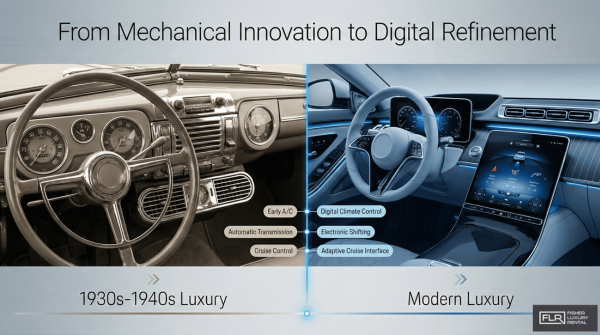
Safety and comfort innovations played a central role in luxury cars by establishing features that defined the premium experience for decades. According to a 2024 MotorTrend analysis of the biggest car technology advancements since 1949, breakthroughs such as in-car air conditioning, automatic transmission, and cruise control all debuted in luxury models before reaching the mass market.
Key comfort and safety innovations that originated in luxury vehicles include:
- Packard introduced in-car air conditioning in 1940, a landmark in passenger comfort.
- The Hydra-Matic automatic transmission, also introduced in 1940, eliminated manual gear changes.
- Hydraulic power steering reduced the physical effort needed to maneuver large luxury sedans.
- Cadillac launched automatic climate control in 1960, refining the controlled cabin environment.
- Chrysler’s “auto-pilot” arrived in 1958, followed by Cadillac’s cruise control a year later.
These features became hallmarks of what buyers expected from a premium automobile, gradually trickling down to standard vehicles over subsequent decades. In many ways, luxury brands served as the testing ground for technologies the broader industry would eventually adopt.
How Has Automotive Performance Progressed in the Luxury Segment?
Automotive performance has progressed in the luxury segment through increasingly powerful engines, advanced drivetrains, and the emergence of entirely new vehicle categories. Early luxury cars like the Duesenberg Model J produced 265 horsepower from a 6.9-liter inline-eight, reaching approximately 130 mph; a staggering figure for the 1930s.
The mid-century shift toward comfort did not eliminate the performance ambition. Mercedes-Benz, for example, carried its racing heritage into production models, with supercharged engines in vehicles like the 540K producing up to 180 horsepower. By the 1960s, the Lamborghini Miura redefined what a luxury-performance vehicle could be, introducing the mid-engine layout in 1966 and effectively creating the supercar category.
This trajectory reveals something important: performance in the luxury segment has never been purely about speed. It has always been about engineering refinement, where each generation pushes boundaries while maintaining the composure and quality expected of a premium automobile. With electrification now delivering instant torque and seamless acceleration, performance leadership continues to define the luxury standard.
In What Ways Did Iconic Luxury Car Brands Influence Industry Standards?
Iconic luxury car brands influenced industry standards by establishing benchmarks in engineering quality, design philosophy, and customer expectations. The following sections examine how Rolls-Royce, Mercedes-Benz, and Cadillac each shaped luxury, and which signature design elements became defining markers of the segment.
How Did Brands Like Rolls-Royce, Mercedes-Benz, and Cadillac Shape Luxury?
Brands like Rolls-Royce, Mercedes-Benz, and Cadillac shaped luxury by each defining a distinct pillar of the premium automobile experience.
- Rolls-Royce established bespoke craftsmanship as the ultimate luxury standard. Founded in 1904, the company built its reputation on meticulous hand-assembly and customization. The Silver Ghost’s remarkable reliability set the benchmark all luxury manufacturers would chase for decades.
- Mercedes-Benz anchored luxury in engineering innovation and motorsport heritage. From the supercharged 540K of the 1930s to modern safety systems, racing technology consistently migrated into production vehicles, blending performance with refinement.
- Cadillac defined American luxury through bold styling and feature leadership. The technologically ambitious V-16 engine of the 1930s and the iconic tailfins of the 1950s demonstrated a willingness to push design boundaries that competitors later followed.
Each brand’s approach created a different expectation of what “luxury” meant, and together they forced the entire industry upward.
What Signature Design Elements Have Become Synonymous With Luxury Cars?
Signature design elements that have become synonymous with luxury cars include distinctive grilles, hood ornaments, bespoke interior materials, and sculpted bodywork. Rolls-Royce’s Pantheon grille and Spirit of Ecstasy hood ornament remain instantly recognizable brand identifiers over a century later. Cadillac’s sweeping tailfins, introduced in the 1950s, became one of automotive history’s most referenced styling cues. According to a 1996 study by Sonfield in Design Issues, custom coachbuilding between 1900 and 1940 established the tradition of individualized exterior design that still influences luxury manufacturers today. Mercedes-Benz contributed the three-pointed star and a design language rooted in aerodynamic precision. These elements transcend function; they communicate exclusivity, heritage, and craftsmanship before a driver ever turns the key. That visual identity is what separates a premium automobile from a merely expensive one.
With brand identity firmly established, the next chapter explores how entirely new vehicle categories pushed luxury even further.
What Are the Key Milestones in the Evolution of Exotic and Super Luxury Cars?
The key milestones in the evolution of exotic and super luxury cars include the birth of the mid-engine supercar in the 1960s and the rise of ultra-high-end luxury SUVs. These shifts redefined what premium performance and exclusivity mean for drivers.
How Did Sports Cars and Supercars Redefine Luxury in the Automotive World?
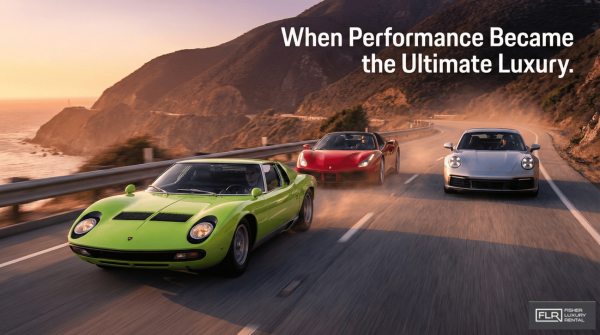
Sports cars and supercars redefined luxury in the automotive world by shifting the focus from comfort-oriented opulence to raw, racetrack-derived performance. The Lamborghini Miura, introduced in 1966, is widely considered the first true supercar, with its revolutionary mid-engine layout and striking design. According to research on supercar history, this mid-engine configuration brought race-level engineering to street-legal vehicles for the first time.
Ferrari and Porsche followed with their own iconic models, captivating public imagination and proving that performance itself could be the ultimate luxury. Rather than isolating passengers from the road, these machines celebrated the driving experience. This performance-first philosophy created an entirely new category of automotive aspiration, one where exclusivity is measured in horsepower and engineering precision as much as in hand-stitched leather.
What Milestones Marked the Shift to Ultra-High-End Luxury SUVs?
The milestones that marked the shift to ultra-high-end luxury SUVs include the convergence of off-road capability with supercar-level refinement and pricing. Brands traditionally associated with sedans and coupes began developing SUV platforms that delivered prestige, space, and commanding road presence without sacrificing performance.
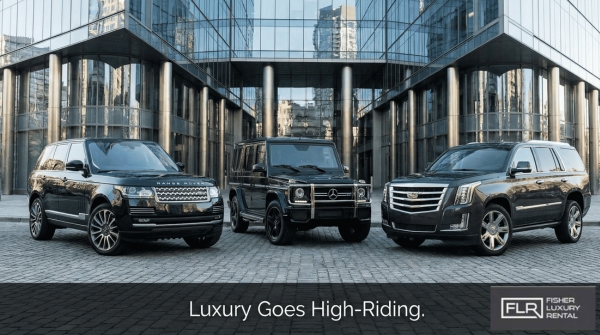
Vehicles such as the Range Rover Autobiography and Mercedes G-Wagon became status symbols in their own right, combining advanced suspension systems, premium interior materials, and powerful engines in a high-riding format. This segment proved that luxury buyers wanted versatility alongside exclusivity. For most buyers today, the ultra-high-end SUV represents the most practical way to experience top-tier luxury daily, which explains why this category continues to grow faster than traditional supercar sales.
With exotic and ultra-luxury milestones established, the broader definition of automotive luxury has also evolved considerably.
How Has the Definition of Automotive Luxury Changed Over the Decades?
The definition of automotive luxury has changed over the decades by shifting from exclusive ownership and handcrafted opulence toward accessible experiences, technological sophistication, and sustainability. The following sections explore the social forces and evolving customer expectations behind this transformation.
What Social and Economic Factors Have Influenced the Luxury Car Market?
The social and economic factors that have influenced the luxury car market include wealth distribution, economic cycles, financing accessibility, and the rise of experiential consumption. The Great Depression devastated early luxury manufacturers; Cadillac lost money on every V-16 unit sold as demand collapsed during the 1930s. While the market was once limited to the ultra-wealthy, leasing and financing options gradually opened luxury vehicles to a broader affluent demographic. According to Mordor Intelligence’s 2026 market analysis, the global luxury car rental market reached a valuation exceeding $50 billion in 2025, reflecting growing demand for luxury experiences without ownership. Inflation-adjusted pricing has remained remarkably consistent: a top-tier luxury car in the 1930s cost roughly the equivalent of a high-end model today. This consistency suggests that luxury automakers have always calibrated pricing to the upper boundary of what the wealthiest consumers will pay.
How Have Customer Expectations and Experiences Evolved?
Customer expectations and experiences have evolved from prioritizing material exclusivity to demanding seamless technology, personalized service, and access-based luxury. Early buyers valued bespoke coachwork and hand-built craftsmanship as primary markers of prestige. By midcentury, expectations shifted toward comfort innovations, including automatic climate control, power steering, and cruise control, features that eventually trickled down to mass-market vehicles. Today’s luxury consumers expect:
- Advanced driver-assistance systems and digital connectivity as standard equipment.
- Sustainable materials and carbon-neutral manufacturing practices.
- Flexible access models, such as premium rentals, that deliver luxury without long-term commitment.
- Curated, hassle-free experiences that extend well beyond the vehicle itself.
This philosophy drives the growth of premium rental services like Fisher Luxury Rental, where customers can experience top-trim exotic vehicles from Lamborghini, Ferrari, Porsche, and other legendary manufacturers without long-term ownership commitment—creating lasting memories at a fraction of ownership costs.
With luxury now defined by experience as much as exclusivity, the industry’s next chapter hinges on electrification and sustainability.
What Does the Future Hold for Luxury Cars in Terms of Technology and Sustainability?
The future of luxury cars in terms of technology and sustainability centers on electrification, autonomous driving, and environmentally conscious manufacturing. These shifts represent the most significant transformation the premium segment has ever faced.
How Are Electric and Hybrid Technologies Impacting Luxury Vehicles?
Electric and hybrid technologies are impacting luxury vehicles by fundamentally redefining what premium performance means. All major luxury brands are investing heavily in electric vehicle technology, driven by regulatory pressure, environmental concerns, and the inherent performance advantages of electric powertrains. Instant torque delivery and near-silent operation, once foreign to the segment, now align naturally with what luxury buyers expect. For enthusiasts who want to experience the current generation of gasoline-powered exotics before the full transition to electric, services like Fisher Luxury Rental provide access to today’s most celebrated performance vehicles, from the Lamborghini Huracan Spyder to the Ferrari 488 Spider. For buyers who value both refinement and responsibility, electric powertrains deliver on both fronts more convincingly than any previous technology shift in automotive history.
What Forthcoming Innovations Might Define Tomorrow’s Premium Automobiles?
Forthcoming innovations that might define tomorrow’s premium automobiles include autonomous driving systems, sustainable materials, and carbon-neutral manufacturing processes. Advanced driver-assistance systems are already standard in most luxury vehicles, and the industry is progressing toward higher levels of autonomy. This technology could redefine luxury itself, shifting emphasis from the driving experience to the in-car experience, where passengers enjoy personalized comfort, connectivity, and productivity.
Sustainability is also shaping the next generation of premium cars. Manufacturers are integrating recycled and bio-based materials into cabin designs while investing in production facilities that minimize environmental impact. These priorities reflect evolving buyer expectations: modern luxury consumers increasingly demand that exclusivity and ecological responsibility coexist. With these convergent forces at work, tomorrow’s premium automobiles will likely measure prestige not only by craftsmanship and power, but by how responsibly that excellence is achieved.
How Can Experiencing Exotic Luxury Car Rentals Enhance Your Appreciation of Automotive History?
Experiencing exotic luxury car rentals can enhance your appreciation of automotive history by putting you behind the wheel of the very engineering legacies covered throughout this article. Below, explore what Fisher Luxury Rental offers and the key takeaways from this evolution.
What Unique Experiences Does Fisher Luxury Rental Offer With Top-Trim Models?
Fisher Luxury Rental offers access to a curated fleet of top-trim exotic and luxury vehicles from brands that shaped automotive history, including Lamborghini, Ferrari, Porsche, Mercedes and many more. Founded in 2022, Fisher Luxury Rental operates providing a hands-on connection to the performance heritage and design philosophy discussed throughout this article.
The fleet spans multiple categories of luxury motoring:
- Lamborghini Huracan Spyder and Ferrari 488 Spider carry forward the mid-engine supercar legacy born with the 1966 Miura.
- Mercedes G-Wagon and Mercedes S580 reflect decades of German engineering excellence.
- Cadillac Escalade Sport continues the bold American luxury tradition.
- Porsche 911 Carrera S embodies over sixty years of performance refinement.
Fisher Luxury Rental specializes in top-trim models, ensuring every rental captures the full scope of each manufacturer’s craftsmanship. Reading about luxury car history provides context; driving these machines transforms that knowledge into visceral understanding.
What Are the Key Takeaways About History of Luxury Cars: Evolution of Premium Automobiles We Covered?
The key takeaways about the history of luxury cars are that premium automobiles evolved through distinct phases, each redefining what “luxury” means. Early pioneers like Duesenberg, Rolls-Royce, Mercedes-Benz, and Cadillac established exclusivity through hand-built craftsmanship and engineering ambition. Mid-century innovations in comfort and safety, from air conditioning to automatic transmissions, shifted luxury toward the passenger experience. The supercar era introduced performance as its own form of prestige. Today, electrification and autonomous technology are reshaping the segment once more.
Throughout every era, one theme remains constant: luxury cars represent the highest expression of automotive engineering, design, and aspiration at any given moment. According to a 2026 Mordor Intelligence report, the global luxury car rental market surpassed $50 billion in value, confirming that experiential access now rivals ownership as the preferred way to engage with these vehicles. Understanding this full arc makes every drive in a modern exotic car a richer, more informed experience.