
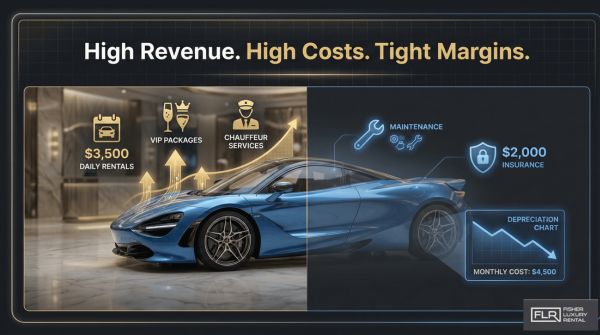
An exotic car rental business is a high-revenue, high-cost venture where profitability depends on the balance between premium daily rental income and substantial operational expenses. Gross margins can reach impressive levels, yet net profit hinges on fleet utilization, strategic pricing, and disciplined cost control.
This guide covers revenue streams and pricing strategy, operational costs and financial hurdles, seasonal demand and location dynamics, risk management and regulatory compliance, and customer experience as a profit driver.
Daily rental rates for exotic vehicles range from a few hundred dollars for entry-level luxury models to several thousand for rare supercars. Flexible rental durations, VIP packages, and ancillary services like chauffeur experiences create additional income channels that strengthen overall revenue per vehicle.
Fleet acquisition represents the largest upfront barrier, with startup investments reaching into the millions. Depreciation, specialized maintenance, and insurance premiums collectively consume the majority of operating budgets, particularly during the first year of business when costs can outpace incoming revenue.
Seasonal demand swings directly shape profit margins. Peak periods around holidays, summer travel, and major events allow operators to command premium pricing, while off-peak months require dynamic rate adjustments and corporate partnerships to maintain healthy occupancy rates. Geographic factors, including local tourism volume, competitor density, and regulatory requirements, further influence whether a market supports sustainable profitability.
Theft, vehicle damage, fraud, and liability exposure present ongoing financial risks. GPS tracking, thorough renter screening, comprehensive insurance portfolios, and airtight rental agreements are essential safeguards that protect margins from catastrophic losses.
White-glove service, curated fleet variety, and personalized experiences drive repeat bookings and referrals. In a competitive luxury market, customer retention directly reduces acquisition costs and builds the brand equity that sustains long-term profitability.
What are the main sources of revenue in an exotic car rental business?
The main sources of revenue in an exotic car rental business are daily rental fees, flexible rental durations, and ancillary services such as VIP packages and special add-ons. High-performance electric vehicles from Tesla, Porsche, and Audi are also creating new rental demand.
How do hourly, daily, and weekly rental rates impact profitability?
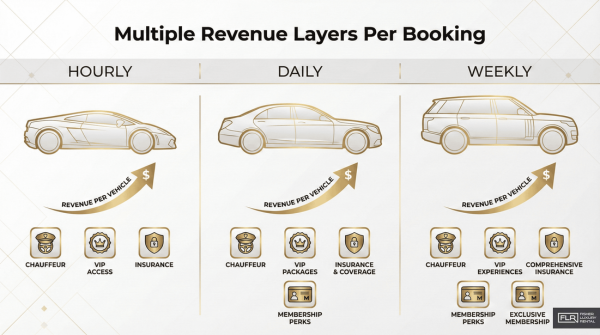
Hourly, daily, and weekly rental rates impact profitability by directly determining how much revenue each vehicle generates relative to its idle time. Offering flexible rental durations caters to a wider range of customer needs, from brief test-drive experiences to extended weekend getaways.
Fleet utilization rate, the percentage of cars rented at any given time, is the key metric connecting rental duration to profit. Longer bookings reduce turnover costs, while shorter hourly rentals can command premium per-hour pricing. Seasonal demand further shapes this equation; peak seasons during holidays, summer months, and major local events allow operators to command higher rates with stronger utilization. Off-peak periods require strategic discounting or corporate targeting to keep vehicles productive.
For operators serious about profitability, blending duration tiers is often more effective than committing to a single pricing model.
What role do VIP packages and special add-ons play in boosting revenue?
VIP packages and special add-ons play a significant role in boosting revenue by increasing the average transaction value beyond the base rental rate. Common high-margin add-ons include:
- Chauffeur and concierge services for clients who want a fully managed experience.
- Customized driving experiences and curated scenic tours.
- Membership programs and loyalty rewards that encourage repeat bookings.
- Insurance waivers and supplemental protection products.
These ancillary services transform a single car rental into a premium experience package, often with margins that exceed the rental fee itself. For most exotic rental operators, the businesses that treat add-ons as core revenue rather than optional extras consistently outperform those relying on base rental income alone.
With revenue streams clearly defined, understanding the costs required to support them is equally important.
What are the essential costs and expenses for running an exotic car rental business?
The essential costs and expenses for running an exotic car rental business include fleet acquisition, depreciation, maintenance, insurance, and marketing. These operational costs represent the most significant challenge to profitability, spanning both high fixed fleet-related expenses and ongoing operational overhead.
What are the upfront costs to acquire an exotic or luxury car fleet?
The upfront costs to acquire an exotic or luxury car fleet represent a massive capital expenditure that determines the business’s foundation. According to a 2026 Business Plan Suite financial model, an initial fleet investment ranges from $3,000,000 to $12,000,000, depending on fleet size and vehicle selection.
Undercapitalization remains one of the most common reasons exotic car rental ventures fail. Successful companies consistently demonstrate strong financial management paired with a deep understanding of their target market. For anyone entering this space, securing sufficient capital before purchasing a single vehicle is non-negotiable; running short on fleet funding creates a cascade of operational problems that few businesses recover from.

How do maintenance, repairs, and depreciation affect operating expenses?
Maintenance, repairs, and depreciation affect operating expenses by consuming the largest share of an exotic car rental company’s budget. Depreciation alone can account for 38% of total vehicle ownership costs, according to Ewald Fleet Solutions. For exotic models specifically, first-year depreciation can reach a staggering 220%.
Maintenance costs compound this burden. High-performance engines, specialized components, and manufacturer-required service intervals drive repair expenses far above standard vehicle costs. During the first year of operation, maintenance costs can consume as much as 95% of revenue. This reality makes the early operational period especially challenging, and operators who underestimate these recurring expenses often struggle to reach profitability.
What insurance requirements and costs are unique to exotic car rentals?
The insurance requirements and costs unique to exotic car rentals stem from the high value of the vehicles and the elevated risk of renting them to a diverse clientele. Liability insurance is mandatory, with typical minimum coverage of $100,000 per person, $300,000 per accident, and $100,000 for property damage. According to Griffith E Harris, some operators opt for higher policies at $250,000/$500,000.
Annual insurance costs typically range from $80,000 to $120,000. Beyond cost, a comprehensive insurance portfolio serves as a critical risk management tool, protecting the business from financial losses caused by accidents, theft, and unforeseen events. Skimping on coverage to save money is one of the most dangerous shortcuts an operator can take.
How do marketing and advertising contribute to overall expenses?
Marketing and advertising contribute to overall expenses by requiring consistent investment to attract the affluent, experience-driven clientele that sustains an exotic car rental operation. Effective marketing spans digital advertising, social media content, search engine optimization, and strategic partnerships with hotels and event planners.
These costs, while smaller than fleet or insurance expenses, remain essential for maintaining visibility in a competitive market. Operators who neglect marketing often struggle with low utilization rates, which undermines revenue regardless of fleet quality. A well-executed marketing strategy directly supports occupancy, making it one of the more controllable levers for improving profitability.
With costs mapped out, understanding how occupancy rates and seasonal demand shape margins becomes the next critical factor.
How do occupancy rates and seasonal demand affect business profit margins?
Occupancy rates and seasonal demand directly determine how much revenue each vehicle in a fleet generates. The sections below cover when demand peaks and dips, and how optimizing occupancy strengthens profitability.
When are peak and off-peak seasons for exotic car rentals?
Peak seasons for exotic car rentals coincide with holidays, summer months, and major local events. During these periods, rental companies command higher prices and achieve higher utilization rates. Off-peak seasons bring lower demand and increased price competition, which compress margins. Operators who rely solely on leisure clients feel this swing most acutely. Targeting the corporate market, which is often less affected by seasonality, helps stabilize revenue year-round. Partnerships with hotels, travel agencies, and event planners can also generate bookings during slower periods. For any exotic fleet, understanding these cycles is essential to forecasting cash flow accurately.

How can occupancy optimization increase profitability?
Occupancy optimization increases profitability by ensuring more vehicles generate revenue on any given day rather than sitting idle. Dynamic pricing is one of the most effective tools available. According to industry analysis from Financial Models Lab, car rental companies adjust rates in real-time based on demand, seasonality, and competitor pricing, maximizing revenue during peak periods while attracting customers with competitive rates during slower stretches. Key strategies that improve fleet utilization include:
- Offering flexible rental durations, such as hourly, daily, weekly, and monthly options.
- Diversifying clientele across leisure travelers, corporate accounts, and special event renters.
- Running targeted off-season promotions to fill gaps in the booking calendar.
Even a modest increase in utilization can meaningfully shift margins, since most fixed costs remain constant regardless of how many cars are rented. With seasonal strategy and dynamic pricing working together, exotic car rental operators can protect margins across the full calendar year.
How does location influence the success and profitability of an exotic car rental business?
Location influences the success and profitability of an exotic car rental business by determining customer demand, pricing power, and regulatory costs. The subsections below cover geographic demand factors and how local regulations shape margins.
What geographic factors make certain cities better for exotic car rentals?
The geographic factors that make certain cities better for exotic car rentals include tourism volume, local wealth concentration, major event calendars, and climate. Cities with year-round warm weather and scenic driving routes attract more leisure renters willing to pay premium rates. High-income metro areas with active nightlife, resort destinations, and convention centers generate consistent demand across corporate and leisure segments.
Geographic location directly affects pricing power. According to industry pricing analysis, daily rental rates range from a few hundred dollars for entry-level luxury cars to several thousand dollars for rare supercars, with geographic location listed as a key pricing variable. Markets like Miami, Las Vegas, Los Angeles, and Scottsdale consistently command higher rates because affluent tourists and event-goers concentrate there. Operators who position their fleets in these high-demand corridors benefit from stronger utilization and shorter idle periods between bookings.
How do local regulations and competition affect profitability?
Local regulations and competition affect profitability by adding compliance costs and compressing margins in saturated markets. Each state and municipality imposes different requirements for business licensing, vehicle registration, and consumer protection. These regulatory layers create variable overhead that operators must account for when selecting a location.
In highly competitive markets, established players with brand recognition and larger fleets can undercut smaller operators on pricing. Successful companies differentiate through fleet specialization, exceptional customer service, and value-added offerings such as chauffeur services and curated driving tours. For newer operators, entering a market with fewer direct competitors can yield better margins, even if overall demand is slightly lower, because pricing pressure remains manageable. Understanding the balance between regulatory burden and competitive density is one of the most overlooked factors when choosing where to launch an exotic rental operation.
What are the biggest risks and challenges for exotic car rental businesses?
The biggest risks and challenges for exotic car rental businesses include vehicle theft, accidental damage, renter fraud, and complex legal liability. Below, we examine how operators mitigate operational risks and navigate the legal landscape unique to high-value vehicle rentals.
How do businesses mitigate risks of theft, damage, or fraud?
Businesses mitigate risks of theft, damage, or fraud through layered operational safeguards. Vehicle damage, theft, and mechanical failure represent the primary operational risks in the exotic rental segment, according to a 2026 Business Plan Suite analysis of exotic car rental operating costs. Effective countermeasures include:
- Thorough customer vetting with background checks and driving record verification before approving any rental agreement.
- GPS tracking and telematics systems installed in every vehicle to monitor location, speed, and usage in real time.
- Comprehensive rental agreements that clearly define renter responsibilities, liability limits, and penalties for misuse.
- Security deposits scaled to the vehicle’s value, creating a financial deterrent against negligent behavior.
A comprehensive risk management plan that addresses financial, operational, and market risks collectively strengthens long-term sustainability. In practice, the operators who invest in prevention rather than reaction tend to lose far fewer vehicles and face significantly lower claim costs over time.
What legal and liability issues are especially important for exotic rentals?
The legal and liability issues especially important for exotic rentals center on regulatory compliance, adequate insurance coverage, and consumer protection obligations. Exotic car rental companies must satisfy federal, state, and local regulations governing:
- Business licensing specific to each operating jurisdiction.
- Proper vehicle registration and titling for every fleet asset.
- Consumer protection laws that prevent unfair or deceptive rental practices.
Because these vehicles carry values often exceeding six figures, liability exposure is substantially higher than in standard car rental. Strict rental agreements that allocate responsibility for damage, define mileage restrictions, and outline insurance obligations are essential for limiting legal exposure. Operators who treat compliance as an afterthought risk costly lawsuits and regulatory penalties that can threaten the entire business.
With risk and compliance strategies in place, customer experience becomes the next driver of long-term profitability.
How can customer experience and service quality impact income and repeat business?
Customer experience and service quality directly impact income and repeat business by driving retention, referrals, and premium pricing power. The subsections below explore how white-glove service builds loyalty and how fleet quality attracts high-value clients.
What role does white-glove service play in customer retention and referrals?
White-glove service plays a critical role in customer retention and referrals by creating memorable, frictionless experiences that justify premium pricing. In a market shaped by brand reputation, fleet composition, pricing, and customer service, personalized attention becomes a key differentiator. Value-added touches, such as vehicle delivery and collection, chauffeur services, and curated driving tours, enhance the rental experience while generating additional revenue.
Mobile apps that let customers book cars, manage rentals, and access services from their smartphones further elevate convenience. When every interaction feels effortless and premium, clients return and recommend the service to others. Fisher Luxury Rental built its business around this principle, delivering white-glove service. Every rental includes personalized attention from a team with customer service experience dating back to the mid-90s.
How important is fleet quality and variety in attracting high-value clients?
Fleet quality and variety are essential in attracting high-value clients because discerning renters expect access to well-maintained, current-model vehicles across multiple categories. A diverse fleet that spans convertible supercars, luxury SUVs, and grand tourers allows operators to serve weddings, corporate events, and weekend getaways with equal confidence.
Fisher Luxury Rental exclusively stocks top-trim models across its exotic and luxury fleet, from the Porsche 911 Carrera S to the McLaren 720S, ensuring every vehicle meets the standards discerning clients expect. In my experience, fleet presentation is the silent salesperson; it either confirms or undermines every marketing promise a brand makes.
With service quality and fleet standards established, the next step is understanding how a specialized rental partner turns these principles into a seamless experience.
How should you approach luxury car rentals with Fisher Luxury Rental’s unique offerings?
You should approach luxury car rentals with Fisher Luxury Rental by prioritizing personalized service, fleet quality, and an experience-first mindset. The following sections cover how Fisher Luxury Rental enhances special events and the key profitability takeaways from this guide.
Can Fisher Luxury Rental’s white-glove exotic car rental service help maximize your special event or travel experience?
Yes, Fisher Luxury Rental’s white-glove exotic car rental service can help maximize your special event or travel experience by combining a curated fleet of top-trim vehicles with personalized attention at every step.
Fisher Luxury Rental offers a curated fleet of top-trim exotic vehicles, including models like the Lamborghini Huracan Spyder and Ferrari 488 Spider, each maintained to exacting standards. According to a 2026 Mordor Intelligence report, the global luxury car rental market is valued at approximately $55.04 billion and is projected to reach $74.41 billion by 2031. That sustained growth reflects what Fisher Luxury Rental sees firsthand: demand for premium, personalized rental experiences continues to climb. In a market where exceptional customer service is a key differentiator, choosing a provider that treats every booking as a bespoke experience makes all the difference.
What are the key takeaways about how profitable an exotic car rental business, revenue & costs explained we covered?
The key takeaways about how profitable an exotic car rental business is center on balancing high revenue potential against substantial operating costs. Here are the most actionable insights from this guide:
- Exotic car rentals can achieve gross margins as high as 82%, but net profitability depends on controlling depreciation, maintenance, and insurance expenses.
- Fleet depreciation is the single largest cost, accounting for up to 38% of total vehicle ownership expenses, with first-year exotic car depreciation reaching 220%.
- Insurance costs range from $80,000 to $120,000 annually and can consume up to 80% of revenue during initial operations.
- Seasonal demand swings require dynamic pricing and corporate client diversification to maintain consistent occupancy.
- Revenue optimization through ancillary services, such as chauffeur packages, curated tours, and membership programs, separates profitable operators from struggling ones.
For anyone evaluating this industry or simply seeking the best rental experience, the lesson is clear: profitability and customer satisfaction both depend on fleet quality, operational discipline, and service excellence. Fisher Luxury Rental builds its business around all three, offering top-trim exotic vehicles with the kind of hands-on care that turns first-time renters into repeat clients.