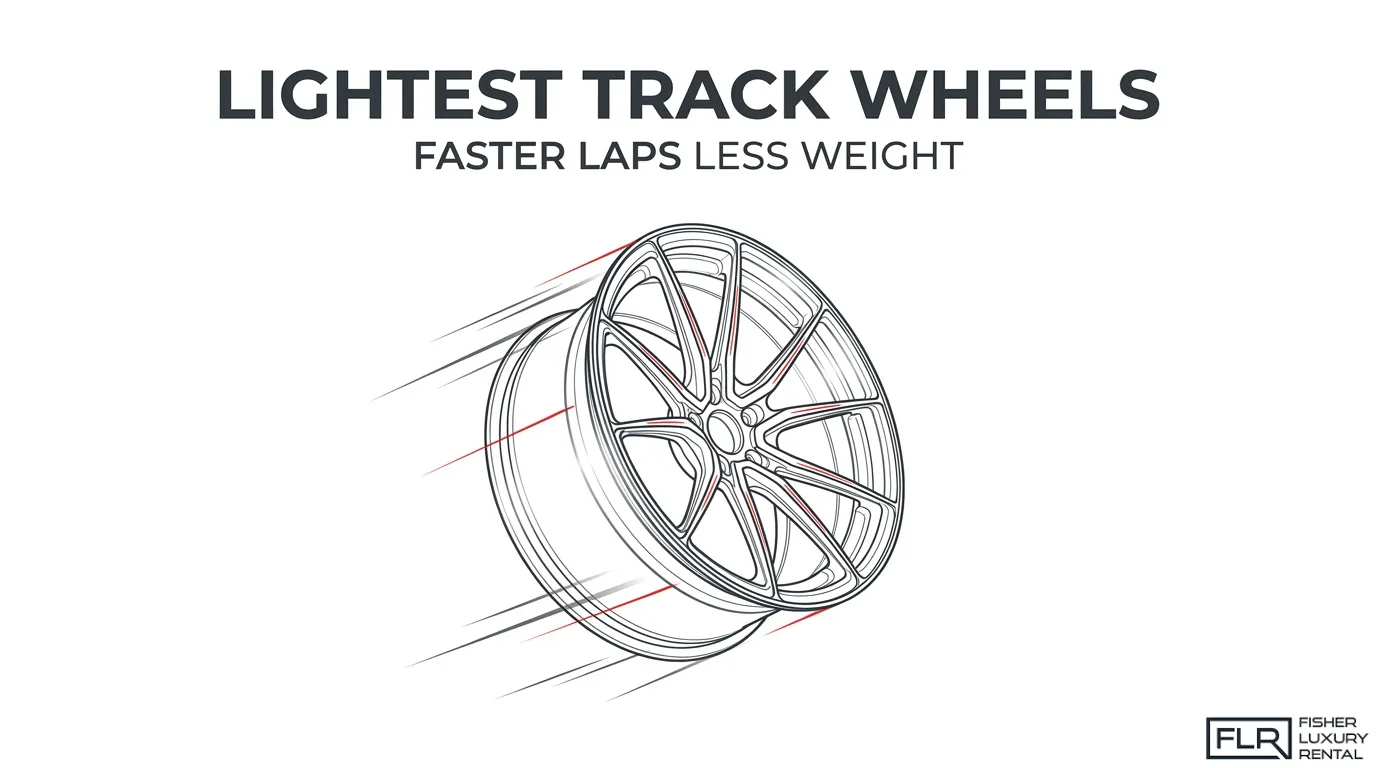
Lightweight performance wheels are purpose-engineered wheel designs that reduce rotational and unsprung mass to improve a car’s acceleration, braking, and handling response on circuit. The manufacturing process, material choice, and fitment specifications determine how much of that improvement a driver actually feels.
This guide covers the physics of wheel weight, the best materials for track use, top forged and budget-friendly wheel picks, fitment selection, real-world weight savings by vehicle class, post-track maintenance, and common buying mistakes.
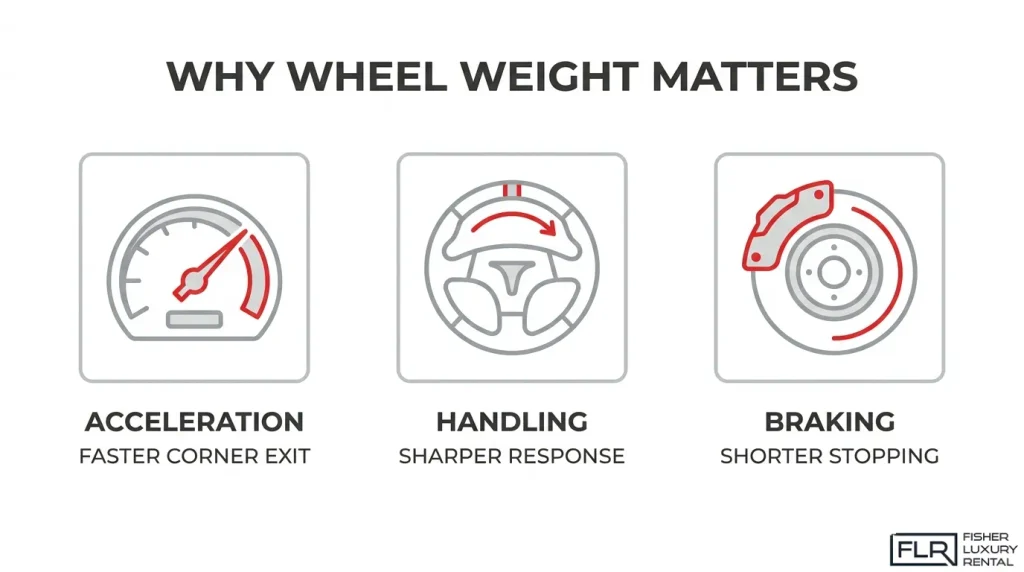
Wheel weight matters because every pound of rotating mass costs more than a pound of static chassis weight in dynamic performance terms. Lighter wheels allow the suspension to react faster, help brakes shed speed in shorter distances, and sharpen corner exit acceleration in ways that accumulate over every lap.
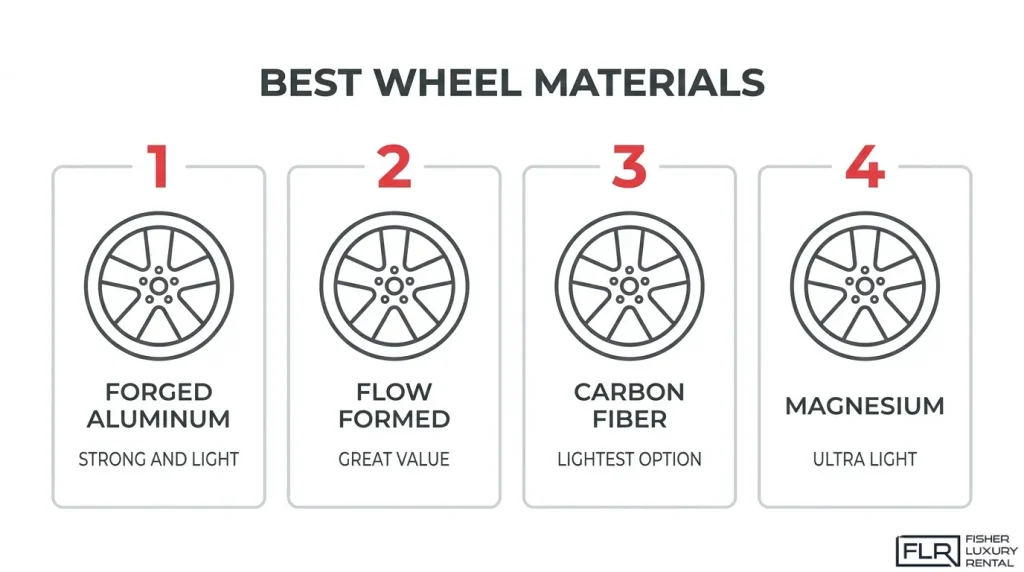
The best materials for track wheels range from forged aluminum, which dominates professional and club racing alike, to flow-formed aluminum for budget-conscious drivers, through to carbon fiber and magnesium at the extreme end of weight reduction and cost.
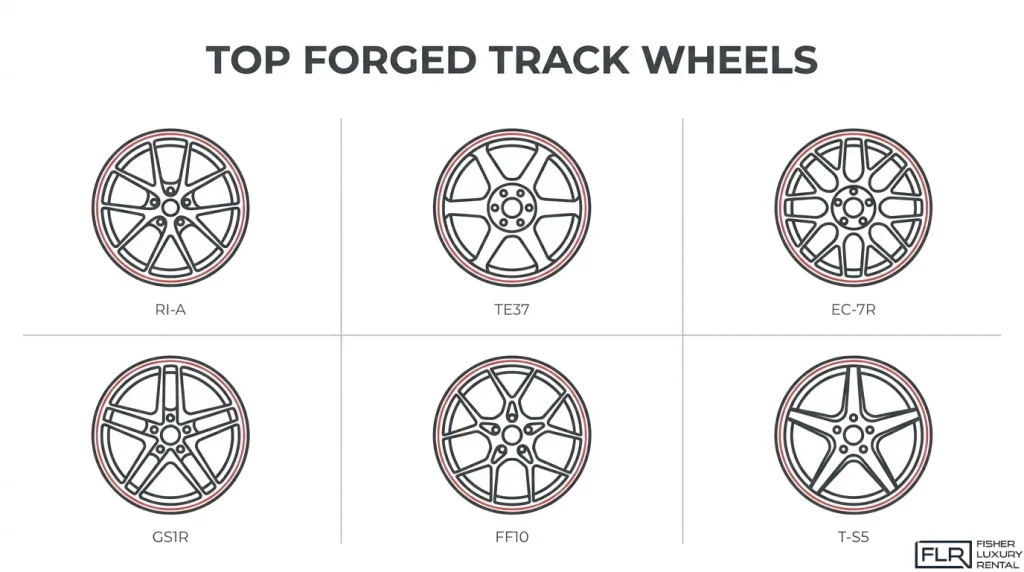
The top forged picks covered here include the BBS RI-A, Volk Racing TE37 Saga S-Plus, Apex EC-7R, Forgeline GS1R, HRE FlowForm FF10, and Titan7 T-S5. Budget-friendly alternatives such as the Enkei RPF1, Konig Hypergram, Apex ARC-8, and Team Dynamics Pro Race LT deliver meaningful savings without forged pricing.
Fitment decisions around diameter, width, and offset affect performance as directly as raw weight. Getting those specs wrong undermines every gram saved elsewhere.
Post-track care, including structural inspection and material-safe cleaning, protects that investment and keeps wheels race-ready long term.
Why Does Wheel Weight Matter for Track Day Performance?
Wheel weight directly affects how a car accelerates, handles, and stops on track. The following sections explain how rotational mass, unsprung weight, and braking performance each respond to lighter wheels.
How Does Rotational Mass Affect Lap Times?
Rotational mass affects lap times because spinning components require energy to accelerate, and wheels are among the largest rotating masses on any car. Heavier wheels demand more engine power to change speed, blunting throttle response and exit acceleration out of corners. Because the effect compounds through every gear change and corner exit, even a modest weight reduction per wheel translates into measurable time gains over a full lap. A 1 kg reduction per wheel is widely regarded by performance engineers as equivalent to removing roughly 3 to 5 kg of static chassis weight in terms of dynamic feel, though the precise figure varies by drivetrain and circuit layout.
How Does Reducing Unsprung Weight Improve Handling?
Reducing unsprung weight improves handling because the suspension can track road surface changes more quickly when there is less mass to control. Unsprung weight includes everything not supported by the suspension spring, such as wheels, tires, and brake rotors. Lighter wheels allow the suspension to react faster to bumps and kerbs, keeping tires in contact with the tarmac longer and improving both mid-corner stability and steering feedback. In practical terms, this means the car follows the driver’s inputs more precisely, reducing understeer and oversteer correction on high-speed circuits.
How Does Wheel Weight Impact Braking Performance?
Wheel weight impacts braking performance because heavier rotating assemblies carry greater rotational inertia, which resists deceleration. The braking system must overcome both the vehicle’s linear momentum and the angular momentum stored in each wheel, so lighter wheels allow brakes to shed speed more effectively in shorter distances. Reduced wheel mass also lowers the thermal load transferred into the hub and bearing assembly during repeated hard stops, a critical factor for sustained track day use where brake fade is a genuine risk. Upgrading to forged or flow-formed wheels is one of the most cost-effective ways to improve both braking consistency and overall stopping performance.
What Are the Best Lightweight Wheel Materials for Track Use?
The best lightweight wheel materials for track use are forged aluminum, flow-formed aluminum, carbon fiber, and magnesium. Each material differs in strength, weight, cost, and suitability depending on vehicle class and track conditions.
Forged Aluminum
Forged aluminum is the most widely used material for performance track wheels. The forging process compresses aluminum billet under extreme pressure, aligning the grain structure and producing a wheel that is significantly stronger and lighter than a cast equivalent. Most premium forged aluminum wheels weigh between 15 and 20 pounds in a 17-inch size, depending on spoke design and wall thickness. The combination of high strength-to-weight ratio, repairability, and broad availability makes forged aluminum the default choice for serious track drivers at virtually every level.
Flow-Formed Aluminum
Flow-formed aluminum wheels occupy a practical middle ground between cast and fully forged construction. The flow-forming process stretches the barrel of a low-pressure cast wheel under heat and rollers, densifying the metal and reducing weight without the full cost of forging. The result is a wheel stronger and lighter than a standard cast unit, typically 10 to 15 percent lighter, at a considerably lower price point. For drivers who want meaningful performance gains without a premium forged budget, flow-formed aluminum is often the smartest value decision available.
Carbon Fiber
Carbon fiber wheels are the lightest option available for track use. A full carbon fiber wheel in a 19-inch fitment can weigh as little as 9 to 12 pounds, roughly half the weight of a comparable forged aluminum design. That reduction translates directly into lower rotational inertia and faster acceleration response. The trade-off is cost: carbon fiber wheels typically range from $5,000 to over $15,000 per set, making them accessible primarily in top-tier motorsport and hypercar applications.
Magnesium
Magnesium wheels are lighter than aluminum and deliver outstanding stiffness, making them a historic staple in professional motorsport. Magnesium is approximately 35 percent less dense than aluminum, allowing wheel weights to drop well below comparable forged aluminum units. However, magnesium corrodes readily, requires specialized maintenance, and is more brittle under impact loads than aluminum. Most magnesium wheel applications today are confined to dedicated racing programs rather than general track day use, where the durability demands and repair logistics make aluminum a more practical long-term choice.
What Are the Top Lightest Forged Wheels for Track Days?
The top lightest forged wheels for track days include the BBS RI-A, Volk Racing TE37 Saga S-Plus, Apex EC-7R, Forgeline GS1R, HRE FlowForm FF10, and Titan7 T-S5. Each offers a distinct balance of weight savings, stiffness, and fitment options for serious track use.
BBS RI-A
The BBS RI-A is a motorsport-grade forged aluminum wheel used extensively in professional racing series, including DTM and GT championships. It uses a monoblock forged construction to achieve an extremely low weight while maintaining high structural rigidity under cornering loads. The RI-A is widely regarded as one of the lightest production-compatible forged wheels available, with select fitments weighing under 6 kg. For drivers who prioritize outright rotational mass reduction, the RI-A represents the benchmark against which other forged wheels are measured.
Volk Racing TE37 Saga S-Plus
The Volk Racing TE37 Saga S-Plus is a forged aluminum wheel manufactured by Rays Engineering using their proprietary RMFG (Rays Magneto Forming) cold-forging process. This process increases material density without added mass, producing a wheel that is both lighter and stronger than conventionally cast alternatives. The six-spoke design minimizes material while preserving torsional rigidity. The TE37 Saga S-Plus is a popular choice among time attack and circuit drivers who need a proven, competition-ready wheel that fits a wide range of Japanese and European performance vehicles.
Apex EC-7R
The Apex EC-7R is a flow-forged monoblock wheel designed specifically for track use. Apex developed the EC-7R with a competition-focused spoke geometry that reduces weight while improving stiffness-to-weight ratio compared to the standard EC-7. It is frequently specified for cars competing in NASA, SCCA, and similar amateur circuit events. The EC-7R delivers competitive weight figures at a lower price point than many fully forged alternatives, making it one of the most accessible high-performance lightweight wheels in its class.
Forgeline GS1R
The Forgeline GS1R is a single-piece forged aluminum wheel designed and manufactured in the United States, purpose-built for road racing. Forgeline machines the GS1R from a 6061-T6 aluminum forging, resulting in a wheel with exceptional strength and a weight profile competitive with multi-piece designs. It is homologated for use in various GT and endurance racing classes. The GS1R is available in a wide range of custom widths and offsets, making it a practical option for both purpose-built race cars and street-driven track vehicles.
HRE FlowForm FF10
The HRE FlowForm FF10 is a flow-formed aluminum wheel produced by HRE Performance Wheels using a manufacturing process that applies rotational pressure to stretch and work-harden the barrel. This process delivers a structural integrity closer to forged aluminum than standard casting, at a lower cost than full forging. The FF10 targets drivers seeking HRE quality and design without the full monoblock forged price premium. It achieves competitive weights suitable for track days while maintaining the fitment precision HRE is known for across its full lineup.
Titan7 T-S5
The Titan7 T-S5 is a flow-formed lightweight wheel engineered with a five-spoke design optimized for both stiffness and weight reduction. Titan7 positions the T-S5 as a direct track-day and time attack wheel, offering fitments tailored to popular performance platforms including Subaru, Mitsubishi, and Honda applications. The T-S5 competes closely with fully forged options on weight while undercutting them on price, making it a compelling value for club racers and track day enthusiasts who need measurable performance gains without a professional racing budget.
What Are the Best Budget-Friendly Lightweight Track Wheels?
The best budget-friendly lightweight track wheels balance low rotational mass with structural rigidity at an accessible price point. The top options include the Enkei RPF1, Konig Hypergram, Apex ARC-8, and Team Dynamics Pro Race LT.
Enkei RPF1
The Enkei RPF1 is a flow-formed aluminum wheel widely regarded as one of the best value track wheels available. Manufactured using Enkei’s MAP (Most Advanced Performance) process, the RPF1 achieves a weight of approximately 13–15 lbs in a 17×8 fitment, making it competitive with wheels costing significantly more. Its simple five-spoke design minimizes material without sacrificing stiffness. For budget-conscious track drivers, the RPF1 is arguably the benchmark against which all other affordable performance wheels are measured.
Konig Hypergram
The Konig Hypergram is a flow-formed lightweight wheel designed specifically for performance and track use. Available in sizes from 15 to 18 inches, it weighs as little as 13.5 lbs in a 15×8 fitment. The multi-spoke design distributes load efficiently across the wheel structure, reducing flex under lateral cornering forces. At its price point, the Hypergram delivers a strength-to-weight ratio typically associated with more expensive forged options.
Apex ARC-8
The Apex ARC-8 is a flow-formed aluminum track wheel engineered with motorsport-specific fitments for popular enthusiast platforms, including BMW and Ford Mustang. The ARC-8 weighs approximately 18–20 lbs in an 18×9.5 fitment, and its stepped-lip design allows for aggressive yet factory-safe offsets. Apex backs the ARC-8 with a lifetime structural warranty, which signals confidence in its durability under repeated track stress.
Team Dynamics Pro Race LT
The Team Dynamics Pro Race LT is a cast aluminum wheel refined for competitive club racing, and is a popular choice in British motorsport series. It weighs approximately 6.5 kg (around 14.3 lbs) in a 17×7 fitment and features a reinforced center section suited for sustained high-load driving. The Pro Race LT demonstrates that budget-friendly wheels can meet genuine motorsport standards without requiring a forged price premium.
How Do You Choose the Right Lightweight Wheel Size for Track?
Choosing the right lightweight wheel size involves balancing diameter, width, and offset for your car’s suspension geometry and tire requirements. The sections below cover each fitment dimension and its specific effect on track performance.
What Wheel Diameter Offers the Best Track Performance?
Wheel diameter offers the best track performance when sized between 17 and 18 inches for most dedicated track applications. Larger diameters increase rotational mass and sidewall stiffness, while smaller diameters limit brake caliper clearance. A 17-inch wheel typically delivers the optimal balance: enough clearance for large brake packages, a taller tire sidewall for progressive feedback, and lower rotational inertia than 19-inch or 20-inch alternatives. For GT and touring cars running wider brakes, 18 inches is the practical minimum. Going larger purely for aesthetics on track is one of the most common and costly fitment mistakes a driver can make.
How Does Wheel Width Affect Grip on Track?
Wheel width affects grip on track by determining the tire’s contact patch width and sidewall support. A wider wheel stretches the tire tread flatter against the surface, increasing the contact area and lateral stiffness under cornering loads. The most common track widths range from 8 to 10.5 inches, matched to tire sizes between 225 and 305. Running a tire too narrow for the wheel creates an overworked crown; running it too wide causes unpredictable shoulder wear. Matching width precisely to the tire manufacturer’s recommended rim width range is critical for consistent lap-to-lap grip.
What Offset and Fitment Specs Matter for Track Driving?
The offset and fitment specs that matter for track driving are offset (ET value), bore diameter, and bolt pattern accuracy. Offset positions the wheel within the wheel well, directly affecting scrub radius and steering feedback. A lower positive offset pushes the wheel outward, widening the track and improving stability, but risks rubbing the fender under suspension compression. Hub-centric fitment, where the center bore matches the hub precisely, eliminates vibration caused by wheel imbalance at high speed. Using lug-centric adapters on track increases stress on wheel studs and is a significant safety risk worth avoiding entirely.
How Much Weight Can You Save per Wheel by Upgrading?
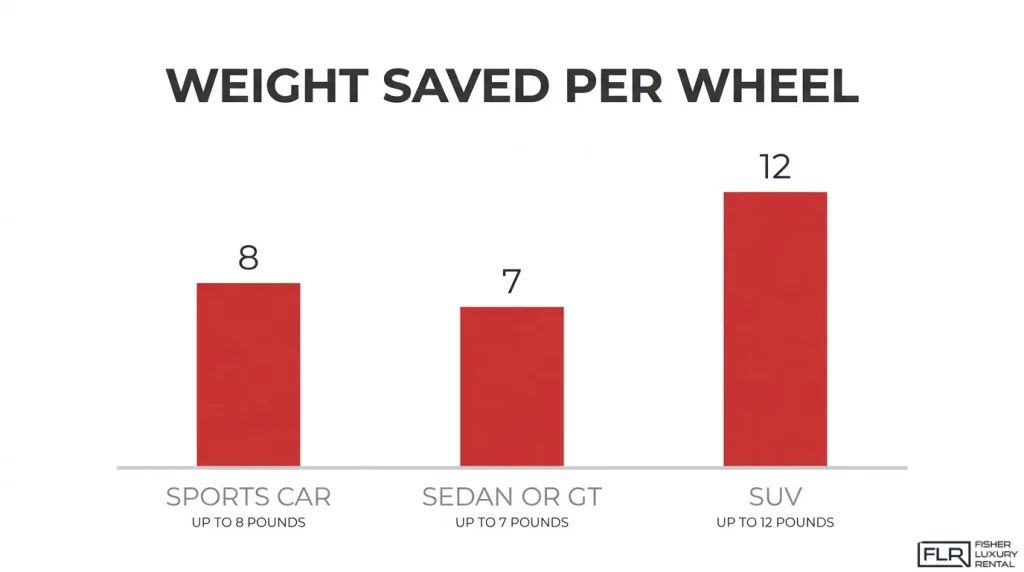
Upgrading to lightweight performance wheels can reduce per-wheel mass by 3 to 10+ pounds, depending on vehicle class. Savings vary across sports cars, sedans, and SUVs, each covered below.
How Much Do Lightweight Wheels Save on a Sports Car?
Lightweight wheels on a sports car typically save 4 to 8 pounds per wheel compared to OEM fitment. A stock Porsche 911 or Subaru BRZ often ships with cast aluminum wheels weighing 22 to 26 pounds each. Upgrading to forged options like the Volk TE37 or BBS RI-A brings that figure down to 14 to 18 pounds in equivalent sizing. Across four corners, that represents 16 to 32 pounds of total unsprung mass reduction. For sports cars already tuned close to their performance ceiling, this kind of savings is genuinely meaningful, sharpening turn-in response and improving acceleration feel in ways that most driver aids cannot replicate.
How Much Do Lightweight Wheels Save on a Sedan or GT?
Lightweight wheels on a sedan or GT save approximately 4 to 7 pounds per wheel versus factory equipment. Performance sedans such as the BMW M3 or Mercedes-AMG C63 typically run OEM wheels in the 22 to 28-pound range due to their larger diameters and load requirements. Forged or flow-formed replacements in 18 to 19-inch sizing routinely land between 18 and 22 pounds. Over a full set, that yields 16 to 28 pounds of unsprung weight savings. Given that GT-class vehicles carry more mass overall, the proportional handling gain per pound saved is slightly smaller than on a sports car, making material quality and stiffness just as important as raw weight reduction.
How Much Do Lightweight Wheels Save on an SUV or Crossover?
Lightweight wheels on an SUV or crossover save roughly 5 to 12 pounds per wheel, reflecting the heavier OEM castings these vehicles use. Factory wheels on performance SUVs like the Porsche Cayenne or BMW X5 M commonly weigh 28 to 36 pounds in 20 to 22-inch diameters. Forged monoblock options from manufacturers such as HRE or Forgeline in similar sizing can reach as low as 22 to 26 pounds. That produces a total saving of 20 to 48 pounds across all four wheels. Because SUVs carry significantly higher unsprung mass to begin with, lightweight wheel upgrades deliver a disproportionately large improvement in ride compliance, body control, and brake cooling clearance compared to lighter vehicle classes.
How Should You Maintain Lightweight Wheels After Track Days?
Maintaining lightweight wheels after track days requires inspection for structural damage and safe, material-appropriate cleaning. The sections below cover damage assessment for forged wheels and cleaning methods safe for performance finishes.
How Do You Inspect Forged Wheels for Track Damage?
Inspecting forged wheels for track damage involves checking for cracks, curb rash, flat spots, and stress marks around the spoke roots and barrel. These areas absorb the greatest load under hard cornering and braking. Run your fingers along each spoke junction and the inner barrel lip, where hairline cracks are easiest to miss visually. Any crack, regardless of size, disqualifies a wheel from further track use until professionally assessed. Check valve stem holes for elongation and look for lateral runout by spinning the wheel slowly on the car. Wheels showing impact flat spots or visible deformation should be inspected with dye-penetrant testing before reuse.
What Cleaning Methods Are Safe for Performance Wheels?
Safe cleaning methods for performance wheels use pH-neutral wheel cleaners, soft microfiber mitts, and low-pressure rinsing to protect anodized, clear-coated, or polished finishes. Avoid acid-based brake dust removers on forged aluminum or magnesium wheels, as they strip protective coatings and accelerate corrosion. After a track day, brake dust bakes onto the finish quickly due to high heat, so cleaning within 24 hours significantly reduces bonding. Dry thoroughly after washing since standing water in spoke pockets promotes oxidation on bare aluminum edges. For carbon fiber wheels, avoid alkaline degreasers, which can degrade the resin matrix over time.
What Common Mistakes Should You Avoid When Buying Track Wheels?
The common mistakes to avoid when buying track wheels include prioritizing aesthetics over weight, ignoring load ratings, choosing incorrect offsets, and skipping material verification. Each error can compromise performance, fitment, or safety on track.
- Buying cast wheels labeled as “lightweight.” Cast aluminum wheels are heavier than forged or flow-formed equivalents. Always verify the manufacturing process, not just the advertised weight.
- Ignoring the wheel’s load rating. Track driving generates higher lateral and braking loads than street use. A wheel rated below your vehicle’s corner weight can crack or fail under stress.
- Choosing incorrect offset for your suspension geometry. Wrong offset changes scrub radius, which destabilizes steering feel and accelerates bearing wear.
- Skipping center bore verification. A hub-centric fit eliminates vibration at speed; a loose bore fit relying solely on lug nuts creates imbalance.
- Selecting diameter and width based on style alone. Wider wheels increase rotating mass and can create clearance issues with brake calipers and wheel wells.
- Overlooking finish durability for track environments. Polished or chrome finishes corrode quickly under brake dust and heat; bare or anodized finishes hold up better.
- Neglecting to confirm TPMS compatibility. Many lightweight forged wheels require aftermarket TPMS sensors, which adds cost and installation time if overlooked.
Treating wheel selection as a purely visual decision is one of the most costly mistakes a track enthusiast can make, since every spec directly affects lap time, safety, and long-term cost.
How Can You Experience High-Performance Cars on the Track?
Not every car enthusiast owns a track-ready exotic. Fisher Luxury Rental bridges that gap, offering access to high-performance vehicles for those who want to experience exotic car performance firsthand. Based in Phoenix, AZ and Portland, OR, Fisher Luxury Rental offers a curated fleet of top-trim luxury and exotic cars available to rent without a long-term ownership commitment.
Can Renting an Exotic Car from Fisher Luxury Rental Fuel Your Track Day Passion?
Yes, renting an exotic car from Fisher Luxury Rental can fuel your track day passion by putting you behind the wheel of a top-trim, high-performance vehicle without the ownership commitment. Fisher Luxury Rental serves Phoenix, AZ and Portland, OR, providing curated fleets of luxury and exotic cars maintained to premium standards.
For car enthusiasts, this means experiencing the driving dynamics of high-performance exotic cars, on your terms. Fisher Luxury Rental selects only top-trim models, so every rental delivers the performance feel that track days demand. It is one of the most practical ways to explore high-performance driving before investing in your own setup.
What Are the Key Takeaways About the Lightest Performance Wheels for Track Days?
The key takeaways about the lightest performance wheels for track days center on material, weight savings, and fitment. Forged aluminum and carbon fiber wheels deliver the best weight-to-strength ratios, while flow-formed aluminum offers a strong budget-conscious alternative.
The most actionable conclusions from this topic are:
- Rotational mass reduction directly improves acceleration, braking, and cornering response.
- Forged wheels from brands such as BBS, Volk Racing, and Apex represent the top performance tier.
- Budget options like the Enkei RPF1 and Apex ARC-8 deliver meaningful savings without sacrificing durability.
- Correct diameter, width, and offset matter as much as raw wheel weight.
- Post-track inspection and proper cleaning extend wheel life significantly.
Understanding these priorities helps you make smarter wheel decisions, whether you own a track car or are experiencing performance driving for the first time. For those still exploring what high-performance driving feels like, Fisher Luxury Rental offers exotic and luxury car rentals in Phoenix, AZ and Portland, OR a practical way to experience these dynamics before committing to a build.