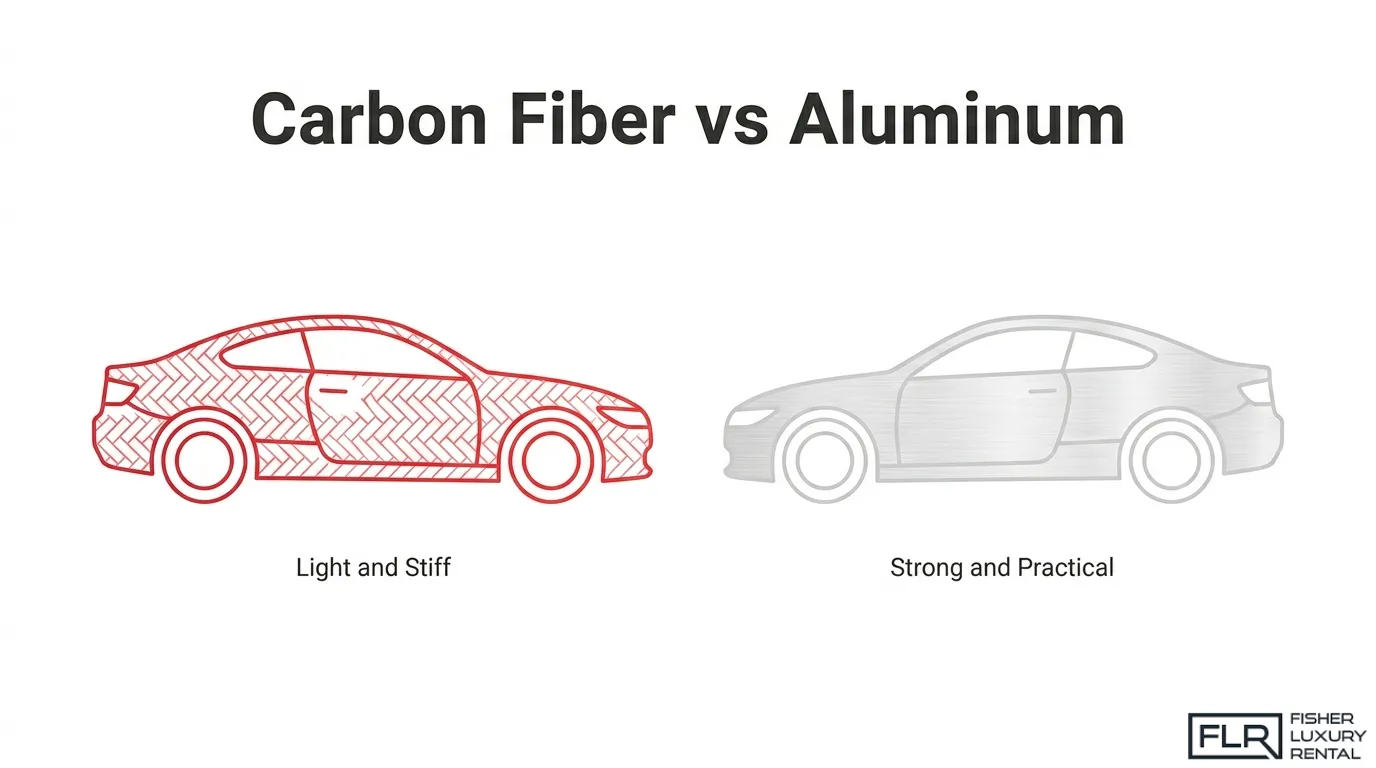
A carbon fiber chassis is a structural framework built from woven carbon filaments bonded in a polymer resin matrix, producing a load-bearing shell with exceptional rigidity at minimal weight. An aluminum chassis serves the same structural function using aluminum alloys, offering a lighter and more practical alternative to steel without the manufacturing complexity of carbon fiber.
This comparison covers material definitions and construction, weight and structural strength, vehicle performance and driving feel, durability and cost, which exotic cars use each platform, safety and fuel efficiency, and how to experience the difference firsthand.
Carbon fiber and aluminum are fundamentally different in how they are built and what they weigh. Carbon fiber monocoques are autoclave-cured from directional fiber plies, while aluminum chassis use stamped, extruded, or bonded alloy sections. That construction gap drives a substantial weight advantage for carbon fiber in high-performance applications.
Each material also behaves differently under load. Carbon fiber delivers higher yield stress at lower density than aluminum, while aluminum absorbs crash energy through controlled plastic deformation, a behavior engineers have tuned for decades.
Cost and repairability separate them further. Carbon-fiber-reinforced thermoplastic monocoques cost roughly 76% more than a conventional steel unibody to produce, and field repairs require specialist equipment that aluminum does not. For mass-production vehicles, aluminum wins on economics; for supercars, carbon fiber wins on performance.
The driving experience reflects all of these differences. Carbon fiber chassis feel immediate and surgical, transmitting every road input with near-zero structural flex. Aluminum chassis blend agility with a slightly more compliant character, making them well-suited to grand tourers that must perform across varied conditions.
What Is a Carbon Fiber Chassis?
A carbon fiber chassis is the structural framework of a vehicle built from woven carbon filaments bonded in a polymer resin matrix, forming a lightweight yet exceptionally rigid load-bearing structure. The sections below cover how carbon fiber chassis are constructed, their historical origins, and the key structural advantages that make them a defining feature of high-performance vehicles.
How Is a Carbon Fiber Chassis Constructed?
A carbon fiber chassis is constructed by layering carbon fiber sheets, or “prepreg” fabric, into molds and curing them under heat and pressure in an autoclave. This process produces a monocoque or composite tub where the outer shell itself carries structural loads, eliminating the need for a separate internal frame. The result is a structure with an exceptional strength-to-weight ratio that no conventional metal fabrication process can match.
What Are the Origins of Carbon Fiber Chassis in Motorsport?
The origins of carbon fiber chassis in motorsport trace directly to the 1981 McLaren MP4/1, which became the first Formula 1 car to feature a chassis made from carbon fiber, according to the Science Museum Group. That single innovation demonstrated that carbon composites could replace metal in the most structurally demanding environments on earth. Within a decade, the technology migrated from racing to road cars, where engineers recognized that the same structural philosophy could transform production vehicle performance.
What Makes Carbon Fiber Structurally Unique as a Chassis Material?
Carbon fiber is structurally unique as a chassis material because its fiber orientation can be engineered directionally, concentrating stiffness and strength precisely where loads are highest. A Northwestern University materials analysis confirmed that carbon fiber composites outperform aluminum and low-carbon steels in density-versus-yield-stress comparisons while remaining significantly less dense. This directional tunability is something no isotropic metal can replicate, making carbon fiber the material of choice when engineers need to minimize weight without sacrificing rigidity.
What Is an Aluminum Chassis?
An aluminum chassis is the structural framework of a vehicle built primarily from aluminum alloys, providing the load-bearing skeleton to which all other components attach. Lighter than steel yet easier to manufacture at scale than carbon fiber, aluminum chassis designs cover a spectrum of approaches, from space frames to monocoques to aluminum-intensive unibody platforms.
What Materials Make Up an Aluminum Chassis?
An aluminum chassis uses aluminum alloys as its primary structural material, typically in extruded, stamped, or cast forms joined by welding, bonding, or riveting. Common alloys include 5000- and 6000-series grades, chosen for their balance of strength, formability, and corrosion resistance. Some advanced platforms combine aluminum with high-strength steel or composite inserts at high-stress nodes to optimize both stiffness and weight.
How Is an Aluminum Chassis Constructed?
An aluminum chassis is constructed using three main methods: space frame assembly, monocoque fabrication, and aluminum-intensive unibody construction. Space frames use extruded aluminum sections joined at nodes to form a rigid cage. Monocoques press or bond aluminum panels into a single load-bearing shell. Unibody platforms integrate the chassis and body into one stamped aluminum structure, which is the most common approach in current luxury vehicle production.
Why Do Automakers Choose Aluminum for Chassis Construction?
Automakers choose aluminum for chassis construction because it significantly reduces vehicle mass without the manufacturing complexity or cost of carbon fiber. According to the U.S. Department of Energy, replacing traditional steel components with aluminum alloys can reduce a vehicle’s body and chassis weight by up to 50 percent, directly improving fuel consumption. For mass-market luxury vehicles produced at high volumes, aluminum offers a practical path to lightweighting that carbon fiber cannot yet match economically.
How Do Carbon Fiber and Aluminum Chassis Compare in Weight?
Carbon fiber and aluminum chassis compare in weight with carbon fiber holding a significant advantage: lightweight materials such as aluminum alloys and carbon fiber can reduce a vehicle’s body and chassis weight by up to 50 percent, according to the U.S. Department of Energy. The sections below cover typical weights for each material and how that difference affects power-to-weight ratio.
How Much Does a Typical Carbon Fiber Chassis Weigh?
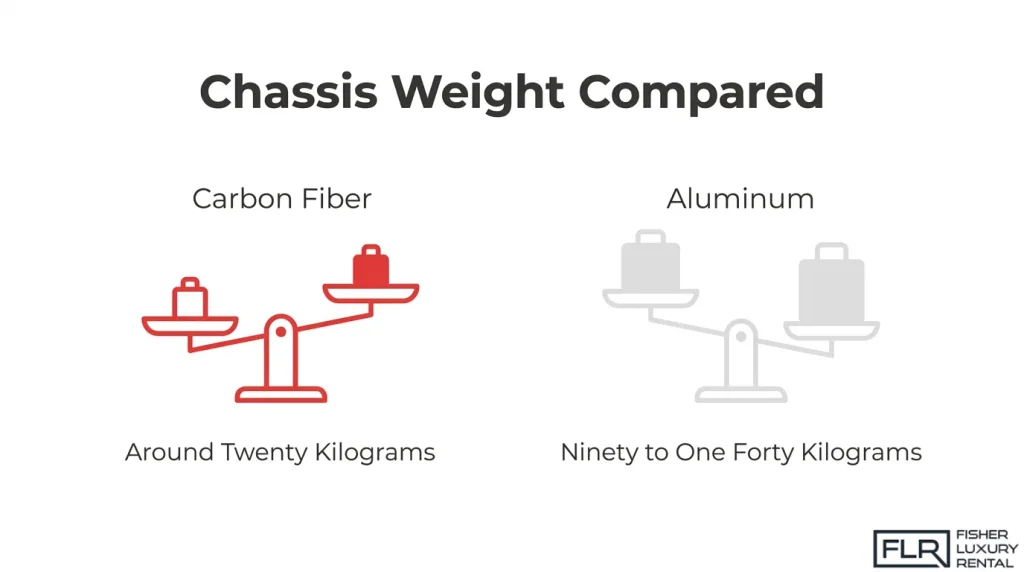
A typical carbon fiber chassis weighs considerably less than equivalent metal structures, and its weight varies by application, from competition monocoques to road car tubs. In 1981, the McLaren MP4/1 became the first Formula 1 car with a carbon fiber chassis, according to the Science Museum Group, marking the moment motorsport proved the material’s structural potential at minimal mass. The Bugatti Chiron’s carbon fiber monocoque is constructed as a single piece to save weight while increasing structural rigidity. A KTH Formula Student monocoque project produced a carbon fiber chassis weighing just 20 kg, a reduction of roughly 10 kg compared to its predecessor despite a larger surface area. For road and competition use, carbon fiber chassis consistently land well below aluminum equivalents of comparable stiffness.
How Much Does a Typical Aluminum Chassis Weigh?
A typical aluminum chassis weighs more than a carbon fiber equivalent but substantially less than a traditional steel structure. Aluminum space frames and platform-based chassis in performance vehicles generally range from 90 to 140 kg depending on vehicle class and design complexity. Replacing steel components with aluminum alloys can reduce chassis weight by meaningful margins, contributing to the broader finding that lightweight materials can cut body and chassis weight by up to 50 percent compared to conventional steel. For production vehicles where cost and repairability matter, aluminum remains the practical lightweight standard.
How Does Chassis Weight Affect Power-to-Weight Ratio?
Chassis weight directly determines power-to-weight ratio, which is the single most influential variable in a vehicle’s acceleration, braking, and cornering performance. A lighter chassis means every unit of engine output moves less total mass, amplifying felt performance without requiring additional horsepower. A Clemson University study on multi-material body-in-white design found a 22.7% weight reduction while maintaining the same mechanical characteristics as the baseline vehicle, demonstrating how structural mass savings translate directly into performance gains. Carbon fiber’s weight advantage over aluminum therefore compounds across every performance metric. For drivers who want to feel that difference, the chassis material is as important a specification as the engine itself.
How Do Carbon Fiber and Aluminum Differ in Structural Strength?
Carbon fiber and aluminum differ in structural strength across three key dimensions: resistance to impact forces, fatigue behavior, and torsional rigidity. The sections below examine each material’s performance in those areas.
How Does Carbon Fiber Perform Under Impact Forces?
Carbon fiber performs under impact forces by combining high yield stress with low density, outperforming metals such as low-carbon steels and aluminum in strength-to-weight comparisons. According to a Northwestern University materials science analysis, carbon fiber composites perform very well in density versus yield stress analysis, being stronger than both low-carbon steels and aluminum while remaining less dense.
This combination is what makes carbon fiber the preferred chassis material in motorsport and exotic car manufacturing. A lighter structure that absorbs more load per gram translates directly into safer, faster platforms.
How Does Aluminum Perform Under Impact Forces?
Aluminum performs under impact forces through controlled plastic deformation, meaning the material bends and crumples progressively rather than fracturing suddenly. This ductile behavior makes aluminum predictable in crash scenarios, which engineers can model and tune with well-established manufacturing tooling.
However, aluminum’s energy absorption per unit weight is lower than that of carbon fiber composites, making it a structural compromise where cost and repairability outweigh the need for maximum performance.
Which Material Offers Better Torsional Rigidity?
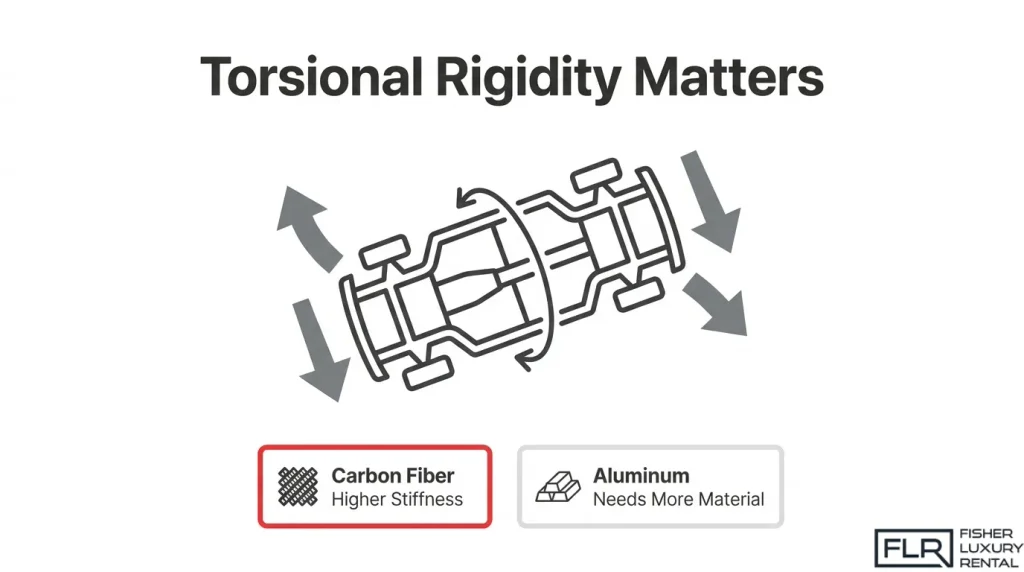
Carbon fiber offers better torsional rigidity than aluminum at equivalent or lower weight, a structural advantage that directly improves steering precision and chassis response. The SAE ALLIANCE project, targeting a 25% weight reduction at costs below 3 euros per kilogram, identified advanced composite and multi-material integration as the path to achieving rigidity gains without mass penalties.
Aluminum can achieve competitive torsional stiffness through geometry and thicker sections, but those solutions add weight, partially negating aluminum’s lightweight advantage.
How Does Chassis Material Affect Vehicle Performance?
Chassis material affects vehicle performance across four measurable dimensions: acceleration, handling, braking, and cornering. The sections below examine how carbon fiber and aluminum each influence these outcomes.
How Does a Carbon Fiber Chassis Improve Acceleration?
A carbon fiber chassis improves acceleration by reducing total vehicle mass without sacrificing structural integrity. Lower mass means the same drivetrain output propels less weight, directly improving power-to-weight ratio. According to the U.S. Department of Energy, replacing traditional components with lightweight materials such as carbon fiber can reduce chassis weight by up to 50%, translating to meaningful gains in straight-line speed. This is why carbon fiber monocoques dominate motorsport and high-performance road cars where every kilogram counts.
How Does an Aluminum Chassis Affect Handling Dynamics?
An aluminum chassis affects handling dynamics by distributing weight more evenly than heavier steel alternatives while remaining stiffer than many composite layups at comparable cost. Lower unsprung and total mass allows suspension components to respond faster to road inputs, improving driver feedback and turn-in response. Aluminum’s predictable elastic behavior also makes chassis tuning more consistent, which benefits engineers designing vehicles for balanced, accessible performance rather than outright lap times.
How Does Chassis Material Influence Braking Performance?
Chassis material influences braking performance primarily through vehicle mass: lighter chassis reduce the kinetic energy that brakes must dissipate during deceleration. A carbon fiber chassis, by reducing total vehicle weight, shortens stopping distances for equivalent braking systems. Aluminum achieves similar benefits versus steel, though carbon fiber’s greater mass reduction gives it a measurable edge at the extreme performance end.
How Does Chassis Stiffness Change Cornering Behavior?
Chassis stiffness changes cornering behavior by controlling how much the structure flexes under lateral load. A stiffer chassis transfers cornering forces more accurately to the suspension, keeping tire contact patches consistent through turns. A Cal Poly Formula SAE study found that increasing torsional stiffness from 1,500 to 1,650 lbf-ft/deg through configuration changes produced directly improved handling response. Carbon fiber typically achieves higher stiffness-to-weight ratios than aluminum, making it the preferred choice where cornering precision is the primary objective.
How Do Carbon Fiber and Aluminum Compare in Durability?
Carbon fiber and aluminum each offer distinct durability profiles, with key differences in long-term fatigue resistance, corrosion behavior, and repairability. The sections below examine how each material holds up over time and after damage.
How Does Carbon Fiber Hold Up Over Long-Term Use?
Carbon fiber holds up over long-term use with exceptional resistance to fatigue and metal creep, two failure modes that commonly affect aluminum structures under repeated stress cycles. Because the material does not corrode in the conventional sense, it resists rust and oxidation indefinitely. However, the FAA Advisory Circular AC 20-107B notes that weathering, ultraviolet radiation, and chemical exposure from fluids such as hydraulic fluid or cleaning agents can cause measurable deterioration in composite structures, requiring appropriate protective treatments.
One underappreciated risk: carbon fiber can suffer internal delamination from impact without any visible surface damage, making hidden structural compromise difficult to detect without specialist inspection equipment.
How Does Aluminum Resist Corrosion and Fatigue?
Aluminum resists corrosion through a naturally forming oxide layer that shields the base metal from moisture and atmospheric exposure. However, aluminum is susceptible to fatigue cracking under repeated high-stress load cycles, which gradually weakens the structure over time. According to the Embry-Riddle Aeronautical University aerospace materials textbook, when carbon fiber composites contact aluminum in the presence of moisture, carbon fibers form a galvanic couple with the aluminum, accelerating electrochemical corrosion in the metal. This means hybrid assemblies combining both materials require careful insulation between components.
Which Material Is Easier to Repair After Damage?
Aluminum is easier to repair after damage than carbon fiber in most real-world scenarios. Skilled technicians can weld, reshape, and patch aluminum using widely available tools and materials. Carbon fiber repair, by contrast, requires specialized layup techniques, autoclaving or vacuum-bagging equipment, and structural verification to confirm the repaired area has recovered its original fiber alignment and load-bearing capacity. For everyday road use, aluminum’s repairability represents a meaningful practical advantage, particularly for owners outside major metropolitan areas where composite repair specialists are scarce.
How Do Carbon Fiber and Aluminum Chassis Compare in Cost?
Carbon fiber chassis cost significantly more than aluminum chassis to produce, driven by raw material prices and manufacturing complexity. The sections below cover production cost differences and why aluminum holds a clear advantage in mass-market manufacturing.
How Much More Does a Carbon Fiber Chassis Cost to Produce?
Carbon fiber chassis cost substantially more to produce than both aluminum and steel alternatives. According to an Oak Ridge National Laboratory study on automotive polymer composites, polymer composites cost approximately 2 to 3 times more than steel on a per-pound basis. More specifically, carbon-fiber-reinforced thermoplastic monocoques cost about 76% more than a conventional steel unibody, while glass-fiber-reinforced thermosets run approximately 62% higher. These figures apply to comparable monocoque designs, making the cost gap concrete rather than theoretical. For exotic and hypercar manufacturers producing in low volumes, that premium is acceptable given the performance returns. For mainstream production, however, the math rarely works in carbon fiber’s favor.
Why Is Aluminum More Cost-Effective for Mass Production?
Aluminum is more cost-effective for mass production because it uses established, scalable manufacturing processes such as stamping, extrusion, and welding that most automotive facilities already support. Raw aluminum costs a fraction of carbon fiber precursor materials, and cycle times per part are far shorter. Unlike carbon fiber layup and autoclave curing, aluminum forming integrates directly into existing high-volume assembly lines without specialized tooling investments. This accessibility makes aluminum the preferred lightweight material for automakers targeting production volumes in the hundreds of thousands annually, where per-unit cost discipline is non-negotiable.
Which Luxury and Exotic Cars Use Carbon Fiber Chassis?
Luxury and exotic cars use carbon fiber chassis to achieve extreme strength with minimal weight. The sections below cover which supercars feature full monocoques and which high-performance models use carbon fiber tubs.
Which Supercars Feature Full Carbon Fiber Monocoques?
Supercars that feature full carbon fiber monocoques include the Bugatti Chiron, McLaren P1, Koenigsegg Agera, and Lamborghini Aventador. According to the Audrain Automobile Museum, the Bugatti Chiron’s backbone is a single-piece carbon fiber monocoque, designed to save weight while increasing structural rigidity. McLaren has built every road car around a carbon fiber monocoque since the F1 in the 1990s, carrying that philosophy through the entire Super Series lineup. Koenigsegg takes this further by hand-laying each monocoque shell in-house. For manufacturers building at this performance tier, a full monocoque is not simply a material choice but a structural philosophy.

Which High-Performance Models Use Carbon Fiber Tubs?
High-performance models that use carbon fiber tubs include the Ferrari LaFerrari, Porsche 918 Spyder, McLaren 720S, and Lamborghini Huracan. A carbon fiber tub serves as the rigid central safety cell, with aluminum or steel subframes bolted to the front and rear to carry suspension and powertrain loads. This hybrid approach reduces manufacturing complexity compared to a full monocoque while still delivering the low weight and stiffness required for supercar-level dynamics. Paolo Feraboli, University of Washington assistant professor of aeronautics and astronautics, stated that composites are no longer the future but the present of structural materials for anything high-performance. Carbon fiber tubs represent the most accessible path for manufacturers to balance cost, safety, and performance at volume.
Which Luxury and Exotic Cars Use Aluminum Chassis?
Luxury and exotic cars that use aluminum chassis include high-performance sports cars and grand tourers from manufacturers such as Aston Martin, Jaguar, Ferrari, and Porsche. The sections below cover all-aluminum space frame designs and aluminum-intensive grand tourer platforms.
Which Sports Cars Feature All-Aluminum Space Frames?
Sports cars featuring all-aluminum space frames include the Aston Martin DB series, Jaguar F-Type, and Ferrari 612 Scaglietti, all built around extruded and bonded aluminum structures. These platforms bond aluminum extrusions, castings, and sheet panels into a rigid skeleton, achieving low weight without carbon fiber’s cost or repair complexity.
According to University of Washington lab director Paolo Feraboli, “Composites are no longer the future, they are the present of structural materials for anything that’s high-performance, whether it’s aerospace or golf clubs or sports cars.” That statement reflects industry momentum, yet aluminum space frames remain the practical choice for manufacturers balancing performance with production volume and repairability.
Which Grand Tourers Use Aluminum-Intensive Platforms?
Grand tourers that use aluminum-intensive platforms include the Aston Martin DB11, Bentley Continental GT, and Ferrari GTC4Lusso, each built on bonded aluminum architecture that prioritizes structural rigidity alongside a compliant, long-distance ride. These platforms combine aluminum stampings, extrusions, and castings to reduce body-in-white mass while preserving the torsional stiffness a grand tourer needs for stable high-speed cruising. Aluminum-intensive construction makes these vehicles more accessible to repair than full carbon fiber alternatives, an important consideration for cars driven across varied road conditions.
How Does Chassis Material Affect the Driving Experience?
Chassis material directly shapes how a car feels, sounds, and responds on the road. The sections below cover the distinct on-road sensations of carbon fiber and aluminum chassis, and how each material handles sound and vibration.
What Does a Carbon Fiber Chassis Feel Like on the Road?
A carbon fiber chassis feels exceptionally stiff and immediate, translating every steering input and road surface detail with near-zero flex. Because carbon fiber composites deliver high structural rigidity at low mass, the car responds with sharp, precise feedback that drivers often describe as almost telepathic. Cornering loads transfer cleanly through the body, giving the driver a strong sense of confidence at speed. That rigidity can also mean a firmer, more demanding ride on imperfect surfaces, since there is little material compliance to absorb minor road irregularities. For high-performance driving, this directness is the point. Fisher Luxury Rental’s fleet of top-trim exotic vehicles in Phoenix, Scottsdale, Portland, and Vancouver includes models built on both carbon fiber and aluminum platforms, making back-to-back comparison drives a genuine possibility.
What Does an Aluminum Chassis Feel Like on the Road?
An aluminum chassis feels composed, responsive, and slightly more forgiving than carbon fiber. Aluminum’s natural ductility allows the structure to absorb minor flex under load, which softens the edge of the ride without sacrificing meaningful handling precision. The result is a chassis character that blends agility with everyday comfort, making it well-suited to grand tourers and performance sedans that must perform on both canyon roads and long highway stretches. Drivers transitioning from steel-chassis vehicles typically find an aluminum platform noticeably lighter and more responsive, while those coming from carbon fiber cars may notice a subtly less surgical steering feel.
How Does Chassis Material Change Sound and Vibration?
Chassis material changes sound and vibration primarily through how each structure transmits and dampens energy from the road. Carbon fiber has a high stiffness-to-mass ratio and low internal damping, so it transfers road noise and vibration efficiently through the structure. Manufacturers of carbon fiber monocoque vehicles typically compensate with additional acoustic insulation or damping materials to manage cabin noise. Aluminum absorbs and scatters vibration more naturally due to its metallic grain structure, which helps attenuate higher-frequency road buzz before it reaches the cabin. The practical outcome is that aluminum chassis cars often require less supplemental sound deadening to achieve a refined interior environment.
How Does Chassis Material Impact Safety Ratings?
Chassis material impacts safety ratings by influencing how a vehicle manages crash energy, maintains structural integrity during impact, and how regulatory bodies classify structural changes. Both carbon fiber and aluminum chassis are engineered to meet rigorous crash standards, but they achieve protection through different mechanisms. The sections below cover crash energy management, regulatory testing scope, and how structural modifications trigger re-evaluation.
How Does Carbon Fiber Manage Crash Energy?
Carbon fiber manages crash energy through controlled progressive crushing rather than plastic deformation. According to a NASA Technical Paper on composite energy absorption, the energy-absorption capability of carbon-epoxy beams was equal or superior to comparable aluminum beams with similar geometry. This means a well-designed carbon fiber chassis can absorb impact forces as effectively as aluminum while contributing less mass to the overall vehicle structure. In racing applications, this principle underpins the safety cell designs mandated by organizations such as the FIA.
How Does Aluminum Manage Crash Energy?
Aluminum manages crash energy by deforming plastically, crumpling in controlled zones designed to absorb and dissipate impact forces away from the occupant cell. This behavior is predictable, well-understood by crash engineers, and straightforward to model in regulatory testing. Aluminum’s ductility gives it an advantage in repairability after minor impacts, since deformed sections can often be reshaped or replaced without the specialized tooling that carbon fiber repair requires.
How Do Regulatory Bodies Account for Chassis Material Changes?
Regulatory bodies account for chassis material changes by re-evaluating vehicles when structural modifications occur. The Insurance Institute for Highway Safety states that each year it determines whether vehicles are changing in ways that could affect crash test performance, specifically including modifications to structure, and obtains confirmation directly from manufacturers. Similarly, Euro NCAP selects new and updated models for testing annually. This means a vehicle switching from an aluminum to a carbon fiber chassis would require fresh evaluation before its existing rating could carry over.
How Does Chassis Choice Affect Vehicle Fuel Efficiency?
Chassis choice affects vehicle fuel efficiency primarily through weight: lighter chassis materials reduce the energy required to accelerate, brake, and sustain speed. The sections below cover how vehicle mass scales with fuel consumption and what lightweight materials like carbon fiber contribute to efficiency gains.
How Does Vehicle Weight Relate to Fuel Consumption?
Vehicle weight is the single most important parameter affecting urban fuel economy. According to a U.S. Environmental Protection Agency archival report, a 5,000-pound vehicle demonstrates 50% lower fuel economy than a 2,500-pound vehicle. The relationship is not subtle; halving vehicle mass can effectively double efficiency in stop-and-go conditions. For high-performance vehicles where chassis weight compounds with powertrain demands, choosing a lighter chassis material has a direct, measurable impact on every mile driven.

How Do Lightweight Chassis Materials Improve Fuel Efficiency?
Lightweight chassis materials improve fuel efficiency by reducing the total mass the powertrain must move. The U.S. Department of Energy notes that a 10% reduction in vehicle weight can result in a 6% to 8% improvement in fuel economy, and replacing steel components with materials such as carbon fiber or aluminum can reduce body and chassis weight by up to 50%. Jenifer Locke of Ohio State University projected that advanced lightweight chassis designs could provide a 1.5 to 3% improvement in fuel efficiency alongside a 10 to 20% weight reduction over a full steel vehicle.
What Role Does Carbon Fiber Play in Reducing Vehicle Emissions?
Carbon fiber plays a direct role in reducing vehicle emissions by cutting the weight that drives fuel consumption. University of Michigan research associate professor Miki Banu stated that lightweight composite materials in transportation “can have a large impact on improving fuel efficiency and reducing CO2 emissions.” Lower mass means less fuel burned per mile, which reduces tailpipe CO2 output across the vehicle’s operational life. For exotic and luxury vehicles where performance is paramount, carbon fiber chassis construction delivers this efficiency benefit without sacrificing structural integrity or driving dynamics.
How Can You Experience Carbon Fiber and Aluminum Chassis Firsthand?
You can experience the chassis difference through direct comparison: renting both carbon fiber and aluminum platform exotics back to back. The sections below cover how rental driving reveals real performance distinctions and what key facts to carry forward from this comparison.
Can Renting Exotic Cars Help You Feel the Chassis Difference?
Yes, renting exotic cars can help you feel the chassis difference in ways no spec sheet can replicate. Carbon fiber chassis vehicles deliver sharper, more immediate feedback through corners, while aluminum platform cars respond with a progressively planted, slightly more compliant character. Driving both types on the same roads gives you a visceral reference point for concepts like torsional stiffness and structural rigidity.
Fisher Luxury Rental offers top-trim exotic and luxury vehicles in Phoenix, Scottsdale, Portland, and Vancouver, giving enthusiasts genuine access to high-performance cars built on these advanced chassis architectures.
What Should You Remember About Carbon Fiber vs Aluminum Chassis?
The key takeaways from the carbon fiber vs aluminum chassis comparison center on performance trade-offs, structural behavior, and material compatibility. Carbon fiber composites outperform aluminum in strength-to-weight ratio, while aluminum offers repairability and lower cost.
The most important facts to remember are:
- Hybrid construction is common: The 2011 Aston Martin AMR-One used a monocoque constructed from carbon fiber composites with an aluminum honeycomb core, blending both materials for optimized performance.
- Energy absorption is comparable: According to a NASA Technical Paper (TP 3284), carbon-epoxy beams matched or exceeded aluminum beams of similar geometry in energy-absorption capability.
- Weight differences are real but nuanced: A Northern Illinois University study measured a carbon fiber shell at approximately 14 lbs versus an aluminum tubing frame at approximately 10 lbs for the same prototype, showing aluminum can be lighter at the component level.
- Galvanic corrosion is a genuine concern: When carbon fiber contacts aluminum in the presence of moisture, carbon fibers form a galvanic couple with the aluminum, accelerating corrosion of the metal.
Understanding these trade-offs makes every drive in a high-performance exotic more informed and rewarding. For those ready to move from research to road, Fisher Luxury Rental provides access to exotic and luxury vehicles across Phoenix, Scottsdale, Portland, and Vancouver — an opportunity to feel the chassis difference rather than just read about it.