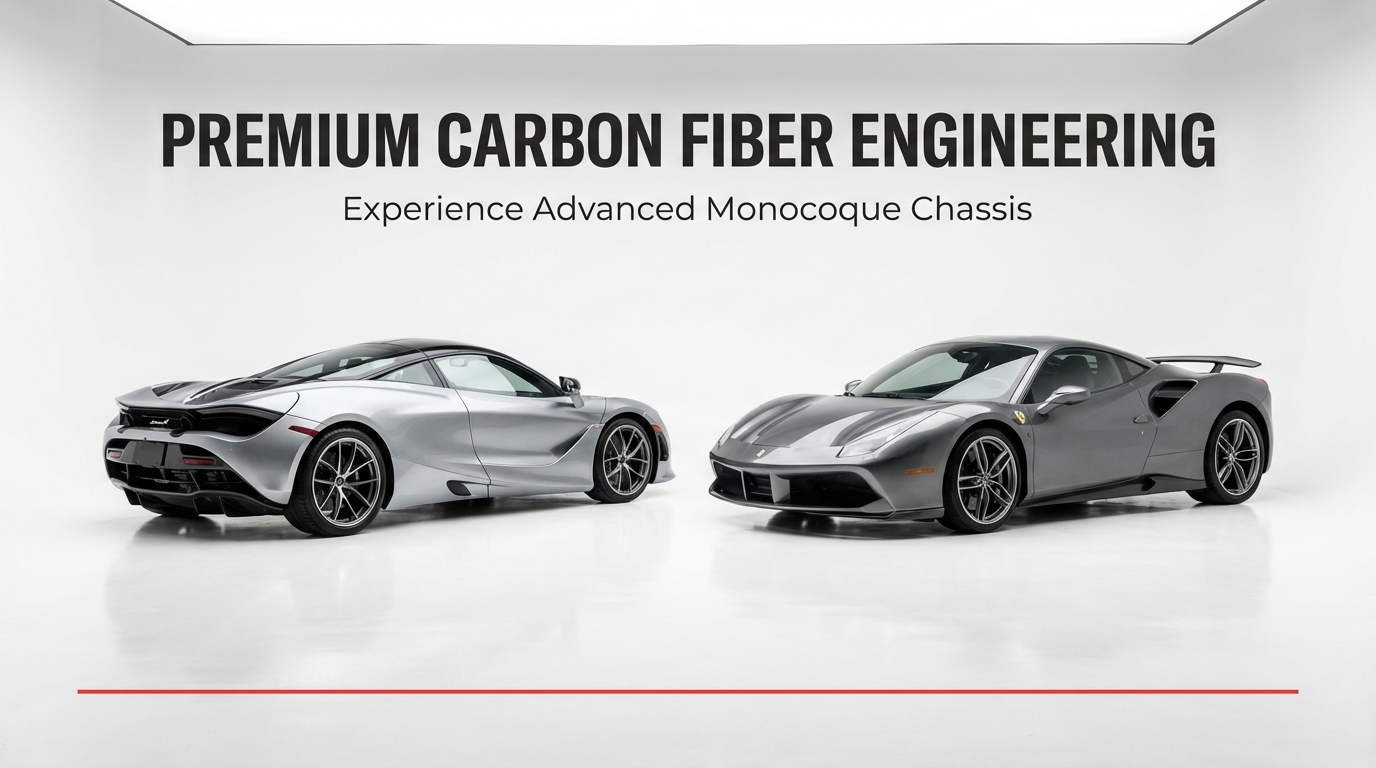
A carbon fiber monocoque chassis is a single-shell structural tub made from carbon fiber reinforced plastic (CFRP) that serves as both the frame and body of an exotic car. This construction replaces traditional multi-piece steel or aluminum frames with one unified structure, delivering extreme rigidity at a fraction of the weight.
This guide covers carbon fiber monocoque engineering and how it differs from conventional chassis design, the brand-specific approaches taken by Lamborghini, Ferrari, McLaren, and Porsche, the performance and safety benefits these structures deliver, the most sought-after models and rare editions built on monocoque platforms, and how enthusiasts can experience these vehicles through ownership or rental.
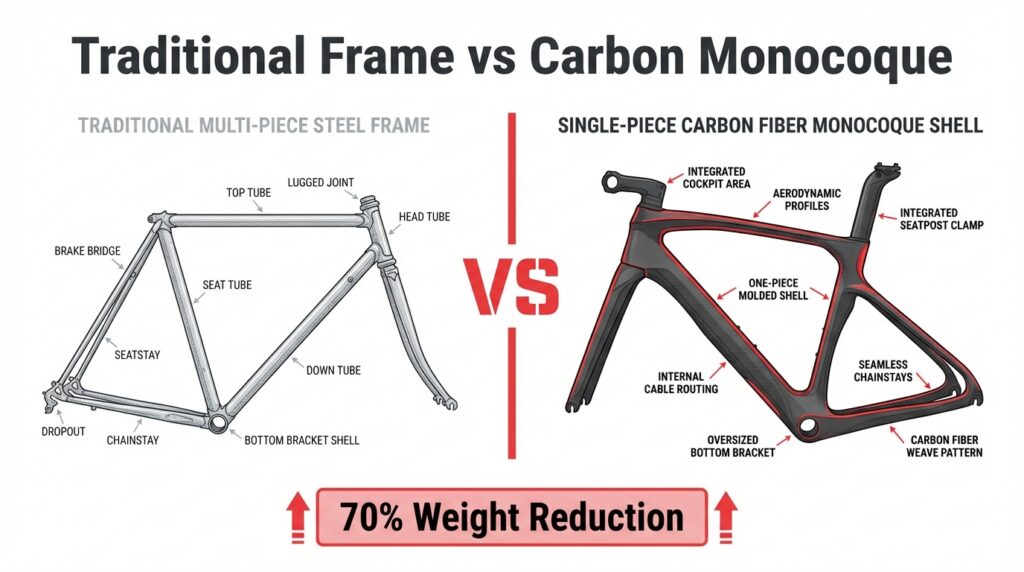
Carbon fiber monocoque construction eliminates the need for a separate body-on-frame assembly. CFRP components can reduce weight by up to 70% compared to steel while matching or exceeding structural stiffness, which fundamentally changes how exotic cars accelerate, brake, and corner.
Each manufacturer engineers its monocoque differently. Lamborghini developed a full “monofuselage” using Forged Composites and Carbon Sheet Molding Compound, while McLaren builds a one-piece MonoCell tub weighing under 80kg. Ferrari integrates carbon fiber structural elements into a multi-material chassis for targeted rigidity gains.
These lightweight structures translate directly into measurable performance. Models like the Aventador SVJ, McLaren 720S, and Ferrari SF90 Stradale post record-setting lap times and acceleration figures enabled by their low curb weights and high torsional stiffness. Carbon fiber monocoques also enhance occupant safety, with crash testing demonstrating structural integrity even after high-speed impacts.
Exotic cars with carbon fiber monocoque chassis carry price tags ranging from roughly $300,000 to well over $500,000. Luxury rental services now provide access to this level of engineering without the commitment of ownership, letting enthusiasts experience top-tier monocoque performance firsthand.
What Is a Carbon Fiber Monocoque Chassis and Why Is It Important in Exotic Cars?
A carbon fiber monocoque chassis is a single-shell structural body made from carbon fiber reinforced plastic that serves as both the frame and the passenger cell of a vehicle. It is important in exotic cars because it delivers extreme weight savings, exceptional rigidity, and superior crash protection compared to traditional multi-piece frames.
How Does Carbon Fiber Construction Differ from Traditional Car Frames?
Carbon fiber construction differs from traditional car frames by replacing a multi-piece steel or aluminum skeleton with a single, integrated structural shell. Traditional body-on-frame and space-frame designs bolt separate panels onto a distinct chassis. A monocoque eliminates that separation; the body itself bears all structural loads.
The material difference is equally significant. According to Wolf Composites, carbon fiber reinforced plastic (CFRP) components can achieve weight reductions of up to 70% compared to steel and 40% compared to aluminum while maintaining or increasing structural rigidity. This means a carbon fiber tub can weigh a fraction of its metal equivalent without sacrificing strength.
Manufacturing complexity also sets these approaches apart. While steel frames rely on stamping, welding, and bolting, carbon fiber monocoques require specialized layup processes, autoclave curing, or advanced molding techniques. For most exotic car buyers, the result is what matters: a lighter, stiffer foundation that transforms every aspect of how the car performs.
What Are the Advantages of a Monocoque Chassis for High-Performance Vehicles?
The advantages of a monocoque chassis for high-performance vehicles include:
- Dramatic weight reduction that improves acceleration, braking, and fuel efficiency.
- Superior torsional rigidity that sharpens steering response and cornering stability.
- Enhanced occupant safety through a continuous structural shell that absorbs and distributes impact energy.
- Lower center of gravity enabled by compact tub packaging, which improves high-speed handling balance.
McLaren’s MonoCell chassis, for example, is a one-piece carbon fiber tub weighing less than 80 kg that provides a rigid safety cell for occupants, according to AutoWin. That combination of minimal weight and maximum stiffness is what separates a true supercar from a merely fast car.
Understanding these structural advantages helps explain why the most celebrated exotic models prioritize carbon fiber monocoque design.
Which Exotic Car Brands Use Carbon Fiber Monocoque Chassis?
Lamborghini, Ferrari, McLaren, and Porsche each use carbon fiber monocoque chassis technology, though their engineering philosophies differ significantly. The following sections explore each brand’s unique approach and the notable design differences between them.
What Unique Approaches Do Lamborghini, Ferrari, McLaren, and Porsche Take with Carbon Fiber Monocoques?
Lamborghini, Ferrari, McLaren, and Porsche take distinct approaches with carbon fiber monocoques that reflect each brand’s engineering priorities.
- Lamborghini developed what it calls a “monofuselage” chassis. The Revuelto features a monocoque built from Forged Composites, with a front structure in specialized short-fiber carbon. According to JEC Composites, this monofuselage utilizes Carbon Sheet Molding Compound (Carbon-SMC) for the first time in a primary structural application for the brand.
- Ferrari uses a hybrid multi-material strategy. The SF90 Stradale integrates a carbon fiber “panchetta,” a one-piece casting between the shock absorber towers, into a predominantly aluminum chassis to improve structural rigidity.
- McLaren builds every road car around a full carbon fiber tub. The MonoCell chassis, introduced in the 12C and evolved for the 720S, is a one-piece carbon fiber structure weighing less than 80 kg.
- Porsche applies carbon fiber selectively in models like the 918 Spyder, reinforcing a hybrid tub where weight savings matter most.
Each philosophy balances manufacturing scalability with performance differently, making brand selection a matter of engineering priority.

Are There Notable Differences in Monocoque Design Among These Brands?
There are notable differences in monocoque design among these brands, particularly in material integration, structural philosophy, and manufacturing technique.
| Brand | Primary Chassis Material | Carbon Fiber Role | Design Philosophy |
| Lamborghini | Full carbon fiber | Complete monocoque structure | Maximum carbon integration |
| Ferrari | Aluminum with carbon fiber | Targeted structural reinforcement | Multi-material optimization |
| McLaren | Full carbon fiber | One-piece tub (MonoCell) | Lightweight single-structure focus |
| Porsche | Hybrid (aluminum, carbon fiber) | Selective reinforcement zones | Balanced modularity |
According to Ferrari Magazine, the SF90 Stradale’s chassis is 40% stiffer in torsion and 30% stiffer in bending than the preceding F8 Tributo, achieved through multi-material joining and a carbon fiber rear bulkhead. This demonstrates that a hybrid approach can rival full carbon monocoques in rigidity. For enthusiasts, understanding these design differences helps clarify what each brand prioritizes when translating carbon fiber technology into real driving dynamics.
What Are the Main Benefits of Driving a Car with a Carbon Fiber Monocoque Chassis?
The main benefits of driving a car with a carbon fiber monocoque chassis span three critical areas: safety, performance, and luxury refinement. These advantages explain why the material defines modern exotic car engineering.
How Does a Carbon Fiber Chassis Impact Safety, Speed, and Handling?
A carbon fiber chassis impacts safety, speed, and handling by combining extreme lightweight construction with exceptional structural rigidity. According to Wolf Composites, carbon fiber reinforced plastic (CFRP) components can achieve weight reductions of up to 70% compared to steel and 40% compared to aluminum while maintaining or increasing structural rigidity.
This weight reduction translates directly into measurable performance gains:
- Faster acceleration: Less mass means the powertrain pushes fewer pounds, enabling quicker sprint times.
- Sharper handling: A lower curb weight improves turn-in response, braking distances, and mid-corner balance.
- Enhanced safety: Carbon fiber monocoques absorb crash energy through controlled delamination rather than metal deformation, preserving the passenger cell’s integrity.
The safety dimension is often underestimated. Real-world crash testing of Rimac C_Two prototypes demonstrated that carbon fiber monocoques can remain structurally intact and potentially reusable even after high-speed impacts. For drivers, this means the material protecting them is simultaneously the lightest and one of the strongest options available.

Does Carbon Fiber Contribute to the Overall Luxury Experience?
Yes, carbon fiber contributes to the overall luxury experience in ways that extend well beyond raw performance numbers. Visible carbon fiber weave has become a signature design element in exotic interiors and exteriors, signaling advanced engineering and exclusivity to anyone who sees or touches it.
The material’s inherent stiffness also eliminates chassis flex, producing a more composed and refined ride quality at both low and high speeds. Fewer vibrations reach the cabin, which enhances comfort during spirited driving. Because carbon fiber monocoque construction commands significantly higher raw material and manufacturing costs than aluminum, its presence signals a vehicle built without compromise. That tangible sense of engineering excellence is what separates a true exotic car from a conventional sports car.
With these benefits established, the next step is identifying which specific models showcase carbon fiber monocoque technology best.
Which Models Are the Most Sought-After Exotic Cars with Carbon Fiber Monocoque Chassis?
The most sought-after exotic cars with carbon fiber monocoque chassis include the Lamborghini Aventador, McLaren 720S, and Ferrari SF90 Stradale. Each stands out through distinct engineering philosophies, while limited-edition variants push exclusivity further.
What Makes Lamborghini Aventador, McLaren 720S, and Ferrari SF90 Stand Out?
The Lamborghini Aventador, McLaren 720S, and Ferrari SF90 stand out because each deploys carbon fiber monocoque technology in fundamentally different ways, producing distinct performance signatures.
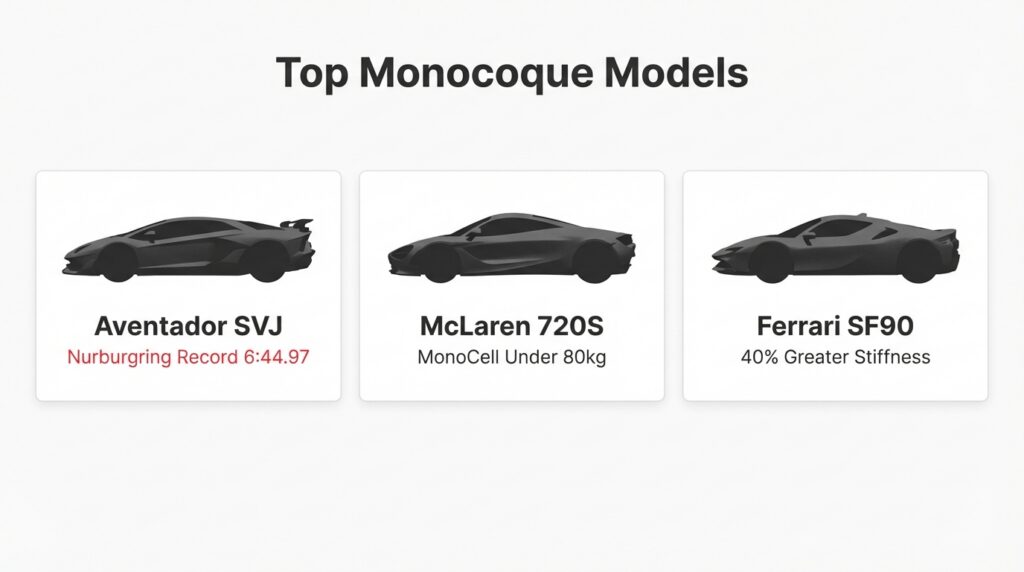
The Aventador SVJ set a production car lap record at the Nürburgring Nordschleife with a time of 6:44.97 minutes, according to Automobili Lamborghini S.p.A. McLaren’s MonoCell chassis, evolved for the 720S, is a one-piece carbon fiber tub weighing less than 80 kg. The Ferrari SF90 Stradale integrates a carbon fiber rear bulkhead into its multi-material chassis, achieving 40% greater torsional stiffness than the preceding F8 Tributo.
These three models represent the clearest expression of how carbon fiber monocoque engineering translates directly into measurable track dominance and road-going refinement.
Are There Limited Editions or Rare Finds in This Category?
There are several limited editions and rare finds in this category, such as the Lamborghini Essenza SCV12, the Lamborghini Revuelto, and the Rimac C_Two.
- The Lamborghini Essenza SCV12 is the first car on the market to feature a full carbon fiber roll cage homologated according to FIA Hypercar safety standards.
- The Lamborghini Revuelto features a “monofuselage” chassis made entirely of multi-technology carbon fiber, utilizing Carbon Sheet Molding Compound in a primary structural application for the first time.
- Crash testing of Rimac C_Two prototypes demonstrated that carbon fiber monocoques can remain structurally intact and potentially reusable even after high-speed impacts, as reported by The Drive.
These rare models often appreciate in value, making them as compelling for collectors as they are for drivers seeking cutting-edge chassis technology.
Beyond collecting, rentals offer another path to experience this engineering firsthand.
How Can Enthusiasts Experience Exotic Cars with Carbon Fiber Monocoque Chassis?
Enthusiasts can experience exotic cars with carbon fiber monocoque chassis through direct ownership or luxury rentals. The sections below compare ownership costs against rental pricing and explain how rentals unlock access to top-tier engineering.
What Is the Cost to Own vs Rent These High-Tech Exotic Vehicles?
The cost to own these high-tech exotic vehicles ranges from roughly $300,000 to over $500,000 at purchase, while renting starts at a fraction of that per day. According to TrueCar, the Ferrari SF90 Stradale carried a starting MSRP of approximately $528,764, and the McLaren 720S started at approximately $301,500. Beyond the sticker price, ownership adds insurance premiums, specialized maintenance for carbon fiber components, and depreciation.
Renting offers a dramatically different cost structure. A McLaren 720S rents for $1,299 per day, and a Ferrari 488 Spider rents for $1,499 per day. For enthusiasts who want to feel the rigidity and responsiveness of a carbon fiber monocoque chassis firsthand, rental pricing removes the six-figure commitment that ownership demands.
How Do Rentals Allow Access to Top-Tier Engineering Without Ownership?
Rentals allow access to top-tier engineering without ownership by eliminating the financial barriers of purchase price, long-term maintenance, and depreciation. Carbon fiber monocoque vehicles represent some of the most advanced automotive engineering available, yet their ownership costs place them beyond most budgets.
The luxury car rental market reflects this growing demand for accessible experiences. According to Fortune Business Insights, the global luxury car rental market is projected to grow from $56.30 billion in 2026 to $125.98 billion by 2034 at a CAGR of 10.59%. This growth signals that more enthusiasts are choosing rentals to experience vehicles like the McLaren 720S and its sub-80kg MonoCell tub without shouldering ownership risk.
For anyone serious about feeling what carbon fiber monocoque engineering delivers on the road, renting remains the most practical entry point. With the next section covering Fisher Luxury Rental’s fleet, finding the right vehicle becomes straightforward.
How Does Fisher Luxury Rental Offer Access to Exotic Cars with Carbon Fiber Monocoque Chassis?
Fisher Luxury Rental offers access to exotic cars with carbon fiber monocoque chassis by maintaining a curated fleet of high-trim supercars available for daily rental. The following subsections cover the fleet’s alignment with carbon fiber engineering and key article takeaways.
Can Fisher Luxury Rental’s Top-Trim Exotic Car Fleet Satisfy Enthusiasts Seeking Carbon Fiber Monocoque Chassis?
Yes, Fisher Luxury Rental’s top-trim exotic car fleet can satisfy enthusiasts seeking carbon fiber monocoque chassis. Established in 2022, Fisher Luxury Rental operates across Phoenix, Portland, and Vancouver with vehicles that represent the pinnacle of lightweight performance engineering, including the McLaren 720S and Ferrari 488 Spider.
The McLaren 720S sits at the core of this offering. McLaren’s MonoCell chassis is a one-piece carbon fiber tub weighing less than 80 kg, providing both a rigid safety cell and the foundation for sharp dynamic response. Fisher Luxury Rental makes this level of engineering accessible at $1,299 per day, while the Ferrari 488 Spider is available at $1,499 per day. Considering that comparable models carry MSRPs exceeding $300,000, renting eliminates the barrier of six-figure ownership costs.
For enthusiasts who want to feel how carbon fiber monocoque construction translates to real-world driving, a rental experience is the most practical path to the driver’s seat.
What Are the Key Takeaways About the List of Exotic Cars with Carbon Fiber Monocoque Chassis?
The key takeaways about the list of exotic cars with carbon fiber monocoque chassis center on three practical conclusions:
- Carbon fiber monocoque construction delivers measurable advantages in weight, rigidity, and safety that directly shape how these cars accelerate, corner, and protect occupants.
- Manufacturers such as Lamborghini, McLaren, and Ferrari each take distinct engineering approaches, from McLaren’s sub-80 kg MonoCell tub to Lamborghini’s Forged Composites monofuselage, meaning no two driving experiences are identical.
- Ownership costs for these vehicles often exceed $300,000, making rental the most accessible way to experience top-tier carbon fiber chassis engineering firsthand.
Understanding the specific monocoque technology behind each model helps enthusiasts choose the right car for their goals, whether that means prioritizing raw lap speed, hybrid efficiency, or open-air touring. Fisher Luxury Rental bridges the gap between engineering curiosity and seat time by placing these machines within reach for a single day.