First-time supercar driving is the experience of operating a high-performance vehicle with capabilities far beyond standard cars, where acceleration, braking, and handling all demand heightened awareness and deliberate control.
This guide covers what makes supercars unique, how to prepare before your drive, safety and driving techniques for beginners, rental rules and vehicle selection, common mistakes to avoid, and how premium rental services elevate the experience.
Supercars produce extreme power outputs and sub-three-second 0-60 mph times, creating a sensory intensity that surprises even confident everyday drivers. The gap between a regular sedan and an exotic car is not just speed; it is responsiveness in steering, braking force, and throttle sensitivity.
Proper preparation starts well before you turn the key. Knowing your document requirements, dressing appropriately for a low-slung cockpit, and understanding the vehicle’s controls prevent unnecessary stress on drive day.
Safe supercar driving relies on smooth inputs rather than aggressive ones. Threshold braking, gradual acceleration, and calm cornering technique protect both you and the vehicle, while managing your mental state keeps confidence steady without tipping into overconfidence.
Rental policies, mileage limits, and insurance details shape your experience just as much as driving skill does. Choosing the right supercar for your comfort level ensures the car works with you, not against you.
Most first-time mistakes stem from underestimating how quickly these cars respond. Recognizing common errors (and knowing recovery steps) builds real competence. White-glove rental services like Fisher Luxury Rental add guided orientation and vehicle walkthroughs that give beginners a foundation of knowledge before they ever leave the lot.
What Makes Driving a Supercar for the First Time Unique?
Driving a supercar for the first time is unique because of the dramatic gap between everyday driving and the raw performance, precision handling, and sensory intensity these machines deliver. The sections below break down the performance differences and the emotional experience you should expect.
How Do Supercars Differ From Regular Cars in Performance and Handling?
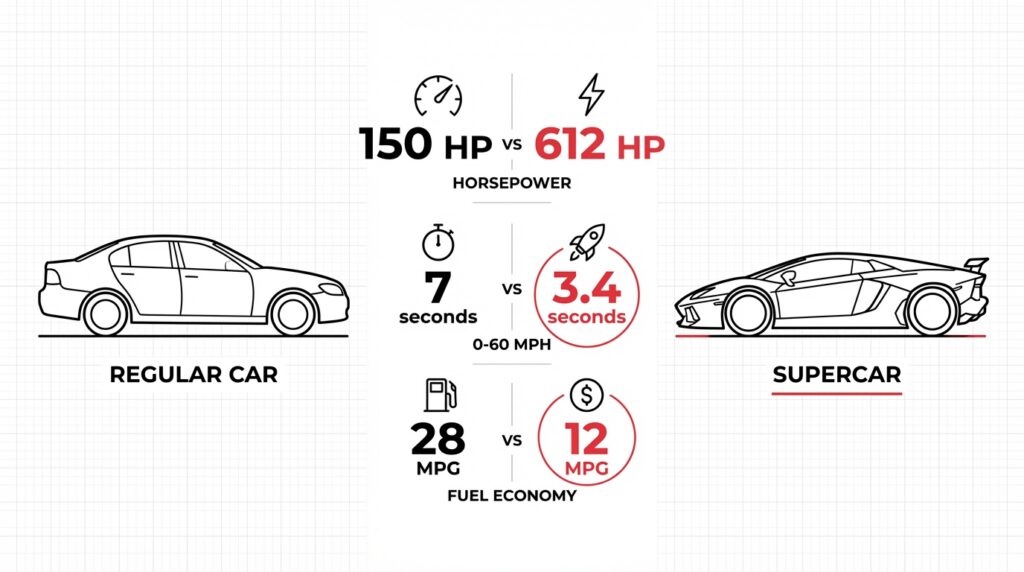
Supercars differ from regular cars in performance and handling through significantly higher power output, faster acceleration, sharper steering response, and advanced braking systems engineered for extreme speeds. A typical sedan produces 150 to 250 horsepower; supercars routinely exceed 600. The Ferrari Roma, for example, generates 612 horsepower from its 3.9-liter V8, reaching 0-60 mph in 3.4 seconds with a top speed over 199 mph.
Key performance differences include:
- Acceleration: Supercars compress 0-60 mph times into 2 to 4 seconds, while most regular cars need 6 to 8 seconds.
- Steering precision: Mid-engine or rear-engine layouts create sharper turn-in and more direct road feedback.
- Braking capability: Carbon-ceramic brakes deliver shorter stopping distances under repeated hard use without fade.
- Suspension tuning: Stiffer, lower setups reduce body roll and keep tires planted through corners.
For first-time drivers, this concentrated responsiveness means every input produces an immediate, amplified reaction, something that demands respect from the very first mile.
What Emotions and Experiences Should You Expect on Your First Drive?
The emotions and experiences you should expect on your first supercar drive range from an initial surge of adrenaline and nervous excitement to a deep sense of focus as you acclimate to the car’s responsiveness. According to research published in PMC (NCBI), a driver’s initial mental state, including stress and excitement levels, significantly impacts subsequent driving behavior and overall safety performance.
Most first-timers report a predictable emotional progression:
- Pre-drive anticipation: Elevated heart rate and heightened awareness before turning the key.
- Initial overwhelm: The engine sound, seating position, and throttle sensitivity feel dramatically different from anything familiar.
- Gradual confidence: Within minutes, nervous tension gives way to focused engagement as your inputs become smoother.
- Flow state: Experienced at its best, the drive produces an immersive, present-moment focus that high-performance driving programs have linked to measurable stress reduction.
Understanding this emotional arc ahead of time helps you stay composed rather than reactive, which is the single most important advantage a prepared first-time driver carries into the cockpit.
What Are the Essential Steps to Prepare for Your First Supercar Drive?
The essential steps to prepare for your first supercar drive include gathering required documents, understanding insurance coverage, and choosing appropriate clothing and gear. The following sections cover documentation requirements and what to bring.
What Documents and Requirements Do You Need Before Driving?
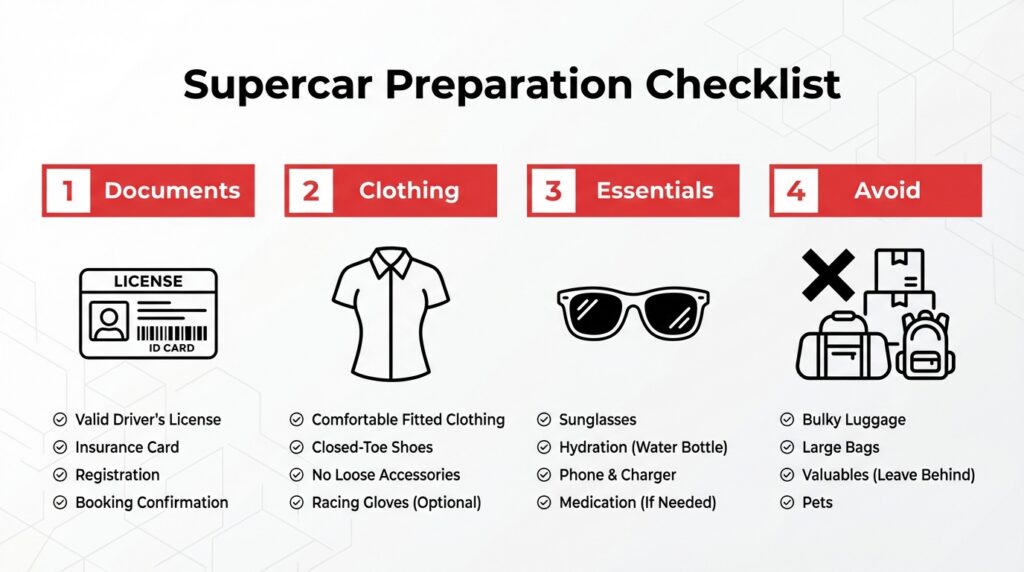
The documents and requirements you need before driving a supercar include a valid driver’s license, proof of insurance, a credit card for the security deposit, and a signed rental agreement. Most exotic car rental providers require renters to be at least 25 years old, though age minimums vary by company and vehicle class.
Reviewing insurance coverage beforehand is especially important. According to a 2025 EIN Presswire market study, global rental car insurance prices for Winter 2025/2026 surged significantly, with some European markets seeing excess liability increases of up to 37%. Even domestically, supplemental coverage for high-value vehicles can carry steep premiums if not arranged in advance.
Confirm whether your personal auto policy or credit card covers exotic rentals, as many standard policies exclude vehicles above a certain value. Bringing a digital or printed copy of your insurance declaration page saves time at pickup.
How Should You Dress and What Should You Bring?
You should dress in fitted, comfortable clothing and flat-soled shoes to maintain precise pedal control in a supercar. Bulky sneakers, heels, or loose-fitting boots reduce sensitivity on the throttle and brake, which matters considerably when a vehicle like the 2026 Porsche 911 Turbo S hybrid reaches 60 mph in just 2.0 seconds, according to Car and Driver.
Key items to bring include:
- Sunglasses with a secure fit to reduce glare without slipping during spirited driving.
- A light jacket or layering piece, since convertible supercars expose you to wind and temperature shifts.
- Your phone and a compact bag that fits in limited supercar storage space.
- A microfiber cloth to handle the interior without leaving marks on leather or carbon fiber surfaces.
Avoid bringing large bags or hard objects that could shift and scratch the cabin. Preparing the right gear before you arrive lets you focus entirely on the driving experience ahead.
How Can You Drive a Supercar Safely as a Beginner?
You can drive a supercar safely as a beginner by following core safety practices, mastering high-performance vehicle controls, and managing your mental state. The sections below cover essential first-timer tips, braking and acceleration techniques, and strategies for staying calm.
What Supercar Driving Safety Tips Are Most Important for First-Timers?
The supercar driving safety tips most important for first-timers focus on respecting the vehicle’s power, understanding its limits, and building habits that prevent dangerous mistakes. According to Resident.com research, 27% of speeding-related crashes involve luxury cars compared to 25% for non-luxury vehicles, underscoring why disciplined speed management matters in high-performance machines.
Key safety priorities for beginners include:
- Familiarize yourself with all controls, drive modes, and mirrors before leaving the lot.
- Keep electronic stability and traction control systems fully engaged at all times.
- Maintain a larger following distance than you would in a standard car.
- Start in the vehicle’s comfort or touring mode rather than sport or track settings.
- Avoid sudden, aggressive inputs on the throttle, brakes, or steering wheel.
Even experienced everyday drivers underestimate how quickly a 600-plus horsepower engine responds to small pedal movements, so treating your first outing as a learning session rather than a performance test is the smartest approach.
How Do You Handle High-Performance Braking, Acceleration, and Steering?
You handle high-performance braking, acceleration, and steering by applying smooth, progressive inputs rather than sudden movements. Supercars amplify every driver input; a vehicle like the Ferrari Roma produces 612 horsepower and reaches 60 mph in 3.4 seconds, meaning even slight throttle pressure generates significant force.
For braking, squeeze the pedal gradually to engage threshold braking, where you apply maximum pressure just before the wheels lock. An MDPI simulation study on high-performance vehicles found a 7.7% reduction in braking distance when using dynamic braking force distribution compared to fixed-ratio methods, confirming that controlled, progressive technique outperforms hard stomping.
For acceleration, roll onto the throttle in a steady, linear motion. For steering, use small, deliberate corrections and keep both hands on the wheel. These three inputs work together; jerking one while applying another destabilizes the car. Practicing each input individually at low speeds builds the muscle memory needed for confident control.
How Can You Stay Calm and Confident Behind the Wheel?
You can stay calm and confident behind the wheel by managing your mental state before and during the drive. According to a study published in PMC (NCBI), initial levels of stress and tiredness have a significant impact on subsequent driving behavior and overall road safety performance.
Practical strategies to control nerves include:
- Get adequate sleep the night before your drive and avoid caffeine overload.
- Take several slow, deep breaths while seated in the car before starting the engine.
- Set a personal speed limit well below the vehicle’s capability for your first outing.
- Focus your eyes far down the road rather than directly in front of the hood.
- Accept that feeling nervous is normal and does not mean you are unprepared.
Adrenaline narrows focus and speeds up reaction impulses, which often leads to overcorrection. Recognizing that sensation and consciously slowing your inputs transforms nervousness into heightened awareness. With the right techniques in place, learning proper driving methods becomes the natural next step.
What Driving Techniques Should First-Time Supercar Drivers Learn?
First-time supercar drivers should learn smooth acceleration control, proper cornering technique, and responsible use of electronic driving features like launch control. These three skill areas form the foundation for safe, confident handling of any high-performance vehicle.
How Do You Master Smooth Acceleration and Shifting in Exotic Cars?
You master smooth acceleration and shifting in exotic cars by applying throttle progressively rather than abruptly. Supercars deliver power almost instantaneously; the Ferrari Roma’s 3.9-liter V8 produces 612 horsepower, making sudden inputs dangerous for inexperienced drivers.
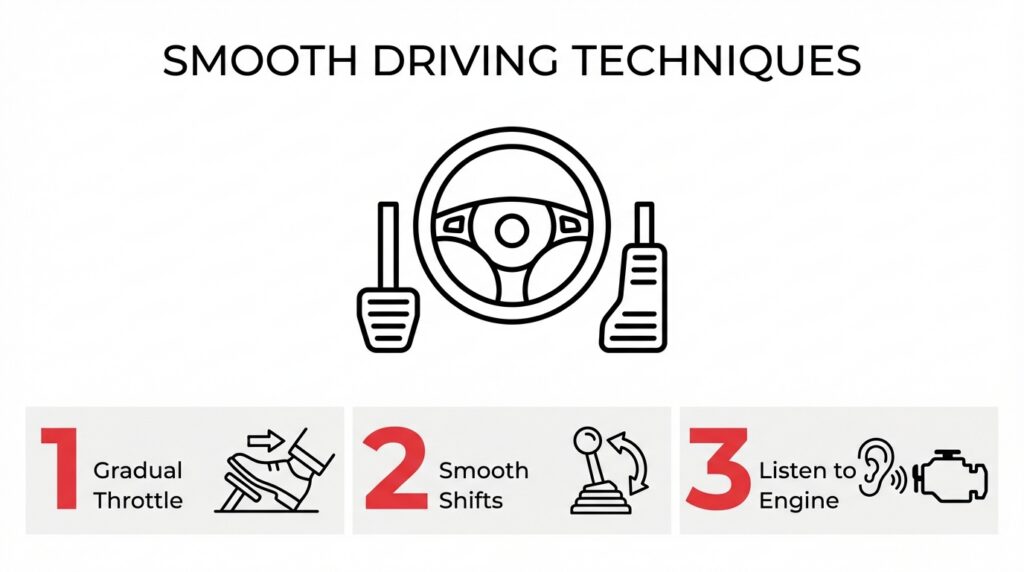
Key principles for smooth power delivery include:
- Squeeze the throttle gradually from a stop instead of stabbing it.
- Allow the dual-clutch or automated transmission to complete each shift before adding more throttle.
- Keep your foot movements small and deliberate, especially in first and second gear where torque is highest.
- Listen to the engine note as a guide for shift timing in paddle-shift modes.
Most modern exotics handle shifting automatically, but understanding how the car responds to your right foot is the single most important skill a first-timer can develop.
Why Is Cornering Technique Crucial in High-Performance Vehicles?
Cornering technique is crucial in high-performance vehicles because their speed potential amplifies every steering input and weight transfer. According to the Winfield Racing School, over-aggressive corner entry ranks among the most common rookie mistakes in high-performance driving.
Proper cornering follows a consistent sequence:
- Brake in a straight line before the turn, not while steering.
- Turn in smoothly at a controlled speed, aiming for the apex.
- Unwind the steering gradually while applying progressive throttle on exit.
When cornering forces increase at higher speeds, even a small error in entry speed or turn-in point can push tires past their grip limit. Practicing slow-in, fast-out technique builds the muscle memory needed to keep a supercar predictable through every curve.
How Should You Use Launch Control and Other Supercar Features Responsibly?
You should use launch control and other supercar features responsibly by reading the vehicle’s manual, starting in the most conservative drive mode, and only activating advanced systems once you feel comfortable with the car’s baseline behavior.
Features to understand before driving include:
- Launch control: Manages wheel spin during maximum acceleration starts; best reserved for controlled, straight environments.
- Drive modes (Comfort, Sport, Race): Each mode adjusts throttle response, traction control sensitivity, and suspension stiffness.
- Traction control and stability management: These systems prevent wheel spin and oversteer; disabling them removes a critical safety net.
A 2026 FIA Region I study of over 13,500 drivers found that advanced driver assistance systems like Adaptive Cruise Control are widely trusted, while more active intervention systems are used less often due to unfamiliarity. The same principle applies to supercar-specific features: trust builds with gradual exposure, not by activating everything at once.
Mastering these techniques prepares you for the etiquette and rental policies that shape your overall experience.
What Rules and Road Etiquette Should You Follow When Driving a Rented Supercar?
The rules and road etiquette you should follow when driving a rented supercar include respecting rental policies, obeying speed limits, and treating fellow drivers with courtesy. The sections below cover common rental restrictions and how to share the road respectfully.
What Are the Common Rental Policies and Restrictions for Supercars?
The common rental policies and restrictions for supercars include mileage caps, age minimums, insurance requirements, and geographic limitations. Most exotic rental agreements set daily mileage limits, typically between 100 and 150 miles, with per-mile overage fees. Renters generally must be at least 25 years old and carry full-coverage insurance or purchase supplemental liability coverage. According to a 2025 EIN Presswire market study, global rental car insurance prices for Winter 2025/2026 saw significant shifts, with some European markets experiencing excess liability increases of up to 37%.
Additional restrictions commonly found in supercar rental contracts include:
- No track use or racing without prior written authorization.
- No smoking, pets, or unapproved secondary drivers.
- Mandatory security deposits ranging from $1,000 to $10,000 depending on vehicle value.
- Required documentation of pre-existing damage during vehicle walk-around inspections.
Reading every clause before signing protects both you and the vehicle.
How Do You Build Positive Experiences With Other Drivers on the Road?
You build positive experiences with other drivers on the road by driving predictably, controlling speed, and showing patience. Supercars attract attention; aggressive driving amplifies negative perceptions. According to Resident.com research, 27% of speeding-related crashes involve luxury cars compared to 25% for non-luxury vehicles, which underscores why restraint matters behind the wheel of an exotic rental.
Practical habits that foster goodwill include:
- Signaling lane changes early and merging smoothly.
- Maintaining safe following distances, especially given the car’s rapid acceleration.
- Allowing faster traffic to pass rather than racing or blocking lanes.
- Avoiding excessive revving or sudden launches in residential areas.
A calm, respectful driving style reflects well on the supercar community and keeps your rental experience free of incidents. With road etiquette covered, choosing the right supercar for your skill level is the next important decision.
How Should You Choose the Right Supercar for Your First Experience?
You should choose the right supercar for your first experience by evaluating your driving skill level, comfort with horsepower output, and the vehicle’s driver-assist features. The following sections cover the key selection factors and how to match specific vehicle characteristics to your abilities.
What Factors Influence the Best Supercar Choice for Beginners?
The factors that influence the best supercar choice for beginners include horsepower output, drivetrain layout, vehicle weight, and the availability of electronic stability systems. A car producing 400 to 500 horsepower, such as the Corvette C8 or Porsche 911 Carrera S, offers thrilling performance without the overwhelming response of a 700-plus horsepower machine.
Key factors to evaluate before selecting a supercar:
- Horsepower range: Lower output models build confidence before graduating to higher-powered vehicles.
- Drivetrain type: All-wheel drive provides more traction and forgiveness than rear-wheel drive in spirited driving.
- Curb weight: Heavier vehicles tend to feel more planted and predictable at speed.
- Electronic aids: Traction control, stability management, and drive-mode selectors let beginners adjust responsiveness.
- Seating position and visibility: A comfortable driving position reduces fatigue and improves reaction time.
For most first-timers, starting in the 400 to 600 horsepower range strikes the ideal balance between excitement and controllability.
How Do You Match Vehicle Features With Your Comfort and Skill Level?
You match vehicle features with your comfort and skill level by selecting drive modes that limit power delivery and by prioritizing cars with progressive throttle response. Most modern supercars offer selectable modes, often labeled Comfort, Sport, and Race, that adjust steering weight, suspension firmness, and traction intervention.
According to a 2026 FIA Region I study of over 13,500 European mobility club members, Adaptive Cruise Control is widely accepted and trusted by drivers, while systems like Lane Keeping Assistance and Intelligent Speed Assistance are perceived as less reliable and used less often. This means beginners should focus on mastering core driving inputs rather than relying heavily on every automated feature.
If you feel tense at any point, dialing the car back to its most forgiving mode is always the right call. Confidence grows naturally with seat time, and matching the vehicle’s output to your current skill prevents costly mistakes on your first outing.
What Are the Most Common Mistakes First-Time Supercar Drivers Make and How Can They Be Avoided?
The most common mistakes first-time supercar drivers make include overconfidence with acceleration, aggressive cornering, skipping warm-up routines, and panicking during unexpected vehicle responses. The following sections cover how inexperience creates risk and what recovery steps keep you safe.
How Do Overconfidence and Inexperience Impact First Drives?
Overconfidence and inexperience impact first drives by pushing beginners to test a supercar’s limits before understanding its responsiveness. A vehicle producing over 600 horsepower reacts to inputs far more aggressively than a standard car, and misjudging that sensitivity leads to loss of control.
According to Winfield Racing School, common rookie mistakes in high-performance vehicles include over-aggressive corner entry, ignoring tire and brake warm-up routines, and underestimating the mental preparation required to control emotional responses under pressure.
These errors compound quickly. Cold tires reduce grip dramatically, and entering a turn too fast in an unfamiliar car leaves almost no margin for correction. The best countermeasure is honest self-assessment: start slow, build speed incrementally, and treat the first 15 to 20 minutes as a calibration period rather than a performance run.
What Recovery Steps Can You Take if You Make a Driving Error?
The recovery steps you can take if you make a driving error depend on the situation, but the core principle is the same: stay calm and avoid abrupt inputs. Jerking the steering wheel or slamming the brakes in a supercar often worsens the problem because these vehicles amplify every input.
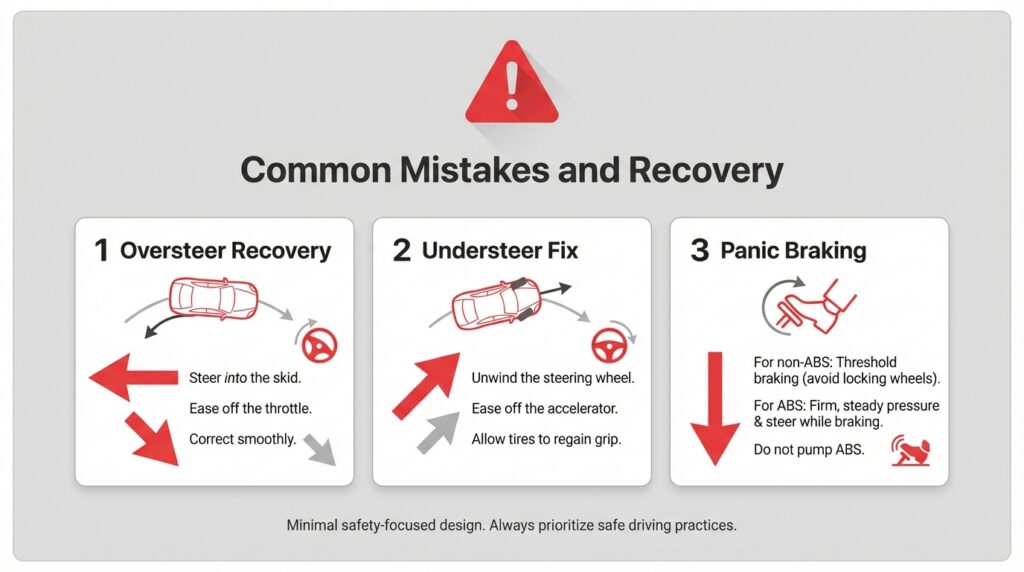
Key recovery actions for common errors include:
- Oversteer (rear slides out): Ease off the throttle and steer gently into the slide without overcorrecting.
- Understeer (car pushes wide): Lift off the accelerator smoothly to shift weight forward and restore front grip.
- Panic braking: Apply firm, progressive pressure rather than stomping; modern supercars with advanced braking systems respond best to controlled, steady input.
- Wrong gear or stall: Pull safely to the shoulder, reset, and re-engage without rushing back into traffic.
Research published in PMC (NCBI) confirms that a driver’s initial stress level significantly impacts subsequent driving behavior and safety performance. Recognizing the mental dimension of error recovery matters just as much as the physical technique. With proper awareness, most first-time mistakes become learning moments rather than lasting problems.
How Can Exclusive Rental Services Enhance Your First Supercar Driving Experience?
Exclusive rental services enhance your first supercar driving experience by providing curated vehicles, personalized delivery, and expert guidance that reduce stress and build confidence. The following sections cover how Fisher Luxury Rental’s white glove approach supports beginners and the essential takeaways for first-time drivers in 2026.
How Does Fisher Luxury Rental’s White Glove Service Benefit First-Time Supercar Drivers?
Fisher Luxury Rental’s white glove service benefits first-time supercar drivers by eliminating the logistical friction and anxiety that often accompany a first high-performance drive. Fisher Luxury Rental specializes in top-trim exotic and luxury vehicles with white-glove delivery across the Phoenix Metropolitan Area and Northwest Oregon, with every vehicle in the fleet carefully purchased to ensure the highest grade of quality.
For a beginner, this approach matters more than most people realize. Rather than navigating an unfamiliar pickup lot, drivers receive their supercar at a preferred location with a personal walkthrough of controls, drive modes, and safety features. That one-on-one orientation directly addresses the kind of initial stress that, according to a 2020 study published in PMC, can significantly impact subsequent driving behavior and overall road safety performance.
Fisher Luxury Rental’s fleet includes models ranging from the Lamborghini Huracan Spyder to the Porsche 911 Carrera S, giving first-timers options matched to their comfort level. Having a curated selection of top-trim vehicles, combined with direct support from a team with customer service roots dating back to the mid-90s, transforms what could be an overwhelming experience into a confident, memorable first drive.

What Are the Key Takeaways for First-Time Supercar Drivers in 2026?
The key takeaways for first-time supercar drivers in 2026 center on preparation, restraint, and choosing the right support system. Modern supercars deliver extraordinary power; the 2026 Porsche 911 Turbo S hybrid, for example, reaches 60 mph in just 2.0 seconds according to Car and Driver. That capability demands respect from any driver, especially a beginner.
The most actionable lessons from this guide include:
- Prepare mentally and physically before every drive, since stress and fatigue directly affect driving performance.
- Start with smooth, progressive inputs on acceleration, braking, and steering rather than testing limits immediately.
- Learn the vehicle’s safety systems and drive modes during a stationary walkthrough before pulling onto the road.
- Choose a supercar matched to your skill level and comfort, not just the fastest or most expensive option available.
- Select a rental provider that offers personalized orientation and quality-maintained vehicles rather than a transactional pickup experience.
The supercar world is evolving rapidly, with the global market projected to grow by USD 11.93 billion through 2030 as electrification reshapes performance benchmarks. For first-time drivers, this means more accessible options and more advanced safety technology in every new model year. Pairing that technology with proper preparation and a trusted rental partner like Fisher Luxury Rental is the most reliable path to a safe, exhilarating first supercar experience.