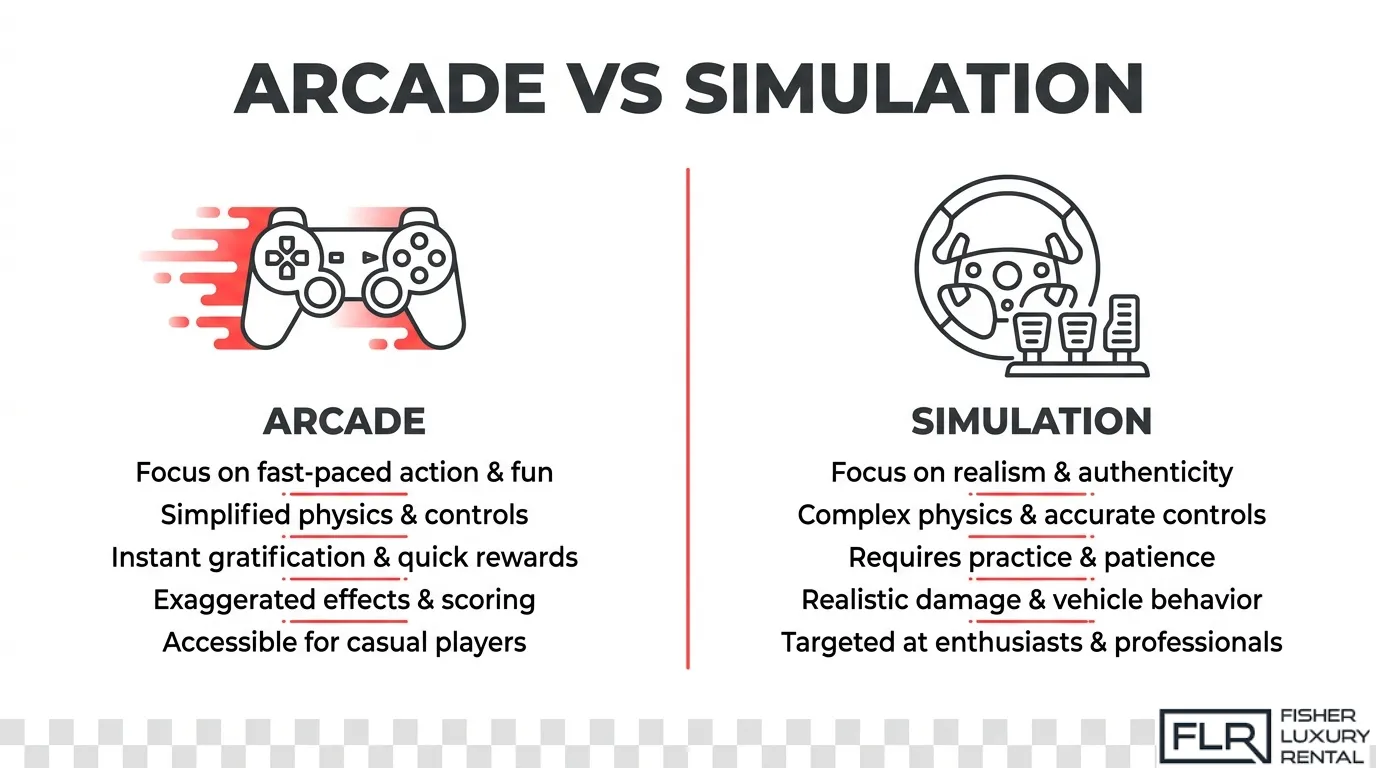
Arcade and simulation racing games are two distinct genres separated by a single core principle: arcade racers prioritize accessibility and excitement over accuracy, while simulation racers replicate real vehicle physics, track conditions, and driving technique as precisely as software allows.
This guide covers genre definitions and history, physics and handling systems, driving controls and hardware, customization and track design, damage modeling, the most popular titles in each genre, beginner guidance, and the simcade middle ground – along with how real-world exotic car experiences compared to what any simulator can deliver.
Arcade and simulation racers diverge earliest in their physics models. Arcade titles smooth over tire slip, weight transfer, and braking forces to keep players in control at all times, while simulators compute tire behavior as a function of pressure, temperature, slip angle, and aerodynamic load simultaneously.
Controls follow the same divide. A gamepad is all an arcade racer needs, whereas simulation racing centers on force feedback wheels and pedal sets that transmit real-time grip changes, curb strikes, and braking pressure directly to the driver’s hands and feet.
Vehicle handling, customization depth, and track design each extend these differences further. Arcade games reward style and progression through forgiving drift mechanics and wider roads; simulators demand trail braking precision, granular differential tuning, and exact knowledge of laser-scanned racing lines.
Popular franchises illustrate both poles clearly, from Need for Speed and Mario Kart on the arcade side to Gran Turismo and iRacing on the simulation side, with simcade titles like GRID Legends occupying deliberate middle ground.
What Is an Arcade Racing Game?
An arcade racing game is a genre designed around accessible, fast-paced driving that prioritizes excitement over realism. These games simplify vehicle physics, reward aggressive driving, and reduce the learning curve so players can compete immediately. The headings below cover the genre’s defining mechanics, historical origins, and track design philosophy.
How Does an Arcade Racer Define Its Core Gameplay?
An arcade racer defines its core gameplay through simplified controls, forgiving physics, and immediate speed gratification. Vehicles respond predictably, rubber-band AI keeps races competitive, and assists run silently in the background. According to Red Bull, GRID game director Chris Smith described this balance directly: “Casual players can go for fun and sim players go for serious fun,” capturing how arcade racers serve a wide audience without demanding technical mastery.
What Were the First Arcade Racing Games?
The first arcade racing games established the genre’s foundational mechanics in the early 1980s. Pole Position, documented by the International Arcade Museum, tasked players with racing an Indy car around the Fuji course against a countdown timer, where qualifying lap time determined grid position – a structure built entirely around momentum and urgency rather than mechanical depth.
How Did OutRun Shape the Arcade Racing Genre?
OutRun shaped the arcade racing genre by replacing competitive racing with the sensation of pure driving freedom. The Guardian’s ranking of Sega’s greatest arcade games describes how designer Yu Suzuki captured the spirit of the 1980s in the 1986 title, giving players branching route choices through an exotic worldwide tour that “feels like a joyride rather than a race.” That distinction, thrilling movement over measured competition, remains the genre’s defining characteristic today.
How Does Arcade Track Design Support Accessible Gameplay?
Arcade track design supports accessible gameplay through intentionally wider road layouts and forgiving geometry. According to Game Developer, wider track width creates more obtuse clipping angles at corners and builds forgiveness directly into the layout. Fantasy venues, inspired by real locations but not bound by them, let designers prioritize spectacle and flow over the precision demands of real-world circuit geometry.
What Is a Simulation Racing Game?
A simulation racing game is a video game genre designed to replicate real-world vehicle physics, driving mechanics, and track conditions as accurately as possible. Unlike arcade racers, simulation titles prioritize authenticity over accessibility, demanding precise inputs and rewarding technical driving skill.
The following headings explore what defines simulation racing, where the genre originated, and which defining titles shaped it.
How Does the Physics Model Differ Between Arcade and Sim Racers?
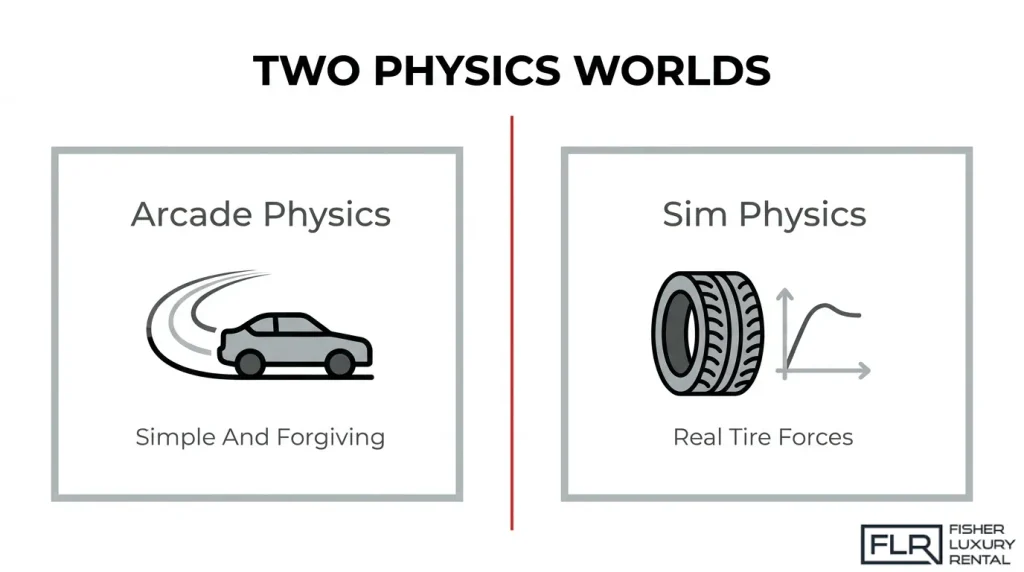
The physics model differs between arcade and sim racers in how accurately vehicle forces are calculated and applied. The following sections break down how arcade racers simplify these systems, how simulators model real-world dynamics, and how tire grip specifically behaves across both genres.
How Do Arcade Racers Handle Vehicle Physics?
Arcade racers handle vehicle physics by using simplified, abstracted systems designed to prioritize fun and accessibility over accuracy. Inputs like steering and throttle produce predictable, forgiving responses that keep players in control even at unrealistic speeds. Tire slip, weight transfer, and load distribution are either minimized or smoothed over entirely. This approach removes the technical barrier that would otherwise intimidate casual players, making momentum-based driving intuitive from the first lap.
How Do Simulation Racers Model Real-World Physics?
Simulation racers model real-world physics by computing tire forces as functions of pressure, temperature, camber angle, slip angle, slip ratio, and normal load, according to research from California Polytechnic State University. The Pacejka tire model, documented by Stanford University’s Center for Design Research, calculates lateral force and aligning torque from slip angle, with model parameters dependent on normal force. Aerodynamic inputs are also translated directly into tire reaction forces, with CFD studies using a 7.5-degree yaw to simulate cornering load distribution. These stacked calculations produce a vehicle that responds to physics, not player convenience.
How Does Tire Grip Behave in Arcade vs. Simulation Racers?
Tire grip behaves very differently between arcade and simulation racers. In simulators, aerodynamic forces translate into precise tire reaction forces, as demonstrated by CFD cornering research at San José State University’s Department of Aerospace Engineering using a 7.5-degree yaw angle. Grip is dynamic, changing with speed, load, and corner geometry. In arcade racers, grip is largely constant and permissive, rarely punishing oversteer or understated braking. GRID Legends, reviewed by GamingBolt, illustrates the middle ground: a sim-cade title that preserves enough arcade approachability to stay welcoming while retaining the grip-based challenge that gives simulators their depth.
How Do the Driving Controls Compare in Arcade vs. Sim Racers?
Driving controls in arcade racers prioritize instant accessibility, while sim racers reward deliberate hardware investment and physical feedback. The sections below cover gamepad input, steering wheel setups, and force feedback technology.
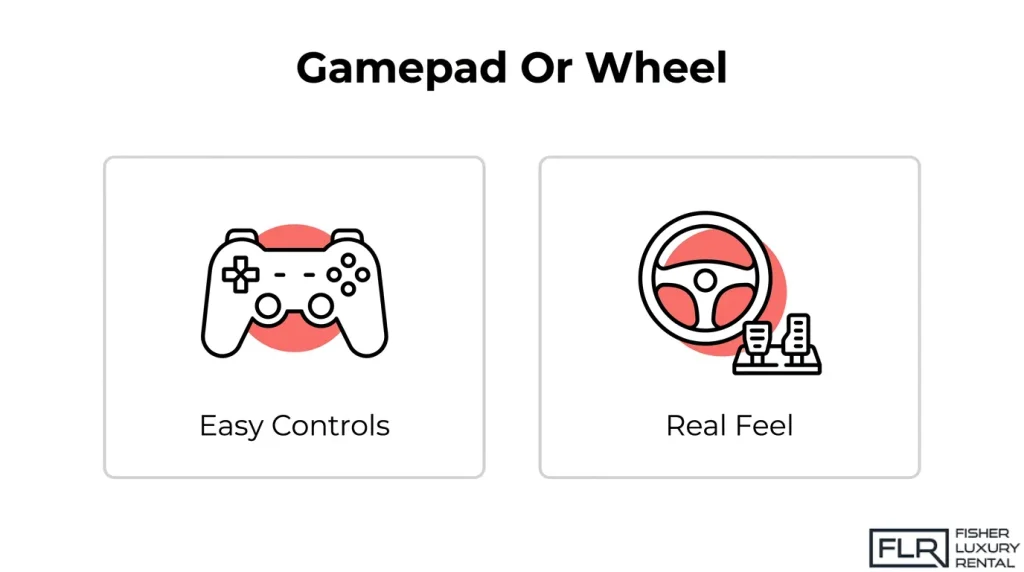
What Controller Input Feels Like in Arcade Racers?
Controller input in arcade racers feels immediate, forgiving, and designed for pure enjoyment. Steering responds to light thumbstick pressure with exaggerated responsiveness, so players rarely fight the car. OutRun, which The Guardian credits as one of Sega’s greatest arcade hits, captures this perfectly: it feels like a joyride rather than a race, prioritizing sensation over precision. Braking and acceleration require no careful modulation, and corrections happen almost automatically. This accessibility is the genre’s greatest strength, as it removes hardware barriers entirely.
What Steering Wheel and Pedal Setup Feels Like in Sim Racers?
A steering wheel and pedal setup in sim racing replaces the gamepad entirely to recreate the physical demands of actual driving. According to PC Gamer’s 2024 beginner guide, new sim racers need a wheel and pedals as their core starting point, with a mounting solution as the recommended next upgrade for stability and positioning. Unlike a gamepad, the wheel requires genuine steering technique: hand-over-hand inputs, throttle modulation with your right foot, and deliberate braking pressure. The learning curve is steep, but the physical engagement is unmatched.
How Does Force Feedback Differ Between the Two Genres?
Force feedback is essentially absent in arcade racers and central to the sim racing experience. Sim hardware transmits real-time physics data through the wheel, so the driver feels grip changes, curb strikes, and understeer as physical resistance. The Logitech G923 uses a 2.3Nm TRUEFORCE system that connects directly to in-game physics engines for continuous feedback. At the enthusiast tier, the Fanatec CSL DD delivers 8Nm of torque via direct drive, offering greater precision and more detailed road texture. As Aristotelis Vasilakos notes in Racecar Engineering, real drivers build pace gradually from under the limit, and this same sensitivity is what sim forces feedback trains.
How Does Vehicle Handling Differ Between Arcade and Sim Racers?
Vehicle handling differs between arcade and sim racers primarily in how each genre models traction loss, drift initiation, and braking physics. The following sections cover drifting mechanics in arcade games, drifting in simulators, and braking behavior across both genres.
How Does Drifting Work in Arcade Racers?
Drifting in arcade racers works by letting players initiate and sustain a slide with minimal input precision, often through a single button tap or sharp steering flick. The game artificially maintains the drift angle, preventing unrecoverable spins. According to the Toyota Research Institute, drifting occurs when a driver purposefully loses rear traction to destabilize the vehicle, but arcade titles abstract this into a forgiving, stylized mechanic rather than a physically accurate one. Recovery is automatic, rewarding style over technique.
How Does Drifting Work in Simulation Racers?
Drifting in simulation racers works by requiring the driver to manage precise throttle, steering, and weight transfer simultaneously to control rear traction loss. There is no automatic correction. The Pacejka tire model, as documented by Stanford University’s Center for Design Research, calculates lateral force from slip angle and longitudinal slip, meaning overcorrection or understeer is penalized immediately. Sustaining a drift demands genuine vehicle control, closely mirroring real-world technique.
How Does Braking Behavior Compare Across Both Genres?
Braking behavior in arcade racers is compressed and forgiving, with exaggerated deceleration that tolerates late braking without significant handling consequences. Simulation racers model trail braking, which Driver61 describes as continued, lightened braking while turning into a corner to manipulate vehicle balance rather than simply reduce speed. In a simulator, braking too late or releasing pressure incorrectly shifts weight distribution and destabilizes the car, demanding precision that translates directly to real-world driving technique.
What Role Does Vehicle Customization Play in Each Genre?
Vehicle customization serves fundamentally different purposes in arcade and simulation racers. Arcade games use upgrades to reward progression and visual expression, while simulation titles treat tuning as a technical discipline that directly shapes on-track performance.
How Do Arcade Racers Approach Car Upgrades?
Arcade racers approach car upgrades as a progression reward system rather than a precision tool. Players typically unlock or purchase performance tiers, such as engine upgrades, nitrous boosts, and visual modifications, through in-game currency earned by winning races. The upgrades make cars noticeably faster and more responsive without requiring the player to understand the underlying mechanics. Visual customization, including body kits, paint, and wheel styles, also carries significant weight, reflecting the genre’s emphasis on style and personal identity over mechanical accuracy. This low barrier to meaningful customization keeps players engaged without demanding technical knowledge.
How Do Simulation Racers Approach Car Tuning and Setup?
Simulation racers approach car tuning and setup as a layered, technical process that mirrors real-world motorsport engineering. Gran Turismo 7’s official manual illustrates the depth involved: players select from four differential configurations, including Normal, One-Way LSD, Two-Way LSD, and Fully Customized, with the Fully Customized option exposing three independent LSD parameters for precise torque distribution control. Beyond the differential, setups span suspension geometry, brake bias, tire compound selection, and aerodynamic balance. Each adjustment produces measurable handling consequences, meaning a poorly configured setup can cost lap time just as easily as poor driving. For serious players, this depth is the point, turning pre-race preparation into a discipline of its own.
How Does Track Design Differ Between Arcade and Sim Racers?
Track design differs between arcade and sim racers in both physical layout and the source of each course. Arcade games use wider, forgiving roads and fantasy venues, while simulation titles replicate real-world circuits with precise accuracy.
How Do Arcade Racers Design Their Tracks?
Arcade racer track design prioritizes accessibility over realism. Wider roads reduce the precision required at corner entry, creating more forgiving clipping points throughout each lap. According to Game Developer, “making the road wider will make corners easier as it creates a more obtuse angle for the clipping points and also provides some forgiveness in the track design.” Beyond geometry, arcade games frequently blend real-life inspired venues with fully fictional courses, keeping environments visually exciting rather than technically accurate. This approach lets players stay competitive without mastering racing lines.
How Do Simulation Racers Design Their Tracks?
Simulation racer track design centers on exact replication of real-world circuits. Titles like Assetto Corsa Competizione use laser-scanned data to recreate every curb, camber change, and surface variation found at actual venues. Track widths match official FIA or sanctioning-body measurements, meaning corner margins are unforgiving and racing lines matter enormously. There is no width inflation to compensate for driver error. In sim racing, a poorly chosen apex is punished immediately, which is precisely what makes circuit knowledge so transferable to real-world driving environments.
How Does Damage Modeling Compare in Arcade vs. Sim Racers?
Damage modeling compares across arcade and sim racers along two dimensions: visual impact and mechanical consequence. Arcade racers use cosmetic damage that resets between races, while simulation racers model structural and performance degradation that directly affects how the car handles. The sections below cover how each genre treats bodywork damage, mechanical failure, and performance consequences.
How Do Arcade Racers Handle Damage?
Arcade racers handle damage as a visual effect with no lasting gameplay consequence. Cars can crumple, spark, and shed panels, but performance remains largely unaffected. Damage resets automatically at checkpoints or race restarts, keeping the experience frictionless and accessible. This design choice prioritizes fun over realism, allowing players to trade paint without worrying about race-ending mechanical failures.
How Do Simulation Racers Model Mechanical Damage?
Simulation racers model mechanical damage by translating physical collisions into performance penalties. A hard wall strike can misalign suspension geometry, causing unpredictable handling. Engine damage from over-revving reduces power output. Tire punctures from debris create pressure loss and force a pit stop. In competitive sim titles, damage is often permanent within a session, meaning a single mistake carries real race consequences that mirror real-world motorsport outcomes.
How Does Damage Affect Gameplay Differently in Each Genre?
Damage affects gameplay differently because simulation racers make damage a strategic variable while arcade racers treat it as spectacle. In sims, drivers must balance aggression against the risk of losing aerodynamic efficiency or braking capability. In arcade titles, contact is part of the entertainment and rarely punished mechanically. For players learning real car control, the sim approach builds consequence awareness that arcade titles cannot replicate.
What Are the Most Popular Arcade Racing Games?
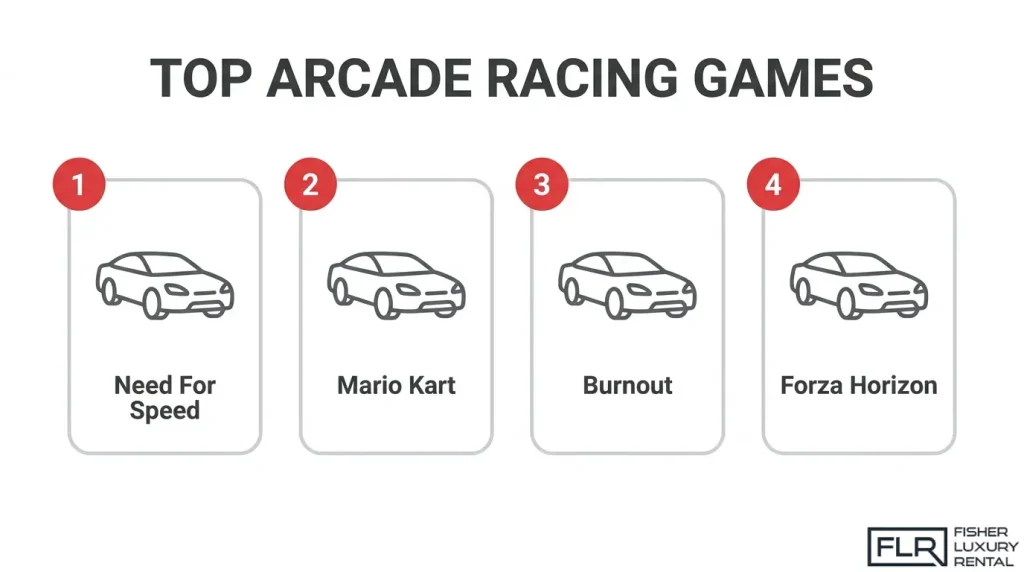
The most popular arcade racing games span several landmark franchises, including Need for Speed, Mario Kart, Burnout, and Forza Horizon. Each series prioritizes accessibility and excitement over simulation accuracy, making them the dominant titles in the genre by player count and sales volume.
Need for Speed Series
The Need for Speed series is one of the longest-running and best-selling arcade racing franchises ever published. According to a 2013 Electronic Arts press release, the franchise had already sold more than 150 million copies since launching in 1994, a figure that reflects nearly three decades of consistent mainstream appeal. Its blend of street racing culture, car customization, and police chases has kept it relevant across console generations in a way few franchises can match.
Mario Kart Series
The Mario Kart series is Nintendo’s flagship arcade racing franchise, built around accessible gameplay, inventive track design, and chaotic item-based combat. Mario Kart 8 Deluxe alone has sold 71.53 million units on Nintendo Switch as of June 30, 2026, according to Nintendo investor relations data, making it one of the best-selling video games of all time on any platform.
Burnout Series
The Burnout series is an arcade racing franchise developed by Criterion Games, defined by high-speed collisions, boost mechanics, and spectacular crash physics. Rather than rewarding cautious driving, Burnout actively incentivizes aggressive play, including near-miss traffic passes and deliberate takedowns. It remains one of the purest expressions of arcade racing design philosophy.
Forza Horizon Series
The Forza Horizon series is an open-world arcade racing franchise developed by Playground Games, known for its vast drivable landscapes and approachable handling model. According to Xbox Wire, Forza Horizon 5 reached over 20 million players within six months of its November 2021 launch, making it the fastest Forza title to reach that milestone. Its scale and visual fidelity set a high bar for the genre.
What Are the Most Popular Simulation Racing Games?
The most popular simulation racing games include Gran Turismo, iRacing, Assetto Corsa Competizione, and rFactor 2. Each title targets a different level of commitment, from console-accessible experiences to professional-grade PC platforms used by real motorsport teams.
Gran Turismo Series
The Gran Turismo series is the best-selling simulation racing franchise in history. First released in Japan in December 1997, Kazunori Yamauchi’s game became both a critical and commercial phenomenon, surpassing two million sales in Japan before reaching North America and Europe, according to IGN. By 2022, Polyphony Digital confirmed the series had reached 90 million units sold worldwide. Gran Turismo 7, released March 4, 2022, earned an 87 Metascore from 120 critic reviews on Metacritic. The game’s depth extends to granular setup tools, including four selectable differential gears and fully customizable LSD options.
iRacing
iRacing is a subscription-based online racing simulator built specifically for competitive and professional use. Priced at $14.75 per month, it provides access to laser-scanned tracks and officially licensed cars. Its structured license system mirrors real motorsport ladder progressions, making it the platform of choice for drivers training for actual competition. No other consumer sim matches iRacing’s focus on clean, racecraft-oriented online competition.
Assetto Corsa Series
Assetto Corsa Competizione uses a laser-scanned physics mesh with millions of polygons derived directly from real circuit data, as confirmed by developer Kunos Simulazioni. This mesh drives both player and AI physics simultaneously, demanding significant computational resources. On PlayStation 5, Digital Foundry measured a virtually locked 60fps in standard conditions, dropping to a low of 55fps only under extreme stress with 26-plus AI cars in heavy rain. For console sim racers, ACC represents one of the most technically rigorous options available.
rFactor 2
rFactor 2 is a PC simulation platform developed by Studio-397, known for its modding depth and use in professional motorsport development. Studio-397 provides an official rF2 Physics Calculator, a dedicated tool that generates HDV, engine, and ultrachassis configuration files for custom vehicle builds. This open physics architecture makes rFactor 2 the preferred platform for teams and manufacturers validating setup changes in a virtual environment before track testing.
Which Genre Is Better for Beginners?
For beginners, arcade racers are the more accessible starting point. They require no specialized hardware, reward casual play, and remove the steep learning curve of real-world physics. The sections below break down hardware requirements, learning curves, and the best starting titles by genre.
What Hardware Do Beginners Need for Each Genre?
The hardware beginners need differs significantly between genres. Arcade racers work well on a standard gamepad, with no additional investment required. Simulation racers, by contrast, demand more. According to PC Gamer (2024), new sim racers primarily need a wheel and pedals to get started, with a mounting solution recommended to prevent slippage and improve lap consistency. That entry-level sim setup adds cost and space that casual players may not be ready to commit to.
How Steep Is the Learning Curve for New Players?
The learning curve for new players is much steeper in simulation racing than in arcade titles. Sim games model real tire behavior, braking points, and vehicle balance, requiring players to unlearn instinctive inputs before improving. Arcade racers flatten this curve through forgiving physics and wider track design, letting beginners focus on the experience rather than technique. For someone who simply wants to enjoy driving, the arcade genre removes friction that sim racing intentionally preserves.
Which Beginner-Friendly Titles Should New Players Try First?
The beginner-friendly titles new players should try first vary by goal. For pure fun and low commitment, these options are ideal:
- Mario Kart 8 Deluxe: Gamepad-only, no racing knowledge required, broad platform availability.
- Forza Horizon 5: Open-world format with adjustable assists, forgiving entry point into licensed car culture.
- Project Cars 3: A simcade option that GamesRadar+ describes as a great way to get into sim racing for newcomers, with an approachable career mode.
Players ready for full simulation should start with Gran Turismo 7, which pairs deep physics with structured licensing tests that teach fundamentals progressively.
What Are Simcade Racers and How Do They Blend Both Styles?
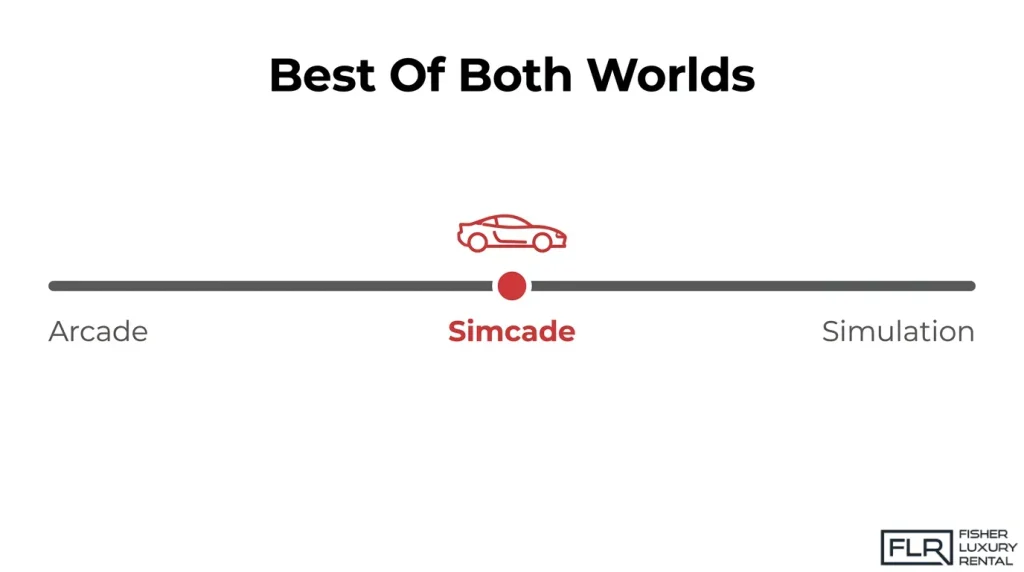
Simcade racers are a hybrid genre that combines accessible arcade handling with meaningful simulation depth. The sections below cover how the genre is defined, which titles represent it best, and what makes it a practical middle ground for players who want a challenge without the full commitment of a pure simulator.
What Is a Simcade Racer?
A simcade racer is a racing game that deliberately bridges the gap between arcade accessibility and simulation authenticity. These titles retain forgiving handling models so newcomers can compete immediately, while adding enough physics depth to reward players who refine their technique over time.
The GRID series illustrates this balance well. According to GamingBolt, GRID Legends “hangs on to enough of the approachable qualities of the arcade racing genre to feel welcoming, while never losing its grip on the challenge and depth that makes more simulation-focused racers so valuable.” That dual appeal is the defining characteristic of the simcade category.
Which Games Are Considered Simcade Racers?
The most widely recognized simcade titles include:
- GRID Legends (Codemasters): deep career structure with controlled, accessible handling
- Project Cars 3 (Slightly Mad Studios): gamey career mode with a simcade physics layer
- Forza Motorsport (Turn 10): real licensed cars and tracks with scalable assists
These games share a tunable difficulty system that lets players shift the experience closer to either end of the spectrum.
How Do Simcade Games Balance Accessibility and Depth?
Simcade games balance accessibility and depth through adjustable assist systems, such as traction control, braking lines, and stability management, that players can remove progressively. GRID game director Chris Smith described the approach directly: “We’re certainly not full arcade, but we provide players options to turn-off assists and increase the difficulty to be very sim. We tend to say this is a game where casual players can go for fun and sim players go for serious fun.”
This scalability is what separates simcade titles from both pure genres. Arcade racers rarely penalize poor technique; true simulators demand it from lap one. Simcade titles make the difficulty curve a player-controlled variable, which is a genuinely smart design philosophy for building long-term player engagement.
How Does Choosing a Racing Genre Compare to Driving Real High-Performance Cars?
Sim racing replicates the physics and feedback of real performance driving, but a gap always remains. For drivers curious about what lies on the other side of that gap, Fisher Luxury Rental provides access to exotic and luxury vehicles in Phoenix, AZ and Portland, OR. The headings below explore whether renting an exotic car bridges that gap, and what the article’s core lessons add up to.
Can Renting an Exotic Car from Fisher Luxury Rental Satisfy the Thrill Sim Racers Try to Recreate?
Yes, renting an exotic car from Fisher Luxury Rental can satisfy the thrill sim racers try to recreate, and in several ways it surpasses what any simulator delivers. No hardware peripheral fully replicates G-forces, engine vibration through the seat, or the visceral sound of a high-performance exhaust at full throttle. Even advanced force feedback wheels use mechanical systems that smooth out certain jolts to protect comfort, meaning some raw feedback is intentionally softened.
Growing demand supports this instinct. According to Market.us, the global luxury car rental market is projected to grow from USD 35.9 billion in 2023 to USD 76.8 billion by 2033, a CAGR of 7.9%, reflecting how many people seek real-world performance experiences alongside or beyond digital ones.
Fisher Luxury Rental offers exotic and luxury vehicles across Phoenix, AZ and Portland, OR, giving sim racers a direct path to the sensations their setup can only approximate.

What Are the Key Takeaways About Arcade vs. Simulation Racers?
The key takeaways about arcade vs. simulation racers come down to purpose, depth, and the limits of any screen-based experience. Fisher Luxury Rental, serving Phoenix, AZ and Portland, OR, offers exotic and luxury vehicles for drivers who want to move beyond the screen and experience real high-performance cars firsthand. The clearest conclusions are:
- Arcade racers prioritize accessibility and fun over accuracy, using forgiving physics and simplified controls.
- Simulation racers model tire slip, aerodynamic load, and braking behavior with precision, rewarding study and practice.
- Simcade titles bridge both, offering adjustable difficulty that suits casual and serious players.
- Hardware matters in sim racing: force feedback wheels and pedals meaningfully increase immersion, but all systems involve engineering trade-offs.
- Skill transfer from sim to real driving is real but limited: understanding braking curves and car balance helps, yet no simulator replicates full physical sensation.
- The best complement to sim racing is real-world seat time in a genuine high-performance vehicle.
For anyone whose sim racing sessions have sparked a deeper appetite for the real thing, renting an exotic car is the natural next step.