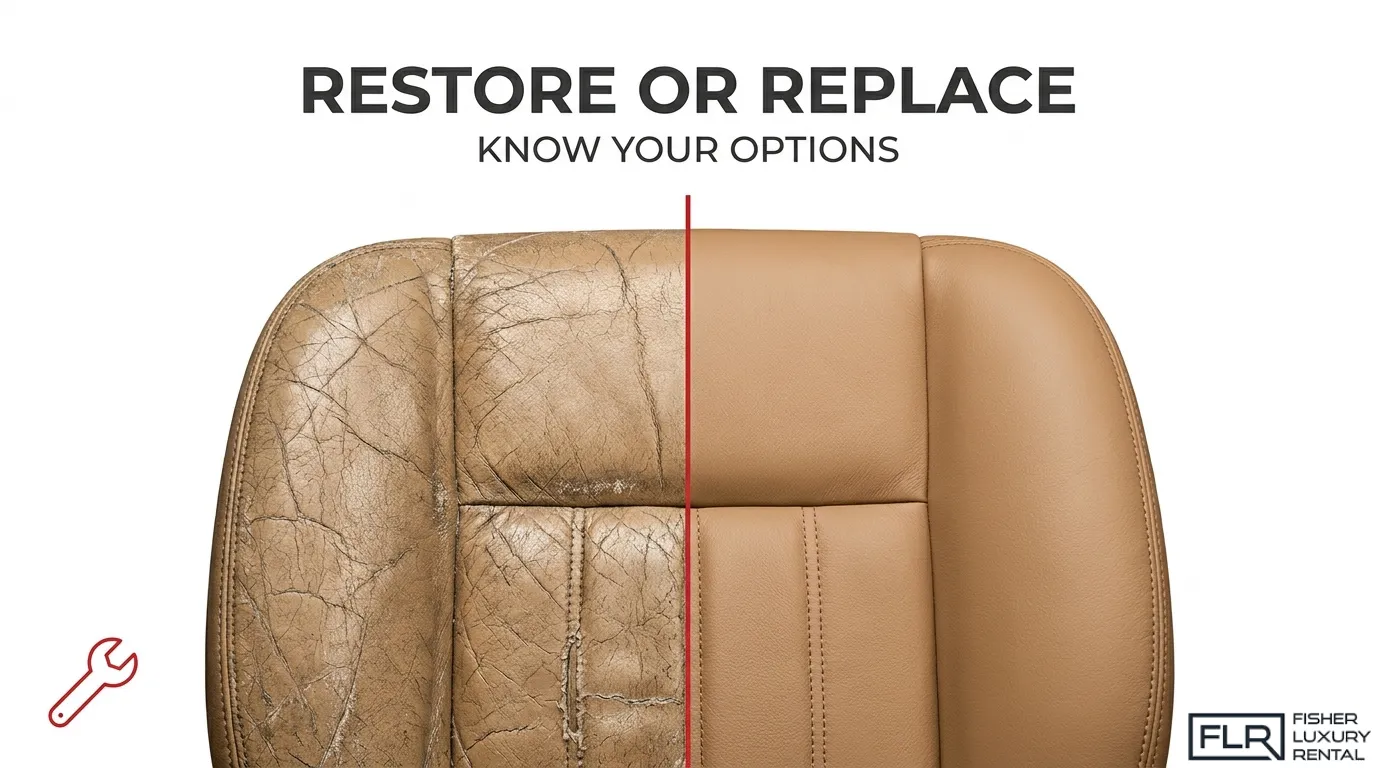
Car leather restoration is the process of cleaning, repairing, recoloring, and refinishing leather that remains structurally intact, while replacement removes the original material entirely and installs new upholstery.
This guide covers how to diagnose leather damage, what leather types actually behave differently under stress, when each approach is the right call, what each service costs, how both processes work step by step, and what maintenance habits protect your investment long-term.
Cracking, fading, stiffness, and worn coating each signal a different damage stage, and the right response depends on which one you are dealing with. Full-grain, corrected-grain, semi-aniline, and synthetic leather each age differently, which shapes both your restoration options and your replacement costs.
Restoration suits surface-level damage, specifically scuffs, minor cracks, sun fading, and finish wear, when the hide beneath remains structurally sound. Replacement becomes necessary when deep tears, structural deterioration, widespread delamination, or extensive mold infiltration put the damage beyond what any topical repair can reverse.
Cost ranges for single-seat repairs, full interior restoration, recoloring, and complete replacement vary by leather grade and scope of work. Each pricing section breaks down what drives those differences.
The restoration process moves through four sequential stages: cleaning and prepping, filling cracks, recoloring, and applying a protective finish. Replacement involves disassembly, patterning, airbag safety compliance, and final installation.
Consistent conditioning, UV protection, and controlled parking environments slow deterioration for any leather grade. Luxury and exotic vehicles, including those maintained by premium rental fleets like Fisher Luxury Rental, demonstrate what that standard looks like in practice.
What Is the Difference Between Restoring and Replacing Car Leather?
The difference between restoring and replacing car leather is the scope of work: restoration repairs and refinishes existing leather, while replacement removes the original material entirely and installs new upholstery. Both are legitimate services, but they serve different damage levels and budgets. The following sections cover how each process is defined, what it involves, and when each approach applies.
How Is Car Leather Restoration Defined?
Car leather restoration is the process of cleaning, repairing, recoloring, and refinishing leather that remains structurally intact. It targets surface-level damage such as scuffs, fading, minor cracks, and finish wear without removing the original hide. According to the International Council of Museums–Committee for Conservation, restoration encompasses “all actions directly applied to a single and stable item aimed at facilitating its appreciation, understanding and use,” applied only when the item has lost part of its function through deterioration. In automotive practice, this means the leather must still have a sound underlying structure to be a viable restoration candidate. Restoration is often the more practical choice when the leather’s substrate is healthy but its surface finish has degraded.
How Is Car Leather Replacement Defined?
Car leather replacement is the complete removal of worn upholstery and installation of new leather or alternative material. The process involves disassembling seat covers, rebuilding seat padding where necessary, patterning new material, and refitting the interior. According to Forsyth Technical Community College’s automotive upholstery curriculum, trained technicians learn to diagnose upholstery condition, then disassemble, repair, replace, or fabricate custom vehicle interior upholstery depending on what the damage requires. Replacement becomes necessary when leather has deteriorated beyond surface repair, including deep tears, structural delamination, or extensive mold infiltration.
What Are the Key Differences Between Restoration and Replacement?
The key differences between restoration and replacement involve scope, cost, and damage threshold:
- Scope: Restoration works on existing leather; replacement removes and rebuilds from new material.
- Damage level: Restoration suits surface wear, fading, and minor cracking; replacement addresses structural failure, deep tears, or irreparable delamination.
- Labor: Restoration requires refinishing skills; replacement requires patterning, cutting, and upholstery fitting.
- Material: Restoration preserves the original hide; replacement introduces new leather or synthetic alternatives.
- Cost: Restoration is generally less expensive than full replacement due to lower material and labor inputs.
Understanding which condition applies to your seats is the essential first step before committing to either service.
What Are the Common Signs Your Car Leather Needs Attention?
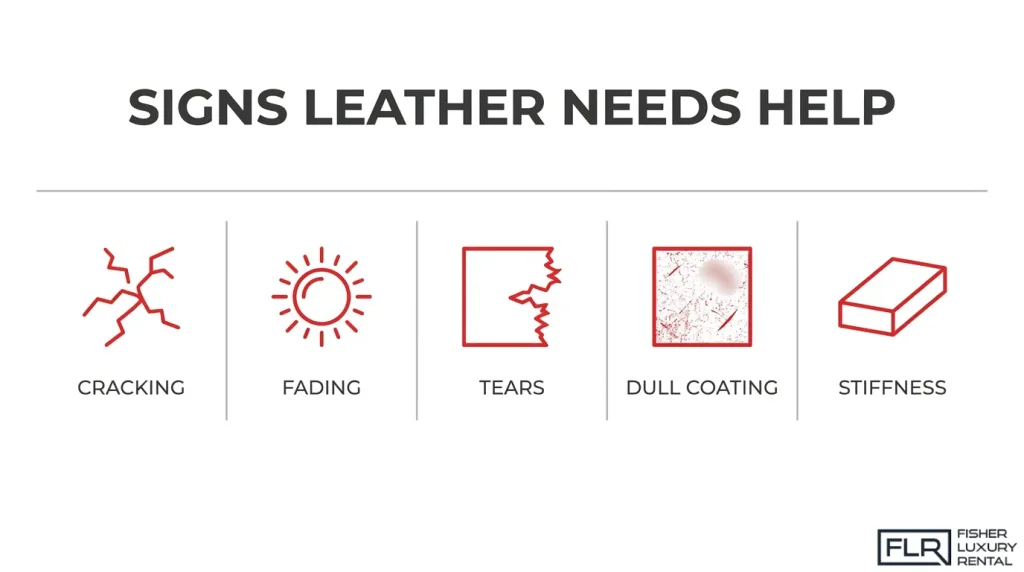
The common signs your car leather needs attention include cracking, fading, tears, worn-out coating, and hardened texture. Each symptom signals a different stage of deterioration and points toward either restoration or replacement.
How Does Cracking Indicate Leather Damage?
Cracking indicates leather damage by revealing that the finish layer has lost its flexibility and begun to separate from the hide beneath it. According to ASTM D2097-03(2023), the standard flex test for upholstery leather evaluates both the resistance of the finish to cracking and the adhesion of the finish to the leather, confirming that surface cracking directly reflects finish failure under repeated flexing. Fine surface cracks typically appear first at seat bolsters and fold points, where stress concentrates during entry and exit. Left unaddressed, cracks deepen, allow moisture penetration, and accelerate structural deterioration of the hide itself.
What Does Fading or Discoloration Tell You About Leather Condition?
Fading or discoloration tells you that the leather’s dye or surface colorant has degraded, often from UV exposure, heat, or moisture. In a vehicle interior, prolonged sunlight through the windshield and windows bleaches pigments unevenly, producing patchy, washed-out areas. High humidity accelerates this process: according to the Canadian Conservation Institute (CCI Notes 8/1, revised 2016), relative humidity between 65 and 100%, warm temperatures, and poor air circulation also promote mold growth, which can cause additional staining and discoloration. Uneven fading signals that the protective topcoat is compromised, leaving the underlying leather exposed to further damage.
When Do Tears and Rips Become Irreparable?
Tears and rips become irreparable when the leather substrate has lost structural integrity across a large area or when the damage extends through multiple layers of hide. Small, clean punctures or edge tears can typically be filled and patched during restoration. Irreparability sets in when tearing is extensive, when the hide around the damage has become brittle and will not hold adhesive or fill material, or when multiple panels are affected simultaneously. At that threshold, continued patch repairs yield diminishing returns, and full panel replacement produces a more durable and visually consistent result.
How Can You Identify Worn-Out Leather Coating or Finish?
Worn-out leather coating or finish is identifiable by a dull, slick, or tacky surface where the original sheen and texture have disappeared. The International Union of Leather Technologists and Chemists Societies (IULTCS Congress, 2019) found that poor performance of automotive leather becomes visible as the polymeric finishing coat wears off or cracks over time, with aging resistance evaluated by measuring how flexible and strong the polymer coating remains after exposure to light, heat, and humidity. Full-grain leather retains its entire grain surface with no mechanical treatment, while corrected-grain leather has been buffed and enhanced with a finishing treatment; the latter’s finish tends to show wear patterns earlier. Semi-aniline leather carries a light pigmented finish that is easier to care for than aniline leather but still degrades visibly when its topcoat thins. Finish failure first appears as color loss on high-contact zones such as seat edges, center cushions, and armrests.
What Does a Stiff or Hardened Texture Mean for Leather Health?
A stiff or hardened texture means that the leather has lost its natural moisture and plasticizer content, leaving the hide fibers dry, rigid, and prone to snapping under flex stress. Natural leather requires consistent conditioning to maintain suppleness; without it, fibers compact and the hide becomes brittle. Stiffness concentrated in fold zones is a reliable early warning: if the leather resists flexing without creaking or cracking, significant fiber-level drying has already occurred. At an advanced stage, hardened leather cannot be fully reversed through conditioning alone, and restoration products offer only partial recovery. Catching stiffness early is one of the most actionable signals a driver has before minor dryness becomes structural damage.
What Types of Car Leather Are Used in Vehicle Interiors?
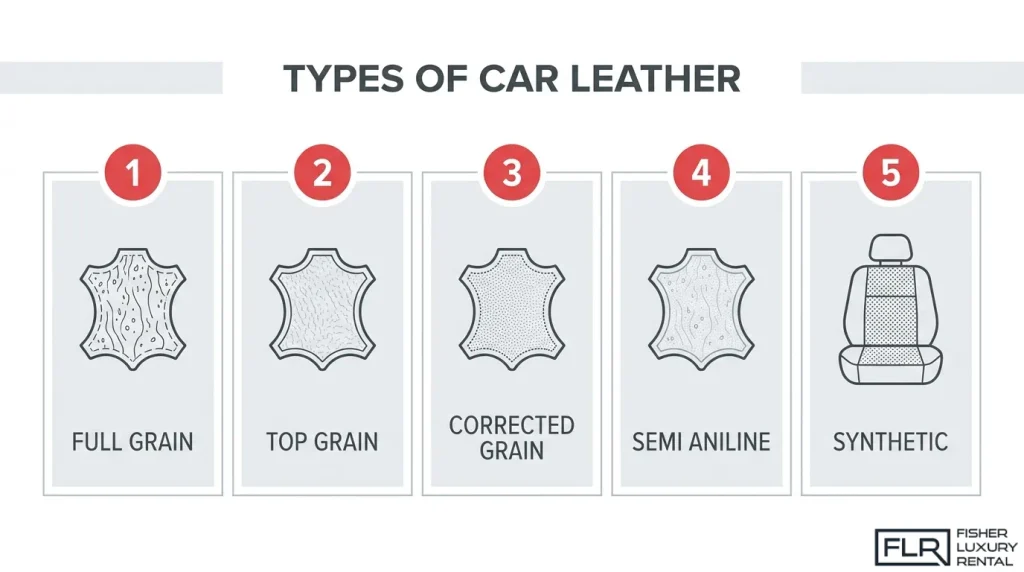
The types of car leather used in vehicle interiors range from premium full-grain hides to synthetic polyurethane alternatives. Understanding each type helps you make smarter decisions about restoration or replacement. The sections below cover full-grain, top-grain, corrected-grain, semi-aniline, and synthetic leather.
Full-Grain Leather
Full-grain leather is the highest-quality hide used in vehicle interiors, retaining the entire natural grain surface without any corrective mechanical treatment. According to the Leather Research Laboratory at the University of Cincinnati, top-grain and full-grain leather are technically the same classification. Because no surface buffing removes the outermost hide layer, full-grain leather develops a distinctive patina over time and resists premature wear better than processed alternatives. It is the least forgiving of all grades when neglected, but the most rewarding when properly maintained.
Top-Grain Leather
Top-grain leather is the grade most commonly installed in mid-to-high-end production vehicles. It shares its classification with full-grain leather in standard terminology, though manufacturers sometimes use the term loosely to describe lightly processed hides. In practice, top-grain used in automotive seating may include minimal surface buffing to achieve a more consistent appearance, making it slightly more uniform but marginally less breathable than unprocessed full-grain.
Corrected-Grain Leather
Corrected-grain leather has had its natural surface partially removed through buffing or similar mechanical treatment, then enhanced with a finishing coat. The Leather Working Group’s ISO-aligned definitions confirm this distinction clearly. Because the original grain is altered, corrected-grain leather relies heavily on its polymer finish for durability. When that finish wears or cracks, the underlying hide deteriorates faster than full-grain variants, making finish condition the critical factor to monitor.
Semi-Aniline Leather
Semi-aniline leather has a light pigmented finish applied over the natural hide surface. According to Leather Naturally’s leather terminology guide, this finish preserves the visible grain while making the surface less susceptible to soiling and easier to maintain than pure aniline leather. For automotive use, semi-aniline offers a practical balance: the tactile feel of natural leather with improved resistance to everyday staining, making it a popular choice in luxury vehicle interiors.
Synthetic or Faux Leather
Synthetic or faux leather is constructed by embossing a polyurethane (PU) coating onto a fabric base, as documented in a 2022 study published in the International Textile and Apparel Association Annual Conference Proceedings by Iowa State University Digital Press. While cost-effective and easy to clean, polyurethane coatings are inherently vulnerable to hydrolysis from heat and humidity, including body heat transferred during normal use. For anyone evaluating restoration versus replacement, this degradation mechanism is worth understanding: faux leather does not age the same way genuine hide does, and peeling or delamination signals a structural failure that restoration cannot fully reverse.
When Should You Restore Car Leather Instead of Replacing It?
Restoration is the right choice when damage is surface-level and the leather’s structural integrity remains intact. The following headings cover four common conditions: surface scratches, sun fading, minor cracks, and staining.
Can Surface Scratches and Scuffs Be Restored?
Yes, surface scratches and scuffs can be restored in most cases. When damage is limited to the finish layer and has not penetrated the hide itself, a professional can apply leather filler compounds, recolor the affected area, and seal it with a protective topcoat. The key factor is depth: scratches that catch a fingernail but do not tear or expose underlying fiber are strong candidates. Replacement is unnecessary for this level of wear, and restoration delivers a clean result at a fraction of the cost.
Is Faded or Sun-Damaged Leather a Good Candidate for Restoration?
Faded or sun-damaged leather is a good candidate for restoration when the hide remains supple and structurally sound. UV exposure degrades dyes and colorants over time, causing visible fading and surface discoloration. A 2024 study published in Cleaner Materials found that chrome-tanned leather experiences significant performance drops after UV aging, particularly in surface abrasion resistance. If that degradation has not yet reached the hide’s core structure, professional recoloring and conditioning can revive the appearance effectively. Acting early, before UV damage hardens or cracks the surface, is the most cost-effective approach.
Can Minor Cracks Be Fixed Through Leather Restoration?
Yes, minor cracks can be fixed through leather restoration when cracking is confined to the finish coat and has not spread into the underlying hide. According to the International Council of Museums–Committee for Conservation, restoration applies only to items that have lost part of their function through past deterioration – meaning the intervention targets existing damage rather than preventing future breakdown. In practical terms: hairline surface cracks respond well to flexible filler products and fresh topcoats. Once cracks deepen and the tissue beneath begins losing resiliency, the window for effective restoration narrows considerably.
Is Restoration Effective for Stained or Discolored Leather?
Restoration is effective for stained or discolored leather when the stain has not permanently altered the hide’s fiber structure. Ink, grease, and most beverage stains respond to professional solvent cleaning followed by recoloring. Discoloration from prolonged UV exposure or chemical contact may require full recoloring of the panel. Restoration becomes less reliable when discoloration is paired with surface hardening or flaking, as those conditions signal deeper deterioration that a topcoat alone cannot reverse. For isolated stains on otherwise healthy leather, restoration consistently outperforms replacement on both cost and visual outcome.
When Should You Replace Car Leather Instead of Restoring It?
Replacement becomes necessary when damage goes beyond the surface. The following section cover the four key conditions, including deep tears, structural deterioration, delamination, and mold, that signal restoration is no longer viable.
Should You Replace Leather With Deep Tears or Punctures?
Yes, you should replace leather with deep tears or punctures when the damage cuts through multiple material layers or spans a large area. Surface fillers and patches cannot restore the structural integrity of a seat panel that has been deeply cut or punctured. According to the Forsyth Technical Community College automotive upholstery curriculum, trained technicians learn to diagnose whether worn upholstery requires repair, replacement, or custom fabrication, recognizing that some damage falls outside what repair can address. A small, clean puncture may be patchable, but jagged tears, blow-outs, or cuts near seams typically require full panel replacement to restore both appearance and durability.
Is Replacement Necessary When Leather Has Structural Deterioration?
Replacement is necessary when leather shows structural deterioration, such as embrittlement, deep cracking, or internal breakdown of the hide fibers. According to the U.S. National Park Service Museum Handbook (1996), oxidative degradation causes hardening, embrittlement, crazing of the skin surface, and serious internal structural changes, driven by high temperatures, humidity, and light exposure. Once a hide reaches this stage, no topical conditioner or filler can reverse the underlying fiber breakdown. Restoration products address surface issues; they cannot rebuild a structurally compromised hide. Replacement is the only option that restores both safety and comfort.
Should Severely Delaminated Leather Be Replaced?
Severely delaminated leather should be replaced. Delamination occurs when the finish or backing layer separates from the hide, causing the surface to peel, bubble, or flake in large sections. Once delamination is widespread, adhesion cannot be reliably restored through topical treatments, as the bond between layers has broken down across the panel. Spot repairs on minor edge lifting may hold temporarily, but extensive delamination leaves the seat visually unsalvageable and prone to further peeling. Full panel or seat replacement is the only lasting solution.
Does Extensive Mold or Mildew Damage Require Replacement?
Extensive mold or mildew damage does require replacement in most cases. The New York State Department of Health (2011) advises discarding porous materials, including upholstered furniture, with extensive mold growth because mold infiltrates porous materials and cannot be completely removed once it penetrates the substrate. Car leather backed with foam or fabric is similarly porous; surface cleaning removes visible growth but leaves mold colonies embedded in the padding beneath. For minor surface mold caught early, professional remediation may suffice, but flood-soaked or heavily contaminated seats should be replaced to eliminate health risks entirely.
How Much Does Car Leather Restoration Cost?
Car leather restoration cost varies by the scope of work: single-seat repairs, full interior restoration, and standalone recoloring each fall into different price ranges. The sections below break down typical costs for each service type.
How Much Does Restoring a Single Leather Seat Cost?
Restoring a single leather seat costs less than a full interior job, making it the most budget-friendly entry point for leather repair. Pricing typically depends on damage severity, leather type, and whether recoloring is included alongside structural repairs such as crack filling or panel restitching. Minor scuff and crack repairs on one seat generally cost less than jobs requiring color matching across multiple panels. Getting an itemized quote per seat helps you compare restoration against replacement on a seat-by-seat basis.
How Much Does a Full Interior Leather Restoration Cost?
A full interior leather restoration cost covers all seating surfaces, door panels, and center console leather, making it significantly higher than single-seat work. Pricing reflects labor intensity, the number of surfaces treated, and whether the leather is full-grain or corrected-grain. Leather grade matters here: full-grain leather retains its entire natural surface without mechanical correction, while corrected-grain leather has been buffed and finished, according to the Leather Working Group’s List of Definitions (Version 1.1, January 2024). Full-grain surfaces often require more careful technique, which can affect labor costs.
How Much Does Professional Leather Recoloring Cost?
Professional leather recoloring cost depends on surface area, color complexity, and finish type. Recoloring a single seat panel costs less than a full-interior color refresh, which requires precise dye matching across every surface. Darker or non-standard colors typically add to the price due to custom mixing requirements. Recoloring is often bundled with crack repair and protective finish application, so ask whether your quote includes all three steps or prices them separately.
How Much Does Car Leather Replacement Cost?
Car leather replacement costs vary based on leather grade, seat count, and whether structural components need rebuilding. The sections below cover single-seat full-grain replacement, complete interior pricing, and synthetic alternative costs.
How Much Does Replacing a Single Seat in Full-Grain Leather Cost?
Replacing a single seat in full-grain leather costs more than any other leather type because the process involves far more than cutting new material. According to a City of Los Angeles Personnel Department upholsterer class specification, a proper seat replacement includes removing old upholstery, covers, and panels, then rebuilding the seat by replacing springs, edge wire, and padding materials such as foam rubber or cotton jute felt. Labor intensity for a single seat can rival a multi-seat job when structural rebuilding is required.
How Much Does a Complete Interior Leather Replacement Cost?
A complete interior leather replacement cost depends on the vehicle’s seat count, leather grade, and material calculations performed before a single cut is made. Clover Park Technical College’s 2024–2025 automotive upholstery program outlines that technicians remove all seat covers for patterning and calculate every material requirement before beginning. Complex interiors with multiple rows, door panels, and headliners multiply both material and labor costs significantly.
How Much Does Replacing Leather With Synthetic Alternatives Cost?
Replacing leather with synthetic alternatives costs less upfront than full-grain options, primarily because polyurethane-coated fabrics use a simpler construction: a PU layer embossed onto a fabric base rather than processed hide. However, synthetic seats carry a long-term trade-off, as polyurethane coatings are vulnerable to hydrolysis from heat and humidity, including body heat transferred during normal use.
What Does the Car Leather Restoration Process Involve?
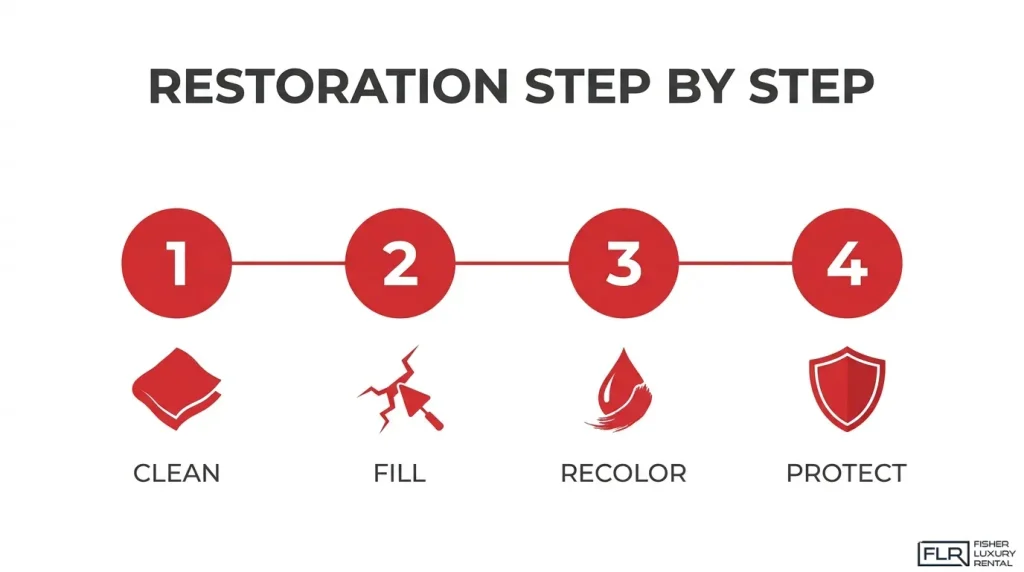
The car leather restoration process involves four sequential stages: cleaning and prepping the leather, filling cracks and scratches, recoloring or redying the surface, and applying a protective finish. Each stage builds on the last to return damaged leather to a functional, presentable condition.
How Is Leather Cleaned and Prepped Before Restoration?
Leather is cleaned and prepped before restoration by removing surface dirt, oils, and old product buildup that would otherwise prevent repair compounds from bonding correctly. Technicians typically use a pH-balanced leather cleaner applied with a soft brush or cloth, working it into the grain to lift contaminants. Any loose or flaking finish is gently abraded away to create a stable, even substrate. Skipping this step is one of the most common reasons DIY restorations fail; fillers and dyes simply will not adhere to contaminated leather.
How Are Cracks and Scratches Filled and Repaired?
Cracks and scratches are filled and repaired using flexible leather filler compounds designed to move with the hide without cracking back out. The filler is pressed into each crack or scratch in thin layers, allowed to dry, and then sanded smooth between coats until the surface is level with the surrounding leather. According to ASTM D2097-03(2023), a standard test method for flex testing of finish on upholstery leather, both finish crack resistance and adhesion are measurable properties – meaning the quality of the filler and its bond to the leather directly determines how long the repair holds under repeated flexing.
How Is Leather Recolored or Redyed During Restoration?
Leather is recolored or redyed during restoration by applying a colorant system, either a water-based dye or a pigmented coating, that is matched to the original seat color. The colorant is applied in multiple thin coats using a sponge, airbrush, or spray bottle to build even coverage without obscuring the natural grain texture. Achieving a precise color match is critical; mismatched recoloring is highly visible on sun-faded or worn seats where surrounding untreated panels serve as a direct comparison.
How Is a Protective Finish Applied After Restoration?
A protective finish is applied after restoration by sealing the repaired and recolored leather with a clear topcoat formulated specifically for automotive use. According to the International Union of Leather Technologists and Chemists Societies (2019), poor performance of automotive leather becomes visible as the polymeric finishing coat wears off or cracks over time, with ageing flexibility and strength considered the key performance parameters. The topcoat restores this protective barrier, shielding the repair work from heat, humidity, and daily friction. A properly applied finish is what separates a restoration that lasts years from one that degrades within months.
What Does the Car Leather Replacement Process Involve?
The car leather replacement process involves removing old seat covers, disassembling interior panels, patterning new material, and reinstalling finished upholstery. It covers seat preparation, material cutting, and safety compliance checks.
How Are Old Seat Covers and Panels Removed?
Old seat covers and panels are removed by disassembling the seat structure and detaching door panels, headliners, and cover fasteners. According to the City of Los Angeles Upholsterer Class Specification 3723, technicians also replace broken springs, edge wire, and padding materials such as foam rubber and cotton felt during this stage. Proper disassembly is essential: rushing removal risks tearing adjacent trim or damaging mounting points that affect reinstallation quality.
How Is New Leather Measured and Patterned?
New leather is measured by removing the existing seat covers first and using them as templates for precise patterning. The 2024–2025 Clover Park Technical College Automotive Upholstery Certificate program specifies that technicians calculate all materials needed to complete an interior after removing covers for patterning. Accurate material calculation at this stage directly prevents costly waste and ensures consistent panel alignment across every seat.
What Safety Checks Are Required During Leather Replacement?
Safety checks during leather replacement must confirm that seat-mounted side airbags remain fully operational after new covers are installed. A 2011 NHTSA interpretation letter states that manufacturers, dealers, and repair businesses are prohibited from knowingly installing seat covers that would render seat-mounted side airbags inoperative under FMVSS No. 214. Any shop skipping this verification creates serious federal safety liability.
How Is the Final Upholstery Installed and Finished?
The final upholstery is installed by fitting patterned leather panels to the rebuilt seat frame and securing all edges, seams, and trim pieces. California Bureau of Automotive Repair accepted trade standards (2023) require all repairs to follow manufacturer recommended procedures to ensure structural integrity. A clean, taut installation with properly aligned seams signals professional workmanship and determines how long the replacement holds up under daily use.
How Long Does Restored Car Leather Last Compared to Replaced Leather?
Restored car leather lasts as long as the underlying hide remains structurally sound, while replaced leather starts fresh from a new baseline. The sections below explain what controls longevity for each approach, how industry testing frames durability, and what decay signs signal a hard limit on restoration.
How Long Does Professionally Restored Leather Last?
Professionally restored leather lasts several years when the hide beneath the finish retains its fiber integrity. Restoration renews the polymeric coating and fills surface damage, but it cannot reverse deterioration within the leather’s internal structure. According to the 2019 IULTCS Congress research on automotive leather performance, ageing behavior is evaluated by measuring how flexible and strong a polymer coating remains after exposure to light, heat, and humidity, making coating quality the primary longevity driver after restoration. Seats that receive fresh protective finish and consistent aftercare realistically extend service life by three to five years before reapplication becomes necessary.
How Long Does Replaced Leather Last?
Replaced leather lasts longer than restored leather over the same use period because it begins with an intact grain structure and a factory-grade polymer finish. The SAE J948 standard (revised 2023) defines abrasion and snagging resistance testing for automotive leather, meaning replacement hides are typically selected and finished to meet these benchmarks from day one. Proper maintenance after replacement, including conditioning and UV protection, is the main variable determining whether that advantage is sustained over time.
What Causes Restored Leather to Deteriorate Faster Than Replaced Leather?
Restored leather deteriorates faster than replaced leather when chemical decay has already progressed beyond surface damage. The 1997 Journal of Conservation and Museum Studies research on leather degradation found that the first sign of chemical decay appears as cracks in areas bent during use, and as deterioration advances, the underlying tissue loses resiliency and eventually disintegrates. Once leather reaches that stage, surface restoration only delays the inevitable. Replacement is the only option that resets this decay clock entirely.
Knowing when restoration reaches its biological limit is the most practical insight this comparison offers, since the right choice depends entirely on the condition of the hide beneath the visible damage.
How Can You Maintain Car Leather to Avoid Costly Repairs?
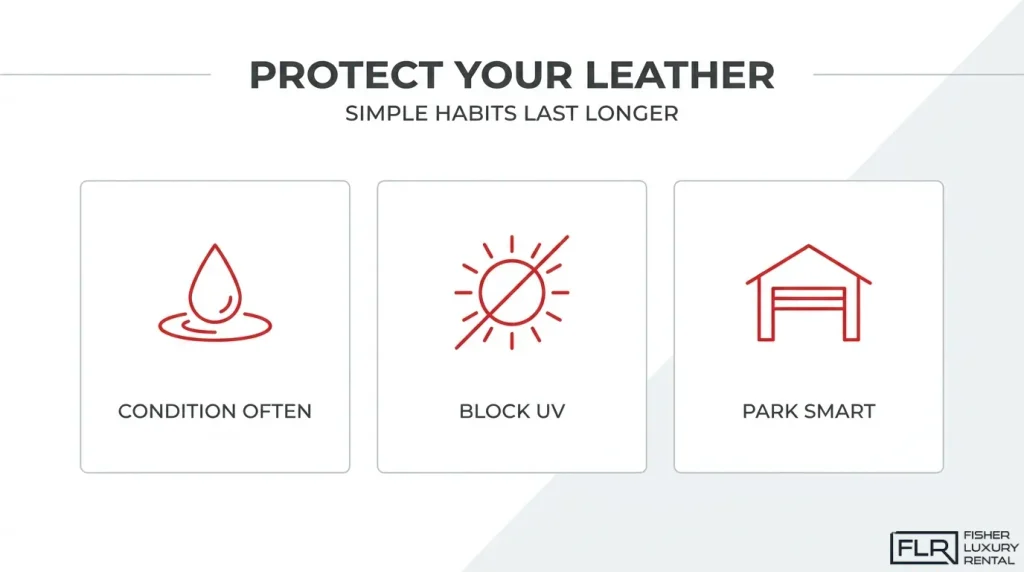
Maintaining car leather involves consistent conditioning, UV protection, and smart parking habits. The sections below cover how often to condition, which protective products to use, and how storage choices directly affect leather longevity.
How Often Should You Condition Car Leather?
Car leather should be conditioned every three months under normal use, or more frequently in climates with extreme heat or low humidity. Conditioning replenishes the natural oils that keep leather supple, preventing the surface from drying out and developing cracks. Skipping regular conditioning is one of the most common mistakes owners make, and the damage accumulates quietly until it becomes expensive to reverse.
What Products Should You Use to Protect Leather From UV Damage?
Products designed to protect leather from UV damage include dedicated leather UV protectants, pigmented conditioners, and sunscreen sprays formulated for automotive interiors. UV radiation causes oxidative degradation, which the U.S. National Park Service Museum Handbook (1996) identifies as producing hardening, embrittlement, surface cracking, and yellowing in leather. The Canadian Conservation Institute (revised 2016) further notes that heat and poor air circulation compound deterioration. Use products that block both light transmission and heat absorption for maximum protection.
How Does Proper Parking and Storage Extend Leather Life?
Proper parking and storage extend leather life by limiting its exposure to the two primary accelerants of material breakdown: UV radiation and humidity. Research published in the Journal of Materials Science (1971) confirmed that polyurethane-based synthetic leathers degrade through hydrolysis driven by heat and moisture, and natural leather faces comparable environmental stress. Parking in shaded garages, using windshield sunshades, and avoiding prolonged outdoor exposure in direct sunlight meaningfully slow surface deterioration. Fisher Luxury Rental, which operates a fleet of luxury and exotic vehicles across Phoenix, AZ and Portland, OR, maintains this standard as a baseline requirement across every vehicle in their fleet. For personally owned exotic cars, applying the same environmental discipline is one of the most effective ways to preserve interior quality.For luxury vehicles especially, where leather quality is a defining feature, consistent environmental management is as important as any product you apply.
How Does Leather Care Differ in Luxury and Exotic Vehicles?
Leather care in luxury and exotic vehicles demands a higher standard than standard automotive maintenance. The following sections explore how Fisher Luxury Rental’s premium fleet sets a benchmark for leather upkeep, along with the key takeaways for your restore-vs.-replace decision.
Can Fisher Luxury Rental’s Premium Fleet Inspire Your Leather Care Standards?
Yes, Fisher Luxury Rental’s premium fleet can inspire your leather care standards by demonstrating what consistent, high-level maintenance looks like in practice. Luxury and exotic vehicles use top-tier leather finishes that face the same stressors as any other interior: light exposure, humidity, and wear cycles. SAE J948 (revised 2023) establishes abrasion resistance testing methods applicable to automotive leather, vinyl, and bodycloth, underscoring that even premium materials require validated protection protocols. Vehicles held to a rental-fleet standard, where cleanliness and presentation are non-negotiable, offer a clear model: condition regularly, protect from UV exposure, control humidity, and inspect for early wear before it escalates. Applying that same discipline to a personally owned exotic vehicle is the most effective way to preserve both appearance and resale value.
What Are the Key Takeaways About Restoring vs Replacing Car Leather?
The key takeaways about restoring vs. replacing car leather come down to damage severity, leather type, and cost-to-value ratio. For drivers in the Phoenix or Portland areas looking to experience what well-maintained luxury leather looks and feels like firsthand, Fisher Luxury Rental’s fleet of top-trim exotic and luxury vehicles offers a practical reference point. Restoration suits surface-level issues such as scuffs, fading, minor cracks, and coating wear. Replacement becomes necessary when structural deterioration, deep tears, or extensive mold infiltration make recovery impractical. Luxury vehicle owners should act on early warning signs, because deferred maintenance compounds into far costlier interventions. Across all leather grades, consistent conditioning, UV protection, and humidity control remain the most reliable tools for extending interior life, regardless of whether the vehicle is personally owned or part of a curated rental fleet.