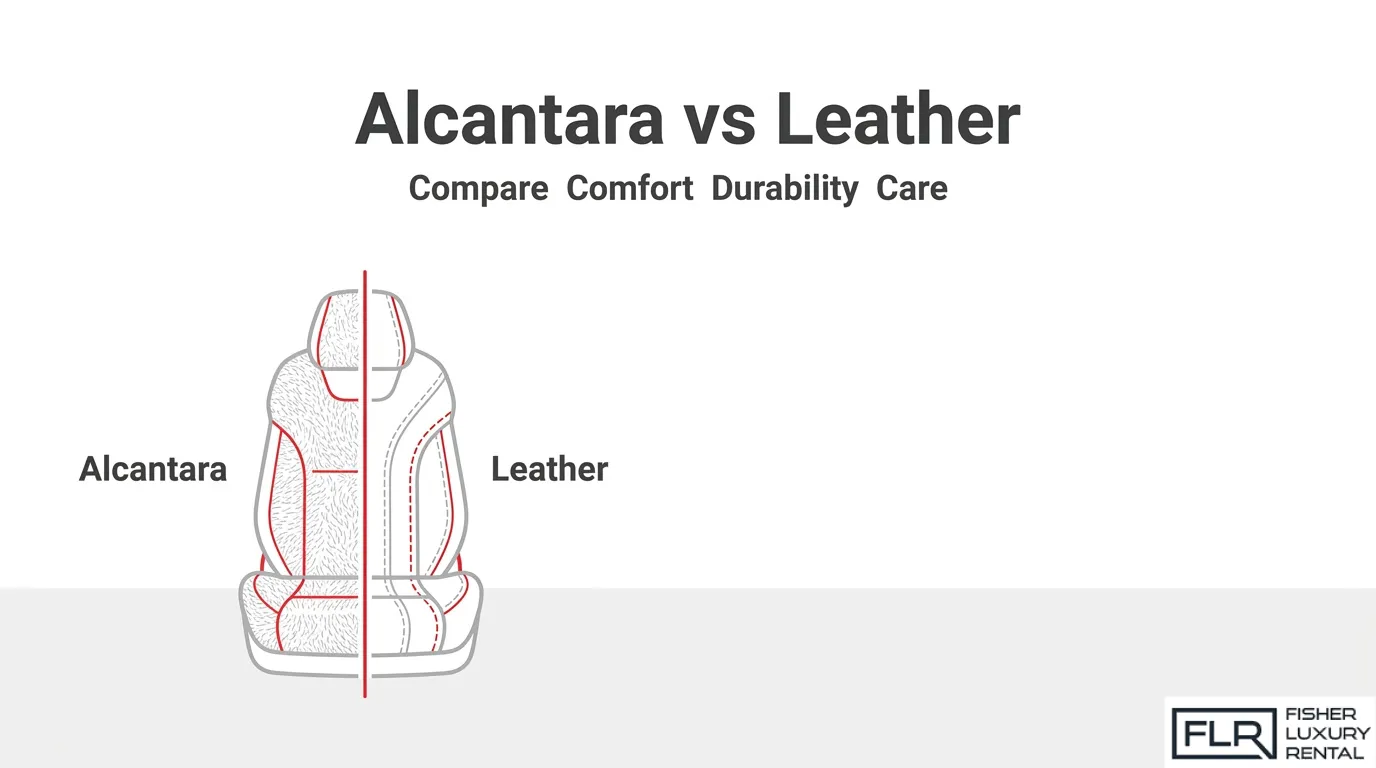
Alcantara is a synthetic polyester-polyurethane microfiber material engineered to replicate suede, while automotive leather is a tanned animal hide processed through chemical and mechanical stages to produce a stable, durable surface used across vehicle interiors.
This guide covers how each material is made and where it appears in luxury vehicles, how they compare in durability and long-term wear, how climate and UV exposure affect each surface, care and maintenance requirements, stain resistance, comfort and grip, cost to repair or replace, and how to evaluate both materials in a real vehicle before committing to ownership.
Alcantara and leather originate from fundamentally different manufacturing processes, and those differences directly shape how each surface holds up over years of use. Leather offers longer lifespan in high-use zones when conditioned consistently, with full-grain and top-grain hides outperforming corrected-grain and bonded alternatives by a significant margin.
Heat, humidity, and UV radiation stress both materials in distinct ways. Alcantara resists cracking and drying under solar exposure, while leather demands proactive conditioning to prevent photodegradation and surface brittleness.
Cleaning protocols, stain response, and repair costs differ considerably between the two. Leather handles spills more forgivingly due to its non-porous surface, while Alcantara requires careful blotting technique and approved cleaning agents to avoid permanent fiber damage.
For drivers considering a luxury or exotic vehicle, factors including climate, driving habits, and maintenance willingness determine which material performs better in practice. Experiencing both in real driving conditions through a short-term rental remains the most direct way to make that comparison accurately.
What Is Alcantara and How Is It Used in Cars?
Alcantara is a synthetic microfiber material developed in the early 1970s through a collaboration between the Italian firm Alcantara S.p.A. and the Japanese chemical company Toray Industries. It consists primarily of polyester and polyurethane, processed into an ultra-fine, suede-like textile used across automotive interiors. The sections below cover Alcantara’s composition, its common applications inside vehicles, and why manufacturers choose it.
What Is Alcantara Made Of?
Alcantara is made of approximately 68% polyester and 32% polyurethane, engineered into a non-woven microfiber fabric that closely mimics the feel and appearance of natural suede. The production process involves splitting ultra-fine fiber bundles and bonding them into a dense, consistent surface structure. This synthetic construction gives Alcantara dimensional stability and a uniform texture that natural suede cannot reliably achieve at scale, making it one of the most controlled interior textiles available to automakers.
What Cars Use Alcantara Interiors?
Alcantara interiors appear most frequently in performance, sports, and luxury vehicles, where tactile quality and weight savings are priorities. Common applications include steering wheels, seat centers, headliners, door panel inserts, and instrument surrounds. Manufacturers such as Ferrari, Lamborghini, Porsche, and BMW M all specify Alcantara in high-performance trim levels. Its low weight relative to leather makes it a preferred choice when reducing cabin mass matters, and its grip-forward surface suits performance driving contexts where secure hand and body contact with the seat is essential.
Why Do Automakers Choose Alcantara?
Automakers choose Alcantara for its combination of premium appearance, tactile differentiation, and engineering consistency. Unlike full-grain leather, which varies in thickness, texture, and natural markings across hides, Alcantara is manufactured to uniform tolerances, simplifying quality control across production runs. Its surface also offers measurably higher friction than smooth leather, which matters for steering wheel grip and seat bolster contact during dynamic driving. For performance brands, this reliability in both appearance and function makes Alcantara a specification-grade material rather than simply a styling choice.
What Is Automotive Leather and What Types Are Common?
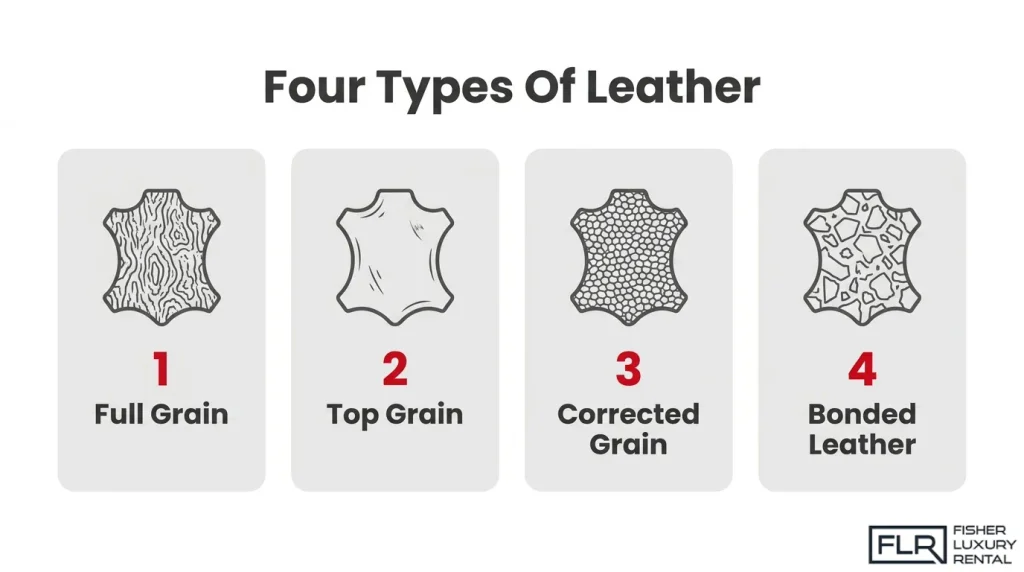
Automotive leather is a processed animal hide material used to trim vehicle interiors, including seats, door panels, steering wheels, and armrests. The types of automotive leather most common in luxury vehicles are full grain, top grain, corrected grain, and bonded leather, each differing in durability, texture, and cost.
What Is Automotive Leather?
Automotive leather is a stabilized material converted from raw animal hide through a sequence of chemical reactions and mechanical processes. According to the European Commission Joint Research Centre, tanning is the fundamental stage in this conversion, giving leather its stability and essential character. Car manufacturers set demanding performance profiles for automotive leather that address wear, emissions, and sustainable manufacture, reflecting how seriously the industry treats this material.
What Are the Main Types of Automotive Leather?
The main types of automotive leather used in vehicles are:
- Full grain leather: The highest quality grade, defined by the Leather Research Laboratory at the University of Cincinnati as the grain split of a hide from which nothing has been removed except the hair and associated epidermis. It retains the natural surface and ages with a distinctive patina.
- Top grain leather: Sanded or buffed to remove surface imperfections, producing a more uniform appearance with slightly reduced breathability.
- Corrected grain leather: Heavily processed with an artificial grain embossed onto the surface, offering consistent looks at lower cost.
- Bonded leather: Made from leather scraps and fibers bonded with polyurethane, the least durable option and rarely found in true luxury applications.
Full grain and top grain remain the preferred choices in luxury and exotic vehicles, where durability and tactile quality matter most.
How Do Alcantara and Leather Compare in Durability?
Alcantara and leather differ significantly in how they handle repeated stress, abrasion, and long-term wear. The sections below cover lifespan in high-use areas and crack resistance for each material.
How Long Does Alcantara Last in High-Use Areas?
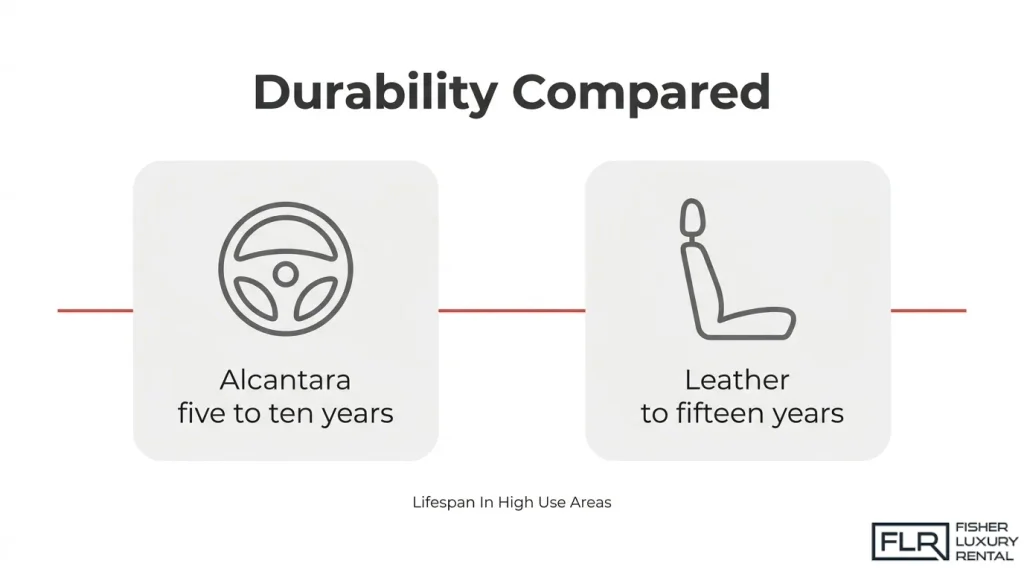
Alcantara lasts between 5 and 10 years in high-use automotive areas such as seats, steering wheels, and door panels, depending on maintenance frequency and use intensity. Its microfiber construction distributes friction across densely packed fibers, which helps resist pilling and surface breakdown under repeated contact. Steering wheels and seat bolsters see the heaviest wear, and Alcantara in those positions typically shows visible matting before other surfaces do. Regular brushing and prompt spot cleaning significantly extend its usable life in these zones.
How Long Does Leather Last in High-Use Areas?
Leather lasts 10 to 15 years in high-use automotive areas when properly conditioned and maintained. Full-grain and top-grain hides perform longest because the natural grain layer remains intact, providing a denser, more abrasion-resistant surface. Bonded and corrected-grain leathers, which use a polyurethane coating over reconstituted fiber, wear through faster under the same conditions. Consistent conditioning prevents the surface from drying out, which is the primary cause of premature degradation in automotive leather seats and armrests.
Which Material Resists Cracking and Peeling Better?
Alcantara resists cracking and peeling better than most leather alternatives because its microfiber structure does not dry out or become brittle the way hide-based materials can. Leather’s resistance to cracking depends heavily on the tanning process. According to the European Commission Joint Research Centre’s Reference Document on Best Available Techniques for the Tanning of Hides and Skins, tanning is the fundamental stage that converts raw hide into a stable material, giving leather its essential character and structural durability. Well-tanned full-grain leather rarely cracks with proper care, but bonded leather and coated splits are prone to surface delamination under UV exposure and temperature fluctuation.
How Does Each Material Wear Over Time?
Wear patterns differ significantly between Alcantara and leather depending on the contact zone. The sections below examine steering wheels, seats, bolsters, door panels, and armrests individually.
According to a study by the Universitat Politècnica de Catalunya, abrasion resistance tests are used to quantify the durability of car seat upholstery in normal usage across a vehicle’s average 12-year lifetime.
How Does Alcantara Wear on Steering Wheels?
Alcantara wears on steering wheels through fiber compression and surface glazing caused by constant palm friction. The microfiber structure flattens at the 9 and 3 o’clock grip positions faster than anywhere else on the wheel. Oils from skin accelerate this process, causing the nap to mat down and develop a shiny, slick patch over time. Regular brushing with a soft-bristle brush can slow fiber compression, but high-contact areas will still show visible wear within two to three years of daily use.
How Does Alcantara Wear on Seats and Bolsters?
Alcantara wears on seats and bolsters primarily through repetitive ingress and egress friction concentrated on the outer bolsters and the seat-cushion center. Bolster edges are especially vulnerable because lateral body contact creates consistent directional abrasion. The microfiber pile gradually thins and pills at these edges while the center cushion develops a compressed, low-nap texture. For drivers with aggressive lateral driving habits, bolster degradation is typically the first visible sign of seat wear.
How Does Leather Wear on Steering Wheels?
Leather wears on steering wheels through surface finish erosion at grip points, eventually exposing the softer substrate beneath the top coat. Car manufacturers have set demanding performance profiles for automotive leather addressing wear, emissions, and sustainable manufacture to meet consumer expectations of durability, according to a study published via the Sächsische Landesbibliothek Dresden. In practice, steering wheel leather develops a darkened, tacky surface at the primary grip zones before the finish cracks. Full-grain leather resists this longer than corrected-grain alternatives because the intact grain layer retains its natural strength.
How Does Leather Wear on Seats and Bolsters?
Leather wears on seats and bolsters through finish cracking, dye fading, and eventual substrate splitting at high-flex zones. The outer bolsters experience the most concentrated stress because they flex repeatedly during entry and exit cycles. Seat-cushion centers lose their surface finish first, transitioning from a uniform sheen to a matte, scuffed texture. In hot climates, UV exposure compounds this by drying the leather and accelerating crack formation along natural grain lines and seams.
How Does Leather Wear on Door Panels and Armrests?
Leather wears on door panels and armrests through abrasion from sleeve and elbow contact, with the armrest surface typically showing wear before the surrounding panel. Elbow contact creates concentrated pressure that erodes the finish coat in a small elliptical zone. Door pull handles see similar localized wear from fingertip grip. Because door panels flex less than seats, the leather here rarely cracks structurally; instead, it develops a worn, dull patch surrounded by intact original finish, making cosmetic inconsistency the primary concern.
How Do Heat and Climate Affect Alcantara vs. Leather?
Heat and climate affect Alcantara and leather in distinct ways. The sections below cover how each material handles extreme heat and how humidity exposure influences long-term performance.
How Does Alcantara Hold Up in Extreme Heat?
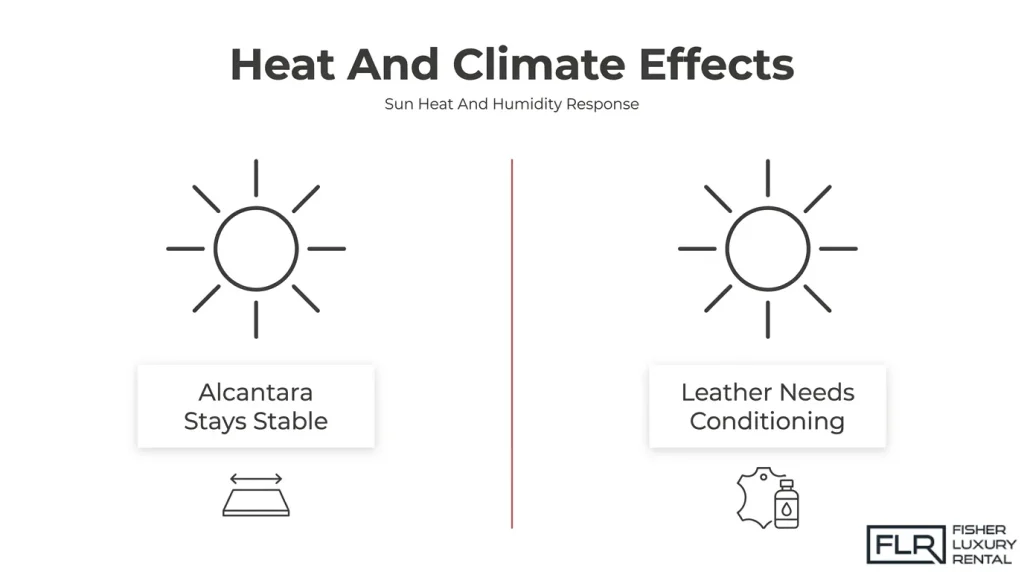
Alcantara holds up well in extreme heat due to its synthetic polyester-polyurethane construction, which resists the thermal expansion and contraction cycles that degrade natural materials. Unlike leather, Alcantara does not dry out or crack when cabin temperatures spike in direct sun. Its microfiber structure also stays dimensionally stable, making it a practical choice for hot climates. Because it does not retain surface heat as aggressively as dark leather, it remains more comfortable to the touch after prolonged sun exposure.
How Does Leather Hold Up in Extreme Heat?
Leather holds up in extreme heat only when properly conditioned and protected. Without regular conditioning, sustained heat accelerates moisture loss in the hide, leading to surface cracking and stiffness over time. Automotive leather is tested under demanding thermal profiles: one peer-reviewed study archived by PubMed Central used a black panel temperature of 60°C over 14-day cycles to simulate real-world heat stress. Top-grain and full-grain leathers perform better under these conditions than bonded or corrected-grain alternatives, but all leather grades require more active heat-protection maintenance than Alcantara.
Which Material Performs Better in Humid Conditions?
Alcantara performs better than leather in humid conditions for moisture resistance, but leather holds an advantage in mold prevention when properly finished. According to the Smithsonian Museum Conservation Institute, organic residues and soiling on textiles promote mildew growth at lower relative humidities, and certain finishes on leather can similarly encourage mold. Alcantara’s synthetic fibers absorb minimal moisture, reducing the risk of mold colonization. Leather, if left dirty or improperly sealed, creates a surface environment more hospitable to mildew, particularly in warm, humid storage conditions.
How Do You Clean and Maintain Alcantara?
Cleaning and maintaining Alcantara requires a different approach than leather. The sections below cover routine care, stain removal, and the products to avoid.
What Is the Routine Cleaning Process for Alcantara?
The routine cleaning process for Alcantara involves dry brushing loose debris with a soft-bristle brush, then wiping the surface with a slightly damp microfiber cloth using light circular motions. Allow the material to air dry completely before use. Brushing the nap back into alignment after drying preserves the material’s characteristic texture. Regular brushing between deeper cleans prevents debris from compressing the fibers over time, which is the primary cause of premature matting in high-contact areas like seats and bolsters.
How Do You Remove Stains from Alcantara?
You remove stains from Alcantara by blotting (never rubbing) the affected area immediately with a clean, dry cloth to absorb as much of the spill as possible. According to the University of Georgia Extension, water-borne stains wash out easily, while oil and grease stains require pre-treatment before cleaning. For water-based stains, a diluted mild soap solution applied with a microfiber cloth works effectively. For oil-based stains, a small amount of isopropyl alcohol dabbed onto the stain before blotting produces better results. Always work from the outer edge inward to prevent spreading.
Which Products Should You Avoid on Alcantara?
The products to avoid on Alcantara are solvent-based cleaners, silicone sprays, leather conditioners, bleach, and any product designed for smooth fabric or vinyl. These products can dissolve the synthetic microfiber structure, cause discoloration, or leave a residue that permanently flattens the nap. Alcantara is a polyester-based microfiber material, so products formulated for natural fibers or smooth surfaces are chemically incompatible with it. Using the wrong product is the most common and most preventable cause of irreversible Alcantara damage in automotive interiors.
How Do You Clean and Maintain Leather?
Cleaning and maintaining leather requires consistent conditioning, gentle products, and prompt stain response. The subsections below cover routine cleaning steps, conditioning schedules, and the common mistakes that accelerate leather’s deterioration.
What Is the Best Way to Clean Leather Car Seats?
The best way to clean leather car seats is to use a pH-balanced leather cleaner applied with a soft microfiber cloth, working in small circular sections. Begin by vacuuming loose debris from seams and crevices, then apply the cleaner sparingly to avoid saturating the hide. According to the CDC, cleaning removes foreign material such as soil and organic residue, typically through water-based solutions with appropriate detergents. Avoid household cleaners like dish soap or alcohol-based sprays, as these strip the leather’s natural oils and accelerate surface cracking over time.
How Often Should You Condition Leather Seats?
Leather seats should be conditioned every three to four months under normal use, or more frequently in hot, dry climates where moisture loss is accelerated. A quality leather conditioner replenishes the oils that tanning removes during processing, keeping the hide supple and resistant to cracking. Skipping conditioning is the single most common maintenance mistake owners make, and it tends to show up visibly within a year in high-UV environments like Phoenix or Scottsdale.
What Products Should You Avoid on Leather Interiors?
The products to avoid on leather interiors include bleach-based cleaners, ammonia solutions, baby wipes, and any solvent-based stain removers. These products degrade the surface coating, discolor the grain, and dry out the underlying hide. Additionally, silicone-based protectants create a glossy residue that attracts dust and can cause the leather to feel sticky in warm temperatures. Using the wrong product once does not always produce immediate damage, but repeated misuse compounds deterioration quickly.
How Do You Remove Stains from Leather Without Damage?
The way to remove stains from leather without damage depends on the stain type: water-based stains, oil-based stains, and dye transfers each require different treatments. According to University of Georgia Extension guidance, water-borne stains wash out relatively easily, while oil and grease stains require a pre-treatment step before cleaning. For oil stains on leather, apply an absorbent powder such as cornstarch, allow it to draw out the grease for several hours, then clean with a leather-specific solution. Acting within the first few minutes of a spill dramatically reduces the risk of permanent staining.
Which Material Is More Resistant to Stains and Spills?
Leather is more resistant to stains and spills than Alcantara in most automotive applications. The sections below compare how each material responds to liquids, oils, and everyday contaminants.
How Does Leather Handle Spills and Stains?
Leather handles spills and stains well because its surface is non-porous, allowing liquids to bead and sit on top rather than absorb immediately. Water-based spills can typically be wiped clean with a dry cloth before penetration occurs. Oil and grease present a greater challenge: according to the University of Georgia Extension, water-borne stains wash out easily, but oil and grease stains require pre-treatment before cleaning. Protected and top-coat leathers perform best, while untreated full-grain hides absorb oils more readily. For rental interiors, properly finished leather is a practical choice when liquid exposure is likely.
How Does Alcantara Handle Spills and Stains?
Alcantara handles spills and stains less favorably than leather because its microfiber structure absorbs liquids quickly. Water-based spills penetrate the pile before they can be blotted, making fast action essential. Oil-based stains are particularly stubborn, as the fine fibers trap residue deep within the material. Dried stains often require specialized cleaning agents and careful brushwork to avoid matting the surface. While Alcantara resists light dust well, its vulnerability to liquids makes it a higher-maintenance option in high-traffic or food-and-drink-present environments.
Which Material Is Easier to Clean After a Spill?
Leather is easier to clean after a spill than Alcantara. Most liquid spills on protected leather require only a damp cloth and mild soap. Alcantara demands a more deliberate process: blotting without rubbing, using approved foam cleaners, and allowing full dry time to restore the nap. Rushing the process risks permanent matting or discoloration. For practical daily use, leather’s wipe-clean surface significantly reduces cleaning effort and time compared to the careful protocol Alcantara requires.
How Do Alcantara and Leather Compare in Comfort and Grip?
Alcantara and leather compare in comfort and grip across several key dimensions, including tactile feel, temperature response, friction, and long-term hand fatigue. The sections below examine how each material performs for drivers and passengers in real-world contact conditions.
How Does Alcantara Feel to the Touch Compared to Leather?
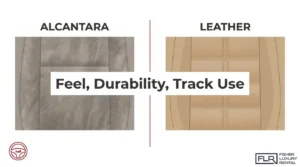
Alcantara feels noticeably softer and more velvety than leather, with a suede-like nap that provides immediate tactile warmth. Leather, by contrast, offers a smooth, firm surface that many drivers associate with a more formal, traditional luxury aesthetic. North Carolina State University’s Wilson College of Textiles notes that hand panel testing, where subjects touch, rub, and squeeze material swatches, consistently reveals meaningful subjective differences in perceived softness and texture between woven and non-woven surfaces. In practice, Alcantara tends to feel more inviting on initial contact, while premium leather develops a more personalized feel as it breaks in over time.
Which Material Offers Better Grip on a Steering Wheel?
Alcantara offers better grip on a steering wheel than leather under most driving conditions, particularly during spirited or performance-oriented driving. Its fibrous texture creates higher friction against bare skin and driving gloves, reducing slip during rapid inputs. Leather steering wheels, while tactilely satisfying, become noticeably slicker when hands perspire, requiring more conscious grip pressure. This is why manufacturers such as Ferrari, Lamborghini, and Porsche frequently pair Alcantara steering wheels with track-focused trims.
Which Material Is More Comfortable for Long Drives?
Alcantara is generally more comfortable for long drives in warm climates because it does not absorb and radiate heat the way leather does. Leather seats can become uncomfortably hot when exposed to direct sunlight before entry, creating an immediate discomfort that Alcantara largely avoids. However, perforated leather with ventilated seating systems can close this gap significantly. For cooler climates, leather retains a comfortable neutral temperature and feels more substantial underweight over extended periods, making material preference here genuinely climate-dependent.
How Does UV Exposure Affect Alcantara vs. Leather?
UV exposure affects Alcantara and leather differently, with each material showing distinct degradation patterns under prolonged sunlight. The sections below cover how UV radiation damages each material and which holds up better over time.
How Does UV Exposure Affect Alcantara?
UV exposure affects Alcantara primarily through color fading and fiber surface degradation. The synthetic microfiber structure absorbs ultraviolet radiation, which breaks down dye bonds over time, causing gradual lightening, especially in darker colorways on seats and headliners exposed to direct sunlight. Because Alcantara lacks the natural oils found in animal hide, it does not crack or dry out under heat and UV stress the way leather does. However, prolonged UV exposure without protection can cause the material to look worn and matted in sun-facing surfaces. Applying a UV-blocking window tint or parking in shade are the most practical ways to slow this process.
How Does UV Exposure Affect Leather?
UV exposure affects leather by accelerating drying, cracking, and color loss through photodegradation of the hide’s collagen structure. Natural oils in leather evaporate under heat and UV radiation, leaving the surface brittle. ISO 4892-3:2024, published by the International Organization for Standardization, specifies fluorescent UV lamp methods specifically designed to simulate these real-world weathering effects on materials exposed to global solar radiation. Unprotected leather in high-sun environments, such as Phoenix, AZ, can show cracking and fading within a few seasons. Regular conditioning with UV-inhibiting leather cream significantly extends surface life by replenishing lost moisture and blocking further photodegradation.
Which Material Handles UV Better Overall?
Alcantara handles UV exposure better than leather in terms of structural integrity under sunlight. Leather is more vulnerable because photodegradation depletes its natural oils, leading to cracking that is difficult to reverse without professional restoration. Alcantara fades but does not crack, making UV damage more cosmetic than structural. For luxury vehicles in high-sun markets, this distinction is practically significant: Alcantara interiors retain their tactile performance longer without conditioning, while leather requires consistent maintenance to offset solar stress. Both materials benefit from window tinting and interior UV protectants, but leather demands more proactive care to avoid irreversible surface damage.
Which Material Holds Its Value Better in Luxury Cars?
Leather generally holds its value better than Alcantara in luxury cars, largely because buyers associate it with prestige, durability, and timeless appeal. Interior condition directly influences resale outcomes, making material choice a meaningful financial consideration alongside mechanical upkeep.
According to a Vehicle Residual Value Analysis by Argonne National Laboratory, luxury segment vehicles retain between 14.3% and 17.4% of their value depending on powertrain type and market conditions, illustrating how narrowly competitive residual values are at the premium end of the market. In that environment, interior wear visible on Alcantara surfaces, such as seat bolster pilling or steering wheel thinning, can accelerate depreciation more visibly than comparable wear on leather. Leather’s surface, when properly conditioned, ages in a way many buyers read as character rather than damage.
Alcantara commands a premium in performance and sports-focused vehicles, where buyers actively seek its tactile grip and racing associations. In those niches, factory Alcantara interiors may preserve or even boost perceived value. Outside that segment, however, leather remains the safer bet for resale across the broader luxury market. Keeping either material in excellent condition through consistent maintenance is, in practice, the single most reliable way to protect interior-driven resale value.
What Do Alcantara and Leather Cost to Repair or Replace?
Repair and replacement costs for Alcantara and leather differ significantly based on material complexity, damage type, and the specific component involved. The sections below cover typical Alcantara repair costs, leather repair costs, and guidance on when replacement is the smarter choice.
How Much Does It Cost to Repair Alcantara?
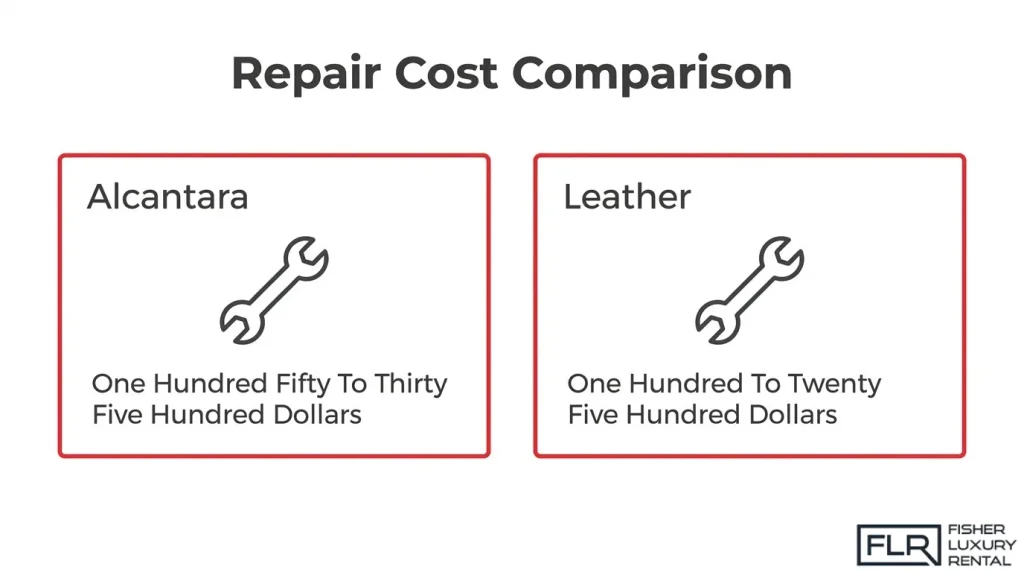
Alcantara repair costs depend on damage severity and panel size. Small tears or worn patches on steering wheels typically run $150 to $400 at a specialty auto upholstery shop. Seat bolster repairs range from $300 to $800 per panel, while full seat reupholstery in Alcantara can reach $1,500 to $3,500 per seat on exotic vehicles.
Because Alcantara is a proprietary microfiber suede, sourcing matched material is harder than sourcing standard leather. DIY repair kits exist but rarely achieve a seamless finish on high-visibility surfaces. For rental fleets or owner vehicles where appearance matters, professional repair is almost always worth the premium over a visible patch job.
How Much Does It Cost to Repair Leather?
Leather repair costs range from $100 to $400 for minor cracks, scuffs, or small tears using professional color-matched compound kits. Seat bolster repairs typically cost $200 to $600 per panel. Full-seat leather reupholstery on a luxury or exotic car ranges from $800 to $2,500 per seat, depending on hide grade and stitching complexity.
Leather benefits from a wider pool of repair technicians and readily available color-matching compounds. According to the Smithsonian Museum Conservation Institute, soiling and organic residues on leather finishes can promote mildew growth, meaning water-damaged leather should be professionally cleaned and sealed promptly to prevent deterioration that escalates repair costs.
When Should You Replace Instead of Repair Each Material?
Replacement becomes the practical choice when structural integrity is compromised or repair costs approach 60 to 70 percent of replacement cost. The key replacement triggers for each material are:
- Alcantara: Replace when delamination covers more than 30% of a panel, when UV-induced fading is uneven across multiple components, or when repeated repairs have created visible texture mismatches.
- Leather: Replace when cracking has penetrated to the foam substrate, when peeling affects the entire seat face, or when color restoration can no longer mask cumulative wear.
Material degradation from prolonged UV and weathering exposure accelerates these timelines. ISO 4892-3:2024 specifies standardized UV and heat cycling test methods that automotive manufacturers use to predict material lifespan under real-world solar exposure, which directly informs replacement intervals on vehicles used in high-sun climates like Phoenix.
Which Luxury and Exotic Cars Feature Alcantara or Leather?
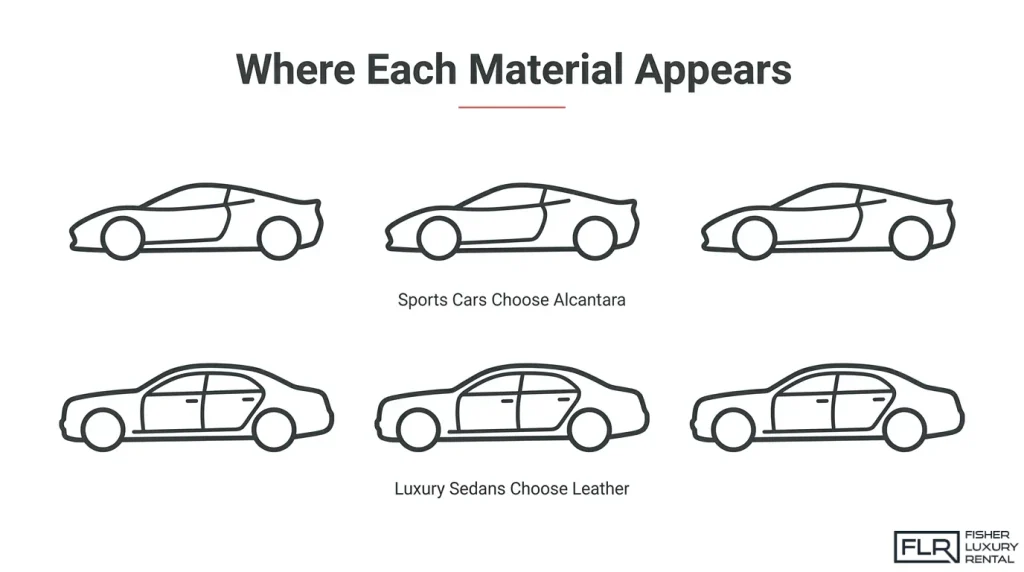
Luxury and exotic cars feature Alcantara or leather across a wide range of models, from performance-focused sports cars to ultra-premium grand tourers. The sections below cover which brands favor each material and where they appear throughout the cabin.
Which Exotic and Sports Cars Use Alcantara?
Exotic and sports cars that commonly use Alcantara include Ferrari, Lamborghini, Porsche, and McLaren, typically on steering wheels, headliners, A-pillars, and seat center panels. Alcantara’s suede-like texture provides tactile grip in performance driving positions where leather would feel slippery under high-speed inputs. Manufacturers like Ferrari and McLaren often use Alcantara in combination with carbon fiber trim to reinforce the race-derived cabin aesthetic. Porsche’s GT-spec models, including the GT3 and GT4, frequently spec Alcantara headliners and sport seat inserts from the factory.
Which Luxury Cars Use Full-Grain Leather Interiors?
Luxury cars that commonly use full-grain leather interiors include Rolls-Royce, Bentley, Mercedes-Benz S-Class, BMW 7 Series, and Lexus LS. According to the Leather Research Laboratory at the University of Cincinnati, full-grain leather is defined as “the grain split of a hide from which nothing has been removed except the hair and associated epidermis,” making it the highest-quality and most durable leather grade available. Brands like Bentley and Rolls-Royce use hand-stitched full-grain hides across virtually every interior surface, setting the benchmark for leather craftsmanship in production vehicles.
Do Luxury Brands Combine Alcantara and Leather?
Yes, luxury brands frequently combine Alcantara and leather in the same interior, using each material where it performs best. Leather typically covers the seat base, door panels, dashboard, and armrests, where abrasion resistance and easy cleaning matter most. Alcantara is reserved for the upper seat bolsters, headliner, steering wheel, and shift boot, where grip and texture create a premium tactile contrast. This dual-material approach is especially common in performance-luxury crossovers from Porsche, Audi, and BMW’s M-division models.
With an understanding of which vehicles feature these materials, the next step is knowing how to evaluate them before getting behind the wheel.
How Should You Evaluate Interior Materials in a Luxury Rental?
Evaluating interior materials in a luxury rental means inspecting wear zones, surface condition, and material type before you drive. The sections below cover how renting exotic cars lets you compare both materials firsthand, and the key durability takeaways to guide your decision.
Can Renting Exotic Cars Help You Experience Both Materials?
Yes, renting exotic cars can help you experience both Alcantara and leather in real driving conditions. A short-term rental gives you direct, tactile exposure to how each surface feels on steering wheels, bolsters, and seat backs under actual use. Abrasion resistance testing by MDPI Polymers found that quality automotive interior materials showed no surface damage after 20,000 wear cycles, but lab results only tell part of the story. Time behind the wheel reveals how Alcantara grips during spirited driving and how leather responds to heat and body pressure in ways no specification sheet captures. Fisher Luxury Rental’s fleet includes top-trim exotic and luxury vehicles across Phoenix, Scottsdale, Portland, and Vancouver, making a rental one of the most practical ways to compare both materials side by side before committing to a purchase or long-term ownership decision.
What Are the Key Takeaways About Alcantara vs. Leather Durability?
The key takeaways about Alcantara vs. leather durability are that each material excels in different conditions and fails under different stressors. According to SAE International research, seat covering is the number one failure point in seat ingress and egress durability testing, with evaluations running approximately 100 hours per seat module. This makes seat surface choice one of the most consequential interior decisions in any vehicle.
The practical conclusions from this guide are:
- Alcantara resists cracking and performs well in high-grip applications such as steering wheels and sport bolsters, but requires careful moisture and stain management.
- Leather offers superior longevity with proper conditioning, handles heat better in dry climates, and resists liquid penetration more effectively than untreated Alcantara.
- High-use zones such as seat edges, bolsters, and steering wheels degrade fastest regardless of material.
- Maintenance frequency is the single biggest variable in how long either material lasts.
- Renting before buying remains the most reliable way to evaluate how each material performs for your specific driving habits.
Both materials are credible in a luxury context; the better choice depends on climate, use intensity, and willingness to maintain the surface correctly.