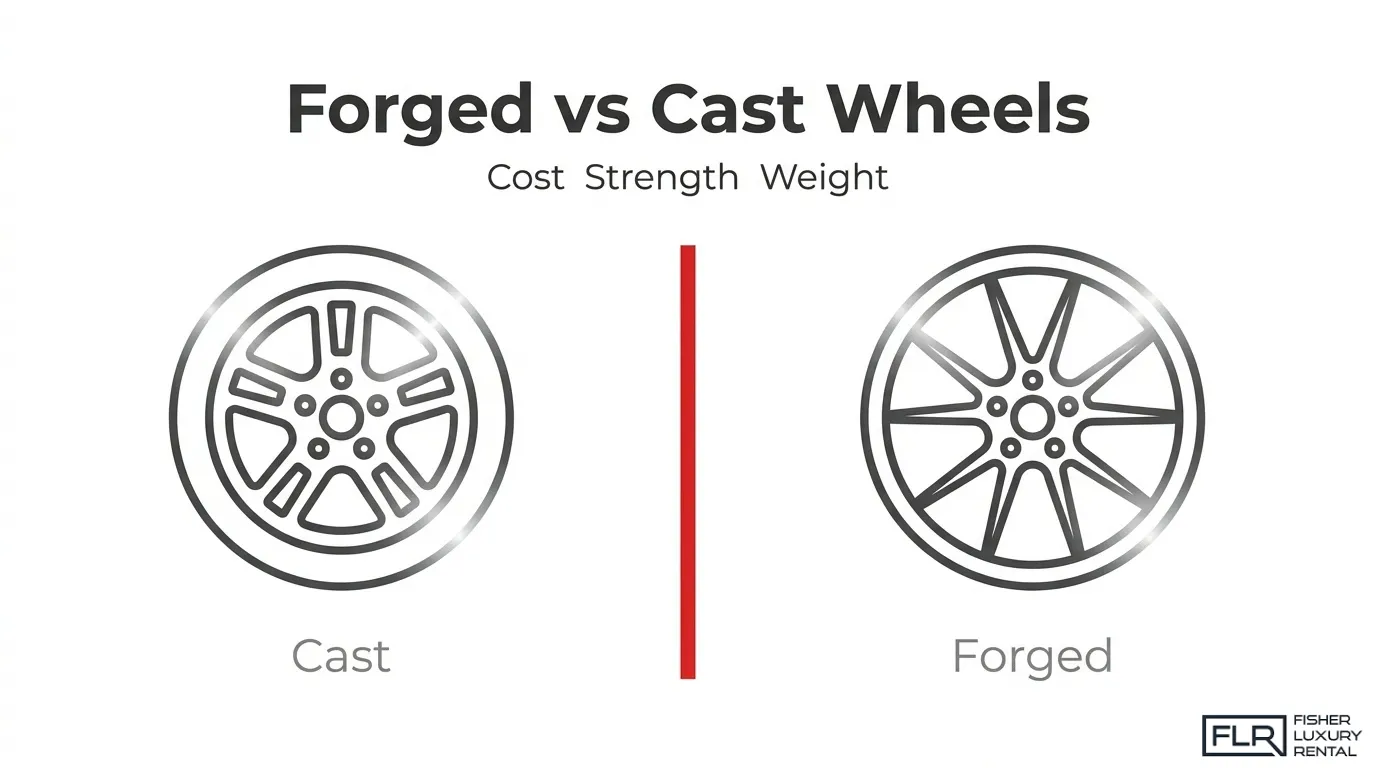
Forged and cast wheels are two distinct aluminum wheel construction methods that differ fundamentally in how the metal is shaped: casting pours molten alloy into a mold, while forging compresses heated solid metal under hydraulic pressure to refine grain structure and improve strength.
This guide covers manufacturing processes, material strength, pricing across both categories, performance and durability differences, and how wheel type affects luxury and exotic vehicles.
Cast wheels are produced through three methods (gravity casting, low-pressure die casting, and counter-pressure casting), each balancing cost against material density. Forged wheels follow their own production path through closed-die pressing, flow forming, and CNC machining, with that added complexity driving costs from $300 per wheel at the entry level to over $3,000 per wheel for three-piece custom builds.
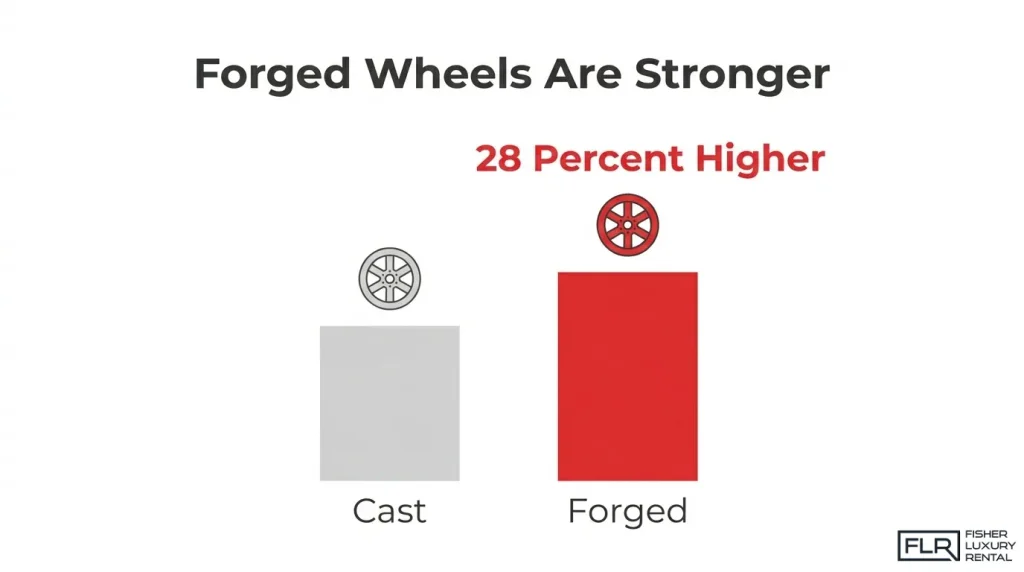
Strength and durability separate the two types in measurable ways. Forged wheels carry a 28 percent higher fatigue endurance limit than cast wheels, bend rather than crack under extreme impact, and deliver a consistent weight reduction that directly reduces rotational inertia.
On the performance side, lighter forged wheels improve acceleration, braking, and suspension response, while cast wheels remain a practical and widely accepted choice for daily driving and street-focused luxury vehicles. Flow-formed wheels occupy a genuine middle ground, offering barrel compression and weight savings at a lower price than full forged construction.
For exotic and luxury vehicles, the wheel choice often comes down to the vehicle’s performance tier and how aggressively it is driven. Supercars and performance-spec sedans specify forged wheels for engineering reasons; grand tourers and large luxury SUVs frequently use well-engineered cast alternatives without meaningful compromise.
How Are Cast Wheels Manufactured?
Cast wheels are manufactured by pouring molten aluminum alloy into a mold, allowing it to cool and solidify into the finished wheel shape. The three primary casting methods are gravity casting, low-pressure die casting, and counter-pressure casting, each offering different trade-offs in production cost, cycle time, and material density.
What Is Gravity Die Casting for Wheels?
Gravity die casting is a process where liquid metal flows through the mold cavity by gravity flow, as documented by the New Jersey Institute of Technology’s ME-215 Engineering Materials and Processes course. No external pressure forces the metal into the mold, which keeps tooling costs low and makes this method well-suited for high-volume, budget-oriented wheel production. The trade-off is that gravity-filled molds are more prone to porosity and inconsistent density compared to pressure-assisted methods, which can limit structural performance at the rim’s thinner sections.
What Is Low-Pressure Die Casting for Wheels?
Low-pressure die casting is a process where pressurized gas pushes molten aluminum upward into a sealed mold from below. This controlled fill reduces air entrapment and produces a denser, more uniform grain structure than gravity casting. It is the dominant method for OEM cast wheels, including the single-piece cast aluminum design used on the Chevrolet Silverado, according to a U.S. EPA mass reduction analysis covering light-duty pickup trucks for model years 2020 to 2025.
What Is Counter-Pressure Casting for Wheels?
Counter-pressure casting is an emerging wheel manufacturing method that applies back pressure to both the mold and the metal supply simultaneously, improving aluminum density and reducing internal defects. According to a study published in the Journal of Materials Research and Technology, counter-pressure casting offers superior capabilities over low-pressure die casting in aluminum parts production, though chamber back pressure introduces a 12-second delay in fill time relative to low back-pressure conditions. This added process complexity raises per-unit cost but yields material properties closer to forged wheels than standard casting methods achieve.
How Are Forged Wheels Manufactured?
Forged wheels are manufactured through a process of applying extreme pressure to heated solid aluminum billets, compressing and reshaping the metal without melting it. This section covers the three main production methods: closed-die forging, flow forming, and CNC machining.
What Is the Closed-Die Forging Process?
The closed-die forging process works by pressing a heated aluminum billet between two precisely shaped dies under thousands of tons of hydraulic pressure. According to the University of Florida’s Department of Mechanical and Aerospace Engineering, forging is the repeated deformation of heated solid metal to refine the grain structure and improve part strength without adversely affecting ductility. This controlled deformation aligns the metal’s grain flow along the wheel’s stress lines, producing a denser, more uniform internal structure than casting achieves. The result is a wheel blank with exceptional structural integrity before any machining begins.
How Does Flow Forming Refine the Wheel Barrel?
Flow forming refines the wheel barrel by spinning the forged blank against a mandrel while rollers apply pressure to stretch and thin the barrel to its final dimensions. This process increases material density in the barrel walls while reducing overall weight. According to research from the University of Strathclyde, high-duty CNC flow forming is now delivering weight and cost savings for small to medium batch sizes while simultaneously improving material properties across aerospace and automotive applications. Flow forming is particularly effective at optimizing the strength-to-weight ratio of the barrel section.
How Does CNC Machining Complete a Forged Wheel?
CNC machining completes a forged wheel by removing excess material from the rough forged blank to create the final spoke geometry, face design, and precise fitment dimensions. Multi-axis CNC machines cut the spokes, drill bolt patterns, and finish the lip to tight tolerances measured in thousandths of an inch. This stage is where forged wheels gain their visual distinction and exact fitment specifications. According to ASM International’s “Aluminum Forging,” the forging process allows for control of microstructure and directional properties, and the resulting fatigue and fracture resistance are superior to shape castings. CNC finishing preserves those metallurgical advantages while achieving the refined aesthetics expected on luxury and performance vehicles.
What Makes Forged Wheels Stronger Than Cast Wheels?
Forged wheels are stronger than cast wheels because the forging process compresses heated solid metal under high pressure, refining the grain structure and producing superior fatigue and fracture resistance. The key strength advantages come down to metallurgical density, impact behavior, and fatigue endurance.
According to an engineering comparison published via OhioLINK, the fatigue endurance limit loading of forgings is 28 percent higher than that of castings. This gap is significant in high-stress applications like performance driving, where wheels endure repeated cyclical loading.
Cast wheels have a greater tendency to crack during heavy impact at high speeds, while forged wheels are more prone to bending rather than fracturing outright. Bending is a safer failure mode because it preserves more structural integrity and is easier to detect before a catastrophic failure occurs.
This strength advantage is why performance-oriented OEM packages specify forged wheels. The Chevrolet Corvette Z51 Performance Package, as documented in a National Highway Traffic Safety Administration service bulletin, includes forged aluminum 19-inch front and 20-inch rear wheels as part of its high-speed stability system.
For drivers who push their vehicles hard, the 28 percent fatigue endurance advantage forged wheels carry over cast is not a marginal improvement; it represents a meaningful safety and longevity benefit that justifies the cost premium in performance contexts.
How Much Do Cast Wheels Cost?
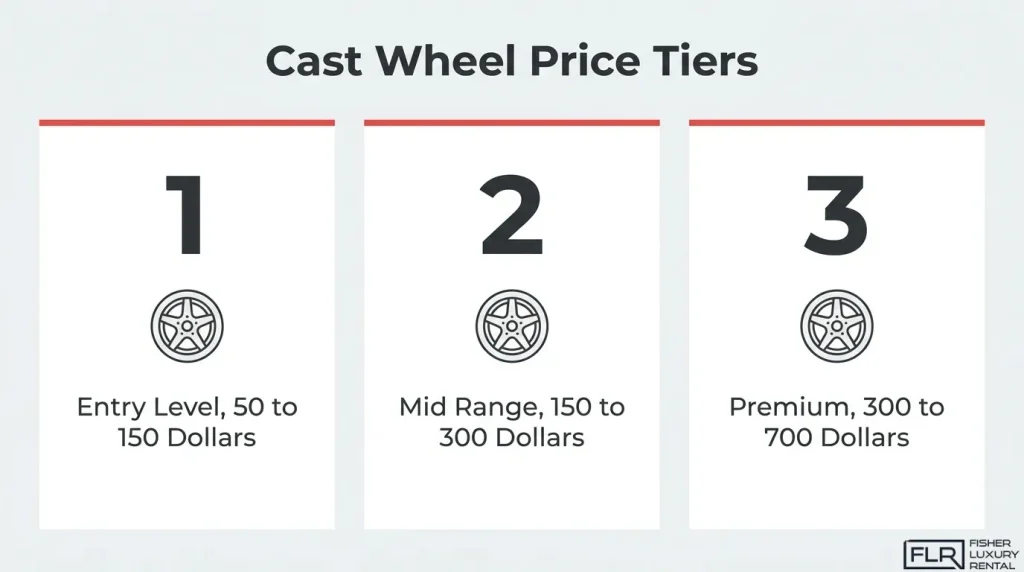
Cast wheel prices vary by manufacturing method, ranging from budget-friendly gravity-cast options to premium low-pressure cast designs. The three tiers covered below are entry-level cast aluminum, mid-range gravity-cast, and premium low-pressure cast wheels.
How Much Do Entry-Level Cast Aluminum Wheels Cost?
Entry-level cast aluminum wheels cost between $50 and $150 per wheel, making them the most affordable aluminum wheel option available. These are produced using basic casting processes where molten aluminum flows into a mold and cools without applied pressure, resulting in a denser, heavier wheel with more internal porosity than pressure-cast alternatives.
OEM fitments illustrate the tier well. According to the U.S. Environmental Protection Agency’s mass reduction analysis, the Chevrolet Silverado uses an 18-inch single-piece cast aluminum wheel as standard equipment, representing exactly the type of cost-optimized cast design found at this price point.
These wheels suit daily commuters and standard passenger vehicles where budget, not performance, drives the purchase.
How Much Do Mid-Range Gravity-Cast Wheels Cost?
Mid-range gravity-cast wheels cost between $150 and $300 per wheel. Gravity casting, also called gravity die casting, fills the mold cavity through gravity flow rather than applied pressure, producing a more consistent grain structure than basic sand casting while keeping tooling costs moderate.
At this tier, buyers get improved surface finish, better dimensional accuracy, and wider style selection compared to entry-level options. These wheels are common on mainstream sedans, crossovers, and light trucks seeking a balance between appearance and affordability.
How Much Do Premium Low-Pressure Cast Wheels Cost?
Premium low-pressure cast wheels cost between $300 and $700 per wheel. Low-pressure die casting (LPDC) forces molten aluminum into the mold under controlled pressure, reducing porosity and improving mechanical properties relative to gravity-cast methods.
Counter pressure casting (CPC) represents the next step up from LPDC. A study published in the Journal of Materials Research and Technology found that CPC produces superior aluminum part quality compared to LPDC, though the addition of chamber back pressure adds approximately 12 seconds to filling time per cycle, increasing production cost.
For performance-oriented street cars and luxury vehicles, low-pressure cast wheels offer the best value within the cast category before stepping up to forged construction.
How Much Do Forged Wheels Cost?
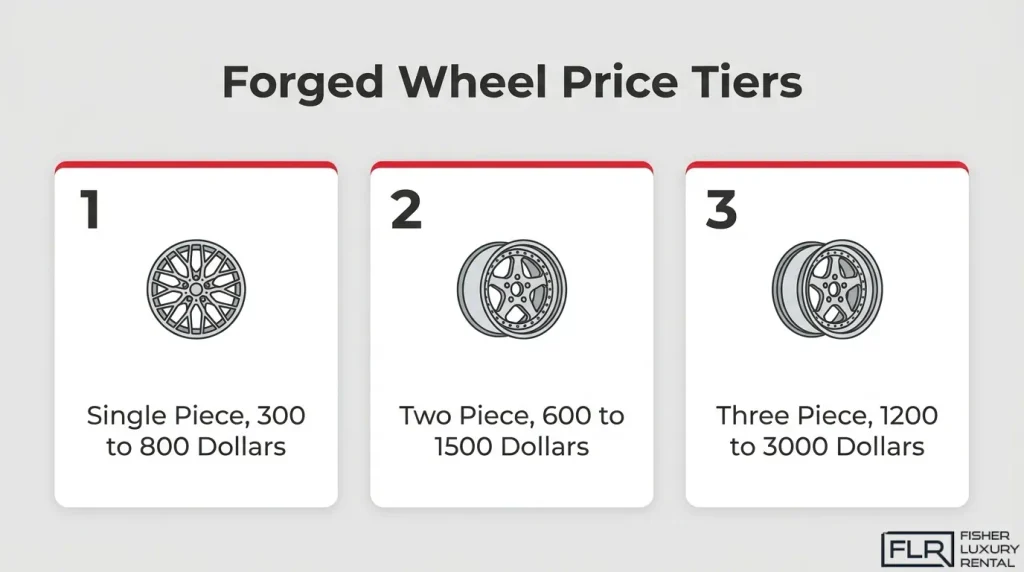
Forged wheel costs vary significantly by construction type: single-piece forged wheels are the most affordable forged option, two-piece forged wheels occupy the mid-to-upper range, and three-piece forged wheels represent the highest tier of custom pricing.
How Much Do Single-Piece Forged Wheels Cost?
Single-piece forged wheels cost between $300 and $800 per wheel at the entry level, with premium monoblock designs from brands such as HRE, Vossen, and BBS ranging from $800 to $1,500 per wheel. A full set of four typically runs $1,200 to $6,000 depending on size, finish, and brand. Single-piece construction compresses the entire forged billet into one unit, keeping manufacturing steps lower than multi-piece alternatives while still delivering the grain-aligned strength that forging produces. For buyers seeking forged performance without full custom pricing, single-piece wheels offer the most accessible entry point into the forged category.
How Much Do Two-Piece Forged Wheels Cost?
Two-piece forged wheels cost between $600 and $1,500 per wheel, placing a set of four between $2,400 and $6,000 at typical market pricing, with luxury fitments reaching higher. Two-piece construction bonds a forged aluminum center to a separate rim barrel, allowing diameter and width combinations that a single forging cannot achieve. This modularity adds machining, hardware, and assembly costs over single-piece designs. Brands such as Rotiform, Avant Garde, and Work Wheels offer two-piece forged options in this tier. The added customization flexibility makes two-piece wheels a popular choice for sport sedans and modified luxury vehicles where fitment precision matters.
How Much Do Three-Piece Forged Wheels Cost?
Three-piece forged wheels cost between $1,200 and $3,000 or more per wheel, making full-set pricing of $5,000 to $12,000 or higher common for exotic and performance applications. Three-piece construction uses a forged center paired with separate inner and outer barrel sections bolted together with hardware, enabling near-unlimited sizing and offset configurations. This level of assembly complexity, combined with custom machined components and bespoke finishing options, drives costs substantially above single-piece and two-piece alternatives. Brands such as HRE, ADV.1, and Brixton Forged specialize in this tier. Three-piece forged wheels are the standard choice on six-figure supercars and highly customized exotic builds where both appearance and engineering precision are uncompromised.
Why Are Forged Wheels So Much More Expensive?
Forged wheels cost more because their manufacturing process requires significantly greater material input, specialized equipment, and precision machining time compared to casting. The following headings break down the specific cost drivers: raw material demands, production complexity, and machining time.
Why Does the Raw Material Cost More for Forged Wheels?
Forged wheels require a dense, high-grade aluminum billet as the starting material, rather than the molten alloy poured into molds during casting. This solid billet must meet tighter metallurgical specifications to withstand compression forging. According to ASM International’s aluminum forging research, the forging process enables direct control of microstructure and directional grain properties, which demands premium-grade input material from the outset. That specification premium alone adds meaningful cost before a single press stroke is made.
Why Does the Forging Process Itself Cost More to Run?
The forging process costs more to run because it requires industrial hydraulic presses operating under extreme force, purpose-built dies, and controlled heating stages that casting lines do not need. Each of these elements represents a significant capital investment. Die tooling for forging is also wheel-specific, meaning a manufacturer cannot easily repurpose equipment across different designs the way casting molds can be adapted. These fixed overhead costs are distributed across relatively small production volumes, which keeps per-unit costs high.
Why Does CNC Machining Add So Much to the Final Price?
CNC machining adds substantially to forged wheel pricing because a forged billet starts as a rough cylindrical shape and must be precision-milled into its final spoke geometry, face design, and barrel profile. This process can require hours of machine time per wheel. High-duty CNC equipment capable of achieving the required tolerances carries high operating costs. University of Strathclyde research on flow-forming notes that advanced CNC machinery delivers superior material properties but remains economically viable only for small-to-medium batch sizes, confirming why per-unit pricing stays elevated compared to mass-produced cast wheels.
How Do Forged and Cast Wheels Compare in Weight?
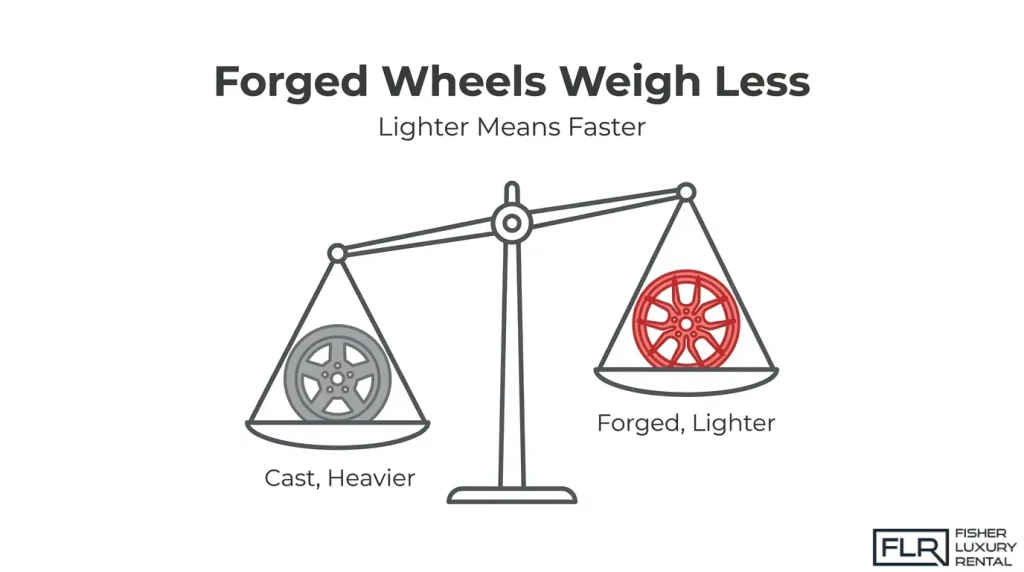
Forged and cast wheels compare in weight with forged wheels consistently coming out lighter, thanks to their denser, more efficiently structured aluminum grain. The sections below cover the weight advantage of forged wheels, how magnesium compares, and what unsprung weight means for real driving dynamics.
How Much Lighter Are Forged Wheels Than Cast Wheels?
Forged wheels are lighter than cast wheels because the forging process produces a denser grain structure, allowing engineers to remove material without sacrificing strength. Cast wheels require additional mass to compensate for porosity and inconsistencies introduced during solidification. According to a review published in Materials (MDPI) on magnesium wheel types, forged magnesium wheels are 25 percent lighter than their cast equivalents. That weight reduction translates directly into lower rotational mass, which is the figure that most affects how a wheel responds during acceleration and cornering.
What Is Unsprung Weight and Why Does It Matter?
Unsprung weight is the mass of vehicle components not supported by the suspension, including wheels, tires, and brake assemblies. Reducing unsprung weight improves suspension response because the wheel can follow road surfaces more quickly without the suspension having to manage excess inertia. Research published by SAE International found that reducing wheel and axle weight reduces the inertia the drivetrain must overcome during acceleration proportionately. Lighter wheels also reduce gyroscopic forces during direction changes, making steering feel more immediate and precise. For performance driving, unsprung weight reduction delivers gains that heavier cast wheels simply cannot replicate.
Do All Forged Wheels Outweigh Cast Wheels in Every Category?
No, not all forged wheels outweigh cast wheels in every category, as material choice and construction method both affect the final result. Aluminum forged wheels reliably save weight over cast aluminum, but the advantage varies by wheel size, spoke design, and finishing process. Flow-formed cast wheels narrow the gap considerably by spinning the barrel thinner after casting, recovering some of the weight penalty. The 25 percent weight advantage documented for forged magnesium represents a best-case scenario; aluminum comparisons typically show smaller but still meaningful differences. Wheel size also matters: a large-diameter forged wheel may weigh more in absolute terms than a small-diameter cast wheel, even if the forged option is lighter for its size class.
How Does Wheel Type Affect Vehicle Performance?
Wheel type affects vehicle performance through unsprung weight, rotational inertia, and structural rigidity. The sections below cover how forged wheels improve acceleration and braking, how cast wheels serve daily driving, and how wheel weight shapes track handling.
How Do Forged Wheels Improve Acceleration and Braking?
Forged wheels improve acceleration and braking primarily by reducing unsprung and rotational mass. Because forging compresses aluminum into a denser grain structure, manufacturers can remove material without sacrificing strength, producing a lighter wheel that spins up and slows down faster. Less rotational mass means the drivetrain spends less energy overcoming inertia with every acceleration event, and braking systems reach full clamping force with less wheel momentum to arrest. For performance-focused vehicles, this translates to measurably quicker throttle response and shorter stopping distances, making forged wheels the clear choice when every tenth of a second counts. Drivers who want to experience this difference firsthand can access top-trim performance vehicles through Fisher Luxury Rental, which serves the Phoenix and Portland areas with exotic and luxury models specified at full factory trim.
How Do Cast Wheels Perform for Daily Street Driving?
Cast wheels perform well for daily street driving, offering adequate strength, good cosmetic variety, and lower replacement cost. On normal roads, the weight penalty of casting is rarely felt at legal speeds, and the wider design library means drivers can match aesthetics to virtually any vehicle. Cast aluminum wheels resist minor curb impacts and typical road debris without catastrophic failure, and when damage does occur, the lower per-wheel cost makes replacement less painful. For commuters and weekend drivers who are not pushing a car to its dynamic limits, cast wheels deliver a sensible balance of appearance, durability, and value.
How Does Wheel Weight Affect Handling on the Track?
Wheel weight affects track handling by directly changing the rotational inertia a suspension and drivetrain must manage through every corner, braking zone, and acceleration point. According to SAE International’s study on decreasing unsprung weight through aluminum, the moment of inertia of an aluminum wheel measured 53 compared to 123 for a steel wheel, and the study confirmed that reducing wheel and axle weight lowers the inertia that must be overcome in accelerating proportionately. On a circuit, that difference compounds across hundreds of direction changes per lap: lighter wheels follow road surface variations more accurately, reduce gyroscopic resistance in fast transitions, and allow suspension geometry to work as intended. Choosing the lightest structurally sound wheel available is one of the highest-return modifications a track driver can make.
How Do Forged and Cast Wheels Compare in Durability?
Forged and cast wheels compare in durability across several key dimensions, including fatigue strength, impact behavior, and long-term structural integrity. The sections below break down how each wheel type performs under stress and repeated loading.
How Does Fatigue Strength Differ Between Forged and Cast Wheels?
Fatigue strength differs significantly between forged and cast wheels, with forged wheels holding a measurable engineering advantage. According to research published via OhioLINK, the fatigue endurance limit loading of forgings is 28 percent higher than that of castings. This gap exists because the forging process refines grain structure and aligns directional properties, producing a denser, more consistent material. For vehicles subjected to repeated high-stress driving, that 28 percent margin is practically meaningful, not just a spec-sheet advantage.
How Do Forged and Cast Wheels Handle Impact Differently?
Forged and cast wheels handle impact differently depending on the type of force applied. Cast wheels, particularly magnesium cast variants, have a greater tendency to crack during heavy impact at high speeds. Forged wheels, by contrast, are more prone to bending under the same conditions. A 2024 review in Materials (MDPI) on magnesium wheel types confirms this distinction. Bending is generally preferable to cracking because a bent wheel often remains structurally contained, while a cracked wheel can fail suddenly. For most drivers, this makes forged wheels the safer failure mode under extreme stress.
Do Forged Wheels Last Longer Than Cast Wheels Overall?
Forged wheels do last longer than cast wheels overall under demanding conditions, largely because of their superior fatigue resistance and impact behavior. Research published in Metals (MDPI) confirms that the forging process elevated both fatigue strength and reduced scatter in fatigue life for aluminum alloys, meaning forged wheels perform more predictably over time. Cast wheels remain durable enough for standard daily driving, but their structural consistency is lower. For high-performance or luxury vehicles driven hard, forged wheels offer a clear longevity advantage.
Which Wheel Type Is Best for Luxury and Exotic Cars?
The best wheel type for luxury and exotic cars depends on the vehicle’s performance tier and how it’s driven. The following sections cover supercars, high-end sports sedans, and street-focused luxury vehicles.

Are Forged Wheels Worth It on a Supercar?
Yes, forged wheels are worth it on a supercar. Vehicles in this category operate at extreme speeds and load levels where wheel integrity directly affects safety and performance. According to ASM International, the forging process controls microstructure and directional properties, giving forged wheels superior fatigue and fracture resistance compared to cast alternatives. A supercar’s braking forces, cornering loads, and power delivery all stress the wheel far beyond what most cast designs tolerate reliably. For manufacturers and owners at this level, the weight savings and structural margin forged wheels provide are not optional upgrades but engineering necessities.
Do High-End Sports Sedans Need Forged Wheels?
High-end sports sedans need forged wheels when performance driving is a priority, though the case is less absolute than with supercars. Models like performance-spec variants often include forged aluminum wheels as standard equipment precisely because the added stiffness improves steering response and reduces unsprung mass. A published NHTSA service bulletin on the Corvette Z51 Performance Package confirms that larger forged aluminum wheels were specified alongside upgraded brakes, shocks, and differential cooling as a cohesive performance system. For a driver who pushes the car on canyon roads or track days, forged wheels add measurable benefit. For primarily urban commuting in a luxury sedan, the difference is real but less critical.
When Are Cast Wheels Acceptable on a Luxury Vehicle?
Cast wheels are acceptable on a luxury vehicle when daily comfort, aesthetic flexibility, and cost efficiency matter more than outright performance. Premium low-pressure cast and flow-formed wheels deliver refined finishes with sufficient structural integrity for normal road use, making them a practical fit for large luxury SUVs, flagship sedans, and grand tourers driven predominantly on public roads. Cast wheels also offer manufacturers far greater design freedom, enabling the intricate spoke patterns that define the visual identity of many luxury brands. Where ride quality and visual presence outweigh track-level weight reduction, a well-engineered cast wheel is a sensible and widely accepted choice.
How Does Wheel Choice Affect Ride Quality and Comfort?
Wheel choice affects ride quality and comfort primarily through unsprung mass, stiffness, and rotational inertia. Lighter forged wheels reduce the load on suspension components, while heavier cast wheels absorb vibration differently. The sections below cover how weight, stiffness, and bump absorption each shape the driving experience.
How Does Wheel Weight Influence Suspension Response?
Wheel weight influences suspension response by changing how quickly the suspension can react to road surface variations. Lighter wheels reduce unsprung mass, allowing dampers and springs to track bumps and dips more accurately. According to SAE International research on aluminum wheel inertia, reducing wheel and axle weight proportionately reduces the inertia that must be overcome during acceleration, with aluminum wheels measuring a moment of inertia of 53 compared to 123 for steel wheels. Lower unsprung mass translates directly into faster vertical suspension movement, meaning the tire stays in better contact with the road. For luxury and exotic cars, this is especially significant: sharper suspension response produces a ride that feels both controlled and refined.
Does Wheel Stiffness Affect Road Vibration Transfer?
Wheel stiffness affects road vibration transfer by determining how much flex occurs between the tire and the hub. Forged wheels, with their dense, refined grain structure, transmit vibration more directly to the chassis. Cast wheels, which carry slight porosity from the manufacturing process, have marginally more flex, which can soften the feel of minor surface imperfections. The practical difference depends on tire profile: a wide, low-profile tire on a stiff forged wheel amplifies harshness, while a taller tire sidewall absorbs most road noise regardless of wheel type. Wheel stiffness matters most on track-focused vehicles with aggressive tire setups, and less so on grand touring builds where tire choice dominates the ride character.
Do Heavier Cast Wheels Make a Car More Comfortable?
Heavier cast wheels do not make a car more comfortable in any meaningful way. The extra rotational mass requires the suspension to work harder to keep the tire in contact with road irregularities, producing a slightly slower, less precise ride response. While some drivers perceive heavier wheels as feeling “planted,” this is typically a byproduct of reduced sensitivity rather than genuine stability. Comfort in a luxury vehicle is better served by properly tuned dampers, generous tire sidewall height, and well-matched spring rates. Wheel mass is a component of the equation, but choosing heavier cast wheels specifically for comfort is a trade-off that compromises handling without delivering a genuinely smoother result.
Understanding how wheel choice shapes the ride experience helps clarify why exotic and luxury vehicles favor forged fitments.
Can You Tell Forged and Cast Wheels Apart by Appearance?
Yes, you can often tell forged and cast wheels apart by appearance, though the differences are subtle. Key visual cues include spoke thickness, surface finish, and weight when you lift the wheel.
What Do Cast Wheels Look Like?
Cast wheels typically have thicker, chunkier spokes because the casting process requires more material to compensate for internal porosity and lower density. According to the University of Florida’s Department of Mechanical and Aerospace Engineering, casting involves pouring molten liquid into a mold where it cools and solidifies, a process that doesn’t refine grain structure the way forging does. The result is a wheel that needs bulk to achieve adequate strength. Surfaces on cast wheels often appear slightly rougher or more uniform in texture, since they take the shape of the mold directly.
What Do Forged Wheels Look Like?
Forged wheels typically feature thinner, more sculpted spokes with sharper, more defined edges. Because forging compresses and refines the metal’s grain structure, the same strength is achievable with less material, allowing designers to remove mass from spoke profiles aggressively. The surface finish on forged wheels tends to be cleaner and more precise, often with machined faces that reveal tighter tolerances. Picking up a forged wheel confirms the difference immediately: noticeably lighter than a cast equivalent in the same diameter.
Can Visual Identification Always Be Trusted?
Visual identification cannot always be trusted, because wheel design trends blur the line between manufacturing types. Modern low-pressure cast wheels are finished and machined to closely resemble forged pieces, making appearance alone unreliable. The safest identification method is checking the wheel’s markings: most manufacturers stamp or engrave the casting or forging designation on the back barrel, hub area, or inner spoke face.
Are Flow-Formed Wheels a Good Middle Ground?
Flow-formed wheels are a strong middle-ground option between cast and forged wheels, combining a cast aluminum starting blank with a high-pressure spinning process that compresses and elongates the barrel. The result is a wheel that is lighter and denser than a standard cast wheel but costs less than a fully forged design. The H3s below cover how flow forming works, where it fits in pricing, and how its performance compares.
How Does the Flow-Forming Process Work?
The flow-forming process works by spinning a cast aluminum preform at high speed while CNC-controlled rollers apply pressure to the barrel, stretching and compressing the metal to its final profile. According to a University of Strathclyde review on flow forming, advances in high-duty CNC machinery have made this process economically viable for small to medium production batches while simultaneously improving material properties. The barrel region, which bears the most stress during driving, develops a tighter grain structure similar to that found in forged components. The hub and face, however, remain cast, so the structural benefit is localized rather than uniform.
How Much Do Flow-Formed Wheels Cost Compared to Cast and Forged?
Flow-formed wheels cost more than standard cast wheels but significantly less than fully forged sets. A typical flow-formed set falls in the range of $800 to $2,000, sitting clearly between gravity-cast and single-piece forged pricing. For drivers who want meaningful weight reduction and improved barrel strength without committing to a full forged budget, this tier offers genuine value. The price premium over basic cast wheels is modest given the measurable gains in structural density and weight.
Do Flow-Formed Wheels Perform Better Than Standard Cast Wheels?
Flow-formed wheels perform better than standard cast wheels in weight and barrel strength, though they do not match fully forged wheels across all performance metrics. The compressed barrel resists fatigue cracking under load more effectively than an unworked cast barrel, making flow-formed wheels well-suited for spirited street driving and light track use. For daily luxury vehicle use, the weight savings translate to a small but real improvement in steering response and braking feel. In purely high-performance track applications, forged wheels remain the superior choice.
How Should You Choose Wheels When Driving a Luxury Rental?
Choosing wheels for a luxury rental means understanding what the vehicle already offers. The H3s below cover how Fisher Luxury Rental delivers that experience firsthand and what key lessons to carry forward.
Can Renting an Exotic Car from Fisher Luxury Rental Let You Experience Forged Wheels Firsthand?
Yes, renting an exotic car from Fisher Luxury Rental can let you experience forged wheels firsthand. Fisher Luxury Rental stocks top-trim models of luxury and exotic vehicles in Phoenix, AZ and Portland, OR, and top-trim configurations of performance and exotic vehicles routinely include forged aluminum wheels as standard equipment. For example, the Corvette Z51 Performance Package specifies forged aluminum 19-inch front and 20-inch rear wheels as part of its factory build, according to a National Highway Traffic Safety Administration Chevrolet Corvette Service Bulletin. Renting rather than buying puts that engineering directly under you without the five-figure wheel investment. For car enthusiasts and first-time exotic drivers alike, renting gives direct access to how these vehicles feel at the wheel without a long-term ownership commitment.
What Are the Key Takeaways About Forged vs Cast Wheels?
The key takeaways about forged vs cast wheels are that each type suits a different priority: performance versus affordability. The most actionable conclusions from this topic are:
- Forged wheels deliver superior strength. The forging process refines grain structure and improves fatigue and fracture resistance beyond what casting achieves, according to ASM International.
- Weight reduction is measurable and meaningful. Lighter wheels reduce rotational inertia, which directly improves acceleration and braking feel.
- Cast wheels are the practical default. For everyday driving and most luxury sedans, cast aluminum wheels provide a reliable, cost-effective solution.
- Flow-formed wheels offer a middle ground. They combine cast construction with forged-like rim strength at a lower price point than full forged.
- Top-trim exotic rentals eliminate the choice entirely. The manufacturer has already selected the optimal wheel for the platform.
Understanding these distinctions helps drivers appreciate what they are experiencing behind the wheel.