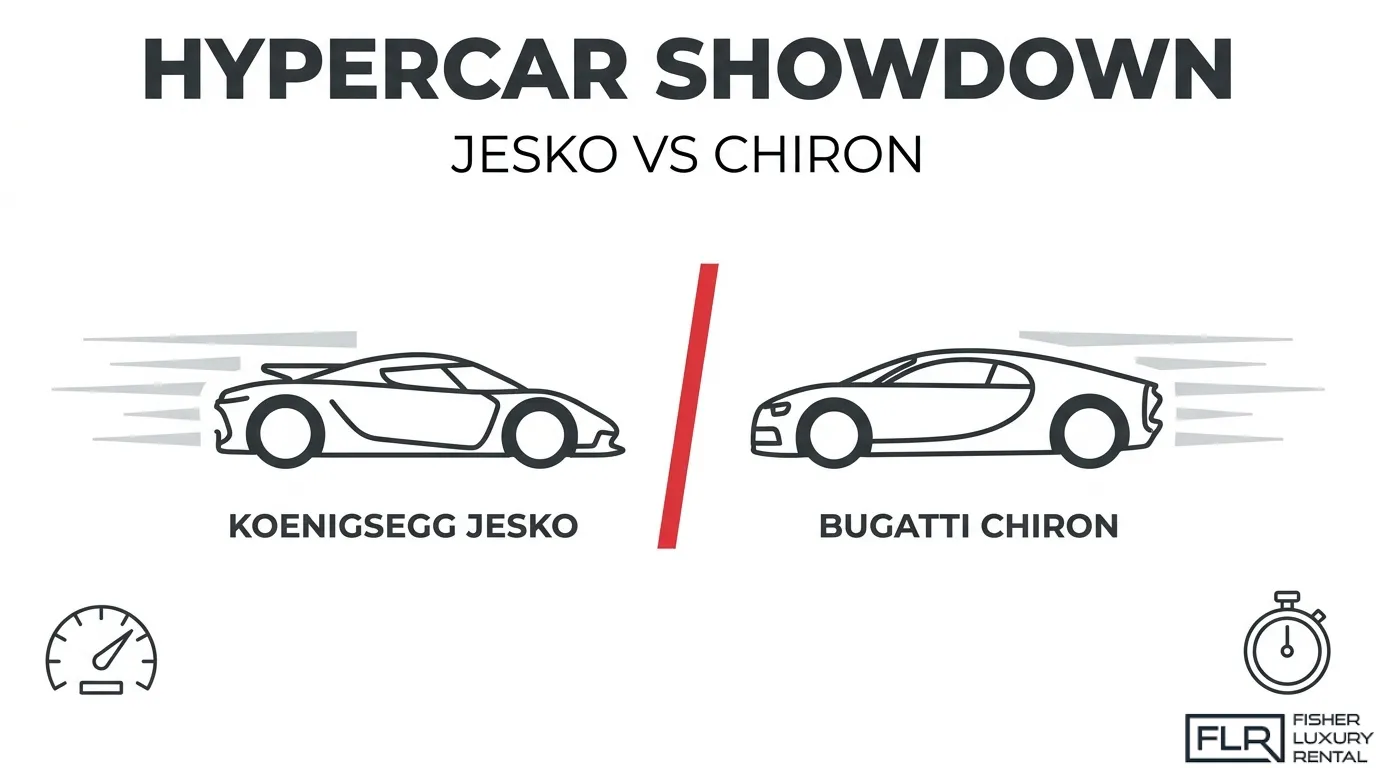
The Koenigsegg Jesko and Bugatti Chiron are two of the most technically extreme road-legal hypercars ever built, each representing a distinct philosophy: Koenigsegg pursues radical minimalism and maximum power-to-weight, while Bugatti delivers brute force through scale, refinement, and heritage.
This comparison covers engine architecture and power outputs, top speed and acceleration figures, transmission technology, aerodynamics and handling, weight and construction, price and exclusivity, and how each car fits real-world driving contexts.
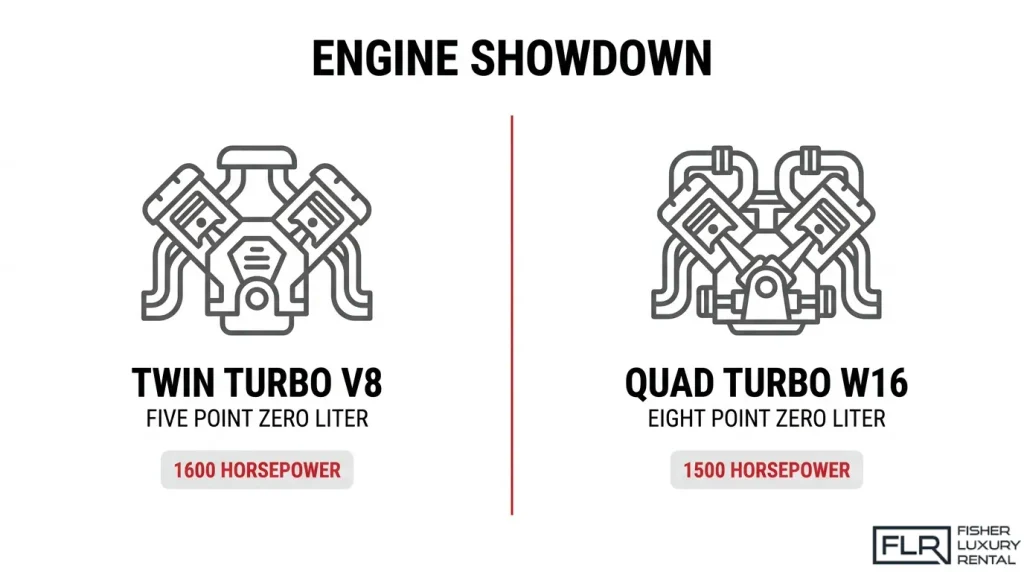
The Jesko’s twin-turbo 5.0L V8 produces up to 1,600 hp on E85, paired with a nine-speed Light Speed Transmission capable of shifting in two milliseconds, while the Chiron’s quad-turbo 8.0L W16 delivers 1,600 Nm of torque from just 2,000 rpm through a seven-speed DSG. These are fundamentally different engines solving the same problem through opposite means.
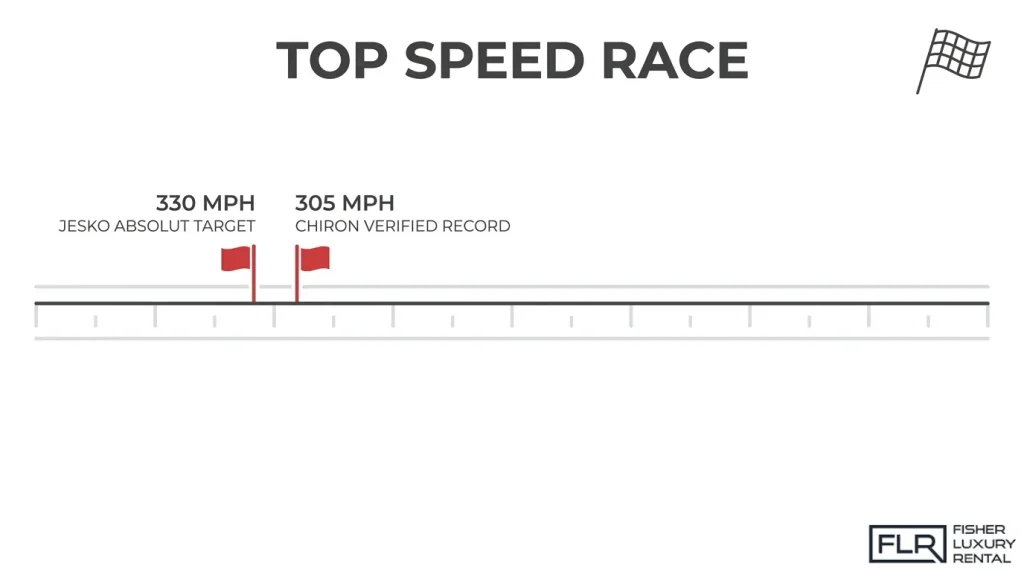
On speed and acceleration, the Jesko Absolut targets a simulation-derived 330 mph, while the Chiron Super Sport 300+ holds a TÜV-certified record of 304.773 mph. In a direct quarter-mile comparison, the Jesko Attack edges the Chiron Super Sport by 0.2 seconds.
The Jesko Attack generates up to 1,400 kg of downforce for circuit-focused handling, while the Chiron’s aerodynamic package prioritizes planted stability at extreme highway speeds. The two cars weigh 1,390 kg and 1,995 kg respectively, a gap that shapes every aspect of how each drives.
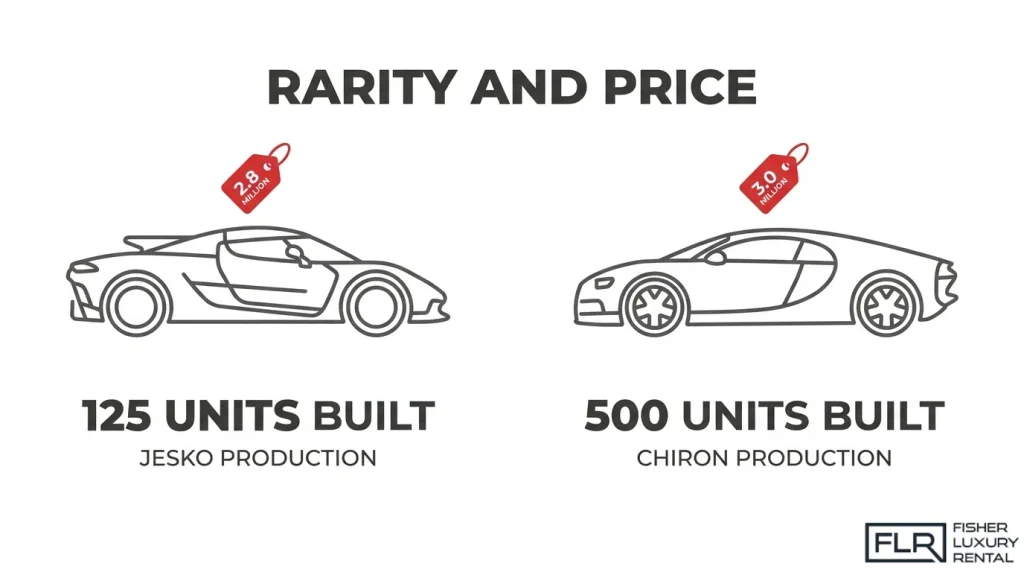
On price and exclusivity, only 125 Jeskos will ever be built against the Chiron’s 500-unit cap, with both already fully allocated.
How Do the Jesko and Chiron Compare on Engine Specs?
The Jesko and Chiron use fundamentally different engine architectures: a twin-turbo V8 versus a quad-turbo W16. The sections below cover each engine’s configuration, output figures, and what those differences mean in practice.
What Engine Does the Koenigsegg Jesko Use?
The Koenigsegg Jesko uses a twin-turbocharged 5.0-liter aluminum V8 with a flat-plane crankshaft, double overhead camshafts, four valves per cylinder, and dry sump lubrication. According to Koenigsegg Automotive AB, it produces 1,280 hp at 7,800 rpm on gasoline, climbs to 1,600 hp on E85, and delivers up to 1,500 Nm of peak torque at 5,100 rpm. The redline sits at 8,500 rpm. Paired with the 9-speed Light Speed Transmission, it reaches 0-60 mph in approximately 2.5 to 2.6 seconds. The engine itself weighs just 189 kg, a remarkable figure given its output.
What Engine Does the Bugatti Chiron Use?
The Bugatti Chiron uses an 8.0-liter quad-turbocharged W16 engine with Bugatti’s proprietary two-stage turbocharging and water-to-air intercooling. Per Bugatti’s official technical specifications, it produces 1,500 hp at 6,700 rpm and 1,600 Nm of torque available from 2,000 to 6,000 rpm, paired with a 7-speed DSG dual-clutch gearbox. Production is capped at 500 units with a starting price of $3 million, per Robb Report. The standard Chiron is electronically limited to 420 km/h for road use.
How Does the Jesko’s Twin-Turbo V8 Compare to the Chiron’s Quad-Turbo W16?
The Jesko’s twin-turbo V8 and the Chiron’s quad-turbo W16 share identical peak power outputs on E85 and the standard Chiron respectively, both rated at 1,500 to 1,600 hp, but they achieve this through opposite philosophies. The Chiron’s W16 displaces 8.0 liters across 16 cylinders, producing brute force through sheer volume. The Jesko’s V8 achieves comparable power from just 5.0 liters, prioritizing a higher-revving character and a dramatically lower engine weight of 189 kg. The Chiron weighs 1,995 kg curb, while the Jesko Absolut weighs just 1,390 kg, making the power-to-weight advantage firmly Koenigsegg’s.
How Much Horsepower and Torque Do the Jesko and Chiron Produce?
The Jesko and Chiron produce some of the highest output figures of any road-legal hypercar, though each achieves them differently. The sections below cover the Jesko’s fuel-dependent power range, the Chiron’s variant-by-variant output, and how torque delivery compares across their RPM bands.
How Much Power Does the Jesko Make on E85 vs Gasoline?
The power the Jesko makes depends directly on fuel type. Running on gasoline, the twin-turbo 5.0L V8 produces 1,280 hp at 7,800 rpm with a redline of 8,500 rpm. Switch to E85, and output climbs to 1,600 hp from the same engine, per Koenigsegg Automotive AB’s official specifications.
That 320 hp swing from a fuel change alone is a remarkable engineering achievement. The flexibility to extract radically different outputs without hardware modifications makes the Jesko one of the most adaptable hypercars ever built.
How Much Power Does the Chiron Produce in Each Variant?
The power the Chiron produces varies across its lineup, with three key variants covering different priorities:
- Chiron (standard): 1,500 hp at 6,700 rpm from the quad-turbo 8.0L W16, per Bugatti’s official technical specifications.
- Chiron Pur Sport: 1,479 hp at 6,700 rpm, with a handling-focused setup optimized for cornering, according to Car and Driver.
- Chiron Super Sport: Up to 1,578 hp, with a 273 mph top speed, per Motor Authority.
The Chiron Super Sport 300+ also produces 1,600 PS, matching the Jesko’s peak E85 figure in metric terms.
Which Car Delivers More Torque at Lower RPMs?
The car that delivers more torque at lower RPMs is the Chiron. Bugatti’s W16 produces 1,600 Nm available from just 2,000 rpm, building massive thrust almost immediately off idle. The Jesko reaches a higher peak torque of 1,500 Nm at 5,100 rpm, but its broad usable band spans 2,700 to 6,170 rpm, delivering over 737 lb-ft across that entire range, as confirmed by BBC Top Gear.
In practical terms, the Chiron’s earlier torque onset gives it a more effortless low-speed surge, while the Jesko rewards drivers who push deeper into the rev range.
What Is the Top Speed of the Jesko vs the Chiron?
The top speed of the Jesko vs the Chiron differs significantly by variant, with the Jesko Absolut claiming a theoretical 330 mph and the Chiron Super Sport 300+ holding a verified record above 300 mph. The sections below cover each car’s peak capability and whether either has officially crossed the 300 mph mark.
What Is the Koenigsegg Jesko Absolut’s Theoretical Top Speed?
The Koenigsegg Jesko Absolut’s theoretical top speed is 330 mph (532 km/h), derived from computer simulations rather than a live track run. According to Motor1.com, that figure accounts for the Absolut’s drag coefficient of 0.278 Cd, its twin-turbo 5.0-liter V8, and the delivery of power across the rpm range. On E85 fuel, the engine produces 1,600 hp, while gasoline yields 1,280 hp at 7,800 rpm. The Koenigsegg 9-speed Light Speed Transmission, which uses seven clutches that open and close in as little as two milliseconds per Road & Track, eliminates the shifting delays that typically limit top-speed runs. The Absolut’s 1,290 kg dry weight and minimal downforce configuration reinforce its straight-line intent.
What Is the Bugatti Chiron Super Sport’s Verified Top Speed?
The Bugatti Chiron Super Sport’s verified top speed is 273 mph (440 km/h) in road production trim, with a rated maximum of 440 km/h. The Chiron Super Sport produces up to 1,578 hp and reaches 60 mph in under 3.0 seconds, hitting 124 mph in 5.8 seconds and 186 mph in 12.1 seconds, according to Motor Authority. Its quad-turbocharged W16 delivers 1,600 Nm of torque from 2,250 to 7,000 rpm, channeled through a seven-speed dual-clutch gearbox. The standard Chiron is electronically limited to 420 km/h for road use. In a quarter-mile drag race, the Jesko Attack completed the run in 9.4 seconds versus the Chiron Super Sport’s 9.6 seconds, a margin of 0.2 seconds.
Has Either Car Officially Broken the 300 MPH Barrier?
The Bugatti Chiron has officially broken the 300 mph barrier; the Jesko Absolut has not yet attempted a verified record run. According to the Bugatti Newsroom, a pre-production Chiron derivative set a TÜV-certified record of 304.773 mph (490.484 km/h) at Ehra-Lessien, with driver Andy Wallace at the wheel. The Jesko Absolut’s 330 mph claim remains a simulation figure. The Chiron holds the verified record today, though the Absolut’s lower drag coefficient and higher theoretical output suggest it could challenge that benchmark if a sanctioned run were completed.
How Fast Do the Jesko and Chiron Accelerate From 0 to 60 MPH?
Both hypercars reach 60 mph in under 2.6 seconds, though each variant tells a slightly different story. The H3s below break down the Jesko’s 0–60 figure, the Chiron’s variant-by-variant times, and which car wins the quarter-mile.
How Quickly Does the Jesko Reach 60 MPH?
The Jesko reaches 60 mph in an estimated 2.5 seconds, according to MotorTrend’s figure for the Absolut. The Attack’s real-world pace is equally brutal: BBC Top Gear recorded the Attack sprinting from 50–150 mph in just 5.66 seconds and covering 100–200 mph in 8.18 seconds. With a power-to-weight ratio of 1,111 bhp/tonne and 737 lb-ft of torque available across a wide 2,700–6,170 rpm band, mid-range pull is relentless. That broad torque window is what separates the Jesko from most rivals – it never hunts for power.
How Quickly Does the Chiron Reach 60 MPH?
The Chiron reaches 60 mph in as little as 2.3 seconds in Pur Sport specification, as measured by Car and Driver in their 2021 test. The standard Chiron hits the mark in 2.4 seconds per official Bugatti specifications, while the Chiron Super Sport completes the run in under 3.0 seconds. All variants benefit from the quad-turbocharged W16’s 1,600 Nm of torque available from 2,000 rpm, which loads the drivetrain immediately off the line.
Which Hypercar Wins in a Quarter-Mile Sprint?
The Jesko Attack wins the quarter-mile sprint against the Chiron Super Sport, completing it in 9.4 seconds versus the Chiron Super Sport’s 9.6 seconds, a margin of 0.2 seconds according to a direct drag race comparison reported by F1rst Motors. The Jesko’s lighter carbon construction and the Light Speed Transmission’s near-instant gear changes give it the edge at the top end of the run. For buyers weighing launch performance alone, the numbers favor the Chiron’s Pur Sport variant – but in an outright sprint, the Jesko Attack pulls ahead by the stripe.
What Transmission and Drivetrain Does Each Car Use?
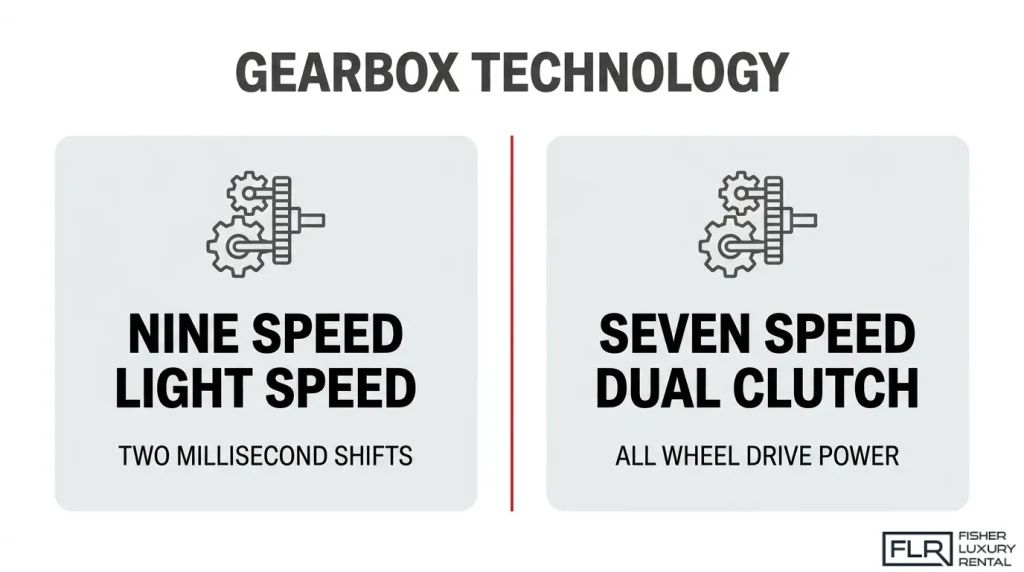
The Jesko uses Koenigsegg’s proprietary nine-speed Light Speed Transmission, while the Chiron uses a seven-speed dual-clutch gearbox paired with all-wheel drive. These two systems reflect fundamentally different engineering philosophies for managing extreme power.
How Does Koenigsegg’s Light Speed Transmission Work?
Koenigsegg’s Light Speed Transmission works by replacing conventional selector forks, collars, and synchronizers with individual clutches for each gear pair. According to Road & Track, the LST uses three gear shafts instead of two, enabling compounded gear combinations that produce nine forward speeds from seven gear pairs. Christian von Koenigsegg states each clutch opens or closes in as little as two milliseconds, making instantaneous gear changes possible at any rpm. The entire unit weighs just 198 pounds including fluids, in a package less than half the length of the Agera’s seven-speed transmission. No comparable production gearbox matches this shift speed, making the LST one of the most significant drivetrain innovations in hypercar history.
How Does the Chiron’s Seven-Speed Dual-Clutch Differ?
The Chiron’s seven-speed dual-clutch transmission differs from the LST by using a conventional twin-clutch architecture paired with permanent all-wheel drive. Bugatti’s technical specifications confirm the DSG gearbox manages 1,600 Nm of torque from the quad-turbo W16, delivering power across all four wheels from 2,000 rpm. The transmission supports the Chiron’s 0 to 100 km/h sprint in 2.4 seconds and sustains thrust through to 7,100 revs. Where the LST prioritizes instantaneous multi-gear jumps, Bugatti’s DSG prioritizes seamless torque delivery and all-weather traction stability at extreme speeds.
How Do the Jesko and Chiron Compare on Aerodynamics and Downforce?
The Jesko and Chiron take fundamentally different approaches to aerodynamics: the Jesko Attack maximizes downforce for cornering grip, while the Chiron prioritizes high-speed stability through passive body engineering. The sections below detail each car’s specific aerodynamic figures and design philosophy.
How Much Downforce Does the Jesko Attack Generate?
The Jesko Attack generates a maximum of 1,400 kg of downforce, with 1,000 kg achieved at 171 mph, according to BBC Top Gear. The Jesko Absolut, optimized for straight-line speed, trades cornering grip for slipperiness, producing a maximum of only 330 pounds of downforce. According to MotorTrend, the Absolut produces just 90 pounds of downforce at 155 mph, allowing it to run softer suspension and a lower ride height for improved daily usability. The Attack’s aerodynamic aggression makes it the clear choice for track-focused driving, where lateral speed matters as much as straight-line pace.
How Is the Chiron Designed for High-Speed Stability?
The Chiron is designed for high-speed stability through a combination of its wide, low body profile, active rear spoiler, and W16 engine placement, all working together to keep the car planted at extreme velocities. The standard Chiron is electronically limited to 420 km/h (261 mph) for road use, with the aerodynamic package engineered to maintain stability at that threshold. Unlike the Jesko Attack’s extreme active downforce system, the Chiron’s approach favors a composed, confidence-inspiring experience at speed rather than maximum lateral grip figures.
How Do the Jesko and Chiron Differ in Weight and Construction?
The Jesko and Chiron differ in weight and construction primarily through their material philosophies: the Jesko prioritizes minimum mass above all else, while the Chiron adds structural bulk to support a far heavier powertrain. These trade-offs shape every aspect of how each car performs.
What Materials Keep the Jesko Lightweight?
The materials that keep the Jesko lightweight are pre-impregnated carbon fiber, Kevlar, aluminum honeycomb, and lightweight sandwich reinforcements. According to Koenigsegg Automotive AB, this construction yields a dry weight of just 1,290 kg and a curb weight of 1,390 kg. The carbon fiber monocoque also integrates the fuel tanks directly, eliminating separate containers and saving additional mass. Even the LST transmission contributes, weighing only 198 pounds including fluids. Every component is engineered to minimize grams, making the power-to-weight ratio a core performance weapon rather than a secondary consideration.
Why Is the Chiron Heavier Despite Carbon Fiber Construction?
The Chiron is heavier despite carbon fiber construction because its 8.0-liter quad-turbo W16 engine, all-wheel-drive system, and luxury interior impose unavoidable mass. Bugatti’s own technical specifications list the Chiron’s DIN empty weight at 1,995 kg, and CarBuzz reports a curb weight of 4,360 lbs. Carbon fiber appears throughout the cabin and body, but it offsets rather than eliminates the weight of a powertrain that is fundamentally larger and more complex than the Jesko’s V8. The Chiron’s mass is a deliberate engineering trade-off: Bugatti prioritized refinement, stability, and grand-touring capability over the razor-thin weight targets Koenigsegg pursues.
How Does Handling Differ Between the Jesko and the Chiron?
Handling differs between the Jesko and the Chiron primarily through their aerodynamic philosophy and vehicle weight. The Jesko prioritizes active downforce and low mass for corner-focused performance, while the Chiron uses mass and stability systems to inspire confidence at extreme straight-line speeds. The sub-sections below cover downforce-driven cornering, weight trade-offs, and real-world driver dynamics.
Jesko Attack vs Jesko Absolut: Two Handling Philosophies in One Nameplate
The Jesko Attack and Jesko Absolut represent opposite handling philosophies within the same platform. According to BBC Top Gear testing, the Jesko Attack generates up to 1,000 kg of downforce at 171 mph and a maximum of 1,400 kg, making it the sharper cornering tool. The Absolut is tuned for straight-line speed, producing only 150 kg of downforce maximum and running softer suspension as a result. In testing, the Attack accelerated from 50 to 150 mph in 5.66 seconds and 100 to 200 mph in 8.18 seconds. The carbon monocoque delivers 65,000 Nm per degree of torsional rigidity, giving both variants a precise, connected feel through chassis flex.
How the Chiron Handles Its 1,995 kg Kerb Weight at Speed
The Chiron handles its 1,995 kg kerb weight through an all-wheel-drive platform, active aerodynamics, and Bugatti’s adaptive suspension tuning. That mass, roughly 600 kg more than the Jesko Attack’s 1,390 kg curb weight, shifts the car’s handling character away from raw agility toward planted, high-speed stability. The Chiron Pur Sport variant addresses this with a shorter final drive ratio and stiffer suspension calibration specifically designed to sharpen cornering response. The result is a car that rewards smooth, committed inputs rather than the rapid directional changes that lighter hypercars reward.
Which Car Feels More Agile in Corners?
The Jesko Attack feels more agile in corners than the Chiron, primarily because of its significant weight advantage and its downforce-led setup. The Jesko Attack is engineered for prodigious lateral speed with total driver control, while still offering creature comforts more typical of a grand tourer. The Chiron delivers impressive lateral grip for a near-2,000 kg car, but its mass means transitions and direction changes require more commitment and planning. For drivers prioritizing corner speed and chassis feedback, the Jesko Attack’s architecture is the stronger tool; the Chiron rewards those who prefer a more planted, confidence-inspiring platform at very high sustained speeds.
How Do the Jesko and Chiron Compare on Price and Exclusivity?
Both hypercars carry seven-figure price tags and severely limited production runs. The sections below cover the Jesko’s cost, the Chiron’s cost, and how their production numbers stack up.
How Much Does a Koenigsegg Jesko Cost?
The Koenigsegg Jesko costs approximately $2,840,000, based on MotorTrend’s pricing for the Absolut variant. BBC Top Gear places the figure at around £2.85 million per car, whether Attack or Absolut. Critically, all 125 units across both variants are already sold out, so the sticker price is largely academic for any new buyer today.
How Much Does a Bugatti Chiron Cost?
The Bugatti Chiron costs north of €3 million for a standard road-legal configuration, according to DW’s reporting on the 300 mph record run. Variant pricing climbs considerably higher: the Chiron Pur Sport carried a base price of $3,599,000, while the Chiron Super Sport starts at approximately $3.9 million. Across the lineup, the Chiron commands a meaningful premium over the Jesko.
Which Hypercar Is More Limited in Production Numbers?
The Koenigsegg Jesko is more limited in production numbers, with only 125 total units planned across both the Attack and Absolut variants, built at a rate of roughly 30 to 40 cars per year, and every allocation already spoken for. The Bugatti Chiron, by contrast, was capped at 500 examples globally. Both figures are extraordinarily small, but the Jesko’s run is less than a quarter the size of the Chiron’s, making it the rarer car by a significant margin.
What Are the Key Design Differences Between the Jesko and Chiron?
The key design differences between the Jesko and Chiron reflect two fundamentally different philosophies: Koenigsegg pursues radical minimalism and engineering innovation, while Bugatti embodies grand luxury through scale and refinement. These contrasts appear across bodywork, interior architecture, and brand heritage.
The Jesko uses a carbon fiber monocoque with aluminum honeycomb and pre-impregnated carbon fiber/Kevlar sandwich reinforcements, producing a dry weight of just 1,290 kg. The Chiron’s body also incorporates carbon fiber, but its W16 engine, quad-turbocharger system, and grand touring interior push curb weight to 1,995 kg – more than 700 kg heavier.
Visually, the Jesko’s silhouette is shaped by aerodynamic function: every surface, vent, and fin serves a downforce or drag-reduction purpose. The Chiron, by contrast, carries Bugatti’s signature horseshoe grille, sweeping haunches, and a cabin trimmed in leather, Alcantara, and carbon – an interior that prioritizes occupant comfort alongside speed.
Bugatti’s design language also carries deeper historical weight. The Volkswagen Group notes that around 3,000 units of the “Bébé” small car designed by Ettore Bugatti were built on Peugeot production lines between 1913 and 1916, establishing a tradition of artisanal craftsmanship that still defines Chiron aesthetics today.
From a design perspective, the Jesko is an engineer’s sculpture; the Chiron is a jeweler’s commission. Both approaches are valid, but buyers choosing between them are really choosing between two entirely different visions of what a hypercar should feel like to own.
Which Hypercar Is Better for Track Use vs Highway Driving?
The answer depends on the variant and the driving context. The Jesko Attack is built for circuit dominance, while the Chiron is optimized for high-speed grand touring. Each H3 below examines one use case in detail.
Is the Jesko Attack Better Suited for Track Performance?
The Jesko Attack is better suited for track performance than virtually any road-registered car available today. The Attack is engineered for prodigious speed in both straight-line and lateral directions with total driver control, while still offering creature comforts more typical of a grand tourer. In BBC Top Gear testing, the Attack accelerated from 50 to 150 mph in 5.66 seconds and covered 100 to 200 mph in 8.18 seconds. Its carbon monocoque reaches a torsional rigidity of 65,000 Nm per degree of twist, giving it the structural backbone that precision cornering demands. For drivers who want a circuit-capable hypercar that does not sacrifice daily usability, the Attack represents an unusually complete package.
Is the Chiron Better Suited for Grand Touring at Speed?
The Chiron is better suited for grand touring at speed than for lap-time competition. Its 1,995 kg curb weight and long-wheelbase platform prioritize refinement, stability, and high-speed endurance over aggressive cornering dynamics. The standard Chiron is electronically limited to 420 km/h for road use, delivering tremendous straight-line thrust in comfort across vast highway distances. Its W16 produces 1,600 Nm of torque from as low as 2,000 rpm, meaning effortless overtaking power is always available without downshifting. Where the Jesko Attack demands driver engagement, the Chiron rewards those who want sovereign, unhurried velocity at the highest level of interior luxury.
How Can You Experience Elite Hypercars Through an Exotic Car Rental?
Experiencing elite hypercars through an exotic car rental means accessing professionally maintained, top-trim vehicles without the ownership costs. The following sections cover Fisher Luxury Rental’s high-performance offerings and the key takeaways from the Jesko vs Chiron comparison.
Does Fisher Luxury Rental Offer High-Performance Driving Experiences?
Fisher Luxury Rental offers a curated fleet of luxury and exotic vehicles in Phoenix, AZ and Portland, OR. Serving car enthusiasts, tourists, and special occasion renters, Fisher Luxury Rental focuses on top-trim models and exceptional customer service. The broader market reflects this demand: according to Fortune Business Insights, the global luxury car rental market was valued at USD 52.82 billion in 2025 and is projected to reach USD 125.98 billion by 2034 at a 10.59% CAGR. For drivers who want the thrill of a hypercar without multi-million-dollar ownership, rental access is the most practical path available.
What Are the Key Takeaways About the Jesko vs Chiron Comparison?
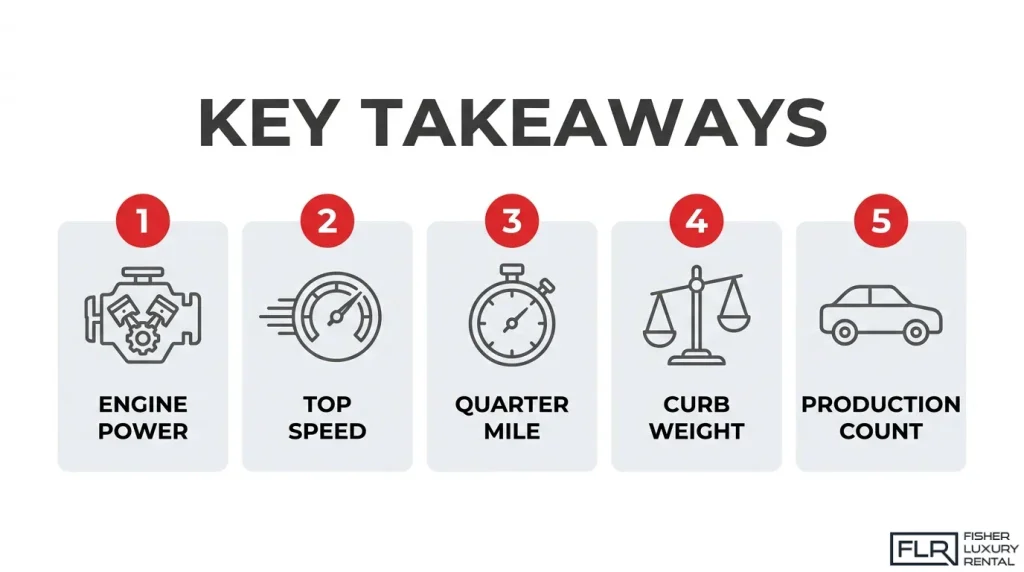
The key takeaways about the Jesko vs Chiron comparison center on performance philosophy, engineering approach, and exclusivity. Each car excels in a distinct context:
- Engine architecture: The Jesko uses a twin-turbo 5.0L V8 producing up to 1,600 hp on E85; the Chiron uses a quad-turbo 8.0L W16 producing 1,500 hp on premium fuel.
- Top speed: The Jesko Absolut targets a theoretical 330 mph; the Chiron Super Sport 300+ achieved a TUV-certified 304.773 mph.
- Quarter-mile: The Jesko Attack completes the quarter-mile in 9.4 seconds, edging the Chiron Super Sport’s 9.6 seconds.
- Weight: The Jesko weighs approximately 1,390 kg; the Chiron weighs roughly 1,995 kg.
- Production: Only 125 Jeskos will ever be built; Bugatti capped the Chiron at 500 units.
- Use case: The Jesko Attack prioritizes lateral performance and track use; the Chiron is engineered for grand touring at extreme speed.
Both represent the absolute pinnacle of hypercar engineering, though the Jesko edges ahead in raw performance metrics while the Chiron delivers unmatched refinement and heritage.