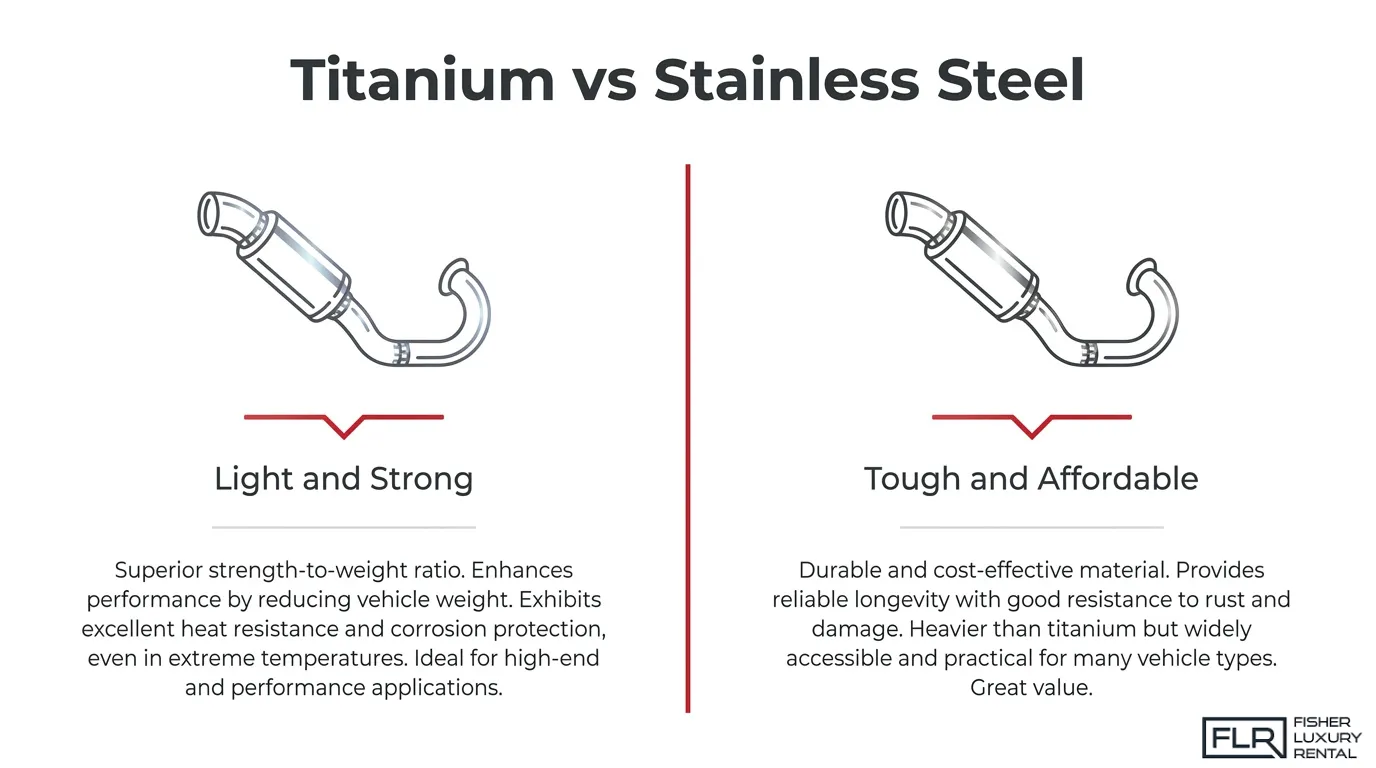
A titanium exhaust system is a full or partial exhaust assembly built from titanium alloy tubing, valued for its exceptional strength-to-weight ratio and heat resistance. A stainless steel exhaust system uses chromium-nickel alloys from the austenitic 300 Series, engineered to resist corrosion and mechanical stress across thousands of drive cycles.
This guide covers both materials from a technical and practical standpoint: what each system is made of, how they compare in weight and real-world performance, durability under heat cycling and road salt, acoustic character, cost, and which use case each material actually suits.
Material composition and construction set the foundation. Titanium exhausts rely on Grade 5 Ti-6Al-4V alloy and require precise inert-gas welding, while stainless systems use graded alloys such as AISI 304, 316, and 321, each selected for specific positions along the exhaust run.
Weight and performance separate the two materials most clearly. A full titanium swap can save 10 to 30 kg on a sports car, a reduction that measurably shifts acceleration times and weight distribution. Stainless steel delivers genuine performance gains over factory systems but carries a real mass penalty at equivalent wall thicknesses.
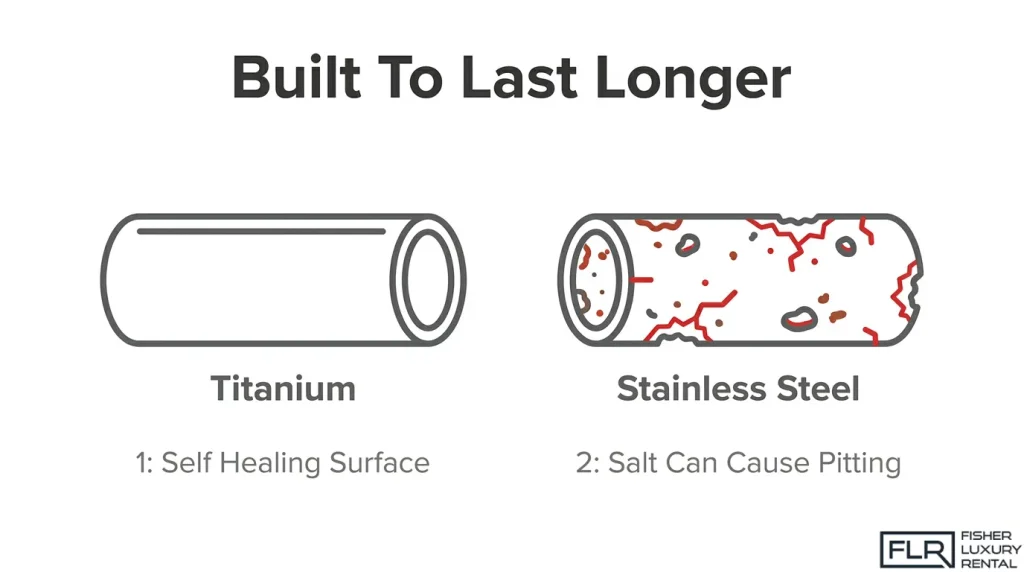
Durability and corrosion resistance diverge significantly in high-chloride environments. Titanium maintains a self-healing passive oxide film in aggressive conditions; stainless steel remains vulnerable to pitting and stress-corrosion cracking from road salt and heat cycling.
Sound, cost, and use-case fit determine the final decision. Titanium produces a sharper, higher-pitched note suited to track builds, while stainless steel delivers a fuller tone at a fraction of the price, making it the more practical choice for most street-driven vehicles.
What Is a Titanium Exhaust System?
A titanium exhaust system is a full or partial exhaust assembly constructed from titanium alloy tubing, replacing the heavier steel or iron components found in standard factory exhausts. Valued for its exceptional strength-to-weight ratio, titanium is the preferred material in motorsport, aerospace, and high-performance road cars.
The sub-sections below cover titanium’s material grades, alloy composition, wall thickness standards, and thermal behavior under high-heat operating conditions.
What Grade of Titanium Is Used in Exhaust Systems?
The grade of titanium used in exhaust systems is typically Grade 5, also designated Ti-6Al-4V. According to AZoM, Ti-6Al-4V is the most widely used of all titanium grades, classified as a medium-to-high-strength general-purpose alloy. Its aluminum and vanadium alloying elements deliver the structural integrity required to withstand exhaust heat and mechanical vibration simultaneously.
Commercially pure grades such as Grade 1 and Grade 2 also appear in some exhaust applications. Per research published in Materials (Basel) via the National Library of Medicine, Grade 1 carries the lowest impurity content of all commercially pure titanium grades, while Grade 4 permits up to 0.4% oxygen and 0.5% iron. For performance exhaust systems, however, Ti-6Al-4V remains the dominant choice because pure grades sacrifice strength for purity.
How Is a Titanium Exhaust Manufactured?
A titanium exhaust is manufactured using precision TIG welding under inert gas shielding, mandrel bending, and hydroforming of thin-wall tubing. Titanium’s sensitivity to atmospheric contamination during welding requires strict process control. According to TWI (The Welding Institute), contamination of titanium weld metal and adjacent heat-affected zones can reduce ductility to unacceptably low levels, potentially causing cracks even under moderate restraint.
Wall thickness also follows tight specifications in high-performance applications. The FIA 2027 Formula 1 Technical Regulations specify that an exhaust tailpipe must have a wall thickness between 0.5mm and 3mm, reflecting how thin titanium can be manufactured while still meeting structural requirements.
How Does Titanium Behave Under Exhaust Heat?
Titanium behaves under exhaust heat by forming a stable surface oxide layer that provides passive corrosion protection at ambient temperatures. However, per NIST research on Ti-6Al-4V, titanium alloys are prone to faster oxidation rates at elevated temperatures, which is why exhaust systems made from titanium develop the signature heat-blued coloration around header sections. This discoloration, caused by a thickening rutile oxide layer, is a visual indicator of sustained high-temperature exposure rather than a sign of structural failure. In practice, titanium exhaust components endure repeated heat cycling better than most ferrous alternatives, making it one of the most heat-resilient exhaust materials available for performance applications.
What Is a Stainless Steel Exhaust System?
A stainless steel exhaust system is a vehicle exhaust assembly constructed from chromium-containing steel alloys engineered to resist heat, corrosion, and mechanical stress across thousands of drive cycles. It covers the major sub-topics of material composition, common grades, and core performance characteristics.
What Materials Make Up a Stainless Steel Exhaust?
Stainless steel exhaust systems are made from iron-chromium alloys, most commonly from the austenitic 300 Series group. According to the Nickel Development Institute’s Design Guidelines for the Selection and Use of Stainless Steel, austenitic stainless steels containing chromium and nickel are classified as 300 Series types, with grades such as 304, 316, 321, and 309 each offering distinct corrosion and heat-resistance profiles. The chromium content forms a passive oxide layer on the surface, which continuously rebuilds when damaged, giving the material its defining corrosion resistance. Grades like AISI 321 and AISI 309 appear frequently in automotive exhaust flexible couplings precisely because they withstand thermo-mechanical fatigue.
How Is a Stainless Steel Exhaust System Structured?
A stainless steel exhaust system consists of several connected components, including headers or manifolds, a mid-pipe, catalytic converter housing, resonator, and tailpipe. Each section handles a distinct function: the manifold collects combustion gases at the cylinder head, the mid-pipe routes them rearward, and the muffler reduces acoustic pressure before the tailpipe exits. The Handbook of Materials Failure Analysis identifies three core exhaust functions: controlling emissions, managing noise, and handling thermal energy. Stainless steel’s structural rigidity makes it well suited to hold these components in precise alignment under the sustained vibration and thermal expansion of daily driving.
What Grades of Stainless Steel Are Used in Exhaust Systems?
The grades of stainless steel used in exhaust systems are primarily AISI 304, 316, 321, and 309, each selected for specific positions based on temperature exposure. The following grades reflect their typical exhaust applications:
- 304: General-purpose grade used in mid-pipes and muffler bodies where temperatures are moderate.
- 316/316L: Higher corrosion resistance, suited to environments with road salt or coastal moisture exposure.
- 321: Titanium-stabilized grade used in high-heat zones such as flexible couplings near the manifold.
- 309: High-chromium, high-nickel grade chosen for extreme-heat sections closest to the engine.
Sandia National Laboratories conducted corrosion tests on Types 316, 316L, and 304 stainless steels for more than 4,000 hours and 500 thermal cycles at a maximum temperature of 565°C, providing a validated baseline for how these grades perform under sustained thermal stress. Selecting the right grade for each section of the system is the single most important decision in stainless exhaust design.
How Do Titanium and Stainless Steel Exhausts Compare in Weight?
Titanium exhausts weigh significantly less than stainless steel exhausts, giving sports cars meaningful gains in acceleration and handling. The sections below cover real-world weight figures for each material and how those savings translate to on-track performance.
How Much Does a Titanium Exhaust Weigh on a Sports Car?
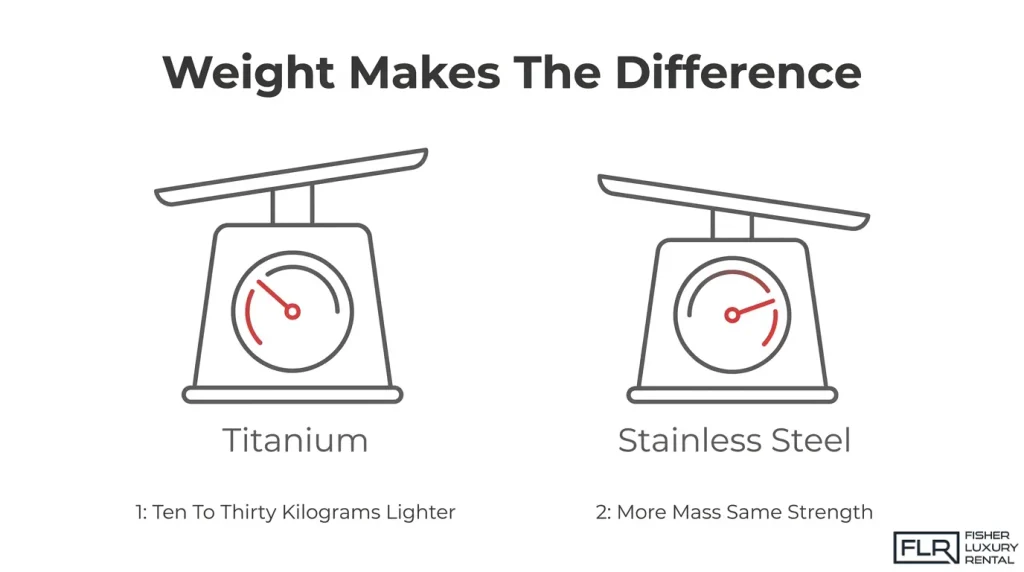
A titanium exhaust on a sports car can save between 10 kg and 30 kg compared to the factory system it replaces. According to Road & Track, Ferrari’s full titanium exhaust swap on the SF90 Stradale Assetto Fiorano delivered a 66-pound (roughly 30 kg) weight reduction, bringing total dry weight to 3,461 pounds. Autocar reported a similarly impressive result for the Lotus Evora 400, where the optional titanium sports exhaust alone saved 10 kg at a cost of £1,350. These are not marginal improvements; on a mid-engine sports car, removing 10 to 30 kg from the rear of the vehicle measurably shifts weight distribution. The McLaren P1 GTR also uses a centrally mounted exhaust clad in titanium and Inconel, prioritizing mass centralization alongside weight reduction.
How Much Does a Stainless Steel Exhaust Weigh on a Sports Car?
A stainless steel exhaust on a sports car typically weighs more than a titanium equivalent, primarily because austenitic stainless steels in the 300 Series, which contain chromium and nickel, carry a higher density than titanium alloys at comparable wall thicknesses. According to the Nickel Development Institute’s design guidelines, these 300 Series grades share many structural characteristics that make them durable but inherently heavier. Stainless steel exhausts do hold up well under repeated thermal cycles: Sandia National Laboratories tested Types 304, 316, and 316L stainless steels through more than 4,000 hours and 500 thermal cycles at up to 565°C without failure. For road cars on a budget, stainless steel remains a practical choice, though the weight penalty is real and accumulates across the full exhaust run.
How Does Exhaust Weight Reduction Affect Acceleration and Handling?
Exhaust weight reduction affects acceleration and handling by lowering total vehicle mass, improving the power-to-weight ratio, and reducing unsprung or rear-biased weight. On the Lamborghini Huracán modified by Ares Performance, fitting a titanium sports exhaust alongside an ECU remap cut the 0-62 mph time by two-tenths of a second to a claimed 3.0 seconds dead, according to Evo. While the exhaust was paired with a tune, lighter exhaust mass directly reduces the load the drivetrain must accelerate. Weight savings concentrated at the rear also improve front-to-rear balance, making the car more responsive to steering inputs. For track-focused builds, this combination of mass reduction and balance improvement is often more valuable than the modest horsepower gains achieved through better gas flow alone.
How Do Titanium and Stainless Steel Exhausts Compare in Durability?
Titanium and stainless steel exhausts differ significantly in how they resist corrosion, handle heat cycling, and respond to road salt exposure. The sections below cover lifespan under normal driving, heat cycling behavior, and salt and moisture resistance for each material.
How Long Does a Titanium Exhaust Last Under Normal Driving?
A titanium exhaust typically outlasts a stainless steel system under normal driving conditions. Titanium forms a stable, self-healing passive oxide layer that continuously protects the base metal from oxygen and moisture. This protective mechanism means titanium exhausts rarely develop surface rust, even after years of daily use in wet or variable climates. Power plant condensers rely on titanium pipes specifically because of this corrosion resistance, according to the Royal Society of Chemistry. For drivers who keep vehicles long-term, the near-permanent lifespan of titanium makes it a sound structural investment beyond just weight savings.
How Long Does a Stainless Steel Exhaust Last Under Normal Driving?
A stainless steel exhaust lasts approximately 5 to 10 years under normal driving conditions, with higher-grade alloys extending toward the upper range. The chromium content in austenitic 300 Series stainless steels provides solid baseline corrosion protection. However, stainless steel carries an inherent vulnerability: according to the Association for Materials Protection and Performance (AMPP), chloride stress corrosion is a type of intergranular corrosion that occurs in austenitic stainless steel under tensile stress in the presence of oxygen, chloride ions, and high temperature. Exhaust systems experience all three of these conditions simultaneously, particularly in road environments where chloride exposure is frequent.
How Does Each Material Handle Corrosion From Heat Cycling?
Both materials handle heat cycling differently based on their electrochemical properties and oxide stability. Titanium maintains a structural advantage: a Cal Poly Pomona study found that titanium and Ti-6Al-4V alloys exhibit lower corrosion rates than carbon steel in both seawater and 3.5 wt% sodium chloride, demonstrating corrosion nobility across aggressive environments. Stainless steel performs reliably under controlled cycling; Sandia National Laboratories conducted corrosion tests on Types 316, 316L, and 304 stainless steels for more than 4,000 hours across 500 thermal cycles at a maximum temperature of 565°C with measurable but manageable corrosion rates. Repeated heating and cooling accelerates oxide fatigue in stainless steel more than in titanium, making titanium the stronger choice for high-cycle applications.
How Does Each Material Resist Road Salt and Moisture?
Titanium resists road salt and moisture more effectively than stainless steel. Its passive oxide film remains intact in high-chloride environments, including brine and seawater exposure. Stainless steel, by contrast, is significantly more vulnerable: the U.S. Environmental Protection Agency notes that chlorides particularly tend to promote pitting, crevice corrosion, and stress-corrosion cracking in stainless steels, with sulfates potentially aggravating these effects. Drivers in cold-weather regions where road salt is applied heavily face a meaningful durability gap between the two materials. For year-round street cars in salt-belt states, the corrosion risk in stainless steel is the single most important durability factor to evaluate before choosing an exhaust material.
How Do Titanium and Stainless Steel Exhausts Compare in Performance?
Both materials influence performance through different mechanisms. The sub-sections below cover horsepower gains, exhaust gas flow efficiency, and throttle response for each material.
How Does a Titanium Exhaust Affect Horsepower Gains?
A titanium exhaust affects horsepower gains primarily through weight reduction rather than direct flow improvements alone. Lighter exhaust systems reduce total vehicle mass, which lowers the power-to-weight ratio and translates into measurable performance gains. Because titanium pipes can be manufactured with thinner walls without sacrificing structural integrity, designers achieve larger internal diameters at lower weights, supporting improved scavenging and reduced back-pressure. The combination of these factors makes titanium the preferred choice for performance-focused builds where every kilogram matters.
How Does a Stainless Steel Exhaust Affect Horsepower Gains?
A stainless steel exhaust affects horsepower gains by enabling precisely engineered tube diameters and mandrel-bent routing that minimize flow restriction. While heavier than titanium, a well-designed stainless system still delivers meaningful back-pressure reduction over restrictive OEM units. The material’s workability allows manufacturers to produce smooth bends and consistent bore diameters at a lower cost, making performance gains accessible without a premium price. For most street-driven vehicles, the horsepower difference between a quality stainless system and titanium is marginal.
How Does Exhaust Material Influence Exhaust Gas Flow Efficiency?
Exhaust gas flow efficiency depends on pipe geometry, wall thickness, and internal surface condition. Thinner walls allow larger internal diameters within a given outer diameter constraint, directly increasing flow area. The FIA’s 2027 Formula 1 Technical Regulations specify that exhaust tailpipes must have a wall thickness of between 0.5mm and 3mm, reflecting how precisely wall thickness is controlled at the highest performance levels. According to the Butterworth-Heinemann Handbook of Materials Failure Analysis, exhaust systems must balance emissions control, noise management, and thermal energy handling, all of which are influenced by material choice. Titanium’s strength-to-weight advantage permits thinner walls at spec, while stainless steel requires slightly thicker walls to achieve equivalent structural performance.
How Does Each Material Affect Throttle Response?
Each material affects throttle response through its contribution to overall exhaust system mass and heat retention. A lighter titanium system reduces rotational and unsprung mass, allowing the engine to spool and respond more freely when throttle input changes. Stainless steel systems, being denser, retain more thermal mass, which can slightly delay the stabilization of exhaust gas velocity at low RPM. In practice, the throttle response difference between the two materials is most noticeable on high-revving naturally aspirated engines, where gas pulse timing and back-pressure interact most directly with engine breathing cycles.
How Do Titanium and Stainless Steel Exhausts Compare in Sound?
Titanium and stainless steel exhausts produce distinctly different tonal characteristics at high RPM. The two sections below cover how each material shapes exhaust note, pitch, and overall acoustic quality.
What Does a Titanium Exhaust Sound Like at High RPM?
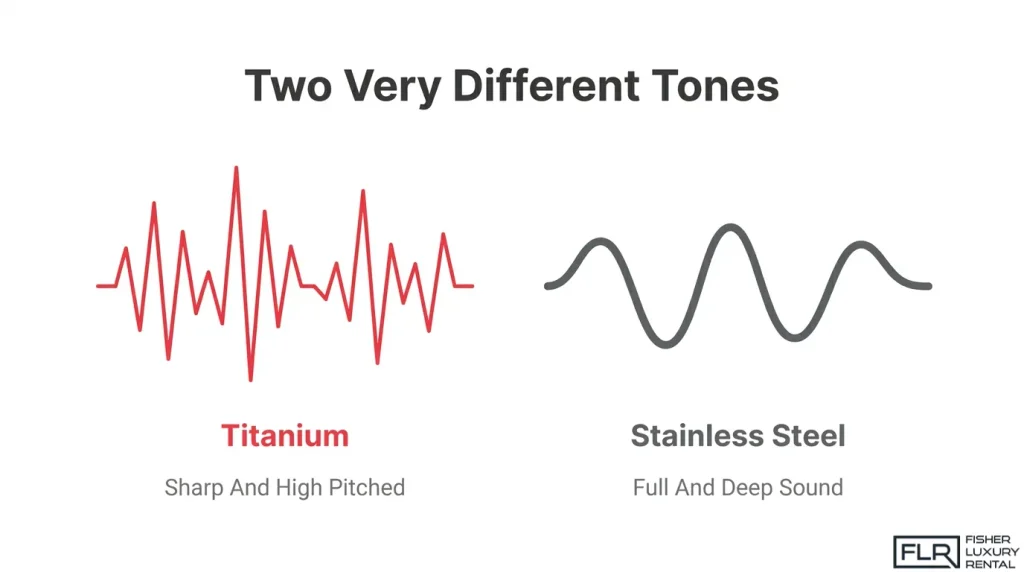
A titanium exhaust sounds notably higher-pitched, sharper, and more mechanical at high RPM compared to stainless steel. The material’s lower density allows pipe walls to vibrate at higher frequencies, producing a raspy, crackling note that enthusiasts associate with motorsport applications. Grade 5 Ti-6Al-4V, the most widely used titanium alloy according to AZoM, is the grade most commonly found in performance exhaust systems because of its strength-to-weight balance, which directly influences acoustic resonance. Because titanium alloys form a stable oxide layer at elevated temperatures, the pipe’s surface character evolves with heat cycles, but wall stiffness remains consistent, keeping that high-frequency tone stable across repeated track sessions. The sound is polarizing: raw and aggressive, it suits track-oriented builds far more than quiet urban commutes.
What Does a Stainless Steel Exhaust Sound Like at High RPM?
A stainless steel exhaust sounds fuller, deeper, and more rounded at high RPM than titanium. Its higher mass density dampens higher-frequency harmonics, producing a broader, more bass-forward exhaust note that most drivers recognize as a classic performance sound. Wall thickness, which the FIA’s 2027 Formula 1 Technical Regulations specify must fall between 0.5mm and 3mm for tailpipes, plays a significant role: thicker stainless walls absorb more vibration energy, softening the tone compared to thin-wall titanium. For street cars, this fuller note is generally more livable across daily driving conditions. Stainless steel suits drivers who want a noticeable performance sound without the sharp, high-pitched edge that titanium produces at peak revs.
How Do Titanium and Stainless Steel Exhausts Compare in Cost?
Titanium and stainless steel exhausts differ significantly in price, driven by raw material costs, fabrication complexity, and target market. The sections below cover typical pricing for each material and whether the titanium premium makes financial sense for street car owners.
How Much Does a Titanium Exhaust System Typically Cost?
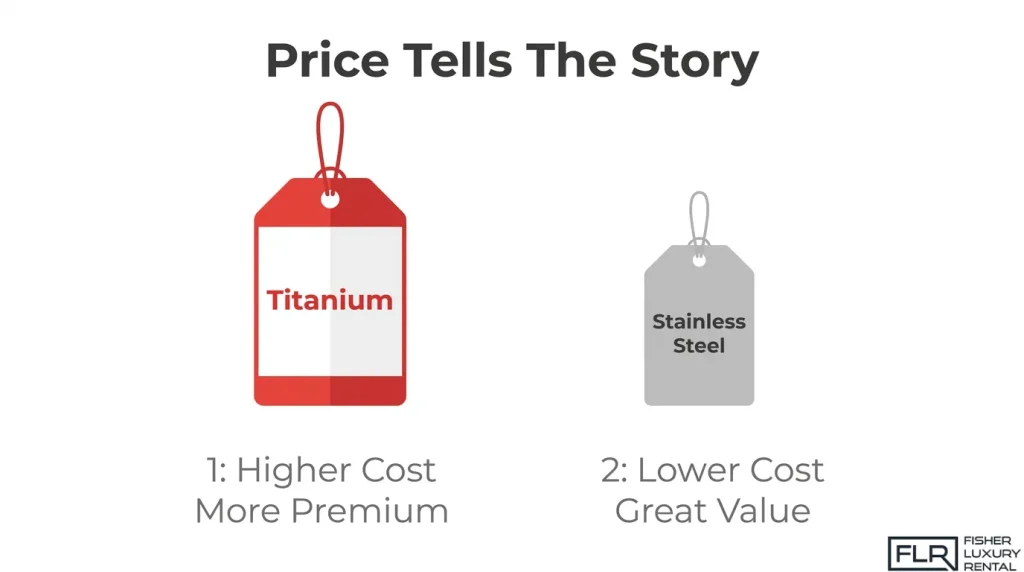
A titanium exhaust system typically costs several times more than a comparable stainless steel unit, with aftermarket systems for performance cars commonly ranging from around £1,000 to well over £5,000 depending on application and brand. The Lotus Evora 400’s titanium sports exhaust, for example, was priced at £1,350 as a factory option, according to Autocar. Specialist fabrication, inert-gas welding requirements, and the raw cost of titanium all drive prices upward. It is also worth noting that UK law prohibits modifying an exhaust to make a vehicle noisier after type approval, per GOV.UK, which can limit which aftermarket titanium systems are road-legal.
How Much Does a Stainless Steel Exhaust System Typically Cost?
A stainless steel exhaust system typically costs considerably less than titanium, making it the default choice for most performance upgrades. Entry-level cat-back stainless systems for popular sports cars generally start in the low hundreds, while high-grade 304 or 316 stainless systems for premium vehicles can reach £500 to £1,500. The wider availability of stainless steel, simpler welding processes, and established supply chains keep manufacturing costs lower. For budget-conscious enthusiasts who still want durability and a meaningful sound improvement, stainless steel delivers strong value.
Is the Price Premium of Titanium Worth It for Street Cars?
The price premium of titanium is worth it for street cars primarily when weight reduction is a performance priority or when the vehicle itself justifies the investment. On a dedicated track-day machine or a high-value exotic, the cost-to-benefit ratio improves considerably. For typical daily driving, however, the weight savings and acoustic character rarely translate into measurable real-world gains that justify doubling or tripling exhaust spend. Stainless steel offers durability, corrosion resistance, and genuine performance improvement at a fraction of the cost, making it the more practical choice for the vast majority of street car owners.
Which Exotic and Performance Cars Come With Titanium Exhausts?
Several exotic and performance cars come with titanium exhausts as either standard or optional fitments, including models from Ferrari, Lamborghini, McLaren, and Lotus. Manufacturers choose titanium for its exceptional strength-to-weight ratio and heat resistance at extreme engine outputs.
The Ferrari SF90 Stradale Assetto Fiorano replaces the entire exhaust with a titanium system, delivering a 66-pound weight reduction according to Road & Track. The Lamborghini Huracán gained a titanium sports exhaust through Ares Performance tuning, which helped cut the 0-62 mph time to 3 seconds flat. The McLaren P1 GTR uses a centrally mounted exhaust clad in titanium and Inconel, pairing exotic alloys for heat management at motorsport intensity. Lotus offered a titanium sports exhaust for the Evora 400, saving 10 kg at a £1,350 option cost. For enthusiasts who want to experience this caliber of engineering without ownership, Fisher Luxury Rental offers top-trim exotic vehicles in Phoenix, AZ and Portland, OR, putting cars built around exactly these performance principles within reach for a day.
According to a study published in Materials (Basel) via PubMed Central, commercially pure titanium is graded by impurity content, with higher grades tolerating more oxygen and iron. The grades used in automotive exhausts are typically selected for their balance of formability and thermal resistance rather than maximum purity.
Titanium exhausts at this level represent genuine engineering decisions, not just aesthetic ones. The weight savings, thermal stability, and acoustic character these systems deliver are difficult to replicate with stainless steel at equivalent mass.
Which Exhaust Material Is Better for Track Use vs Street Use?
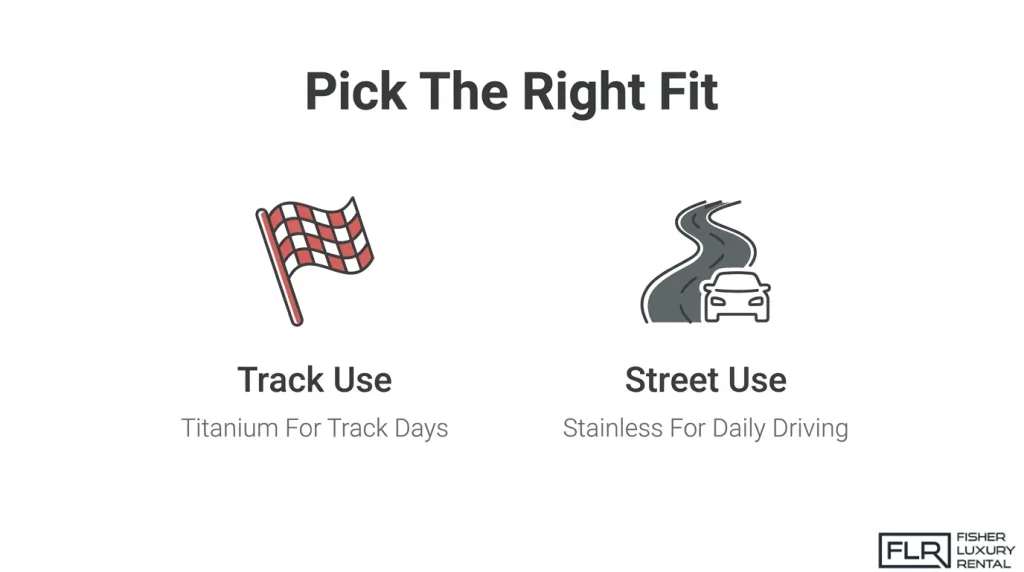
The better exhaust material depends on the use case: titanium excels on track, while stainless steel is more practical for street driving. The following sections cover track performance advantages and daily street driving considerations.
Which Exhaust Material Performs Better on the Track?
Titanium performs better on the track due to its superior strength-to-weight ratio and heat tolerance under sustained high-RPM stress. Reduced unsprung and total vehicle mass directly improves acceleration, cornering response, and braking balance, all of which matter acutely in competitive driving.
The legal and regulatory environment also shapes track choices. The FIA’s 2027 Formula 1 Technical Regulations specify exhaust tailpipe wall thickness between 0.5mm and 3mm, a tolerance range where titanium’s thinner walls meet structural requirements while contributing less mass than equivalent stainless steel tubing.
For serious track builds, titanium is the professional default. The weight savings it delivers translate into measurable lap-time improvements that stainless steel simply cannot match at equivalent wall thicknesses.
Which Exhaust Material Is More Practical for Daily Street Driving?
Stainless steel is more practical for daily street driving because it costs significantly less, is easier to repair, and meets noise and emissions standards with less risk of legal complications. According to GOV.UK, modifying an exhaust system to increase noise after type approval is illegal, and police can act if a silencer does not function as designed. Stainless steel aftermarket systems are more commonly engineered to remain compliant within these boundaries.
Insurance considerations also favor stainless steel. Under California Department of Insurance regulations, non-OEM replacement parts must match original parts in quality, safety, fit, and performance, a standard that stainless steel upgrades more reliably satisfy at lower cost. For most street drivers, stainless steel offers the best balance of durability, compliance, and value.
How Does Exhaust Material Choice Affect Resale Value on Luxury Cars?
Exhaust material choice affects resale value on luxury cars through a combination of OEM specification matching, perceived condition, legal compliance, and buyer demand for factory-correct components. The sections below cover how original fitment, modification legality, and insurance considerations each influence what a luxury car commands at resale.
Does a Titanium Exhaust Increase Resale Value on a Luxury Car?
A titanium exhaust increases resale value on a luxury car when it is an OEM-fitted option from the manufacturer, such as factory-spec titanium systems on Ferrari or Lamborghini models. Aftermarket titanium swaps, however, can complicate sales. Buyers at the top of the luxury market often prefer cars in unmodified, factory-correct condition. A non-original exhaust, regardless of material quality, introduces questions about installation standards, warranty status, and prior use patterns that can reduce buyer confidence and negotiated price.
Does a Stainless Steel Exhaust Hurt Resale Value on a Luxury Car?
A stainless steel exhaust hurts resale value on a luxury car primarily when it replaces a higher-specification OEM component, such as a titanium or Inconel factory system. If the original exhaust is stainless steel, maintaining it in good condition preserves value. The California Department of Insurance requires that replacement parts meet the kind, quality, safety, fit, and performance of original equipment manufacturer parts, meaning deviations from OEM specification can create insurance complications that informed buyers factor into their offers.
How Do Noise Laws and Compliance Affect Resale Value?
Noise laws and compliance affect resale value by creating legal liability that buyers price into their offers. Under UK law, modifying an exhaust system to make a vehicle noisier after type approval is illegal, and police can act if the silencer does not function as designed. Oregon administrative rules similarly prohibit operating any road vehicle with exhaust system leaks, a missing muffler, or a pinched outlet pipe. A luxury car with a non-compliant exhaust carries real regulatory risk, which sophisticated buyers discount heavily, particularly on collector and limited-edition vehicles where legal road use is a core part of the car’s value proposition.
How Can You Experience Titanium and Stainless Steel Exhaust Performance Firsthand?
You can experience titanium and stainless steel exhaust performance firsthand by renting an exotic car that features one of these systems. The sections below cover what Fisher Luxury Rental offers and the key takeaways from this comparison.
Can Renting an Exotic Car From Fisher Luxury Rental Show You the Difference in Exhaust Performance?
Yes, renting an exotic car from Fisher Luxury Rental can show you the difference in exhaust performance in a way no spec sheet replicates. Reading about titanium’s weight savings or stainless steel’s durability is useful, but the real distinction becomes tangible behind the wheel: the sharper throttle response, the acoustic character at high RPM, and the way reduced unsprung weight sharpens handling are all sensations that only a drive delivers.
Fisher Luxury Rental operates in Phoenix, AZ, and Portland, OR, offering top-trim luxury and exotic vehicles for rent. For car enthusiasts who want to move beyond theory and feel the engineering firsthand, a rental is the most direct path to an informed decision.
What Are the Key Takeaways About Titanium vs Stainless Steel Exhaust Durability and Performance?
The key takeaways about titanium vs stainless steel exhaust durability and performance center on three trade-offs: weight, longevity, and cost. Neither material is universally superior; the right choice depends on how and where the car is driven.
- Weight: Titanium delivers meaningful mass reduction. Ferrari documented a 66-pound savings on the SF90 Stradale Assetto Fiorano with a full titanium exhaust system, according to Road and Track.
- Corrosion resistance: Titanium outperforms stainless steel in aggressive environments, particularly around chlorides and road salt. Stainless steel, while durable, remains vulnerable to chloride-induced pitting and stress-corrosion cracking.
- Durability under heat cycling: Stainless steel grades such as 316 and 304 have demonstrated resilience through 500 thermal cycles in laboratory conditions, making them a proven street choice.
- Cost: Titanium commands a significant price premium, justified primarily for track-focused or performance-critical applications.
- Street practicality: Stainless steel offers an excellent durability-to-cost ratio for daily driving, while titanium is the enthusiast’s choice when every gram matters.
For most drivers, stainless steel is the practical default. For those who prioritize maximum performance and can absorb the cost, titanium is the clear engineering upgrade.