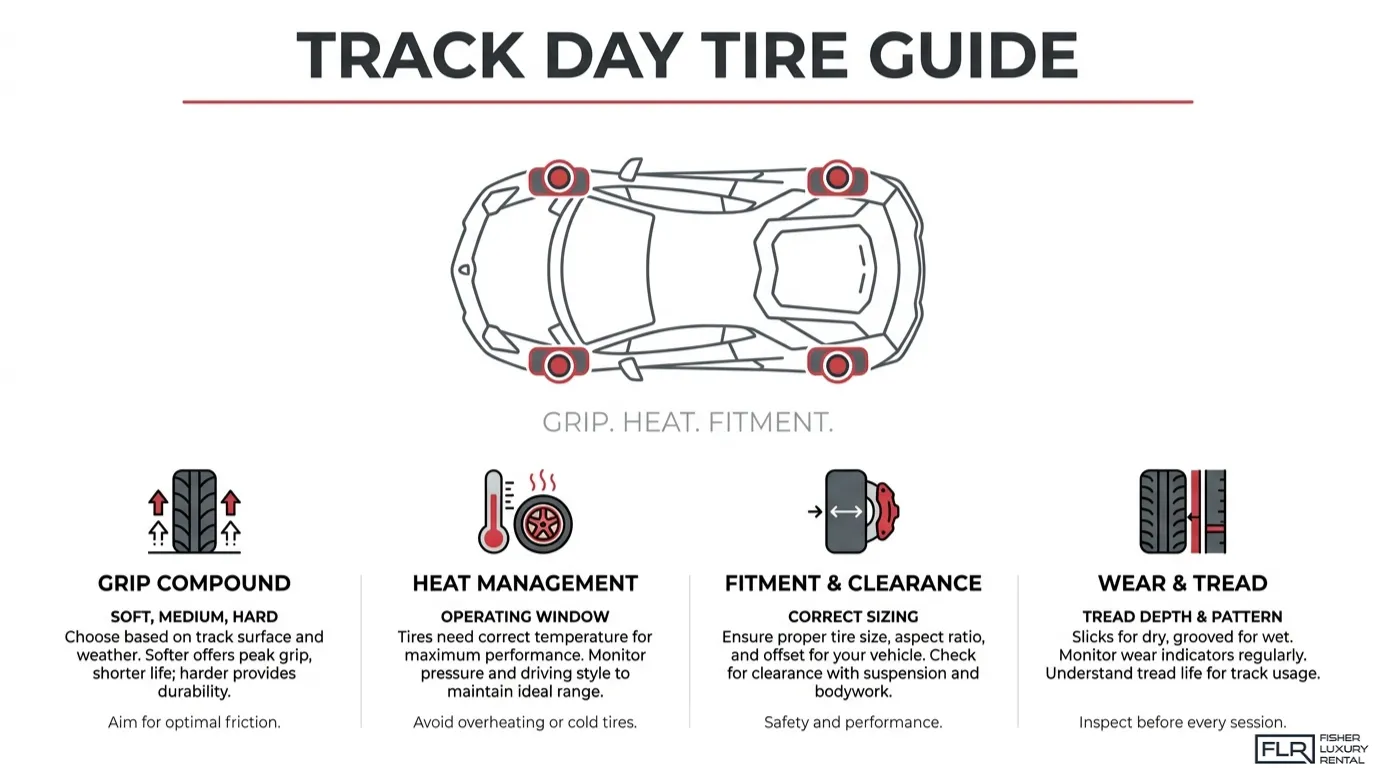
The best tires for track day supercars are purpose-built compounds matched to a specific car’s weight distribution, power output, fitment specs, and the thermal conditions of the circuit. Tire selection outranks every other performance modification because all mechanical force from a 600-plus horsepower supercar transfers through four contact patches, each roughly the size of a human hand.
This guide covers why tires matter above all other upgrades, the five tire categories available for track use, model-specific fitment recommendations for mid-engine and front-engine GT supercars, the leading tire brands and how each performs, and the technical disciplines of fitment, compound chemistry, pressure management, heat cycling, surface and climate matching, and proper maintenance.
Tires matter more than any other modification because grip, braking, and cornering all depend on adhesion and hysteresis in the tread rubber. Aerodynamic and suspension upgrades only deliver performance to the extent the contact patch can receive and transmit the resulting forces.
Track day tire categories range from street-legal performance summer tires to full slick racing compounds, each offering a distinct balance of grip, durability, road legality, and heat tolerance suited to different experience levels and supercar setups. For those newer to high-performance driving, spending time behind the wheel of a rental exotic, such as those available through Fisher Luxury Rental in Phoenix and Portland, can help build the foundational feel for how a supercar responds before investing in purpose-built track rubber.
Model-specific fitment covers the Lamborghini Huracán, Ferrari 488 and F8, McLaren 720S and 765LT, Porsche 911 GT3, Chevrolet Corvette Z06, Aston Martin Vantage, Mercedes-AMG GT, and Nissan GT-R Nismo, with validated compound choices and OEM size requirements for each.
Compound chemistry, pressure protocols, heat-cycle discipline, climate-based selection, and storage practices together determine lap time and tire longevity across a full season of track use.
Why Do Tires Matter More Than Any Other Mod for Track Day Supercars?
Tires matter more than any other modification for track day supercars because they are the only contact point between a 600-plus horsepower car and the pavement. Every performance gain from engine, suspension, or aero upgrades must ultimately transfer through four tire contact patches, each roughly the size of a human hand.
How Do Tires Directly Control Grip, Braking, and Cornering?
Tires directly control grip, braking, and cornering by converting the mechanical forces generated by the drivetrain and chassis into friction against the track surface. According to a 1968 Transportation Research Board study on tire-pavement friction, under dry conditions friction is almost entirely due to adhesion and hysteresis losses in the tread rubber. These two mechanisms, adhesion (molecular bonding between rubber and asphalt) and hysteresis (energy absorption as rubber deforms over surface irregularities), determine how much lateral and longitudinal force a tire can produce at any given moment.
The compound and construction determine the ceiling of those forces. A tire running at the wrong temperature, wrong pressure, or past its heat-cycle limit cannot fully exploit adhesion or hysteresis, regardless of how capable the supercar beneath it is. That physical reality is why tire selection outranks every other track day upgrade.
Why Can’t Aerodynamic or Suspension Mods Replace Better Tires?
Aerodynamic and suspension modifications cannot replace better tires because they produce performance only to the extent that the tire contact patch can receive and transmit the resulting forces. Downforce increases vertical load, but if the tire compound cannot convert that load into lateral grip, the added aerodynamic work is partially wasted. Similarly, suspension geometry improvements optimize contact-patch angle and load distribution, but a tire already at its thermal limit will simply slide regardless of how precisely the geometry is set.
A 2010 U.S. Department of Transportation study on tire-pavement friction confirmed that friction depends on viscoelastic properties of the rubber, pavement texture, temperature, vehicle speed, slip ratio, and normal pressure acting together. Suspension and aero influence only some of those variables; compound chemistry and construction influence them all. In practice, a supercar on the correct high-performance tires will outpace the same car on mismatched tires with an upgraded suspension, every time. Drivers who haven’t yet experienced how a factory-spec exotic performs on its OEM tire compounds can gain that baseline reference through a rental before committing to aftermarket upgrades.
What Role Does Tire Temperature Play in Supercar Track Performance?
Tire temperature plays the role of activating or deactivating the compound’s grip potential during a track session. Performance tire compounds require a specific operating temperature window to achieve full adhesion and hysteresis output. Below that window, the rubber remains too stiff to conform to surface microtexture, reducing adhesion. Above it, the compound softens excessively, accelerating wear and causing unpredictable handling.
A 2020 study published in Polymers via PubMed Central on rubber compound mechanics found that crosslink density has the most significant effect on the mechanical properties of rubber, and that filler dispersion and filler-rubber interaction also govern performance. Temperature directly alters how those crosslinks and fillers function under dynamic load. This means thermal management during a session, controlled through compound selection, pressure settings, and driving style, is as technically demanding as any chassis tuning decision a driver makes on track.
What Types of Tires Can You Use on a Track Day Supercar?
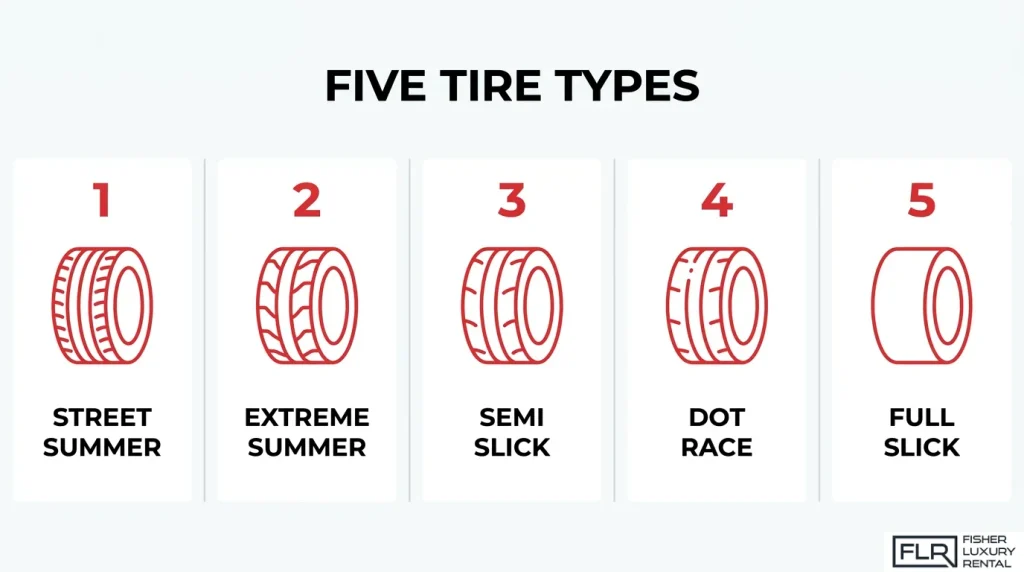
The types of tires you can use on a track day supercar range from street-legal summer tires to full slick racing compounds. Each category offers a distinct balance of grip, durability, road legality, and heat tolerance suited to different track experience levels and supercar setups.
Street-Legal Performance Summer Tires
Street-legal performance summer tires are the entry point for track day use, designed to work on both public roads and closed circuits without modification. Tires in this category, such as the Michelin Pilot Sport 4S and Pirelli P Zero, feature tread patterns optimized for high-speed cornering while retaining the wet-weather drainage grooves required for road legality. They warm up gradually, making them forgiving for drivers newer to track environments. For a rented supercar or a daily-driven exotic, this category provides the most practical starting point.
Extreme Performance Summer Tires
Extreme performance summer tires occupy the tier directly above standard performance summer tires, using softer rubber compounds and reduced tread depth for greater dry-surface grip. Models such as the Michelin Pilot Sport Cup 2 and Pirelli P Zero Corsa carry DOT approval for road use while delivering contact-patch characteristics that approach semi-slick territory. The trade-off is accelerated wear and significantly reduced cold-weather and wet-weather capability compared to standard performance tires. They represent the most popular choice for factory-equipped supercars attending open-lapper events.
R-Compound Semi-Slick Tires
R-compound semi-slick tires use a race-derived rubber compound with minimal tread grooves, retaining just enough patterning to qualify for street legality in most jurisdictions. Tires such as the Toyo Proxes R888R and Bridgestone Potenza RE-71RS deliver grip levels that close the gap to dedicated slicks while remaining DOT-marked. Semi-slicks require higher operating temperatures to reach their performance window, meaning they demand consistent, sustained track use rather than occasional street driving to perform correctly.
DOT-Approved Competition Tires
DOT-approved competition tires are tires that carry a DOT marking but are engineered specifically for motorsport rather than daily road use. In the United States, the National Highway Traffic Safety Administration operates a self-certification process, meaning manufacturers declare compliance with Federal Motor Vehicle Safety Standards without third-party pre-approval before sale. This framework allows competition-focused tires such as the Michelin Pilot Sport Cup 2 R and Pirelli P Zero Trofeo RS to be sold legally for road use while using compounds optimized almost entirely for track performance.
Full Slick Racing Tires
Full slick racing tires eliminate all tread grooves to maximize the contact patch area between the rubber and the track surface. The Sports Car Club of America notes that proper tire management, including monitoring pressures before and immediately after sessions, is essential for slicks because their narrow operating temperature window makes pressure control critical to both performance and longevity. Full slicks are not road-legal and are typically restricted to dedicated race series or closed private test days. For supercar track experiences at open-lapper events, full slicks are rarely permitted and are impractical without a dedicated race setup, tire warmers, and expert support.
What Are the Best Track Day Tires for Mid-Engine Supercars?
The best track day tires for mid-engine supercars vary by platform, weight distribution, and power delivery. The sections below cover optimal fitments for the Lamborghini Huracán, Ferrari 488 and F8, McLaren 720S and 765LT, Porsche 911 GT3, and Chevrolet Corvette Z06.
Which Tires Work Best on the Lamborghini Huracán?
The tires that work best on the Lamborghini Huracán are wide-contact semi-slick and extreme-performance summer options sized to the car’s staggered OEM fitment. The Huracán’s all-wheel-drive layout distributes torque aggressively, so rear tires must handle sustained lateral and longitudinal loads simultaneously. The Michelin Pilot Sport Cup 2 R and Pirelli P Zero Trofeo RS are the most commonly validated choices, both available in the OEM-specified front and rear widths. These compounds reach operating temperature quickly, which suits the Huracán’s tendency to generate heat fast under hard braking. Running undersized aftermarket replacements risks uneven wear patterns across the AWD system, making OEM-width fitment a non-negotiable baseline for track use.
Which Tires Work Best on the Ferrari 488 and F8?
The tires that work best on the Ferrari 488 and F8 are rear-biased performance compounds matched to the car’s staggered fitment and high rear downforce profile. Both models produce extreme rear-axle loads at speed, so the rear tire compound must resist heat buildup across extended sessions. The Michelin Pilot Sport Cup 2 R is a factory-validated option for both platforms, offering the tread stiffness needed to maintain contact-patch integrity under the F8’s 710-horsepower output. The Pirelli P Zero Trofeo RS also fits both models and provides slightly more aggressive initial bite. Prioritizing rear compound durability over peak grip pays dividends during multi-session track days, where consistent lap times matter more than a single fast outlier.
Which Tires Work Best on the McLaren 720S and 765LT?
The tires that work best on the McLaren 720S and 765LT are ultra-low-profile semi-slick compounds sized to the platform’s extreme staggered geometry. The 720S and 765LT use a rear-mid-engine layout that concentrates mass centrally, producing rapid weight transfer that demands tires with high lateral stiffness. OEM fitment calls for notably wide rear tires to manage the 765LT’s 755-horsepower output. The Pirelli P Zero Trofeo RS and Michelin Pilot Sport Cup 2 R are both validated for these platforms and deliver the sidewall rigidity needed to resist squirm under aggressive cornering. For the 765LT specifically, staying within validated size ranges is critical, as even small deviations affect the car’s finely calibrated suspension geometry and active dynamics system.
Which Tires Work Best on the Porsche 911 GT3?
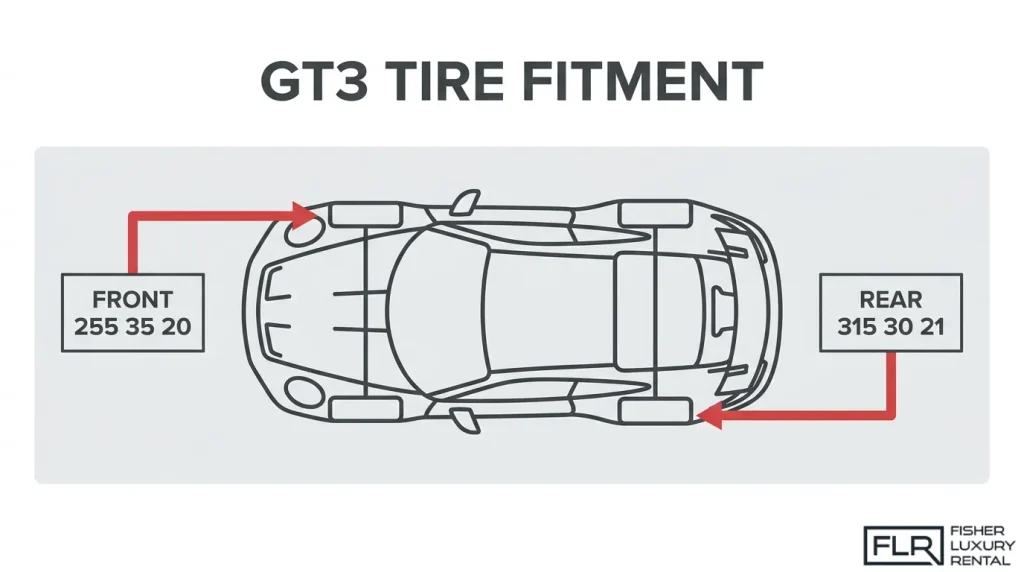
The tires that work best on the Porsche 911 GT3 are staggered-fitment semi-slick compounds engineered for the car’s rear-engine weight bias. According to Porsche Club of America, the 2022 911 GT3 (992) uses 255/35-20 front and 315/30-21 rear tires wrapped around 9.5 x 20-inch and 12 x 21-inch wheels respectively. That 315-wide rear footprint is essential for managing the pendulum effect created by the rear-mounted flat-six under hard braking. The Michelin Pilot Sport Cup 2 R is the OEM-specified tire on GT3 RS variants and delivers the fastest warm-up of any street-legal compound in this class. Deviating from the 315 rear width risks reducing the mechanical grip margin that the GT3’s chassis relies on to stay predictable near the limit.
Which Tires Work Best on the Chevrolet Corvette Z06?
The tires that work best on the Chevrolet Corvette Z06 are high-load-rated semi-slick compounds matched to the front-mid-engine platform’s balanced weight distribution and wide track width. The Z06’s naturally aspirated flat-plane-crank V8 delivers power cleanly rather than in surges, allowing softer semi-slick compounds to maintain operating temperature without overheating. The Michelin Pilot Sport Cup 2 R is a factory option on Z06 configurations, offering strong edge grip suited to the car’s wide front and rear track. The Goodyear Eagle F1 SuperSport RS also fits Z06 fitment specs and provides competitive wear resistance for drivers running multiple track sessions per event. Of all the platforms covered here, the Z06 rewards tire selection that maximizes mechanical grip balance front-to-rear rather than prioritizing outright rear compound grip alone.
What Are the Best Track Day Tires for Front-Engine GT Supercars?
The best track day tires for front-engine GT supercars vary by model, weight distribution, and power delivery. The H3s below cover fitment and compound recommendations for the Aston Martin Vantage, Mercedes-AMG GT, and Nissan GT-R Nismo.
Which Tires Work Best on the Aston Martin Vantage?
The tires that work best on the Aston Martin Vantage are rear-biased fitments that manage the front-heavy weight distribution while sustaining grip through long, fast corners. The Vantage carries significant mass over the front axle, which loads front tires harder than most mid-engine rivals during trail-braking. Michelin Pilot Sport Cup 2 R and Pirelli P Zero Trofeo RS are the most commonly recommended options, both offering the lateral stiffness and heat tolerance the Vantage demands. Running a staggered setup with a wider rear fitment helps balance understeer tendencies under power. For track days without strict class regulations, these semi-slick compounds provide the best combination of initial bite and consistent lap-to-lap performance.
Which Tires Work Best on the Mercedes-AMG GT?
The tires that work best on the Mercedes-AMG GT are rear-biased performance compounds suited to its front-engine, rear-transaxle layout and high torque output. The AMG GT places exceptional stress on rear tires during hard acceleration exiting slow corners, making heat resilience and lateral stability the primary selection criteria. Michelin Pilot Sport Cup 2 R handles these demands well, delivering progressive feedback as rear loads increase. Pirelli P Zero Trofeo RS is a strong alternative for drivers prioritizing outright corner-exit grip over session longevity. Both compounds should be run slightly staggered in width to match the AMG GT’s rear-heavy torque bias and prevent premature rear-tire wear during high-horsepower exits.
Which Tires Work Best on the Nissan GT-R Nismo?
The tires that work best on the Nissan GT-R Nismo are stiff-sidewall, high-load-rated compounds compatible with its all-wheel-drive system and aggressive torque vectoring. The GT-R Nismo uses all four contact patches simultaneously under hard acceleration, making uniform grip across the axle especially important. Dunlop Sport Maxx Race 2 tires are OEM-specified for the Nismo variant, engineered to handle the combined thermal and lateral loads the AWD system generates. Aftermarket upgrades to Michelin Pilot Sport Cup 2 R or Bridgestone Potenza RE-71RS can improve lap times, provided load ratings meet or exceed OEM specifications. For a front-engine GT supercar, the GT-R rewards tire choices that deliver balanced four-corner bite rather than rear-focused compounds.
Which Tire Brands Dominate Supercar Track Day Performance?
The tire brands that dominate supercar track day performance are Michelin, Pirelli, Bridgestone, Toyo, and Goodyear, each offering purpose-built compounds targeting different grip, wear, and temperature profiles. The sections below compare the Pilot Sport Cup 2 R, P Zero Trofeo RS, Potenza RE-71RS, Proxes R888R, and Eagle F1 SuperSport RS across key performance dimensions.
How Does the Michelin Pilot Sport Cup 2 R Perform?
The Michelin Pilot Sport Cup 2 R performs as a DOT-legal semi-slick that consistently sets the benchmark for road-legal track tires, serving as OEM fitment on the Ferrari 488 Pista, Porsche GT3 RS, and McLaren 720S. Its bi-compound construction pairs a softer outer shoulder for cornering grip with a stiffer inner section for stability under braking. The Cup 2 R requires sustained heat to reach peak operating window, making it less effective in ambient temperatures below 50°F. For drivers using a supercar that left the factory on this tire, it remains the safest choice to preserve predictable handling characteristics at the limit.
How Does the Pirelli P Zero Trofeo RS Perform?
The Pirelli P Zero Trofeo RS performs as a high-grip semi-slick developed in close partnership with Lamborghini and Ferrari as OEM fitment on track-focused variants. Its asymmetric tread pattern uses a near-slick inner zone with light drainage channels on the outer shoulder, generating strong lateral grip from a wider effective operating temperature range than the Cup 2 R. The Trofeo RS warms faster, making it more accessible on cooler track mornings, though this broader window can come at the cost of peak lap-time performance compared to a fully heat-soaked Cup 2 R. Head-to-head comparisons on controlled circuits have shown negligible lap-time differences between the two, with driver preference and surface texture ultimately deciding the winner.
How Does the Bridgestone Potenza RE-71RS Perform?
The Bridgestone Potenza RE-71RS performs as an extreme-performance summer tire that sits one category below a true semi-slick, offering a strong balance of street usability and track capability. Its asymmetric compound uses a high-silica outer block for dry cornering and a reinforced inner rib for stability. The RE-71RS suits drivers who trailer their supercar to the track, because its tread depth allows more sessions before wear becomes critical compared to the Cup 2 R or Trofeo RS. It is a practical choice for high-powered front-engine GT cars where compound durability across longer track days matters as much as outright lap pace.
How Does the Toyo Proxes R888R Perform?
The Toyo Proxes R888R performs as an R-compound semi-slick that prioritizes mechanical grip through an ultra-soft compound, making it one of the stickiest DOT-legal options available for club-level track days. Its large tread blocks and shallow depth minimize squirm under lateral loading, producing sharp initial turn-in response. Wear rates are aggressive, particularly on high-horsepower rear-wheel-drive supercars, so the R888R suits short sprint sessions more than endurance lapping. The R888R’s UTQG treadwear rating sits at 100, placing it firmly in semi-slick territory with limited road driving practicality between events.
How Does the Goodyear Eagle F1 SuperSport RS Perform?
The Goodyear Eagle F1 SuperSport RS performs as a track-focused semi-slick developed specifically as OEM fitment on the Porsche 911 GT2 RS and Chevrolet Corvette C8 Z06. Its compound uses a hybrid silica-carbon black formulation that sustains grip across a wide operating temperature range, giving it strong performance from the first timed lap through extended sessions. The SuperSport RS offers meaningfully longer tread life than either the Cup 2 R or Trofeo RS at comparable grip levels, making it a compelling value proposition for drivers running multiple track weekends per season. For supercar owners prioritizing fewer tire changes without sacrificing podium-competitive lap times, the Eagle F1 SuperSport RS is often the most practical choice in the semi-slick category.
What Tire Size and Fitment Specs Should You Follow?
Tire size and fitment specs vary by model, with OEM dimensions defining the baseline for load ratings, speed ratings, and compatible aftermarket fitments. The sections below cover fitment details for the Porsche 911 GT3, along with key fitment principles for other track-day supercars.
Porsche 911 GT3
The 2022 Porsche 911 GT3 (992) uses 255/35-20 front tires and 315/30-21 rear tires, mounted on 9.5 x 20-inch and 12 x 21-inch wheels respectively, according to the Porsche Club of America. This staggered setup reflects the rear-biased weight distribution of the GT3 and demands aftermarket tires that match the OEM load index precisely. Running undersized or mismatched load ratings on a 500-plus horsepower rear-engine platform is a risk no lap time justifies.
Load Ratings, Speed Ratings, and Validated Aftermarket Fitments
Tire load ratings and speed ratings define the structural and thermal limits a tire can sustain during sustained track use. For supercars, exceeding these limits under repeated high-speed cornering causes carcass deformation and dangerous heat buildup. Validated aftermarket fitments for track use should meet or exceed OEM load index and carry a minimum speed rating of Y (186 mph) or ZR for high-downforce applications.
Key fitment criteria for track-day supercars include:
- Load index: Match or exceed the OEM specification for each axle.
- Speed rating: Y (186 mph) or ZR minimum for sustained track speeds.
- Rim width compatibility: Verify the tire’s listed rim width range includes the fitted wheel width.
- Overall diameter tolerance: Stay within 3% of OEM diameter to preserve ADAS calibration and stability control accuracy.
How Does Tire Compound Affect Grip and Wear on Track?
Tire compound affects grip and wear on track by controlling how much rubber surface bonds with the asphalt, how quickly heat builds in the tread, and how fast the contact layer degrades under load. The H3 sections below cover soft, medium, and hard compound tradeoffs in sequence.
How Do Soft-Compound Tires Trade Grip for Longevity?
Soft-compound tires trade grip for longevity by offering maximum adhesion at the cost of accelerated tread wear. A softer rubber matrix deforms more readily into pavement microtextures, increasing contact area and peak lateral force. That same pliability, however, means the tread ablates faster under braking and cornering loads, particularly on high-horsepower supercars generating sustained downforce. Crosslink density in the vulcanized rubber governs this balance: a lower crosslink density produces a more compliant, grippy compound but reduces structural resistance to shear stress at elevated temperatures. For sprint-format track days, the shortened service life is an acceptable tradeoff. For events spanning multiple long sessions, soft-compound attrition can become a practical problem before lap count goals are reached.
How Do Medium-Compound Tires Balance Grip and Wear?
Medium-compound tires balance grip and wear by positioning tread stiffness and heat tolerance between the soft and hard extremes. They reach operating temperature more gradually than soft compounds but sustain performance across a wider session-length window. According to a 2023 U.S. Environmental Protection Agency report, tire-road contact causes abrasion of both the tire and road surface, depositing particles that enter stormwater or become airborne dust. This abrasion rate is measurably lower on medium compounds than on soft compounds under equivalent track loads, reflecting the higher crosslink density that resists surface shear. Medium compounds suit multi-session track days where drivers need consistent lap times without a mid-day tire swap.
How Do Hard-Compound Tires Perform in Endurance Sessions?
Hard-compound tires perform best in endurance sessions because their higher crosslink density resists heat degradation and surface abrasion across extended run times. The stiffer tread generates less peak grip than soft compounds, requiring a longer warm-up period before the compound reaches its optimal operating window. Once at temperature, hard compounds deliver predictable, repeatable behavior lap after lap. A 2020 study published in Polymers via PubMed Central confirmed that crosslink density has the most significant effect on mechanical properties of rubber, directly explaining why hard compounds maintain structural integrity where softer alternatives would grain or chunk. For endurance-format days on high-load supercars, hard compounds are the practical choice when tire longevity outranks outright peak grip.
What Tire Pressures Should You Run on Track Day?
Tire pressures for track day require two separate measurements: cold pressure before you leave the pits and hot pressure immediately after returning. According to the Sports Car Club of America, pyrometer data across three points on each tire (outside, middle, and inside) completes the picture and tells you whether your setup is dialed in.
What Cold Pressures Work Best for Semi-Slick Tires?
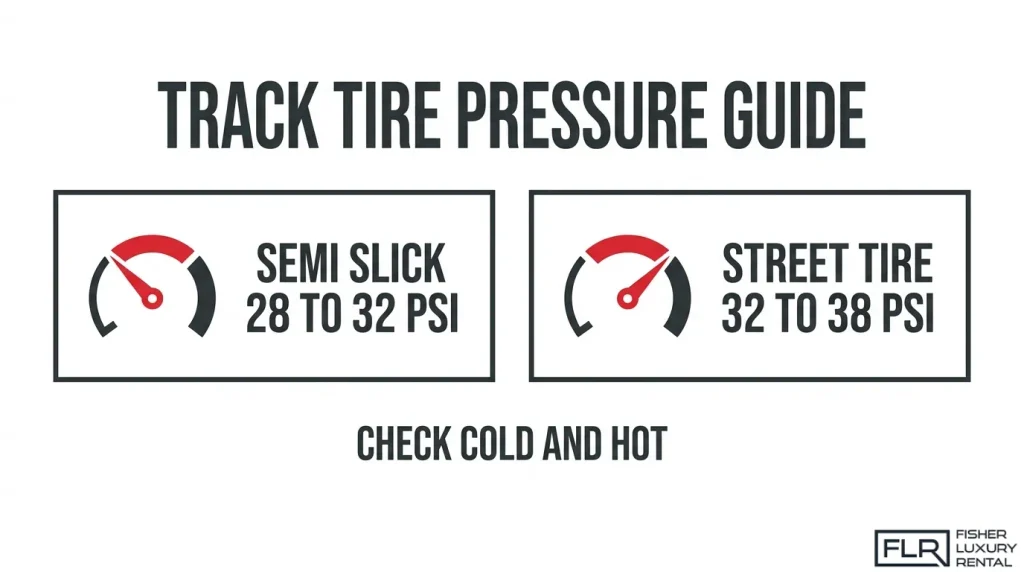
Cold pressures for semi-slick tires typically start in the range of 28 to 32 PSI. Semi-slicks generate significant heat under track conditions, so starting on the lower end of the recommended range leaves room for thermal expansion without exceeding the tire’s optimal hot operating window. The European Tyre and Rim Technical Organisation defines cold inflation as pressure measured after at least one hour of rest or only minimal low-speed running. Running too high a cold pressure on a semi-slick reduces the contact patch before the tire has a chance to heat cycle properly, which costs grip in the critical first laps.
What Cold Pressures Work Best for Street Performance Tires?
Cold pressures for street performance tires on track generally fall between 32 and 38 PSI, slightly higher than semi-slick starting points. Street performance tires have stiffer sidewalls and are engineered to a different operating temperature window, so they require more inflation to maintain carcass integrity under sustained lateral loads. Dropping too far below 32 PSI risks sidewall roll and unpredictable handling in high-speed corners.
How Should You Adjust Pressures During a Track Session?
Tire pressure adjustment during a track session works by using post-session hot readings to calculate the rise from your cold baseline. A healthy cold-to-hot rise is typically 4 to 6 PSI for semi-slicks and 5 to 8 PSI for street performance tires. If hot pressures climb beyond this range, reduce cold pressures by 1 to 2 PSI before the next session. Pyrometer readings across the outside, middle, and inside of the tread confirm whether pressure is correct: a hotter center band than edges indicates overinflation, while hotter edges signal underinflation. Before returning to road use, always restore pressures to the manufacturer’s recommended street specification.
How Do Heat Cycles Affect Track Day Tire Performance?
Heat cycles affect track day tire performance by progressively degrading the rubber compound’s molecular structure, reducing grip with each successive cycle. The sections below cover molecular bonding changes, optimal cycle counts by tire type, and between-event storage practices.
How Do Heat Cycles Degrade Tire Compounds?
Heat cycles degrade tire compounds by breaking down the sulfur crosslinks and polymer chains that give the rubber its grip characteristics. Each time a tire heats to operating temperature and cools, the compound undergoes thermo-oxidative stress: oxygen reacts with the polymer backbone, stiffening the matrix and reducing the rubber’s ability to conform to pavement micro-texture. According to research published via the U.S. Department of Energy’s Office of Scientific and Technical Information, chemical reactions between the polymer backbone and oxygen during thermo-oxidative aging are the primary cause of changes in the polymer matrix. In practical terms, a tire that gripped confidently in its first session may feel progressively wooden and slow-building in later ones, even with no visible wear.
What Are the Optimal Heat-Cycle Counts by Tire Type?
The optimal heat-cycle counts vary by tire type, with softer competition compounds exhausting their performance window far sooner than harder street-performance tires. As a general framework:
- DOT competition/R-compound semi-slicks: typically 6 to 10 heat cycles before peak grip degrades noticeably.
- Extreme performance summer tires: generally 10 to 20 cycles before meaningful compound hardening occurs.
- Street performance summer tires: the most heat-cycle-resilient category, often usable for 20 or more cycles with gradual degradation.
Softer compounds deliver their best lap times within the first few cycles, making cycle management a critical discipline for anyone prioritizing consistent performance over a season.
How Should You Store Track Tires Between Events?
Track tires should be stored in a clean, dry, cool, and well-ventilated location between events. The U.S. Tire Manufacturers Association states that tires, whether mounted on a rim or not, must be kept away from heat, sunlight, and chemicals to prevent compound damage. UV exposure accelerates oxidative hardening, while ozone from electrical equipment causes surface cracking. Keeping tires in opaque bags in a temperature-stable garage extends usable cycle life noticeably. Proper storage is often underestimated, but it directly impacts how many competitive heat cycles remain in a set when the next track day arrives.
How Does Track Surface and Climate Change Your Tire Choice?
Track surface and climate directly change your tire choice by altering grip demand, compound activation temperatures, and wear rates. The following H3s cover abrasive desert circuits, smooth technical circuits, and ambient temperature ranges.
Which Tires Perform Best on Abrasive Desert Circuits?
Tires that perform best on abrasive desert circuits are harder-compound options with reinforced sidewalls, such as the Toyo Proxes R888R and Goodyear Eagle F1 SuperSport RS. Coarse pavement aggressively abrades soft compounds, generating excessive heat buildup and dramatically shortening tread life. A 2023 U.S. EPA report confirmed that contact between tires and road surfaces causes abrasion of both the tire and the road, depositing wear particles near roadways. On abrasive circuits, prioritizing compound durability over peak grip is the more practical approach for any multi-session track day.
Which Tires Perform Best on Smooth Technical Circuits?
Tires that perform best on smooth technical circuits are soft-compound, high-grip options such as the Michelin Pilot Sport Cup 2 R and Pirelli P Zero Trofeo RS. Smooth asphalt reduces abrasive wear, allowing softer compounds to operate within their optimal temperature window for longer. Without the aggressive texture of desert-grade pavement to generate excessive heat, these tires maintain consistent contact patch compliance through tight, technical sections where lateral load sensitivity is highest.
How Does Ambient Temperature Affect Tire Selection?
Ambient temperature affects tire selection by determining how quickly and completely a compound reaches its operating grip window. A 2010 U.S. Department of Transportation study found that tire-pavement friction depends on multiple variables including temperature, viscoelastic properties of rubber, vehicle speed, and normal pressure. The three key temperature bands each call for a different compound strategy:
- Below 50°F: Soft compounds, such as the Michelin Cup 2 R, activate sooner on cold asphalt, where harder compounds remain too stiff to generate adequate friction.
- 50°F to 75°F: Medium-compound tires, such as the Pirelli P Zero Trofeo RS, offer the broadest operational window across this moderate range.
- Above 75°F: Harder-compound or heat-stable options, such as the Bridgestone Potenza RE-71RS, resist thermal degradation and graining when ambient heat accelerates compound softening.
The European Tyre and Rim Technical Organisation recommends measuring cold inflation pressure only after tires have rested for at least one hour or covered no more than two to three kilometers at low speed, since pressure rises as tires warm. This matters most in hot climates where ambient heat pre-loads the tire before the session even begins.
How Should You Maintain and Store Track Day Tires?
Maintaining and storing track day tires correctly extends their usable life and preserves compound integrity between events. The key practices cover inspection after sessions, heat cycle management, and proper storage conditions.
How Should You Inspect Track Tires After Each Session?
Track tire inspection should begin immediately after each session, while heat-related damage is still visible. Check for the following:
- Tread wear indicators: Uneven wear across the contact patch signals misaligned camber or incorrect pressure.
- Chunking and blistering: Surface chunks or bubbles indicate the compound exceeded its thermal limit.
- Sidewall cracking: Fine cracks along the sidewall suggest the rubber is oxidizing between events.
- Embedded debris: Stones, grit, and track particulates lodge in tread grooves and accelerate compound degradation.
Catching these issues early prevents a compromised tire from being mounted for the next event.
How Many Heat Cycles Do Track Day Tires Last?
Heat cycle count determines when track day tires should be retired, and it varies by tire category. Each time a tire heats to operating temperature and cools completely, the rubber compound undergoes irreversible molecular restructuring. According to research published by the U.S. Department of Energy, chemical reactions between the polymer backbone and oxygen during thermo-oxidative aging are the primary cause of changes in the polymer matrix. This process accelerates with each cycle.
General heat cycle limits by tier:
- R-compound semi-slicks: Typically 6 to 10 heat cycles before grip drops measurably.
- Extreme performance summer tires: Approximately 10 to 15 cycles under hard track use.
- Street performance tires used on track: Wear-limited rather than cycle-limited in most cases.
Tracking cycle count per set is one of the most underrated maintenance habits serious track drivers use.
How Should You Store Track Day Tires Between Events?
Track day tires should be stored in a clean, dry, cool, well-ventilated place to prevent damage from heat, sunlight, and chemicals, as recommended by the U.S. Tire Manufacturers Association. Ozone generated by electric motors and UV exposure accelerates surface cracking even on unmounted tires. Additional storage guidelines include:
- Keep tires upright or stacked flat on a clean, dry surface away from concrete floors when possible.
- Avoid hanging tires by a single bead, which stresses the sidewall structure.
- Seal tires in opaque plastic bags when storing longer than a few weeks to limit ozone exposure.
- Maintain ambient temperatures between 40°F and 70°F; extreme cold makes compounds brittle, and heat accelerates aging.
Proper storage between events preserves the compound characteristics that make high-performance tires worth the investment.
How Can You Experience Supercar Performance Firsthand?
You can experience supercar performance firsthand by renting an exotic car, then applying everything covered in this article about tires, pressures, and heat cycles. The sections below connect Fisher Luxury Rental’s offerings to the key takeaways from this guide.

Can Renting an Exotic Car from Fisher Luxury Rental Fuel Your Track Day Passion?
Yes, renting an exotic car from Fisher Luxury Rental can fuel your track day passion by placing you behind the wheel of a high-performance machine without the ownership costs of tires, storage, and maintenance.
Fisher Luxury Rental serves Phoenix, AZ and Portland, OR, offering top-trim exotic and luxury vehicles across its fleet. For car enthusiasts who want to understand how tire compound, pressure, and heat cycling translate into real-world feel, seat time in a well-maintained exotic rental is one of the most direct paths. Reading about Michelin Pilot Sport Cup 2 R behavior through high-speed corners only becomes meaningful once you have actually felt grip transition under braking. Fisher Luxury Rental offers exotic and luxury vehicles in Phoenix, AZ and Portland, OR, giving enthusiasts a practical way to build seat time in high-performance machines before making ownership or modification decisions. Renting before buying also lets you evaluate whether a specific platform suits your driving style before committing to a set of track tires. Renting before buying also lets you evaluate whether a specific platform suits your driving style before committing to ownership costs.
What Are the Key Takeaways About the Best Tires for Track Day Supercars?
The key takeaways about the best tires for track day supercars are that compound selection, fitment accuracy, pressure management, and heat-cycle discipline together determine lap time and tire longevity more than any single factor.
The most actionable conclusions from this guide are:
- Match compound to intent: Extreme performance summer tires suit occasional track days with street driving; semi-slick R-compounds suit dedicated sessions where warm-up laps are guaranteed.
- Follow OEM fitment sizes: Deviating from manufacturer-specified widths and load ratings on platforms like the Porsche 911 GT3 or Lamborghini Huracán compromises both handling balance and safety margins.
- Check cold pressures before every session: According to the Sports Car Club of America, pressures should be recorded cold before going on track and immediately after coming off, using pyrometer data across the outer, middle, and inner tread zones to diagnose setup issues.
- Respect heat-cycle limits: Each heat cycle degrades molecular bonding in the tread compound; exceeding the recommended cycle count for your tire type accelerates unpredictable grip loss.
- Store tires correctly between events: The U.S. Tire Manufacturers Association recommends storing tires in a clean, dry, cool, and well-ventilated place to prevent degradation from heat, sunlight, and chemicals.
- Adjust selection for climate: Ambient temperature and circuit abrasiveness both shift the optimal compound choice, with colder conditions favoring softer compounds that reach operating temperature more quickly.
Applying these principles consistently separates drivers who destroy a set of tires in two sessions from those who extract maximum performance across an entire season.