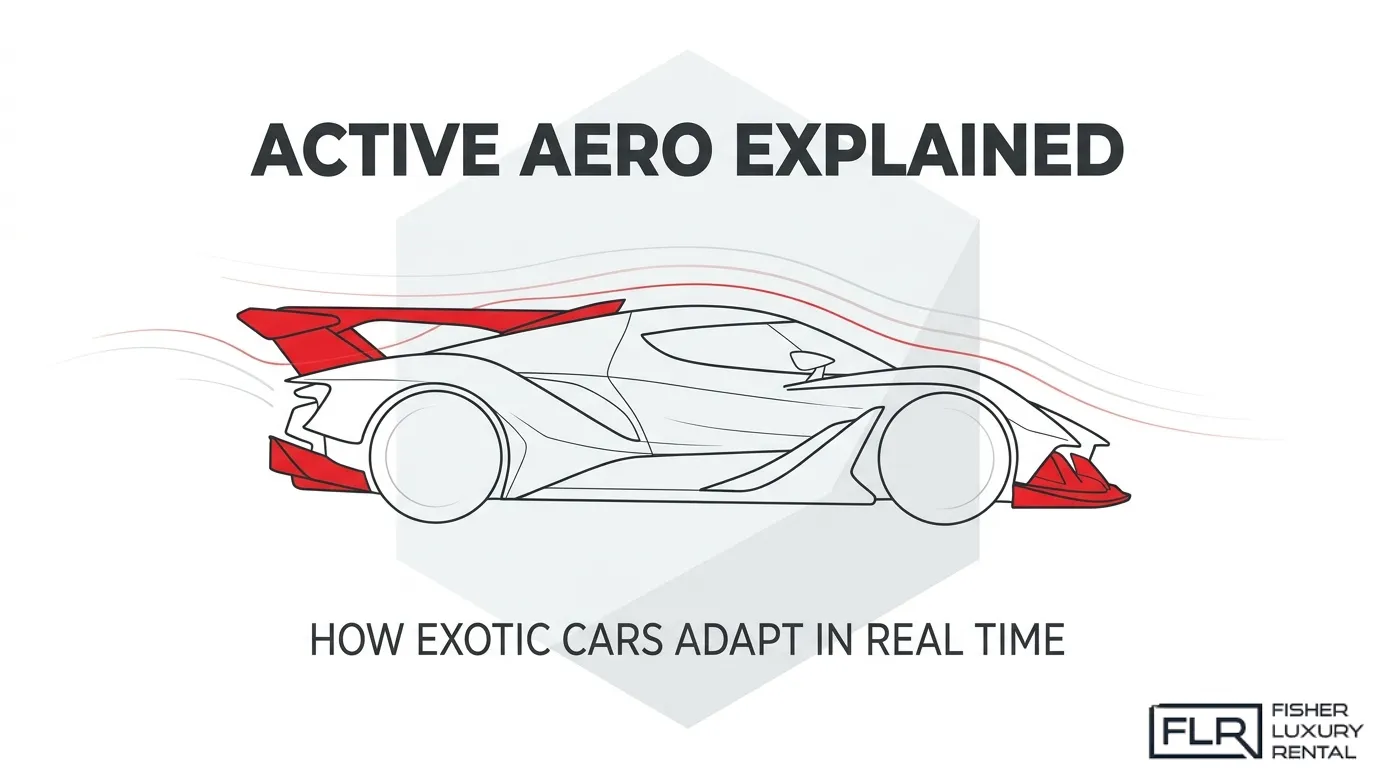
Active aerodynamics is a system of electronically or mechanically controlled surfaces, including wings, flaps, splitters, and diffusers, that adjust in real time as a car’s speed, braking force, and cornering load change. Unlike fixed passive components, these surfaces reposition continuously to balance two competing demands: maximum downforce for grip and minimum drag for speed.
This guide covers how active aero systems are built and function, how they perform across different speeds and driving conditions, which exotic cars use the most advanced implementations, and how to experience these systems firsthand through an exotic car rental.
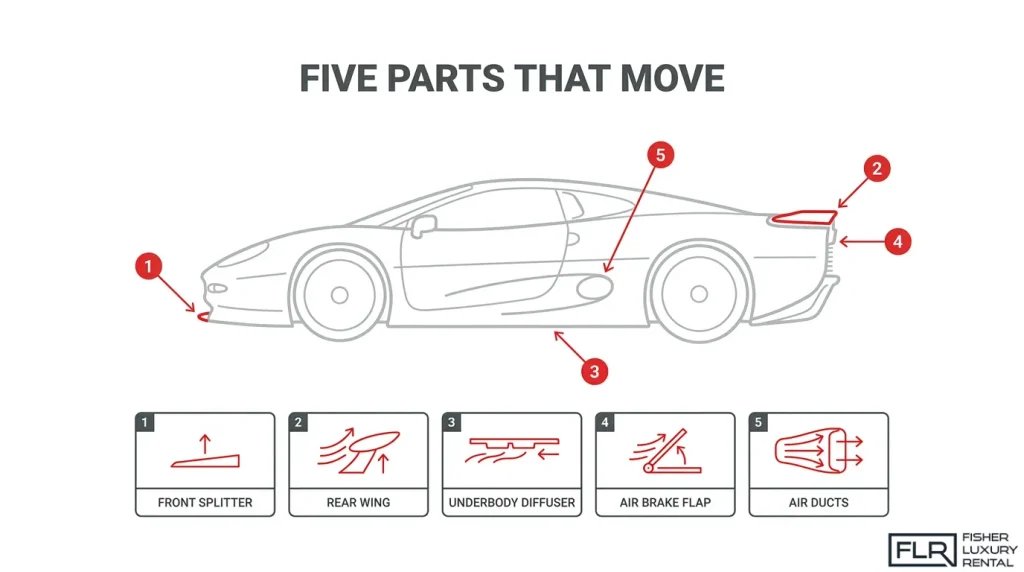
Active aero systems are constructed from several interdependent components: front splitters, rear wings, underbody diffusers, air brake flaps, and electronically controlled ducts. Each plays a distinct role, and systems like Lamborghini’s ALA demonstrate how these parts work together to adapt to driving style and route conditions simultaneously.
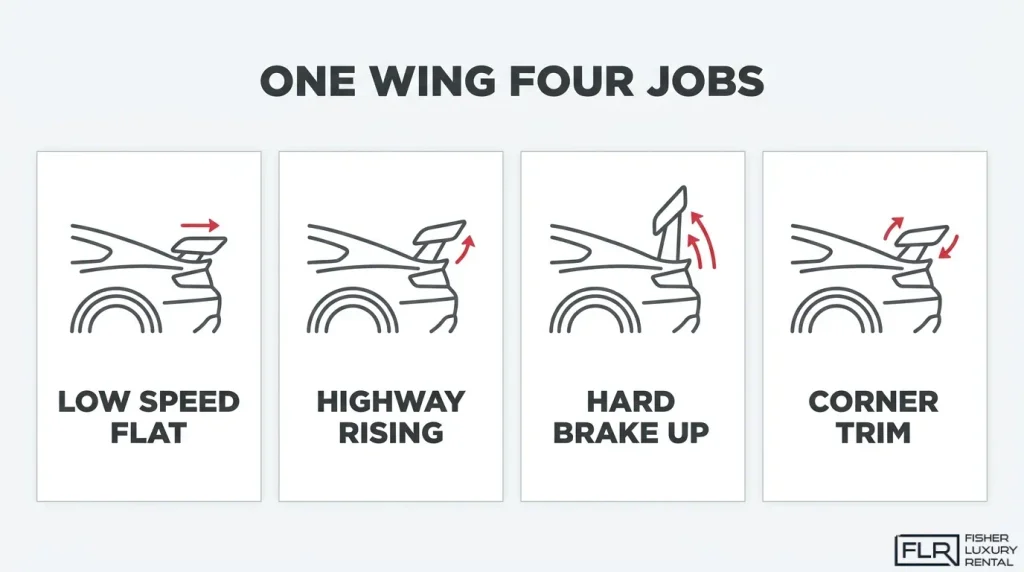
At different speeds, active rear wings behave in fundamentally different ways: sitting neutral at low speeds, deploying for downforce above highway thresholds, pivoting as air brakes under hard deceleration, and trimming their angle of attack through high-speed corners to sustain consistent grip without excess drag.
The cars that define this technology, including the McLaren P1, Porsche 911 GT3 RS, Lamborghini Huracán Performante, Ferrari SF90 Stradale, Bugatti Chiron, and Pagani Huayra, each use distinct engineering approaches to manage airflow, and their measurable results illustrate what active aero actually delivers.
Finally, the difference between everyday road use and track performance is stark, and renting an exotic car from Fisher Luxury Rental offers one of the most direct ways to experience that contrast in real conditions.
What Does Active Aerodynamics Mean in a Car?
Active aerodynamics means a system that automatically adjusts a vehicle’s aerodynamic surfaces in real time, responding to speed, braking, and cornering forces rather than remaining in a fixed position. These adjustments balance two competing priorities: maximum downforce for grip and minimum drag for speed. The following sections cover how active aero is defined, what differentiates it from fixed setups, and why the physics demand a dynamic solution.
What Is the Definition of Active Aerodynamics?
Active aerodynamics is the use of mechanically or electronically controlled surfaces, such as wings, flaps, and diffusers, that move to change a car’s airflow in response to driving conditions. Unlike static components, these surfaces reposition continuously as speed, braking force, and cornering load change. According to NASA, aerodynamics describes how objects move through air, and the forces generated scale dramatically with velocity. Because drag increases with the square of speed, a car traveling at 150 mph faces roughly four times the aerodynamic resistance of one traveling at 75 mph, making passive, fixed surfaces an inadequate solution for high-performance exotic cars.
How Does Active Aero Differ from Passive Aerodynamics?
Active aero differs from passive aerodynamics in that it changes configuration during driving, while passive aerodynamics uses fixed, unchanging surfaces. A standard rear spoiler generates the same downforce profile at every speed, requiring engineers to compromise between low-speed drag and high-speed grip. Active systems eliminate that compromise by adjusting angle, height, or orientation on demand. This is arguably the single most important distinction for anyone evaluating exotic car performance: passive aero optimizes for one operating condition, while active aero optimizes continuously across all of them.
Why Do Exotic Cars Use Active Aero Systems?
Exotic cars use active aero systems to solve a fundamental conflict: a fixed aerodynamic shape cannot simultaneously minimize drag for top speed and maximize downforce for cornering and braking. Active aero resolves this by adjusting in real time. The sections below cover the performance, safety, and speed benefits that drive this engineering choice.
Why Is Downforce So Critical at High Speeds?
Downforce is critical at high speeds because it presses the tires into the road surface, increasing the grip available for cornering and braking. Without sufficient downforce, aerodynamic lift reduces tire contact, making a car progressively harder to control as speed rises. The Lamborghini Huracán Performante’s ALA system illustrates this precisely: under braking, its spoilers reroute airflow to increase downforce, delivering additional grip exactly when the car needs it most. For engineers building cars that exceed 200 mph, passive downforce alone is insufficient because the wing angle required for cornering creates too much drag on the straight.
Why Does Reducing Drag Matter for Exotic Car Performance?
Reducing drag matters because aerodynamic resistance increases as the square of speed, meaning drag quadruples when speed doubles. A fixed high-downforce wing that generates the grip needed in corners becomes a significant speed penalty on straights. Active aero resolves this trade-off dynamically. According to a study published in Fluids (MDPI), activating a drag reduction flap generates approximately a 78% decrease in the aerodynamic drag coefficient, demonstrating how dramatically drag can be cut by adjusting wing geometry alone. Without this capability, manufacturers would be forced to compromise, accepting either slower top speeds or reduced cornering capability.
Why Do Active Aero Systems Improve Braking Safety?
Active aero systems improve braking safety by deploying additional aerodynamic resistance the moment hard braking is detected, shortening stopping distances at speeds where mechanical brakes alone face their limits. The Clemson University Center for Automotive Research documented that the McLaren MP4-12C’s active air brake reduces braking distances by up to 20 meters, deploying from 32 degrees to 69 degrees under airflow pressure above 95 kph. At the extreme end, the Bugatti Chiron uses 18 hydraulic cylinders to fold its rear wing upward as a brake flap, enabling safe deceleration from speeds exceeding 400 km/h. This braking function is arguably the most safety-critical role active aero performs.
Why Do Exotic Car Manufacturers Invest in Active Aero Over Passive Solutions?
Exotic car manufacturers invest in active aero because static aerodynamic solutions require choosing one performance mode permanently. Active systems allow a single car to behave as a low-drag sprint machine under acceleration and a high-downforce stability platform under braking, without the driver changing anything. Road & Track reported that the Lamborghini Huracán Performante lapped the Nürburgring 28 seconds faster than its LP610-4 sibling despite carrying only 30 additional horsepower, demonstrating that aerodynamic intelligence delivers performance gains that raw power alone cannot replicate. For manufacturers competing at the top of the exotic car segment, active aero is the difference between a very fast car and a genuinely exceptional one.
What Are the Main Components of an Active Aero System?
The main components of an active aero system are the front splitter, rear wing or spoiler, underbody panels and diffusers, air brake flaps, and electronically controlled air ducts. Systems like Lamborghini’s ALA demonstrate how these parts work together, adapting to driving style and route conditions to balance stability, downforce, and drag in real time.
Front Active Splitter
The front active splitter is a movable panel beneath the front bumper that controls airflow under and around the vehicle’s nose. According to a study published via PubMed Central, adding a front splitter produces a 9% reduction in drag alongside a 73% reduction in lift. The Pagani Huayra takes this further: its active front suspension and four corner flaps work together to optimally balance the drag coefficient and downforce across changing conditions. Front splitters are often the most underappreciated component in an active aero system, yet their lift-reduction effect directly determines how planted the front axle feels at speed.
Rear Active Wing or Spoiler
The rear active wing is a movable surface mounted at the vehicle’s tail that adjusts its angle of attack based on speed, cornering load, and braking demand. The Ford GT’s rear wing automatically deploys for aerodynamic effect above 90 mph and stows again below 81 mph, also activating as an air brake under hard deceleration, according to BBC TopGear. By trimming wing angle as speed rises, manufacturers reduce drag on straights while preserving the high-downforce angles needed for cornering stability.
Active Underbody Panels and Diffusers
Active underbody panels are adjustable surfaces mounted beneath the car’s floor that manage airflow between the vehicle and the road surface. By controlling the volume and velocity of air exiting through the diffuser, these panels regulate ground-effect downforce without adding drag-inducing wing area. The more efficiently a diffuser operates, the less rear wing angle is required to achieve equivalent total downforce, allowing engineers to optimize both top speed and cornering grip simultaneously.
Active Air Brake Flaps
Active air brake flaps are aerodynamic surfaces that deploy under hard braking to increase drag and transfer load onto the tires. The McLaren MP4-12C deploys its air brake above 95 kph: a piston sets the initial angle at 32 degrees, and passing airflow forces it to extend to 69 degrees, reducing braking distances by up to 20 meters, according to Clemson University’s Center for Automotive Research. This is one of the clearest examples of active aero delivering a direct, measurable safety benefit rather than just performance gain.
Electronically Controlled Air Ducts and Vents
Electronically controlled air ducts and vents are channels that direct airflow to radiators, brake cooling systems, and aerodynamic surfaces on demand. By opening or closing ducts based on thermal and speed data, the system reduces parasitic drag when cooling is not required and maximizes airflow when components need it most. This active thermal management allows exotic cars to maintain peak aerodynamic efficiency across the full range of driving conditions, from slow urban traffic to sustained high-speed runs.
How Does an Active Rear Wing Work at Different Speeds?
An active rear wing works by continuously adjusting its angle of attack in response to speed, braking force, and cornering load. The sections below cover low-speed behavior, highway deployment, hard-braking activation, and high-speed cornering response.
How Does an Active Rear Wing Behave at Low Speeds?
At low speeds, an active rear wing behaves passively, sitting in a low-drag, neutral position. Aerodynamic forces at low speeds are minimal, so the wing generates little meaningful downforce or drag. The system remains stowed until sensors detect speed thresholds or braking events that warrant deployment.
How Does an Active Rear Wing Adjust at Highway Speeds?
An active rear wing adjusts at highway speeds by extending and increasing its angle of attack to generate downforce as aerodynamic forces rise. According to BBC TopGear’s coverage of the Ford GT, the rear wing deploys automatically above 90 mph and retracts below 81 mph. At 124 mph, the Porsche Newsroom reports the 911 GT3 RS produces over 900 lbs. of downforce through its continuously adjustable two-part rear wing, twice that of its predecessor.
How Does an Active Rear Wing Deploy Under Hard Braking?
An active rear wing deploys under hard braking by pivoting to a high-angle position that creates aerodynamic drag, supplementing mechanical braking. According to Clemson University’s Center for Automotive Research, the McLaren MP4-12C deploys its active air brake above 95 kph, with the wing extending from 32 degrees to 69 degrees under airflow pressure, reducing braking distances by up to 20 meters. The Ferrari SF90 Stradale uses a two-piece rear wing where the forward element drops to close the gap between pieces, increasing drag precisely when the car needs additional stopping force. This air-brake function is one of the most practically impactful roles an active rear wing performs.
How Does an Active Rear Wing Respond on High-Speed Corners?
An active rear wing responds on high-speed corners by increasing its angle of attack to maximize downforce, pressing the rear axle into the road surface for traction. According to Aston Martin Media, the Valhalla actively manages its rear wing from 149 mph onward, trimming the angle of attack as speed climbs toward 217 mph to sustain over 600 kg of downforce consistently while reducing drag across the full operating window.
How Does Active Aero Improve Downforce and Grip?
Active aero improves downforce and grip by continuously adjusting aerodynamic surfaces in real time, shifting between low-drag configurations for acceleration and high-downforce configurations for cornering and braking. The sections below cover how this works through specific mechanisms and measurable performance gains.
How Does Active Aero Increase Downforce During Braking?
Active aero increases downforce during braking by redirecting airflow onto surfaces that press the car into the road. The Lamborghini ALA system demonstrates this directly: under full acceleration, the two spoilers minimize drag to maximize speed, but under braking, they reroute airflow to increase downforce, providing additional grip precisely when the car needs it most. This on-demand switching between slippery and planted configurations is what separates active systems from fixed passive setups.
How Does Asymmetric Downforce Control Improve Lap Times?
Asymmetric downforce control improves lap times by modulating aerodynamic load independently on each side of the car, allowing more precise handling adjustments through corners. According to a 2025 study published in Vehicle System Dynamics, the asymmetrically controlled aerodynamic configuration achieves the highest lap time reduction of approximately 0.92 seconds (0.76%), specifically because it modulates downforce both longitudinally and laterally. That granular control over weight distribution mid-corner is something symmetric systems simply cannot replicate.
How Does Drive Mode Affect Downforce Levels?
Drive mode directly determines how much downforce an active aero system generates. On the McLaren W1, race mode causes the active longtail to extend by 300mm while the entire car drops in ride height, producing five times more downforce than road mode. This scale of difference shows that active aero is not a subtle trim adjustment; it fundamentally reshapes the car’s aerodynamic character based on driver intent.
How Does Active Aero Reduce Drag for Higher Top Speeds?
Active aero reduces drag for higher top speeds by flattening or stowing aerodynamic surfaces during straight-line acceleration, cutting air resistance so the car can reach its maximum velocity. The key mechanism is the same drag-reduction principle used in Formula 1.
According to Vehicle Dynamics International, the McLaren P1 uses a DRS (drag reduction system) function, borrowed directly from Grand Prix racing, to reduce downforce and increase straight-line speed. When the system activates, the rear wing flattens, reducing the angle of attack and the aerodynamic load pressing down on the car. Less downforce means less induced drag, allowing the engine’s power to translate more directly into forward momentum. This trade-off is intentional: grip is sacrificed temporarily on straights where cornering load is unnecessary, then restored the moment the driver brakes for the next turn. For cars chasing maximum top speeds, this active management of the drag-downforce balance is not optional; it is essential.
Which Exotic Cars Feature the Most Advanced Active Aero?
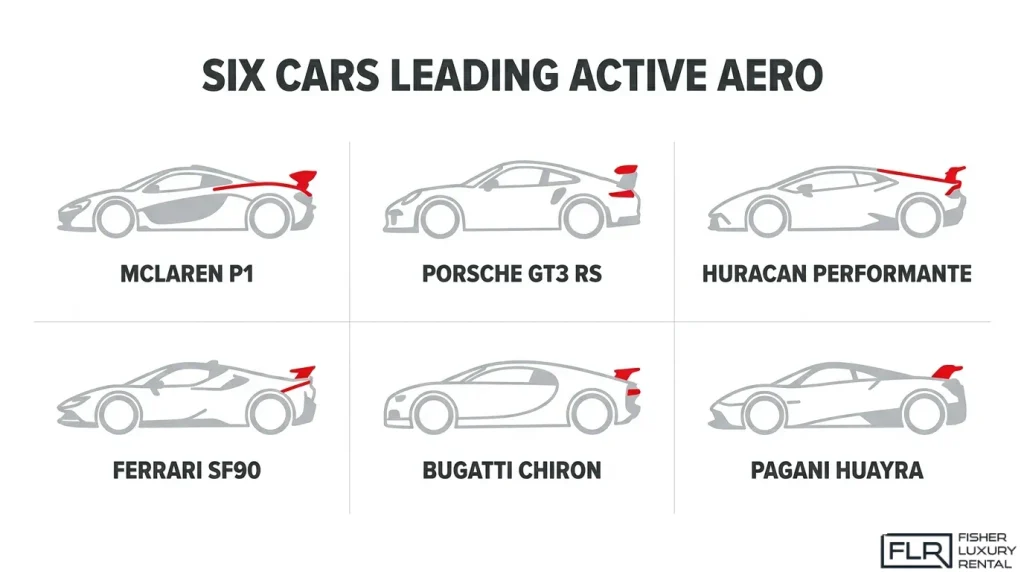
The exotic cars featuring the most advanced active aero include the McLaren P1, Porsche 911 GT3 RS, Lamborghini Huracán Performante, Ferrari SF90 Stradale, Bugatti Chiron, and Pagani Huayra. Each uses a distinct approach to managing downforce and drag in real time.
How Does the McLaren P1 Use Active Aero?
The McLaren P1 uses active aero through a large adjustable rear wing that automatically boosts downforce and optimizes aerodynamics depending on conditions. It also features a DRS (drag reduction system) function, borrowed directly from Formula 1, that reduces downforce to increase straight-line speed. According to McLaren Automotive, in race mode the active longtail extends by 300mm while the whole car drops, producing five times more downforce than in road mode. The P1’s ability to toggle between maximum downforce and minimum drag within milliseconds makes it one of the most dynamically intelligent active aero systems ever built into a road car.
How Does the Porsche 911 GT3 RS Use Active Aero?
The Porsche 911 GT3 RS uses active aero through continuously adjustable wing elements at the front and on its two-part rear wing. According to Porsche, these elements combine with other aerodynamic measures to generate more than 900 lbs. of downforce at approximately 124 mph, twice that of its 991.2-generation predecessor and three times that of a standard 911 GT3. The system adapts angle of attack in real time to balance cornering grip against straight-line efficiency.
How Does the Lamborghini Huracán Performante’s ALA System Work?
The Lamborghini Huracán Performante’s ALA system works by using electronically actuated flaps in the front splitter and rear wing to redirect airflow on demand. According to Motor Authority, under full acceleration ALA makes the car as slippery as possible to maximize speed; under braking, it reroutes airflow through the spoilers to increase downforce and restore grip. The results speak for themselves: the Performante lapped the Nürburgring 28 seconds faster than its LP610-4 sibling despite only 30 additional horsepower, a result that aerodynamics, not power, largely delivered.
How Does the Ferrari SF90 Stradale Manage Airflow Actively?
The Ferrari SF90 Stradale manages airflow actively through a two-piece rear wing with a fixed element and a movable fairing. According to Ferrari, in the low-drag configuration the two pieces align so air flows freely beneath them. When cornering or braking at speed, the forward part lowers and closes the gap, generating the downforce needed for stability. This elegant two-state design lets the SF90 Stradale perform as both a high-speed GT and a precise cornering machine without driver input.
How Does the Bugatti Chiron Use Its Active Rear Wing?
The Bugatti Chiron uses its active rear wing as both a downforce generator and a critical safety device. According to Bugatti’s newsroom, to enable the Chiron to brake safely from its top speed of over 400 km/h, the rear wing folds upward and acts as a brake flap, while the entire active aero system is controlled at the front and rear by a total of 18 hydraulic cylinders. In full air brake mode, the wing reaches a maximum angle of 49 degrees. The scale of that hydraulic infrastructure reflects just how extreme the aerodynamic demands become at 400 km/h.
How Does the Pagani Huayra Use Active Aero Flaps?
The Pagani Huayra uses active aero flaps through four independent control flaps positioned at each corner of the car, combined with an adjustable front ride height. According to New Atlas, the aerodynamic concept of the Huayra is that of a wing, and the vehicle modifies that wing’s properties by dynamically varying the front ride height and adjusting all four corner flaps simultaneously. Pagani notes that the active front suspension and four flaps work together to optimally balance the drag coefficient and downforce at any given moment. With each flap controlling its own corner independently, the Huayra can fine-tune balance in ways a single rear wing alone cannot match.
How Does Active Aero Differ from Passive Aerodynamics?
Active aero differs from passive aerodynamics in one fundamental way: passive aerodynamics uses fixed, unchanging shapes to manage airflow, while active aero adjusts its surfaces in real time to suit changing conditions. According to NASA, aerodynamics is the way objects move through air, and both approaches apply this science, but through very different means.
Passive elements, such as fixed wings, static splitters, and sculpted body panels, are set at a single angle or position by engineers before the car leaves the factory. They deliver consistent aerodynamic behavior but cannot adapt when speed, braking, or cornering demands shift. Active systems, by contrast, respond dynamically, increasing downforce when grip is needed and reducing drag when straight-line speed is the priority. This adaptability is precisely what makes active aero a defining feature of modern exotic cars rather than a styling exercise.
What Sensors and Electronics Control Active Aero Systems?
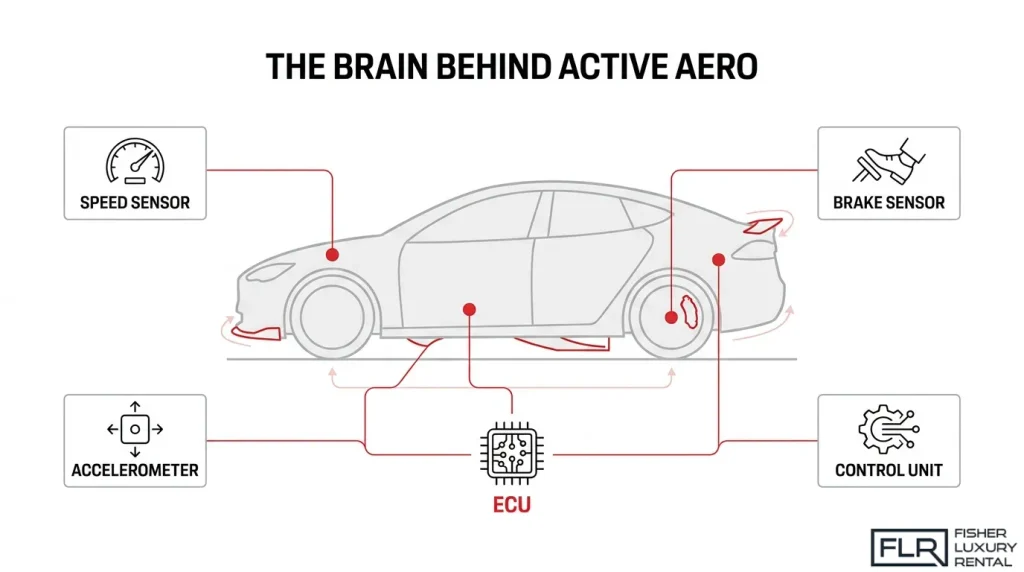
The sensors and electronics that control active aero systems include Electronic Control Units (ECUs), speed sensors, accelerometers, steering angle sensors, actuators, and microprocessors. These components work together to read driving conditions and command physical adjustments to wings, flaps, and splitters in real time.
According to the John A. Volpe National Transportation Systems Center, U.S. Department of Transportation, today’s motor vehicles incorporate an increasingly complex array of electronic systems including sensors, actuators, microprocessors, instrumentation panels, controllers, and displays. ECUs sit at the center of this architecture, interpreting sensor data and issuing commands to the aerodynamic actuators.
Speed sensors trigger wing deployment thresholds. Lateral acceleration inputs from accelerometers signal cornering loads. Brake pressure sensors detect hard braking events and command air brake flap deployment. All of these signals feed into the ECU, which cross-references driving mode settings and outputs precise actuator commands within milliseconds.
The PHM Society notes that ECUs have been used in the automotive industry for decades to control one or more vehicle subsystems, making them a proven and reliable backbone for active aero logic.
From an engineering standpoint, the reliability of this sensor-ECU-actuator chain is what separates truly dynamic active aero from simple speed-triggered passive systems. The more input channels the ECU monitors simultaneously, the more precisely the car can balance downforce and drag for any given corner, straight, or braking zone.
Can You Feel Active Aero Working While Driving?
Yes, you can feel active aero working while driving, though the sensation varies by system, speed, and driving mode. The sections below cover what drivers notice during braking, cornering, and high-speed runs.
What Does Active Aero Feel Like During Hard Braking?
During hard braking, active aero produces one of its most physically noticeable effects. When a rear wing deploys as an air brake, the car’s deceleration feels more planted and linear than brakes alone can achieve. According to Clemson University’s Center for Automotive Research, the McLaren MP4-12C’s active air brake reduces braking distances by up to 20 meters. That kind of stopping force translates directly into a sensation of the car being pulled rearward more aggressively than expected. Drivers frequently describe it as the car “biting” into the air. It is one of the few moments where aerodynamic load is felt viscerally rather than inferred.
What Does Active Aero Feel Like Through High-Speed Corners?
Through high-speed corners, active aero feels like increased grip without added steering effort. The car resists lateral movement more confidently as downforce builds, giving the front and rear tires a sense of being pressed into the road. This sensation intensifies above 100 mph, where aerodynamic load becomes a meaningful percentage of total grip. The effect is subtle at first but becomes unmistakable on sweeping curves at track speeds. Experienced drivers often describe it as the car “settling” mid-corner rather than pushing toward the edge of the road.
What Does Active Aero Feel Like on a Straight at Speed?
On a straight at speed, active aero in drag-reduction mode makes the car feel lighter and more eager. Wing elements flatten or retract, reducing resistance, and the car accelerates with noticeably less effort at higher velocities. According to BBC TopGear, the Ford GT’s rear wing automatically adjusts for aerodynamics above 90 mph and stows again at 81 mph. That transition is not dramatic but is perceptible as a slight reduction in wind buffeting and an increase in forward momentum. Most road drivers encounter this on highway on-ramps rather than racetracks, where the difference is real but brief.
Is Active Aero Noticeable on Public Roads?
Active aero is noticeable on public roads, but the experience is far more muted than on a circuit. Most systems activate above speeds rarely sustained in traffic, so road drivers catch brief moments of wing deployment during emergency stops or spirited acceleration rather than continuous aerodynamic management. The subtlety is by design. Manufacturers tune active aero to be transparent, letting it work without distracting the driver. That transparency is actually a sign of how well-engineered these systems are: the car simply feels more composed than physics alone should allow.
How Does Active Aero Affect Everyday Driving vs Track Use?
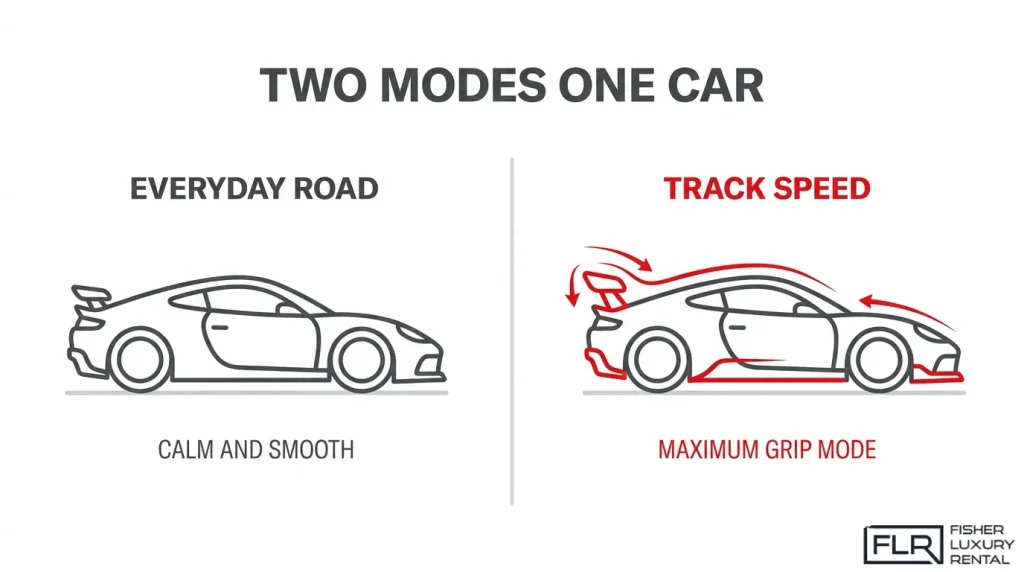
Active aero affects everyday driving and track use in fundamentally different ways: on public roads, the system prioritizes comfort and low-speed stability, while on track, it maximizes downforce and aerodynamic braking performance. The section below covers both driving environments in detail.
How Does Active Aero Behave During Everyday Road Driving?
Active aero behaves conservatively during everyday road driving, remaining largely invisible to the driver. At low urban speeds, wings stay retracted and underbody panels hold neutral positions to minimize drag and preserve ride comfort. The Lamborghini ALA system, for example, adapts to driving style automatically, increasing aerodynamic resistance only when cornering demands it. In routine highway driving, most systems do not activate until speeds exceed thresholds well above posted limits. For the typical commute or leisure drive, active aero adds stability without any noticeable physical intrusion or stiffening.
How Does Active Aero Perform at Track Speeds?
Active aero performs at its highest capability at track speeds, where the full aerodynamic load is needed to keep exotic cars stable and fast. The Porsche 911 GT3 RS generates over 900 lbs. of downforce at approximately 124 mph through continuously adjustable front and rear wing elements. On track, systems cycle rapidly between low-drag modes on straights and maximum downforce configurations through corners and under hard braking. This precision is impossible to replicate on public roads, where legal speed limits prevent the aerodynamic loads that make these systems genuinely transformative. For drivers who want to experience this contrast without ownership, Fisher Luxury Rental offers top-trim exotic vehicles in Phoenix, AZ and Portland, OR locations with driving environments that give performance cars room to breathe.
Experiencing this contrast firsthand, behind the wheel of an exotic rental, is the clearest way to understand what active aero actually does.
How Should You Experience Active Aero in an Exotic Car Rental?
Experiencing active aero firsthand means choosing a vehicle where the technology is genuinely present and driving it on roads that let the system engage. The sections below cover how Fisher Luxury Rental delivers that opportunity and what key lessons to carry away from everything covered in this article.
Can Renting an Exotic Car from Fisher Luxury Rental Let You Feel Active Aero Firsthand?
Yes, renting an exotic car from Fisher Luxury Rental can let you feel active aero firsthand. Fisher Luxury Rental stocks top-trim exotic vehicles in Phoenix, AZ and Portland, OR, prioritizing the highest-spec models so the full suite of features included by the manufacturer are present. Unlike renting a base-spec sports car where performance features may be deleted or detuned, Fisher Luxury Rental’s commitment to top trims means you access the full performance suite the engineers intended. The open roads around Phoenix and the scenic routes near Portland offer driving environments where exotic car performance can be genuinely explored, making a Fisher Luxury Rental booking one of the most direct ways a non-owner can experience these systems in real conditions.
What Are the Key Takeaways About Active Aero Systems in Exotic Cars?
The key takeaways about active aero systems in exotic cars are that they are speed-sensitive, purpose-specific, and measurably effective. According to a study published in Fluids (MDPI), activating a DRS flap generates approximately a 78% decrease in the aerodynamic drag coefficient and a 53% decrease in the lift coefficient, illustrating how dramatically a single moving surface reshapes a car’s behavior. The Lamborghini Huracán Performante’s ALA system set a Nurburgring lap record with only 30 additional horsepower over its sibling, proof that aerodynamic management delivers performance beyond what raw power alone can achieve. Active aero is not decorative engineering; it is the variable that separates a genuinely fast exotic from a merely powerful one, and renting one remains the most accessible way to experience that difference personally. Fisher Luxury Rental’s focus on top-trim models means the vehicles in their Phoenix and Portland fleets are configured the way manufacturers intended them to perform.