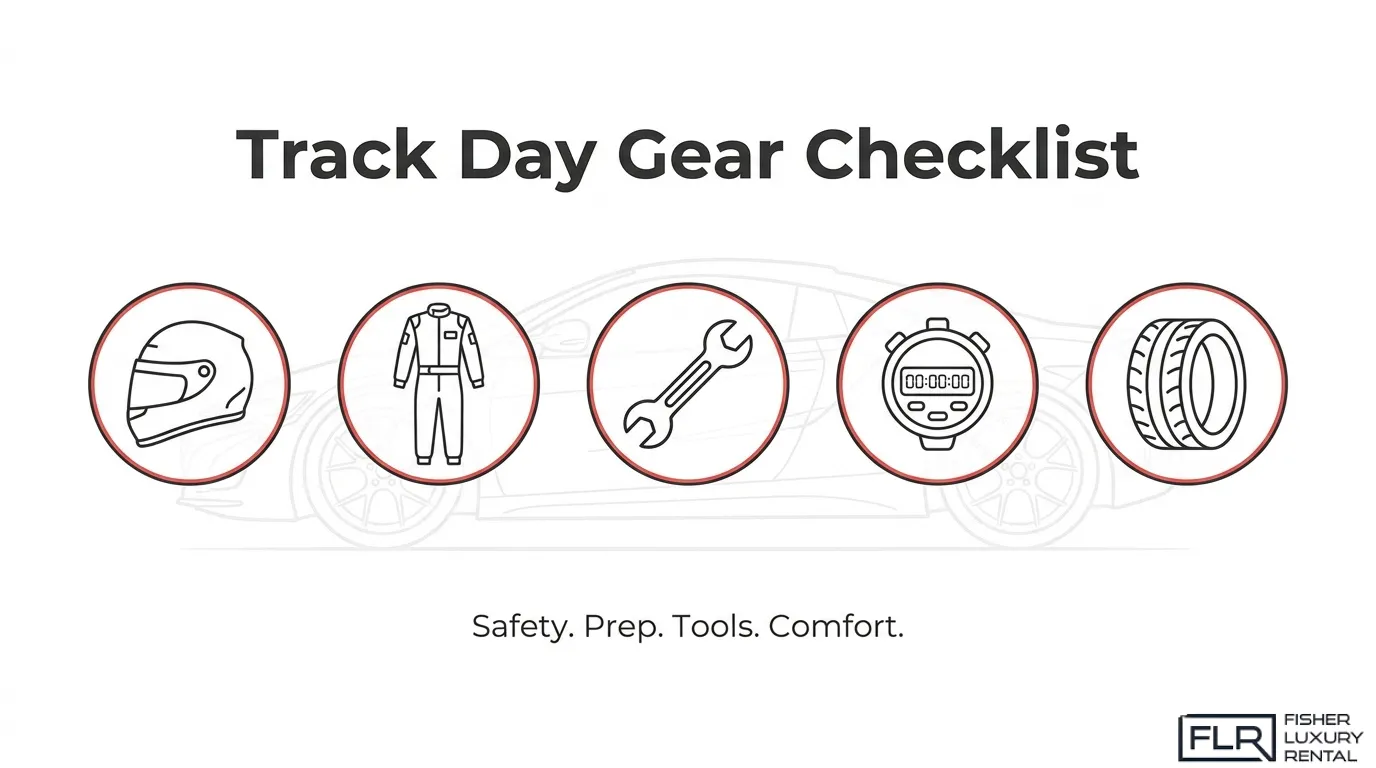
Essential track day gear is the combination of certified personal safety equipment, prepared vehicle components, and trackside support items required to participate safely and effectively in a high-performance driving event.
This guide covers driver safety gear, vehicle preparation, trackside tools and supplies, personal comfort items, data and communication equipment, common packing mistakes, and how to maximize your overall track day experience.
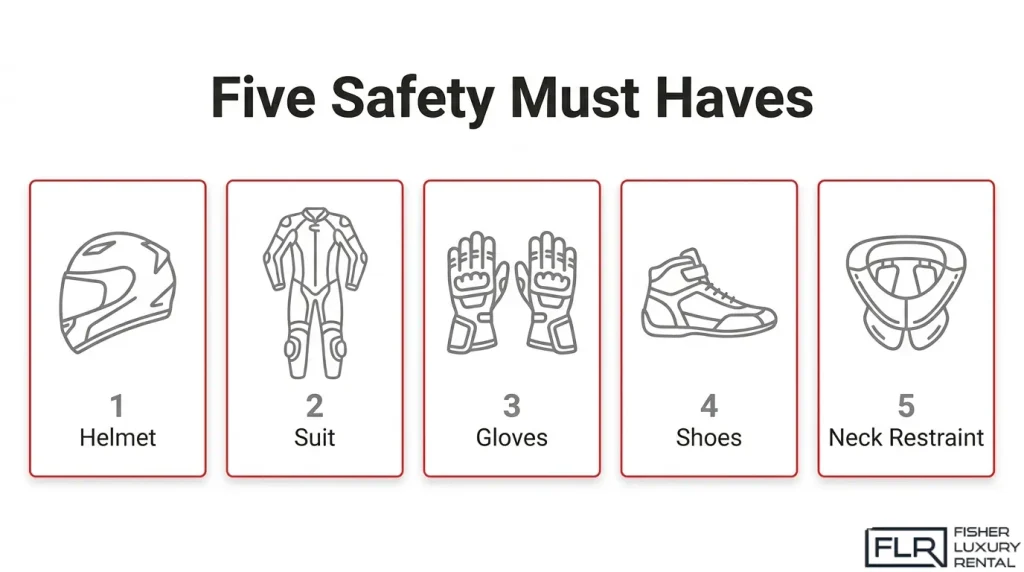
A certified helmet meeting Snell SA2025 or SA2020 standards, a flame-resistant racing suit, SFI or FIA-rated gloves and shoes, and a head-and-neck restraint form the non-negotiable safety foundation every driver needs before entering a run group.
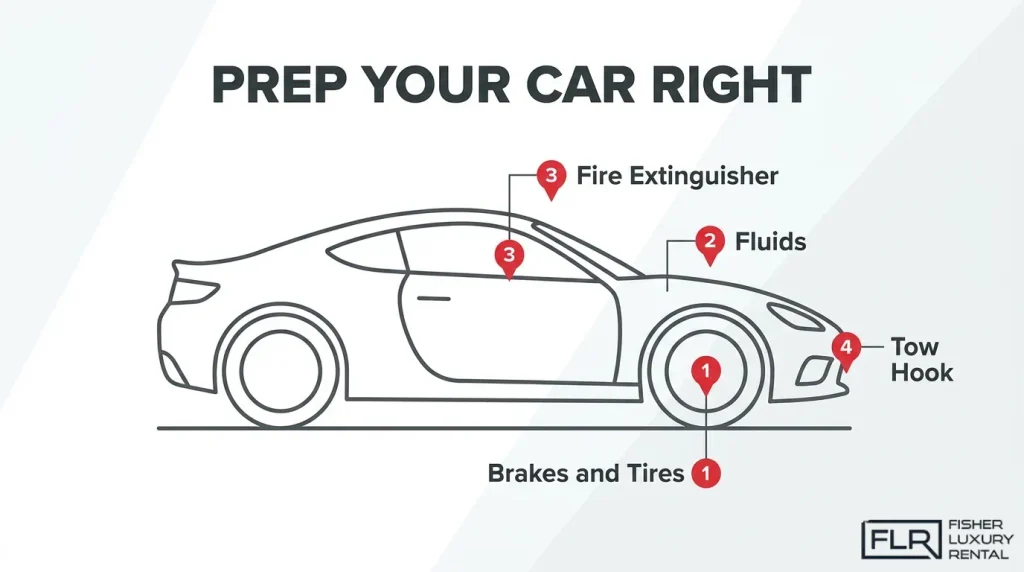
Vehicle preparation determines whether your car survives the session. High-temperature brake pads, fresh DOT 4 or DOT 5.1 fluid, correct tire pressures, a mounted Class B fire extinguisher, and a screw-in tow hook are the items most likely to keep your day from ending early.
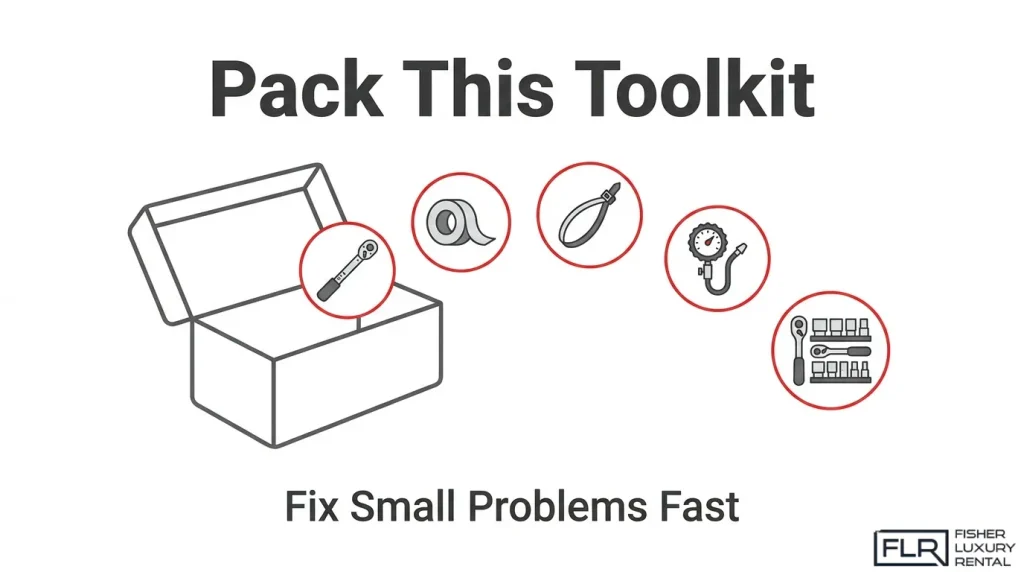
A focused toolkit, including a torque wrench, fluid reserves, zip ties, and gaffer tape, handles the minor mechanical issues that regularly surface in a busy pit lane without requiring a full garage.
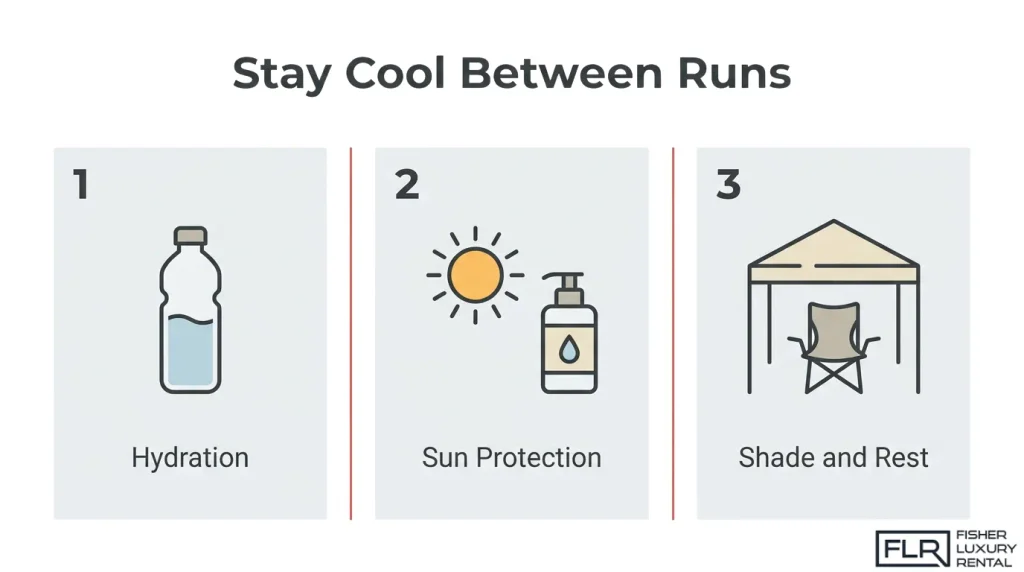
Sustained physical performance across multiple sessions depends on consistent hydration with electrolyte beverages, adequate nutrition, SPF 30-plus sun protection, and shaded seating to limit heat fatigue between runs.
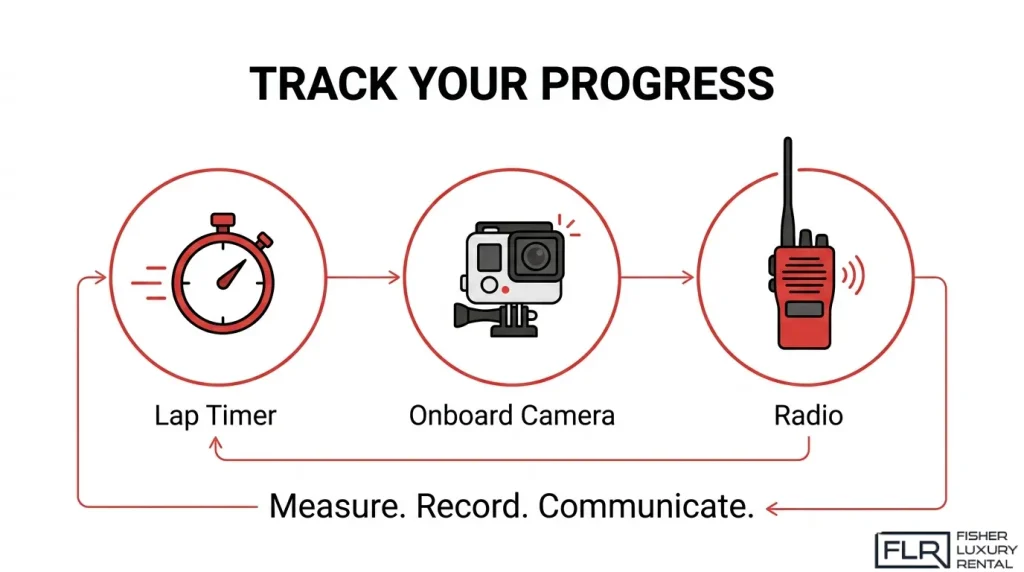
Lap timers, action cameras, and reliable two-way radios transform raw seat time into measurable progress and keep communication dependable inside large motorsport facilities where cellular service often fails.
What Safety Gear Is Required for a Track Day?
Safety gear required for a track day includes a certified helmet, a fire-resistant racing suit, gloves, shoes, and neck protection. The following sections cover the specific standards and options for each item.
What Helmet Standards Should You Meet for Track Days?
The helmet standards you should meet for track days depend on your event organizer’s rules, but Snell SA2025 and SA2020 ratings are widely accepted at most HPDE and track day events. The Snell SA2025 standard took effect October 1, 2025, with over 100 certified models already available, according to the Snell Foundation. An open-face helmet is generally acceptable for lower-speed novice groups, while full-face helmets are standard for higher-speed run groups. Always verify the minimum accepted rating with your specific event organizer before purchasing.
What Type of Racing Suit Do You Need for a Track Day?
The type of racing suit you need for a track day is determined by your event’s sanctioning body and speed category. According to FIA Standard 8856-2018, approved suits must not exhibit after-flaming time exceeding 2 seconds during standardized burn testing, with no molten debris or holes formed. Single-layer suits satisfy most casual HPDE events, while multi-layer SFI or FIA-rated suits are required for competitive circuit racing. Motorsport UK notes that in circuit racing, overalls, the helmet, gloves, and boots must all carry an approved standard label. A properly rated suit is arguably the most underestimated piece of safety gear, particularly if a car fire occurs at speed.
What Gloves Are Best for Track Day Driving?
The best gloves for track day driving are thin, fire-resistant racing gloves with tactile feedback, such as Sparco Arrow, OMP One-S, or Alpinestars Tech-1 K. These gloves protect against heat and abrasion while preserving steering feel. Thicker gloves designed for rally or rally-cross reduce fine motor control, making them a poor choice for circuit driving. Look for SFI 3.3 or FIA 8856-2018 certification on any glove you select.
What Racing Shoes Should You Wear on Track Day?
The racing shoes you should wear on track day are thin-soled, fire-resistant driving shoes that allow precise pedal feel, such as those meeting SFI 3.3 or FIA 8856-2018 approval. According to Motorsport UK, circuit racing requires boots to carry an approved standard label, unlike some other disciplines. Thin rubber soles improve throttle and brake sensitivity significantly compared to standard athletic footwear. Street shoes or thick-soled sneakers are generally prohibited at sanctioned events and reduce brake modulation accuracy.
What Neck Protection Do You Need for High-Speed Driving?
The neck protection you need for high-speed driving is a head-and-neck restraint (HNR) device, such as the HANS device, which meets SFI Specification 38.1. According to the SFI Foundation, SFI 38.1 uses a dynamic sled procedure to simulate violent frontal impacts and tests an HNR’s ability to reduce neck tension and compression, lowering the risk of fatal basal skull fracture. Most track day events require or strongly recommend an HNR for open-cockpit cars and mandate one for higher-speed run groups. This is one piece of gear where skimping on certification carries serious, potentially fatal consequences.
What Vehicle Preparation Items Should Be on Your Checklist?
Vehicle preparation items on your checklist should cover brakes, fluids, tires, fire safety equipment, and recovery gear. The sections below detail what to inspect, upgrade, or pack for each category before arriving at the track.
What Brake Upgrades Should You Consider Before a Track Day?
Brake upgrades to consider before a track day include high-temperature brake pads, stainless steel brake lines, and fresh DOT 4 or DOT 5.1 fluid. Street brake pads fade quickly under repeated hard stops, and a single session can overheat standard components. Upgrading to a motorsport-compound pad designed for sustained high temperatures is the single most impactful preparation step most drivers skip.
What Fluids and Coolants Should You Check or Replace?
Fluids and coolants to check or replace before a track day include engine oil, brake fluid, coolant, and power steering fluid. Many track organizations restrict or prohibit antifreeze in the cooling system entirely. According to the NASA Pro Racing 2026 Spec Iron National Rules, the only permitted engine coolant is water, with antifreeze additions explicitly prohibited. Brake fluid should be flushed if it has absorbed moisture, since wet fluid boils at a significantly lower temperature under race conditions.
What Tires Perform Best for Track Day Conditions?
Tires that perform best for track day conditions are ultra-high-performance summer tires or dedicated track-compound tires with appropriate pressure settings. Tire pressure directly affects handling: a study published in Vehicles on circular-track cornering found that dropping pressure from 2.5 to 2.0 bar reduced maximum cornering speed by approximately 8.4% and increased steering angle variation by about 18.1%. Check recommended pressures for your specific tire model and adjust cold pressures accordingly before each session.
What Fire Safety Equipment Does Your Car Need?
Fire safety equipment your car needs includes a mounted fire extinguisher capable of suppressing a Class B fire. According to the Vintage Sports Car Drivers Association’s 2020 Technical Requirements, the extinguisher must be at least a 2-pound system with a charge indicator, securely fastened inside the cockpit with a metal quick-release bracket within the driver’s reach. Verify that the extinguisher is fully charged and that the mounting hardware does not shift under cornering loads.
What Tow Hook and Recovery Gear Should You Have Ready?
Tow hook and recovery gear you should have ready includes a screw-in tow hook stored in your vehicle at all times. According to the Sports Car Club of America, many modern cars use a screw-in hook that threads into the bumper, and having it on hand is essential if your car needs to be pulled from a sand trap or gravel runoff. Confirm the tow hook fits your specific bumper receiver before track day, since some drivers discover the mismatch only after going off course.
What Tools and Spare Parts Should You Bring to the Track?
The right trackside toolkit prevents a minor issue from ending your day early. The sections below cover tire and wheel tools, fluid supplies, and emergency repair items every driver should carry.
What Tire and Wheel Tools Are Essential for Trackside Repairs?
The tire and wheel tools essential for trackside repairs include a torque wrench, a breaker bar or impact wrench, and a quality floor jack with jack stands. According to the Porsche Club of America Alabama Region’s HPDE guidance, a torque wrench for tightening wheel lug nuts is a recommended paddock item. Properly torqued lugs are non-negotiable after any wheel removal, since under-torqued nuts can loosen at speed with serious consequences. A tire pressure gauge rounds out this kit, letting you verify pressures between sessions and make meaningful adjustments.
What Fluid Top-Off Supplies Should You Pack?
The fluid top-off supplies you should pack include engine oil, brake fluid, coolant or distilled water, and power steering fluid. Brake fluid is particularly important: bring the same grade already in your system, whether DOT 4 or DOT 5.1, since mixing incompatible grades changes boiling point performance. Note that some track organizations prohibit antifreeze in the cooling system entirely, requiring plain water instead. A set of clean funnels, nitrile gloves, and absorbent shop rags keep spills manageable. Pack each fluid in a sealed container stored upright to avoid leaks in transit.
What Emergency Repair Items Can Save Your Track Day?
The emergency repair items that can most reliably save your track day are a tow hook, zip ties, gaffer tape, a basic socket set, and a fire extinguisher rated for Class B fires. The SCCA notes that many modern cars use a screw-in tow hook stored in the trunk, and confirming it is in the car before you leave for the track avoids a costly recovery situation. Zip ties and gaffer tape handle loose bodywork, splitter stays, and unexpected trim failures that are common at sustained high speeds. A compact but comprehensive socket set covers sensor connectors, battery terminals, and intercooler couplings. Keeping these items in a single labeled bag makes pit stops fast and efficient.
What Comfort and Personal Items Improve Your Track Day?
Comfort and personal items improve your track day by reducing fatigue, protecting you from the elements, and keeping your body performing well between sessions. The heading below cover hydration and nutrition, sun and weather protection, and pit area comfort gear.
What Hydration and Nutrition Should You Bring to the Track?
Hydration and nutrition at the track should include enough water, electrolyte drinks, and easily digestible food to sustain performance across multiple sessions. According to the British Journal of Sports Medicine’s IOC consensus statement, body water losses during intense prolonged exercise in the heat are normal, and hydration should aim to minimise those losses without causing overhydration or body weight gain. Electrolyte beverages matter particularly for sessions lasting beyond two hours, since sweat depletes sodium and other minerals that plain water cannot replace. For food, bring portable, low-fat options such as bananas, energy bars, and nuts that digest quickly without sitting heavily before a driving session.
What Sun and Weather Protection Do You Need Trackside?
Sun and weather protection you need trackside includes sunscreen, UV-blocking sunglasses, a wide-brim hat, and a light weatherproof layer. The World Health Organization notes that UV rays are strongest in the two-hour window before and after solar noon, which often coincides with peak track session times. The American Academy of Dermatology recommends sunscreen rated SPF 30 or higher with broad-spectrum UVA and UVB coverage. A light windbreaker handles early-morning cold snaps or unexpected rain without adding bulk to your pit bag.
What Seating and Shade Gear Makes Pit Time More Comfortable?
Seating and shade gear that makes pit time more comfortable includes a folding camp chair, a pop-up canopy or shade tent, and a small portable fan. Hours spent in an exposed pit lane in direct sun accumulate quickly, and fatigue from heat shortens focus during driving sessions. A compact folding chair and a six-by-six canopy cover the essentials without requiring a large trailer to transport. Investing in quality pit comfort is often underestimated, but staying cool and rested between sessions directly translates to sharper reaction times on track. For drivers who want to arrive at the track without the added stress of pre-event mechanical preparation, Fisher Luxury Rental offers well-maintained, top-trim exotic vehicles, removing the vehicle-readiness burden so you can focus entirely on the driving experience.
What Data and Communication Gear Enhances Your Track Day?
Data and communication gear enhances your track day by turning raw seat time into measurable learning. The section below cover lap timers and data loggers, action cameras, and communication devices.
What Lap Timers and Data Loggers Are Worth Using?
Lap timers and data loggers worth using include dedicated GPS units, smartphone apps, and OBD-integrated systems such as the AiM Solo 2, Harry’s LapTimer, and Racebox Mini. A GPS lap timer records split times, speed traces, and lateral g-forces, giving you objective data to review between sessions. Comparing overlaid laps reveals where you are braking too early, carrying too little corner speed, or getting on the throttle late. Even a mid-range unit paying back a single improved lap per session compounds quickly into meaningful skill progression. For drivers new to data review, start with one channel, such as speed versus distance, before adding braking and steering overlays. Drivers who want to experience a high-performance vehicle before committing to ownership or upgrades may find that renting an exotic car from Fisher Luxury Rental, serving the Phoenix and Portland areas, provides a useful real-world baseline for understanding how a purpose-built performance platform responds to data-informed driving.
What Action Cameras Best Capture Track Day Footage?
Action cameras best suited for track day footage include the GoPro Hero series, Insta360 Ace Pro, and DJI Osmo Action 5. Mount position matters as much as camera quality: a windshield or roll bar mount captures steering inputs and track context simultaneously, while a low hood mount shows tire behavior through corners. Look for cameras offering at least 4K at 60fps and electronic image stabilization to keep fast footage smooth and reviewable. Pairing video with a GPS overlay app such as Dashware or GoPro Telemetry Tool lets you sync speed and braking data directly onto the footage, transforming your onboard video into a genuine coaching tool rather than a highlight reel.
What Communication Devices Help You Stay Connected at the Track?
Communication devices that help you stay connected at the track include two-way radios, Bluetooth intercoms, and pit-to-driver radio systems. Cellular service inside large motorsport facilities is often unreliable due to thick concrete structures and crowd congestion, making two-way radios such as the Motorola T800 or BaoFeng UV-5R a more dependable option for paddock communication. Bluetooth intercoms mounted inside open-face helmets allow co-drivers, instructors, or pit crew to speak without removing headgear. If you are running with a track day instructor in the passenger seat, a wired intercom system eliminates the need to shout over wind and exhaust noise, making coaching feedback during a session far more effective.
What Common Mistakes Should You Avoid When Packing for a Track Day?
The most common mistakes to avoid when packing for a track day include forgetting required safety certifications, neglecting hydration, skipping fluid checks, and overlooking track-specific regulations. Each error can end your day early or create safety risks.
- Assuming your helmet meets current standards. Certification requirements vary by event organizer. Verify your helmet’s rating against the specific event’s rulebook before arriving.
- Bringing only water for a long event. According to OSHA, activities lasting more than two hours require electrolyte-containing beverages such as sports drinks, because sweat depletes salt and other electrolytes beyond what water alone replaces.
- Forgetting your tow hook. Many modern cars use a screw-in tow hook stored in the trunk. Without it, recovering your car from a gravel trap becomes significantly more complicated.
- Packing street brake fluid. High-speed braking generates heat that standard DOT 3 fluid cannot handle reliably. Bring the correct high-temperature fluid your car requires.
- Ignoring the event rulebook. Coolant restrictions, fire extinguisher minimums, and apparel requirements differ between organizations. Review the rules for your specific event in advance.
- Overpacking tools without priorities. Bring a torque wrench, essential fluids, and a tire pressure gauge first. Rarely used items waste space and time during a busy pit session.
- Leaving sun protection behind. Long paddock hours expose you to sustained UV radiation, creating fatigue that affects focus behind the wheel.
Reviewing your checklist against the specific event’s requirements the night before is the single most effective way to prevent these mistakes.
How Can You Get the Most Out of Your Track Day Experience?
Getting the most out of a track day means pairing the right gear with the right car. The sections below cover how renting an exotic car elevates the experience and what core gear lessons to carry forward.
Can Renting an Exotic Car from Fisher Luxury Rental Elevate Your Track Day?
Yes, renting an exotic car can elevate high-performance street driving by putting you behind the wheel of a top-trim vehicle without the ownership costs or maintenance burden. Book exotic car rental in Phoenix (Fisher also serves Portland), confirm permitted use before any closed-course plan, and keep the gear checklist in this article for helmets, fluids, and tools.
One important consideration involves your rental coverage. According to the Federal Trade Commission, if you purchase a Collision Damage Waiver, your coverage can be canceled if you damage the car while driving recklessly, under the influence, or by allowing an unauthorized person to drive. Review your waiver terms carefully before heading to the track.
What Are the Key Takeaways About Essential Track Day Gear?
The key takeaways about essential track day gear are that preparation, safety certification, and physical readiness determine the quality of your session. A certified helmet, flame-resistant suit, proper footwear, and gloves form the non-negotiable safety foundation. Vehicle preparation, including brake fluid, tires, and fire safety equipment, keeps your car track-legal. Tools, hydration, and sun protection sustain your performance through a full event day. Pairing well-chosen gear with a high-performance rental from Fisher Luxury Rental turns a single track day into a genuinely memorable driving experience. Fisher Luxury Rental’s fleet of luxury and exotic vehicles is available across the Phoenix, Scottsdale, Portland, and Vancouver areas, and can be reached at rental@fisherluxuryrental.com for availability and booking questions.