Track driving is the practice of operating a vehicle on a closed, purpose-built circuit in a controlled environment, free from speed limits, traffic enforcement, and unpredictable hazards. It gives beginners a structured framework for pushing a car beyond everyday street conditions with certified instruction and clearly defined safety rules.
This guide covers what the sport actually requires to get started, how to choose the right event format, what gear and car preparation matter, the core driving techniques every novice needs, the most common mistakes to avoid, how to prepare your car, how to progress after your first session, and how exotic car rentals fit into that journey.
Track day eligibility, licensing requirements, and physical fitness demands vary by organization and age, so we walk through each threshold with specific figures. Knowing the rules before you arrive removes the most common reasons beginners get turned away.
Event formats range from High-Performance Driving Experiences with one-on-one instructor coaching to low-cost autocross events starting at $25, and each offers a different entry point for new drivers. Choosing the right format for your experience level makes a significant difference in what you learn during your first session.
Driving technique covers five skills: finding the racing line, braking correctly, managing throttle, shifting smoothly, and correcting understeer and oversteer. These fundamentals determine how safe and how fast your laps become.
Car preparation and safety gear cover the mechanical checks, helmet certification standards, and cabin requirements that most organized events verify before you enter the circuit. Post-session progression ties everything together, showing how data logging, video review, and run-group advancement turn early sessions into measurable improvement.
What Is Track Driving and Why Do Beginners Love It?
Track driving is the practice of operating a vehicle on a closed, purpose-built racing circuit in a controlled environment. Beginners love it because it removes the hazards of public roads, including speed limits, pedestrians, and traffic enforcement, while providing structured instruction.
What Is Track Driving?
Track driving is a supervised high-performance driving activity conducted on a closed circuit, where participants push their vehicles beyond everyday street conditions. According to NASA’s High Performance Driving Event program, drivers learn the fine points of high-performance driving on America’s greatest road courses in a safe, controlled, and affordable setting, with no speed limits, no pedestrians, and no tickets. A certified instructor rides along one-on-one, guiding each driver through the event at whatever pace they feel comfortable. Beginners set their own goals and progress on their own terms, making track driving genuinely accessible from the first session.
Why Do Beginners Choose Track Driving Over Street Performance?
Track driving appeals to beginners because a dedicated circuit eliminates the legal and physical risks of street performance. Public roads expose drivers to oncoming traffic, unpredictable pedestrians, and serious legal consequences, none of which exist on a closed course. The structured format, with beginner run groups, instructor coaching, and clearly communicated flag signals, gives new drivers a framework that street driving never provides. This controlled progression is arguably the single biggest reason beginners gain confidence faster on a track than through any amount of spirited road driving.
What Are the Basic Requirements to Drive on a Track?
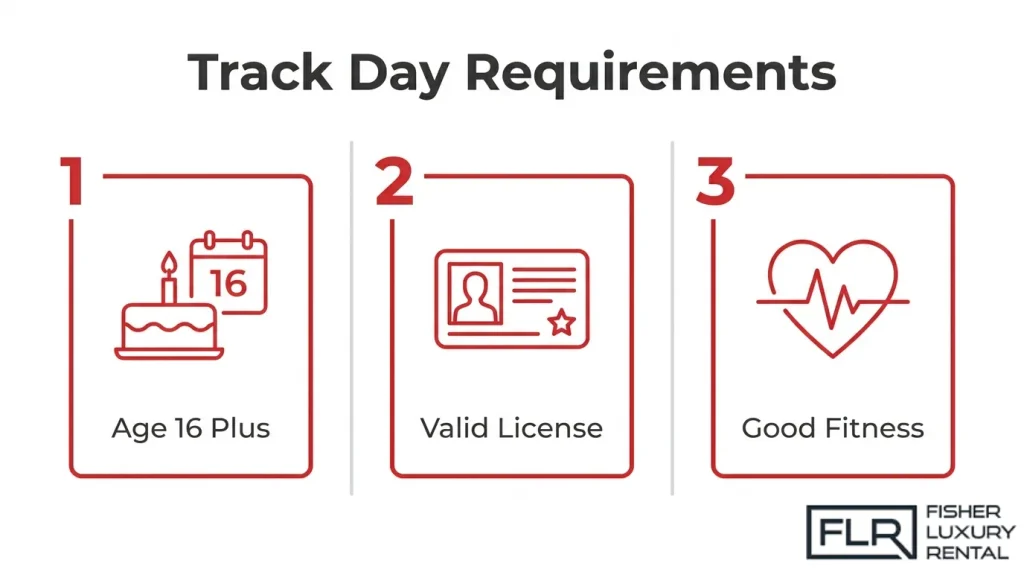
The basic requirements to drive on a track include a minimum age, a valid driver’s license, and a mechanically sound vehicle. The sections below cover age thresholds, licensing rules, and the physical demands you should prepare for.
How Old Do You Need to Be for a Track Day?
The age requirement for a track day varies by organization and country. SCCA Track Night in America requires participants to be over 18 for standard on-track activities. For minors, an unrestricted driver’s license, a parent or guardian on-site, and prior sanctioned driving experience in autocross, karting, or track events are all required. Some club events, such as BMW CCA driving schools, accept participants as young as 16 with a full, valid driver’s license and no learner’s permit.
What Driver’s License or Experience Do You Need?
The driver’s license requirement for most track days is a full, valid license — learner’s permits are not accepted. According to RMC BMW CCA’s FAQ, the minimum age is 16 with a full license, and experienced drivers may advance to solo running only with Chief Instructor approval. Most beginner-level events also require club membership, such as BMW CCA membership for BMW driving schools. No prior track experience is needed for novice groups, though some programs place first-timers in instructor-led, lead-follow sessions until competency is demonstrated.
What Physical Fitness Level Is Recommended?
The physical fitness level recommended for track driving includes cardiovascular endurance, mental concentration, and heat tolerance. Track sessions expose drivers to sustained G-forces, high cockpit temperatures, and rapid decision-making over multiple laps. Motorsport UK’s Fit to Race guidance identifies stamina, strength, speed, suppleness, and mental spirit as the five key fitness pillars for motorsport competitors. Even at a beginner HPDE level, fatigue accumulates faster than most new drivers expect. Preparing your body beforehand is as important as preparing your car — a fit driver makes fewer errors when it matters most. Vehicle readiness matters equally: SCCA Time Trials safety rules require clean DOT 4 brake fluid, all fluids at correct levels, tires in good condition with adequate tread and speed rating, and the interior completely cleared of loose items.
What Should You Know Before Your First Track Day?
Before your first track day, you need to understand three key areas: the pre-session walk-through, mandatory rules and flag signals, and what classroom and briefing sessions cover.
What Is a Track Day Walk-Through and Why Does It Matter?
A track day walk-through is a guided or self-directed on-foot inspection of the circuit before driving begins. According to NASA Speed News, track walks are a time-honored practice that let drivers discern details impossible to perceive from behind the wheel, such as the true steepness of elevation changes at corners like the Corkscrew at WeatherTech Raceway Laguna Seca. Walking the track helps you identify braking markers, apex points, and track-out zones before speed becomes a factor. For beginners, this preparation is genuinely irreplaceable.
What Are the Common Track Day Rules and Flag Signals?
Common track day rules include attending the mandatory safety briefing, obeying all flag signals, and following passing regulations in your run group. According to KymiRing’s Requirements and Safety Information, all drivers must attend the safety briefing before entering the circuit, and missing it means you cannot join the session. Flag signals are explained at that briefing, and failure to follow marshal instructions may result in removal from the track. Road America reinforces this: novice group participants follow a lead-follow format with instructors, and drivers must follow all flag and passing rules throughout the event.
How Do Classroom and Briefing Sessions Prepare You?
Classroom and briefing sessions prepare you by covering flag signals, passing zones, emergency procedures, and group-specific conduct before you ever turn a lap. These sessions remove ambiguity around on-track communication, so your first session focuses on driving rather than guessing what a yellow flag means. Road America’s novice program includes dedicated classroom time alongside the lead-follow format precisely because structured instruction before seat time produces safer, more confident drivers. Arriving early and engaging fully with the briefing is the single most underrated preparation step a beginner can take.
What Are the Best Types of Track Events for Beginners?
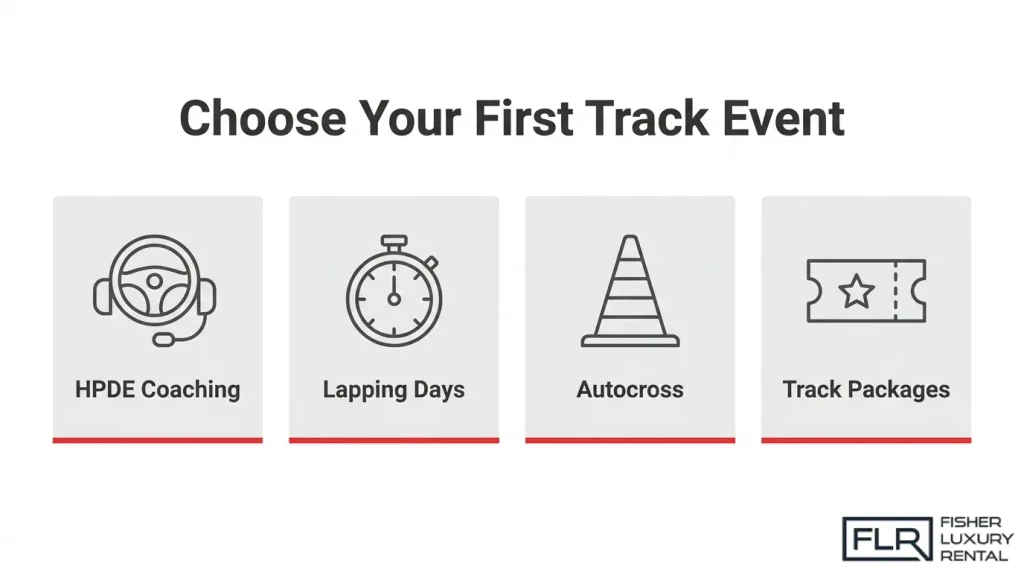
The best types of track events for beginners are High-Performance Driving Experiences (HPDE), lapping days, autocross events, and structured track day experience packages. Each format offers a different entry point, cost level, and learning environment.
High-Performance Driving Experience (HPDE)
A High-Performance Driving Experience is a supervised on-track program where beginners drive alongside certified instructors in a safe, non-competitive environment. According to the National Auto Sport Association (NASA), HPDE events welcome enthusiast drivers to learn high-performance driving on real road courses, with a one-on-one instructor guiding each participant at their own pace. No prior racing experience is required, and drivers set their own speed goals.
Lapping Days
Lapping days are open-track sessions where drivers complete repeated laps at their own pace, without timed competition. Costs vary by registration timing: according to High Plains Raceway, early online registration costs $219 for a full day or $159 for a half day, while registering after midnight the night before increases those prices to $239 and $179, respectively. Booking early is the simplest way to reduce your first lapping day costs.
Autocross Events
Autocross events are low-to-medium speed car control events run one driver at a time through a cone-defined course, typically in a parking lot or airport. According to the Sports Car Club of America (SCCA), most regional autocross entry fees range from $25 to $45, while National Series events cost between $100 and $150. Autocross is widely considered the most affordable and accessible starting point for new track drivers. For drivers who want to experience high-performance handling before committing to a track program, Fisher Luxury Rental offers top-trim exotic and luxury vehicles for rent in Phoenix, AZ and Portland, OR — a practical way to build familiarity with throttle response and braking feel in a controlled setting.
Track Day Experience Packages
Track day experience packages are beginner-specific programs that combine limited track time with structured guidance. Lime Rock Park recommends its Track Tapas program for first-timers: a two-hour session covering both its proving grounds and the 1.5-mile road racing course in the participant’s own car, priced at $195 per person. For beginners unsure which format to try first, a curated package like this removes guesswork and delivers a complete introduction in a single session.
What Car Should a Beginner Take to the Track?
A good beginner track car balances predictability, affordability, and mechanical simplicity. The sections below cover what qualities to look for, whether your daily driver qualifies, and whether renting a performance car is a smarter first-day choice.
What Makes a Good Beginner Track Car?
A good beginner track car is lightweight, forgiving at the limit, and inexpensive to repair. Cars with modest power outputs teach fundamentals more effectively than high-horsepower machines, because mistakes happen at speeds that are recoverable. Braking, in particular, defines lap times more than most new drivers expect. As two-time Formula 1 world champion Jim Clark observed, “braking is more important than most people think,” and a car that communicates brake grip clearly makes that lesson far easier to learn.
Strong candidates share these qualities:
- Low curb weight for responsive, predictable handling
- Naturally aspirated engine with linear power delivery
- Rear-wheel or balanced all-wheel drive to teach proper car control
- Affordable replacement parts to limit post-session repair costs
Can You Use a Daily Driver for Track Days?
Yes, you can use a daily driver for track days, but doing so carries significant practical and financial risks. Standard road insurance will not cover track day incidents; per Silverstone’s Car Track Days Terms and Conditions, drivers must make their own arrangements for accident cover. Every participant also signs a liability waiver accepting full risk of property damage and personal injury. Running your only car means a single off can leave you without transportation and facing uninsured repair costs. Fisher Luxury Rental provides exotic and luxury car rentals in Phoenix, AZ and Portland, OR for drivers who want to experience high-performance vehicles without the financial exposure of running their own car
Practical risks of using a daily driver include:
- Accelerated brake pad and rotor wear from repeated hard stops
- Elevated coolant temperatures stressing standard cooling systems
- Tire degradation far exceeding normal road use rates
- Loss of your primary vehicle if damage occurs
Renting a purpose-prepared performance car through a dedicated rental program eliminates these risks entirely
Should Beginners Rent a Performance Car for the Track?
Yes, beginners should strongly consider renting a performance car for the track, especially on their first event. Rental programs provide vehicles already inspected, insured for circuit use, and matched to the novice run group. According to SCCA Track Night in America Rules and Regulations, participants must hold a valid full driver’s license and be over 18, and minors require additional documentation including prior sanctioned performance driving experience. Rental programs remove vehicle preparation as a variable, allowing beginners to focus entirely on learning technique rather than worrying about mechanical readiness or uninsured damage to a personal car.
What Gear and Safety Equipment Do You Need?
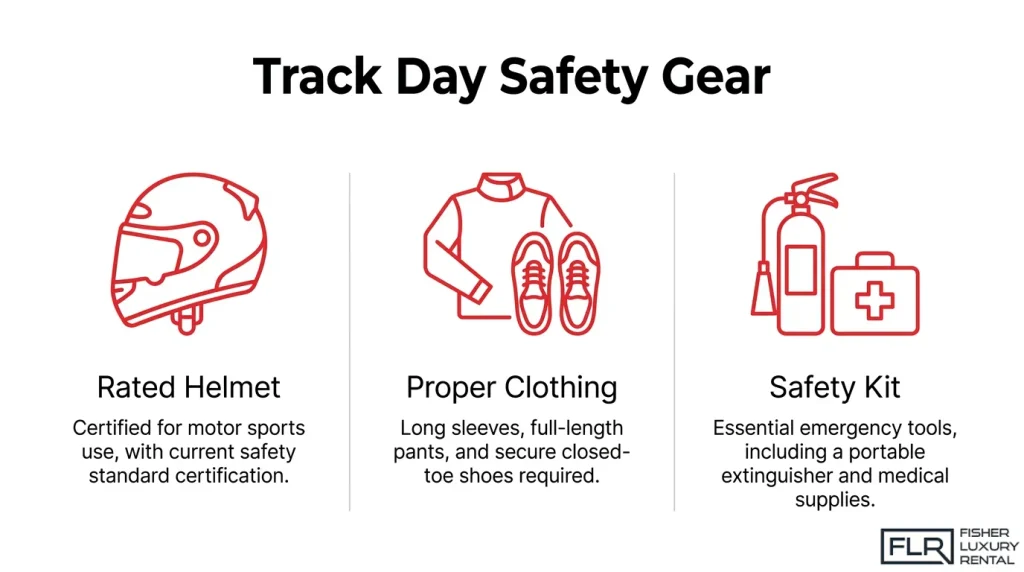
The right gear protects you if something goes wrong on track. The following H3s cover helmet certification standards, appropriate clothing and footwear, and essential in-car safety items every beginner should bring.
What Helmet Specifications Are Required for Track Days?
Helmet specifications required for track days fall under two primary certification bodies: the SFI Foundation and the Snell Memorial Foundation. According to the SFI Foundation, certified helmets must pass strict testing procedures developed by industry experts, with two applicable specs: SFI 31.1 for flame-resistant helmets and SFI 41.1 for non-flame-resistant helmets. Both specs cover open-face and full-face designs. The Snell SA2020 standard is also widely accepted, with impact criteria that are equal to or more stringent than FIA 8859-2015 requirements. Most track day organizers require at minimum an SFI or Snell-rated lid. Always verify the specific rating your event accepts before purchasing.
What Clothing and Footwear Should You Wear?
Appropriate clothing and footwear for a track day prioritize safety and pedal control. Key recommendations include:
- Long-sleeved cotton or fire-resistant shirt and trousers: Synthetic fabrics melt on contact with heat; natural fibers or nomex offer better protection.
- Closed-toe shoes with thin, flat soles: Thin soles improve brake and throttle pedal feel, reducing the risk of missed inputs.
- Avoid sandals, flip-flops, or thick-soled boots: These reduce pedal sensitivity and can snag under pedals.
- Gloves (optional but recommended): Improve grip on the steering wheel during extended sessions.
Many events require long pants and closed-toe shoes as a minimum; check your organizer’s rules in advance.
What In-Car Safety Items Should You Bring?
Essential in-car safety items to bring to a track day include a fire extinguisher, a working first-aid kit, and a charged mobile phone. Beyond basics, confirm your car passes a standard safety check: all fluids topped and sealed, no loose items in the cabin or trunk, and floor mats secured or removed. Loose objects become dangerous projectiles under hard braking. Most events conduct a tech inspection before you enter the paddock, so arriving prepared avoids disqualification. Good preparation is the single most controllable safety variable a beginner manages.
What Are the Essential Driving Techniques for Beginners?
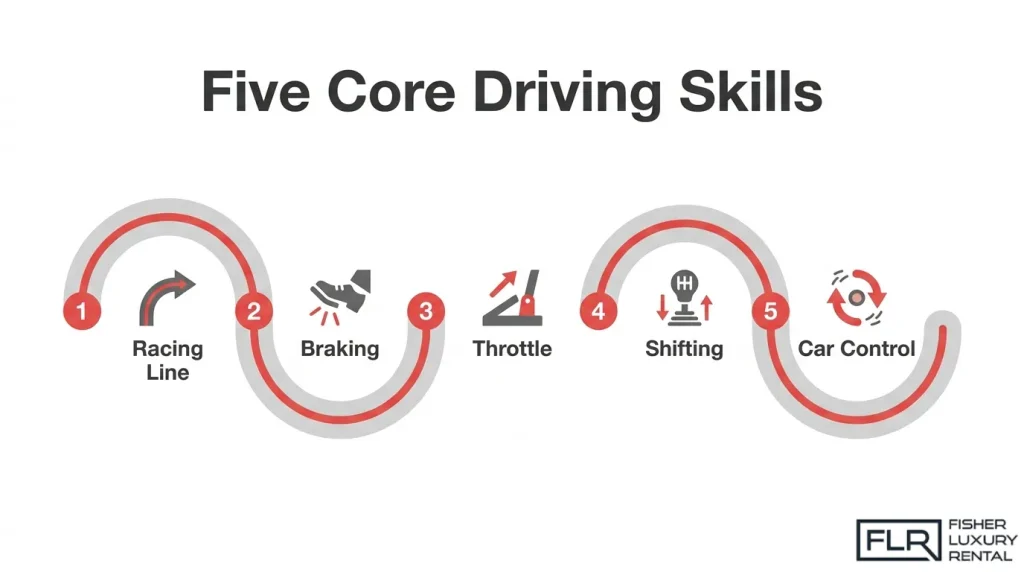
The essential driving techniques for beginners cover five core skills: finding the racing line, braking correctly, managing throttle, shifting smoothly, and handling understeer and oversteer. Mastering each of these builds the foundation for safe, fast, and controlled track driving.
How Do You Find and Follow the Racing Line?
The racing line is the fastest arc through a corner on a race circuit. According to Scott Mansell of Driver61, the trajectory of the racing line depends on corner severity, the length of the following straight, and the type of car being driven. In practice, the classic approach is late apex: enter wide, hit the apex late, and exit wide to maximize corner speed. Beginners often cut in too early, which tightens the exit and forces a lift. Learning to be patient with your turn-in point is one of the highest-leverage skills a new track driver can develop.
How Do You Brake Correctly on a Track?
Correct track braking means applying firm, progressive pressure in a straight line before the corner entry, then releasing smoothly as you turn in. Street drivers habitually brake early and gently; on track, threshold braking compresses the front tires for maximum grip. As legend Jim Clark noted, “It comes as a great shock to find that you can brake much later than you ever thought was possible.” Begin by braking at a conservative marker, then incrementally move that point later as confidence builds.
How Does Throttle Control Differ from Street Driving?
Throttle control on track differs from street driving in timing and precision: on track, throttle application begins at the apex and builds progressively through the exit, not mid-corner. Applying full throttle before the car is pointed toward the straight overloads the rear tires and causes oversteer. Smooth, deliberate inputs keep the car balanced and the tires in their optimal grip window throughout the corner.
What Is the Proper Way to Shift on a Track?
The proper way to shift on a track is to match engine revs during downshifts, keeping the drivetrain stable under hard braking. Nik Berg, writing for Hagerty, explains that when you match revs on downshifts, gearchanges slot home more readily and you avoid the sharp speed fluctuation caused by mismatched engine and wheel speeds. For upshifts, brief, decisive movements prevent missed gears at high RPM. Heel-and-toe technique achieves simultaneous braking and rev-matching for manual transmission drivers.
How Do You Handle Understeer and Oversteer?
Understeer occurs when the front tires lose grip and the car pushes wide; oversteer occurs when the rear tires lose grip and the car rotates excessively. The corrections are:
- Understeer: Reduce steering input, ease off the throttle gradually, and allow the front tires to regain grip before reapplying steering.
- Oversteer: Apply smooth counter-steer in the direction of the slide and modulate throttle carefully to avoid overcorrection.
Both conditions are triggered by exceeding tire grip limits, so smooth inputs through braking, steering, and throttle prevent them from developing in the first place. Understanding these responses before they happen on track is what separates composed beginners from those who end up in the gravel.
What Are the Most Common Beginner Mistakes on Track?
The most common beginner mistakes on track include overdriving beyond skill level, target fixation, braking too late into corners, and ignoring track etiquette. Each mistake carries real safety consequences, so understanding them before your first session is essential.
Why Is Overdriving Dangerous for New Drivers?
Overdriving is dangerous for new drivers because it pushes the car beyond what the driver can perceive and manage. Beginners frequently overestimate their ability to recognize and respond to hazards at speed. According to CDC data on risk factors for teen drivers, 35% of male drivers and 18% of female drivers aged 15 to 20 involved in fatal crashes were speeding at the time of the crash in 2020. Even adult novices share this pattern: the instinct to go faster arrives well before the skills to do so safely. Staying within a comfortable pace, especially in early sessions, is the single most protective habit a new track driver can develop.
How Does Target Fixation Cause Accidents?
Target fixation causes accidents by locking a driver’s gaze onto a hazard, which unconsciously steers the car directly toward it. When a beginner spots a wall, cone, or stalled car, the natural reflex is to stare at it. The body follows the eyes. Breaking fixation requires a deliberate habit: look through the corner to your exit point, not at the obstacle in front of you. Practicing this eye discipline at lower speeds builds the neural pathways needed to apply it under pressure.
Why Do Beginners Brake Too Late Into Corners?
Beginners brake too late into corners because they misjudge the gap between their braking marker and the turn-in point, often compressing both into one rushed action. The result is entry speed too high to hold the racing line, leading to understeer or a wide exit. As Jim Clark noted in a Formula1.com feature, “it comes as a great shock to find that you can brake much later than you ever thought was possible” — but that capability comes with progressive training, not guesswork. Novices should brake earlier than feels necessary and tighten their braking point only as consistency builds.
What Happens When You Ignore Track Etiquette?
Ignoring track etiquette puts every driver on circuit at risk, not just the offender. Core etiquette rules include using designated passing zones only, signaling clearly before moving aside, and never brake-testing following cars. Marshals can remove drivers who fail to respect flag signals or safe passing conventions. Beyond safety, poor etiquette damages the experience for everyone and can result in permanent bans from events. Learning and following these conventions from the very first session is as important as any driving technique.
How Should You Prepare Your Car for a Track Day?
Preparing your car for a track day covers four key areas: fluid and mechanical checks, brake inspection, tire pressure, and cabin clearance. Each H3 below addresses one of these areas in sequence.
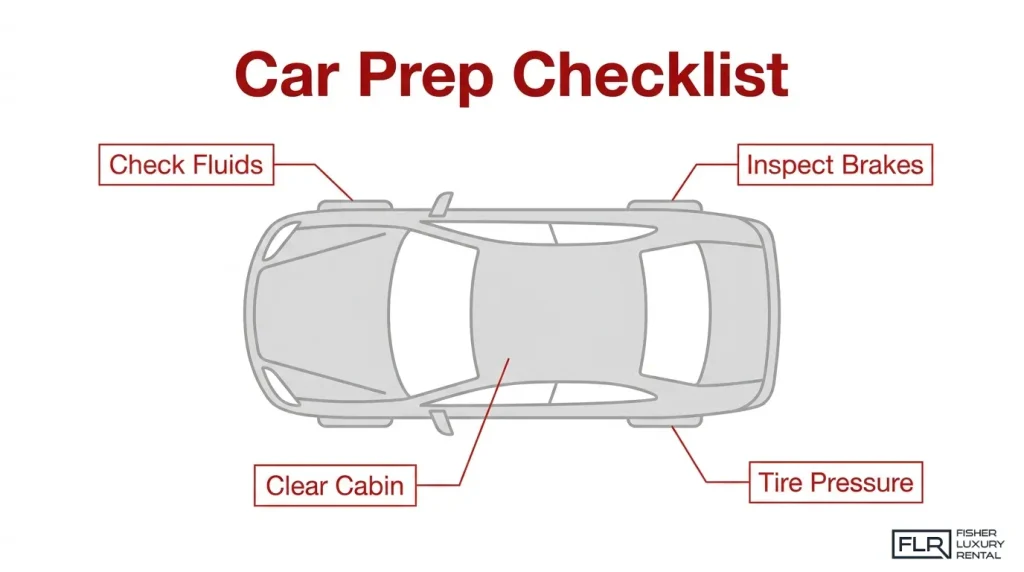
What Fluid Levels and Mechanical Checks Matter Most?
The fluid levels and mechanical checks that matter most are engine oil, coolant, brake fluid, and tire condition. According to SCCA Time Trials Safety Rules, brake fluid must be clean and full (DOT 4 recommended), all fluid caps must be tight and secure, overflow containers must be present, and there must be no leaks anywhere. Lug nuts must be present and torqued to spec. These checks are non-negotiable at most organized track events and will be verified during the pre-session technical inspection.
How Should You Inspect Brakes Before a Track Day?
Brakes should be inspected for pad thickness, rotor condition, and fluid integrity before any track session. BMW M’s official track guidance recommends allowing brakes to cool by driving at reduced speeds after your final lap rather than parking immediately, which prevents heat-related damage to both pads and rotors. Inspecting for brake fluid leaks beforehand is equally critical. On track, sustained high-speed braking generates far more heat than road driving, making fresh fluid and adequate pad depth essential safety requirements.
What Tire Pressures and Conditions Are Ideal?
The ideal tire pressures for track use are between 2.3 and 2.7 bar for warm tires, according to BMW M’s race track guidance. Cold pressure will read lower before a session, so checking pressures after a warm-up lap gives a more accurate reading. Tires must have adequate tread depth and a speed rating appropriate for track use. After the event, inspect tires for wear and reset pressures to road-use specifications before driving home.
Why Should You Remove Loose Items From the Cabin?
You should remove loose items from the cabin because unsecured objects become dangerous projectiles under hard braking and cornering forces. SCCA Time Trials Safety Rules require that the interior and trunk be completely clear of all loose items, including floor mats not secured with clips or fasteners. Items such as water bottles, bags, sunglasses, and removable mats must all be taken out before entering the circuit. This applies to every session, not just your first.
How Can You Progress After Your First Track Day?
Progression after a first track day follows a clear path: refine core skills, earn advancement into faster run groups, and use data tools to find time. The following H3s cover each step in sequence.
What Skill-Building Steps Should Beginners Follow?
The skill-building steps beginners should follow focus on consistency before speed. Start by perfecting one element per session, such as brake points, turn-in timing, or throttle application at corner exit. Revisit the same circuit repeatedly so layout familiarity stops consuming mental bandwidth. Most organized programs, including HPDE ladder structures, build this repetition deliberately into their run-group framework. Only add speed once each technique feels automatic rather than deliberate.
When Should You Move to Advanced Track Day Groups?
You should move to advanced track day groups when your instructors consistently confirm that your lines, flags, and passing etiquette are reliable without prompting. Most programs, such as NASA HPDE and SCCA Track Night in America, require instructor sign-off before a solo or advanced group promotion. Rushing promotion is counterproductive; experienced drivers earn solo status through demonstrated consistency, not elapsed time on track.
How Do Data Logging and Video Review Improve Lap Times?
Data logging and video review improve lap times by showing exactly where speed is gained or lost across each lap. According to AiM Sportline, the SmartyCam 3 Sport overlays GPS and ECU data onto session video, which can then be split into individual lap clips for direct side-by-side comparison. Apps such as Harry’s LapTimer let drivers select any lap, overlay telemetry, and analyze braking, throttle, and cornering through built-in charts. Watching two laps simultaneously pinpoints the precise braking zone or corner where one lap outperformed another, turning subjective impressions into measurable correction targets.
How Does an Exotic Car Rental Elevate Your Track Experience?
An exotic car rental elevates your track experience by giving you access to high-performance machinery without the ownership costs or mechanical preparation stress. The two H3s below cover how Fisher Luxury Rental fits into a beginner’s track journey and the core takeaways from this guide.
Can Renting a Luxury Car From Fisher Luxury Rental Prepare You for Track Driving?
Yes, renting a luxury car from Fisher Luxury Rental can prepare you for track driving by placing you behind genuinely capable, well-maintained exotic vehicles before you commit to owning or modifying one.
Fisher Luxury Rental operates in Phoenix, AZ and Portland, OR, offering top-trim exotic and luxury cars for rent. For a beginner exploring track driving, renting serves a practical purpose: it removes the variables of car preparation, mechanical inspections, and insurance complications that come with bringing a personal vehicle to the circuit. You arrive, drive, and focus entirely on technique rather than worrying about whether your brakes or tires are track-ready.
Renting a high-performance car also builds familiarity with throttle sensitivity, braking feel, and steering response that exceeds what most daily drivers deliver. That exposure directly sharpens the skills discussed throughout this guide, from finding the racing line to managing understeer. Fisher Luxury Rental’s fleet of top-trim vehicles makes this kind of preparation accessible without long-term commitment.
What Are the Key Takeaways About Track Driving for Beginners?
The key takeaways about track driving for beginners are that preparation, technique, and the right vehicle are the three pillars that determine how safe and rewarding your first track day will be.
The most actionable lessons from this guide are:
- Eligibility comes first. Most track events, including SCCA Track Night in America, require a valid full driver’s license and participants to be 18 or older.
- Safety gear is non-negotiable. An SFI or Snell-certified helmet is required at virtually every event; clothing and footwear matter too.
- Start slow, build deliberately. HPDE programs and autocross events are designed for beginners precisely because they let you set your own pace with instructor support.
- Car preparation prevents incidents. Fluid levels, brake condition, tire tread, and a clear cabin are checks that must happen before you leave the paddock.
- Technique over speed. Mastering the racing line, proper braking points, and smooth throttle application produces faster, safer laps than simply driving harder.
- Standard road insurance does not cover track days. Arrange appropriate cover before attending any event.
- Renting a performance car removes friction. It eliminates preparation stress and lets beginners focus on learning, not logistics.
Track driving rewards patience. The drivers who improve fastest are those who prioritize consistency and coachability over raw aggression from the very first session.
Track Driving for Beginners: Essential Guide & Tips 2026
Track driving is the practice of operating a vehicle on a closed, purpose-built circuit in a controlled environment, free from speed limits, traffic enforcement, and unpredictable hazards. It gives beginners a structured framework for pushing a car beyond everyday street conditions with certified instruction and clearly defined safety rules.
This guide covers what the sport actually requires to get started, how to choose the right event format, what gear and car preparation matter, the core driving techniques every novice needs, the most common mistakes to avoid, how to prepare your car, how to progress after your first session, and how exotic car rentals fit into that journey.
Track day eligibility, licensing requirements, and physical fitness demands vary by organization and age, so we walk through each threshold with specific figures. Knowing the rules before you arrive removes the most common reasons beginners get turned away.
Event formats range from High-Performance Driving Experiences with one-on-one instructor coaching to low-cost autocross events starting at $25, and each offers a different entry point for new drivers. Choosing the right format for your experience level makes a significant difference in what you learn during your first session.
Driving technique covers five skills: finding the racing line, braking correctly, managing throttle, shifting smoothly, and correcting understeer and oversteer. These fundamentals determine how safe and how fast your laps become.
Car preparation and safety gear cover the mechanical checks, helmet certification standards, and cabin requirements that most organized events verify before you enter the circuit. Post-session progression ties everything together, showing how data logging, video review, and run-group advancement turn early sessions into measurable improvement.
What Is Track Driving and Why Do Beginners Love It?
Track driving is the practice of operating a vehicle on a closed, purpose-built racing circuit in a controlled environment. Beginners love it because it removes the hazards of public roads, including speed limits, pedestrians, and traffic enforcement, while providing structured instruction.
What Is Track Driving?
Track driving is a supervised high-performance driving activity conducted on a closed circuit, where participants push their vehicles beyond everyday street conditions. According to NASA’s High Performance Driving Event program, drivers learn the fine points of high-performance driving on America’s greatest road courses in a safe, controlled, and affordable setting, with no speed limits, no pedestrians, and no tickets. A certified instructor rides along one-on-one, guiding each driver through the event at whatever pace they feel comfortable. Beginners set their own goals and progress on their own terms, making track driving genuinely accessible from the first session.
Why Do Beginners Choose Track Driving Over Street Performance?
Track driving appeals to beginners because a dedicated circuit eliminates the legal and physical risks of street performance. Public roads expose drivers to oncoming traffic, unpredictable pedestrians, and serious legal consequences, none of which exist on a closed course. The structured format, with beginner run groups, instructor coaching, and clearly communicated flag signals, gives new drivers a framework that street driving never provides. This controlled progression is arguably the single biggest reason beginners gain confidence faster on a track than through any amount of spirited road driving.
What Are the Basic Requirements to Drive on a Track?
The basic requirements to drive on a track include a minimum age, a valid driver’s license, and a mechanically sound vehicle. The sections below cover age thresholds, licensing rules, and the physical demands you should prepare for.
How Old Do You Need to Be for a Track Day?
The age requirement for a track day varies by organization and country. SCCA Track Night in America requires participants to be over 18 for standard on-track activities. For minors, an unrestricted driver’s license, a parent or guardian on-site, and prior sanctioned driving experience in autocross, karting, or track events are all required. Some club events, such as BMW CCA driving schools, accept participants as young as 16 with a full, valid driver’s license and no learner’s permit.
What Driver’s License or Experience Do You Need?
The driver’s license requirement for most track days is a full, valid license — learner’s permits are not accepted. According to RMC BMW CCA’s FAQ, the minimum age is 16 with a full license, and experienced drivers may advance to solo running only with Chief Instructor approval. Most beginner-level events also require club membership, such as BMW CCA membership for BMW driving schools. No prior track experience is needed for novice groups, though some programs place first-timers in instructor-led, lead-follow sessions until competency is demonstrated.
What Physical Fitness Level Is Recommended?
The physical fitness level recommended for track driving includes cardiovascular endurance, mental concentration, and heat tolerance. Track sessions expose drivers to sustained G-forces, high cockpit temperatures, and rapid decision-making over multiple laps. Motorsport UK’s Fit to Race guidance identifies stamina, strength, speed, suppleness, and mental spirit as the five key fitness pillars for motorsport competitors. Even at a beginner HPDE level, fatigue accumulates faster than most new drivers expect. Preparing your body beforehand is as important as preparing your car — a fit driver makes fewer errors when it matters most. Vehicle readiness matters equally: SCCA Time Trials safety rules require clean DOT 4 brake fluid, all fluids at correct levels, tires in good condition with adequate tread and speed rating, and the interior completely cleared of loose items.
What Should You Know Before Your First Track Day?
Before your first track day, you need to understand three key areas: the pre-session walk-through, mandatory rules and flag signals, and what classroom and briefing sessions cover.
What Is a Track Day Walk-Through and Why Does It Matter?
A track day walk-through is a guided or self-directed on-foot inspection of the circuit before driving begins. According to NASA Speed News, track walks are a time-honored practice that let drivers discern details impossible to perceive from behind the wheel, such as the true steepness of elevation changes at corners like the Corkscrew at WeatherTech Raceway Laguna Seca. Walking the track helps you identify braking markers, apex points, and track-out zones before speed becomes a factor. For beginners, this preparation is genuinely irreplaceable.
What Are the Common Track Day Rules and Flag Signals?
Common track day rules include attending the mandatory safety briefing, obeying all flag signals, and following passing regulations in your run group. According to KymiRing’s Requirements and Safety Information, all drivers must attend the safety briefing before entering the circuit, and missing it means you cannot join the session. Flag signals are explained at that briefing, and failure to follow marshal instructions may result in removal from the track. Road America reinforces this: novice group participants follow a lead-follow format with instructors, and drivers must follow all flag and passing rules throughout the event.
How Do Classroom and Briefing Sessions Prepare You?
Classroom and briefing sessions prepare you by covering flag signals, passing zones, emergency procedures, and group-specific conduct before you ever turn a lap. These sessions remove ambiguity around on-track communication, so your first session focuses on driving rather than guessing what a yellow flag means. Road America’s novice program includes dedicated classroom time alongside the lead-follow format precisely because structured instruction before seat time produces safer, more confident drivers. Arriving early and engaging fully with the briefing is the single most underrated preparation step a beginner can take.
What Are the Best Types of Track Events for Beginners?
The best types of track events for beginners are High-Performance Driving Experiences (HPDE), lapping days, autocross events, and structured track day experience packages. Each format offers a different entry point, cost level, and learning environment.
High-Performance Driving Experience (HPDE)
A High-Performance Driving Experience is a supervised on-track program where beginners drive alongside certified instructors in a safe, non-competitive environment. According to the National Auto Sport Association (NASA), HPDE events welcome enthusiast drivers to learn high-performance driving on real road courses, with a one-on-one instructor guiding each participant at their own pace. No prior racing experience is required, and drivers set their own speed goals.
Lapping Days
Lapping days are open-track sessions where drivers complete repeated laps at their own pace, without timed competition. Costs vary by registration timing: according to High Plains Raceway, early online registration costs $219 for a full day or $159 for a half day, while registering after midnight the night before increases those prices to $239 and $179, respectively. Booking early is the simplest way to reduce your first lapping day costs.
Autocross Events
Autocross events are low-to-medium speed car control events run one driver at a time through a cone-defined course, typically in a parking lot or airport. According to the Sports Car Club of America (SCCA), most regional autocross entry fees range from $25 to $45, while National Series events cost between $100 and $150. Autocross is widely considered the most affordable and accessible starting point for new track drivers. For drivers who want to experience high-performance handling before committing to a track program, Fisher Luxury Rental offers top-trim exotic and luxury vehicles for rent in Phoenix, AZ and Portland, OR — a practical way to build familiarity with throttle response and braking feel in a controlled setting.
Track Day Experience Packages
Track day experience packages are beginner-specific programs that combine limited track time with structured guidance. Lime Rock Park recommends its Track Tapas program for first-timers: a two-hour session covering both its proving grounds and the 1.5-mile road racing course in the participant’s own car, priced at $195 per person. For beginners unsure which format to try first, a curated package like this removes guesswork and delivers a complete introduction in a single session.
What Car Should a Beginner Take to the Track?
A good beginner track car balances predictability, affordability, and mechanical simplicity. The sections below cover what qualities to look for, whether your daily driver qualifies, and whether renting a performance car is a smarter first-day choice.
What Makes a Good Beginner Track Car?
A good beginner track car is lightweight, forgiving at the limit, and inexpensive to repair. Cars with modest power outputs teach fundamentals more effectively than high-horsepower machines, because mistakes happen at speeds that are recoverable. Braking, in particular, defines lap times more than most new drivers expect. As two-time Formula 1 world champion Jim Clark observed, “braking is more important than most people think,” and a car that communicates brake grip clearly makes that lesson far easier to learn.
Strong candidates share these qualities:
- Low curb weight for responsive, predictable handling
- Naturally aspirated engine with linear power delivery
- Rear-wheel or balanced all-wheel drive to teach proper car control
- Affordable replacement parts to limit post-session repair costs
Can You Use a Daily Driver for Track Days?
Yes, you can use a daily driver for track days, but doing so carries significant practical and financial risks. Standard road insurance will not cover track day incidents; per Silverstone’s Car Track Days Terms and Conditions, drivers must make their own arrangements for accident cover. Every participant also signs a liability waiver accepting full risk of property damage and personal injury. Running your only car means a single off can leave you without transportation and facing uninsured repair costs. Fisher Luxury Rental provides exotic and luxury car rentals in Phoenix, AZ and Portland, OR for drivers who want to experience high-performance vehicles without the financial exposure of running their own car
Practical risks of using a daily driver include:
- Accelerated brake pad and rotor wear from repeated hard stops
- Elevated coolant temperatures stressing standard cooling systems
- Tire degradation far exceeding normal road use rates
- Loss of your primary vehicle if damage occurs
Renting a purpose-prepared performance car through a dedicated rental program eliminates these risks entirely
Should Beginners Rent a Performance Car for the Track?
Yes, beginners should strongly consider renting a performance car for the track, especially on their first event. Rental programs provide vehicles already inspected, insured for circuit use, and matched to the novice run group. According to SCCA Track Night in America Rules and Regulations, participants must hold a valid full driver’s license and be over 18, and minors require additional documentation including prior sanctioned performance driving experience. Rental programs remove vehicle preparation as a variable, allowing beginners to focus entirely on learning technique rather than worrying about mechanical readiness or uninsured damage to a personal car.
What Gear and Safety Equipment Do You Need?
The right gear protects you if something goes wrong on track. The following H3s cover helmet certification standards, appropriate clothing and footwear, and essential in-car safety items every beginner should bring.
What Helmet Specifications Are Required for Track Days?
Helmet specifications required for track days fall under two primary certification bodies: the SFI Foundation and the Snell Memorial Foundation. According to the SFI Foundation, certified helmets must pass strict testing procedures developed by industry experts, with two applicable specs: SFI 31.1 for flame-resistant helmets and SFI 41.1 for non-flame-resistant helmets. Both specs cover open-face and full-face designs. The Snell SA2020 standard is also widely accepted, with impact criteria that are equal to or more stringent than FIA 8859-2015 requirements. Most track day organizers require at minimum an SFI or Snell-rated lid. Always verify the specific rating your event accepts before purchasing.
What Clothing and Footwear Should You Wear?
Appropriate clothing and footwear for a track day prioritize safety and pedal control. Key recommendations include:
- Long-sleeved cotton or fire-resistant shirt and trousers: Synthetic fabrics melt on contact with heat; natural fibers or nomex offer better protection.
- Closed-toe shoes with thin, flat soles: Thin soles improve brake and throttle pedal feel, reducing the risk of missed inputs.
- Avoid sandals, flip-flops, or thick-soled boots: These reduce pedal sensitivity and can snag under pedals.
- Gloves (optional but recommended): Improve grip on the steering wheel during extended sessions.
Many events require long pants and closed-toe shoes as a minimum; check your organizer’s rules in advance.
What In-Car Safety Items Should You Bring?
Essential in-car safety items to bring to a track day include a fire extinguisher, a working first-aid kit, and a charged mobile phone. Beyond basics, confirm your car passes a standard safety check: all fluids topped and sealed, no loose items in the cabin or trunk, and floor mats secured or removed. Loose objects become dangerous projectiles under hard braking. Most events conduct a tech inspection before you enter the paddock, so arriving prepared avoids disqualification. Good preparation is the single most controllable safety variable a beginner manages.
What Are the Essential Driving Techniques for Beginners?
The essential driving techniques for beginners cover five core skills: finding the racing line, braking correctly, managing throttle, shifting smoothly, and handling understeer and oversteer. Mastering each of these builds the foundation for safe, fast, and controlled track driving.
How Do You Find and Follow the Racing Line?
The racing line is the fastest arc through a corner on a race circuit. According to Scott Mansell of Driver61, the trajectory of the racing line depends on corner severity, the length of the following straight, and the type of car being driven. In practice, the classic approach is late apex: enter wide, hit the apex late, and exit wide to maximize corner speed. Beginners often cut in too early, which tightens the exit and forces a lift. Learning to be patient with your turn-in point is one of the highest-leverage skills a new track driver can develop.
How Do You Brake Correctly on a Track?
Correct track braking means applying firm, progressive pressure in a straight line before the corner entry, then releasing smoothly as you turn in. Street drivers habitually brake early and gently; on track, threshold braking compresses the front tires for maximum grip. As legend Jim Clark noted, “It comes as a great shock to find that you can brake much later than you ever thought was possible.” Begin by braking at a conservative marker, then incrementally move that point later as confidence builds.
How Does Throttle Control Differ from Street Driving?
Throttle control on track differs from street driving in timing and precision: on track, throttle application begins at the apex and builds progressively through the exit, not mid-corner. Applying full throttle before the car is pointed toward the straight overloads the rear tires and causes oversteer. Smooth, deliberate inputs keep the car balanced and the tires in their optimal grip window throughout the corner.
What Is the Proper Way to Shift on a Track?
The proper way to shift on a track is to match engine revs during downshifts, keeping the drivetrain stable under hard braking. Nik Berg, writing for Hagerty, explains that when you match revs on downshifts, gearchanges slot home more readily and you avoid the sharp speed fluctuation caused by mismatched engine and wheel speeds. For upshifts, brief, decisive movements prevent missed gears at high RPM. Heel-and-toe technique achieves simultaneous braking and rev-matching for manual transmission drivers.
How Do You Handle Understeer and Oversteer?
Understeer occurs when the front tires lose grip and the car pushes wide; oversteer occurs when the rear tires lose grip and the car rotates excessively. The corrections are:
- Understeer: Reduce steering input, ease off the throttle gradually, and allow the front tires to regain grip before reapplying steering.
- Oversteer: Apply smooth counter-steer in the direction of the slide and modulate throttle carefully to avoid overcorrection.
Both conditions are triggered by exceeding tire grip limits, so smooth inputs through braking, steering, and throttle prevent them from developing in the first place. Understanding these responses before they happen on track is what separates composed beginners from those who end up in the gravel.
What Are the Most Common Beginner Mistakes on Track?
The most common beginner mistakes on track include overdriving beyond skill level, target fixation, braking too late into corners, and ignoring track etiquette. Each mistake carries real safety consequences, so understanding them before your first session is essential.
Why Is Overdriving Dangerous for New Drivers?
Overdriving is dangerous for new drivers because it pushes the car beyond what the driver can perceive and manage. Beginners frequently overestimate their ability to recognize and respond to hazards at speed. According to CDC data on risk factors for teen drivers, 35% of male drivers and 18% of female drivers aged 15 to 20 involved in fatal crashes were speeding at the time of the crash in 2020. Even adult novices share this pattern: the instinct to go faster arrives well before the skills to do so safely. Staying within a comfortable pace, especially in early sessions, is the single most protective habit a new track driver can develop.
How Does Target Fixation Cause Accidents?
Target fixation causes accidents by locking a driver’s gaze onto a hazard, which unconsciously steers the car directly toward it. When a beginner spots a wall, cone, or stalled car, the natural reflex is to stare at it. The body follows the eyes. Breaking fixation requires a deliberate habit: look through the corner to your exit point, not at the obstacle in front of you. Practicing this eye discipline at lower speeds builds the neural pathways needed to apply it under pressure.
Why Do Beginners Brake Too Late Into Corners?
Beginners brake too late into corners because they misjudge the gap between their braking marker and the turn-in point, often compressing both into one rushed action. The result is entry speed too high to hold the racing line, leading to understeer or a wide exit. As Jim Clark noted in a Formula1.com feature, “it comes as a great shock to find that you can brake much later than you ever thought was possible” — but that capability comes with progressive training, not guesswork. Novices should brake earlier than feels necessary and tighten their braking point only as consistency builds.
What Happens When You Ignore Track Etiquette?
Ignoring track etiquette puts every driver on circuit at risk, not just the offender. Core etiquette rules include using designated passing zones only, signaling clearly before moving aside, and never brake-testing following cars. Marshals can remove drivers who fail to respect flag signals or safe passing conventions. Beyond safety, poor etiquette damages the experience for everyone and can result in permanent bans from events. Learning and following these conventions from the very first session is as important as any driving technique.
How Should You Prepare Your Car for a Track Day?
Preparing your car for a track day covers four key areas: fluid and mechanical checks, brake inspection, tire pressure, and cabin clearance. Each H3 below addresses one of these areas in sequence.
What Fluid Levels and Mechanical Checks Matter Most?
The fluid levels and mechanical checks that matter most are engine oil, coolant, brake fluid, and tire condition. According to SCCA Time Trials Safety Rules, brake fluid must be clean and full (DOT 4 recommended), all fluid caps must be tight and secure, overflow containers must be present, and there must be no leaks anywhere. Lug nuts must be present and torqued to spec. These checks are non-negotiable at most organized track events and will be verified during the pre-session technical inspection.
How Should You Inspect Brakes Before a Track Day?
Brakes should be inspected for pad thickness, rotor condition, and fluid integrity before any track session. BMW M’s official track guidance recommends allowing brakes to cool by driving at reduced speeds after your final lap rather than parking immediately, which prevents heat-related damage to both pads and rotors. Inspecting for brake fluid leaks beforehand is equally critical. On track, sustained high-speed braking generates far more heat than road driving, making fresh fluid and adequate pad depth essential safety requirements.
What Tire Pressures and Conditions Are Ideal?
The ideal tire pressures for track use are between 2.3 and 2.7 bar for warm tires, according to BMW M’s race track guidance. Cold pressure will read lower before a session, so checking pressures after a warm-up lap gives a more accurate reading. Tires must have adequate tread depth and a speed rating appropriate for track use. After the event, inspect tires for wear and reset pressures to road-use specifications before driving home.
Why Should You Remove Loose Items From the Cabin?
You should remove loose items from the cabin because unsecured objects become dangerous projectiles under hard braking and cornering forces. SCCA Time Trials Safety Rules require that the interior and trunk be completely clear of all loose items, including floor mats not secured with clips or fasteners. Items such as water bottles, bags, sunglasses, and removable mats must all be taken out before entering the circuit. This applies to every session, not just your first.
How Can You Progress After Your First Track Day?
Progression after a first track day follows a clear path: refine core skills, earn advancement into faster run groups, and use data tools to find time. The following H3s cover each step in sequence.
What Skill-Building Steps Should Beginners Follow?
The skill-building steps beginners should follow focus on consistency before speed. Start by perfecting one element per session, such as brake points, turn-in timing, or throttle application at corner exit. Revisit the same circuit repeatedly so layout familiarity stops consuming mental bandwidth. Most organized programs, including HPDE ladder structures, build this repetition deliberately into their run-group framework. Only add speed once each technique feels automatic rather than deliberate.
When Should You Move to Advanced Track Day Groups?
You should move to advanced track day groups when your instructors consistently confirm that your lines, flags, and passing etiquette are reliable without prompting. Most programs, such as NASA HPDE and SCCA Track Night in America, require instructor sign-off before a solo or advanced group promotion. Rushing promotion is counterproductive; experienced drivers earn solo status through demonstrated consistency, not elapsed time on track.
How Do Data Logging and Video Review Improve Lap Times?
Data logging and video review improve lap times by showing exactly where speed is gained or lost across each lap. According to AiM Sportline, the SmartyCam 3 Sport overlays GPS and ECU data onto session video, which can then be split into individual lap clips for direct side-by-side comparison. Apps such as Harry’s LapTimer let drivers select any lap, overlay telemetry, and analyze braking, throttle, and cornering through built-in charts. Watching two laps simultaneously pinpoints the precise braking zone or corner where one lap outperformed another, turning subjective impressions into measurable correction targets.
How Does an Exotic Car Rental Elevate Your Track Experience?
An exotic car rental elevates your track experience by giving you access to high-performance machinery without the ownership costs or mechanical preparation stress. The two H3s below cover how Fisher Luxury Rental fits into a beginner’s track journey and the core takeaways from this guide.
Can Renting a Luxury Car From Fisher Luxury Rental Prepare You for Track Driving?
Yes, renting a luxury car from Fisher Luxury Rental can prepare you for track driving by placing you behind genuinely capable, well-maintained exotic vehicles before you commit to owning or modifying one.
Fisher Luxury Rental operates in Phoenix, AZ and Portland, OR, offering top-trim exotic and luxury cars for rent. For a beginner exploring track driving, renting serves a practical purpose: it removes the variables of car preparation, mechanical inspections, and insurance complications that come with bringing a personal vehicle to the circuit. You arrive, drive, and focus entirely on technique rather than worrying about whether your brakes or tires are track-ready.
Renting a high-performance car also builds familiarity with throttle sensitivity, braking feel, and steering response that exceeds what most daily drivers deliver. That exposure directly sharpens the skills discussed throughout this guide, from finding the racing line to managing understeer. Fisher Luxury Rental’s fleet of top-trim vehicles makes this kind of preparation accessible without long-term commitment.
What Are the Key Takeaways About Track Driving for Beginners?
The key takeaways about track driving for beginners are that preparation, technique, and the right vehicle are the three pillars that determine how safe and rewarding your first track day will be.
The most actionable lessons from this guide are:
- Eligibility comes first. Most track events, including SCCA Track Night in America, require a valid full driver’s license and participants to be 18 or older.
- Safety gear is non-negotiable. An SFI or Snell-certified helmet is required at virtually every event; clothing and footwear matter too.
- Start slow, build deliberately. HPDE programs and autocross events are designed for beginners precisely because they let you set your own pace with instructor support.
- Car preparation prevents incidents. Fluid levels, brake condition, tire tread, and a clear cabin are checks that must happen before you leave the paddock.
- Technique over speed. Mastering the racing line, proper braking points, and smooth throttle application produces faster, safer laps than simply driving harder.
- Standard road insurance does not cover track days. Arrange appropriate cover before attending any event.
- Renting a performance car removes friction. It eliminates preparation stress and lets beginners focus on learning, not logistics.
Track driving rewards patience. The drivers who improve fastest are those who prioritize consistency and coachability over raw aggression from the very first session.