The McLaren 720S test drive experience is a full-spectrum encounter with a 710 bhp, twin-turbocharged mid-engine supercar built around precision, driver feedback, and a carbon fiber structure that keeps every input direct and honest. This guide covers the car’s core specifications, how it feels across its three drive modes, what the interior delivers at speed, how it stacks up against its closest rivals, and how to get behind the wheel yourself through Fisher Luxury Rental.
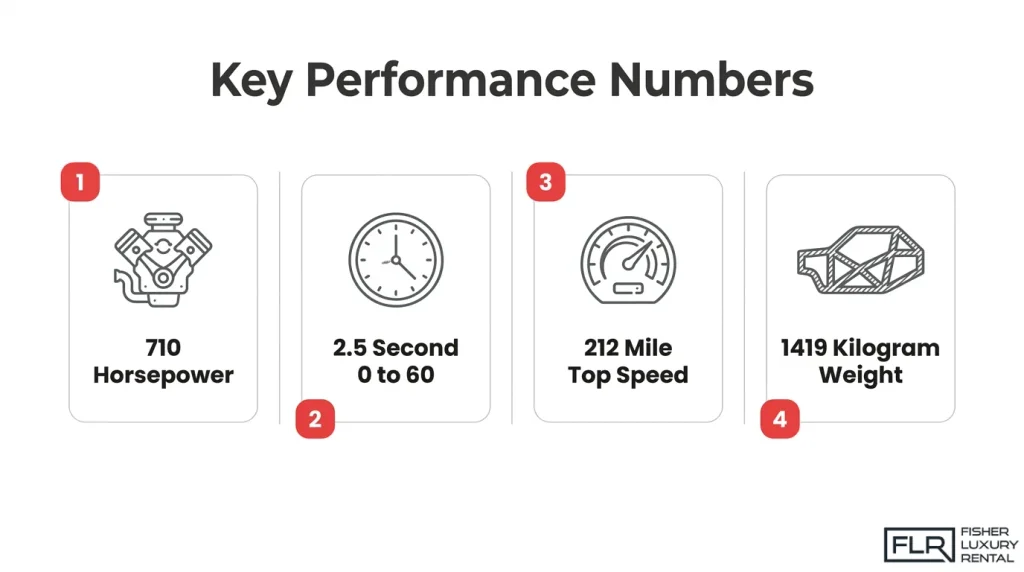
The 720S is defined by a 4.0-litre twin-turbo V8 producing 720 PS and 770 Nm of torque, a 0-60 time of 2.5 seconds, and a 212 mph top speed housed in a Carbon Fibre Monocage II structure weighing just 1,419 kg. Those numbers set the stage for everything that follows.
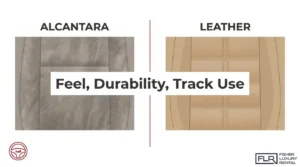
Behind the wheel, the car communicates constantly through electro-hydraulic steering and carbon-ceramic brakes, while Proactive Chassis Control II reshapes the suspension character entirely across Comfort, Sport, and Track modes. The cockpit pairs a folding driver display and Nappa leather Alcantara seats with exceptional outward visibility, making the interior feel purposeful rather than spartan.
Against the Ferrari 488 GTB, Lamborghini Huracán, and Porsche 911 Turbo S, the 720S positions itself as the most analytically precise and driver-focused choice in the class. First-time drivers consistently report surprises: the brake pedal firmness, the active rear wing deploying under braking, and how genuinely livable the car is day to day.
What Are the Key Specs That Define the McLaren 720S?
The key specs that define the McLaren 720S center on its engine output, acceleration, top speed, and carbon fiber construction. The H3s below cover horsepower, engine type, 0-60 time, top speed, and curb weight.
How Much Horsepower Does the McLaren 720S Produce?
The McLaren 720S produces 720 PS (710 bhp), a figure that names the car itself. That output arrives from a 4.0-litre twin-turbocharged V8 paired with 770 Nm (568 lb-ft) of torque. Evo named precision the car’s defining characteristic, writing it is “completely absorbing, frighteningly intense, life-affirming, but not inherently scary.” For a supercar in this class, that balance between raw power and driver accessibility is genuinely rare.
What Type of Engine Powers the McLaren 720S?
The engine powering the McLaren 720S is a 4.0-litre twin-turbocharged V8. According to McLaren Automotive, this unit delivers 720 PS and 770 Nm of torque, housed within a Carbon Fibre Monocage II body structure. The combination of a lightweight carbon chassis and forced-induction V8 is what separates the 720S from heavier, less focused competitors.
How Fast Does the McLaren 720S Go From 0 to 60?
The McLaren 720S goes from 0 to 60 mph in approximately 2.5 seconds. MotorTrend recorded that figure and noted the 720S is “tied for the third-quickest car we’ve tested to 60 mph.” An active rear wing assists this by lying flat during straight-line acceleration to reduce drag, then raising as an airbrake under heavy braking.
What Is the Top Speed of the McLaren 720S?
The top speed of the McLaren 720S is 341 km/h (212 mph), per McLaren Automotive’s official figures. The instrument pack supports high-speed use by tipping forward in track mode to display only essential data: revs, gear, and speed. That focused cockpit design reinforces how seriously McLaren engineered this car for performance at the limit.
How Much Does the McLaren 720S Weigh?
The McLaren 720S weighs 1,419 kg (3,128 lbs) at DIN kerb weight. The optional Track Pack, a $28,000 upgrade available exclusively on the Performance specification, reduces unsprung mass further through super-lightweight 10-spoke alloy wheels. Weight discipline is central to what makes the 720S feel so responsive; the carbon structure earns its place at every speed.
How Does the McLaren 720S Feel Behind the Wheel?
The McLaren 720S feels like a car engineered to communicate with its driver at every moment. The following sections cover steering feedback, cornering behavior, throttle response, cockpit visibility, and long-distance comfort.
What Is the Steering Feel Like in the McLaren 720S?
The steering feel in the McLaren 720S is precise, communicative, and deliberately hydraulic. While Ferrari, Jaguar, and Porsche have all adopted fully electric steering, McLaren rejected EPAS, arguing the efficiency gains are too small to justify the loss of connectivity. According to BBC Top Gear, McLaren’s chief test driver Chris Goodwin confirms the electro-hydraulic setup carries all the feel and linearity of the 675LT, with minor comfort refinements.
Road & Track describes the experience simply: the 720S educates you, communicating what it needs through subtle feedback in both the steering and brake pedal. One practical note for new drivers: the carbon-ceramic brakes feel almost like unboosted race brakes and require noticeably more pedal pressure than conventional setups.
That tactile honesty between driver and car is what separates the 720S from most modern supercars.
How Does the McLaren 720S Handle Tight Corners?
The McLaren 720S handles tight corners with surgical precision. The Proactive Chassis Control II suspension uses hydraulically linked dampers and 12 sensors, including corner-mounted accelerometers, to continuously adjust damping across Comfort, Sport, and Track modes. Through bends, the chassis stays remarkably flat while feeding grip information back through the steering. The car rewards commitment: the more confidently you enter a corner, the more composed and planted it feels.
What Is the Throttle Response Like in the McLaren 720S?
The throttle response in the McLaren 720S is immediate and linear across the entire rev range. Power from the 4.0-litre twin-turbocharged V8 arrives with very little lag, making in-corner acceleration precise and confidence-inspiring rather than violent or unpredictable. CarThrottle notes that among supercars usable every day, the 720S is probably the best option currently on sale, a verdict driven largely by how manageable its throttle feels in normal traffic. That accessibility does not dull the experience when you open it up fully.
How Does the Visibility Feel From the 720S Cockpit?
Visibility from the 720S cockpit is exceptional for a mid-engine supercar. McLaren used the inherent strength of the carbon-fibre pillars to reduce their physical bulk, then glazed the sections between the rear pillars to open up rearward sightlines. The result is a cockpit that feels connected to the road in every direction, reducing the claustrophobia common in cars of this class. For daily driving, that visibility is a meaningful practical advantage that most rivals cannot match.
How Comfortable Is the McLaren 720S on Longer Drives?
The McLaren 720S is comfortable on longer drives when set to Comfort mode, which softens the adaptive dampers significantly without sacrificing body control. The Nappa leather and Alcantara seats provide substantial support over distance, and the carbon-fibre Monocage II structure keeps road noise well managed for a car this capable. Switching between drive modes on a long highway stretch, from Comfort to Sport, shows just how wide the 720S’s personality range really is. That versatility makes it genuinely livable in a way few supercars achieve.
How Does the McLaren 720S Perform in Each Drive Mode?
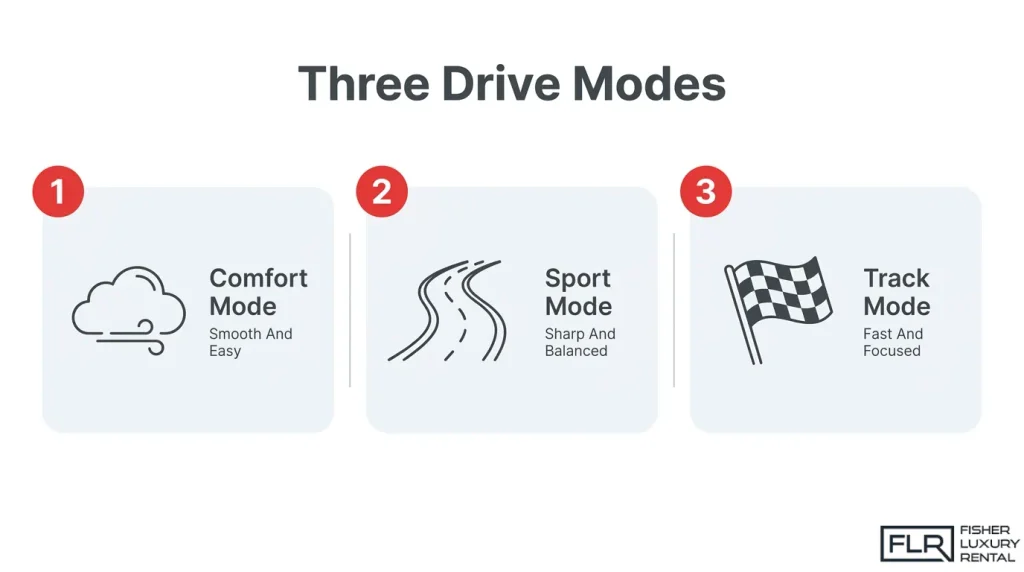
The McLaren 720S performs differently across three selectable modes: Comfort, Sport, and Track. Each mode adjusts damping, throttle response, and chassis behavior through Proactive Chassis Control II, transforming the car’s character entirely depending on the situation.
How Does the 720S Feel in Comfort Mode?
The 720S feels surprisingly composed and approachable in Comfort mode. According to Motor Authority, Proactive Chassis Control II uses hydraulically linked dampers with two pressure sensors each, plus twelve additional sensors including a corner-mounted accelerometer, to optimize damping continuously. In Comfort, this system softens the ride substantially, absorbing road imperfections without the harshness you might expect from a 710 bhp supercar. Throttle inputs feel smoother, gearchanges less aggressive. For anyone new to the 720S, Comfort mode is the ideal starting point.
How Does the 720S Feel in Sport Mode?
Sport mode is where the 720S finds its most versatile balance. The same Proactive Chassis Control II system tightens damping responses, sharpens throttle delivery, and tunes the chassis for spirited driving without crossing into outright aggression. Body roll reduces noticeably, and the car communicates more directly through corners. It handles city driving with enough compliance while still rewarding faster-paced roads. For most drivers, Sport mode represents the sweet spot between comfort and performance.
How Does the 720S Feel in Track Mode?
Track mode transforms the 720S into a tenacious, pavement-gripping machine. Damping firms to its most aggressive setting, the chassis stiffens significantly, and throttle response becomes razor-sharp. The Pirelli P Zero Corsa tires are kept under maximum load as the sensor array feeds real-time corrections through the system. Every input becomes more immediate and consequential. This mode demands a driver who knows what they are doing, but the reward is a car that feels purpose-built for lap times.
What Is the McLaren 720S Interior Like During a Test Drive?
The McLaren 720S interior balances focused driver ergonomics with genuine luxury materials. The sections below cover the infotainment system’s usability, seat support at speed, and the cabin’s overall character.
How Intuitive Is the McLaren 720S Infotainment System?
The McLaren 720S infotainment system is reasonably intuitive, though its most distinctive feature is the folding driver display. According to Auto Express, the instrument pack tips forward for track use, leaving only essential information such as revs, gear, and speed visible. The same review noted the previous IRIS system “looked novel, but in reality was awkward, impractical and under-developed,” a candid admission that McLaren prioritized improvement where it mattered most. The folding display concept is clever in principle, though first-time drivers may need a few minutes to feel comfortable navigating it at speed.
How Supportive Are the McLaren 720S Seats at Speed?
The McLaren 720S seats are highly supportive at speed, combining Nappa leather and Alcantara for both grip and comfort. According to a 2019 CarPro review, the test car featured sumptuous Nappa leather and Alcantara seats, with the area behind the seats trimmed in rich leather. The Alcantara surface holds the driver firmly during hard cornering without the harshness of dedicated racing buckets, making them well-suited to both spirited driving and longer stints.
Does the McLaren 720S Cabin Feel Premium or Spartan?
The McLaren 720S cabin feels premium but purposefully restrained. Every surface within reach uses quality materials, yet the layout keeps unnecessary clutter out of the driver’s sightline. It is neither the opulent cocoon of a grand tourer nor the stripped shell of a track car. This balance is intentional: the 720S is engineered so the cabin serves the driver rather than distracts them, which makes the experience feel more focused than sparse.
How Does the McLaren 720S Sound at Full Throttle?
The McLaren 720S sounds like a high-pitched, mechanically fierce twin-turbocharged V8 at full throttle, delivering an exhaust note that blends sharp metallic urgency with deep, chest-compressing resonance. Unlike naturally aspirated supercars, the 720S produces a distinctive turbo whoosh layered beneath its rev climb, creating a soundtrack that is purposeful rather than theatrical.
At wide-open throttle, the 4.0-litre twin-turbo V8 builds quickly through the rev range, producing a rising wail that sharpens noticeably above 5,000 rpm. The exhaust note has an industrial edge: tightly wound and aggressive, rewarding drivers who push into the upper register. Lift off, and the induction noise and blow-off character add a second layer of sound that few supercars replicate.
Compared to Ferrari’s naturally aspirated scream or the Lamborghini Huracán’s theatrical howl, the 720S soundtrack is arguably more restrained at low speeds. But at full throttle on a stretch of open road, the difference disappears entirely. The intensity matches the acceleration, which MotorTrend confirmed hits 60 mph in just 2.5 seconds. Sound and speed arrive simultaneously, making the acoustic experience inseparable from the physical one. For first-time drivers, that combination is genuinely startling in the best possible way.
How Does the McLaren 720S Compare to Other Mid-Engine Supercars?
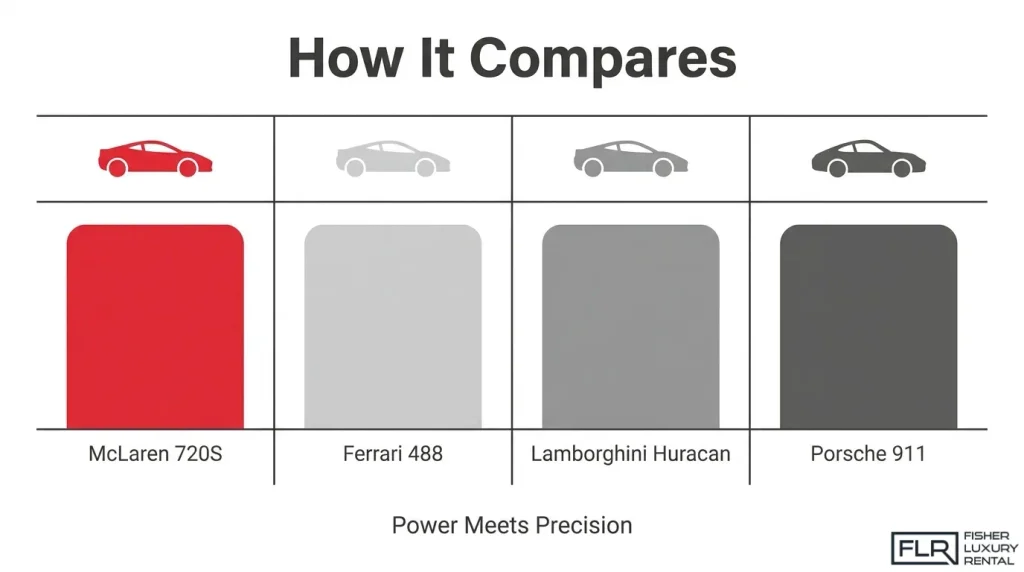
The McLaren 720S competes directly against the Ferrari 488 GTB, Lamborghini Huracán, and Porsche 911 Turbo S. Each rival takes a different approach to performance, feel, and daily usability, making the comparisons genuinely instructive for any serious driver.
How Does the McLaren 720S Compare to the Ferrari 488 GTB?
The McLaren 720S compares to the Ferrari 488 GTB as the more analytically focused, numerically superior machine in raw performance metrics. The 720S delivers 710 bhp against the 488 GTB’s 661 bhp, with a faster 0-60 time and a higher top speed. Where the Ferrari rewards emotion and mechanical drama, the McLaren prioritizes precision and data-driven dynamics. According to iSeeCars, both the 720S Luxury and 720S Performance variants carry a 30.9% depreciation rate, making the ownership cost calculation a real consideration when choosing between these two. From a driving standpoint, the 720S feels more clinical and surgical, while the 488 GTB leans into Italian theater. For drivers who want maximum lap-time capability with a composed, communicative chassis, the 720S holds the clear edge.
How Does the McLaren 720S Compare to the Lamborghini Huracán?
The McLaren 720S compares to the Lamborghini Huracán as the more driver-focused, lightweight alternative to Lamborghini’s visceral, all-wheel-drive spectacle. The Huracán prioritizes drama, aggressive styling, and AWD traction, while the 720S uses its carbon fiber Monocage II structure and rear-wheel drive to deliver a purer, more connected experience. Drivers who want a car that communicates through the steering and chassis will find the 720S considerably more rewarding on technical roads.
How Does the McLaren 720S Compare to the Porsche 911 Turbo S?
The McLaren 720S compares to the Porsche 911 Turbo S as the more exotic, track-biased choice against Porsche’s legendary everyday usability. The 911 Turbo S offers AWD, a rear-engine layout, and refinement that genuinely suits daily use. The 720S trades some of that accessibility for sharper throttle response, lighter weight, and a mid-engine balance that rewards committed driving. For those who prioritize the pure supercar experience over versatility, the 720S is the more compelling machine.
What Are Common Surprises First-Time 720S Drivers Notice?
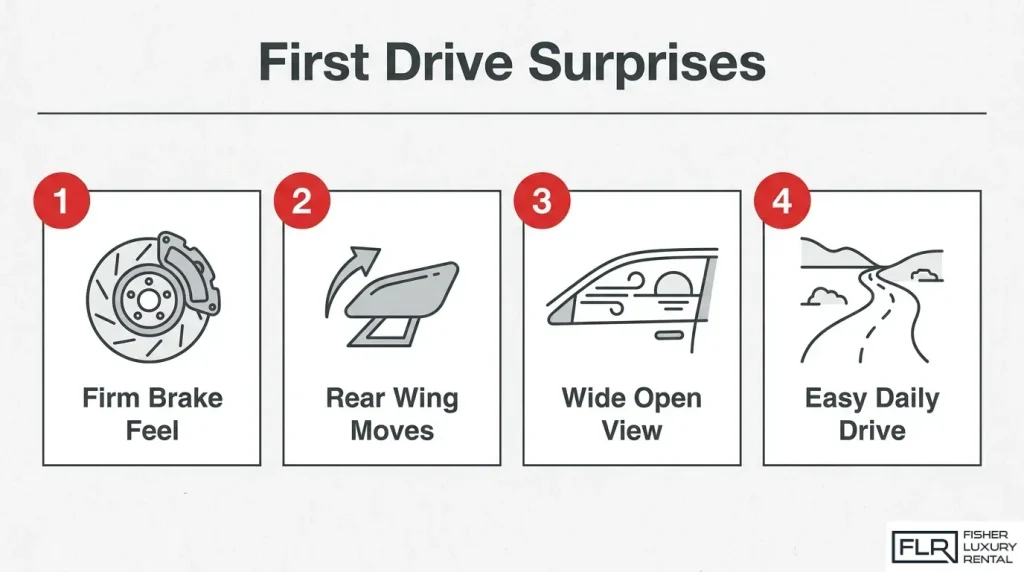
Common surprises first-time 720S drivers notice include the brake pedal firmness, the active rear wing behavior, the cockpit visibility, and the car’s genuine everyday usability despite its supercar performance. Each of these catches new drivers off guard in distinct ways.
The Carbon-Ceramic Brakes Feel Unlike Any Road Car
The carbon-ceramic brakes feel almost like unboosted race brakes, requiring noticeably more pedal pressure than drivers expect. According to Autoweek, you have to push harder on them to make them work, which can initially feel unsettling. Once acclimated, however, that firm pedal becomes a precise tool, not a liability. Most first-timers are surprised how quickly they adapt.
The Active Rear Wing Moves Visibly Under Braking
The active rear wing deploys automatically as an airbrake under heavy braking, reducing stopping distances and improving stability. Many first-time drivers are startled the first time they see and feel it rise in the mirror. The wing also lies flat during straight-line acceleration to reduce drag, and raises for additional downforce in corners. It is one of those systems that makes the car feel genuinely alive.
The Outward Visibility Is Surprisingly Good
The outward visibility from the 720S cockpit surprises drivers who expect a claustrophobic supercar environment. McLaren reduced the bulk of its carbon fiber pillars and glazed the areas between the rear ones, giving the cabin a remarkably open, airy feel. For a mid-engine supercar, the sightlines feel closer to a sports coupe than a track-focused machine.
The Car Is More Drivable Daily Than Expected
The McLaren 720S is more usable as a daily driver than most first-time drivers anticipate. For those curious whether the 720S fits their lifestyle, Fisher Luxury Rental’s exotic fleet in Phoenix and Portland provides a real-world answer without the ownership commitment. CarThrottle describes it as probably the best daily-driver supercar currently on sale, a conclusion that surprises nearly everyone who assumes extreme performance demands extreme compromise. Comfort mode genuinely smooths out road imperfections, and the cabin materials, including Nappa leather and Alcantara, make the interior feel refined rather than stripped out.
Who Is the McLaren 720S Best Suited For?
The McLaren 720S is best suited for drivers who prioritize raw performance, precision feedback, and track capability over everyday convenience. It rewards skill, welcomes daily use in the right context, and draws a notably younger buyer demographic than most comparable supercars.
Is the McLaren 720S a Good Daily Driver?
Yes, the McLaren 720S is a good daily driver for a supercar. CarThrottle describes it as “probably the best option currently on sale” for drivers who want to use a supercar every day. Proactive Chassis Control II softens the ride in Comfort mode substantially, making city and highway driving manageable. That said, carbon-ceramic brake pedal feel, tight ingress, and limited storage make it a commitment rather than a convenience.
Who Buys the McLaren 720S?
The McLaren 720S attracts a younger buyer profile than most British performance brands. According to Hagerty, the number of under-40 buyers choosing McLaren is shifting at a faster pace than for comparable British marques. This reflects a buyer who values engineering and track performance alongside status, rather than traditional luxury heritage. Experienced enthusiasts, weekend track drivers, and high-income collectors represent the core ownership profile.
Is the McLaren 720S Right for First-Time Supercar Drivers?
The McLaren 720S is accessible for first-time supercar drivers, but it demands respect. Road and Track notes that “the 720S will educate you, teach you what it needs with subtle touches of feedback in the steering and brake pedal.” Its progressive communication style actually makes it more forgiving than its power figure suggests. Renting before committing to ownership is the smartest way to assess fit, as the car’s intensity is genuinely not for everyone. Fisher Luxury Rental offers access to exotic vehicles in Phoenix, AZ and Portland, OR, giving first-time supercar drivers a structured opportunity to experience this level of performance before making any ownership decision. Fisher Luxury Rental offers access to exotic vehicles in Phoenix, AZ and Portland, OR, giving first-time supercar drivers a structured opportunity to experience this level of performance before making any ownership decision.
How Can You Experience a McLaren Test Drive Yourself?
Experiencing a McLaren 720S test drive is accessible through exotic car rental companies. The sections below cover how Fisher Luxury Rental connects drivers to this supercar and the key takeaways from the 720S driving experience.

Can Fisher Luxury Rental Put You Behind the Wheel of an Exotic Supercar?
Yes, Fisher Luxury Rental can put you behind the wheel of an exotic supercar, offering access to high-performance vehicles in Phoenix, AZ, Scottsdale, AZ, Portland, OR, and Vancouver, WA. The rental process requires meeting standard exotic car eligibility criteria. According to Enterprise, renters must be at least 25 years old to qualify for an exotic car rental. Insurance coverage is also a key consideration: as Prime Insurance notes, exotic car rental liability insurance covers injuries or damage sustained by others due to an accident resulting from the renter’s negligence. Fisher Luxury Rental emphasizes top-trim models and exceptional customer service, making it a practical path to a genuine McLaren-level driving experience without ownership.
What Are the Key Takeaways About the McLaren 720S Driving Experience?
The key takeaways about the McLaren 720S driving experience are that it delivers supercar performance, communicative handling, and surprising everyday usability in one package. The core lessons from every expert review and owner account point to the same conclusions:
- Performance is immediate and visceral: The 720S reaches 60 mph in 2.5 seconds, making acceleration feel violent and relentless at any throttle input.
- The car teaches you: Steering and brake feedback communicate grip and limit with unusual clarity, rewarding attentive drivers rather than intimidating them.
- Drive modes reshape the car’s character: Comfort, Sport, and Track modes genuinely transform ride quality and chassis aggression, making the 720S adaptable to any situation.
- The interior rewards focus: The folding driver display and Alcantara-trimmed cockpit prioritize the driver without feeling sparse.
- Rental is the smartest entry point: Ownership carries significant cost and maintenance complexity; a rental day through Fisher Luxury Rental delivers the full experience without the commitment.