
The history of car exhibitions is the story of how the automobile transformed from a mechanical curiosity into the world’s most culturally influential consumer product, displayed, debated, and celebrated through organized public events spanning more than 130 years.
This guide covers the origins of the first shows in the 1890s, the rise of iconic pre-war and post-war events, the role concept cars played in shaping design ambition, the digital disruption that forced exhibitions to reinvent themselves, the modern shows leading the industry today, and how electric vehicles have redefined what show floors display and why audiences attend.
The earliest exhibitions, from the 1898 Paris Salon’s 140,000 visitors in the Tuileries Garden to New York’s first national automobile show in 1900, proved that public appetite for the automobile was real and commercially serious.
Pre-war and post-war shows turned that appetite into institutions: Geneva emerged as a neutral international platform, Detroit anchored American manufacturing identity, Tokyo introduced Japanese engineering to the world, and Berlin demonstrated how governments could weaponize exhibitions for political ends.
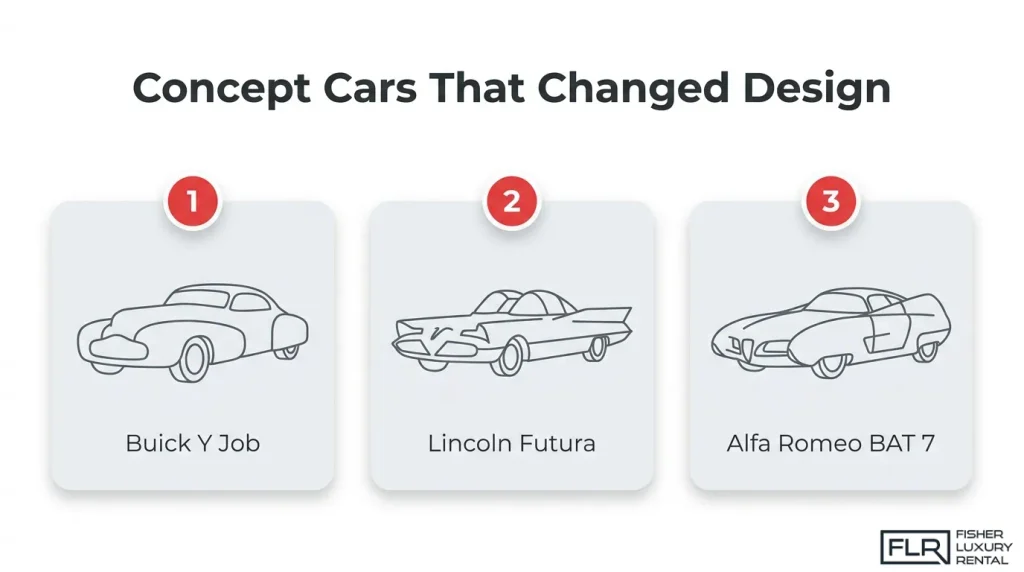
Concept cars gave shows a second identity, transforming them from product displays into laboratories of design ambition, with landmarks like the Buick Y-Job, Lincoln Futura, and Alfa Romeo BAT 7 setting the template.
The digital age forced a structural rethink, as brands moved from shared show floors to standalone launch events and live-streamed reveals, while consumer demand for hands-on access kept physical attendance resilient.
Today, Auto Shanghai, Detroit, Geneva, and Goodwood each shape the industry differently, with electric vehicles now commanding over 70 percent of some show floors and attendance figures surpassing one million visitors at a single event.
How Did the First Car Exhibitions Begin in the 1890s?
The first car exhibitions began in the 1890s through a combination of racing events, national expositions, and industry-organized shows that gave the automobile a public stage. The following sections cover the 1894 Paris context, the 1897 Berlin origins of the IAA, and the landmark 1898 Paris Salon.
What Happened at the 1894 Paris Exhibition?
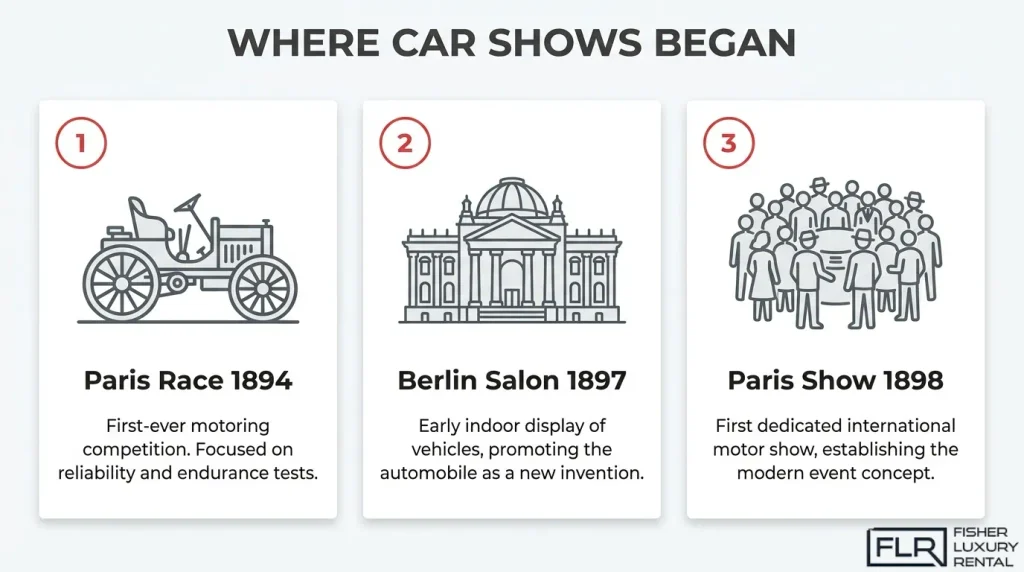
The 1894 Paris exhibition context centers on a pivotal motor race rather than a standalone show. The Paris to Rouen motor car race of 1894 demonstrated the practical capability of early automobiles, with Daimler and Maybach’s performance drawing significant investor attention. According to the Smithsonian Institution’s National Museum of American History, British investor Fredrick Simms subsequently conditioned his investment in Daimler Motoren Gesellschaft on Daimler’s return to the firm, illustrating how early competitive events directly shaped automotive business relationships and future exhibition strategies.
Why Was the 1897 Brussels Auto Salon Significant?
The 1897 Brussels Auto Salon was significant because it coincided with a wider European moment of organized automotive display. That same year, according to IAA Transportation’s official history, the Mitteleuropäische Motorwagenverein organized a one-day exhibition of cars in Berlin, the direct origin of the Internationale Automobilausstellung (IAA). Called the “Automobile Revue,” it was a modest affair; early cars were little more than motorized open carriages and attracted limited public enthusiasm. These parallel 1897 events across Europe signaled that the automobile industry needed formal exhibition structures to build mainstream acceptance.
How Did the 1898 Paris Automobile Salon Shape the Industry?
The 1898 Paris Automobile Salon shaped the industry by establishing the blueprint for all major auto shows that followed. According to the Automobile Club de France, the ACF organized the first “Exposition Internationale” from June 15 to July 3, 1898, arranged by Gustave Rives. Held in temporary structures within the Jardin des Tuileries, the event drew 232 exhibitors and attracted 140,000 visitors, proving that large-scale public interest in the automobile was real and commercially significant. This show set the standard of combining manufacturer participation with mass attendance that defines auto exhibitions to this day.
Which Early Car Shows Defined the Pre-War Era?
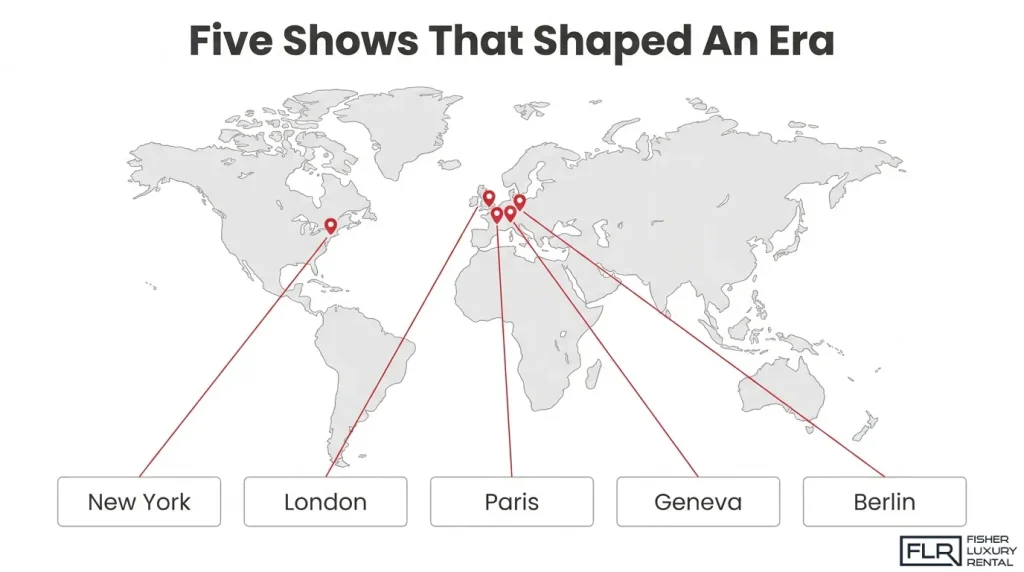
The early car shows that defined the pre-war era include the Paris Motor Show, the New York Auto Show, the London Motor Show, the Geneva Motor Show, and the Berlin Internationale Automobilausstellung. Each shaped automotive culture differently, from democratic access to political spectacle.
How Did the Paris Motor Show Evolve From 1898 to 1939?
The Paris Motor Show evolved from a single open-air exhibition into the world’s most influential recurring automotive event. Growing from its 1898 origins in the Tuileries Garden, the show expanded through the pre-war decades as manufacturers competed to display engineering advances to an increasingly automobile-aware European public. Organizers and exhibitors crossing borders relied on EU-style temporary admission frameworks, which allowed vehicles to enter for exhibition purposes without full customs processing, smoothing the logistics of international participation throughout this period.
What Role Did the New York Auto Show Play Starting in 1900?
The New York Auto Show played a foundational role in establishing automotive culture in the United States. According to the American Oil & Gas Historical Society, manufacturers presented 160 different vehicles at Madison Square Garden during the first national automobile show, held November 3 to 10, 1900, sponsored by the Automobile Club of America, with approximately 48,000 visitors each paying 50 cents to attend. That combination of high attendance and paid admission signaled genuine public demand. The show gave manufacturers a single national stage to reach consumers directly, a model that still drives show strategy today.
Why Did the London Motor Show Become a Global Benchmark?
The London Motor Show became a global benchmark because it was one of the first shows governed by an industry body with regulatory authority. The Society of Motor Manufacturers and Traders held its first exhibition at Crystal Palace in January 1903, then relocated to Olympia, where it remained for 32 years. That institutional stability, combined with SMMT’s mandate to control motor shows, gave London a consistency and credibility that peer events lacked. Sustained venue commitment allowed manufacturers to plan major reveals around a reliable annual calendar.
How Did the Geneva Motor Show Emerge in 1905?
The Geneva Motor Show emerged in 1905 as a neutral international platform, distinct from shows tied to major manufacturing nations. Its Swiss setting gave it political neutrality, attracting brands from competing European markets throughout the pre-war decades. That founding identity proved durable: according to Qatar Tourism, when the Geneva International Motor Show held its first-ever edition outside Switzerland, it drew more than 1,000 journalists from over 50 countries and 180,000 visitors across 10 days, demonstrating the global equity the event had built since 1905.
What Made the Berlin Auto Show Important Before World War II?
The Berlin Auto Show was important before World War II because it became a direct instrument of state industrial policy. According to the Deutsches Historisches Museum, on March 7, 1934, Hitler used the Internationale Automobilausstellung in Berlin to publicly advocate for the development of an affordable Volkswagen, with a target price of no more than 1,000 Reichsmarks. That single speech transformed the show from a commercial exhibition into a platform for mass-motorization ideology. No pre-war show was more explicitly politicized, making Berlin a striking example of how governments can weaponize automotive culture for propaganda purposes.
How Did World War II Change Car Exhibitions Worldwide?
World War II changed car exhibitions worldwide by halting them entirely as nations redirected industrial capacity toward military production. The postwar period then triggered a global expansion of auto shows, with new events launching across Europe, North America, and Asia to meet surging consumer demand for civilian vehicles.
The war’s disruption proved, unexpectedly, to be a catalyst. When exhibitions resumed, organizers rebuilt them with greater ambition, broader international participation, and a sharper focus on the consumer rather than the engineer. Detroit shows ran continuously from 1924 through 1940 at Grindley’s Convention Hall until wartime manufacturing shutdowns ended them. Once peace arrived, the vacuum created space for entirely new shows to emerge.
Recovery brought Frankfurt its first IAA in April 1951, drawing 570,000 visitors from 45 countries. France’s 1948 Paris Salon reopened with affordable postwar models headlining the floor, most notably the Citroën 2CV. Japan launched its first All-Japan Motor Show in April 1954 at Hibiya Park in Tokyo, with 254 companies exhibiting 267 vehicles. Each of these postwar debuts reflected a shared ambition: reestablish national automotive identity through public spectacle.
Today, the energy that returned to exhibitions after 1945 continues to evolve. According to the International Energy Agency’s Global EV Outlook 2025, electric car sales topped 17 million worldwide in 2024, rising by more than 25%, and that shift now defines what exhibition floors showcase and what audiences expect to see.
Which Major Auto Shows Dominated the Post-War Boom?
The post-war boom produced three shows that became global benchmarks: the Detroit Auto Show, the Tokyo Motor Show, and the Frankfurt Motor Show. Each shaped a different region’s automotive identity and drew manufacturers competing for international attention.
How Did the Detroit Auto Show Rise to Prominence?
The Detroit Auto Show rose to prominence by anchoring American automotive culture in the heart of the country’s manufacturing capital. Originally held at Grindley’s Convention Hall from 1924 through 1940, the show paused during World War II before resuming as the industry recovered. According to the Detroit Auto Dealers Association, the 2025 Detroit Auto Show drew 275,000 attendees over 11 days, generating an estimated economic impact of up to $370 million. Few regional shows have maintained that kind of relevance across nearly a century of change, which makes Detroit’s resilience genuinely remarkable.
Why Did the Tokyo Motor Show Matter for Global Innovation?
The Tokyo Motor Show mattered for global innovation because it introduced Japanese manufacturing to the world stage during a critical period of postwar industrial recovery. According to the official Tokyo Motor Show history, the First All-Japan Motor Show launched on April 20, 1954, at Hibiya Park in Tokyo, with 254 Japanese companies exhibiting 267 vehicles, including 17 passenger cars. That debut signaled Japan’s intent to compete internationally. In 2023, the show rebranded as the Japan Mobility Show to spotlight the sector’s broader transformation, uniting automotive, IT, telecommunications, and electronics industries under one platform.
How Did the Frankfurt Motor Show Showcase European Engineering?
The Frankfurt Motor Show showcased European engineering by becoming the premier stage for German and continental automakers to debut their most ambitious designs. The 34th IAA, held in Frankfurt in April 1951, drew 570,000 visitors from 45 countries, according to IAA MOBILITY’s official history, establishing the show’s international scale from its very first Frankfurt edition. Since 2021, the IAA relocated to Munich and reinvented itself as a 360° mobility platform. At IAA MOBILITY 2025, nearly 750 exhibitors from 37 countries participated, with well over 500,000 visitors, slightly surpassing the record set in 2023.
What Role Have Concept Cars Played in Auto Show History?
Concept cars have served as the creative engine of auto show history, giving designers a stage to showcase ideas decades ahead of production. The sections below cover the origins of the concept car format, the Buick Y-Job, the Lincoln Futura, and the Alfa Romeo BAT 7.
What Is a Concept Car and Why Does It Matter at Auto Shows?
A concept car is a non-production vehicle built to showcase forward-thinking automotive design ideas rather than something the public can purchase. According to the High Museum of Art, the experimental “dream car,” as it became known in the early 1950s, served as a testing ground for innovations that might find expression in automobiles produced decades later. Concept cars matter at auto shows because they shift the audience’s focus from what exists today to what is possible tomorrow, transforming exhibitions into laboratories of design ambition.
How Did the Buick Y-Job Establish the Concept Car Tradition?
The Buick Y-Job established the concept car tradition as the industry’s first purpose-built concept vehicle. Harley Earl, General Motors’ first designated head of design, built it on a 1937 Buick chassis, combining his design vision with new technologies to create a benchmark for future production models, according to the Audrain Automobile Museum.
How Did the Lincoln Futura and Alfa Romeo BAT 7 Push Boundaries?
The Lincoln Futura and the Alfa Romeo BAT 7 each pushed concept car boundaries at major postwar shows. The University of Michigan’s Automotive Design Oral History Project records that the Futura was exhibited at the Chicago Auto Show in 1955. One year earlier, Alfa Romeo introduced the BAT 7 at the 1954 Turin Auto Show, just one year after unveiling the BAT 5, demonstrating how rapidly designers were escalating aerodynamic experimentation.
With these landmark concepts redefining what shows could present, the format evolved from showcasing current models into revealing the automotive future.
How Did Car Exhibitions Evolve During the Digital Age?
Car exhibitions evolved during the digital age by shifting from exclusive physical reveals to multi-platform events combining live audiences with online audiences. The section below cover how the internet changed reveal strategies, why brands launched standalone events, and how live streaming affected physical attendance.
How Did the Internet Change Auto Show Reveals in the 2000s?
The internet changed auto show reveals in the 2000s by allowing manufacturers to publish teaser images, specifications, and video previews online before the show floor opened. Traditional auto shows had previously controlled the reveal experience entirely within the venue, giving attending press exclusive first access. Once information spread online within hours, the scarcity of the physical reveal diminished. According to The Henry Ford’s curator of transportation, Matt Anderson, in the 21st century traditional auto shows compete with flashy online presentations and press events. Brands responded by designing reveals as shareable media moments rather than purely venue-driven spectacles.
Why Did Brands Start Hosting Standalone Launch Events?
Brands started hosting standalone launch events to regain full narrative control over their vehicle introductions. At a shared auto show, dozens of competitors announce simultaneously, splitting media attention and diluting individual brand impact. A standalone event lets a manufacturer choose the location, timing, audience size, and visual staging without compromise. This approach also allows brands to tailor the experience to a specific model’s identity, pairing a performance car reveal with a racetrack setting or an SUV launch with an off-road environment. From a brand equity perspective, a standalone event signals confidence and exclusivity, two qualities that resonate strongly with luxury and exotic vehicle buyers.
What Impact Did Live Streaming Have on Show Attendance?
Live streaming had a significant impact on show attendance by expanding global reach while simultaneously reducing urgency for some in-person attendees. Viewers anywhere in the world could watch a keynote reveal in real time, removing distance as a barrier. However, physical attendance remains valuable because the in-person experience, including sensory access to vehicles and test drive opportunities, cannot be replicated digitally. The tradeoff is evident in how major shows have restructured: press days now prioritize streamed reveals designed for online audiences, while consumer days focus on hands-on access that streaming cannot replace.
Which Modern Auto Shows Are the Most Influential Today?
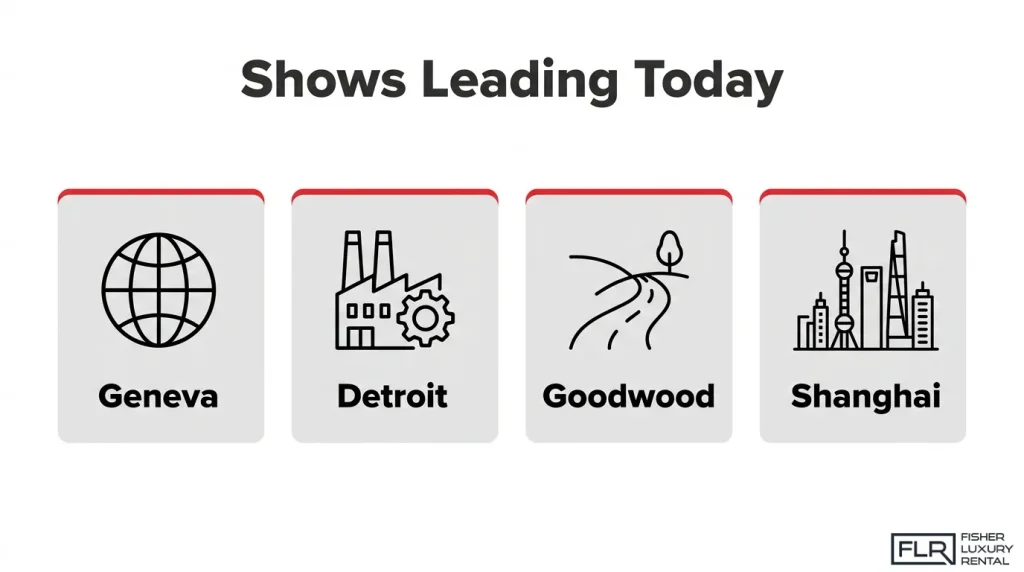
The most influential auto shows today include the Geneva International Motor Show, the Detroit North American Auto Show, the Goodwood Festival of Speed, and Auto Shanghai. Each shapes the industry differently, from EV debuts to heritage hill climbs.
How Does the Geneva International Motor Show Stand Out?
The Geneva International Motor Show stands out for its political neutrality and global manufacturer access, having operated since its inception in 1905. Its reach recently expanded internationally: according to Qatar Tourism, the first GIMS Qatar drew more than 1,000 journalists from over 50 countries and 180,000 visitors across 10 days. The show has also faced disruption, with the City of Geneva confirming a cancellation of the March edition due to extraordinary circumstances. That vulnerability highlights a broader truth: even century-old shows must adapt to survive in a changing event landscape.
What Makes the Detroit North American Auto Show Unique?
The Detroit North American Auto Show is unique for its deep roots in American automotive manufacturing history. The show began in December 1907, when the Detroit Area Dealer Association held the event at Riverview Park with just 17 exhibitors. According to The Henry Ford’s curatorial research, traditional auto shows in the 21st century now compete directly with online presentations and standalone press events. Despite that pressure, the show retains a powerful consumer identity, connecting the heartland of U.S. auto production with everyday buyers.
Why Is the Goodwood Festival of Speed Different From Others?
The Goodwood Festival of Speed is different from other shows because it centers on living motorsport heritage rather than new-model reveals. From 1993, the Duke of Richmond and Gordon revived British racing history through a hill climb past Goodwood House, according to the Louwman Museum. Unlike convention-floor exhibitions, Goodwood places historic and modern performance cars in motion. The Chichester District Council’s City Centre Audit notes that footfall in nearby Chichester drops by as much as 8% during the event, reflecting how intensely attendance concentrates at the estate itself.
How Has Auto Shanghai Reshaped Global Exhibition Trends?
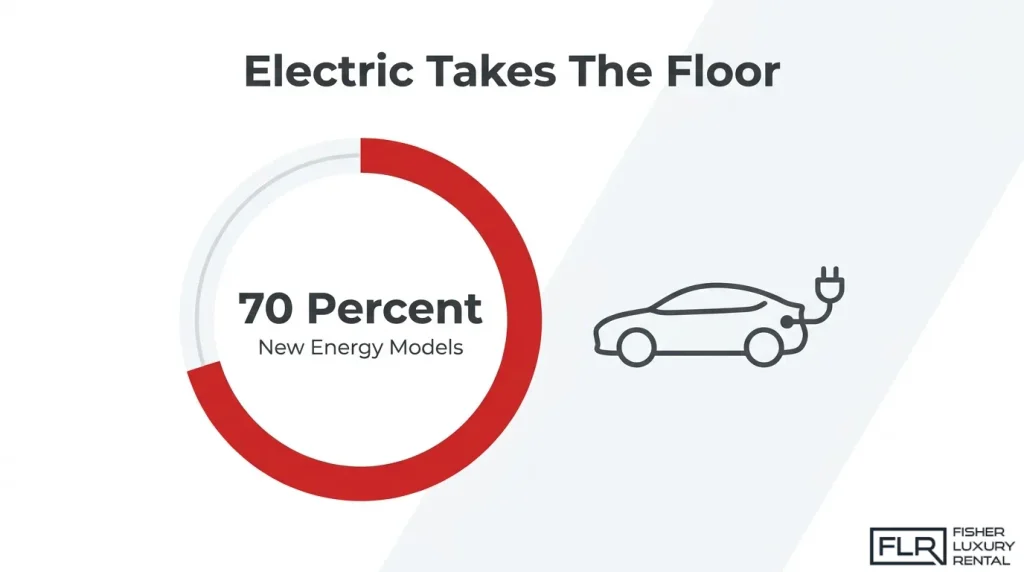
Auto Shanghai has reshaped global exhibition trends by making China’s electric vehicle dominance impossible to ignore. Auto Shanghai 2025, held at the National Exhibition and Convention Center, drew 1.01 million visitors and showcased 1,366 vehicles, with over 70 percent being new energy models, according to Hongqiao Focus. The International Energy Agency’s Global EV Outlook 2025 confirms the context: electric car sales topped 17 million worldwide in 2024, rising more than 25%. Auto Shanghai now functions less as a regional showcase and more as a barometer for the entire global transition to electrified mobility.
How Have Electric and Autonomous Vehicles Transformed Shows?
Electric and autonomous vehicles have fundamentally reshaped car exhibitions, shifting their focus from horsepower and styling to software, sustainability, and mobility ecosystems. The sections below cover EV market growth, the show floor’s response, and how test drives are changing consumer perception.
How Has EV Market Growth Changed What Exhibitors Display?
EV market growth has changed what exhibitors display by making electric models the centerpiece of major auto shows rather than a niche category. According to the International Energy Agency’s Global EV Outlook 2025, electric car sales topped 17 million worldwide in 2024, rising by more than 25%. Auto Shanghai 2025 reflected this shift directly: of the 1,366 vehicles showcased at the event, over 70 percent were new energy models, with 163 making their world debut.
How Have Autonomous and Mobility Technologies Reshaped Show Floors?
Autonomous and mobility technologies have reshaped show floors by expanding exhibitions beyond cars into full mobility ecosystems. The IAA in Munich, which transitioned from a traditional car show to a 360-degree mobility platform starting in 2021, exemplifies this transformation. Japan Mobility Show 2025 carried the shift further, drawing a record 522 participating companies from automotive, IT, telecommunications, electronics, and startup sectors.
How Do EV Test Drives Influence Buyer Decisions?
EV test drives at shows influence buyer decisions significantly. A Veloz Best.Drive.EVer. 2017 Ride and Drive Series report found that while 84% of respondents held a positive perception of EVs before a test drive, that figure rose to 93% afterward. Hands-on exposure at show floors remains one of the most effective tools for converting curiosity into purchase intent, making experiential display strategies essential for EV brands. Fisher Luxury Rental extends that same principle beyond the show floor, offering direct access to top-trim luxury and exotic vehicles in Phoenix, AZ and Portland, OR, so the hands-on experience doesn’t have to end when the exhibition does.
With EVs now dominating major show floors worldwide, the car exhibition format continues evolving toward immersive, technology-driven experiences.
What Is the Future of Car Exhibitions After the Pandemic?
The future of car exhibitions after the pandemic combines physical recovery, digital integration, and a shift toward broader mobility themes. The sections below cover format reinvention, EV-driven content changes, and persistent consumer demand for in-person experiences.
How Have Auto Shows Reinvented Their Format Post-Pandemic?
Auto shows have reinvented their format post-pandemic by moving away from vehicle-only displays toward immersive mobility platforms. According to the International Trade Administration, U.S. Department of Commerce, the IAA moved to Munich in 2021 and reinvented its entire concept from a traditional car show into a 360-degree mobility platform. This shift reflects a broader industry consensus: static manufacturer stands no longer justify the cost of attendance alone. Outdoor activations, test drive corridors, and cross-industry exhibitors from IT and telecommunications now fill that gap.
What Role Do Electric Vehicles Play in the New Show Landscape?
Electric vehicles now define the editorial agenda of major auto shows worldwide. The International Energy Agency’s Global EV Outlook 2025 reports that electric car sales topped 17 million worldwide in 2024, rising by more than 25%. Auto Shanghai 2025 reflected this directly: of 1,366 vehicles exhibited, over 70 percent were new energy models. Shows that once centered on combustion engine debuts now position EV launches as their headline moments, making electrification the organizing principle of modern exhibition programming.
Is Consumer Demand for In-Person Auto Shows Still Strong?
Consumer demand for in-person auto shows remains strong despite digital competition. The 2025 Detroit Auto Show drew 275,000 attendees over 11 days, with an estimated economic impact of up to $370 million, according to the Detroit Auto Dealers Association. A 2024 Seattle Auto Show review found that 60% of consumers attended specifically to see the latest models. Physical presence offers something digital reveals cannot replicate: tactile engagement, live test drives, and brand-immersive environments that measurably shift purchase intent. In-person exposure remains the most reliable trust-building tool the industry has. For enthusiasts who want that tactile connection year-round, companies like Fisher Luxury Rental make it possible to experience top-trim exotic and luxury vehicles on demand in Phoenix, AZ and Portland, OR – no auto show ticket required.
How Can You Experience Iconic Show Cars Beyond Exhibitions?
Experiencing iconic show cars beyond exhibitions is possible through luxury and exotic car rentals, which put legendary automotive performance directly in your hands. The sections below cover rental access and the core lessons car exhibition history leaves behind.
Can Renting Luxury and Exotic Cars Deliver the Thrill?
Yes, renting luxury and exotic cars can deliver the thrill by giving drivers direct, hands-on access to the same performance DNA showcased at auto shows worldwide. According to a 2017 Veloz Ride and Drive Series report, positive perceptions of high-performance vehicles rose from 84% to 93% after a test drive, confirming that physical experience outperforms passive observation every time.
Access-based consumption, where customers pay for temporary access rather than ownership, has become an increasingly popular way to engage with aspirational vehicles. Fisher Luxury Rental offers exactly this: top-trim luxury and exotic vehicles available in Phoenix, AZ and Portland, OR, turning a show-floor fantasy into a real driving memory.
What Are the Key Takeaways About Car Exhibition History?
The key takeaways about car exhibition history are that auto shows evolved from modest curiosity events into global cultural platforms, and they consistently prove that experiencing a vehicle in person drives deeper engagement than any static display.
From the SMMT’s first exhibition at Crystal Palace in 1903 to the Goodwood Festival of Speed, which the Duke of Richmond and Gordon launched in 1993 as a living hill-climbing celebration of British racing heritage, shows have always sought to close the gap between spectator and machine. That impulse, to feel the power rather than simply see it, is exactly what luxury rental delivers today.