
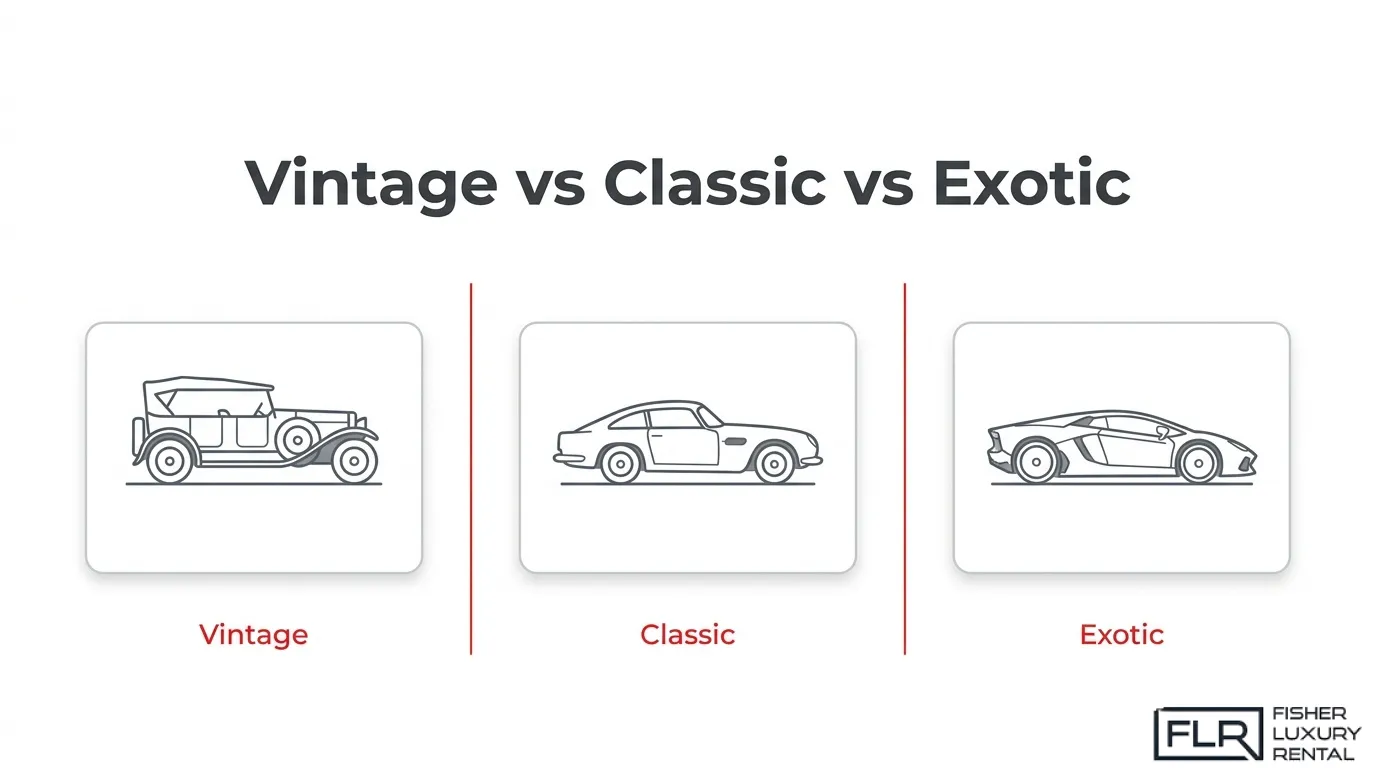
Vintage, classic, and exotic cars are three distinct vehicle categories, each defined by a separate set of criteria: era of production, engineering pedigree, or performance exclusivity.
This guide covers how each category is defined, how their age requirements compare, how they differ in value and appreciation, and what ownership and insurance actually cost across all three.
Vintage cars are tied to specific production eras, with organizations like the Vintage Sports-Car Club recognizing only vehicles built between 1919 and 1930, while FIVA applies a broader 30-year rolling threshold. Iconic models from this period, including the Ford Model T, Bugatti Type 35, and Mercedes-Benz SSK, are prized for scarcity and mechanical heritage that modern production cannot replicate.
Classic cars carry their own age standards, which vary by organization and jurisdiction. The Classic Car Club of America restricts the label to motorcars built between 1915 and 1948 that meet fine design and engineering criteria, while some states set the threshold as low as 15 years. Definitions shift depending on whether a registrar, insurer, or collector community is doing the classifying.
Exotic cars operate on entirely different terms. Age is irrelevant; what qualifies a car as exotic is extreme performance, limited production, and engineering ambition that exceeds what any luxury vehicle delivers. Brands such as Lamborghini, McLaren, and Bugatti define the category through output figures and manufacturing exclusivity rather than historical standing.
Value trajectories, maintenance demands, insurance structures, and the question of whether a single car can belong to more than one category are all examined in the sections that follow.
What Defines a Vintage Car?
A vintage car is defined by its age, rarity, and historical significance, though the exact criteria vary by organization and context. The following sections cover age thresholds, iconic models, and the collector motivations behind vintage ownership.
How Old Does a Car Need to Be to Qualify as Vintage?
The age required to qualify as vintage depends on which authority you consult. The Vintage Sports-Car Club defines a vintage car as any vehicle with a specification dated between January 1, 1919, and December 31, 1930. FIVA takes a broader approach, classifying any mechanically propelled road vehicle at least 30 years old, preserved in historically correct condition and not used for daily transport, as a historic vehicle. The Antique Automobile Club of America applies an even wider standard, recognizing any car more than 25 years old. Because no single universal definition governs the term, the label “vintage” can shift depending on the registering body, insurer, or collector community involved.
What Are the Most Iconic Vintage Car Models?
The most iconic vintage car models include the Ford Model T, Bugatti Type 35, Duesenberg Model A, and Mercedes-Benz SSK. By 1924, more than half of all cars sold worldwide were Model Ts, according to The Henry Ford. The 1924 Bugatti Type 35 was one of five built specifically for the French Grand Prix at Lyon. Only 31 Mercedes-Benz SSKs were produced across three years, an extraordinarily small output even against the company’s 9,000-car annual production at the time. These models are prized precisely because scarcity and historical context combine in ways that no modern production vehicle can replicate.
Why Are Vintage Cars Valued by Collectors?
Vintage cars are valued by collectors for a wide range of personal, cultural, and financial reasons. A 2017 peer-reviewed study from Delft University of Technology identified seven distinct owner profiles, including recreational owners, die-hard fans, repair enthusiasts, frequent drivers, and collectors, demonstrating that motivations behind historic car ownership are far more diverse than simple investment logic. Some owners are drawn to mechanical craftsmanship from an era before computer-aided manufacturing, while others value the cultural heritage these vehicles represent. For many collectors, a vintage car is as much a piece of living history as it is a financial asset.
What Defines a Classic Car?
A classic car is a vehicle recognized for its historical significance, fine engineering, and preservation status. Definitions vary by age, condition, and the authority setting the standard, whether a national club, state government, or international body.
How Old Does a Car Need to Be to Qualify as Classic?
The age requirement for a classic car depends on which organization sets the standard. The Classic Car Club of America defines classic cars as fine or unusual motorcars built between 1915 and 1948, distinguished by representative fine design, high engineering standards, and superior workmanship. Other bodies apply different thresholds, with some states setting the bar as low as 15 years. Age alone is rarely sufficient; condition, originality, and historical significance all factor into recognition.
How Do Classic Car Definitions Vary by State and Organization?
Classic car definitions vary significantly across states and organizations. According to the Pennsylvania Department of Transportation, an antique motor vehicle must be manufactured more than 25 years prior to the current year, while a classic motor vehicle requires only 15 years, provided both are maintained or restored to manufacturer specifications and appearance. This distinction matters practically: the classification a vehicle receives affects registration fees, plate eligibility, and usage restrictions.
What Are the Most Popular Classic Car Models?
The most popular classic car models include the Ford Model T, Duesenberg Model A, Mercedes-Benz 300SL Gullwing, Bugatti Type 35, and Jaguar E-Type. These models appear consistently in museum collections, major auctions, and collector literature, valued for their rarity, design innovation, and cultural impact. In many cases, scarcity drives desirability more than performance alone.
What Defines an Exotic Car?
An exotic car is defined by extreme performance, exclusivity, and engineering that exceeds what luxury cars deliver. The headings below cover whether age or rarity matter, the performance benchmarks that separate exotic from luxury, and the brands most associated with the category.
Does an Exotic Car Have to Be Old or Rare?
No, an exotic car does not have to be old or rare, though rarity often reinforces its status. Age is irrelevant to the exotic classification. What qualifies a car as exotic is a combination of limited production, extraordinary engineering, and performance capabilities that place it far beyond mainstream vehicles. A brand-new Lamborghini qualifies as exotic on its first day off the line, while a mass-produced car from decades ago does not. Rarity amplifies desirability and resale value, but it is not a prerequisite. The defining traits are performance, exclusivity of design, and engineering ambition, not calendar age.
What Performance Specs Separate Exotic Cars from Luxury Cars?
Exotic cars separate themselves from luxury cars through extreme powertrain output, sub-four-second acceleration, and purpose-built engineering that prioritizes performance over comfort. The 1994 McLaren F1, for example, achieves 0 to 60 mph in approximately 3.2 seconds, according to the Audrain Automobile Museum. The 2006 Bugatti Veyron generates 1,001 horsepower from a quad-turbocharged W16 engine displacing 488 cubic inches. The 2011 Lamborghini Aventador LP 700-4 delivers 700 horsepower and shifts gears in just 50 milliseconds using its ISR transmission, the fastest single-clutch system ever fitted to a road car. Luxury cars prioritize ride quality and refinement; exotic cars treat those as secondary to raw capability.
What Are the Most Recognized Exotic Car Brands?
The most recognized exotic car brands are Ferrari, Lamborghini, McLaren, Bugatti, Koenigsegg, and Pagani. These manufacturers share a common profile: low annual production volumes, hand-assembled powertrains, and performance benchmarks that define the ceiling of road-legal capability. Ferrari and Lamborghini represent the Italian tradition that established the exotic category globally. McLaren applies Formula 1 engineering principles directly to its road cars. Bugatti and Koenigsegg compete for top-speed records at the ultra-exclusive end of the spectrum. What unites them is not price alone but a commitment to engineering that makes each model a statement of what is mechanically possible.
How Do Vintage, Classic, and Exotic Cars Differ in Age Requirements?
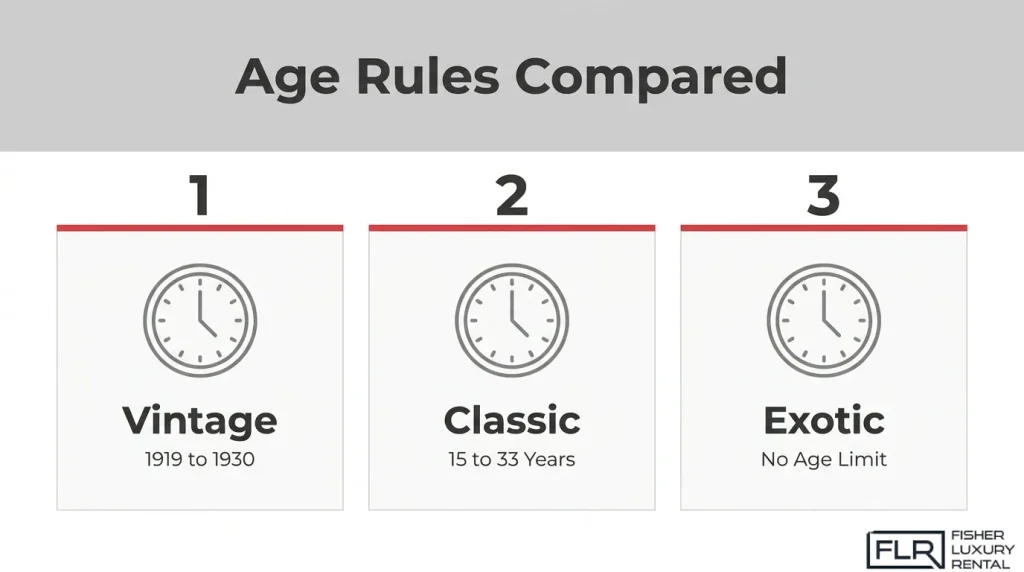
Vintage, classic, and exotic cars differ in age requirements significantly, with vintage carrying the strictest historical thresholds, classic using a rolling or fixed-era window, and exotic carrying no age requirement at all. The sections below compare each category’s defining age criteria side by side.
What Age Threshold Defines a Vintage Car?
The age threshold for a vintage car depends on the governing body applying the definition. The Vintage Sports-Car Club sets the strictest standard, recognizing only cars built between January 1, 1919, and December 31, 1930, as true vintage vehicles. The Fédération Internationale des Véhicules Anciens (FIVA) takes a broader approach, defining a historic vehicle as one at least 30 years old, preserved in historically correct condition, and not used for daily transport. These two standards represent opposite ends of the vintage spectrum: one locks cars to a specific decade, while the other uses a rolling minimum age.
What Age Threshold Defines a Classic Car?
The age threshold for a classic car varies by organization and jurisdiction. The Classic Car Club of America fixes its definition to motorcars built between 1915 and 1948, emphasizing fine design, high engineering standards, and superior workmanship. Pennsylvania’s Department of Transportation takes a more flexible approach, defining a classic motor vehicle as one manufactured at least 15 years prior to the current year. This contrast illustrates a critical point: “classic” has no universal age floor, making context essential when evaluating any specific vehicle’s classification.
Does an Exotic Car Have a Minimum Age Requirement?
An exotic car has no minimum age requirement. Exotic status is determined by rarity, extreme performance, and production exclusivity rather than vehicle age. A brand-new Lamborghini Aventador and a decade-old Bugatti Veyron both qualify as exotic because of their specifications and scarcity, not their birth years. This is the clearest distinction between exotic and the other two categories: vintage and classic look backward at history, while exotic looks at what the car does and how few exist. For drivers more interested in performance than provenance, exotic cars remain the most accessible category to experience firsthand. Fisher Luxury Rental, which serves the Phoenix, Scottsdale, Portland, and Vancouver areas, offers rental access to exotic vehicles for drivers looking to experience that performance without purchasing.
How Do Vintage, Classic, and Exotic Cars Compare in Value?
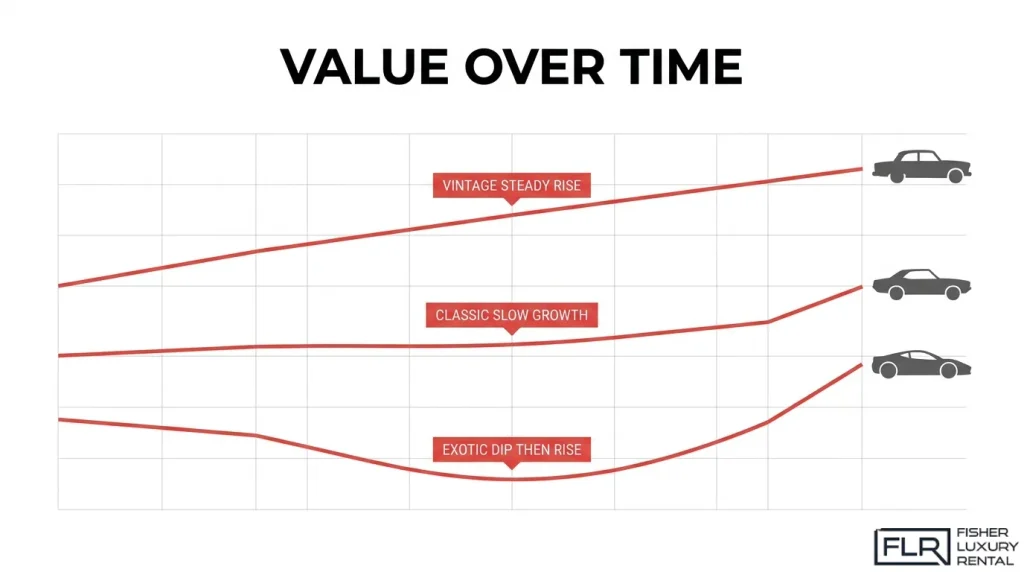
Vintage, classic, and exotic cars each follow a distinct value trajectory shaped by age, rarity, and performance pedigree. The sections below examine how each category appreciates, and what drives the differences.
How Does a Vintage Car Appreciate Over Time?
Vintage cars appreciate over time primarily through scarcity and historical significance. Because vehicles from the 1919–1930 era are rarely preserved in original, drivable condition, supply shrinks naturally while collector demand remains steady. Provenance, originality, and documented racing or ownership history all amplify value, sometimes dramatically. Restored examples command premiums over worn survivors, though concours-quality restorations require substantial upfront investment that can narrow net gains.
How Does a Classic Car Appreciate Over Time?
Classic cars appreciate over time at a measured but real pace. According to a 2019 study using auction data from Tilburg University, classic cars returned 3.37% annually in real terms and 5.63% in nominal terms before transaction costs. One structural advantage of classic car ownership is agreed value insurance: per the Insurance Information Institute, the insurer and owner set a fixed value at policy inception, and the car is covered up to that amount without depreciation, protecting the asset’s appraised worth.
Why Do Exotic Cars Follow a Different Value Trajectory?
Exotic cars follow a different value trajectory because performance, brand prestige, and limited production interact differently than age-based scarcity. New exotics typically depreciate sharply in their first years, then stabilize or appreciate once a model becomes discontinued or culturally iconic. Limited-run editions and flagship models from marques such as Bugatti, McLaren, and Lamborghini can reverse early depreciation entirely, ultimately outperforming both vintage and classic benchmarks at auction.
How Do Maintenance and Ownership Costs Differ Across All Three?
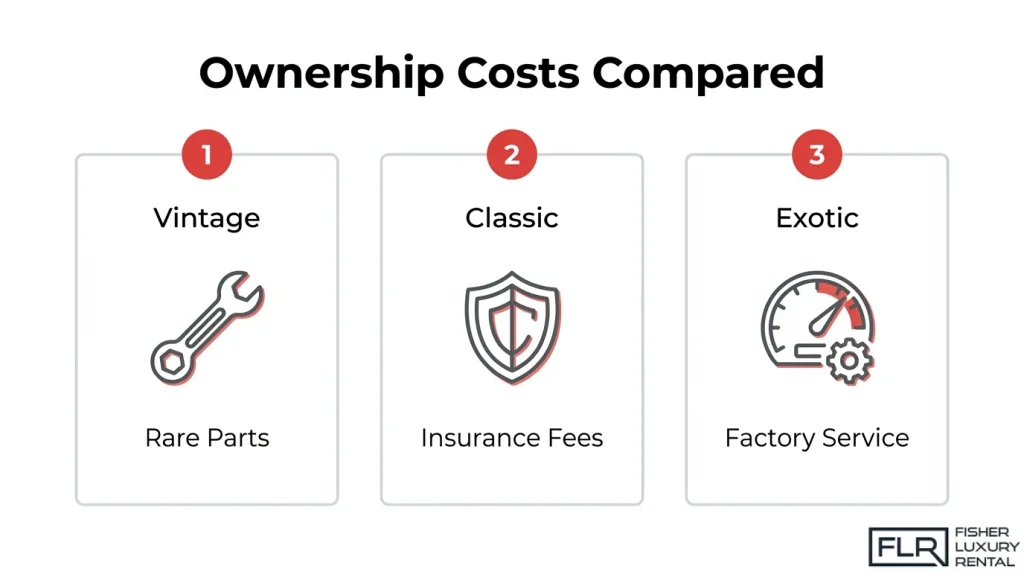
Maintenance and ownership costs differ across vintage, classic, and exotic cars based on parts availability, required expertise, and usage intensity. The following sections break down what each category typically demands from owners.
What Does It Cost to Maintain a Vintage Car?
Vintage car maintenance costs are driven primarily by parts scarcity and specialized labor. Cars from the 1919–1930 era require hand-fabricated or sourced components, since mass-produced replacements rarely exist. Mechanical work demands craftsmen familiar with pre-war engineering, making labor rates significantly higher than standard shop rates. Storage adds another layer: the Canadian Conservation Institute recommends keeping relative humidity below 70% to prevent corrosion and wooden joint swelling in period-correct components like wheel spokes. Climate-controlled storage is therefore a recurring fixed cost, not an optional one. For vintage owners, the ongoing investment in preservation often exceeds the cost of acquisition over a long enough horizon.
What Does It Cost to Maintain a Classic Car?
Classic car maintenance costs include auction fees, transport, insurance, guarding, maintenance, and restoration. A 2023 study published via RePEc/IDEAS covering classic car markets from 1994 to 2021 found moderated volatility, a low range of returns, and a weak expectation of financial gain given the weight of these ancillary costs. Pennsylvania’s Department of Transportation defines a classic motor vehicle as one manufactured at least 15 years prior to the current year, maintained in conformity with manufacturer specifications – meaning any deviation from original condition can affect both classification and insured value. Restoration to spec is not cheap, and market correlations across classic car segments remain low, limiting diversification for investment-minded owners.
What Does It Cost to Maintain an Exotic Car?
Exotic car maintenance costs are the highest among the three categories, reflecting cutting-edge engineering, low production volumes, and manufacturer-authorized service requirements. Specialized components for vehicles like the Bugatti Veyron or Lamborghini Aventador are sourced directly through the manufacturer, with labor performed by factory-certified technicians. Routine items such as tire sets, brake systems, and fluid changes carry costs that multiply several times over compared to standard vehicles. Comprehensive insurance, often valued well above market depreciation curves, adds further to the annual ownership burden. For renters rather than buyers, exotic car rental companies convert these significant fixed costs into a single, accessible daily rate.
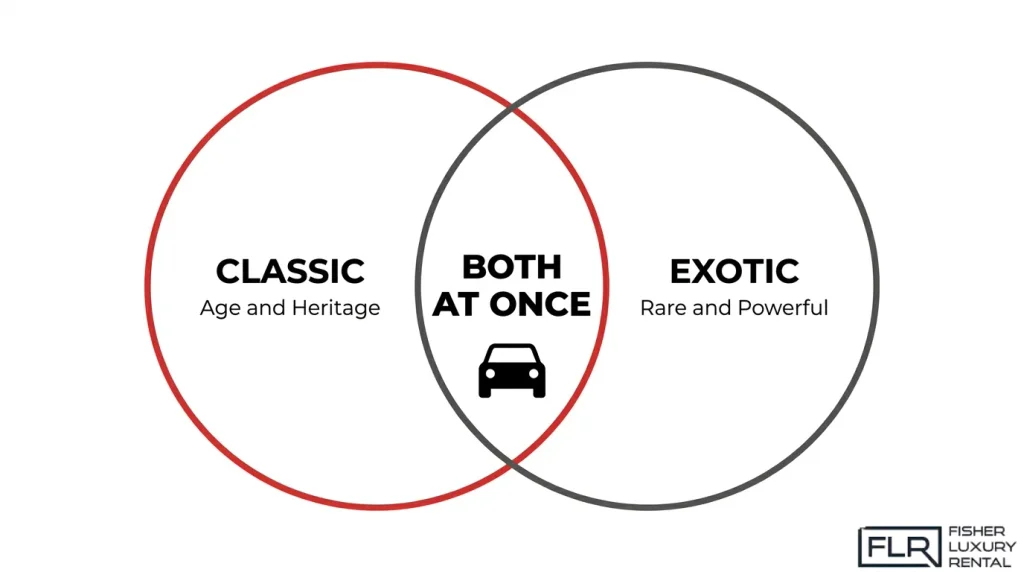
Can a Car Be Both Classic and Exotic at the Same Time?
Yes, a car can be both classic and exotic at the same time. Age-based classification and performance-based classification operate on separate criteria, so a vehicle can satisfy both simultaneously. A 1955 Mercedes-Benz 300SL Gullwing, for example, meets classic age thresholds while retaining the rarity, performance pedigree, and exclusivity that define an exotic.
The distinction matters because collectors, insurers, and registrars apply these labels for different purposes. Classic status reflects historical standing and preservation value. Exotic status reflects engineering ambition, scarcity, and desirability. When both converge in a single vehicle, the result is often a car with outsized cultural significance and collector demand. For those who want to experience vehicles at the intersection of performance heritage and modern exclusivity, Fisher Luxury Rental’s fleet includes exotic models that reflect this same engineering ambition.
The Gullwing illustrates this overlap precisely: the Simeone Foundation Automotive Museum documents that only 1,400 were manufactured between 1954 and 1956, a production volume low enough to qualify as genuinely rare by any standard. That rarity, combined with its age, places it firmly in both categories at once.
How Does Insurance Differ for Vintage, Classic, and Exotic Cars?
Insurance differs for vintage, classic, and exotic cars primarily in how vehicle value is calculated and what usage restrictions apply. The sections below cover agreed value coverage, actual cash value, and how each car category is treated at claim time.
How Is a Classic Car Insured Differently from a Standard Vehicle?
Classic car insurance differs from standard auto insurance in one fundamental way: value is agreed upon upfront rather than depreciated at the time of a claim. According to the Insurance Information Institute, the first step in insuring a classic car is for you and your insurer to reach an agreement on the vehicle’s value, which is then specified in the policy and paid out without depreciation if a covered loss occurs. Standard policies use actual cash value, defined by the National Association of Insurance Commissioners as replacement cost minus depreciation. For a vehicle that appreciates over time, depreciation-based payouts can leave owners significantly undercompensated. Agreed value coverage eliminates that gap entirely, making it the clearly superior choice for any collectible vehicle worth protecting.
Do Vintage and Exotic Cars Use the Same Coverage Model as Classic Cars?
Vintage and exotic cars typically use the same agreed value framework as classic cars, though the underwriting criteria differ by category. Vintage vehicles require documentation of historical accuracy and condition, since insurers must verify the car matches its agreed value at policy inception. Exotic cars present a different challenge: their market values can shift rapidly based on manufacturer output, model generation changes, and collector demand, so policies often require periodic reappraisal to keep agreed values current. Usage restrictions also vary. Classic and vintage policies commonly limit annual mileage and require that the vehicle not serve as daily transportation, while exotic car policies may permit broader use but carry significantly higher premiums reflecting replacement cost. Owners of any collectible vehicle should review coverage annually as values change.
What Should You Know Before Driving an Exotic Car?
Before getting behind the wheel of an exotic car, understanding rental options and the broader distinctions between vehicle categories helps you make a confident, informed decision. The following covers what Fisher Luxury Rental offers and key takeaways from this guide.
Can You Rent an Exotic Car from Fisher Luxury Rental?
Yes, you can rent an exotic car from Fisher Luxury Rental. Fisher Luxury Rental is a luxury and exotic car rental company serving Phoenix, AZ, Scottsdale, AZ, Portland, OR, and Vancouver, WA. Established in 2022, Fisher Luxury Rental stocks top-trim models exclusively, meaning every vehicle in the fleet represents the highest configuration available, not an entry-level variant of the nameplate. Rentals are available for special occasions, leisure drives, photoshoots, and first-time exotic car experiences. Fisher Luxury Rental can be reached at 602-661-3970 (Arizona) or 503-883-8756 (Oregon/Washington), or by email at rental@fisherluxuryrental.com.

What Are the Key Takeaways About Vintage, Classic, and Exotic Cars?
The key takeaways about vintage, classic, and exotic cars are that each category carries distinct age thresholds, design standards, and value drivers. Vintage cars are defined by their pre-1931 production era and mechanical heritage. Classic cars are recognized for engineering excellence and fine craftsmanship, with the Classic Car Club of America focusing on motorcars built between 1915 and 1948 distinguished by superior workmanship. Exotic cars are defined by performance, rarity, and exclusivity, regardless of age. Knowing these differences helps collectors, renters, and enthusiasts choose the right vehicle for their goals.