Track day preparation is the process of systematically inspecting, equipping, and organizing your car and supporting gear so it can perform safely under sustained high-speed, high-heat conditions that far exceed normal road use.
This guide covers mechanical readiness, tires and wheels, safety equipment, interior and exterior preparation, trackside spares and tools, logistics and paperwork, common prep mistakes, and how a luxury rental can simplify the entire process.
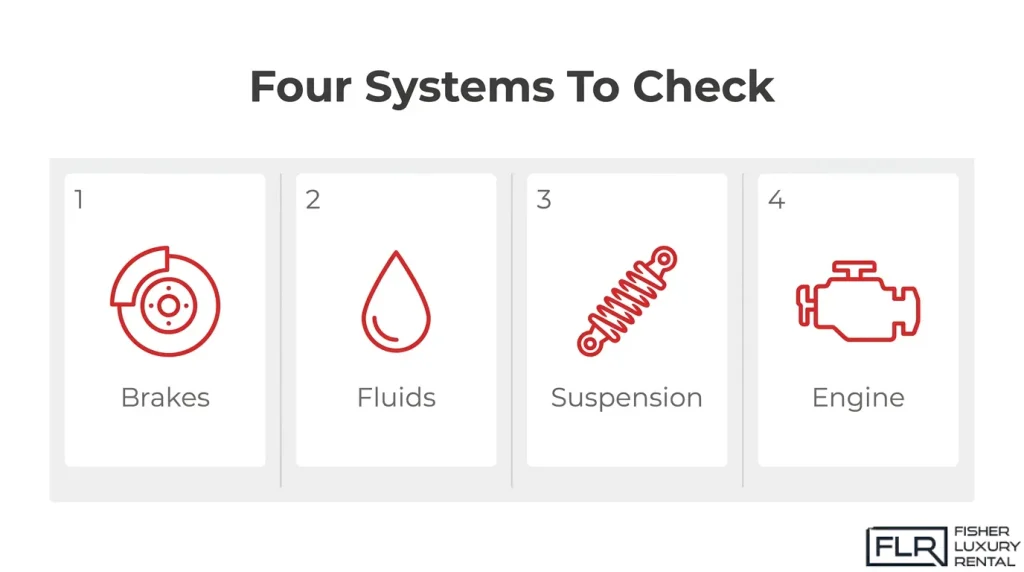
Pre-track mechanical inspections address the four systems most stressed on circuit: brakes, fluids, suspension and steering, and the engine and cooling system. Fresh brake fluid, correct pad thickness, clean coolant, and confirmed suspension integrity form the foundation everything else builds on.
Tires and wheels require cold pressure calibration before each session, a tire choice suited to sustained heat cycles, and torqued lug nuts verified with a calibrated wrench rather than an impact gun.
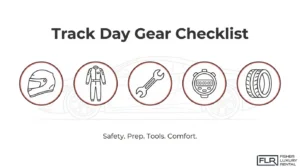
Safety equipment starts with a certified helmet and close-toed shoes, both mandated by most organizers, and extends to fire extinguishers, in-car harness decisions, and the compatibility requirements that govern HANS devices and safety seats.
Interior and exterior preparation eliminates projectile hazards by removing all loose items, adjusts the driver’s seat and mirrors before reaching the grid, and protects paint and lighting with physical barriers applied before the car leaves the paddock.
Spares, tools, logistics, and paperwork cover the consumables most likely to end your day early, the pre-event timeline that prevents gate-scramble errors, and the registration, insurance, and tech inspection requirements that gate your access to the track.
Finally, renting an exotic car through Fisher Luxury Rental removes the mechanical preparation burden entirely, pairing a maintained, high-performance vehicle with a memorable high-performance driving experience.
What Pre-Track-Day Mechanical Inspections Does Your Car Need?
Pre-track-day mechanical inspections cover four critical systems: brakes, fluids, suspension and steering, and the engine and cooling system. Each area below outlines exactly what to check before your car turns a wheel on track.
What Brake Components Should You Inspect Before Track Day?
The brake components you should inspect before track day include pads, rotors, calipers, brake lines, and fluid. Fresh fluid throughout the system is essential; according to the Sports Car Club of America Chicago Region, track specification pads and high-temperature brake fluid are not strictly required but are strongly recommended. The Porsche Club of America advises that any car seeing track duty should have its fluid changed at least once a year, since air in the system causes a spongy pedal. Check pad thickness visually, look for rotor cracking or deep scoring, and confirm caliper hardware is secure. Compromised brakes at track speeds leave no margin for error.
What Fluid Levels and Conditions Should You Check?
The fluid levels and conditions you should check include engine oil, coolant, power steering fluid, and transmission fluid. Top each reservoir to its correct operating mark and note the color and clarity of the fluid. Milky or heavily discolored oil signals contamination that worsens under sustained high-rpm loads. Coolant should be clean and at the correct concentration for your climate. Steering and transmission fluids require a visual check for leaks at hoses and seals, since track cornering loads stress these systems far beyond normal road use.
How Should You Assess Your Suspension and Steering?
Your suspension and steering assessment should cover wheel bearings, ball joints, tie rod ends, control arm bushings, and shock absorbers. Push and pull each front wheel to detect bearing play, and feel for looseness in the steering column when the wheel is turned at full lock. Worn bushings allow geometry changes mid-corner, reducing predictability. Inspect shock absorbers for oil weeping around the body and confirm spring perches are intact. Steering should return to center smoothly with no binding or clunking over bumps.
What Engine and Cooling System Checks Are Essential?
The essential engine and cooling system checks include the thermostat function, coolant hoses, radiator cap pressure rating, fan operation, and drive belt condition. Sustained full-throttle laps generate heat that overwhelms a marginally functioning cooling system quickly. Squeeze upper and lower radiator hoses for brittleness or soft spots, and confirm the cap holds rated pressure. Inspect the drive belt for fraying and correct tension. Check that the electric fan cycles on at the correct temperature, since slow traffic between sessions leaves no airflow from forward motion to cool the engine. With all four mechanical areas confirmed, your car is ready for the next preparation steps.
What Tires and Wheels Setup Do You Need for Track Day?
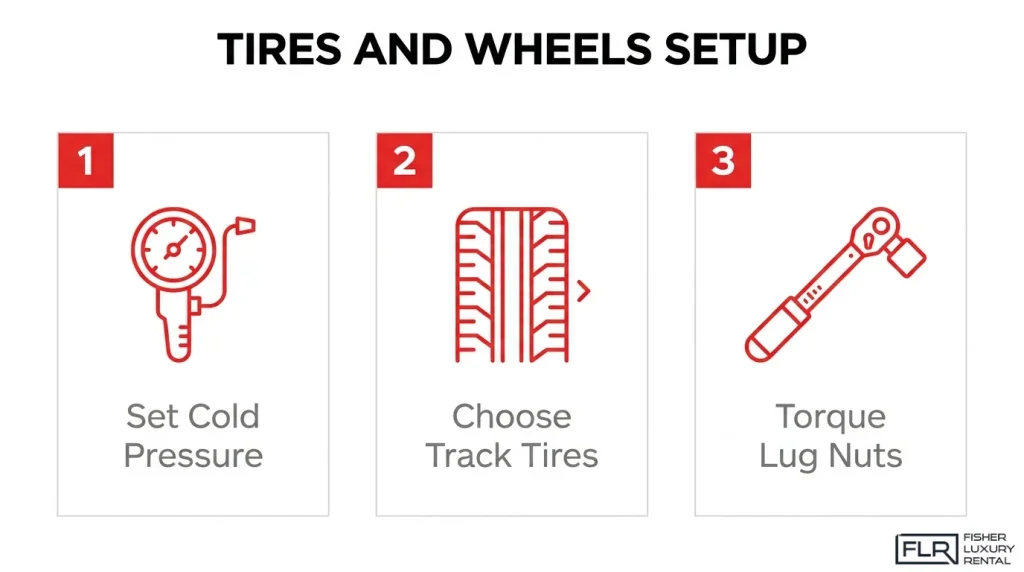
Your tires and wheels setup for track day covers three priorities: setting the correct cold pressure before sessions, selecting tires with adequate heat capacity, and verifying wheel torque and lug nut condition before you roll out.
What Tire Pressure Should You Set for Track Driving?
Tire pressure for track driving should be set cold, before the car leaves the paddock. Track driving generates significantly more heat than street driving, which raises pressure mid-session. Starting lower than street pressures, typically 30–32 psi cold for most performance tires, gives the tire room to build toward its optimal operating range. Check your tire manufacturer’s recommended hot target pressure and work backward from there. Recording pressures before and after each session helps you dial in the correct cold starting point for your specific car, tire, and track combination.
How Do You Choose the Right Tires for a Track Day?
The right tires for a track day are high-performance summer or dedicated track tires rated for sustained high-speed and high-heat use. All-season and standard touring tires degrade rapidly under repeated hard braking and cornering. For drivers who want to skip tire selection concerns entirely, Fisher Luxury Rental maintains a fleet of top-trim exotic and luxury vehicles that arrive event-ready, removing one of the most consequential pre-track decisions from your plate. According to the National Highway Traffic Safety Administration, tire problems accounted for approximately 35% of vehicle-assigned critical reasons in crash investigations, underscoring how quickly compromised tires become a safety liability. For HPDE events, street-legal performance tires in good condition with adequate tread depth are generally acceptable, while dedicated track tires offer meaningfully better grip and heat resistance for drivers logging multiple sessions.
What Wheel and Lug Nut Checks Should You Perform?
Wheel and lug nut checks should include a visual inspection for cracks, curb damage, and corrosion, followed by torquing every lug nut to the manufacturer’s specification. Lug nuts that are under-torqued can loosen under the lateral loads generated on track. Use a calibrated torque wrench rather than an impact gun to confirm final torque values. Inspect wheel studs for thread damage and verify center bore fitment if you are running aftermarket wheels. Re-torque after the first session, as wheels can settle slightly after initial heat cycling. Bringing a torque wrench in your pit kit makes this quick to repeat between every run group.
What Safety Equipment Must You Have for Track Day?
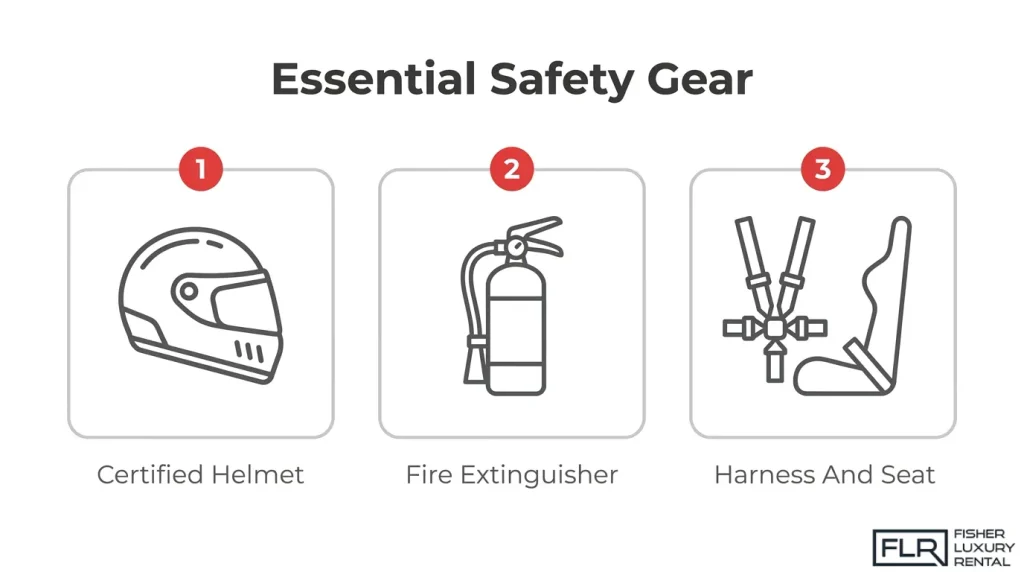
Safety equipment requirements vary by organizer, but every track day demands a certified helmet at minimum. The following headings cover driver gear, in-car modifications, and fire safety essentials.
What Driver Safety Gear Is Required at Most Tracks?
Driver safety gear required at most tracks includes, at minimum, a certified helmet and close-toed shoes. According to the Sports Car Club of America’s Track Night in America rules, helmets certified to the most current or two most recent applicable Snell, FIA, or SFI standards are acceptable. The Snell Foundation recommends replacing any helmet after five years of normal use, since each track and event sets its own acceptance criteria independently.
Beyond the basics, drivers using a HANS device with a saloon car must pair it with an FIA-homologated safety seat meeting standard 8855-1999, 8855-2021, or 8862-2009. The shoulder strap’s rear section must run downward from the HANS belt-bearing surface to the car’s anchorage point, preferably at about 20° below horizontal, per FIA technical guidance.
What In-Car Safety Modifications Should You Consider?
In-car safety modifications to consider for track day include harness systems, roll protection, and window nets, though most HPDE events do not mandate them beyond the stock configuration. If you add a multi-point harness, pairing it with a compatible safety seat and HANS device is essential, since a harness alone without proper head restraint can increase neck-load risk in a frontal impact. For street cars running open lapping days, keeping the factory seatbelt is often the safer and regulation-compliant choice unless the full safety package is installed correctly.
What Fire Safety Items Should You Carry?
Fire safety items you should carry to a track day include a hand-held fire extinguisher rated for automotive fires. The SFI Foundation specifies a two-year service interval for SFI 17.1 on-board fire suppression systems, with a six-year maximum service life. Motorsport Australia’s regulations similarly require FIA-standard extinguishers to be serviced every two years per manufacturer instructions. Even at casual HPDE events where a fire system is not mandatory, keeping a serviced extinguisher in the pits is strongly advisable.
Confirm your extinguisher is within its service window before arriving at the track, as expired units may be rejected at tech inspection.
How Should You Prepare Your Car’s Interior for the Track?
Interior preparation focuses on two priorities: eliminating projectile hazards and ensuring driver control. The following sections cover loose item removal, seat and mirror adjustment, and roll bar or harness considerations.
What Loose Items Should You Remove Before Driving?
Loose items you should remove before driving include floor mats, spare change, water bottles, tools, and any unsecured cargo. According to BMW Car Club of America guidelines, all loose items must be removed from the vehicle, and any video camera must be securely mounted and preferably tethered. The ACT Government road rules handbook reinforces this: loose objects such as groceries become dangerous projectiles during a collision and must be removed or secured in the boot. This risk is amplified on track, where braking forces far exceed everyday driving conditions.
How Should You Secure or Adjust Your Seats and Mirrors?
Your seat and mirrors should be adjusted before you reach the grid, not once you are strapped in and moving. Set the seat so your arms have a slight bend at the wheel and your heels rest flat on the floor. Mirrors should provide maximum rear and side visibility without requiring head movement. A poorly positioned seat reduces your ability to apply full brake pressure, which is one of the most underappreciated setup errors at beginner track days.
Should You Add a Roll Bar or Harness for Track Day?
Adding a roll bar or harness for a standard HPDE track day is not universally required, but the decision depends on your specific event rules and car setup. Most HPDE organizers permit stock seatbelts for street cars. However, if you install a multi-point harness, pairing it with a compatible roll cage or roll bar is essential: a harness without a roll bar can increase injury risk by holding the occupant rigid during a roof-crush scenario. Verify your event’s rulebook before making any structural modifications.
With your interior secured and your driver position dialed in, the next step is protecting the car’s exterior before it ever turns a lap.
What Exterior Preparations Help Protect Your Car on Track?
Exterior preparations protect both your car’s appearance and its compliance with track event requirements. The key areas to address are lighting and trim protection, paint defense, and proper car identification.
Should You Remove or Tape Over Lights and Trim?
You should remove or tape over lights and trim that could shatter, vibrate loose, or create debris on track. Headlight assemblies, fog lights, and decorative trim pieces are common targets. Taping over lights with painter’s or vinyl masking tape prevents broken lens debris from reaching other drivers if contacted. Removable trim clips can fail under sustained vibration at speed, so either remove the pieces beforehand or secure them firmly. Many HPDE organizers require this as part of their pre-event tech inspection.
How Do You Protect Your Paint During a Track Day?
Paint protection during a track day relies on physical barriers against stone chips, tire marbles, and brake dust. The most effective options include:
- Paint protection film (PPF): Applied to the front bumper, hood leading edge, and side mirrors before the event.
- Vinyl wrap panels: A temporary alternative that can be peeled off post-event without damaging the finish.
- Automotive masking tape: Used along panel edges and door jambs to guard against incidental contact.
Waxing or applying a ceramic sealant beforehand also makes post-event cleaning easier by reducing brake-dust bonding.
Should You Apply Fresh Numbers or Decals for Identification?
Fresh numbers or decals for identification should be applied before arriving at a track event, as most organizers assign run-group numbers for corner worker reference and incident reporting. Use large, high-contrast vinyl numbers on both door panels, sized to be legible at speed. Avoid permanent paint markings; removable vinyl or magnetic door numbers allow you to restore the car’s appearance afterward. Clear placement alongside the cockpit ensures corner workers can identify your car quickly during a session.
What Track-Day Spares and Tools Should You Pack?
Packing the right spares and tools can mean the difference between a brief pit stop and a lost track day. This section covers replacement parts, essential pit equipment, and emergency recovery supplies to keep you running.
What Replacement Parts Should You Bring to the Track?
The replacement parts you should bring to the track include brake pads, brake fluid, spare fuses, and wheel hardware. Brake pads are the most commonly consumed item during aggressive driving, and running out mid-event ends your day immediately. Extra brake fluid lets you bleed the system if you notice a spongy pedal developing between sessions. According to the ChampCar Endurance Series 2020 rulebook, brake fluid and a torque wrench set to your wheel lug torque spec are both listed as recommended pit supplies. A matched set of spare lug nuts and valve stems rounds out the essentials without adding significant weight or cost.
What Tools and Pit Equipment Do You Need Trackside?
The tools you need trackside include a torque wrench, floor jack, jack stands, and basic hand tools such as screwdrivers, pliers, and combination wrenches. A torque wrench is non-negotiable: re-torquing wheels to spec after any rotation prevents dangerous loosening under load. A low-profile floor jack and a pair of rated jack stands let you change pads or inspect suspension without improvising. A cordless impact wrench speeds up wheel removal significantly during short breaks. Most seasoned track drivers also bring a tire pressure gauge and a portable inflator, since hot pressures must be managed between sessions.
What Emergency and Recovery Supplies Should You Carry?
The emergency and recovery supplies you should carry include a fire extinguisher, first-aid kit, tow strap, and duct tape. A rated dry-powder or AFFF extinguisher belongs in an accessible location, not buried under gear. A basic first-aid kit handles minor cuts and burns before medical staff arrive. A tow strap or tow hook lets another driver or corner worker extract your car from a gravel trap quickly. Duct tape temporarily secures loose bodywork that might otherwise come free on track, preventing both debris hazards and flag penalties. These items take up little space but remove serious risk.
How Do You Plan Your Track Day Logistics and Paperwork?
Planning your track day logistics involves completing registration, arranging appropriate insurance, building a pre-event timeline, and preparing for fuel and hydration needs. The section below address each area in turn.
What Registration and Insurance Requirements Apply?
Registration and insurance requirements vary by event organizer, but most HPDE events require a completed technical inspection form, a signed waiver, and proof of a valid driver’s license before you receive your registration packet. According to an NCM Motorsports Park event packet, all driver groups must submit the HPDE Technical Inspection Form and the Helmet Release and Harness Waiver to tech inspection before proceeding to registration, and an uninspected car is not permitted on track. Standard personal auto policies often exclude track use, so confirm your coverage in writing before the event. Many drivers secure a dedicated track-day insurance policy for the session.
What Should Your Pre-Event Timeline Look Like?
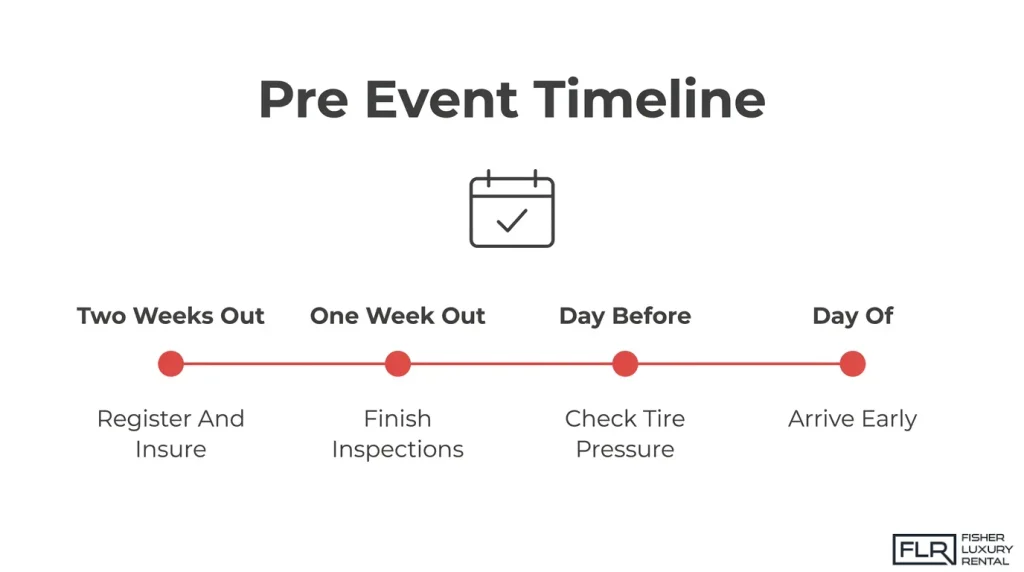
Your pre-event timeline should work backward from the track’s gate opening time. A practical structure includes:
- Two to four weeks out: Complete registration, book track-day insurance, and order any needed brake fluid, pads, or consumables.
- One week out: Finish all mechanical inspections, confirm tech-inspection documents are printed, and pack your spares bag.
- Day before: Top off fuel, check tire pressures cold, and stage your gear bag with helmet and driving shoes.
- Day of: Arrive 30 to 60 minutes before your run group’s first session for grid orientation and any organizer briefings.
A tight timeline prevents the scramble that causes drivers to skip critical safety checks at the gate.
How Do You Plan for Fuel and Hydration at the Track?
Fuel and hydration planning requires estimating track consumption accurately and pre-staging both before the event. Research from Oregon State University on Formula Student Germany 2013 track data demonstrated a fuel-estimation method with only a 2.1% error margin, confirming that consumption figures derived from dynamometer data translate reliably to real lap conditions. While street cars burn less aggressively than formula vehicles, the same principle applies: calculate expected fuel use per session and carry a safety buffer. For hydration, pre-hydrate the morning of the event and bring at least 500 ml of water per run session; track environments are physically demanding even from the driver’s seat.
What Common Track Day Prep Mistakes Should You Avoid?
Common track day prep mistakes fall into three categories: skipping brake inspections, ignoring fluid temperature limits, and over-modifying your car. Each mistake carries real consequences, from brake failure to lap-time regression.
What Happens If You Skip a Brake Inspection?
Skipping a brake inspection means entering one of the most demanding braking environments your car will ever face without confirming your stopping system is ready. The National Transportation Safety Board, in a study of 18 brake-related accidents, found that 13 involved maintenance deficiencies, with out-of-adjustment brakes being the most common failure. Track sessions compound worn pads, soft pedals, and air-contaminated fluid into compounding hazards at high speed. Checking pad thickness, brake line condition, and pedal feel before the event takes minutes but can prevent a corner-exit incident with no margin for recovery.
Why Is Ignoring Fluid Temperatures a Costly Mistake?
Ignoring fluid temperatures is a costly mistake because brake fluid can boil under repeated heavy braking, creating vapor that compresses instead of transmitting pedal force. A 1997 Washington State Department of Transportation experiment found that brake fluid must cool to at least 250°F before brakes safely recover from a boiling event. Once you lose pedal pressure mid-session, the only response is pumping the brake and hoping heat dissipates before the next braking zone. Upgrading to a high-temperature fluid before track day is a low-cost intervention that directly protects pedal confidence.
How Can Over-Modifying Your Car Hurt Performance?
Over-modifying your car can hurt performance by creating component mismatches that introduce unpredictable handling, added weight, or mechanical stress your chassis was never designed to manage. Installing stiffer springs without matching dampers, for example, often degrades grip rather than improving it, because the suspension cannot respond to surface changes quickly enough. Modifications that exceed your skill level or your car’s baseline setup also make it harder to diagnose handling problems mid-day. The most effective track prep keeps the car as close to a well-sorted stock configuration as possible, then adds targeted, tested changes incrementally. Drivers who prefer to avoid the modification guesswork altogether sometimes opt to rent through companies like Fisher Luxury Rental, which offers a curated fleet of maintained exotic vehicles in Phoenix, AZ and Portland, OR.
How Can a Luxury Rental Elevate Your Track Day Experience?
A luxury rental can elevate your track day experience by placing you behind the wheel of a high-performance exotic car without the prep, ownership costs, or mechanical risk. The sections below cover renting from Fisher Luxury Rental and the key takeaways for track day preparation.
Can Renting an Exotic Car from Fisher Luxury Rental Enhance Your Track Day?
Yes, renting an exotic car can elevate a driving weekend by placing you in a maintained, high-performance vehicle without the ownership costs or mechanical preparation burden. Book exotic car rental in Portland (or Phoenix), keep the drive on public roads unless Fisher confirms closed-course permission in writing, and use this checklist for cars you own and are allowed to run on track.
Fisher Luxury Rental offers Ferraris, Lamborghinis, Corvettes, and more through a white-glove service designed to make every rental smooth and memorable. Before booking, confirm coverage details carefully. According to the Texas Department of Insurance, personal auto policies differ, but some cover rental car damage from a wreck or theft; however, you must cover your own deductible if you file a claim. Additionally, the Wisconsin Department of Agriculture, Trade and Consumer Protection notes that some policies exclude pricey or exotic vehicles entirely, so verifying coverage before track day is essential.
What Are the Key Takeaways for Preparing Your Car for Track Day?
The key takeaways for preparing your car for track day center on safety, compliance, and logistics. Prioritize these before any event:
- Brakes: Use fresh fluid and track-rated pads; bleed the system at least once per year for track duty.
- Tires: Verify pressure, tread condition, and lug nut torque before every session.
- Safety gear: Bring a Snell, FIA, or SFI-certified helmet and close-toed shoes at minimum.
- Interior: Remove all loose items and securely mount any camera.
- Spares and tools: Pack brake fluid, a torque wrench, and completed tech inspection forms.
- Hydration and fuel: Plan refueling stops and drink fluids consistently throughout the day.
Skipping even one of these steps can end your day early or create a safety hazard. Renting through Fisher Luxury Rental removes the mechanical preparation burden entirely, making it one of the most practical ways to experience a track day without compromising on performance or safety.