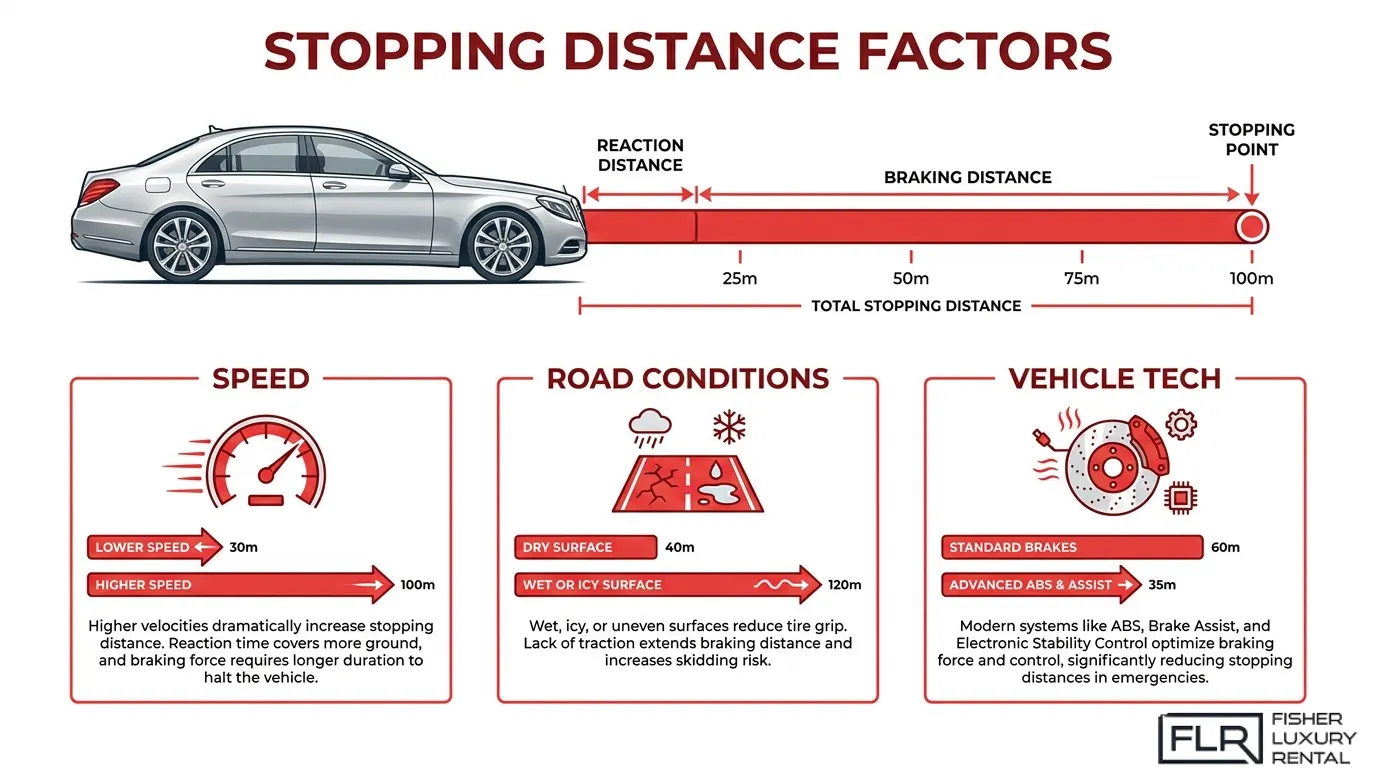
Vehicle stopping distance is the total distance a vehicle travels from the moment a driver perceives a hazard to the point the vehicle comes to a complete stop. It combines pre-braking distance (covering perception and reaction time) with braking distance (the phase where the brakes actively slow the vehicle).
This guide covers how stopping distance is measured and calculated, the physical and mechanical variables that extend or compress it, how driver behavior shapes outcomes, and how modern vehicle technology closes the gap between hazard and halt.
Stopping distance breaks down into three sequential phases (perception, reaction, and braking), each adding feet before the vehicle stops, with speed compounding every phase exponentially. Road surface conditions and tire conditions then multiply those baseline distances further, as icy roads can carry friction coefficients below 0.2 compared to 0.7 to 0.8 on dry asphalt, and tires worn to the legal minimum can double stopping distance entirely.
Vehicle weight, brake system health, and suspension condition each act as mechanical constraints on how quickly a vehicle sheds speed, with heavier vehicles and degraded components consistently requiring more distance to stop. Driver factors, including fatigue, distraction, and impairment, extend the pre-braking gap because reaction distance is traveled at full speed with no braking applied. Advanced technologies such as ABS, electronic brake-force distribution, and automatic emergency braking narrow these gaps considerably, and well-maintained luxury vehicles bring all of these advantages together in ways older or neglected vehicles cannot.
What Is Vehicle Stopping Distance?
Vehicle stopping distance is the total distance a vehicle travels from the moment a driver perceives a hazard to the moment the vehicle comes to a complete stop. It combines the distance covered during the driver’s perception and reaction time with the distance covered while the brakes are actively engaged.
The following sections cover the two main components of stopping distance, how speed compounds braking requirements, and the key factors that influence how quickly any vehicle can halt.
What Are the Two Main Components of Stopping Distance?
The two main components of stopping distance are the distance covered before the brakes are applied and the distance covered while the brakes slow the vehicle to a stop. These components break down further into perception distance, reaction distance, and braking distance — each covered in the H3s below.
What Is Perception Distance?
Perception distance is the distance a vehicle travels from the moment a driver’s eyes register a hazard to the moment the brain recognizes it requires action. According to Visual Expert, the best estimate for driver reaction time is 0.7 seconds total, of which 0.5 seconds is pure perception. At highway speeds, even this half-second delay adds meaningful feet to the total stopping gap before the driver has consciously decided to brake.
What Is Reaction Distance?
Reaction distance is the distance a vehicle travels between the brain recognizing a hazard and the foot actually depressing the brake pedal. Visual Expert identifies the movement phase at 0.2 seconds, covering the time required to release the accelerator and depress the brake. Combined with perception, this means the vehicle is still traveling at full speed while the driver transitions from awareness to physical response.
What Is Braking Distance?
Braking distance is the distance a vehicle travels from the moment the brakes engage to the point the vehicle reaches a complete stop. According to InsideEVs, the Porsche 718 Cayman GT4 RS required 132 feet from 70 mph, demonstrating how high-performance braking systems compress this phase significantly. Tire condition, road surface, vehicle weight, and brake system quality all directly influence how short or long this phase becomes.
How Does Vehicle Speed Affect Stopping Distance?
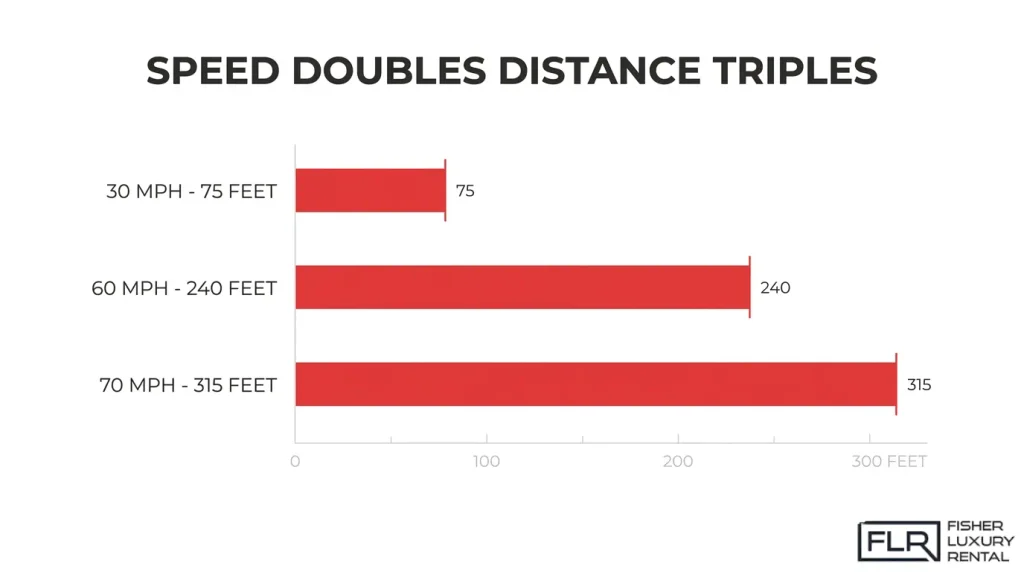
Vehicle speed affects stopping distance exponentially, not linearly. The following H3 sections cover how stopping distance changes at 30 mph, 60 mph, and highway speeds above 70 mph.
How Does Stopping Distance Change at 30 MPH?
Stopping distance at 30 mph totals approximately 75 feet under typical conditions. According to the UK Department for Transport’s Highway Code, 30 mph produces a stopping distance of 23 metres (75 feet), while 20 mph requires only 12 metres (40 feet). That 10 mph difference nearly doubles the distance needed to stop. At this speed range, reaction time accounts for a substantial share of the total distance, making attentiveness a critical factor even in low-speed urban zones.
How Does Stopping Distance Change at 60 MPH?
Stopping distance at 60 mph reaches approximately 240 feet under typical dry conditions. The Highway Code places 60 mph stopping distance at 73 metres (240 feet), roughly three times the distance required at 30 mph despite only doubling the speed. This disproportionate increase reflects the physics of kinetic energy, which grows with the square of velocity. Under FMVSS No. 121, adopted in 2011, the NHTSA requires fully loaded tractor-trailers traveling at 60 mph to stop within 250 feet, a standard that highlights how demanding this speed is even for regulated commercial braking systems.
How Does Stopping Distance Change at Highway Speeds Above 70 MPH?
Stopping distance at highway speeds above 70 mph escalates sharply, with the Highway Code reporting 70 mph requires 96 metres (315 feet) to stop. According to the Utah Department of Transportation, a 4,000-pound passenger vehicle traveling at 65 mph under ideal conditions needs 316 feet to stop. Meanwhile, NHTSA data shows ABS reduces stopping distances by 5 percent on dry concrete but 14 percent on wet surfaces, making brake technology especially valuable at these speeds. At this range, the gap between perception, reaction, and braking distance becomes a serious safety margin, one that most drivers consistently underestimate.
How Do Road Surface Conditions Affect Stopping Distance?
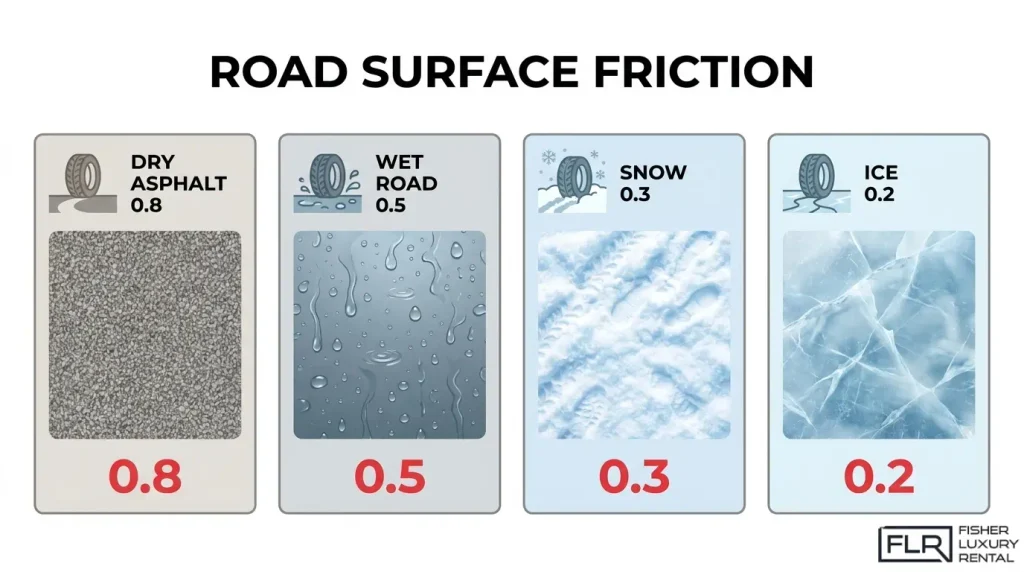
Road surface conditions affect stopping distance by changing the friction coefficient between tires and the road. Lower friction means longer braking distances. The H3s below cover wet pavement, ice and snow, gravel, and hot asphalt.
How Does Wet Pavement Affect Stopping Distance?
Wet pavement affects stopping distance by significantly reducing the friction available between tires and the road surface. According to OnSpot, dry asphalt carries a friction coefficient of 0.7 to 0.8, while wet roads drop to just 0.4 to 0.6. That reduction directly extends how far a vehicle travels before stopping. Water between the tire and road displaces grip, especially at higher speeds where hydroplaning becomes a real risk. Drivers should increase following distances substantially in wet conditions and reduce speed before entering standing water.
How Does Ice or Snow Affect Stopping Distance?
Ice or snow affects stopping distance more severely than any other common surface condition. Icy roads carry a friction coefficient often below 0.2, compared to 0.7 to 0.8 on dry asphalt. According to RAC Drive, wet or icy conditions are at least double the stopping distance compared to dry conditions. Snow compounds this further by creating an unstable, compressible layer between tires and the road. On ice, even a vehicle traveling at moderate speed may require dramatically more distance than drivers typically anticipate.
How Does Gravel or Loose Dirt Affect Stopping Distance?
Gravel or loose dirt affects stopping distance by creating an unstable surface where tire contact is inconsistent. Unlike solid asphalt, loose aggregate shifts under braking force, reducing the effective friction that slows the vehicle. Tires cannot grip individual particles the way they grip a bound surface, so braking force transfers inefficiently. This is particularly dangerous on gravel roads where the surface depth varies, making braking response unpredictable. Drivers on loose surfaces should reduce speed well in advance rather than relying on emergency braking.
How Does Hot Asphalt Affect Stopping Distance?
Hot asphalt affects stopping distance in two competing ways: softened asphalt can slightly increase grip in some conditions, but it also increases the risk of tire deformation and surface delamination. In extreme heat, road surfaces can become tacky or uneven, reducing consistent tire contact. Beyond the surface itself, high ambient temperatures increase the risk of tire overinflation, which reduces the contact patch between tire and road. As JT Hughes notes, reduced tire-to-road contact directly worsens stopping distance, making hot-weather tire pressure checks an important safety step.
How Do Tire Conditions Affect Stopping Distance?
Tire conditions affect stopping distance through three primary factors: tread depth, inflation pressure, and tire compound. Each directly influences how much friction a tire generates against the road surface, which determines how quickly a vehicle can stop.
How Does Tire Tread Depth Affect Stopping Distance?
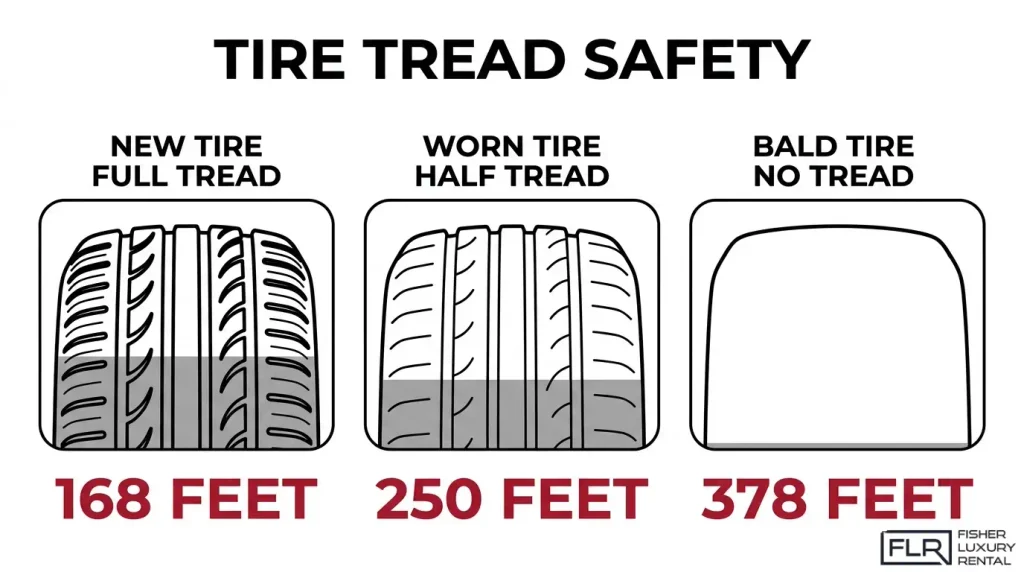
Tire tread depth affects stopping distance by controlling how effectively a tire channels water and maintains contact with the road. In the United States, tread must be at least 2/32 of an inch (1.6 mm) thick — and at that minimum legal depth, stopping distance doubles compared to new tires.
According to Tire Rack testing, tires at the legal minimum of 2/32-inch tread depth required 378.8 feet to stop from 70 mph, taking 5.9 seconds. Tires below this threshold are considered legally bald in most states and present a serious safety risk. Replacing tires before they reach the legal minimum is one of the highest-impact safety decisions a driver can make.
How Does Tire Pressure Affect Stopping Distance?
Tire pressure affects stopping distance by changing how much of the tire’s surface contacts the road. As tire pressure decreases below the recommended level, braking distance increases, according to a ResearchGate study on tire pressure and vehicle braking distance. Underinflated tires reduce the contact patch between the tire and road surface, weakening the friction needed to slow the vehicle efficiently. Maintaining manufacturer-recommended pressure is a simple, often overlooked way to preserve optimal braking performance.
How Does Tire Compound and Type Affect Stopping Distance?
Tire compound and type affect stopping distance because different rubber formulations perform differently across temperature ranges and surfaces. In dry conditions, summer tires stop shortest from 60 mph at 157 feet, followed by snow tires at 181 feet and all-season tires at 215 feet, per Edmunds testing. Winter tires stay flexible below 45°F, where summer and all-season tires harden and lose grip, according to Michelin USA. Firestone Complete Auto Care confirms winter tires outperform all-season tires on snowy and icy surfaces. Matching tire type to seasonal conditions is as critical as any other braking variable. Reputable luxury rental providers like Fisher Luxury Rental ensure their fleet vehicles are fitted with appropriate, properly inflated tires, one of the most direct ways a rental company’s maintenance standards translate into real-world braking safety for the driver.
How Does Vehicle Weight Affect Stopping Distance?
Vehicle weight directly increases stopping distance because greater mass requires more force to decelerate. Heavier vehicles carry more kinetic energy at any given speed, which brakes must overcome to bring the vehicle to a halt.
According to STAR Mutual Risk Retention Group, a fully loaded semi-truck traveling at 55 mph in ideal conditions may need roughly 300 feet to stop, while the same vehicle loaded to its 80,000 lb GVWR can require 450–525 feet depending on conditions. That gap of up to 225 feet illustrates how dramatically payload alone reshapes braking performance.
The physics behind this are straightforward: kinetic energy scales with mass, so doubling a vehicle’s weight roughly doubles the braking energy the system must absorb. Even exceptional braking hardware cannot fully compensate for the inertia of extreme mass. For drivers sharing roads with heavy commercial vehicles, understanding this limitation is essential. A fully loaded semi simply cannot mirror the stopping behavior of a passenger car, regardless of how advanced its brakes are.
How Do Brake System Components Affect Stopping Distance?
Brake system components affect stopping distance through pad material, fluid condition, and rotor integrity. The following H3s cover each component and its specific impact on braking performance.
How Do Brake Pad Materials Affect Stopping Distance?
Brake pad materials affect stopping distance by determining how much friction the pad generates against the rotor under heat and load. Organic pads offer quiet, low-temperature performance, while semi-metallic and ceramic compounds handle higher heat before fading. According to Car and Driver, the Porsche 911 with Ceramic Composite Brakes (PCCB) averaged around 305 feet from 100 mph, essentially matching standard brake-equipped variants. This result shows that material quality matters less than pad condition and overall system maintenance at street speeds. Keeping pads within their designed heat range, rather than simply upgrading to exotic compounds, delivers the most consistent stopping performance for everyday drivers.
How Does Brake Fluid Condition Affect Stopping Distance?
Brake fluid condition affects stopping distance because degraded fluid boils at lower temperatures, compressing as vapor and reducing pedal pressure transferred to the calipers. DOT 3 fluid carries a dry boiling point of 205°C/401°F and a wet boiling point of 140°C/284°F, according to AMSOIL. DOT 4 fluid raises those thresholds to 230°C/446°F dry and 155°C/311°F wet. Moisture absorption over time pushes fluid toward its wet boiling point faster, increasing fade risk during sustained braking. Regular fluid flushes are one of the most cost-effective ways to protect braking performance.
How Do Worn Rotors or Drums Affect Stopping Distance?
Worn rotors affect stopping distance by reducing the surface area and thermal mass available to absorb braking energy. According to PowerStop, worn rotors increase stopping distances and diminish braking performance, creating a dangerous situation. Rotors worn below minimum thickness flex under clamping force, reducing pad-to-rotor contact and generating uneven heat distribution. Drums suffer similarly, with worn friction surfaces losing the geometry needed for full shoe contact. Inspecting rotors and drums at every tire rotation catches dangerous wear before it extends stopping distances on the road.
How Do Advanced Vehicle Technologies Reduce Stopping Distance?
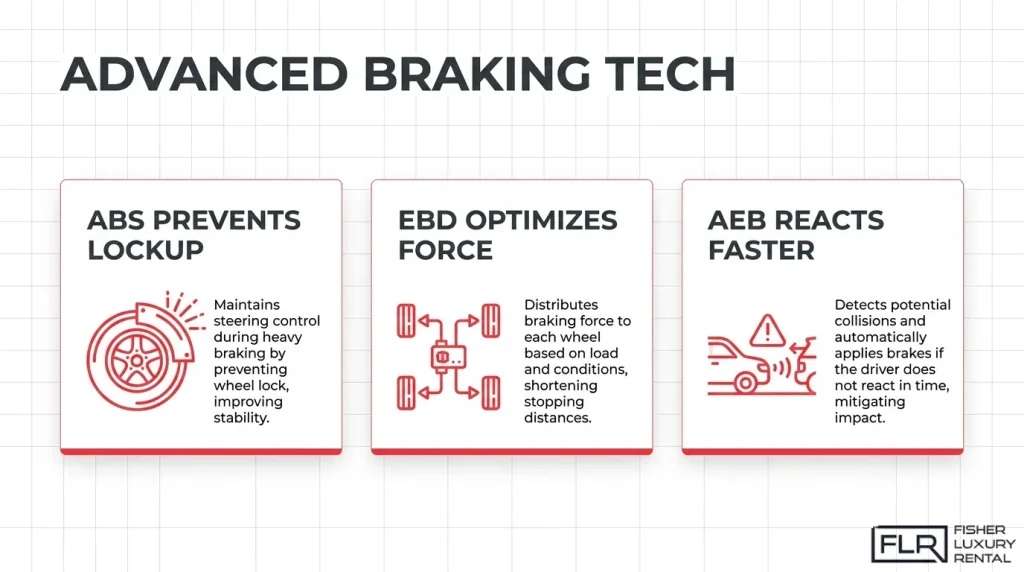
Advanced vehicle technologies reduce stopping distance through systems that prevent wheel lockup, optimize brake-force distribution, and trigger braking faster than human reaction allows. The sections below cover ABS, electronic brake-force distribution, and automatic emergency braking.
How Does Anti-Lock Braking System Technology Reduce Stopping Distance?
Anti-lock braking system technology reduces stopping distance by preventing wheels from locking during hard braking, allowing the driver to maintain steering control while stopping. According to Verizon Connect, vehicles equipped with ABS stop 10% to 15% faster than those without it.
ABS achieves this by rapidly modulating brake pressure, keeping tires in a controlled slip rather than a full skid. The real-world impact is significant: average braking distances from 70 mph have dropped from roughly 200 feet in the early 1970s to 168 feet today, even as vehicle curb weights have grown nearly 50% over the same period.
How Does Electronic Brake-Force Distribution Affect Stopping Distance?
Electronic brake-force distribution (EBD) affects stopping distance by automatically adjusting the amount of braking force applied to each wheel based on load, speed, and traction conditions. Rather than applying equal pressure to all four wheels, EBD directs greater force to wheels carrying more weight, keeping the vehicle stable and maximizing grip during deceleration. This is especially valuable in cornering or when passenger and cargo loads shift weight unevenly across axles.
How Does Automatic Emergency Braking Affect Stopping Distance?
Automatic emergency braking affects stopping distance by detecting imminent collisions and applying the brakes before the driver can react, effectively eliminating the human reaction delay. The Insurance Institute for Highway Safety reports that AEB cuts rear-end crashes in half.
NHTSA projects that FMVSS No. 127, the new federal AEB standard, will save at least 360 lives and prevent at least 24,000 injuries annually. AEB represents the most consequential leap in stopping-distance reduction because it closes the gap between hazard recognition and brake application, the phase where most crash-related distance is still being covered.
How Does Driver Reaction Time Affect Stopping Distance?
Driver reaction time affects stopping distance by adding distance traveled before brakes are ever applied. The sections below cover how fatigue, distraction, and alcohol each extend that pre-braking gap.
How Does Fatigue Affect Driver Reaction Time?
Fatigue affects driver reaction time by slowing the perception-to-response process that precedes every brake application. Under ideal, alert conditions, the best estimate for driver reaction time is 0.7 seconds: 0.5 seconds for perception and 0.2 seconds for physical movement to release the accelerator and depress the brake pedal, according to Visual Expert. Fatigue stretches both phases, meaning the vehicle continues traveling at full speed longer before braking begins. The Texas Department of Transportation sets the standard brake reaction time at 2.5 seconds, adequate for 90% of drivers in moderately complex highway environments. A fatigued driver can easily exceed that threshold, adding meaningful feet of unbraked travel. At highway speeds, even fractions of a second matter enormously.
How Does Distracted Driving Affect Reaction Time?
Distracted driving affects reaction time by diverting attention away from the road entirely, eliminating any perception response during that window. According to NHTSA, sending or reading a text takes a driver’s eyes off the road for 5 seconds, equivalent to driving the length of a football field blind at 55 mph. A separate analysis found a motorist’s eyes are off the road for an average of 4.6 seconds per text transmitted or received. During those seconds, reaction time is effectively infinite: the driver cannot perceive a hazard they cannot see, and braking cannot begin until attention is restored.
How Does Alcohol or Medication Affect Reaction Time?
Alcohol and medication affect reaction time by impairing the central nervous system functions responsible for hazard perception and muscle response. Both substances slow the neural signaling that drives the 0.5-second perception phase and the 0.2-second physical movement phase that together form baseline driver reaction time. Even at legal blood alcohol limits, cognitive processing delays accumulate enough to extend reaction distance by several feet at highway speeds. Certain prescription medications, including sedatives, antihistamines, and muscle relaxants, produce similar impairment. Because reaction distance is a direct multiplier of speed, any drug-induced delay compounds dramatically the faster a vehicle travels.
How Do Weather and Visibility Conditions Affect Stopping Distance?
Weather and visibility conditions affect stopping distance by reducing road friction, impairing driver perception, and extending both reaction distance and braking distance. Rain, fog, snow, and glare each create distinct hazards covered in the sections below.
How Does Rain Affect Stopping Distance?
Rain affects stopping distance by lowering road surface friction and reducing tire grip. Wet roads carry a friction coefficient of 0.4 to 0.6, compared to 0.7 to 0.8 on dry asphalt. According to RAC Drive, wet conditions will at least double stopping distance compared to braking on dry roads. Rain also reduces visibility, which increases perception distance before a driver even begins to react.
How Does Fog Affect Stopping Distance?
Fog affects stopping distance by severely limiting a driver’s sight distance, which means hazards are detected much later. When a driver cannot see far ahead, available stopping distance shrinks dramatically relative to actual stopping distance needed at any given speed. Drivers should reduce speed significantly in fog, because reaction distance alone can exceed visibility range at highway speeds.
How Does Snow or Ice Change Stopping Distance in Winter Conditions?
Snow and ice change stopping distance by reducing the friction coefficient to below 0.2, far lower than wet or dry pavement. At this level, braking distance can increase several times beyond dry-road equivalents. Winter tires stay flexible below 45°F, where summer and all-season tires harden and lose grip, according to Michelin USA, making tire selection especially critical in freezing conditions.
How Does Sun Glare Affect Driver Reaction Time and Stopping Distance?
Sun glare affects stopping distance by temporarily blinding a driver, which delays hazard perception and extends reaction distance before braking begins. Because reaction distance is traveled at full speed with no braking applied, even a one-second perception delay adds significant feet of travel. Glare is most dangerous at dawn and dusk when it aligns with road level and offers little warning before a hazard appears.
How Does Vehicle Suspension Condition Affect Stopping Distance?
Vehicle suspension condition affects stopping distance by influencing tire contact with the road during braking. The following H3 sections cover how shock absorbers, wheel alignment, and suspension failure each alter braking performance.
How Do Worn Shock Absorbers Affect Braking?
Worn shock absorbers affect braking by allowing excessive wheel bounce and body dive, which reduces the tire’s contact patch with the road surface during emergency stops. When shocks lose their damping ability, weight transfer under hard braking becomes uncontrolled, causing the front tires to skip or chatter rather than maintain consistent grip. This intermittent contact directly extends braking distance because friction force depends on stable, continuous tire-to-road contact. Shock absorbers are a frequently overlooked maintenance item, yet their condition may matter as much as tire tread on uneven or rough road surfaces.
How Does Wheel Alignment Affect Stopping Distance?
Wheel alignment affects stopping distance by determining whether all four tires contact the road at their optimal angle during braking. Misaligned wheels cause uneven tire wear, reduce the effective contact patch, and can create pulling forces that destabilize the vehicle when the brakes are applied. A car that pulls left or right during braking forces the driver to steer while stopping, dividing attention and extending the total stopping event. Correct alignment ensures braking forces are distributed evenly across all four tires, maximizing available friction.
How Does Suspension Failure Increase Stopping Risk?
Suspension failure increases stopping risk by compromising vehicle stability, steering control, and tire contact simultaneously. A broken spring, failed control arm bushing, or collapsed strut can dramatically alter vehicle geometry under braking load, causing unpredictable handling or partial loss of tire contact with the road. These failures are particularly dangerous at highway speeds, where any reduction in effective tire grip compounds quickly over the greater distances required to stop. Regular suspension inspections are one of the most practical steps a driver can take to preserve braking performance between tire and brake service intervals. For drivers renting rather than owning, choosing a company like Fisher Luxury Rental, which emphasizes rigorous vehicle upkeep as part of its service promise, removes the uncertainty of unknown maintenance history before a trip.
How Can You Calculate Total Stopping Distance?
Total stopping distance calculation combines two components: the distance covered during reaction time and the distance covered during braking. The sections below cover the standard formula, reaction time constants, and deceleration benchmarks used by engineers and transportation authorities.
What Is the Formula for Calculating Total Stopping Distance?
The formula for calculating total stopping distance is SSD = 1.47Vt + (1.075V²) / a, where SSD is stopping distance in feet, V is speed in mph, t is brake reaction time, and a is deceleration rate in ft/s². According to the City of Los Angeles Street Design Manual, which applies the AASHTO standard, this formula is used for level road design. Metric users apply SSD = 0.278Vt + (0.039V²) / a, substituting km/h and m/s². Both versions separate reaction distance from braking distance cleanly, making it straightforward to isolate which variable dominates at a given speed.
What Reaction Time Value Should You Use in the Formula?
The reaction time value to use in the stopping distance formula is 2.5 seconds. According to the Texas Department of Transportation, this value is considered adequate for 90% of drivers in simple to moderately complex highway environments. Using a higher reaction time adds a safety margin for impaired, fatigued, or distracted drivers, which is good engineering practice. In real-world calculations, underestimating reaction time is the single most common error that produces dangerously optimistic stopping distance estimates.
What Deceleration Rate Should You Use?
The deceleration rate to use for stopping distance calculations is at least 14.8 ft/s² (4.5 m/s²). The Federal Highway Administration notes that most drivers decelerate at a rate greater than this value when stopping for an unexpected object. Transportation engineers typically apply 11.2 ft/s² as a conservative baseline for road design, providing a built-in buffer for adverse conditions such as wet pavement or worn tires.
How Does Stopping Distance Matter When Driving a Luxury Vehicle?
Stopping distance matters in a luxury vehicle because modern luxury and exotic cars combine powerful braking hardware with advanced safety technology, producing measurably shorter stops than older or less-maintained vehicles. The H3s below cover how a well-maintained rental affects stopping performance and the key takeaways from this guide.
Can Renting a Well-Maintained Luxury Car Improve Stopping Performance?
Yes, renting a well-maintained luxury car can improve stopping performance compared to driving an older or poorly serviced vehicle. Modern luxury vehicles benefit from premium braking systems, properly inflated tires, and fresh brake components that work together to reduce stopping distances. Car testing data shows that average stopping distances from 70 mph have improved from roughly 200 feet in the early 1970s to approximately 168 feet today, even as vehicle curb weights have grown by nearly 50 percent. High-performance models push this further: the Porsche 718 Cayman GT4 RS stopped in just 132 feet from 70 mph. Fisher Luxury Rental, which serves Phoenix, AZ and Portland, OR, stocks top-trim luxury and exotic vehicles maintained to these performance standards, meaning renters benefit from current braking technology rather than degraded systems common in older or lower-spec cars. Luxury rental fleets that prioritize top-trim vehicles and proper maintenance can help preserve these performance advantages for every driver.
What Are the Key Takeaways About Vehicle Stopping Distance?
The key takeaways about vehicle stopping distance are that multiple interconnected factors, including speed, tires, road surface, brake condition, and driver attention, each add to or subtract from your total stopping distance. No single upgrade eliminates braking risk; safe driving requires all systems working together. The most actionable lessons from this guide are:
- Speed compounds distance non-linearly: Small speed increases produce disproportionately longer stops.
- Tire condition is critical: Worn tread or low pressure significantly extends braking distance.
- Road surface multiplies everything: Wet or icy roads can double stopping distances compared to dry pavement.
- Brake system health matters: Worn rotors, degraded fluid, or faded pads all increase stopping distance.
- Advanced technology helps: ABS, EBD, and AEB reduce distances and improve control, especially in emergencies.
- Driver attention is irreplaceable: No technology fully compensates for distracted or impaired reaction time.
Choosing a well-maintained, technology-equipped vehicle puts every mechanical advantage in choosing a well-maintained, technology-equipped vehicle from Fisher Luxury Rental puts every mechanical advantage in your favor before you even start the engine.