Classic car show judging standards are the formal criteria, scoring systems, and eligibility rules that governing organizations use to evaluate collector vehicles in sanctioned competition. These standards vary by organization and event format, but all share a common foundation: measuring how faithfully a vehicle reflects its original factory-delivered condition.
This guide covers the main judging systems used at shows, the specific categories judges evaluate, how point scales and scoring sheets work, the distinction between originality and restoration quality, vehicle classification and eligibility rules, competition preparation, penalties and disqualifications, and how a vehicle’s condition connects to its collector market value.
Judging formats range from the precision of concours d’elegance rubrics to popular vote balloting and mileage-based touring awards, each rewarding different aspects of ownership and stewardship.
Every judged category, from exterior paint and engine bay to undercarriage and convertible tops, carries its own scoring weight, and understanding how those categories are measured is the foundation of competitive preparation.
Organizations such as the Classic Car Club of America, the Antique Automobile Club of America, Pebble Beach, and Amelia Island each apply distinct point scales, eligibility thresholds, and award structures that directly shape what a competitive entry must demonstrate.
Preparation, documentation, and classification decisions, including where replicas, restomods, and preservation-class survivors compete, determine whether a vehicle earns deductions or awards. Those same standards of condition and originality that drive show scores also influence a classic car’s long-term collector value. For enthusiasts who want to experience automotive excellence without the demands of ownership or show preparation, Fisher Luxury Rental offers top-trim luxury and exotic vehicles for rent in Phoenix, Scottsdale, Portland, and Vancouver, WA.
What Are the Main Judging Systems Used at Classic Car Shows?
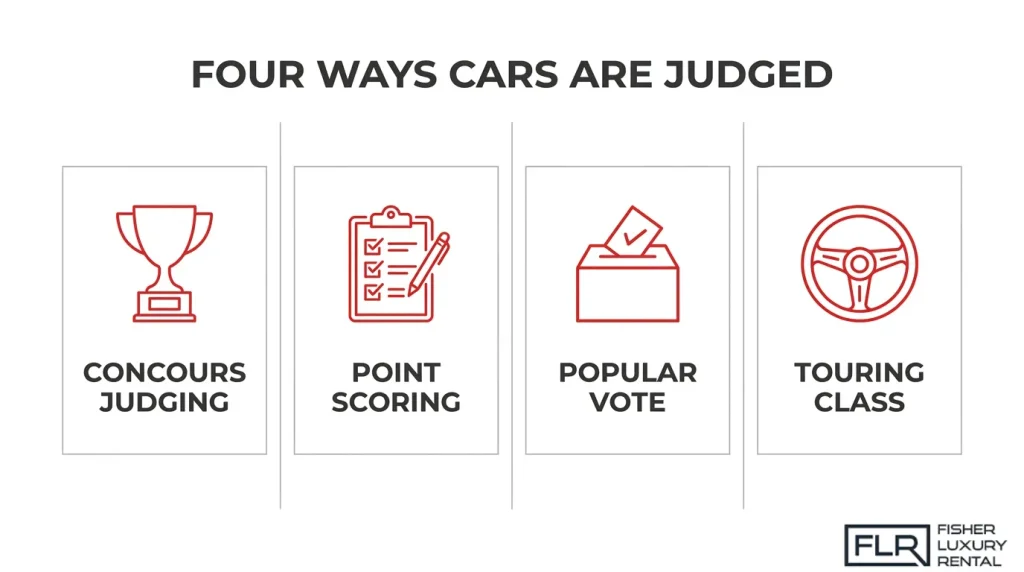
The main judging systems used at classic car shows are concours d’elegance evaluation, point-based scoring, popular vote, and drive-through touring class formats. Each system applies different criteria and suits different event formats and vehicle categories.
Concours d’Elegance Judging
Concours d’elegance judging uses one of two approaches: the French style, which prioritizes a vehicle’s visual style and elegance, or points-based judging, where judges fill out an event-issued rubric and deduct points for blemishes and nonworking parts. According to the Revs Institute’s coverage of the 2024 Amelia Concours d’Elegance, judges have a limited window to inspect each car in their class, meaning large classes require each vehicle to be evaluated in a matter of minutes. This time constraint makes presentation, preparation, and immediate visual impact critical factors in earning high scores.
Point-Based Scoring Systems
Point-based scoring systems assign a fixed starting total and deduct points for deficiencies across defined categories such as exterior, interior, engine bay, and chassis. Score sheets break evaluation into measurable subsections, allowing judges to apply consistent standards across all entries in a class. Deductions reward precise restoration work and penalize any deviation from factory-correct condition.
Popular Vote or Participants’ Choice
Popular vote judging gives registered participants, rather than official judges, the authority to select class winners. According to the Pontiac-Oakland Club International’s 2026 Official Judging Manual, each registered participant receives one ballot to vote in up to five separate classes, with only one vote permitted per class. At the Pebble Beach Concours d’Elegance, a hybrid model applies: class winners are determined by judges, but the Best of Show award is then decided by the Chief Judge, Class Judges, and Honorary Judges voting collectively from among the class winners.
Drive-Through or Touring Class Judging
Drive-through or touring class judging rewards vehicles that are actively driven rather than statically displayed. The Vintage Chevrolet Club of America’s Touring Guidelines Manual recognizes members at milestones of 500, 1,000, 2,000, 5,000, and 10,000 miles driven, with touring awards displayed on the vehicle alongside class judging awards. This format values mechanical reliability and real-world use over cosmetic perfection, making it accessible to owners whose vehicles are driven regularly rather than kept as show pieces.
What Categories Do Judges Evaluate During a Classic Car Show?
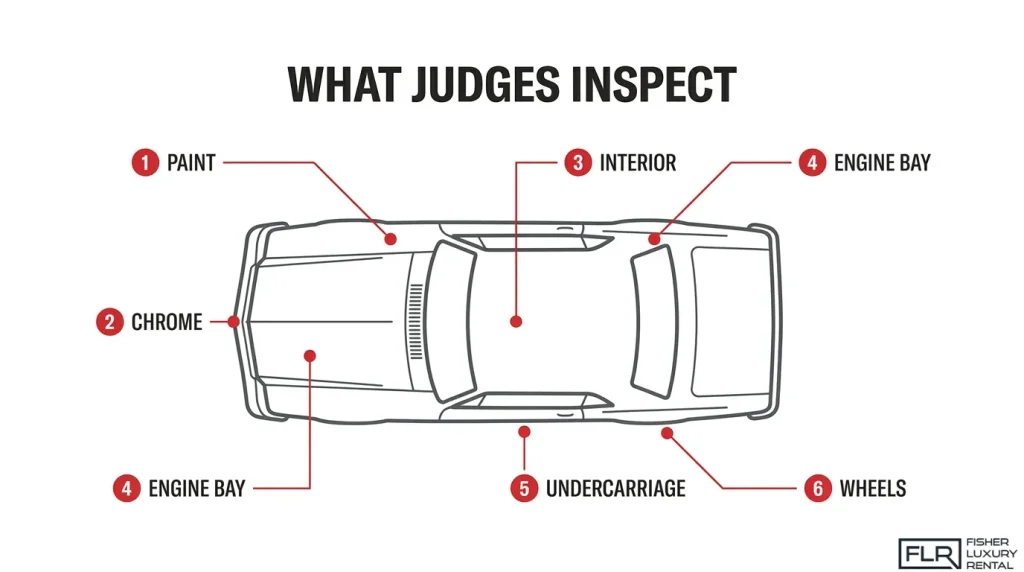
The categories judges evaluate during a classic car show include exterior paint, chrome and trim, interior condition, engine bay, undercarriage, wheels and tires, electrical systems, and convertible tops. Authenticity guides every judgment: according to the Classic Car Club of America’s Judging Manual, if doubt exists about a component’s originality, the presumption always favors the exhibitor.
How Is Exterior Paint and Bodywork Scored?
Exterior paint and bodywork is scored based on finish quality, panel alignment, surface consistency, and freedom from defects such as chips, cracks, orange peel, or overspray. Judges examine color accuracy against factory specifications and inspect body gaps for uniformity. Preservation-class vehicles may be assessed differently, with original but aged paint often treated as a positive attribute rather than a flaw.
How Are Chrome, Trim, and Brightwork Evaluated?
Chrome, trim, and brightwork are evaluated for surface condition, correct fit, pitting, rust, and factory-accurate placement. Judges check that all brightwork matches period-correct specifications, including correct logo badges, molding profiles, and plating quality. Aftermarket substitutions that deviate from OEM appearance typically result in point deductions, as correct trim is a strong indicator of overall restoration integrity.
How Is Interior Condition and Originality Judged?
Interior condition and originality are judged by measuring how closely the vehicle matches its original factory delivery state. According to the Porsche Club of America Zone 7 Concours Rules (2025 Edition), originality reflects how close the vehicle is to how it was delivered when new through an authorized dealer. Judges inspect upholstery, carpeting, dash components, headliner, hardware, and period-correct gauges for material accuracy and condition.
How Is the Engine Bay Assessed for Detail and Accuracy?
The engine bay is assessed for cleanliness, component originality, correct finishes, and accurate wiring layout. Judges look for factory-correct hose routing, correct date-coded components where applicable, and absence of non-period modifications. Scoring typically covers both cleanliness and originality separately, as a pristine but incorrectly rebuilt engine will still lose points for inauthentic parts.
How Are Undercarriage and Chassis Condition Rated?
Undercarriage and chassis conditions are rated on cleanliness, correct finish coatings, structural integrity, and original hardware. Judges inspect frame rails, suspension components, exhaust routing, and floor pans for corrosion, improper welds, or non-factory repairs. The undercarriage is often one of the most overlooked areas by first-time entrants, yet it carries significant weight in rigorous points-based judging formats.
How Do Judges Score Wheels, Tires, and Hub Caps?
Judges score wheels, tires, and hub caps based on factory correctness, cleanliness, and condition. According to the BMW Car Club of America’s Delaware Valley Chapter 2026 Concours FAQ, cars with aftermarket wheels and tires paired with a factory suspension setup may still qualify under the original classification, whereas additional modifications push the vehicle into the modified classification. Hub cap fit, correct finish, and period-accurate tire sidewall markings also factor into scoring.
How Is Electrical and Lighting Functionality Evaluated?
Electrical and lighting functionality is evaluated by testing that all factory-installed systems operate correctly, including headlights, taillights, turn signals, horn, gauges, and interior lighting. Non-functional components typically result in direct point deductions. Judges assess both operation and correct period appearance, meaning a working but visually incorrect replacement bulb or switch can still reduce a score.
How Are Convertible Tops and Soft Trim Judged?
Convertible tops and soft trim are judged on material condition, correct color and texture, proper fit, and freedom from tears, fading, or incorrect stitching. Judges verify that the top material matches factory specifications for that model year and that all associated hardware, such as latches, bows, and weatherstripping, is original or correctly reproduced. A well-preserved or accurately restored top signals careful, detail-oriented stewardship of the entire vehicle.
What Point Scales and Scoring Sheets Do Official Shows Use?
Point scales and scoring sheets vary by organization, but most use either a deduction-from-perfect or a percentage-threshold model. The sections below cover the most widely used systems across major clubs and registries.
AACA’s 400-Point Deduction System
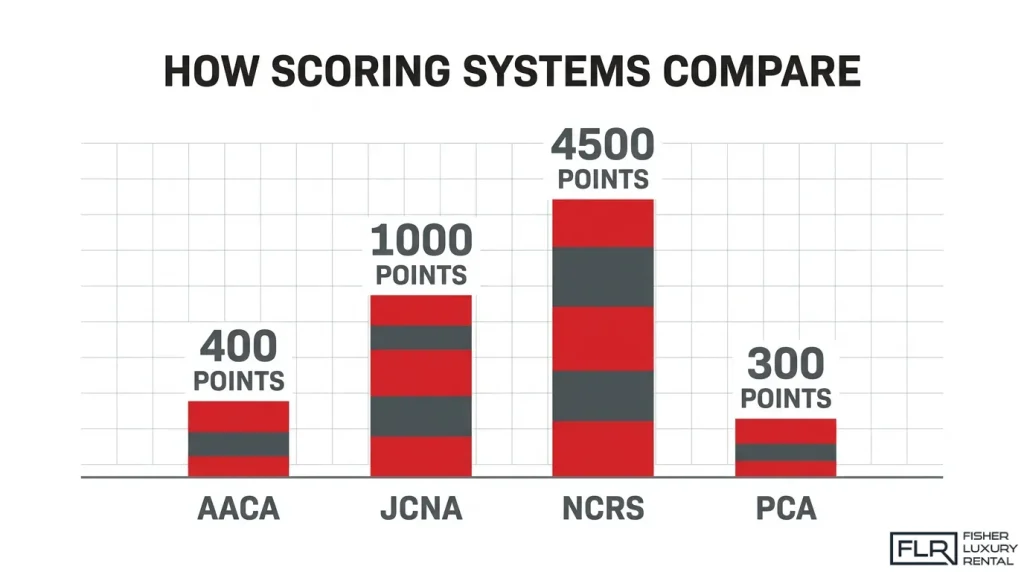
The AACA’s scoring system starts every vehicle at 400 points. According to the Antique Automobile Club of America’s 2026 Official Judging Guidelines, judges deduct points for any area that falls below accepted AACA standards, making a perfect score 400. This deduction model rewards preparation discipline — every overlooked detail costs points directly.
JCNA’s 1,000-Point Sheet
The JCNA’s 1,000-point score sheet assigns point values across all judged areas, then divides the raw total by 10 to produce the competing score. Under the Jaguar Clubs of North America’s 2026 Concours Rule Book, a score of 100 represents a perfect Champion Division entry. The division step normalizes scores across vehicle classes.
NCRS’s 4,500-Point Threshold Standard
The NCRS Top Flight award requires Corvette entries to achieve 94% or above of 4,500 available points. The National Corvette Restorers Society applies this threshold across five judged areas: Operations Check, Exterior, Interior, Mechanical, and Chassis. Earning Top Flight under this system is among the most rigorous benchmarks in marque-specific judging.
PCA’s Category-Weighted Scoring Sheet
The PCA Chesapeake Region’s Full Concours Scoring Sheet allocates points across four categories: Exterior (100), Interior (100), Engine Compartment (50), and Storage and Wheels (50), totaling 300 points. Within mechanical sub-areas, individual line items such as wiring originality, exhaust cleanliness, and metal condition each carry separate point values, making granular preparation essential for competitive entries.
What Is the Difference Between Originality and Restoration Quality?
The difference between originality and restoration quality is that originality measures how closely a vehicle matches its factory-delivered condition, while restoration quality measures how well any repair or refinishing work was executed. These are two distinct criteria, and judges evaluate them separately.
A car with all its original components may score highly for originality even if its paint has aged or its upholstery has worn. Conversely, a flawlessly restored car can score well for workmanship quality while losing points in originality categories if period-correct parts were replaced with non-factory substitutes.
According to Ferrari Club of America Chief Judge Leslie Blinn at the FCA2023 Concours Presentation, the intention of the concours process is not a competition between judges and entrants, but a collaborative effort to ensure the authenticity and originality of the cars. That framing matters: judges are not adversaries hunting for flaws but partners verifying that a vehicle’s history remains intact.
For competitors, the practical implication is significant. A show-quality restoration that uses incorrect materials or out-of-period components will be penalized in originality scoring regardless of how pristine the finish appears. Owners who preserve unrestored vehicles often benefit from this distinction, since documented factory-correct condition carries weight that a polished but inaccurate restoration cannot replicate. The same reverence for precision and authentic craftsmanship that defines concours judging is reflected in the fleet philosophy at Fisher Luxury Rental, where only top-trim models are offered, no base trims or compromised configurations.
What Does It Mean to Be Judged to Factory-Correct Standards?
Being judged to factory-correct standards means your vehicle must match its original condition as it left the manufacturer, covering preparation, parts authenticity, and cleanliness across every inspected area.
According to the Peachstate Region of the Porsche Club of America, Tour Class preparation involves meticulous hand cleaning and parts replacement to OEM (Original Equipment Manufacturer) standards, with the goal of producing a near-perfect specimen as it originally arrived from the manufacturing plant, regardless of the vehicle’s current age or mileage.
In practice, this standard applies to every component a judge can see, touch, or verify: paint, engine bay, trim, upholstery, and mechanical hardware. A car does not earn a pass simply because it looks clean; each element must reflect what the factory originally specified. This makes factory-correct judging one of the most demanding standards in the collector car world, rewarding owners who treat authenticity as a discipline rather than a cosmetic goal.
What Are the Most Recognized Classic Car Show Organizations?
The most recognized classic car show organizations include national clubs, regional concours events, and prestigious invitational shows. Each applies distinct judging standards, eligibility requirements, and award structures covered in the H3s below.
Classic Car Club of America
The Classic Car Club of America (CCCA) is one of North America’s most respected marque-agnostic judging authorities, governing concours competition for pre-war and full classic vehicles. According to the CCCA Judging Manual (November 2019), judges must base all authenticity calls on certain knowledge, and when doubt exists, the presumption of authenticity always favors the exhibitor and the vehicle. This principle reflects a philosophy shared across many affiliated clubs, including the Ferrari Club of America, Porsche Club of America, Mustang Club of America, Buick Club of America, BMW Car Club of America, and Model A Ford Club of America, each of which publishes its own scoring sheets and judging procedures.
Antique Automobile Club of America
The Antique Automobile Club of America (AACA) administers one of the most structured points-based judging programs in the hobby. Per the AACA 2026 Official Judging Guidelines, all vehicles begin with 400 points, and judges deduct from that total according to accepted AACA standards. The AACA also administers the National Historic Vehicle Register, the only federally recognized program that records the history of America’s most significant automobiles, preserving their information in perpetuity at the Library of Congress.
Pebble Beach Concours d’Elegance
The Pebble Beach Concours d’Elegance is widely regarded as the world’s premier collector car competition. According to Pebble Beach Concours official judging rules, a vehicle must first win its class before becoming eligible for Best of Show. Once class winners are named, the Chief Judge, Chief Honorary Judge, each Chief Class Judge, Honorary Judge team leaders, and select Class Judges cast votes to determine the final winner.
Amelia Island Concours d’Elegance
The Amelia Island Concours d’Elegance applies a selective, invitation-based submission process. According to the Amelia Concours vehicle submission guidelines, only the highest-quality collectible automobiles and motorcycles that meet the Selection Committee’s standards are accepted for display. The Revs Institute notes that Amelia uses both French-style elegance judging and points-based rubrics depending on the class.
The Elegance at Hershey
The Elegance at Hershey is a Pennsylvania-based invitational concours with a philanthropic mission. The inaugural event introduced the distinctive “Worn but Not Forgotten” award, recognizing unrestored survivors alongside traditionally judged entries. According to the AACA Museum, the 2019 edition drew one of the highest attendances in the event’s history, with spectators filling the gardens behind The Hotel Hershey to view 75 world-class collector cars. WITF reported in September 2019 that organizers announced a hiatus for 2020.
Understanding which organizations govern competition helps collectors align their preparation and documentation to the right set of standards before entering a show. Car enthusiasts in the Phoenix, Scottsdale, Portland, and Vancouver, WA areas who want to deepen their appreciation for high-performance vehicles can explore Fisher Luxury Rental’s fleet of luxury and exotic cars as a hands-on complement to the show experience.
What Are the Common Vehicle Classes and Eligibility Rules?
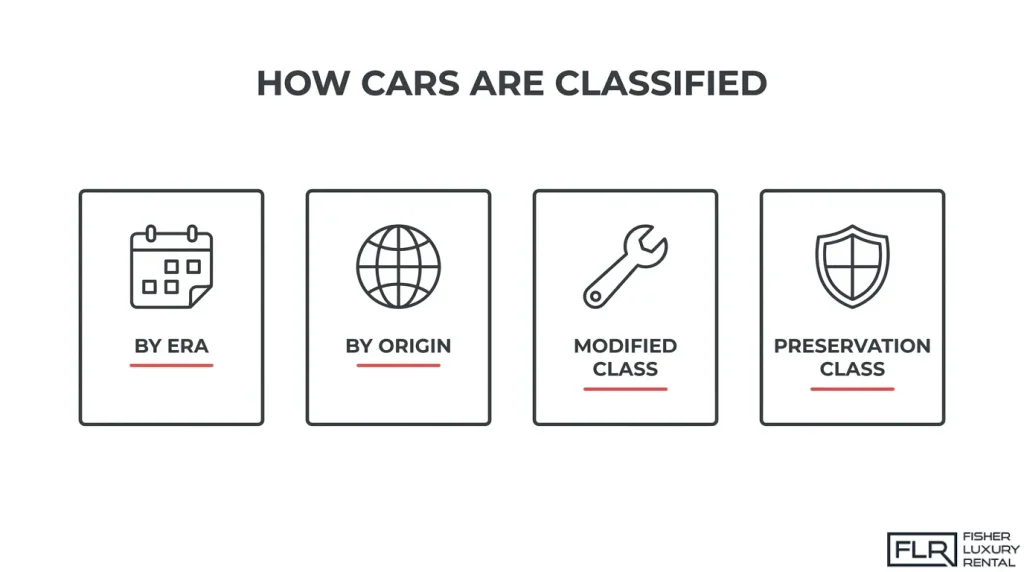
Vehicle classes and eligibility rules vary by production year, origin, modification status, and preservation condition. The following sections cover how era, make, custom work, and preservation standards each determine where a vehicle competes.
How Are Vehicles Classified by Era or Production Year?
Vehicles are classified by era or production year using age thresholds set by governing bodies. According to the Pennsylvania Department of Transportation’s Antique and Classic Vehicles Fact Sheet (February 2025), an antique motor vehicle is one manufactured more than 25 years prior to the current year, maintained or restored to substantially conform with manufacturer specifications. Reproductions are explicitly excluded from this classification. Most club-level shows mirror this threshold, though some organizations apply narrower decade-based brackets to separate pre-war, post-war, and late-classic entries into distinct competition classes.
How Are Vehicles Classified by Make or Country of Origin?
Vehicles are classified by make or country of origin when their manufacturer identity or national heritage creates a meaningful competitive grouping, such as American muscle, British roadsters, or Italian exotics. The Fédération Internationale des Véhicules Anciens notes in its 2023 Charter of Turin Paint Supplement that vehicles retaining untouched original paintwork are rare and highly coveted, with original coatings increasingly affecting value. Separating cars by origin preserves the integrity of these distinctions, ensuring a numbers-matching American classic is not evaluated against a coachbuilt European tourer on the same criteria.
How Are Modified or Custom Vehicles Classified Separately?
Modified or custom vehicles are classified separately to ensure they are not scored against factory-correct entries using originality criteria they cannot meet. BMW Car Club of America’s Delaware Valley Chapter 2026 Concours FAQ specifies that cars with more than a defined set of permitted modifications, such as aftermarket wheels with factory suspension, aftermarket exhausts, or aftermarket steering wheels, move into the Modified classification. This boundary protects both the restomod owner from unfair deductions and the original-class entrant from being judged against highly modified competitors.
What Qualifies a Vehicle for Preservation Class Judging?
A vehicle qualifies for preservation class judging when it retains documented historical integrity rather than a fresh restoration. Per the Amelia Concours vehicle submission guidelines, only the highest quality collectible automobiles and motorcycles meeting the Selection Committee’s standards are accepted for display. Under AACA’s 2026 Official Judging Guidelines, all vehicles begin with 400 points, with judges deducting for deviations from accepted standards. The Buick Club of America’s 2026 Judging Manual adds that Driven Award entries must be registered under an available classification and be at least 12 years old. Preservation classes reward honest, unrestored survivors rather than polished show-quality rebuilds.
How Should You Prepare a Classic Car for Competition Judging?
Preparing a classic car for competition judging requires meticulous detailing, correct documentation, and avoiding the common errors that cost points. The following sections cover pre-show detailing, required paperwork, and the mistakes judges most frequently penalize.
What Pre-Show Detailing Steps Do Winning Entries Follow?
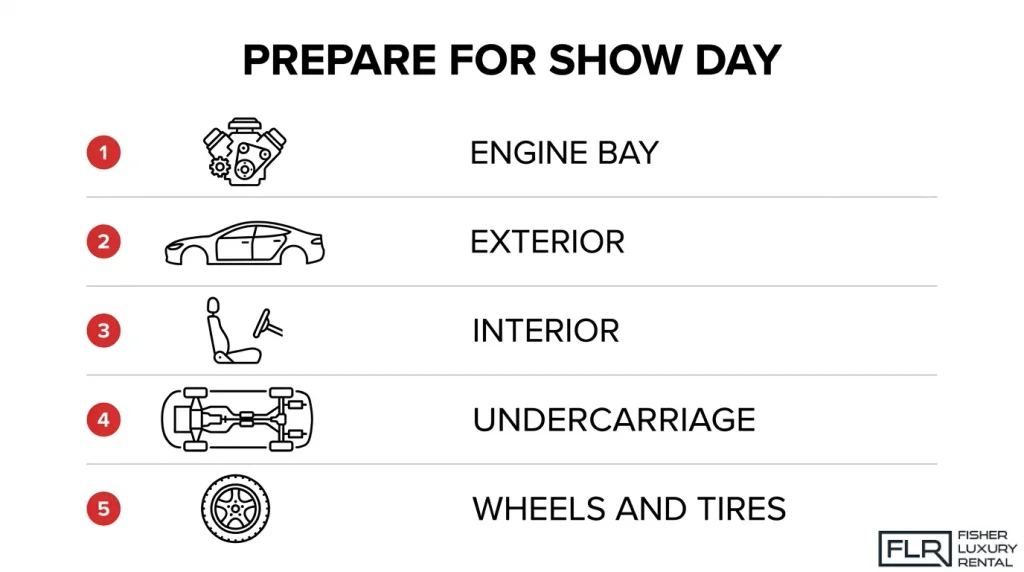
Pre-show detailing steps for winning entries involve hand cleaning every accessible surface to OEM standards, replacing worn parts with factory-correct components, and presenting the vehicle as it originally left the manufacturing plant. According to Peachstate Region, Porsche Club of America, Tour Class preparation means producing a near-perfect specimen regardless of the car’s current age or mileage.
Key areas requiring attention before a show include:
- Engine bay: Clean wiring, plastic components, metal surfaces, and the exhaust system.
- Exterior: Paint, bodywork, chrome, trim, and brightwork.
- Interior: Upholstery, dash, and all factory-fitted components.
- Undercarriage: Chassis cleanliness and originality.
- Wheels and tires: Correct period-spec fitment.
Every surface a judge can see, open, or reach is a scoring opportunity. Overlooking the undercarriage or wiring harness is one of the most costly preparation mistakes entrants make.
What Documentation Should You Bring to a Judged Show?
The documentation you should bring to a judged show includes your entry registration, build records, and any variance letters for non-standard components. According to the Model A Ford Club of America Judging Procedures (updated November 16, 2018), a variance documentation letter attached to the windshield placard, which confirms a component to be judged differently from the Guidelines, must carry the signature of the JSC chairman.
Essential documents to prepare include:
- Entry registration confirmation from the organizing club.
- Original factory build sheet or window sticker to support authenticity claims.
- Restoration records detailing parts sourcing and work performed.
- Variance documentation letter (JSC chairman-signed) for any non-conforming components.
What Common Mistakes Cause Point Deductions at Car Shows?
Common mistakes that cause point deductions at car shows include incorrect parts, cleanliness failures, and non-functional equipment. The Model A Restorers Club specifies that vehicles failing equipment functional checks receive a 25-point deduction for each failed item.
Frequent deduction triggers include:
- Non-working lights, wipers, or horn: Functional checks are scored separately from appearance.
- Incorrect or non-original parts without supporting variance documentation.
- Dirty or poorly detailed engine bay, exhaust, or undercarriage.
- Missing or incomplete windshield placard and documentation.
- Unsportsmanlike conduct: The Mustang Club of America’s 2018 Judging Etiquette Book states that unsportsmanlike conduct results in immediate disqualification, with the Head Judge’s decision being final.
Consistent point losses almost always come from avoidable oversights, not from major mechanical issues. A thorough pre-show checklist reviewed against the specific event’s scoring sheet is the most reliable preparation strategy.
What Disqualifications or Penalties Can Judges Issue?
Judges can issue penalties such as point deductions for non-functional equipment and disqualification for unsportsmanlike conduct. The sections below cover the two primary penalty types entrants face at sanctioned shows.
Point Deductions for Equipment Failures
Point deductions are the most common penalty judges issue at classic car shows. According to the Model A Restorers Club’s Touring Class guidelines, vehicles receive 25 points deducted from their total score for each functional equipment item that fails its check. These deductions accumulate quickly, making pre-show mechanical preparation just as important as cosmetic detailing. Entrants who skip a thorough operational check before the event often lose more points to failed functions than to cosmetic imperfections.
Disqualification for Conduct Violations
Disqualification is the most severe penalty a judge can issue, and it removes an entrant entirely from competition. The Mustang Club of America’s 2018 Judging Etiquette Book states directly that unsportsmanlike conduct results in disqualification, and that decisions by the Nation Head Judge are final. Conduct violations include arguing with judges, interfering with the judging process, or attempting to influence scoring improperly. Once a disqualification is issued, there is no appeal pathway available to the entrant.
Documentation Errors and Variance Penalties
Documentation errors can also trigger scoring consequences. Per the Model A Ford Club of America’s Judging Procedures, a variance documentation letter confirming a non-standard component must carry the JSC chairman’s signature to be valid. Without that signature, the component is judged against standard guidelines, which typically results in point deductions rather than disqualification.
How Do Judges Handle Replicas, Restomods, and Kit Cars?
Judges handle replicas, restomods, and kit cars by placing them in separate modified or specialty classifications rather than competing them against factory-original vehicles. Most sanctioning organizations maintain distinct class structures so each vehicle type is evaluated on its own merits.
How Are Replica and Kit Cars Classified at Judged Shows?
Replica and kit cars are classified outside standard antique or original classes because most rulebooks define an eligible antique motor vehicle as the actual manufactured unit, not a reproduction. Pennsylvania’s Department of Transportation defines an antique motor vehicle explicitly as “a motor vehicle, but not a reproduction thereof,” manufactured more than 25 years prior, maintained or restored to manufacturer specifications. Show organizers typically direct replicas into display, contemporary, or specialty classes where authenticity scoring does not apply.
How Do Judges Evaluate Restomods in Competition?
Restomods are evaluated in modified classifications, where judging criteria shift away from factory correctness toward build quality, fit and finish, and craftsmanship. The BMW Car Club of America’s Delaware Valley Chapter guidelines illustrate the boundary: vehicles with aftermarket wheels, exhausts, or steering wheels remain eligible for original classification, but anything beyond those modifications moves the entry into the modified class. Within that class, judges assess execution rather than period accuracy. From an expert standpoint, a well-built restomod judged in the right class often scores more consistently than a borderline-original car evaluated under strict authenticity rules.
What Documentation Helps Replica or Modified Entries at Car Shows?
Documentation helps replicate and modify entries by giving judges a verified reference for intentional deviations from standard guidelines. The Model A Ford Club of America requires that any variance documentation letter attached to the windshield placard carry the signature of the Judging Standards Committee chairman before judges will score that component differently from the published guidelines. Bringing build records, receipts, and manufacturer specs supports the entry’s classification and prevents unnecessary point deductions rooted in uncertainty.
With the right classification and paperwork in place, non-original entries can compete on equal footing within their designated class.
Why Does the Condition of a Classic Car Determine Its Value?
The condition of a classic car determines its value because originality, mechanical integrity, and presentation directly influence both show scores and collector market desirability. The following sections connect those judging standards to real-world investment outcomes and explore how Fisher Luxury Rental lets enthusiasts experience exceptional automotive craftsmanship firsthand.
Can Renting a Luxury or Exotic Car From Fisher Luxury Rental Fulfill Your Automotive Passion?
Yes, renting a luxury or exotic car from Fisher Luxury Rental can fulfill your automotive passion by placing you behind the wheel of meticulously maintained, top-trim luxury and exotic vehicles without the financial commitment of ownership. For enthusiasts captivated by classic car culture, the same principles that drive concours judges, such as precision engineering, immaculate presentation, and mechanical excellence, are built into every vehicle in Fisher Luxury Rental’s fleet. Fisher Luxury Rental serves Phoenix, Scottsdale, Portland, and Vancouver, WA, offering an accessible entry point into the world of extraordinary automobiles. The connection between appreciating show-quality standards and experiencing a premium rental is more direct than most enthusiasts realize.
What Are the Key Takeaways About Classic Car Show Judging Standards and Official Guidelines?
The key takeaways about classic car show judging standards and official guidelines are that condition, originality, and documentation govern every competitive outcome. According to the Antique Automobile Club of America’s 2026 Official Judging Guidelines, all vehicles begin with 400 points, and judges deduct any deviation from accepted standards. The Pontiac-Oakland Club International’s 2026 Official Judging Manual uses popular-vote balloting, where each registered participant casts one vote per class, illustrating that judging formats vary significantly across organizations. Across all formats, the core lesson is consistent: factory correctness and meticulous preparation separate award-winners from participants. Understanding these standards deepens appreciation for the craftsmanship that defines both concours champions and exceptional modern exotics.