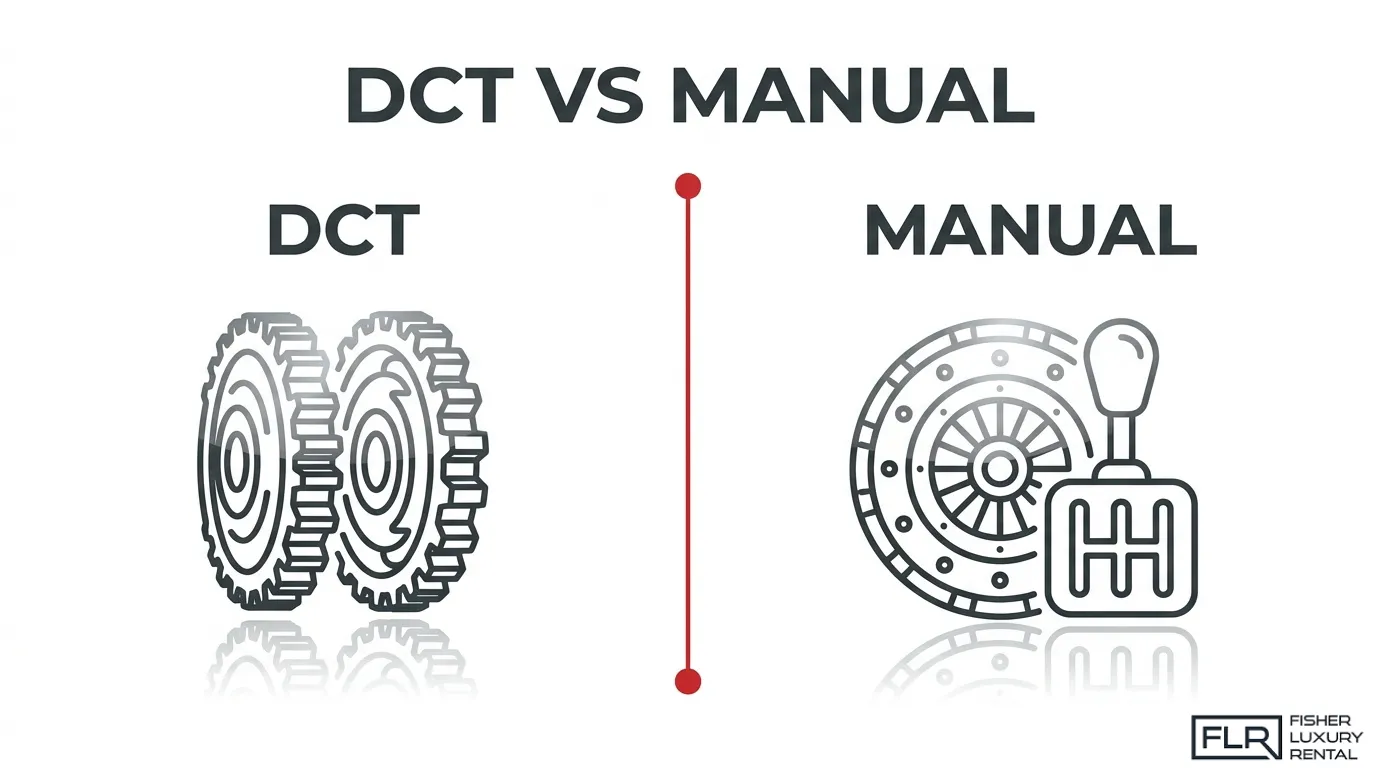
A dual-clutch transmission (DCT) is an automated gearbox that uses two parallel clutches to pre-select gears, enabling shifts measured in milliseconds. A manual gearbox is a driver-operated system where a single clutch, a gear lever, and a clutch pedal give the driver complete mechanical control over every ratio change.
This guide covers how each transmission works internally, how they compare in real-world driving conditions, their respective strengths and weaknesses, how maintenance costs differ, and which transmission suits each driving style.
DCTs and manuals are built around fundamentally different clutch architectures. A DCT splits odd and even gears across two separate clutches operating in parallel, while a manual uses one clutch disc the driver engages and disengages manually with a foot pedal. That mechanical difference shapes everything from shift speed to pedal layout.
In everyday drivability and performance, the two transmissions behave differently across city traffic, highway cruising, and track driving. DCTs deliver seamless automatic shifts and strong fuel efficiency in modern tuning, while manuals require constant driver coordination but reward it with physical feedback no automated system replicates.
The pros and cons of each transmission reflect that divide: DCTs excel at speed, convenience, and efficiency, but carry higher repair costs and a documented history of low-speed shudder. Manuals offer lower running costs, simpler mechanics, and a tactile driving experience, but impose slower shift times and growing scarcity in new vehicle production.
Supercar and sports car availability now sits firmly on the DCT side, with manual options narrowing to a handful of enthusiast-focused models, making real-world experience with both transmissions more valuable than ever. Fisher Luxury Rental, based in Phoenix and Portland, provides access to exotic and luxury vehicles that let drivers experience high-performance transmissions firsthand, a practical way to inform a major purchase decision.
What Is a Dual-Clutch Transmission and How Does It Work?
A dual-clutch transmission (DCT) is an automated gearbox that uses two separate clutches to pre-select gears, enabling faster and smoother shifts than a traditional manual. The sections below cover its internal gear structure, clutch operation, and how electronic control systems manage the shifting process.
How Is a DCT Structured Internally?
A DCT is structured around two independent gear trains and clutches operating in parallel. According to NHTSA documentation on the 7-speed Double-Clutch Transmission 0AM, odd gears (1, 3, 5, and 7) are controlled by clutch K1 through gear train half 1, while even gears (2, 4, 6, and reverse) are actuated by clutch K2 through gear train halves 2 and 3. This parallel architecture is what allows the next gear to be pre-loaded before the current one disengages, eliminating the power interruption typical of a manual shift.
How Do the Two Clutches Work Together?
The two clutches in a DCT work by alternating engagement and disengagement to transfer drive seamlessly between gear sets. One clutch handles the active gear while the other pre-engages the next predicted gear. Research published in the International Journal of Automotive Technology shows that coordinated control of an electric oil pump and two proportional solenoid valves regulates hydraulic pressure, allowing precise engagement and disengagement on both the engine and motor sides of the drivetrain. This hydraulic precision is what separates a DCT from a basic automated manual.
What Role Does Electronic Control Play in a DCT?
Electronic control plays a central role in a DCT by managing shift timing, clutch pressure, and gear selection without driver input. The transmission control unit continuously monitors vehicle speed, throttle position, and load to determine the optimal shift point. A mathematical model developed at Ohio State University on wet dual-clutch transmissions confirms that engine dynamics, hydraulic actuation, and mechanical components must all be modeled together to accurately predict DCT behavior. In practice, this means the system responds faster and more consistently than any human driver could achieve manually.
What Is a Manual Gearbox and How Does It Work?
A manual gearbox is a transmission system that requires the driver to manually select and engage gear ratios using a hand-operated shift lever and a foot-operated clutch pedal. It remains one of the most mechanically direct ways to connect engine power to the wheels. The sections below cover the core components, the clutch engagement process, and how gear changes occur.
What Are the Core Components of a Manual Gearbox?
The core components of a manual gearbox are the clutch assembly, gear train, shift lever, and output shaft. The clutch assembly includes a flywheel, pressure plate, and clutch disc. According to a U.S. Department of Defense technical manual, a foot-operated clutch engages and disengages the engine and transaxle, while a hand-operated shift lever allows the driver to change gear ratios. These components work together as a mechanical chain: the driver controls each link manually, with no electronic intervention between input and output.
How Does the Clutch Engage and Disengage in a Manual?
The clutch engages and disengages by pressing or releasing the clutch pedal, which controls contact between the flywheel and clutch disc. When the pedal is depressed, the flywheel and pressure plate spin with the engine while the clutch disc, connected to the transmission main shaft, remains stationary. Releasing the pedal causes the pressure plate to clamp the clutch disc against the flywheel, transferring engine torque to the drivetrain. This friction-based engagement is precise but demands consistent technique, particularly during low-speed maneuvers.
How Does a Driver Change Gears in a Manual Gearbox?
A driver changes gears in a manual gearbox by depressing the clutch pedal to interrupt torque flow, moving the shift lever into the desired gear position, then releasing the clutch smoothly to re-engage drive. An Ohio State University study measured manual shift duration at between 0.5 and 1.4 seconds, averaging 0.836 seconds. Each shift requires the driver to coordinate three inputs simultaneously: throttle, clutch, and gear selection. This process gives the driver granular control over power delivery, which is central to the manual gearbox’s enduring appeal among driving enthusiasts.
What Are the Key Mechanical Differences Between a DCT and a Manual?
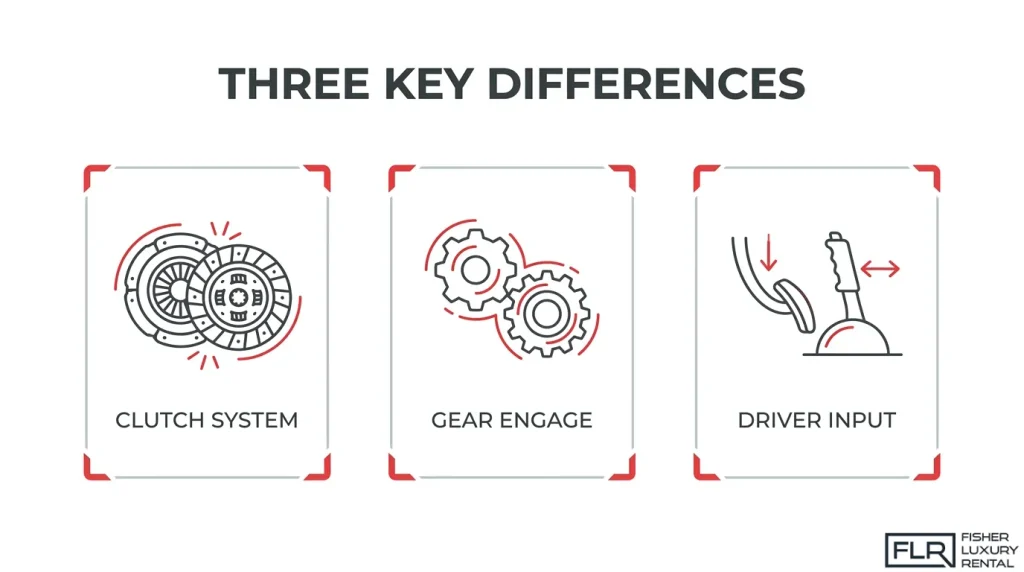
The key mechanical differences between a DCT and a manual gearbox involve the clutch architecture, gear engagement method, and driver input requirements. The sections below cover how clutch systems compare, how gear engagement works in each transmission, and what drivers physically operate in each case.
How Do the Clutch Systems Differ in a DCT vs a Manual?
The clutch systems differ in that a DCT uses two separate clutches operating in parallel, while a manual uses a single clutch controlled entirely by the driver’s left foot. In a DCT, one clutch handles odd gears and the other handles even gears, allowing the next gear to pre-engage before the shift occurs. A manual’s single clutch disc connects and disconnects the engine from the gearbox only when the driver depresses the clutch pedal. According to SAE International, the Lamborghini Huracan’s DCT is a seven-speed unit controlled by steering column-mounted paddles, replacing the older Gallardo’s automated manual as the high-performance automatic-shifting option.
How Does Gear Engagement Differ Between a DCT and a Manual?
Gear engagement differs in that a DCT pre-selects the next gear on its inactive clutch while the current gear remains in drive, whereas a manual requires the driver to fully disengage the clutch, select a gear by hand, and re-engage before drive resumes. Research from Ohio State University found that manual shift duration averaged 0.836 seconds, ranging from 0.5 to 1.4 seconds. A DCT manages engagement through an electric oil pump and proportional solenoid valves that regulate hydraulic pressure precisely. However, fluid leaks in 7-speed DCT units can cause pressure loss and interrupt power transmission entirely, a reliability risk absent from mechanical manual systems.
How Do the Pedal Layouts and Driver Inputs Compare?
The pedal layouts differ in that a manual gearbox requires three pedals (clutch, brake, and throttle) plus a hand-operated gear lever, while a DCT requires only two pedals (brake and throttle) with gear selection handled automatically or via paddle shifters. According to the U.S. Department of Defense, in a manual transmission a foot-operated clutch engages and disengages the drivetrain while a hand-operated shift lever changes gear ratios. A DCT removes both of those driver responsibilities entirely. For drivers accustomed to full mechanical control, this represents a fundamental change in how engagement with the vehicle is experienced.
Which Shifts Faster — a DCT or a Manual Gearbox?
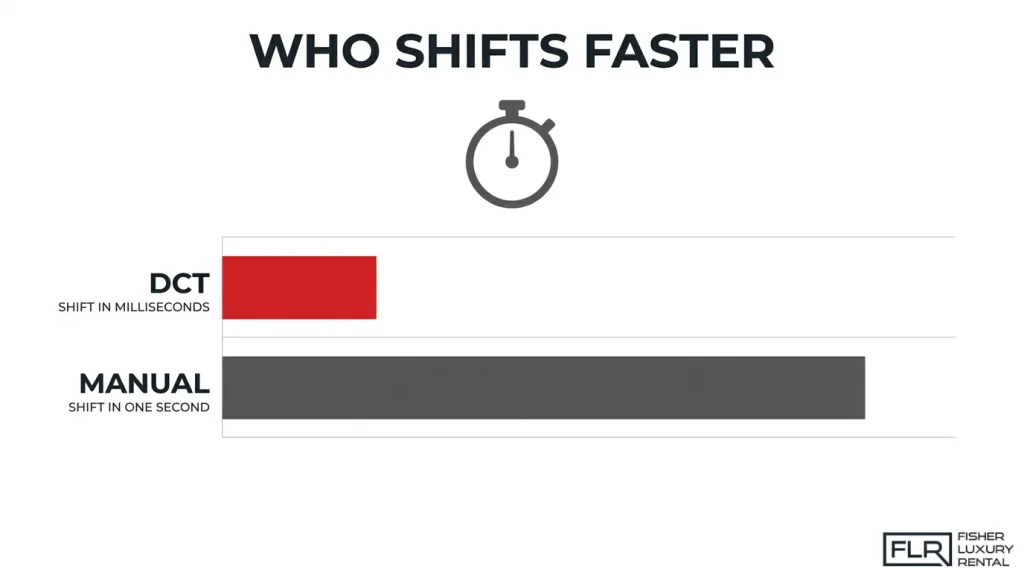
A DCT shifts faster than a manual gearbox in every measurable condition. By pre-selecting the next gear on its second clutch, a DCT executes gear changes in milliseconds, while a skilled human driver takes considerably longer to complete the same task.
Research from Ohio State University measured manual shift duration at between 0.5 and 1.4 seconds, averaging 0.836 seconds. A DCT’s electro-hydraulic actuation completes the same change in a fraction of that window, with no interruption in power delivery. The gap is not marginal; it is structural, because no human hand and foot can match a computer-controlled clutch swap happening simultaneously on two parallel gear trains.
For drivers who prioritize outright acceleration and lap times, this speed advantage is decisive. The manual’s slower shifts are not a flaw in execution but a physical ceiling imposed by human reaction time. For enthusiasts who want to feel that DCT speed advantage before buying, renting an exotic car through a company like Fisher Luxury Rental offers a low-commitment way to experience it on real roads.
How Does a DCT Compare to a Manual in Everyday Drivability?
A DCT and a manual gearbox feel noticeably different in everyday driving, particularly in stop-and-go traffic and on the highway. The sections below compare each transmission across these two real-world conditions.
How Does a DCT Perform in Stop-and-Go Traffic?
A DCT performs smoothly in stop-and-go traffic at moderate speeds but can feel hesitant or jerky at very low speeds. Because the DCT pre-selects the next gear automatically, it manages repeated acceleration and deceleration efficiently without driver input. However, wet DCTs managing cold oil and dry DCTs handling slow creep conditions are both prone to shudder and abrupt engagement at low speeds, which some drivers find unsettling in heavy traffic. For commuters who prioritize convenience over tactile feedback, a DCT still outperforms a manual in this environment.
How Does a Manual Perform in Stop-and-Go Traffic?
A manual performs in stop-and-go traffic, but it demands constant clutch, throttle, and gear coordination from the driver. Repeated clutch engagement in dense traffic accelerates wear on the clutch disc and generates additional heat in the friction materials. Riding the clutch to control crawling speed, a common reflex in slow traffic, increases wear further. For drivers accustomed to the technique, a manual remains manageable, but it is objectively more fatiguing than a DCT in prolonged urban stop-and-go conditions.
How Does a DCT Feel on Highway Cruising?
A DCT feels refined and effortless on highway cruising. Gear changes are executed automatically at optimal rev points, keeping the engine in its most efficient power band without driver intervention. The absence of a clutch pedal and the seamless upshifts make long-distance highway driving genuinely relaxed. For performance-oriented vehicles, the DCT can also execute rapid downshifts when overtaking without the delay of a manual clutch cycle.
How Does a Manual Feel on Highway Cruising?
A manual feels engaging but less economical on highway cruising. According to data from the U.S. Department of Transportation, manual transmissions deliver only a 2.8% average fuel economy improvement over the EPA Highway Cycle, the smallest of the three drive cycles measured. On sustained highway runs, the manual requires fewer gear changes than in urban driving, reducing fatigue considerably, and many drivers appreciate the direct connection The pros of a manual gearbox include direct driver control, lower purchase cost, and simpler mechanical design. The cons include slower shift times, demanding stop-and-go driving, and declining model availability. The following sections cover driver engagement, cost, reliability, performance drawbacks, and convenience drawbacks.
to the powertrain. That said, the fuel economy advantage over modern DCTs is slim on the highway, making driver preference the real deciding factor at speed.
What Are the Pros and Cons of a DCT?
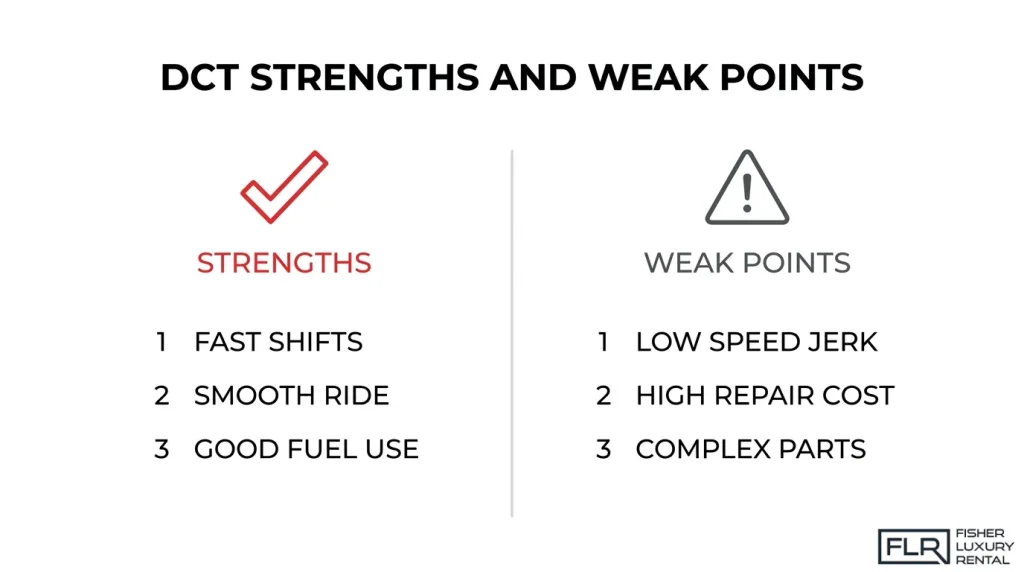
The pros of a DCT include rapid gear changes, strong fuel efficiency, and a smooth driving experience, while the cons center on low-speed hesitation and higher repair costs. The H3s below cover performance, efficiency, comfort, low-speed drawbacks, and maintenance costs.
What Are the Performance Advantages of a DCT?
The performance advantages of a DCT are faster gear changes, uninterrupted power delivery, and stronger acceleration compared to a manual. Because the next gear is pre-selected on the second clutch, shifts execute in milliseconds with no torque interruption. This gives DCT-equipped vehicles a measurable edge during hard acceleration, where every fraction of a second counts. For drivers who prioritize outright speed over tactile involvement, a DCT is difficult to beat.
What Are the Fuel Efficiency Benefits of a DCT?
The fuel efficiency benefits of a DCT come from its ability to select optimal gear ratios automatically and execute shifts without power loss. According to the International Council on Clean Transportation, automated manual transmissions, which share the core pre-selection logic of DCTs, reached 28% market penetration in U.S. tractor trucks by 2015, driven largely by measurable fuel savings over conventional manuals. In passenger cars, the same principle applies: fewer inefficient rev hangs during shifts means less wasted fuel across a full drive cycle.
What Are the Comfort and Convenience Advantages of a DCT?
The comfort and convenience advantages of a DCT are seamless automatic operation, no clutch pedal, and smooth progress in both city and highway driving. Drivers can stay fully focused on traffic without managing gear selection manually. In sport modes, paddle shifters restore driver control without adding physical effort. This combination of ease and responsiveness makes the DCT particularly well-suited to long-distance motorway driving and dense urban commutes alike.
What Are the Drawbacks of a DCT at Low Speeds?
The drawbacks of a DCT at low speeds are clutch shudder, hesitation, and jerky engagement during slow maneuvers such as parking or crawling in traffic. Research from the Proceedings of the 9th International Modelica Conference found that cold clutch pull-away events produce jerk 2.5 times higher than with a warm clutch, making the first few minutes of driving noticeably rough. At low oil temperatures, the clutch control system struggles to modulate engagement smoothly, which is the DCT’s most consistent real-world weakness.
What Are the Maintenance and Repair Cost Drawbacks of a DCT?
The maintenance and repair cost drawbacks of a DCT are complex mechatronic components, expensive clutch pack replacements, and a documented history of reliability issues across several mainstream models. The Australian Competition and Consumer Commission found that 37% of Ford vehicles fitted with a dual-clutch PowerShift transmission required at least one clutch replacement, with complaints including shudder, jerking, and delayed acceleration. Fluid leaks can also cause pressure loss that interrupts power transmission entirely. Compared to a manual gearbox, DCT repairs typically require specialist knowledge and carry significantly higher parts and labor costs.
What Are the Pros and Cons of a Manual Gearbox?
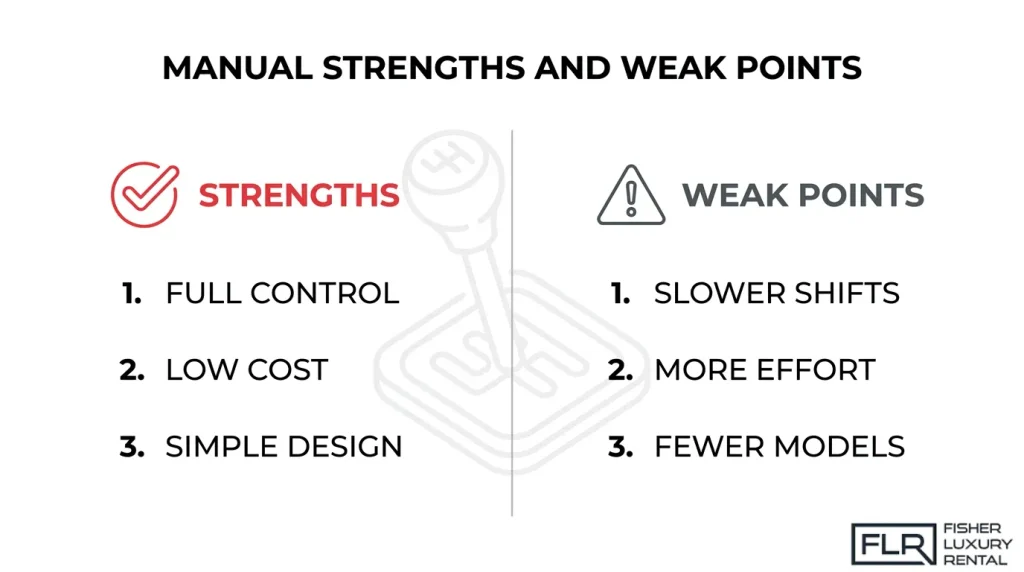
The pros of a manual gearbox include direct driver control, lower purchase cost, and simpler mechanical design. The cons include slower shift times, demanding stop-and-go driving, and declining model availability. The following sections cover driver engagement, cost, reliability, performance drawbacks, and convenience drawbacks.
What Are the Driver Engagement Advantages of a Manual?
The driver engagement advantages of a manual gearbox center on complete, tactile control over every gear change. The driver personally selects ratios, modulates clutch bite, and feels the mechanical connection between engine and wheels in a way no automated system replicates. For enthusiasts, this physical involvement is the defining appeal: heel-and-toe downshifts, rev-matched entries into corners, and the satisfaction of a perfectly executed upshift are experiences unique to the manual format. That sense of mastery is difficult to quantify but easy to feel, making it the strongest argument for choosing a manual in a sports or exotic car.
What Are the Cost and Simplicity Advantages of a Manual?
The cost and simplicity advantages of a manual gearbox stem from fewer components and a straightforward mechanical layout. A manual transmission contains no complex hydraulic circuits, no mechatronic units, and no dual-clutch assemblies, which means both the purchase price and the cost of repairs stay lower than comparable automated options. The simpler design also makes the transmission easier for technicians to diagnose and service, reducing labor time. For buyers prioritizing long-term affordability without sacrificing mechanical character, the manual remains the most cost-effective gearbox choice.
What Are the Reliability and Maintenance Advantages of a Manual?
The reliability and maintenance advantages of a manual gearbox come from its mechanical simplicity and the driver’s direct control over clutch engagement. Because there are no solenoid valves, hydraulic pumps, or dual-clutch packs to manage, the failure modes are fewer and better understood. Clutch wear is gradual and predictable, and replacement is a well-established repair at most independent workshops. In contrast, the Australian Competition and Consumer Commission found that 37% of Ford vehicles fitted with a PowerShift dual-clutch transmission required at least one clutch replacement under complaint conditions. For drivers who value predictable, low-drama ownership, manual transmissions carry a meaningful durability advantage.
What Are the Drawbacks of a Manual in Performance?
The drawbacks of a manual in performance primarily involve shift speed and consistency. Research from The Ohio State University measured human manual shift duration at between 0.5 and 1.4 seconds, averaging 0.836 seconds, a window during which power delivery is interrupted and vehicle momentum is lost. A skilled driver can minimize this gap, but even expert technique cannot match the millisecond-range shift speeds achievable by automated systems. On a track, those fractions of a second accumulate across dozens of shifts per lap. This makes the manual a less competitive choice in applications where outright acceleration and lap time are the primary objectives.
What Are the Drawbacks of a Manual in Convenience?
The drawbacks of a manual in convenience are most apparent in urban traffic and declining model availability. Constant clutch engagement in stop-and-go conditions increases driver fatigue and accelerates clutch disc wear over time, particularly on steep inclines where repeated hill starts demand precise throttle and clutch coordination. Beyond daily usability, the U.S. EPA’s Automotive Trends Report confirms that manual transmissions have fallen below 1% of all U.S. vehicle production since model year 2021, leaving buyers with very few new-vehicle options outside small cars, sports cars, and select off-road trucks. For most drivers, these practical limitations outweigh the engagement benefits in everyday use.
How Do DCT and Manual Gearboxes Compare in Fuel Efficiency?
DCT and manual gearboxes compare in fuel efficiency differently depending on the model year. Historically, manuals held a slight advantage, but modern automatic and DCT technology has closed that gap entirely.
How Has Fuel Efficiency Changed Between DCT and Manual Over Time?
The fuel efficiency relationship between DCT and manual gearboxes has shifted decisively in favor of modern automatics. According to the U.S. Department of Energy, beginning with model year 2016, improvements in automatic transmission efficiency made them more fuel efficient than manual transmissions. DCTs contributed heavily to this shift, using their pre-selected gear logic to minimize power interruption and reduce engine load during shifts. For drivers choosing between the two today, assuming a newer vehicle, a DCT is likely to deliver equal or better real-world fuel economy than its manual equivalent, making the old argument for manual efficiency largely obsolete in current model lineups.
How Do Maintenance Costs Compare Between a DCT and a Manual?
Maintenance costs differ significantly between a DCT and a manual gearbox, with the DCT carrying higher long-term service expenses due to its mechatronic complexity. The sections below cover clutch replacement costs, fluid servicing requirements, and the manual’s simpler, more affordable upkeep profile.
How Much Does DCT Maintenance Typically Cost?
DCT maintenance typically costs more than manual servicing because the transmission contains two clutch packs, solenoid valves, hydraulic actuators, and proprietary control software. Each component adds a potential failure point and a specialized labor requirement. The Australian Competition and Consumer Commission documented that 37% of Ford vehicles fitted with the PowerShift dry DCT required at least one clutch replacement, illustrating how clutch wear in a DCT can generate significant unexpected repair costs. Fluid changes alone require specific dual-clutch fluid and intervals more frequent than most drivers anticipate. From a long-term ownership perspective, DCT repairs are rarely inexpensive and often require dealer-level diagnostics.
How Much Does Manual Gearbox Maintenance Typically Cost?
Manual gearbox maintenance typically costs less because the transmission relies on a single clutch disc, pressure plate, flywheel, and a simple shift linkage with no electronic actuation. Clutch replacement on a manual is a well-understood procedure at independent shops, keeping labor rates competitive. Gearbox oil changes are infrequent and use widely available gear oil. There are no solenoids, no hydraulic pressure circuits, and no software calibrations to budget for. For drivers who prioritize low running costs over convenience, the manual gearbox remains the more economical choice over the vehicle’s lifetime.
With repair costs clearly favoring the manual, the next question is which transmission delivers a more rewarding experience when driving with intent.
Which Transmission Is Better for Spirited Driving?
For spirited driving, neither transmission is universally better: the DCT dominates on track where lap times and shift precision matter, while the manual delivers an irreplaceable sense of connection for drivers who want to feel every gear change.
How Does a DCT Enhance the Track Day Experience?
A DCT enhances the track day experience by eliminating power interruption between gears, keeping the engine in its optimal power band through every corner exit and straight. Paddle-mounted controls, as found in the Lamborghini Huracán’s seven-speed DCT, let drivers shift without removing hands from the wheel. According to SAE International, the Huracán’s DCT uses steering column-mounted paddles, replacing the Gallardo’s older automated manual as its performance gearbox option. On track, this translates to faster, more consistent lap times. The DCT also pre-selects the next gear, so the shift executes the instant the driver commands it, with no hesitation from clutch depression or hand movement.
How Does a Manual Enhance the Enthusiast Driving Experience?
A manual enhances the enthusiast driving experience by keeping the driver physically involved in every gear selection, creating a visceral feedback loop that no automated system replicates. The heel-toe downshift, the clutch bite point, the throttle blip before a corner: these are skills that reward practice and define the purist driving experience. An Ohio State University study found manual shift duration averaged 0.836 seconds per change, a window that forces the driver to plan ahead and read the road actively. That cognitive engagement is precisely the point. For drivers who measure enjoyment in involvement rather than lap time, a manual remains the more emotionally satisfying choice, even if a DCT is the faster tool.
Which Supercars and Sports Cars Use a DCT vs a Manual?
Supercars and sports cars split between DCT and manual transmissions depending on the manufacturer’s performance philosophy, with some iconic models offering both. The sections below cover which cars use each gearbox type and how availability has shifted over time.
Which Supercars Use a DCT?
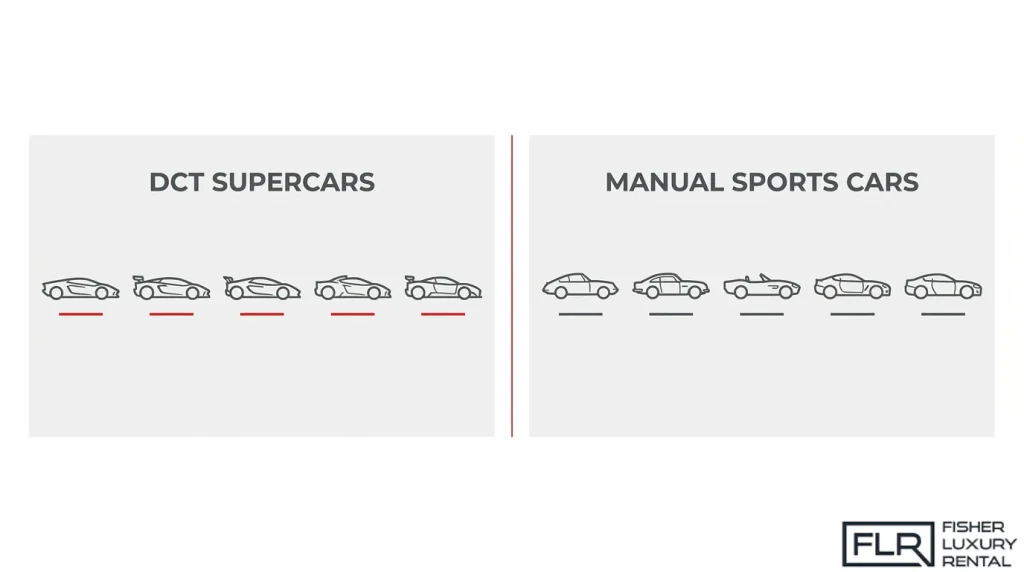
The supercars that use a DCT include the Lamborghini Huracán, Ferrari 488, McLaren 720S, Porsche 911 Turbo S, and Audi R8. These models use DCTs because lightning-fast, uninterrupted shifts directly support their high-output engines and track-oriented engineering. According to SAE International, the Huracán uses a seven-speed DCT controlled by steering column-mounted paddles, replacing the older Gallardo’s automated manual gearbox. Ferrari, McLaren, and most modern mid-engine supercars followed the same path, pairing DCTs with paddle shifters to maximize acceleration performance. For this class of car, DCT is the clear default.
Which Sports Cars Still Offer a Manual Gearbox?
The sports cars that still offer a manual gearbox include the Porsche 911 Carrera T, Porsche 911 GT3, Mazda MX-5 Miata, Toyota GR86, Subaru BRZ, and Honda Civic Type R. Manual availability has narrowed sharply across the industry. According to the U.S. Environmental Protection Agency’s Automotive Trends Report, manual transmissions fell from nearly 35% of new vehicles in model year 1980 to below 1% of all production by model year 2021. Today they survive mainly in sports cars, a handful of off-road SUVs, and small pickups. Porsche’s commitment to the manual in driver-focused trims like the GT3 reflects genuine enthusiast demand, not just tradition.
How Has Manual Transmission Availability Changed in Supercars?
Manual transmission availability in supercars has declined dramatically, with most manufacturers phasing them out entirely in favor of DCTs over the past two decades. Ferrari no longer offers a manual in any current production model. Lamborghini replaced the Gallardo’s optional manual with the Huracán’s standard DCT. Even Porsche, the most manual-friendly supercar brand, has for 2025 limited manual availability to just the Carrera T and GT3. The shift reflects both performance priorities and production economics. Buyers who want a rowing stick in a high-performance machine now have a very short list to choose from, which makes those remaining manual options more collectible and emotionally significant than ever.
Is a DCT or Manual Better for Your Driving Style?
The better transmission depends on your driving style: performance drivers gain the most from a DCT’s rapid shifts, commuters benefit from its ease in traffic, and purists often prefer the tactile engagement of a manual. The sections below break down each driver profile.
Which Transmission Suits a Performance-Focused Driver?
A performance-focused driver is best suited to a DCT in most objective measures. The DCT pre-selects the next gear before the shift occurs, eliminating the power interruption inherent to a manual clutch engagement. According to research published in Polymers (PMC), when the clutch pedal is depressed, the flywheel and pressure plate rotate at engine speed while the clutch disc remains stationary, meaning every manual upshift briefly disconnects drive to the wheels. A DCT bypasses this entirely, keeping acceleration continuous through gear changes.
That said, many performance drivers still choose a manual for certain track applications where feel and adjustability matter more than raw shift speed.
Which Transmission Suits a Daily Commuter?
A daily commuter is best suited to a DCT. In dense urban traffic, the manual’s repeated clutch engagement and gear selection becomes fatiguing, while a DCT handles low-speed stop-and-go automatically. The DCT also removes the risk of stalling, hill starts require no clutch-balance technique, and modern units operate seamlessly in city conditions. Fuel efficiency is comparable or better than a manual in real-world mixed driving.
Which Transmission Suits a Purist Car Enthusiast?
A purist car enthusiast is best suited to a manual gearbox. The manual delivers a physical, three-pedal connection between driver and machine that no automated system replicates. Selecting gears by hand, modulating clutch bite, and rev-matching on downshifts are skills that define the purist experience. The Porsche Club of America notes that for 2025, Porsche limited manual availability in the 911 lineup to just the Carrera T and GT3, confirming that manuals now carry genuine rarity and desirability among enthusiasts.
For purists, the manual is not a compromise; it is the point.
How Can You Experience Both Transmissions in a Luxury Car?
Experiencing both a DCT and a manual gearbox firsthand is the most reliable way to decide which suits your driving style. The sections below cover how exotic car rentals enable that comparison and summarize the key takeaways from the DCT vs manual debate.
Can Renting an Exotic Car Help You Compare DCT and Manual?
Yes, renting an exotic car can help you compare DCT and manual transmissions directly, without the commitment of ownership. Fisher Luxury Rental offers access to high-performance vehicles across its Phoenix and Portland locations, letting drivers experience exotic and luxury cars firsthand before committing to ownership.
A University of Maryland study found that direct product experience consistently produces stronger, more confident preferences than reading reviews alone. Driving both transmissions on the same roads, in the same conditions, eliminates guesswork that spec sheets cannot resolve. For 2025, Porsche limits manual availability to just two 911 models, the Carrera T and the GT3, making rental access increasingly valuable for enthusiasts who want to drive one before they buy.
What Are the Key Takeaways About DCT vs Manual Gearbox?
The key takeaways about DCT vs manual gearbox center on matching transmission type to driving purpose. Neither is universally superior; each excels in specific contexts.
- DCT strengths: Faster gear changes, smoother highway cruising, and strong fuel efficiency in modern tuning.
- Manual strengths: Greater driver engagement, simpler mechanical design, lower long-term repair costs.
- Reliability: DCTs carry more complexity and documented failure modes, including fluid leaks and clutch shudder, while manuals remain mechanically straightforward.
- Availability: Manual transmissions represent below 1% of U.S. production since 2021, making real-world access increasingly rare.
- Best approach: Drive both before deciding — rental access removes the risk of an expensive commitment to the wrong transmission.
Fisher Luxury Rental makes that decision easier by putting both transmission experiences within reach.