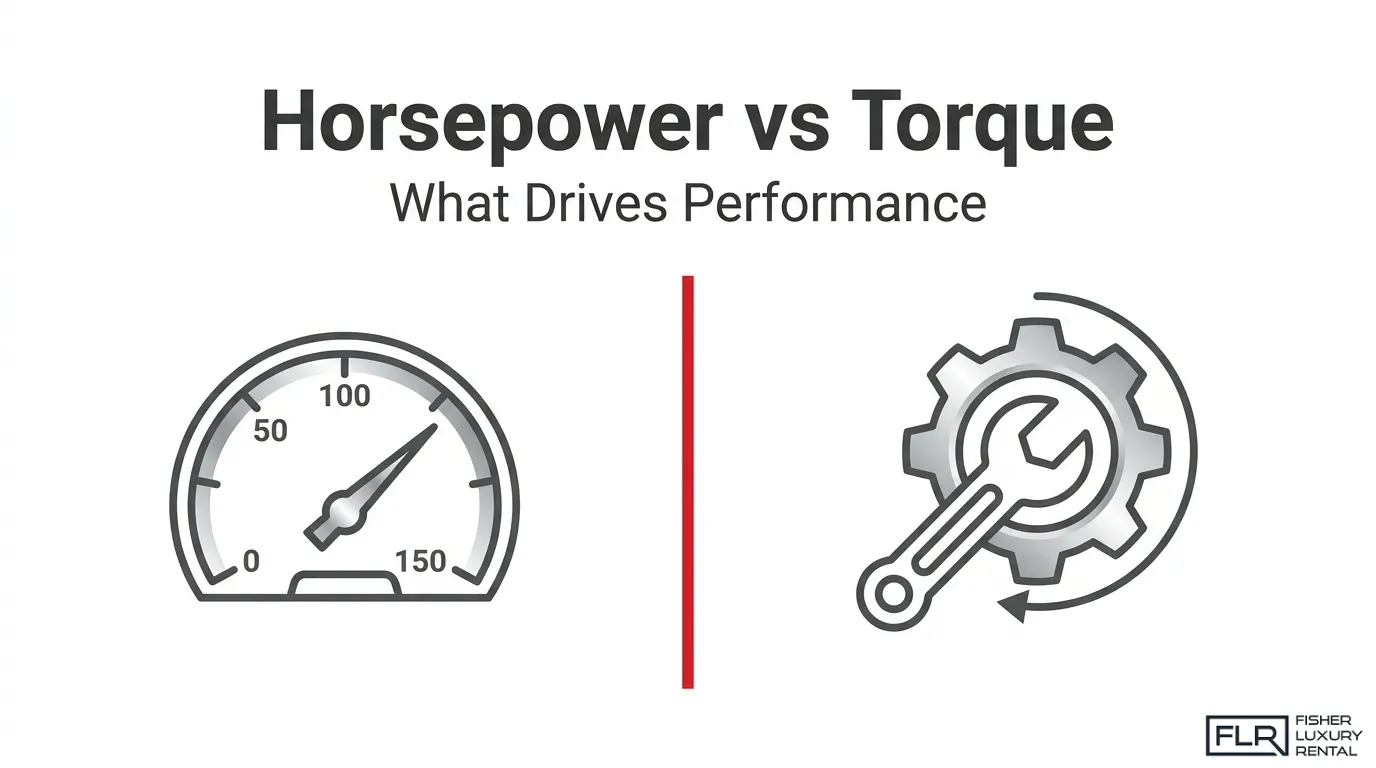
Horsepower and torque are the two fundamental metrics that define how a vehicle performs. Horsepower measures the rate at which an engine sustains work over time, while torque measures the rotational force it applies to move a vehicle in the first place.
This guide covers what each metric means and how they relate, how both shape real-world driving, how different engine types deliver them, and what they mean for high-performance and exotic vehicles.
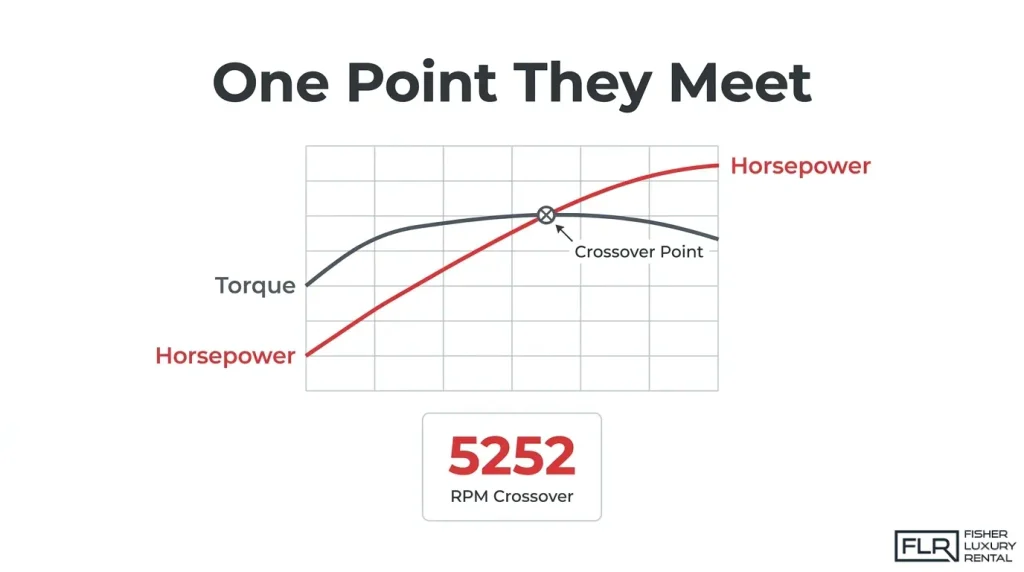
Horsepower and torque share a fixed mathematical relationship: HP = (Torque × RPM) ÷ 5,252. Their curves always cross at exactly 5,252 RPM on a dyno chart, and neither figure exists independently of the other. Understanding this formula clarifies why two engines with identical peak horsepower can feel completely different to drive.
Torque governs the physical sensations drivers feel most often: the push into the seat at a stoplight, the confidence pulling a loaded trailer up a grade, and the immediacy of an off-the-line launch. Horsepower takes over at higher speeds, determining how long and how hard acceleration continues past the point where torque alone runs out.
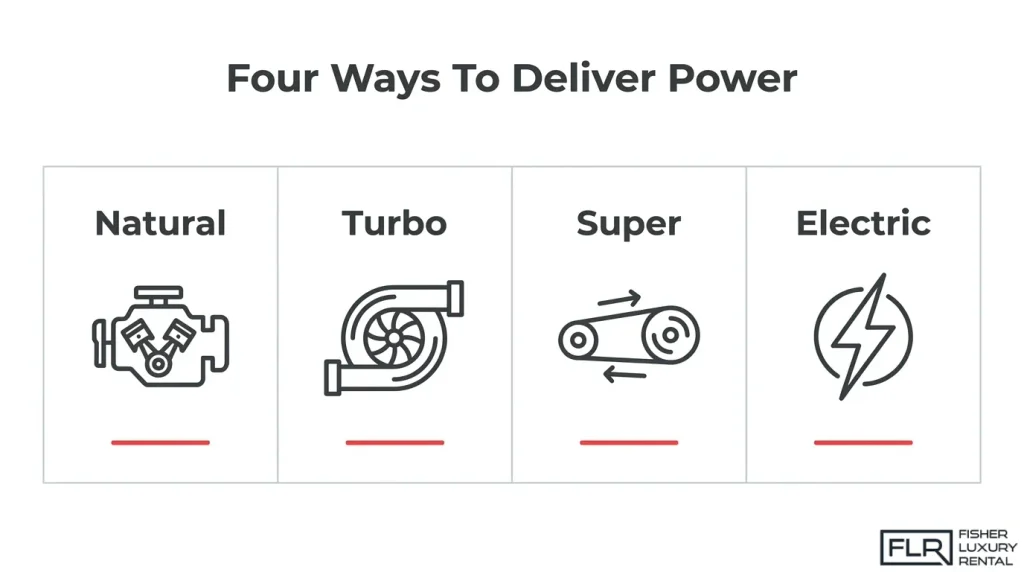
Engine architecture shapes how these forces are delivered. Naturally aspirated engines build both figures progressively through the rev range, turbocharged engines front-load torque at lower RPMs, supercharged engines produce strong linear output across a wide band, and electric motors deliver peak torque from 0 RPM with no buildup required.
For exotic and supercar applications, both peak horsepower and broad torque delivery define the difference between a fast car and a genuinely unforgettable one. Machines like the McLaren 750S and Lamborghini Revuelto are built to optimize both curves together rather than sacrifice one for the other. Fisher Luxury Rental’s fleet in Phoenix and Portland includes exotic vehicles where these performance principles play out in real-world driving, offering enthusiasts a firsthand way to feel how horsepower and torque interact beyond the spec sheet.
What Is Horsepower?
Horsepower is a unit of power that measures how much work an engine can perform over time. James Watt coined the term while developing the steam engine, describing output in terms of how many horses his machines could replace. The subsections below cover horsepower’s precise definition, its standard measurement value, and how it is officially certified for modern vehicles.
What Does Horsepower Measure?
Horsepower measures an engine’s rate of work output. According to the Federal Aviation Administration’s Airplane Flying Handbook Glossary, one horsepower equals 550 foot-pounds per second, or 33,000 foot-pounds per minute. In practical terms, a higher horsepower rating means the engine can sustain greater work output continuously, not just in brief bursts. This distinction matters most at sustained speeds, where maintaining momentum requires constant power delivery rather than a single forceful push.
How Did Horsepower Originate as a Unit?
Horsepower originated with James Watt during his work on the steam engine. Because his engines replaced horses as a primary power source, Watt described their output in terms of equivalent horse labor, giving buyers a familiar reference point. The National MagLab notes that Watt developed this concept specifically to communicate engine capability in relatable terms. It was a brilliant marketing and engineering decision that has endured for over two centuries.
How Is Horsepower Officially Measured and Certified?
Horsepower is officially measured using a dynamometer, which records torque and rotational speed. Power is then calculated as a product of those two measurements rather than measured directly. SAE International’s Engine Power Test Code J1349 provides the standardized method for obtaining repeatable, accurate engine performance measurements that reflect true real-world output.
What Is Torque?
Torque is the rotational or twisting force an engine applies to its crankshaft. According to the National Institute of Standards and Technology, torque shares the same physical dimension as energy but is measured in foot-pounds (lb-ft) or newton-meters (Nm) rather than joules, because it expresses force applied at a rotational distance rather than energy transferred. In practical terms, torque is what you feel pushing you back into your seat the moment you press the accelerator. The sub-sections below cover how torque is produced, how it is measured, and why it matters for everyday driving.
How Are Horsepower and Torque Related?
Horsepower and torque are mathematically linked: one cannot exist without the other on a running engine. The two H3s below cover the exact formula connecting them and the specific RPM point where their curves intersect on a dyno chart.
What Is the Mathematical Formula Linking Horsepower and Torque?
The mathematical formula linking horsepower and torque is: HP = (Torque × RPM) ÷ 5,252. To find power output at any engine speed, multiply torque in lb-ft by the RPM at which that torque is produced, then divide by 5,252. The constant 5,252 derives from the definition of one horsepower as 33,000 foot-pounds per minute, combined with the mathematical conversion of RPM into radians per second. Understanding this formula makes clear that horsepower is not an independent measurement; it is always a function of torque and engine speed together.
Where Do Horsepower and Torque Curves Cross on a Dyno Chart?
Horsepower and torque curves cross at exactly 5,252 RPM on a dyno chart. According to the University of Alaska Fairbanks’ analysis of physics behind modern four-stroke engines, this crossing point is a direct consequence of the HP = (Torque × RPM) ÷ 5,252 formula: at 5,252 RPM, the divisor and the RPM term cancel, making horsepower and torque numerically equal. Below that RPM, the torque curve sits above the horsepower curve; above it, horsepower exceeds torque. This crossover is one of the most reliable reference points on any dyno printout for evaluating an engine’s power delivery character.
What Is the Difference Between Horsepower and Torque?
Horsepower and torque measure different aspects of engine output: torque measures rotational force, while horsepower measures how quickly that force is sustained over time. The sections below explain how each metric is defined, measured, and experienced behind the wheel.
How Does Horsepower Differ from Torque in Measuring Engine Output?
Horsepower and torque differ in what they quantify: torque measures the twisting force an engine produces at the crankshaft, while horsepower measures the rate at which that force is delivered over time.
James Watt developed the concept of horsepower while working with steam engines, framing output in terms of how many horses would have been required to match it, according to the National MagLab. Torque, by contrast, is the foundational measurement taken directly from the engine shaft. As the University of Arkansas notes, a dynamometer measures torque and speed directly; horsepower is not measured independently but calculated as a product of both values.
The distinction matters practically. Two engines can share identical peak horsepower ratings yet deliver very different driving experiences if their torque curves differ. According to a U.S. Congress Office of Technology Assessment report, the Honda Civic VTEC-E and standard DX engine were both rated at 92 hp, yet at 2,500 rpm the VTEC engine produced about 10 percent more torque. The National Academies of Sciences further notes that turbocharged engines generate higher torque at lower engine speeds, enabling comparable vehicle performance from a smaller displacement.
For exotic benchmarks, the Bugatti Chiron Super Sport’s 8.0-liter W16 delivers 1,600 newton meters of torque accessible from 2,000 to 7,000 rpm, illustrating how torque breadth across the rev range defines real-world performance just as much as peak horsepower figures.
How Do Horsepower and Torque Feel Different While Driving?
Horsepower and torque feel different while driving in a distinct and noticeable way: torque is what you feel pressing you into the seat at low RPM, while horsepower is what sustains acceleration at higher speeds.
Torque produces the immediate, physical sensation of thrust. According to Rochester Institute of Technology, electric motors produce maximum torque even at very low rotational velocity, which explains why electric vehicles feel so urgently responsive off the line compared to traditional combustion engines.
Horsepower, by contrast, governs how long and how hard that acceleration continues as engine speed climbs. An MIT OpenCourseWare analysis illustrates this relationship: for a lower-RPM engine to match the horsepower of a higher-RPM engine, it must generate proportionally greater cylinder pressure, because horsepower and torque are mathematically inseparable.
In everyday driving, low-end torque defines the confidence you feel merging onto a freeway or climbing a grade. High horsepower defines the exhilaration of sustained wide-open acceleration at triple-digit speeds. Understanding both tells you far more about a vehicle’s true character than either number alone.
Why Does Horsepower Matter in a Vehicle?
Horsepower matters in a vehicle because it determines how quickly a car can reach and sustain high speeds. The H3s below cover how horsepower shapes top speed potential and real-world highway performance.
How Does Horsepower Affect Top Speed?
Horsepower affects top speed by determining how much power an engine can sustain at high RPMs, where aerodynamic drag becomes the dominant resistance force. At elevated speeds, overcoming air resistance requires exponentially more power, so a higher horsepower rating directly raises the ceiling of what a vehicle can achieve. Vehicles with lower horsepower ratings plateau earlier because their engines cannot generate enough sustained output to overcome drag at speed. For exotic cars and performance vehicles, peak horsepower is the single most critical specification for maximum velocity potential.
How Does Horsepower Influence Passing and Highway Performance?
Horsepower influences passing and highway performance by providing the sustained power needed to accelerate quickly from cruising speeds. According to a PLOS ONE study, vehicle drivability, defined as the smooth operation and stability of a vehicle in response to driver inputs, significantly influences the performance of passenger cars. On the highway, a driver requesting a sudden burst of speed, such as during a passing maneuver, depends on the engine’s power output at mid-to-high RPMs rather than low-end torque. A vehicle with robust horsepower responds predictably and confidently to those inputs, reducing the time and road distance required to complete a safe pass.
Why Does Torque Matter in a Vehicle?
Torque matters in a vehicle because it determines the rotational force the engine applies to the wheels, directly shaping how a car accelerates from rest, manages heavy loads, and feels during launch. The following sections cover stop-line acceleration, towing capability, and off-the-line launch feel.
How Does Torque Affect Acceleration from a Stop?
Torque affects acceleration from a stop by providing the rotational force needed to overcome a vehicle’s inertia at low speeds. This is most evident in electric vehicles: according to Lafayette College’s Electric Vehicles course, an electric motor delivers instantaneous torque at 0 RPM, producing strong, smooth acceleration from a standstill. Gasoline engines, by contrast, must climb through their RPM range to reach peak torque output. The practical difference is immediate: high low-end torque means shorter hesitation and a more confident pull away from traffic lights, intersections, and highway on-ramps.
How Does Torque Influence Towing and Hauling Capability?
Torque influences towing and hauling capability by supplying the sustained rotational force required to move heavy loads at low engine speeds. When a vehicle tows a trailer, it must overcome the combined weight of both the vehicle and the load, especially on inclines. According to SAE standards cited by SAE Media Group’s Automotive Engineering Magazine, a J2807-compliant tow vehicle must accelerate to 30 mph in under 12 seconds, reach 60 mph in under 30 seconds, and complete a 12% grade launch test five times within five minutes. Engines producing high torque at low RPMs meet these demands without straining or requiring excessive gear downshifts.
How Does Torque Impact Off-the-Line Launch Feel?
Torque impacts off-the-line launch feel by determining how forcefully a vehicle pushes you back into the seat the moment throttle is applied. A high-torque engine creates immediate rotational force at the drivetrain, producing a surge that feels physical and visceral. Vehicles with peak torque concentrated in the lower RPM band deliver this sensation before the engine even sounds aggressive. This is one reason diesel trucks and electric vehicles, both renowned for low-RPM torque, feel so effortlessly powerful in daily driving despite differences in powertrain architecture. For drivers, torque is what makes a car feel alive at the moment it matters most.
How Do Horsepower and Torque Differ Across Engine Types?
Horsepower and torque delivery vary significantly across naturally aspirated, turbocharged, supercharged, and electric powertrains. Each engine type produces and distributes these forces differently, shaping how a vehicle feels and performs in the real world.
How Do Naturally Aspirated Engines Deliver Horsepower and Torque?
Naturally aspirated engines deliver horsepower and torque by relying entirely on atmospheric pressure to fill the cylinders, without forced induction assistance. Power builds gradually as RPM climbs, producing a linear torque curve that peaks in the mid-to-upper rev range. According to a U.S. Congress Office of Technology Assessment report, the Honda Civic VTEC-E engine produced approximately 10% more torque at 2,500 rpm than a comparable standard DX engine, both rated at 92 hp, demonstrating how valve-timing strategies can broaden the torque band without forced induction. The tradeoff is a narrower peak window compared to boosted alternatives.
How Do Turbocharged Engines Deliver Horsepower and Torque?
Turbocharged engines deliver horsepower and torque by compressing intake air using exhaust-driven turbines, forcing more oxygen into the combustion chamber. According to the National Academies of Sciences, pressure-charged engines generate higher torque levels at lower relative engine speeds, enabling smaller-displacement engines to match the performance of larger naturally aspirated units. The practical result is strong mid-range torque, though early throttle response can feel delayed until the turbo spools to sufficient boost pressure.
How Do Supercharged Engines Deliver Horsepower and Torque?
Supercharged engines deliver horsepower and torque by using a belt-driven compressor to force pressurized air into the intake at all engine speeds. Because boost is available immediately rather than after exhaust gases build, supercharged engines produce strong, linear torque across a wide RPM range with minimal throttle lag. An MDPI study found that a VW Golf engine equipped with a Hyprex pressure wave supercharger reached 100 kW at 5,000 rpm, compared to 77 kW at 5,500 rpm in turbocharged configuration, illustrating both higher output and an earlier power peak.
How Do Electric Motors Deliver Horsepower and Torque?
Electric motors deliver horsepower and torque by generating magnetic force directly at the rotor, with peak torque available from 0 RPM and no combustion cycle required. Michigan State University notes that shaft power is proportional to torque multiplied by rotational speed, and that this torque changes as speed increases. A National Renewable Energy Laboratory field evaluation of medium-duty electric delivery trucks recorded peak motor torque of 442.5 ft-lbs and peak power of 150 kW, illustrating the immediate force available at standstill. Hybrid systems combine both worlds: the Lamborghini Revuelto pairs a V12 engine with three electric motors for a total of 1,015 CV. This instantaneous torque delivery is the single greatest performance differentiator electric powertrains hold over any combustion alternative.
Should You Prioritize Horsepower or Torque?
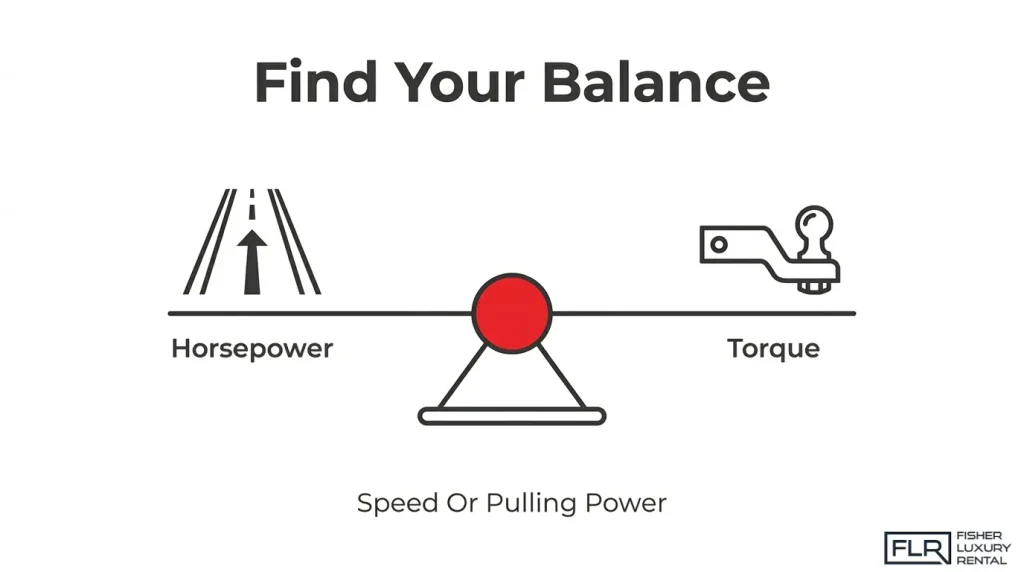
The answer depends on how and where you drive. High-speed and highway performance favor horsepower, while low-speed pulling and acceleration favor torque. Some driving scenarios demand both equally. The following H3s break down each situation.
When Does Horsepower Matter More Than Torque?
Horsepower matters more than torque when sustained high-speed performance is the priority. At highway cruising speeds, a vehicle must continuously overcome aerodynamic drag, which grows exponentially with velocity. In that context, the engine’s ability to sustain work output over time – horsepower determines how confidently a car accelerates during passing maneuvers or holds speed on long grades.
Sports cars and performance vehicles built for track use are the clearest examples. Their engines are tuned to produce peak power at high RPMs, where horsepower separates ordinary vehicles from truly fast ones. According to a Duke University analysis, horsepower per unit of vehicle weight is by far the strongest determinant of consumer demand for performance vehicles. For drivers seeking top-speed capability, spirited highway driving, or a thrilling track-ready experience, horsepower is the figure that matters most.
When Does Torque Matter More Than Horsepower?
Torque matters more than horsepower when a vehicle needs to move heavy loads or accelerate from a standstill. Torque is the rotational force that gets a vehicle moving in the first place, making it the dominant factor in towing, hauling, and low-speed off-road driving.
Research conducted under SAE J2807 compliance standards demonstrates this clearly: a tow vehicle must accelerate to 30 mph in under 12 seconds and navigate a 12% grade from a standstill, five times within five minutes. That kind of repeated, loaded effort is entirely torque-dependent. Diesel trucks, turbocharged SUVs, and electric vehicles all prioritize torque for exactly this reason. Electric motors, in particular, deliver maximum torque at 0 RPM, providing immediate pulling force with no rev-building required.
When Do Horsepower and Torque Matter Equally?
Horsepower and torque matter equally in all-around performance vehicles designed to excel across multiple driving conditions. Grand touring cars, high-performance luxury sedans, and hybrid supercars are built to launch quickly from a stop, sustain strong mid-range acceleration, and carry speed at highway velocities without compromise.
The Lamborghini Revuelto illustrates this balance precisely. Its 1,015 CV powertrain combines a V12 engine with three electric motors, pairing combustion-sourced high-RPM horsepower with electric-sourced low-RPM torque. The result is a car that performs at every point in the RPM range. For most drivers, a balanced combination is the most versatile and satisfying choice, whether the road is a city street, an on-ramp, or an open highway.
What Do Horsepower and Torque Specs Mean for Exotic Cars?
Horsepower and torque specs mean the quantified performance benchmarks that define how fast, responsive, and viscerally exciting an exotic car feels to drive. For supercars, these numbers are not marketing abstractions; they translate directly into acceleration, throttle response, and top-speed capability.
How Do Horsepower and Torque Define a Supercar?
Horsepower and torque define a supercar by setting the performance thresholds that separate exotic vehicles from conventional cars. Horsepower determines sustained high-speed output, while torque governs the rotational force available at any given engine speed. According to the Federal Aviation Administration’s Airplane Flying Handbook Glossary, one horsepower equals 550 foot-pounds per second, a unit James Watt originated to quantify mechanical work output. In a supercar context, these numbers set the ceiling for acceleration, top speed, and driving character. High peak horsepower enables breathtaking straight-line velocity, while broad torque delivery across the RPM range creates the effortless surge that makes exotic cars feel unlike anything else on the road.
Why Do Exotic Cars Emphasize Both Peak Horsepower and Torque?
Exotic cars emphasize both peak horsepower and torque because each metric serves a distinct and irreplaceable role in real-world performance. Peak horsepower governs maximum speed and sustained power delivery at high RPM, while torque drives the immediate force that propels the car forward at any throttle input. The McLaren 750S illustrates this balance precisely, producing 750 PS alongside 800 Nm of torque, combining high-RPM power with authoritative mid-range thrust. Focusing on one metric alone produces an imbalanced driving experience. A car with massive horsepower but weak torque feels strained at low speeds; one with strong torque but modest horsepower plateaus before reaching its potential top end. The most celebrated exotic cars optimize both curves together.
How Can You Experience Horsepower and Torque Firsthand?
You can experience horsepower and torque firsthand by driving a high-performance vehicle, where the physics become immediately physical. The following sections cover how exotic car rentals translate spec-sheet numbers into real sensation, and the core takeaways every driver should know.
Can Renting an Exotic Car Help You Feel the Difference?
Yes, renting an exotic car can help you feel the difference between horsepower and torque in a way no specification sheet can replicate. Torque announces itself the moment you press the accelerator from a standstill: the seat pushes back, the nose lifts slightly, and the car surges forward before the tachometer has time to climb. Horsepower takes over at higher RPMs, sustaining that acceleration into a relentless pull that builds toward triple-digit speeds. Research published in the African Journal of Hospitality, Tourism and Leisure confirms that customer experience dimensions, including the physical experience of a rental vehicle, significantly influence overall satisfaction. Fisher Luxury Rental offers a fleet of exotic and luxury vehicles across its Phoenix, AZ and Portland, OR service areas, giving drivers direct access to both sensations in a single drive.
What Are the Key Takeaways About Horsepower vs Torque?
The key takeaways about horsepower vs torque are that each metric governs a distinct phase of performance, and understanding both leads to smarter driving and better vehicle choices. The most actionable conclusions from this topic are:
- Torque drives initial acceleration. It is the rotational force that moves a vehicle from rest and dominates low-RPM performance, towing capacity, and off-the-line launch feel.
- Horsepower sustains speed. It measures how quickly work is done over time, determining top speed capability and high-RPM passing power.
- They are mathematically linked. Horsepower equals torque multiplied by RPM, divided by 5,252, meaning neither figure exists independently of the other.
- Engine type shapes delivery. Turbocharged and electric powertrains front-load torque at low RPMs; naturally aspirated engines build both figures progressively through the rev range.
- Use case determines priority. Towing and hauling demand high torque; sustained highway performance and top speed demand high horsepower; most real-world driving benefits from both.
Fisher Luxury Rental’s fleet puts these principles into practice, letting drivers discover firsthand how a vehicle’s power profile shapes every mile.