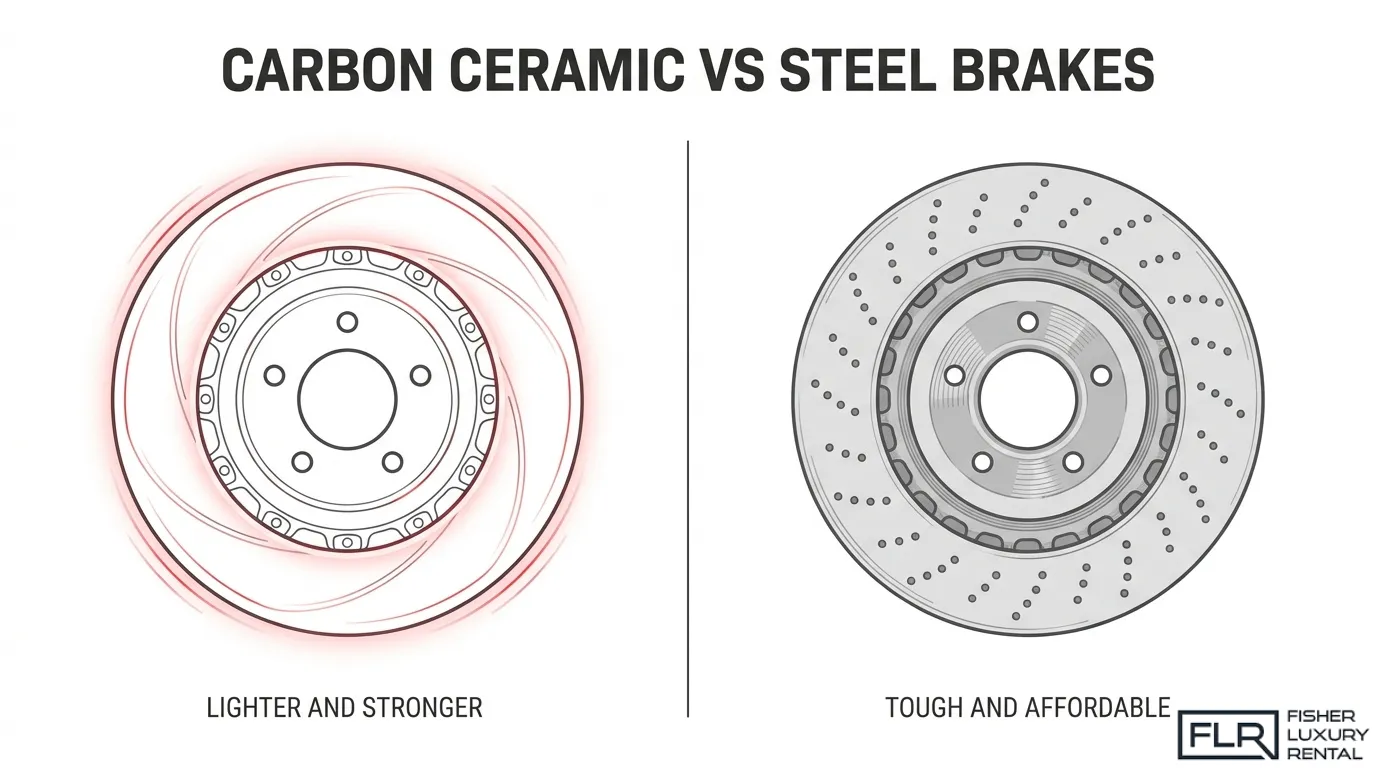
Carbon ceramic brakes are high-performance braking components made from a carbon fiber and silicon carbide composite, engineered to withstand higher temperatures, weigh less, and last longer than conventional steel rotors made from gray cast iron.
This guide covers what each system is made of, how they perform across street and track conditions, their thermal limits and fade resistance, the weight and handling implications of each, lifespan and replacement costs, wet-weather behavior, and which exotic and luxury cars use carbon ceramics.
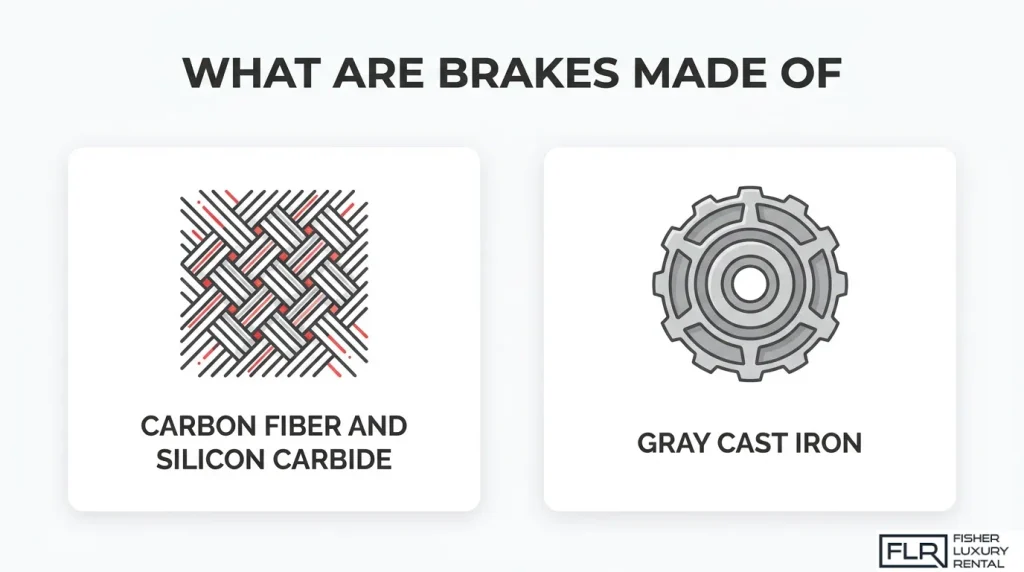
Carbon ceramic and steel rotors differ at the material level before a single stop is made. Carbon ceramic uses carbon fiber reinforced silicon carbide, produced through advanced sintering or infiltration processes, while steel relies on gray cast iron requiring a minimum 3.4% carbon content and a pearlitic microstructure.
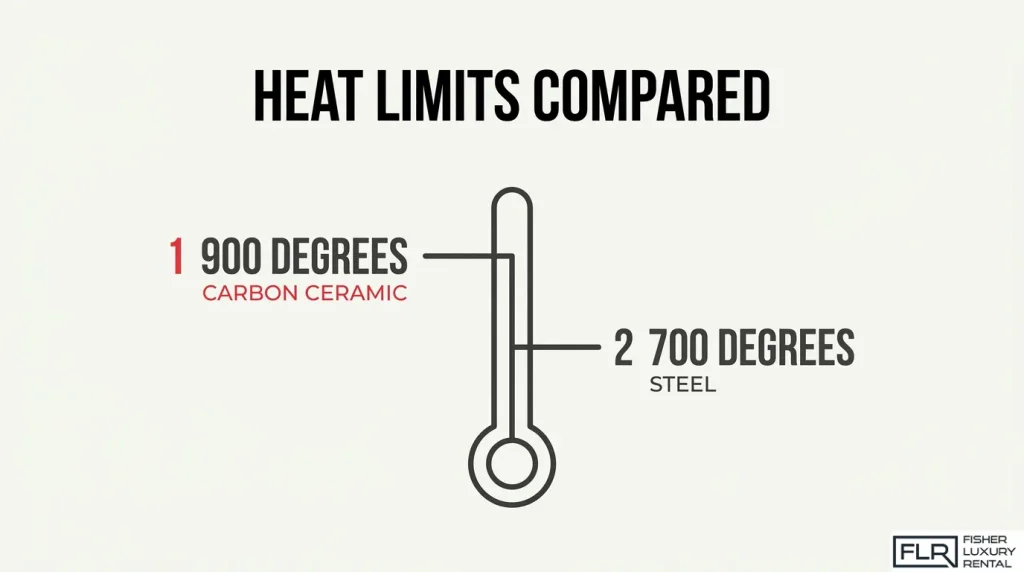
Performance separates sharply once heat enters the picture. Carbon ceramic maintains stable friction up to 900°C and resists fade across repeated hard stops; steel operates reliably to around 700°C before friction drops and stopping distances grow. In cold or wet conditions, however, that advantage reverses, and steel’s faster warm-up gives it a practical edge.
Weight savings from carbon ceramic are substantial, roughly 50% lighter than equivalent cast iron, reducing unsprung mass at every corner and sharpening both handling response and ride quality.
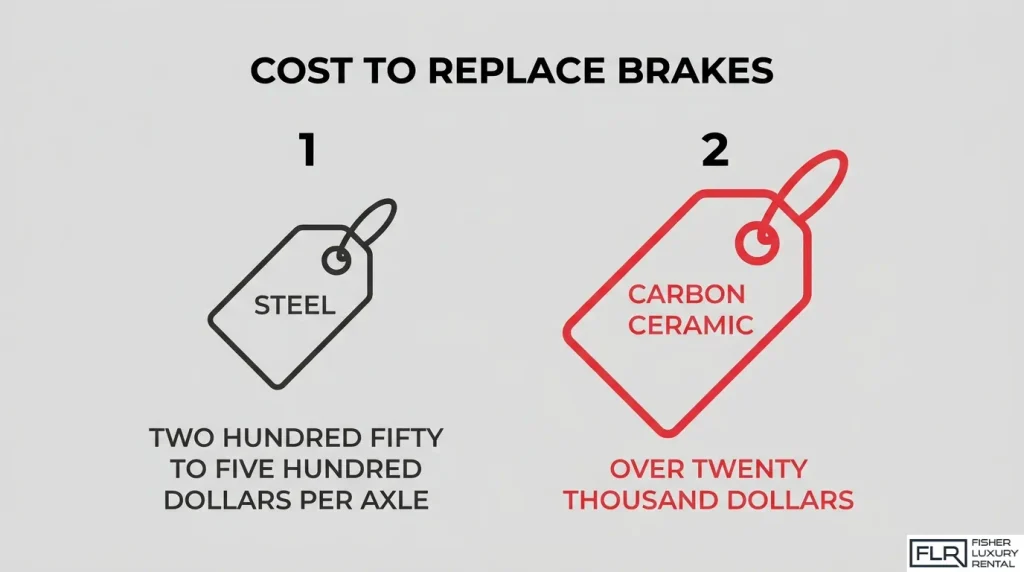
Cost tells the other side of the story. Steel brake service runs $250 to $500 per axle; a full carbon ceramic replacement can exceed $20,000, though ceramic discs used primarily on the road can last the lifetime of the vehicle, often surpassing 200,000 km.
What Are Carbon Ceramic Brakes?
Carbon ceramic brakes are high-performance braking components made from a composite of carbon fiber and silicon carbide. They cover key attributes such as how these rotors are manufactured, what materials define them, and which properties set them apart from conventional steel alternatives.
How Are Carbon Ceramic Brake Rotors Made?
Carbon ceramic brake rotors are made through a multi-stage manufacturing process that fuses carbon fiber and silicon carbide into a single dense composite disc. According to a patented process (Google Patents, WO2012074262A2), production involves mixing carbon fiber with phenolic resin, pressing and molding the mixture, carbonizing the molded body, then infiltrating it with molten silicon before a final polish. That silicon reacts with the carbon matrix to form silicon carbide, which gives the rotor its exceptional hardness and thermal stability.
What Materials Make Up a Carbon Ceramic Brake Disc?
Carbon ceramic brake discs contain carbon fiber reinforced silicon carbide as the primary composite. The carbon fiber provides tensile strength and low weight, while the silicon carbide matrix delivers hardness and heat resistance. According to SGL Carbon’s brake technology documentation, this combination produces high thermal stability, corrosion resistance, and wear resistance, resulting in exceptionally long brake disc service life. This material profile is fundamentally different from the gray cast iron used in conventional rotors.
What Are the Core Properties of Carbon Ceramic Brakes?
The core properties of carbon ceramic brakes are high heat tolerance, low weight, corrosion resistance, and superior wear life. These properties work together: the low density reduces unsprung mass at each wheel corner, while heat tolerance prevents fade during sustained hard braking. According to Brembo, carbon ceramic discs are highly resistant to corrosion and high temperatures, making them suitable for long-lasting and reliable use across performance applications.
What Are Steel Brakes?
Steel brakes are disc brake systems that use rotors machined from gray cast iron, the most widely used material in brake disc manufacturing. They work by clamping friction pads against a spinning iron rotor to convert kinetic energy into heat. Steel brakes cover the following key characteristics: composition, thermal limits, performance feel, and typical applications.
What Material Makes Up Steel Brake Rotors?
Steel brake rotors are made from gray cast iron, a material requiring a minimum 3.4% carbon content and a pearlitic microstructure, as specified by the SAE J431 standard for brake disc grades. The pearlitic matrix gives the rotor its characteristic stiffness and heat-absorbing capacity. Because it is inexpensive to cast and machine, gray cast iron remains the dominant rotor material across virtually every vehicle segment.
How Do Steel Brakes Perform on the Street?
Steel brakes perform predictably in everyday street conditions, delivering consistent stopping power across a wide temperature range. Their friction characteristics are well-understood, and compatible brake pads are universally available. One practical drawback is that gray cast iron discs begin forming red surface rust after brief exposure to moisture, which is an optical issue common in open-wheel designs, as noted in published research on ceramic brake disc integration into automotive systems.
What Are the Common Uses for Steel Brakes?
The common uses for steel brakes span virtually all vehicle types, including economy cars, trucks, SUVs, and many high-performance sports cars. They are the standard fitment on most production vehicles, and even some purpose-built track cars run iron rotors. For casual road driving and budget-conscious ownership, steel brakes remain the most practical and cost-effective choice available.
How Do Carbon Ceramic and Steel Brakes Differ in Materials?
Carbon ceramic and steel brake rotors differ fundamentally in their base materials, manufacturing processes, and resulting material properties. The sections below cover the specific compositions of each rotor type.
What Raw Materials Make Up Carbon Ceramic Brake Rotors?
Carbon ceramic brake rotors are made from carbon fiber reinforced with silicon carbide matrix materials, produced through advanced manufacturing methods. A 2024 SAE Mobilus study identified three distinct composite formulations used in rotor production:
- Polymer infiltration pyrolysis (PIP): produces carbon fiber reinforced silicon oxicarbide
- Reactive melt infiltration (RMI): produces carbon fiber reinforced silicon carbide
- Electric field assisted sintering (EFAS): produces carbon fiber reinforced silicon carbide-zirconium diboride
SGL Carbon notes that high thermal stability, corrosion resistance, and wear resistance are defining material properties of carbon ceramic discs. Unlike gray cast iron, which develops surface rust shortly after wet exposure, carbon ceramic composites resist oxidation entirely. The Ferrari Challenge Stradale adopted carbon ceramic discs as early as 2003, establishing them as a legitimate performance material rather than a novelty.
What Raw Materials Make Up Steel Brake Rotors?
Steel brake rotors are primarily made from gray cast iron, the dominant material in mainstream rotor manufacturing. According to the SAE J431 standard, brake disc and drum materials require a minimum of 3.4% carbon content and a pearlitic microstructure to meet performance grades. This pearlitic matrix provides the hardness and thermal mass that makes gray cast iron reliable under repeated braking cycles. However, as a Porsche Club of America technical expert noted regarding steel rotor pairings, performance pads on steel rotors can underperform when cold, reducing braking effectiveness until the system reaches operating temperature.
How Does Braking Performance Compare Between Carbon Ceramic and Steel?
Braking performance between carbon ceramic and steel depends heavily on driving conditions and temperature ranges. The sections below cover normal street driving, track performance, and how steel brakes hold up in each context.
How Do Carbon Ceramic Brakes Perform Under Normal Driving?
Carbon ceramic brakes perform strongly under normal driving conditions, delivering consistent stopping power and stable pedal feel across repeated applications. According to Porsche, the PCCB system maintains stable friction even when decelerating repeatedly at high speeds, whereas steel brakes can see friction vary significantly under heavy use, causing them to begin losing effectiveness.
One important caveat for everyday use: cold and wet weather reduces carbon ceramic friction coefficients. Porsche’s own technical bulletin confirms that PCCB and PSCB systems show a poor friction coefficient compared to grey cast iron in wet or cold conditions, which can alter pedal feel at the same pressure. For primarily dry-weather street driving, carbon ceramics are exceptionally capable. In mixed conditions, that performance advantage narrows considerably.
How Do Carbon Ceramic Brakes Perform Under Track Conditions?
Carbon ceramic brakes perform with immense, consistent stopping power under track conditions, particularly where sustained heat buildup would otherwise cause fade in steel rotors. Car and Driver Technical Editor Dan Edmunds, reviewing the 2022 Porsche Cayman GT4 RS, noted that the carbon ceramics “generated immense and unfailing stopping power, with a clairvoyant delicacy that made their response easy to predict.”
However, track use does accelerate wear. Maserati’s technical service documentation explicitly states that carbon ceramic components are subject to increased wear during aggressive, high-intensity track driving, where the system reaches extremely high temperatures. Cold or wet track sessions are also problematic: CTE Carbon Composites identifies cold and wet performance as the most common complaint after cost. Paul Watson, a veteran Porsche Australia technical representative, goes further: “If you’re doing club days, we’d always recommend iron discs.” Carbon ceramics excel on hot, dry circuits but are not the universal track solution their reputation suggests.
How Do Steel Brakes Perform Under Normal Driving?
Steel brakes perform reliably under normal driving conditions, providing consistent, predictable stopping power across a wide range of temperatures and weather conditions. Gray cast iron rotors reach their operating temperature quickly and deliver strong initial bite even when cold, which gives them a practical advantage in commuting, city driving, and wet-weather situations where carbon ceramics can feel wooden or unpredictable.
For everyday road use, steel brakes are entirely fit for purpose. They are also far more forgiving when driven hard before fully warming up, making them the more versatile choice for drivers who do not operate their vehicles exclusively under controlled conditions.
How Do Steel Brakes Perform Under Track Conditions?
Steel brakes perform competently on track but are limited by heat saturation under sustained, repeated high-speed braking. As brake temperatures climb, friction coefficients in steel rotors become unstable, which is the root cause of brake fade. Steel brakes typically operate reliably up to around 700°C; beyond that threshold, fade becomes a meaningful risk.
That said, for club days and amateur track events, iron discs remain the practical recommendation from Porsche’s own technical staff. Steel rotors warm faster, cost far less to replace when worn, and deliver consistent, well-understood performance across wet, cold, and moderate-heat conditions that many track days actually involve. The thermal ceiling is real, but the average track day driver rarely exceeds it in a way that justifies the cost and conditional trade-offs of carbon ceramics.
How Does Heat Resistance Differ Between Carbon Ceramic and Steel?
Heat resistance differs significantly between carbon ceramic and steel rotors, with each material reaching a distinct thermal ceiling before performance degrades. The sections below cover how each rotor type responds to sustained high heat.
How Do Carbon Ceramic Rotors Handle Sustained High Heat?
Carbon ceramic rotors handle sustained high heat by maintaining friction stability and structural integrity at temperatures that would compromise steel. According to BMW M technical documentation, the M Carbon ceramic brake on the BMW M2 CS is corrosion-free and highly heat-resistant, producing less wear than conventional brake systems under sustained thermal load.
Unlike gray cast iron, which begins to fade as temperatures climb, carbon ceramic’s silicon carbide matrix dissipates heat without softening or glazing the friction surface. This means repeated hard braking events from high speed produce consistent pedal response rather than progressive fade. For drivers who push a vehicle hard, that consistency is arguably the most valuable thermal property ceramic brakes offer.
How Do Steel Rotors Handle Sustained High Heat?
Steel rotors handle sustained high heat less effectively than carbon ceramic, with gray cast iron operating at approximately 700°C compared to the 900°C threshold carbon ceramic can withstand, according to an IOP Publishing thermal analysis of disc brakes. Once gray cast iron approaches its upper operating limit, friction coefficient drops and brake fade sets in.
That said, steel rotors warm up faster from cold, giving them a genuine advantage in short stop-and-go cycles where carbon ceramic has not yet reached operating temperature. Steel is also far more forgiving of track use followed by cool-down periods, making it a practical choice when operating temperatures stay well below the fade threshold.
How Does Brake Fade Compare Between Carbon Ceramic and Steel?
Brake fade occurs when sustained heat reduces braking effectiveness. Carbon ceramic rotors tolerate significantly higher temperatures before fading, while steel rotors reach their thermal ceiling sooner. The sections below cover how each material responds to repeated hard stops and what the temperature gap means in practice.
How Do Carbon Ceramic Rotors Resist Brake Fade?
Carbon ceramic rotors resist brake fade by maintaining friction stability at operating temperatures up to 900 °C, according to a thermal and structural analysis published by IOP Publishing. Steel gray cast iron rotors, by comparison, operate effectively only up to around 700 °C before thermal degradation affects braking force. That 200 °C advantage means carbon ceramic systems can absorb repeated hard stops without the friction coefficient dropping in a way that lengthens stopping distances. BMW’s own product documentation confirms this: the M Carbon ceramic brake system on the 2025 BMW M4 CS delivers greater fade resistance, enhanced thermal stability, and higher resistance to wear than conventional compound brakes.
For drivers who push a car hard, fade resistance is arguably the single most important brake attribute — and carbon ceramic excels here.
How Do Steel Rotors Respond to Repeated Hard Stops?
Steel rotors respond to repeated hard stops with increasing susceptibility to brake fade as heat accumulates beyond the gray cast iron’s roughly 700 °C operating threshold. Once that limit is approached, friction force drops, pedal pressure requirements increase, and stopping distances grow. The Federal Motor Carrier Safety Administration notes that disc brakes in general cause less brake fade than drum brakes under sustained use, such as descending a long downgrade, but this advantage applies to all disc formats. Under track-style repeated stops, steel rotors are more vulnerable than carbon ceramic because they cannot shed or withstand the same thermal load. U.S. federal safety standards under 49 CFR § 571.105 require vehicles to complete multiple fade stops from 60 mph, a test that steel rotors pass for street use but that highlights their limits under extreme repeated braking.
How Does Weight Differ Between Carbon Ceramic and Steel Rotors?
Carbon ceramic rotors weigh significantly less than steel rotors, reducing unsprung mass at each corner of the vehicle. The sections below cover the raw weight difference and how that mass reduction translates into real handling and acceleration gains.
How Much Do Carbon Ceramic Rotors Weigh Compared to Steel?
Carbon ceramic rotors weigh approximately 50% less than equivalent cast iron rotors. According to the official Maserati MC20 press release, Brembo CCM brake discs offer a 50% reduction in weight compared to cast iron, producing a significant reduction in unsprung mass that translates into exceptional vehicle dynamic behaviour and improved ride comfort.
That kind of weight saving is not trivial. Removing several kilograms per corner lowers the mass that the suspension must control over every bump and corner, which is exactly why manufacturers like Aston Martin, BMW, and Range Rover cite unsprung mass reduction as a headline benefit when specifying carbon ceramic brakes on performance models.
How Does Rotor Weight Affect Vehicle Handling and Acceleration?
Rotor weight affects vehicle handling primarily through its role as unsprung mass, the portion of a vehicle’s weight not supported by the suspension. Published research on unsprung mass dynamics found that every 10% reduction in unsprung mass contributes to approximately a 6% reduction in sprung mass acceleration for the same level of wheel-hop, meaning the body stays calmer and tyres maintain better road contact.
Rotating inertia also plays a role in acceleration. A Virginia Tech study on rotating inertia in electric vehicles found that energy stored in rotating components represents only 0.4 to 1.7% of output energy depending on drive cycle, so the acceleration benefit of lighter rotors is modest but measurable, particularly in repeated acceleration events.
How Long Do Carbon Ceramic Brakes Last Compared to Steel?
Carbon ceramic rotors outlast steel by a significant margin, particularly under road driving conditions. The two H3s below cover typical lifespan figures for each rotor type.
What Is the Typical Lifespan of Carbon Ceramic Rotors?
The typical lifespan of carbon ceramic rotors is effectively the lifetime of the vehicle under normal road use. According to Brembo SGL Carbon Ceramic Brakes, carbon ceramic discs are highly resistant to wear, and it is not uncommon for a set to exceed 200,000 km when used primarily on public roads. Their resistance to both corrosion and high temperatures, confirmed by Brembo, prevents the gradual degradation that limits steel rotors.
Track use changes this picture considerably. Extreme heat cycles under aggressive driving accelerate wear, which is why lifespan figures always carry the caveat of usage conditions.
What Is the Typical Lifespan of Steel Rotors?
The typical lifespan of steel rotors is considerably shorter than that of carbon ceramic, generally ranging from 30,000 to 70,000 miles depending on driving habits and pad compound. Steel is susceptible to corrosion, which can degrade rotor surfaces even when the vehicle sits unused, and repeated heat cycling causes warping over time.
For drivers who keep their vehicles long-term, this means two to four steel rotor replacement cycles over a period in which a single set of carbon ceramic discs would still be serviceable. That long-term calculus matters when weighing the higher upfront cost of ceramic systems.
How Much Do Carbon Ceramic Brakes Cost Compared to Steel?
Carbon ceramic brake replacement costs far exceed steel, driven by exotic materials and specialized labor. The sections below cover rotor replacement pricing for both brake types.
What Do Carbon Ceramic Brake Rotors Cost to Replace?
Carbon ceramic brake rotor replacement costs are significantly higher than steel alternatives. According to Brake & Front End, replacing all four discs and pads on some carbon ceramic systems can exceed $20,000, a figure so steep that many owners switch back to cast iron rotors and semi-metallic pads. A single OEM ceramic composite rotor for a 2021 Audi RS6 carries a dealer price of $8,253.38. These costs reflect the exotic raw materials, precision manufacturing, and brand-specific fitment required.
Given this pricing reality, carbon ceramic brakes make the most financial sense when their extended road lifespan offsets the replacement cost over many years of ownership.
What Do Steel Brake Rotors Cost to Replace?
Steel brake rotor replacement costs are accessible for most vehicle owners. According to AAA Auto Repair, average brake pads and rotors typically cost between $250 and $500 per axle, covering both parts and labor. Because wear rates vary by driving habits, brakes should be inspected every 12,000 to 15,000 miles or 12 to 15 months to determine actual replacement need.
This low replacement cost is steel’s single greatest practical advantage over ceramic systems for everyday drivers.
How Do Carbon Ceramic and Steel Brakes Perform in Wet Weather?
Carbon ceramic and steel brakes both experience reduced friction in wet conditions, but each responds differently. The sections below cover carbon ceramic’s wet-weather friction drop, steel’s comparative wet advantage, and how pedal feel changes in rain.
How Do Carbon Ceramic Brakes Perform in Wet Weather?
Carbon ceramic brakes perform with a notable friction reduction in wet weather. A Porsche AfterSales symptom bulletin for the Taycan explicitly identifies a poor friction coefficient for the Porsche Ceramic Composite Brake (PCCB) and Porsche Surface Coated Brake (PSCB) compared to grey cast iron brakes in wet and cold conditions, which can alter pedal feel at the same pressure.
BMW’s official guidance for the M3 Touring similarly warns that road salt or wetness from car washes, overnight condensation, or rain “can cause the braking effect to be similar to that of a conventional brake system,” adding that greater pedal pressure compensates for the reduction.
This is the single most commonly cited real-world drawback of carbon ceramic brakes on public roads, and drivers should anticipate it in daily use.
How Do Steel Brakes Perform in Wet Weather?
Steel brakes perform more predictably than carbon ceramic in wet and cold conditions because cast iron reaches effective friction temperatures far more quickly. A study published in the Journal of Ceramics notes that grey cast iron discs develop surface rust rapidly after brief exposure to moisture, which is a cosmetic drawback but does not significantly impair initial wet-weather bite the way cold carbon ceramic does.
According to the Northern Ireland Highway Code (Rule 227), wet stopping distances double compared to dry roads regardless of brake material, since tyre grip is the primary limiting factor in wet braking for both systems.
For everyday street driving in variable weather, steel brakes offer more consistent and immediate response with zero warm-up dependency.
Does Wet Weather Affect Pedal Feel on Carbon Ceramic Brakes?
Wet weather does affect pedal feel on carbon ceramic brakes. The Porsche AfterSales Taycan bulletin confirms the reduced friction coefficient in wet or cold conditions results in a perceptible change in brake pedal feel when applying the same pedal pressure.
Carbon ceramic discs require a heat activation threshold to reach peak friction. Until that threshold is met, whether due to cold temperatures or surface moisture, the pedal response feels softer and less immediate than on a warmed steel system.
From a practical standpoint, drivers transitioning from steel brakes to carbon ceramic in wet weather should apply more deliberate, earlier pressure to compensate.
How Does Brake Feel and Pedal Response Differ Between the Two?
Brake feel and pedal response differ between carbon ceramic and steel brakes primarily in consistency, cold-weather behavior, and wet-condition sensitivity. Carbon ceramic systems deliver a more uniform pedal feel across a wide temperature range, while steel rotors can vary more noticeably under changing conditions.
Carbon Ceramic Pedal Feel: Consistent but Condition-Sensitive
Carbon ceramic brake pedal feel is notably consistent under heat-loaded, high-performance conditions. The Jaguar XE SV Project 8’s Carbon Ceramic Brake (CCB) system is specifically cited for delivering consistent pedal feel alongside fade resistance and longevity.
However, that consistency has a known cold-weather limitation. BMW Australia’s documentation on ceramic-equipped M3 models notes that road salt, wetness from car washes, overnight condensation, or rain “can cause the braking effect to be similar to that of a conventional brake system,” requiring greater pedal pressure to compensate. The pedal response is predictable once the system reaches operating temperature, but drivers should anticipate a softer, less responsive feel during the first cold stops of any session.
Steel Brake Pedal Feel: Immediate but Fade-Prone
Steel brake pedal feel is immediate and familiar at low temperatures, making them more intuitive straight from cold. Because gray cast iron reaches usable friction levels quickly, there is no warm-up penalty on morning commutes or short urban drives.
The trade-off appears under sustained load. Unlike carbon ceramic systems, steel rotors are subject to friction variation under repeated heavy braking, which can translate into a progressively softer or inconsistent pedal feel as temperatures build. A Porsche AfterSales technical bulletin confirms that ceramic systems like PCCB also show reduced friction in cold or wet conditions, altering pedal feel at the same applied pressure compared to grey cast iron, underscoring that neither system is unconditionally superior in every scenario.
For most street drivers, steel brakes feel more natural and require no acclimatization.
Which Exotic and Luxury Cars Come with Carbon Ceramic Brakes?
Many of the world’s most prestigious sports and luxury cars come with carbon ceramic brakes, either as standard equipment or as a high-value option. The following models represent the clearest examples of this technology across manufacturers. Fisher Luxury Rental, serving Phoenix and Portland, specializes in top-trim exotic and luxury vehicles – the same category of cars most commonly factory-fitted with carbon ceramic brake systems.
BMW M5 CS and M Carbon Ceramic Brakes
The BMW M5 CS comes equipped with M Carbon ceramic brakes that are 23 kilograms lighter than the M Compound brakes fitted to the BMW M5 Competition. According to BMW Media Information, this reduction in unsprung and rotating mass contributes directly to the M5 CS achieving 0 to 100 km/h in 3.0 seconds, placing it 0.3 seconds ahead of the M5 Competition.
Lamborghini Huracán STO and the CCMR Disc
The Lamborghini Huracán STO uses the CCMR carbon-ceramic brake disc, developed by Brembo and derived directly from Formula 1 racing. This disc is paired with track tires, a dedicated brake cooling system, and a higher aerodynamic load to maximize braking consistency over time.
McLaren GT and McLaren 750S
The McLaren GT offers carbon ceramic brakes as an option, upgrading the calipers from black cast aluminium to forged aluminium. The McLaren 750S takes this further, specifying CCM-R brakes as standard with 6-piston forged monobloc aluminium calipers at the front and 4-piston forged aluminium calipers at the rear.
Carbon ceramic brakes at this level represent genuine engineering intent, not just a luxury checkbox.
Are Carbon Ceramic Brakes Worth It for Street Driving?
Carbon ceramic brakes deliver genuine advantages for street driving, but whether those advantages justify the cost depends on driving habits, climate, and budget. The key considerations are cold and wet weather behavior, lifespan on street use, and replacement cost.
Do Carbon Ceramic Brakes Perform Well in Cold and Wet Street Conditions?
Carbon ceramic brakes perform adequately in everyday street conditions, but they carry a notable limitation in cold and wet weather. According to a Porsche AfterSales technical service bulletin, the Porsche Ceramic Composite Brake (PCCB) exhibits a poor friction coefficient compared to grey cast iron brakes in wet or cold conditions, which can alter pedal feel under the same applied pressure. BMW Australia confirms that road salt, rain, or overnight condensation can reduce braking effect to levels similar to a conventional steel system, requiring greater pedal pressure to compensate.
For drivers in warm, dry climates, this limitation rarely surfaces. In colder or wetter regions, however, steel brakes actually outperform carbon ceramics during the initial stops of the day.
How Long Do Carbon Ceramic Brakes Last on Street-Driven Cars?
Carbon ceramic brakes last significantly longer than steel rotors when used primarily on public roads. According to Brembo SGL Carbon Ceramic Brakes, carbon ceramic discs can last the entire lifetime of a street-driven vehicle, with many sets exceeding 200,000 km. The material’s corrosion resistance also eliminates the surface rust that appears on grey cast iron rotors after brief exposure to moisture.
For a street-driven exotic car with no track use, this longevity makes the high upfront cost easier to justify over a long ownership period.
Are Carbon Ceramic Brakes Cost-Effective for Street Use?
Carbon ceramic brakes are not cost-effective for most street drivers when replacement is factored in. Standard steel brake pads and rotors cost between $250 and $500 per axle according to AAA Auto Repair, while Brake & Front End reports that a full carbon ceramic replacement across four corners can exceed $20,000, prompting many owners to switch back to cast iron.
The value calculation shifts only when the vehicle is driven primarily on dry roads at high frequency, kept for many years, and never taken to track days. For occasional or rental-style use, the replacement cost risk is real and significant.
When Should You Choose Steel Brakes Over Carbon Ceramic?
Steel brakes are the better choice in several specific scenarios: cold-climate daily driving, frequent track days on a budget, high-mileage commuter use, and situations where replacement cost is a primary concern. The sections below break down each scenario.
Steel Brakes in Cold and Wet Conditions
Steel brakes outperform carbon ceramic rotors in cold and wet conditions. A Porsche AfterSales technical bulletin confirms that ceramic composite brakes exhibit a poor friction coefficient compared to grey cast iron brakes in wet or cold weather, which can alter pedal feel at the same applied pressure. Steel rotors reach effective operating temperature faster from a cold start, delivering predictable bite immediately. For drivers in rainy climates or winter conditions, this consistent cold-weather performance is a practical safety advantage that carbon ceramic systems simply cannot match.
Steel Brakes for Track Day and Club Racing Use
Steel brakes are the preferred choice for club racing and track day use. Paul Watson, a veteran Porsche Australia technical representative, stated directly: “If you’re doing club days, we’d always recommend iron discs.” The reason is pragmatic: aggressive track driving exposes carbon ceramic discs to extreme thermal cycling, and replacement costs for a full ceramic system can exceed $20,000 according to Brake & Front End. Steel rotors accept punishment, can be replaced affordably, and pair well with dedicated race pads for repeated high-heat stops.
Steel Brakes for Budget-Conscious Owners
Steel brakes are the right choice when ownership cost matters most. AAA Auto Repair reports that steel brake pads and rotors average $250 to $500 per axle, compared to a single OEM ceramic rotor priced above $8,000. For owners who drive hard, replace components regularly, or simply want reliable stopping power without exotic-tier maintenance bills, steel delivers equivalent everyday braking performance at a fraction of the cost. The weight penalty of steel brakes is real, but for most drivers the financial trade-off is straightforward.
How Do Brake Types Shape Your Luxury Driving Experience?
Brake type shapes your luxury driving experience by determining stopping confidence, pedal feel, and handling refinement. The H3s below cover firsthand access to carbon ceramic brakes through Fisher Luxury Rental and the key takeaways from comparing both brake systems.
Can Renting Exotic Cars from Fisher Luxury Rental Let You Experience Carbon Ceramic Brakes Firsthand?
Yes, renting exotic cars from Fisher Luxury Rental can let you experience carbon ceramic brakes firsthand, without the ownership costs that make these systems prohibitive for most drivers.
Fisher Luxury Rental maintains a fleet of exotic and luxury vehicles, with quality and vehicle condition emphasized as a core part of the rental experience. Many of the exotic and luxury vehicles in the fleet come from manufacturers that specify carbon ceramic brake systems as standard or optional equipment on their performance models.
According to The BRAKE Report, the braking power of carbon ceramic brakes feels no different from iron under normal road conditions, though their key advantage is resistance to overheating, which shortens stopping distances under repeated hard braking. A rental gives you precisely the road conditions where that difference is subtle but real.
For enthusiasts curious about how carbon ceramics respond underfoot, a day behind the wheel of a properly equipped exotic is the most honest evaluation available.
What Are the Key Takeaways About Carbon Ceramic vs Steel Brakes?
The key takeaways about carbon ceramic vs steel brakes are that each system suits a specific driver profile, use case, and budget.
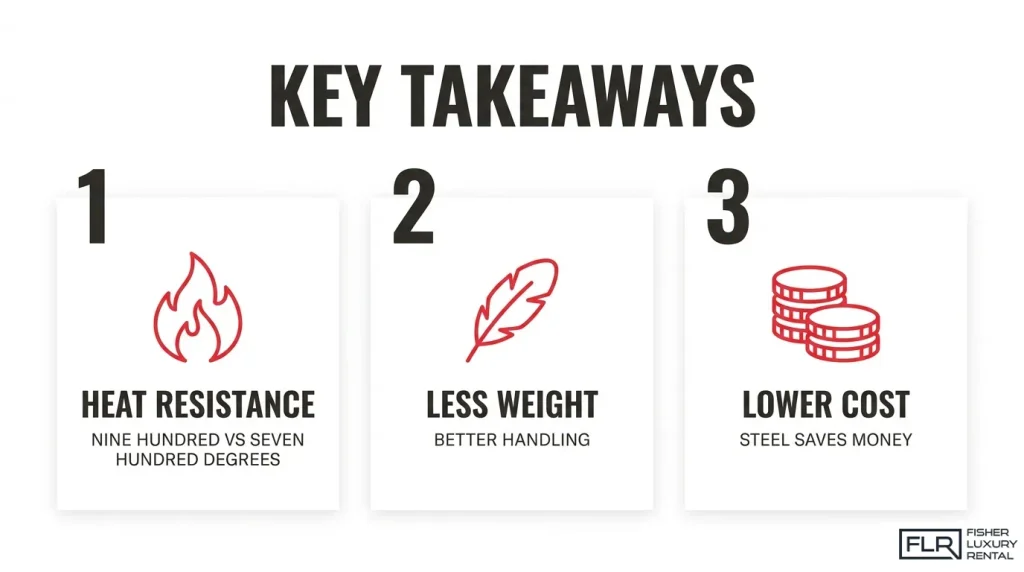
- Heat resistance: Carbon ceramic rotors operate up to 900°C versus approximately 700°C for gray cast iron, delivering superior fade resistance under sustained hard braking.
- Weight savings: Carbon ceramic systems reduce unsprung mass significantly, improving handling response and ride quality.
- Street performance: On public roads, both systems provide comparable stopping power under normal conditions; the carbon ceramic advantage is most pronounced during repeated high-speed stops.
- Wet and cold weather: Carbon ceramics can exhibit reduced friction in wet or cold conditions, sometimes requiring greater pedal pressure to compensate.
- Cost: Replacement costs for carbon ceramic systems can exceed $20,000 for four discs and pads, versus a few hundred dollars per axle for steel.
- Lifespan: On road-driven vehicles, carbon ceramic discs can exceed 200,000 km, often outlasting the vehicle itself.
For most drivers, steel brakes deliver dependable everyday performance at a fraction of the price. Carbon ceramics reward those who push their vehicles hard and value the engineering behind every stop.