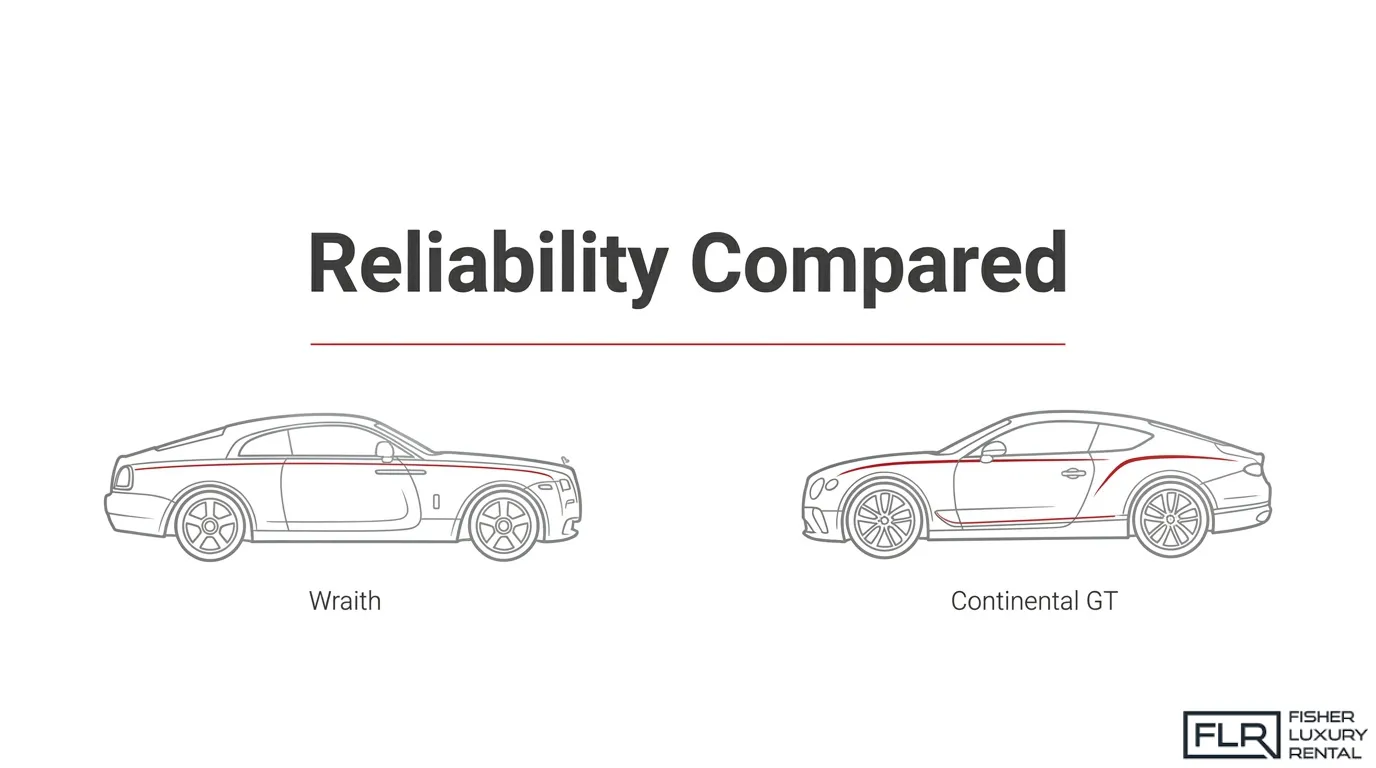
Rolls-Royce Wraith reliability and Bentley Continental GT reliability represent two distinct engineering philosophies applied to the same grand touring mission: covering long distances in effortless comfort without mechanical interruption. Both carry price tags exceeding $200,000, which means any failure is disproportionately costly in time, money, and experience.
This comparison covers what makes reliability uniquely critical at this price point, how each model performs across its powertrain and electronics, what ownership actually costs through servicing and unscheduled repairs, how warranty programs and certified pre-owned protections differ, and what driving habits, depreciation, and failure patterns reveal about each car’s long-term character.
Reliability shapes the entire ownership case for ultra-luxury grand tourers. When a high-output turbocharged engine fails to dissipate heat properly, or an air suspension strut leaks at high mileage, the repair bill and the lost time are both severe. Understanding where each model is strong and where it carries documented risk is the foundation for any serious buying decision.
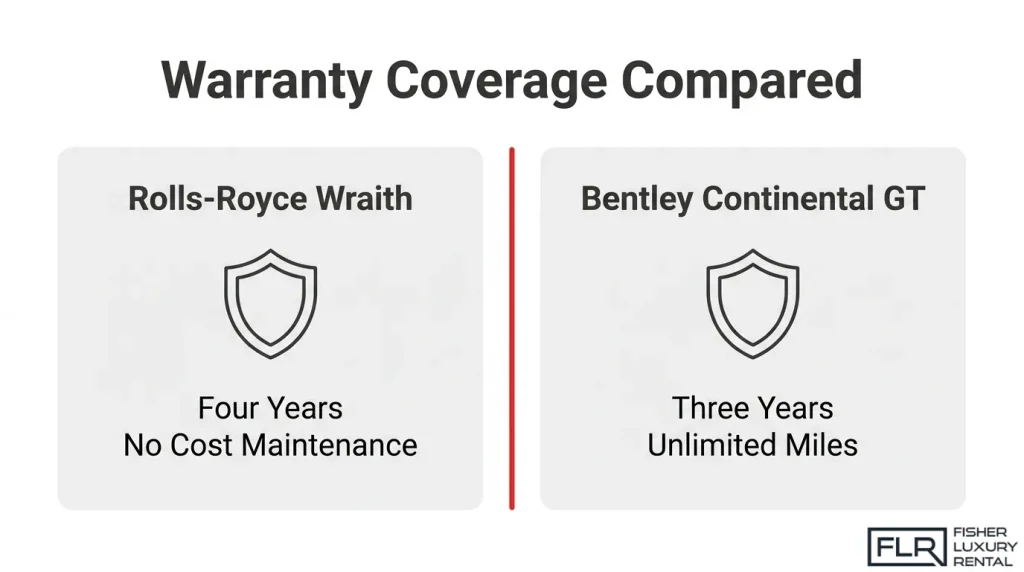
Maintenance costs diverge most clearly in the warranty period. Rolls-Royce covers factory-recommended servicing at no cost for four years with no mileage cap, while Bentley’s new-car warranty runs three years with unlimited mileage but does not include complimentary maintenance. That structural difference shapes the true cost of first ownership before a single unscheduled repair enters the equation.
Failure patterns, depreciation, and driving style each add another layer. The Continental GT carries a documented NHTSA coolant pump recall on V8 variants, the Wraith’s air suspension components are a recurring concern at higher mileage, and aggressive urban driving accelerates wear on both platforms far faster than the sustained highway use each car was engineered to handle.
What Makes Reliability a Critical Factor for Ultra-Luxury Grand Tourers?
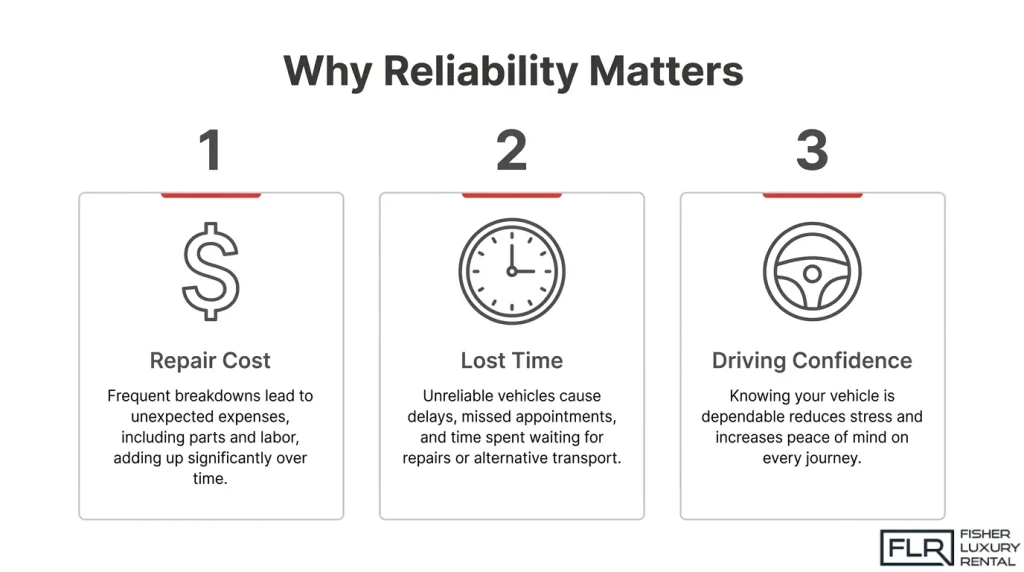
Reliability is a critical factor for ultra-luxury grand tourers because mechanical failure directly undermines the purpose these vehicles exist to fulfill: effortless, long-distance travel at the highest level of comfort and refinement. When a $300,000+ car breaks down, the financial and experiential cost is disproportionately high. The sections below cover how reliability shapes ownership cost, resale value, and driving confidence for both the Rolls-Royce Wraith and Bentley Continental GT.
How Reliable Is the Rolls-Royce Wraith Overall?
The Rolls-Royce Wraith is generally regarded as a well-engineered grand tourer built on proven BMW Group architecture. The sections below cover its V12 powertrain durability, recurring mechanical concerns, electronic system performance, and how reliability shifts once factory coverage ends.
How Does the Wraith’s BMW-Derived V12 Powertrain Hold Up Over Time?
The Wraith’s BMW-derived V12 powertrain holds up well over time, benefiting from the same N74-family engine architecture used across BMW Group’s flagship vehicles. According to BMW Group Technical Training documentation, the N74 engine uses an electric auxiliary water pump that continues dissipating heat from the exhaust turbochargers for up to 30 minutes after the engine is switched off. This active post-run cooling reduces heat soak, a common cause of turbocharger wear in high-output engines. BMW Group modular architectures are also designed to serve multiple segments while integrating varied drive concepts, which means components are extensively validated before deployment. In practice, this shared engineering heritage gives the Wraith’s powertrain a reliability foundation stronger than its bespoke appearance suggests.
What Are the Most Common Rolls-Royce Wraith Mechanical Issues?
The most common Rolls-Royce Wraith mechanical issues involve the air suspension, cooling system components, and transmission electronics. Owners and independent specialists frequently report that the self-leveling air struts can develop leaks over time, particularly in vehicles that accumulate higher mileage or sit unused for extended periods. The eight-speed automatic gearbox, sourced from ZF and shared with other BMW Group vehicles, is generally robust but can exhibit rough shifting if software updates are neglected. Brake and tire wear also accelerate with the Wraith’s substantial 5,400-pound curb weight, meaning consumable replacement cycles are shorter than buyers of lighter grand tourers typically expect.
How Reliable Is the Wraith’s Electronic and Infotainment System?
The Wraith’s electronic and infotainment system is competent but carries reliability caveats typical of complex luxury vehicles from the mid-2010s. The iDrive-based head unit and the Bespoke Audio system by Rolls-Royce add multiple proprietary control modules that can develop software faults as the car ages. No published model-specific failure rate exists for the Wraith’s infotainment hardware, as this data point falls within the research evidence gaps for both models reviewed here. That said, owner reports consistently flag ambient lighting controllers and the rear-seat entertainment modules as the most frequent electronic nuisances. These are rarely safety-critical but can be expensive to diagnose and repair outside an authorized dealer network.
How Does Wraith Reliability Change After the Factory Warranty Expires?
Wraith reliability becomes noticeably more cost-sensitive after the factory warranty expires. Rolls-Royce provides no-cost factory-recommended maintenance for four years with unlimited mileage from the original in-service date, according to Rolls-Royce Motor Cars. Once that coverage lapses, owners absorb the full cost of air suspension repairs, cooling system servicing, and electronic diagnostics, all of which carry substantial labor rates at authorized centers. Independent specialists can reduce per-visit costs, but sourcing genuine components for a low-volume, hand-built vehicle adds lead-time risk. Buyers considering a used Wraith should budget conservatively for post-warranty ownership, as even minor unscheduled repairs on ultra-luxury platforms carry disproportionately high parts and labor costs compared to mainstream vehicles. For those who want to experience the Wraith’s powertrain and cabin refinement before committing to ownership, Fisher Luxury Rental offers exotic and luxury vehicles for short-term hire in Phoenix, AZ and the Portland, OR area.
How Reliable Is the Bentley Continental GT Overall?
The Bentley Continental GT is a broadly dependable grand tourer, though its complexity means reliability varies by engine choice, electronics, and ownership stage. The sections below cover W12 and V8 engine durability, common mechanical issues, electronics, and post-warranty considerations.
How Dependable Is the Continental GT’s W12 Engine Long-Term?
The Continental GT’s W12 engine is dependable over the long term, supported by a rigorous hand-build and testing process. According to Bentley Motors Media, each W12 is hand-built over 6.5 hours before undergoing more than an hour of diagnostic testing across three specialist machines, with one engine per week fully stripped for extended inspection. That level of production scrutiny is rare in any segment and reflects genuine engineering commitment. Owners who follow Bentley’s recommended service intervals consistently report strong mechanical longevity from the W12, though the engine’s complexity means repairs outside of authorized facilities carry real risk.
What About Bentley Continental GT V8 Engine Reliability?
The Continental GT V8 engine is generally well-regarded, but it carries one documented safety concern worth understanding. A National Highway Traffic Safety Administration Part 573 Safety Recall (23V-034) found that liquid can permeate the external coolant pump housing and reach the electrical circuit board, potentially causing a short circuit, thermal damage to the pump, and in rare cases a harness fire if left unnoticed. Pre-purchase recall verification is essential on any used V8 Continental GT. Outside of this cooling-system issue, V8 owners report positive long-term experiences, with forum members noting consistent satisfaction across extended ownership.
What Are the Most Common Bentley Continental GT Mechanical Issues?
The most common Bentley Continental GT mechanical issues fall into several recurring categories:
- Coolant system faults: The V8’s external coolant pump defect (NHTSA 23V-034) is the most safety-critical documented issue.
- Air suspension wear: Adaptive air-ride components are subject to gradual degradation, particularly on older third-generation examples.
- Convertible roof mechanism: On GTC variants, the hydraulic soft-top mechanism requires periodic inspection and fluid maintenance.
- Oil consumption: Some W12 units show elevated consumption between service intervals, particularly at higher mileages.
Addressing these proactively through scheduled Bentley servicing avoids the most expensive escalations.
How Reliable Is the Continental GT’s Electronics and MMI System?
The Continental GT’s electronics and MMI system are sophisticated but represent one of the more failure-prone areas of the car. The infotainment architecture, shared in part with Volkswagen Group platforms, can develop touchscreen calibration faults, HVAC control glitches, and instrument cluster errors, particularly in third-generation models during early production years. Software updates from Bentley authorized dealers resolve many persistent issues. No model-specific electronic failure rate data is publicly available, so reported owner experiences remain the primary reference. Keeping software current and using authorized service centers significantly reduces unresolved electronic faults.
How Does Continental GT Reliability Change After Warranty Coverage Ends?
Continental GT reliability becomes more cost-sensitive after warranty coverage ends. Bentley Motors provides a three-year unlimited-mileage warranty from the date of first delivery, which covers most mechanical and electrical failures during that window. Once that coverage lapses, repair costs for complex systems, including the W12 engine, air suspension, and infotainment, rise substantially. Extended service plans through Bentley or a reputable independent specialist are the most practical hedge against post-warranty exposure. Without a service plan, budgeting conservatively for unscheduled repairs is essential, particularly on pre-owned examples that are already outside factory coverage.
How Do Rolls-Royce Wraith and Bentley Continental GT Maintenance Costs Compare?
Rolls-Royce Wraith and Bentley Continental GT maintenance costs compare differently across routine servicing and unscheduled repairs. The sections below cover annual servicing costs for each model and what the data shows about unexpected repair expenses.
How Much Does Routine Wraith Servicing Cost Annually?
Routine Wraith servicing costs are substantially offset during the ownership period by Rolls-Royce’s factory maintenance program. According to Rolls-Royce Motor Cars, the Rolls-Royce Maintenance Program provides no-cost factory-recommended maintenance for 4 years with unlimited mileage from the original in-service date. Beyond that coverage window, servicing at an authorized dealer carries premium labor rates, given the hand-built construction and specialized components. Owners who extend coverage through a Rolls-Royce-approved program can soften post-warranty exposure, though exact annual figures vary by usage and market.
How Much Does Routine Continental GT Servicing Cost Annually?
Routine Continental GT servicing costs follow a similar premium-tier structure, with Bentley’s new-car warranty covering three years with no mileage limitation from the date of delivery. Scheduled service intervals for the W12 and twin-turbo V8 variants involve specialized fluids, filters, and dealer-trained technicians, placing annual maintenance expenses firmly in the luxury tier. Both powertrain options are internal combustion engines; research from Argonne National Laboratory confirms that ICE powertrains carry higher maintenance and repair costs relative to vehicle price than electrified alternatives, a relevant benchmark for long-term budget planning.
Which Model Has More Expensive Unscheduled Repairs?
No publicly available model-level dataset establishes which model incurs higher average unscheduled repair bills or breaks down more frequently. Neither Rolls-Royce nor Bentley publishes granular failure-rate or average-repair-cost data by model. Owners and rental operators should treat both vehicles as requiring dedicated emergency repair budgets, given that bespoke components and limited dealer networks can extend repair timelines and inflate parts costs. From a practical standpoint, the Wraith’s longer no-cost maintenance window gives it a measurable first-ownership cost advantage over the Continental GT’s three-year coverage.
How Do Wraith and Continental GT Warranty and Certified Programs Compare?
The Wraith and Continental GT warranty programs differ in duration and maintenance coverage, giving each model distinct ownership advantages. The sections below cover factory warranty terms and certified pre-owned protections for both models.
What Factory Warranty Does the Rolls-Royce Wraith Include?
The Rolls-Royce Wraith factory warranty includes a 4-year unlimited-mileage coverage period. Beyond basic warranty terms, Rolls-Royce adds its Maintenance Program, which provides no-cost factory-recommended maintenance for 4 years with unlimited miles from the original in-service date, according to Rolls-Royce Motor Cars. That combination of unlimited mileage and included scheduled servicing makes the Wraith’s ownership package unusually comprehensive for the segment. For buyers prioritizing predictable costs during early ownership, this structure is genuinely difficult to match.
What Factory Warranty Does the Bentley Continental GT Include?
The Bentley Continental GT factory warranty covers 3 years with no mileage limitation, commencing on the date of delivery to the first owner, according to Bentley Motors. Bentley’s 3-year term is one year shorter than Rolls-Royce’s coverage, though the unlimited mileage provision means high-use drivers are never penalized by odometer thresholds. Routine maintenance costs during that period remain the owner’s responsibility, distinguishing it from the Wraith’s all-inclusive approach.
How Do Certified Pre-Owned Programs Compare Between the Two Brands?
Both Rolls-Royce and Bentley offer manufacturer-backed certified pre-owned programs that extend protection beyond the original factory warranty. Rolls-Royce Approved and Bentley Certified each apply rigorous multi-point inspections before certification, with coverage terms and benefit structures that vary by model year and region. No publicly available model-specific data currently documents the exact CPO inspection pass rates or repair rectification rates for the Wraith or Continental GT. Buyers should request full certification documentation and confirm remaining coverage terms directly with an authorized dealer before purchase.
What Do Owner Satisfaction Surveys Say About Each Model’s Dependability?
Owner satisfaction surveys say that both models earn high praise from long-term drivers, though verified model-specific reliability scores from major survey publishers are not publicly available for either vehicle.
What Do Rolls-Royce Wraith Owners Report About Long-Term Dependability?
Rolls-Royce Wraith owners consistently report a refined, trouble-free ownership experience in enthusiast communities and marque forums. The Wraith’s BMW-derived N74 V12 platform benefits from decades of engineering refinement, and owners frequently cite the powertrain’s smoothness as a confidence-building trait. No publicly available model-specific reliability score from J.D. Power or Consumer Reports exists for the Wraith, as low production volumes exclude it from standardized surveys. For owners who prioritize peace of mind, the Rolls-Royce Maintenance Program covers factory-recommended service at no cost for four years with unlimited mileage, which meaningfully reduces unscheduled cost anxiety during the prime ownership window.
What Do Bentley Continental GT Owners Report About Long-Term Dependability?
Bentley Continental GT owners report that long-term dependability is generally positive, with driving satisfaction frequently cited in owner communities. A member of the Bentley Drivers Club forum summarized the sentiment directly: “every journey has been a joy.” Like the Wraith, the Continental GT falls outside standardized mass-market survey pools, so no published J.D. Power dependability index applies. Owners of the W12 variant often highlight the engine’s hand-built quality, with each unit undergoing more than an hour of diagnostic testing across three specialist machines before delivery. However, real-world reports do include minor electrical niggles and the documented 2023 coolant pump recall, which Bentley addressed proactively.
Expert interpretation: in the ultra-luxury segment, owner forums and marque club communities are the most reliable proxies for satisfaction data, since neither model reaches the production volume required for independent survey inclusion.
How Do Depreciation Rates Reflect Wraith vs. Continental GT Reliability?
Depreciation rates for the Wraith and Continental GT reflect perceived reliability indirectly: no model-specific residual-value curves or depreciation percentages are publicly available for either vehicle. What the broader market does confirm is that used-car reliability directly shapes resale values. A study published in the Journal of Retailing and Consumer Services found that car quality measurably affects residual values, and buyers become risk-averse when reliability exceeds their reference expectations, bidding prices upward accordingly. Both the Wraith and Continental GT occupy a segment where brand prestige, limited production volumes, and service history influence resale more than fleet-scale depreciation data typically captures. For prospective buyers, this means verified maintenance records, factory warranty transfers, and documented service intervals carry outsized weight in determining what either car actually retains at resale.
Which Common Failure Points Differ Between the Wraith and Continental GT?
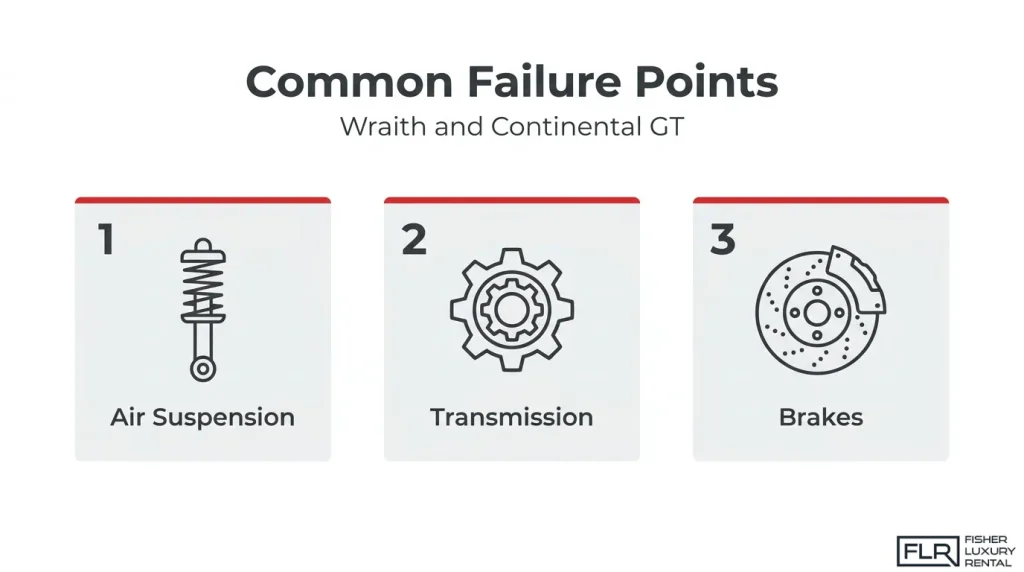
The failure points that differ between the Wraith and Continental GT span three primary systems: suspension and air ride, transmission, and brakes. Each model carries distinct mechanical tendencies shaped by its engineering platform and intended use.
What Suspension and Air Ride Issues Affect Each Model?
The suspension and air ride issues that affect each model differ meaningfully by platform design. The Wraith uses a self-leveling air suspension system inherited from the BMW/Rolls-Royce architecture, which prioritizes ride isolation over dynamic stiffness. Over time, air struts, compressors, and height sensors on the Wraith are commonly cited weak points, particularly on higher-mileage examples. The Continental GT’s air suspension similarly manages a heavier platform but is tuned more toward GT handling balance, making its adaptive dampers susceptible to wear under spirited driving. No model-specific failure rate data is currently available for either system, though a published study in the Journal of Retailing and Consumer Services confirms that used-car reliability directly influences buyer behavior and residual values, reinforcing why suspension condition matters disproportionately in this segment.
How Do Transmission Reliability Records Compare?
Transmission reliability records for the two models reflect their different gearbox philosophies. The Wraith uses an eight-speed ZF automatic paired to the N74 V12, a combination generally regarded as durable when serviced on schedule. The Continental GT uses a dual-clutch transmission in later generations, which delivers faster shifts but introduces greater complexity and higher sensitivity to fluid maintenance intervals. Owner reports suggest the dual-clutch unit on the Continental GT requires more attentive upkeep than the Wraith’s traditional torque-converter setup. For rental operators prioritizing seamless gear changes and minimal drivetrain surprises, the Wraith’s ZF pairing arguably presents a lower operational risk profile.
Which Model Has More Frequent Brake System Problems?
Brake system problems for the Wraith and Continental GT are not well documented through model-specific failure statistics. Both vehicles use large-diameter rotors with high-performance calipers suited to their weight and power output. Driving patterns significantly influence brake wear on either model: a UK government call for evidence by the Department for Environment, Food and Rural Affairs found that frequent braking and acceleration cycles, particularly over poorly designed speed bumps, accelerate both tyre wear and brake particle emissions. For either grand tourer, urban stop-and-go use creates substantially greater brake wear than highway cruising, making usage environment a stronger predictor of brake service intervals than brand alone.
How Does Driving Style Affect Reliability in Each Grand Tourer?
Driving style affects reliability in both grand tourers by determining how much stress is placed on their powertrains, brakes, suspension systems, and cooling components over time. Aggressive habits accelerate wear across all three systems, while disciplined, highway-oriented driving preserves long-term mechanical integrity.
How Does Aggressive Driving Affect the Rolls-Royce Wraith’s Reliability?
Aggressive driving affects the Wraith’s reliability by placing sustained thermal and mechanical demand on its BMW-derived N74 V12, air suspension, and braking system. Hard acceleration from the 624 hp twin-turbocharged engine generates significant heat. The N74’s electric auxiliary coolant pump runs for up to 30 minutes after shutdown to dissipate turbocharger heat, according to BMW Group Technical Training. Drivers who cut that cycle short by immediately powering off accessories risk incomplete heat dissipation. Frequent hard braking compounds wear on the Wraith’s large brake rotors. Given that unscheduled repair costs for either model have no published benchmark, avoiding aggressive habits is the most practical way to protect long-term reliability.
How Does Aggressive Driving Affect the Bentley Continental GT’s Reliability?
Aggressive driving affects the Continental GT’s reliability by concentrating stress on its W12 or twin-turbo V8 powertrain, cooling system, and transmission. The UK Department for Environment, Food and Rural Affairs found that frequent braking and acceleration increases tyre wear and brake particle emissions considerably. Because the Continental GT’s documented 2023 NHTSA recall involved thermal damage to an external coolant pump, drivers who push the engine hard and allow heat to accumulate face elevated risk of engaging that exact failure mode. Smooth, consistent highway cruising minimizes thermal cycling, reduces brake and tyre wear, and keeps the cooling system operating within its intended parameters. Rental platforms like Fisher Luxury Rental can give prospective buyers direct exposure to how each car behaves under real-world highway conditions before a purchase decision is made.
What Driving Habits Best Preserve Long-Term Reliability in Both Models?
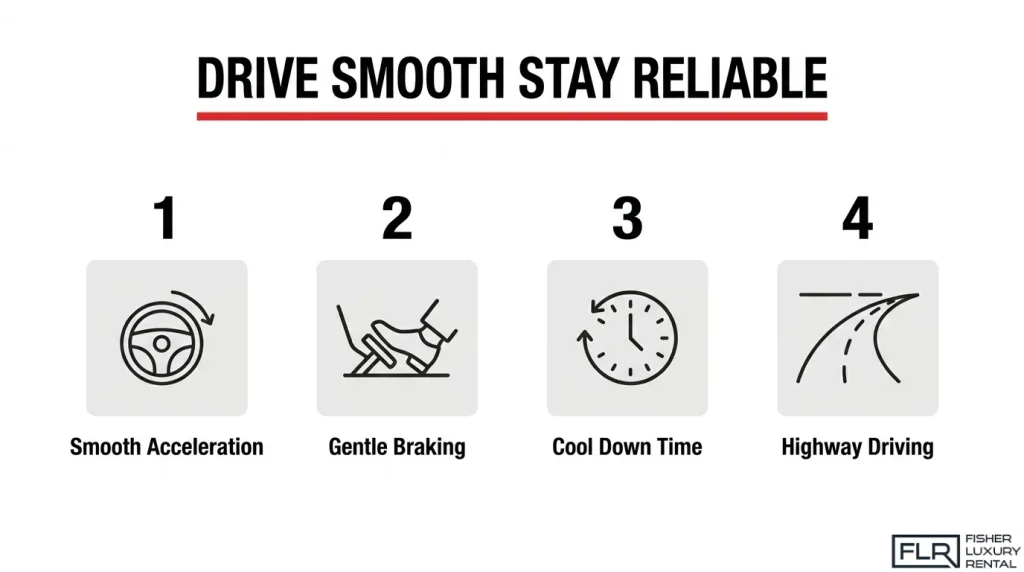
The driving habits that best preserve long-term reliability in both models are smooth acceleration, gradual braking, full post-drive cool-down periods, and avoiding road surfaces that stress suspension components. Both the Wraith and Continental GT are engineered as grand tourers, meaning sustained highway travel aligns with their design intent far better than urban stop-and-go patterns. Allowing turbocharged engines to idle briefly before shutdown lets oil and coolant temperatures normalize. Avoiding road salt exposure also matters: the U.S. EPA notes that rock salt causes approximately $5 billion in annual corrosion damage to vehicles nationwide. Treating either car as the refined long-distance machine it was built to be is the most reliable operating strategy available.
Should You Experience a Wraith or Continental GT Through a Luxury Rental?
Renting lets you evaluate both grand tourers firsthand without the financial commitment of ownership. The H3s below cover what Fisher Luxury Rental offers and the key reliability takeaways from this article.
Can Renting from Fisher Luxury Rental Let You Compare Both Models Firsthand?
Yes, renting from Fisher Luxury Rental can let you compare both models firsthand without ownership costs or long-term risk. No published data exists on ultra-luxury rental fleet downtime or cost-per-rental-mile specific to Wraith or Continental GT vehicles, so the strongest case for renting is experiential: a short-term rental gives you direct access to each car’s ride character, cabin refinement, and powertrain behavior before committing to a six-figure purchase decision. Fisher Luxury Rental stocks top-trim luxury and exotic vehicles across its Phoenix and Portland locations, with rentals available for prospective buyers wanting hands-on evaluation time in either market.
Fisher Luxury Rental operates in Phoenix, AZ and the Portland, OR area, offering top-trim luxury and exotic vehicles. For buyers researching either model, a rental removes the guesswork that owner forums and reliability surveys cannot fully resolve.
What Are the Key Takeaways About Rolls-Royce Wraith vs. Bentley Continental GT Reliability We Covered?
The key takeaways from this article are:
- The Wraith’s BMW-derived N74 V12 benefits from an extensive shared-parts ecosystem and a post-shutdown auxiliary cooling pump that protects turbochargers after the engine stops.
- The Continental GT’s W12 is hand-built over 6.5 hours per unit with a rigorous test regime, according to Bentley Motors Media, though a documented NHTSA recall (23V-034) flagged an external coolant pump defect on affected V8 variants.
- Rolls-Royce covers factory-recommended maintenance at no cost for four years with no mileage cap; Bentley’s new-car warranty runs three years with no mileage limit.
- No public dataset establishes which model breaks down more frequently, making direct ownership experience or a rental comparison the most reliable evaluation method available.