Matrix LED and laser headlights are the two most advanced automotive lighting technologies available, each using fundamentally different methods to generate, shape, and deliver light on the road ahead.
This guide covers how each technology works at a technical level, how their light output and adaptive precision compare, what they cost to buy and repair, which vehicles offer them, and how they perform across real-world driving conditions.
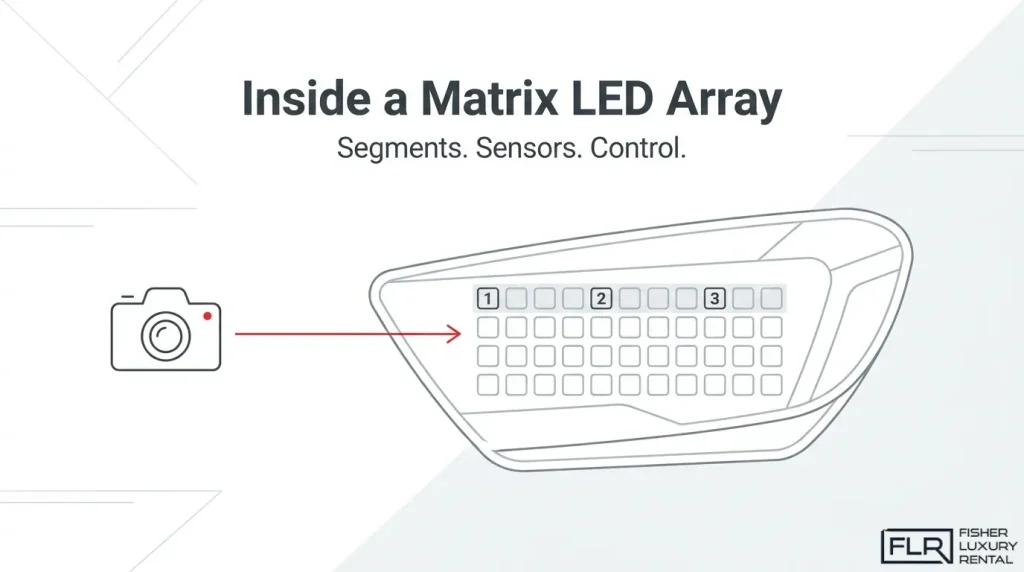
Matrix LED systems use arrays of individually controlled LED segments paired with cameras and algorithms to selectively dim zones around oncoming traffic, delivering pixel-level beam shaping with broad horizontal coverage. High-resolution implementations use up to 84 independent light segments, each mapped to a discrete road zone and controlled separately by the vehicle’s onboard system.
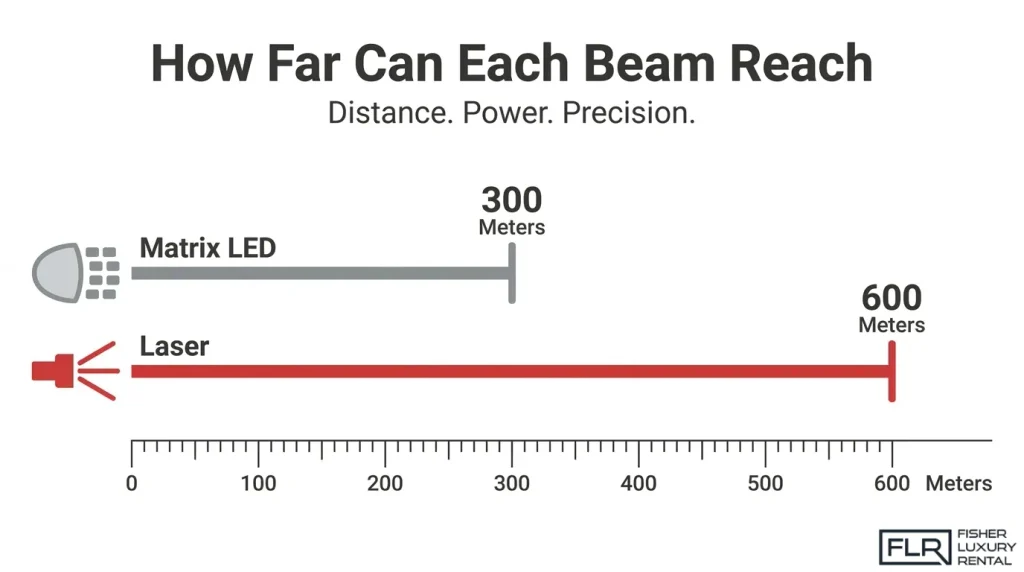
Laser headlights take a different approach: a blue laser diode fires into a sealed optical train, passing through a collimator, MEMS scanner, and beam expander before striking a phosphor plate that converts it to white light. The result is a beam that can reach 500 to 600 meters, roughly double the practical throw of matrix LED systems, though at a significantly higher unit and replacement cost.
Energy efficiency, durability, and legal status separate the two technologies further. Matrix LED modules draw 20 to 40 watts per unit and are rated for 30,000 to 50,000 hours of service life. Laser systems draw less at the diode level but carry greater thermal sensitivity and repair exposure. Regulatory approval also differs by market, with adaptive matrix LED now permitted in the US following a long-awaited NHTSA rule change, while laser headlights remain primarily an EU-market feature on flagship vehicles.
What Are Matrix LED Headlights and How Do They Work?
Matrix LED headlights are an adaptive lighting technology that divides the headlight array into individually controlled LED segments, allowing the system to shape the beam around other road users in real time. The following sections cover how those segments are arranged, how adaptive beam control operates, and which sensors make dynamic beam shaping possible.
What Individual LED Segments Make Up a Matrix Array?
The individual LED segments that make up a matrix array are discrete, independently powered LEDs arranged in a grid, each paired with its own optic to direct light into a defined zone of the road ahead. One documented high-resolution design uses 84 independent silicon lenses to collimate the LEDs and project illumination across 84 separate areas at 25 meters, with each segment’s brightness controlled independently by the system’s control unit, according to research published in the journal Applied Sciences (MDPI, 2021).
How Does Adaptive Beam Control Function in Matrix LED Units?
Adaptive beam control in matrix LED units functions by activating or dimming individual LED segments in response to detected road conditions, rather than switching between a fixed high beam and low beam. According to SPIE research on advanced LED technology for automotive applications, adaptive beam functions are achieved through matrix modules consisting of a matrix board of LEDs, pre-collimating optics, and a projection lens or reflective mirrors. Under the U.S. Federal Code (49 CFR 571.108), adaptive driving beam is formally defined as a long-range forward-visibility beam that automatically modifies portions of projected light to reduce glare to other road users on a continuous, dynamic basis. This architecture is far more capable than a traditional two-state beam switch, making pixel-level control the foundation of modern glare-free high-beam systems.
Which Sensors and Cameras Enable Real-Time Beam Shaping?
The sensors and cameras that enable real-time beam shaping are forward-facing cameras, radar or lidar sensors, and onboard processing algorithms working together. According to a 2023 study presented at ACM ICMLT, the system uses cameras, sensors, and algorithms to detect the presence of other vehicles and adjust the headlight beams accordingly. The camera captures the scene ahead, the algorithms classify objects such as oncoming headlights and tail lights, and the control unit instantly dims only the LED segments that would otherwise strike those targets, leaving the rest of the beam at full intensity.
What Are Laser Headlights and How Do They Work?
Laser headlights are automotive lighting systems that use blue laser diodes to excite a phosphor element, producing an exceptionally bright white beam. The sections below cover the phosphor conversion process, the optical components that shape the beam, and the safety mechanisms that make laser light road-legal.
How Does Laser-Phosphor Conversion Produce White Light?
Laser-phosphor conversion produces white light by directing a high-intensity blue laser diode onto a phosphor plate, which absorbs the blue wavelength and re-emits it as broad-spectrum white light. The phosphor plate acts as the conversion stage, so the raw laser beam never exits the headlight housing as coherent blue light. This two-step process yields luminous intensity far exceeding conventional LED sources while keeping emitted light safe for oncoming drivers. According to the U.S. Department of Energy, good-quality white LED lighting products have a useful life of 30,000 to 50,000 hours, and laser-phosphor systems are engineered to meet or exceed that benchmark by running the laser diode at lower thermal loads than direct LED arrays.
What Optical Components Focus and Distribute a Laser Beam?
The optical components that focus and distribute a laser beam are a collimator, a beam expander, a MEMS scanner, and a phosphor plate working in sequence. A blue laser diode fires into a collimator, which straightens the diverging rays into a parallel beam. A single-axial MEMS scanner then spatially modulates that beam, and a beam expander widens it into a 2D projection pattern before it strikes the phosphor plate. The resulting white light is then shaped by a projection lens or reflective mirror into the final road beam. Per OSHA’s Technical Manual on Laser Hazards, an enclosure around the laser limits access to the beam at or below the applicable maximum permissible exposure level, ensuring the optical train remains sealed throughout normal operation.
Which Safety Mechanisms Prevent Direct Laser Exposure?
The safety mechanisms that prevent direct laser exposure include hermetically sealed housings, phosphor-plate interlock systems, automatic shutoff circuits, and compliance with international laser safety standards. If the phosphor plate is damaged or displaced, the shutoff circuit kills the laser diode before coherent blue light can exit the unit. IEC 60825-1:2014, which covers laser products emitting radiation in the wavelength range of 180 nm to 1 mm, sets the classification framework that automotive laser headlights must satisfy before reaching the market. These layered controls mean the driver and pedestrians are never exposed to the raw beam under any realistic road scenario, making the technology far safer in practice than its “laser” label might suggest.
How Does Light Output Compare Between Matrix LED and Laser?
Light output differs significantly between matrix LED and laser systems in throw distance, intensity, and energy use. The sections below compare high-beam reach models and mid-range lux levels for both technologies.
How Far Does a Matrix LED High Beam Reach Models?
Matrix LED high beams models reach approximately 200 to 300 meters, depending on the number of independently controlled segments and optical design. What makes this performance notable is the efficiency behind it: according to research by Waldner, Müller, and Bertram published in the International Journal of Electrical and Computer Engineering Research, a matrix adaptive system achieves comparable object detection quality to a conventional high beam while requiring only around 16% of the energy. For a technology that matches full high-beam visibility, that energy ratio is arguably its most underappreciated advantage.
How Far Does a Laser High Beam Reach Models?
Laser high beam models extend to approximately 500 to 600 meters, roughly double the practical throw of matrix LED systems under ideal conditions. This long-range capability comes with an important safety consideration: the UK Health Security Agency notes that dazzle, flash-blindness, and afterimages may be caused by a Class 2 laser beam, particularly under low ambient light conditions, with specific concern for safety-critical tasks such as driving. Automakers address this through phosphor conversion and sealed optical enclosures that eliminate direct laser exposure, but the raw intensity advantage remains the defining characteristic of laser systems.
How Do Lux Levels and Beam Intensity Differ at Mid-Range?
Lux levels and beam intensity differ meaningfully between the two technologies at mid-range distances, roughly 100 to 200 meters. Laser systems maintain higher candela output at those distances because the collimated beam disperses less than an LED array. Matrix LED systems compensate with broader horizontal spread and granular zone control, making them better suited for illuminating road edges and pedestrian areas at mid-range. For high-speed highway driving where forward throw matters most, laser has a clear intensity edge; for mixed urban and suburban environments, matrix LED’s coverage pattern is more practical.
How Does Adaptive Beam Precision Differ Between the Two?
Adaptive beam precision differs between matrix LED and laser headlights in the granularity of masking zones, the sharpness of shadow boundaries, and system response speed. The H3s below cover matrix LED masking accuracy, laser masking accuracy, and which system reacts faster to dynamic conditions.
How Precisely Can Matrix LED Headlights Mask Oncoming Traffic?
Matrix LED headlights mask oncoming traffic by selectively dimming individual LED segments within a multi-zone array. A representative high-resolution implementation uses 84 independent light segments, each controlled separately, projecting across distinct zones at 25 meters. Because each LED maps to a fixed spatial zone, the shadow boundary is defined by segment width rather than a continuously steerable beam. This creates a graduated but discrete masking pattern: precise enough to protect oncoming drivers from glare, though shadow edges may show slight stepping artifacts between adjacent zones at close range.
How Precisely Can Laser Headlights Mask Oncoming Traffic?
Laser headlights mask oncoming traffic using a MEMS scanner that steers a collimated blue laser beam across a phosphor plate in real time, generating a spatially modulated 2D illumination pattern. According to research published in a study on piezoelectric MEMS mirror scanning for automotive laser headlights, the single-axial scanner reflects and linearly expands the beam before it reaches the phosphor, allowing the system to shape shadow zones with sub-segment resolution. The resulting mask boundary is smoother and more continuously adjustable than fixed-zone LED arrays, since the steered spot is not constrained to discrete segment positions.
Which System Responds Faster to Dynamic Road Conditions?
Response speed to dynamic road conditions favors laser-based systems with active scanning architectures over current commercial matrix LED implementations. A study cited in IEEE Transactions on Intelligent Transportation Systems found average adaptation times for commercial ADB systems ranging from 560 ms on the Audi A8 to 1.2 seconds on the BMW X5. By contrast, a Carnegie Mellon University report on programmable automotive headlights found that a DMD-based system achieves a total end-to-end latency of just 2.0 ms. Laser and high-density pixel systems with active modulation components can therefore respond orders of magnitude faster, though thermal management at interconnects remains a reliability consideration for sustained high-speed operation.
How Does Energy Efficiency Compare in Matrix LED vs Laser?
Energy efficiency in matrix LED vs laser headlights differs in wattage draw, thermal management, and impact on vehicle range. The H3s below cover per-module power consumption for each technology and how both systems influence EV range and fuel economy.
How Many Watts Does a Matrix LED Headlight Module Draw?
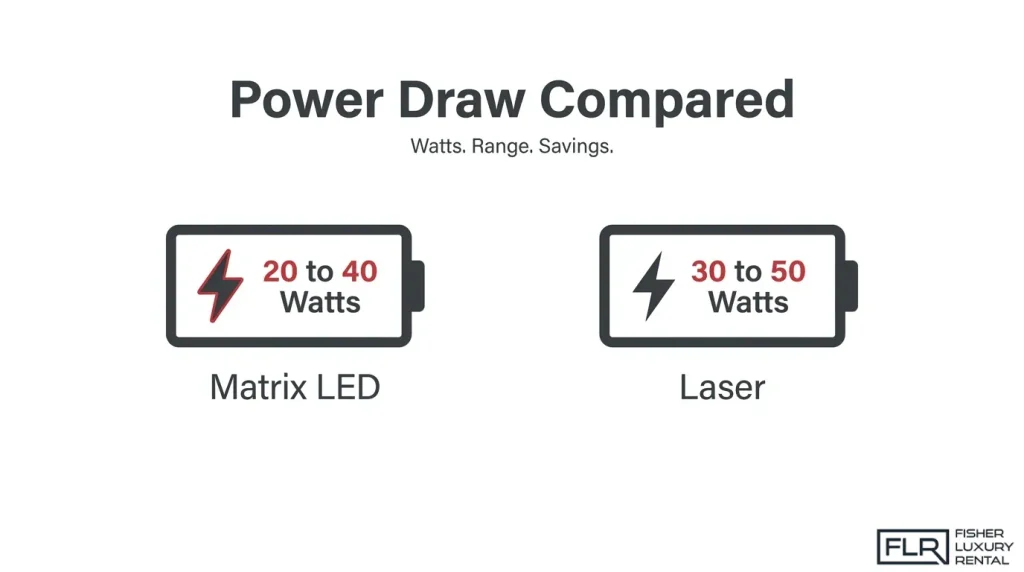
A matrix LED headlight module draws roughly 20 to 40 watts per unit under typical operating conditions, depending on the number of active segments and dimming state. Because each LED segment can be switched off independently, real-world draw is often well below the peak rating. A University of Michigan Transportation Research Institute study found that an all-LED system produces general power savings of approximately 50% at night and up to 75% during daytime compared to traditional halogen systems, largely because LEDs only consume power in the zones where illumination is needed.
How Many Watts Does a Laser Headlight Module Draw?
A laser headlight module draws approximately 3 to 10 watts per unit for the laser diodes themselves, making the light source considerably more power-efficient per lumen than conventional LEDs. However, the total system draw rises when accounting for the MEMS scanner, control electronics, phosphor cooling, and safety monitoring circuits. In practice, total laser headlight system consumption sits closer to 30 to 50 watts per assembly, partially offsetting the raw diode efficiency advantage.
How Does Each System Affect EV Range and Fuel Economy?
Each headlight system affects EV range and fuel economy through its total electrical load on the vehicle’s power supply. Lower sustained wattage translates directly into extended range on battery-electric vehicles, where every watt matters. Research published in the International Journal of Electrical and Computer Engineering Research by Waldner, Müller, and Bertram found that adaptive headlight concepts can achieve object-detection quality comparable to conventional high beam while requiring only around 16% of the energy, illustrating the outsized efficiency gains available from intelligent beam management. Both matrix LED and laser systems benefit from zone-based dimming strategies; adaptive operation, rather than raw hardware choice, tends to deliver the largest real-world fuel and range savings.
How Do Lifespan and Durability Differ Between the Two?
Matrix LED modules and laser headlight modules differ meaningfully in rated lifespan, failure modes, and thermal sensitivity. The H3s below cover expected service life for each technology and how extreme temperatures affect long-term reliability.
How Long Do Matrix LED Modules Last Before Replacement?
Matrix LED modules last between 30,000 and 50,000 hours under normal operating conditions, according to the U.S. Department of Energy. At two hours of nightly use, that translates to roughly 40 or more years before meaningful output degradation occurs in most vehicles. However, the IEA 4E Solid State Lighting Annex cautions that high junction temperatures degrade components surrounding the LED chip, causing parametric failure, while thermal stress at interconnects can cause catastrophic failure well before the rated ceiling is reached. In practice, module longevity depends heavily on heat management quality. Matrix LEDs are, by most measures, the longer-serving technology for everyday drivers who prioritize low-maintenance ownership.
How Long Do Laser Headlight Modules Last Before Replacement?
Laser headlight modules are rated for comparable or slightly shorter service lives than matrix LED arrays, primarily because the blue laser diodes and phosphor conversion plates each have independent degradation timelines. The phosphor plate dims with cumulative photon exposure, and the laser diode itself is sensitive to drive current stability and thermal cycling. No single standardized lifespan figure applies across all manufacturers, and replacement intervals vary by brand and usage intensity. Because laser systems carry higher unit costs, a failed laser module typically represents a significantly more expensive repair event than replacing an equivalent LED array.
How Does Extreme Heat or Cold Affect Each Technology?
Extreme heat and cold affect matrix LED and laser headlight modules in distinct ways. For LED systems, a Yonsei University study on automotive headlamp thermal performance found that LED array junction temperature dropped from 70.6°C to 30.25°C as airflow increased from 0 to 120 km/h, confirming that thermal management is directly tied to vehicle speed and cooling design. In stationary or slow-moving traffic, heat buildup accelerates component wear. Cold temperatures generally extend LED lifespan but can slow phosphor warm-up in laser units and introduce condensation risks around precision optics. Laser systems are more sensitive to temperature extremes at both ends, as the phosphor plate and mirror assembly require tighter operating tolerances than a solid-state LED array.
What Does Each Headlight System Cost to Buy and Repair?
Headlight system costs vary significantly between matrix LED and laser technologies, both at the factory option stage and during ownership. The sections below cover typical new-vehicle pricing, repair exposure, and module replacement costs for each system.
What Is the Typical Cost of Factory Matrix LED Headlights?
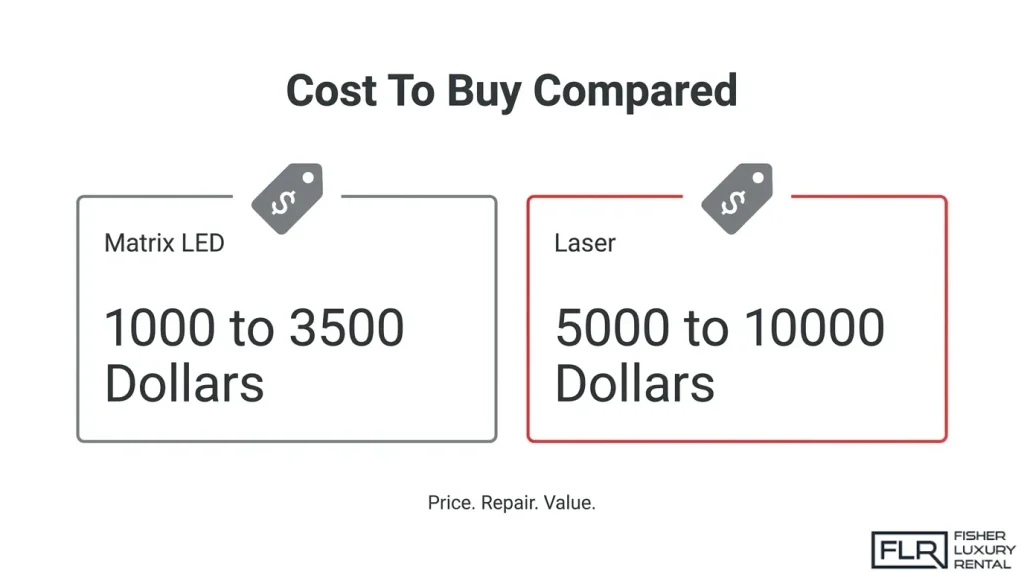
The typical cost of factory matrix LED headlights ranges from roughly $1,000 to $3,500 as an option or trim upgrade, depending on the manufacturer and configuration. Entry-level matrix systems appear on mid-tier trims of mainstream luxury vehicles, while high-resolution pixel LED variants with 84 or more independently controlled segments command premium pricing on upper trims. Because the technology is now widely manufactured, production volume has driven unit costs down considerably compared to even five years ago. For most buyers, matrix LED represents the more accessible advanced headlight investment. For drivers who want to evaluate these systems before committing to a purchase, luxury rental companies like Fisher Luxury Rental offer top-trim models in Phoenix and Portland where these technologies can be assessed on real roads.
What Is the Typical Cost of Factory Laser Headlights?
The typical cost of factory laser headlights runs from approximately $5,000 to $10,000 or more as a standalone option, most commonly on flagship trims of brands such as BMW, Audi, and Mercedes-Benz. Laser systems require phosphor conversion plates, precision collimating optics, and enclosed beam housings, all of which add manufacturing complexity and cost. In most cases, laser headlights are bundled within premium technology or lighting packages rather than offered as isolated line items, making the true per-system cost difficult to separate from package pricing. This bundling often inflates the perceived cost even further.
How Much Does a Single Module Replacement Cost for Each?
A single module replacement cost for matrix LED headlights typically falls between $800 and $2,500 per assembly at an authorized dealer, while laser headlight module replacement commonly ranges from $3,000 to over $8,000 per unit. Labor for either system is non-trivial, as both require calibration after installation. The Carnegie Mellon University report on smart automotive headlights notes that DMD-based systems achieve a total processing latency of just 2.0 ms, which reflects the precision electronics embedded in these assemblies and explains why component costs remain high. For ownership planning, laser systems carry meaningfully greater repair exposure than matrix LED.
Which Luxury Vehicles Offer Each Headlight Technology?
The luxury vehicle landscape splits headlight technology across trim levels and manufacturers, with matrix LED far more widely available than laser. The sub-sections below cover models with standard matrix LED, models with standard laser headlights, and models offering both as configurable options.
Which Models Come Standard with Matrix LED Headlights?
The models that come standard with matrix LED headlights include vehicles equipped at specific trim levels. According to IIHS ratings data, Volvo EC40 receives Pixel LED Headlights on the Plus trim (as a package option) and the Ultimate trim as standard equipment. Matrix LED availability across the broader luxury segment follows a similar pattern: manufacturers typically reserve these systems for upper trims rather than base configurations.
- Volvo EC40: Plus trim (with Pixel LED Headlights package) and Ultimate trim
- Typical availability: Upper and top-trim configurations across most luxury brands
Buyers prioritizing adaptive beam precision should confirm trim-level specifications directly with the manufacturer before purchase, as packaging can shift mid-model year.
Which Models Come Standard with Laser Headlights?
The models that come standard with laser headlights remain a small and premium subset of the luxury segment. Laser headlight systems use a blue laser collimated into a beam, spatially modulated by a MEMS scanner, then expanded and projected onto a phosphor plate to produce high-brightness white light, as documented in research published in a study on piezoelectric MEMS mirror scanning for adaptive laser headlights. This optical complexity limits laser headlights to flagship-tier vehicles and halo models from European manufacturers, where the technology justifies a significant price premium.
Confirmed or expected laser headlight fitment is concentrated in brands such as BMW and Audi at their top specification levels, though exact model-year availability should be verified through manufacturer configurators.
Which Models Offer Both Technologies as Configurable Options?
The models that offer both technologies as configurable options are generally those from European luxury manufacturers with extensive build-to-order programs. Buyers can typically select matrix LED as a standard upper-trim feature and upgrade to laser units through an optional lighting package on select models. This approach is most common in brands such as BMW and Audi, where matrix LED ships as standard on mid-tier trims and laser headlights appear as a premium add-on for flagship variants. Verifying real-world availability through a brand’s online configurator remains the most reliable confirmation method, as regional regulations still limit laser headlight approval in some markets.
Are Matrix LED and Laser Headlights Legal Everywhere?
Matrix LED and laser headlights are not universally legal. Legality depends on region, regulatory body, and technology type. The H3s below cover adaptive LED street-legality, laser headlight status, and recent NHTSA rule changes.
Where Are Adaptive Matrix LED Headlights Street-Legal?
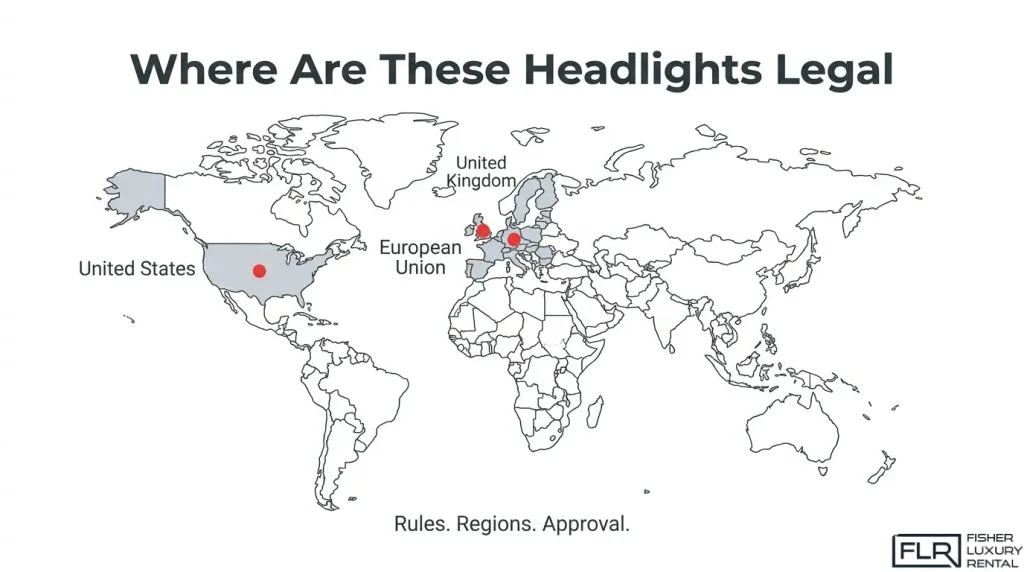
Adaptive matrix LED headlights are street-legal in most major markets, including the European Union, United Kingdom, and United States, though the path to US legality was long. The EU governs approval under Regulation (EU) 2018/858, which requires vehicles and components to comply with listed regulatory acts. The UK permits adaptive beams provided they do not cause undue dazzle under The Road Vehicles Lighting Regulations 1989. In the US, the Federal Register published a final rule amending FMVSS 108 to permit certification of adaptive driving beam (ADB) headlamps, with the Electronic Code of Federal Regulations defining ADB as a long-range beam that dynamically modifies projected light to reduce glare. SAE standard J3069 provides supporting test procedures and performance requirements manufacturers must meet for US compliance.
Where Are Laser Headlights Street-Legal?
Laser headlights are street-legal primarily in the European Union and select other markets, while US availability remains limited. The technology has faced scrutiny due to eye-safety concerns, with IEC 60825-1:2014 governing laser product safety across the wavelength range 180 nm to 1 mm. However, momentum is clearly building. According to IEEE Spectrum, Paul Rudy, general manager of the laser division of Soraa, states: “Wherever you want directional, flexible applications of light, the industry is moving like a freight train in the laser’s direction.” For consumers, laser headlights remain largely an EU-market feature on premium vehicles, with broader global adoption still developing.
How Have Recent US NHTSA Regulations Changed Availability?
Recent NHTSA regulations have significantly expanded adaptive headlight availability in the United States. The National Highway Traffic Safety Administration issued a final rule allowing automakers to install adaptive driving beam headlights on new vehicles, ending a decades-long regulatory gap where the US lagged far behind Europe. Under the amended standard, FMVSS 108 now formally permits ADB headlamp certification, and UNECE UN Regulation No. 149 provides an international framework that bridges US and European compliance approaches. This regulatory shift means US buyers can now expect factory-fitted ADB systems on new models, though laser-specific rules remain less defined domestically.
How Do Real-World Driving Conditions Affect Performance?
Real-world driving conditions affect performance differently for each system. The following H3s cover wet roads, fog and heavy snow, and winding mountain roads at night.
How Does Each System Perform on Wet or Rainy Roads?
Each system performs on wet or rainy roads by adapting beam patterns to compensate for reduced visibility and increased light scatter. Matrix LED units segment their output across independent zones, allowing the system to lower intensity in areas where road surface reflections would otherwise cause glare. Laser headlights maintain a highly focused, long-range beam, though their narrow projection means peripheral illumination on wet curves depends more heavily on the vehicle’s steering-reactive optics. For rain-soaked city driving with oncoming traffic, the pixel-level masking of matrix LED systems offers a practical advantage over laser’s concentrated throw.
How Does Each System Perform in Fog or Heavy Snow?
Each system performs in fog or heavy snow by relying on beam modulation to reduce backscatter. Standard high-beam output from either technology amplifies reflected light off precipitation, reducing visibility. However, programmable headlight research shows promise: according to researchers cited by the American Institute of Physics (Inside Science), a smart headlight system could eliminate up to 70 to 80 percent of visible rain or snow while driving at low speeds during heavy storms. Matrix LED systems are better positioned to adopt this approach, as their independent zone control can selectively suppress pixels striking active precipitation droplets.
How Does Each System Handle Winding Mountain Roads at Night?
Each system handles winding mountain roads at night by delivering sustained illumination through curves, but they differ in efficiency. Matrix LED headlights draw less power while maintaining broad coverage across tight bends. According to the University of Michigan Transportation Research Institute (UMTRI), an all-LED system produces power savings of approximately 50 percent at night compared to traditional systems, supporting longer adaptive operation without thermal throttling. Laser headlights offer superior straight-line distance on open mountain passes, but their narrower beam spread requires supplementary LED fill elements through hairpin curves. For the full variety of mountain driving, matrix LED’s wider zone coverage provides more consistent illumination.
With conditions ranging from rain to mountain switchbacks, choosing the right headlight technology matters most when visibility is already compromised.
How Can You Experience Matrix LED or Laser Headlights Firsthand?
You can experience matrix LED or laser headlights firsthand by renting a top-trim luxury or exotic vehicle equipped with these systems. The sections below cover hands-on rental driving and the key takeaways from this full comparison.
Can Renting a Top-Trim Exotic Car Show the Difference on Real Roads?
Yes, renting a top-trim exotic car can show the difference on real roads, and it remains the most practical way for most drivers to compare these technologies without a six-figure purchase commitment. Dealership test drives rarely include nighttime routes, but a multi-day rental does. Driving a vehicle equipped with matrix LED or laser high beams on unlit highways, winding roads, and rain-slicked streets makes the adaptive beam behavior immediately tangible in ways no spec sheet can replicate. Fisher Luxury Rental stocks top-trim models across its luxury and exotic fleet, which means the vehicles it carries are more likely to include advanced lighting packages that entry configurations typically omit. For anyone weighing which technology suits their lifestyle, a real-road night drive is the most informative evaluation available. Fisher Luxury Rental, which operates in Phoenix, AZ and Portland, OR, specializes in top-trim luxury and exotic vehicles – the trim levels where matrix LED and laser headlight packages are most commonly found as standard equipment.
What Are the Key Takeaways About Matrix LED vs Laser Headlights?
The key takeaways about matrix LED vs laser headlights are that both outperform conventional halogen and HID systems, but they serve different priorities. Matrix LED headlights deliver precise, pixel-level adaptive beam control across a wide array of segments, making them the more accessible and broadly available choice. Laser headlights offer superior throw distance and luminous intensity, suited for high-speed, open-road driving. According to the U.S. Food and Drug Administration, lasers are classified across four major hazard classes (I to IV), including three subclasses (IIa, IIIa, and IIIb), underscoring why automotive laser systems require tightly engineered safety enclosures before reaching consumers. For most drivers, matrix LED delivers exceptional performance at a lower cost of entry, while laser technology remains the pinnacle option for those who prioritize maximum range and prestige.