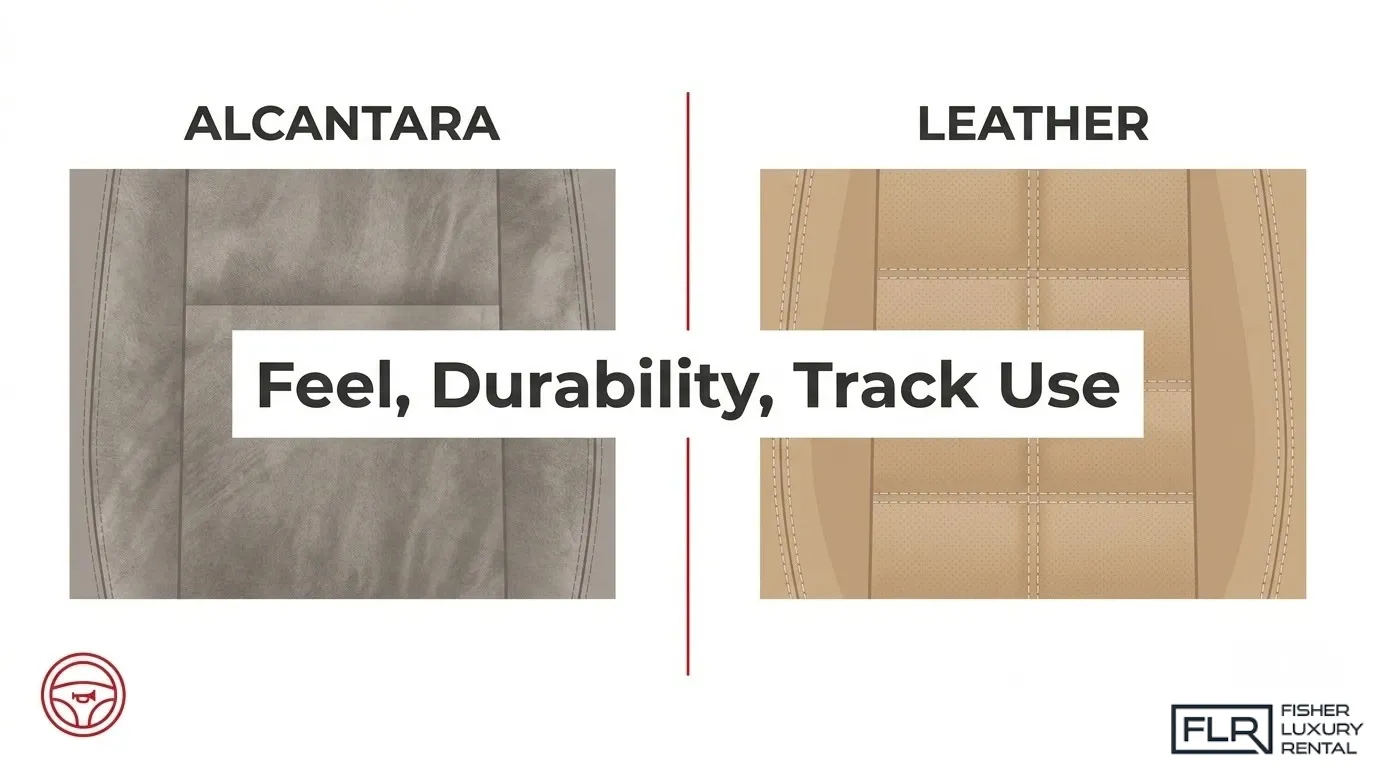
Alcantara is a synthetic microfiber material composed of 68% polyester and 32% polyurethane, developed in Italy to mimic suede’s texture while offering greater resilience and significantly lower weight than natural leather. Leather, by contrast, is animal hide processed to varying grades – full-grain, semi-aniline, and synthetic alternatives – each with distinct durability, breathability, and maintenance characteristics.
This guide covers what each material is made of and how they differ, how they feel across temperature extremes and grip scenarios, how they hold up under daily use and UV exposure, why track cars and supercars favor Alcantara, and how interior material choice affects luxury car resale value.
Alcantara and leather feel distinctly different in the hand and against the body. Alcantara stays closer to ambient temperature in heat, warms faster in cold, and offers strong seat grip during lateral cornering loads. Leather runs cooler to the touch initially, conducts heat away from the body in winter, and generally outperforms Alcantara on steering wheel grip for spirited driving.
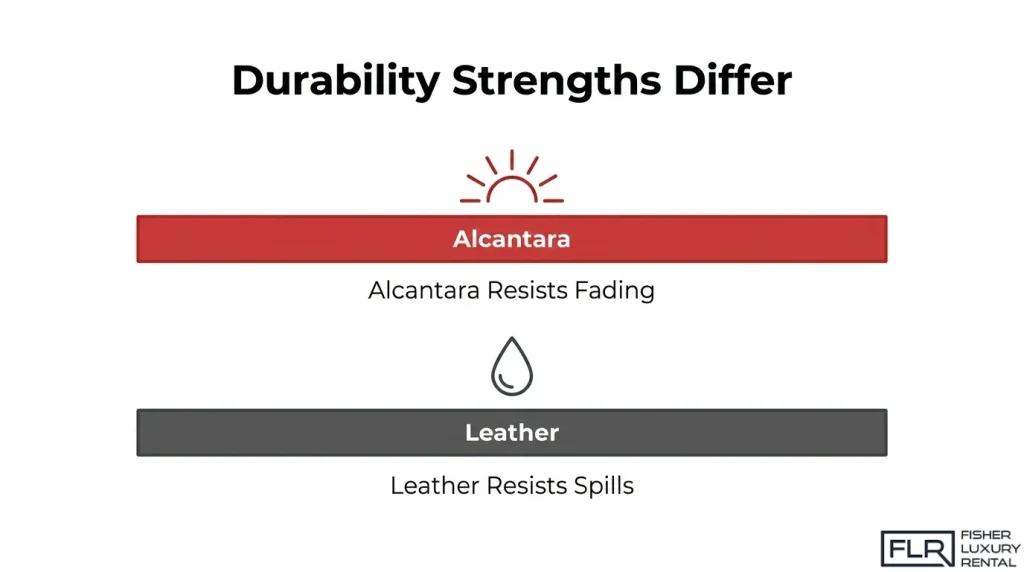
Durability and maintenance separate the two materials further. Leather resists liquid spills more readily on coated surfaces and ages into a patina when conditioned properly, while Alcantara resists cracking and UV fading but absorbs spills faster and demands careful, fiber-specific cleaning routines.
Alcantara’s dominance in performance vehicles comes down to weight and function. It is up to 50% lighter than leather, and manufacturers including Lamborghini and Ferrari specify it in track-focused models precisely because those mass savings translate directly into lap-time gains. For daily drivers, leather remains the more practical long-term surface, while Alcantara excels in performance-oriented builds where grip, weight, and cabin feel are the engineering priorities.
What Is Alcantara and How Does It Differ From Real Leather?
Alcantara and real leather differ in origin, composition, and performance properties. The sections below cover what Alcantara is made of, how leather is defined and graded, and the key distinctions between the two materials in automotive applications.
What Is Alcantara Made Of?
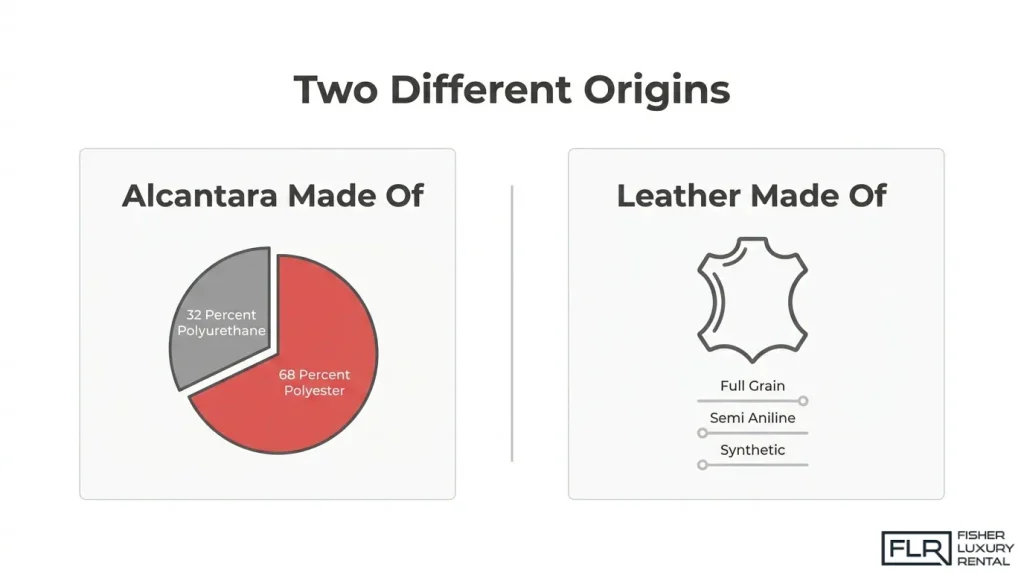
Alcantara is a synthetic material developed in Italy, composed of 68% polyester and 32% polyurethane. Manufactured through a proprietary process by Alcantara S.p.A., with production at its plant in Nera Montoro, Umbria, the material mimics the texture of suede while offering greater resilience. Its microfiber construction gives it a soft, velvety hand feel that distinguishes it from both natural leather and standard synthetic upholstery.
What Is Real Leather in an Automotive Context?
Real leather in an automotive context is animal hide processed to varying grades, such as full-grain, top-grain, and semi-aniline, each retaining different amounts of the original surface. According to the Leather Research Laboratory at the University of Cincinnati, full-grain leather retains the original grain surface with no buffing or splitting, making it the most natural and densely fibered grade. Semi-aniline leather receives a light pigment coating that evens surface color and adds protective uniformity. These grades directly affect softness, breathability, and long-term durability in car interiors.
How Does Alcantara Differ From Leather as a Material?
The core difference between Alcantara and leather is that one is a synthetic microfiber product and the other is a natural animal-derived material. Leather’s hydrophilic fibers absorb moisture, contributing to breathability that synthetics struggle to match; a study published in the journal Coatings by M. Meyer et al. found that none of the alternative materials tested achieved the comfort properties of leather, particularly in water vapor management. Alcantara, by contrast, is lighter, more consistent in appearance, and does not require the conditioning routines that leather demands to prevent cracking or drying.
What Does Alcantara Feel Like Compared to Leather?
Alcantara feels like suede: velvety, soft, and tactile, while leather feels smooth, firm, and cooler to the touch. The sections below cover how each material performs in hot and cold conditions, and which provides better grip on seats and steering wheels.
How Does Alcantara Feel in Hot Weather?
Alcantara feels noticeably more comfortable than leather in hot weather because its fibrous, breathable structure does not absorb and radiate heat the way smooth leather does. The material stays closer to ambient temperature, reducing the burning sensation common with sun-exposed leather seats. Ferrari uses Alcantara extensively in the 488 Pista Spider cockpit precisely because its technical properties suit high-temperature, high-performance environments without sacrificing tactile quality.
How Does Leather Feel in Hot Weather?
Leather feels noticeably hot in warm weather because its smooth, dense surface absorbs solar heat and transfers it directly to skin. A sun-exposed leather seat can become uncomfortably warm within minutes of parking, making entry unpleasant in summer climates. Perforated leather reduces this effect, but solid leather retains heat far more than Alcantara’s open-fiber construction.
How Does Alcantara Feel in Cold Weather?
Alcantara feels warmer than leather in cold conditions because its dense microfiber pile traps a thin layer of air that acts as insulation. Unlike leather, which feels immediately cold on contact, Alcantara reaches a comfortable hand temperature quickly. This makes it a more pleasant experience during winter without requiring heated seat pre-conditioning.
How Does Leather Feel in Cold Weather?
Leather feels cold and stiff in low temperatures because it conducts heat away from the body on initial contact. Thicker hides take longer to warm up, and untreated leather can stiffen slightly, affecting the suppleness of the surface. Heated seats substantially offset this, but the initial cold-to-the-touch sensation remains a consistent characteristic of leather interiors.
Which Material Provides Better Grip on Seats and Steering Wheels?
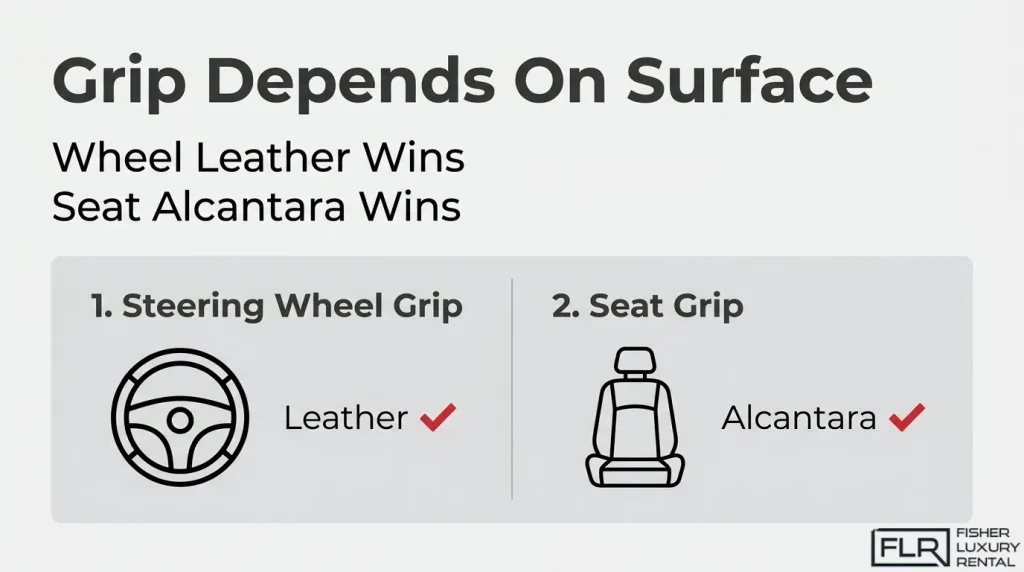
The grip comparison between Alcantara and leather depends on the application: leather generally outperforms Alcantara on steering wheels, while Alcantara provides more body grip on seats. According to a KTH Royal Institute of Technology study on steering wheel tactility, friction between hand and wheel is essential for control without requiring excessive grip force. Some reviewers note that Alcantara is a low-friction material that the skin slides over fairly easily on steering wheels, making leather the grippier option for spirited driving. BMW counters this with engineered exceptions; the M Alcantara steering wheel on the M2 Coupe is specifically designed with an ergonomic, non-slip surface. For seat surfaces, Alcantara’s fibrous texture naturally holds the driver in position better than smooth leather during lateral cornering loads.
How Durable Is Alcantara Compared to Leather?
Alcantara and leather each hold up differently depending on use, environment, and maintenance. The following sections cover lifespan, UV resistance, and stain resistance for both materials.
How Long Does Alcantara Last With Regular Use?
Alcantara lasts well under regular use, but its fiber structure makes it more vulnerable to heavy abrasion than full-grain leather. High-contact areas such as seat bolsters and steering wheels tend to show wear first, particularly with repeated friction from driving gloves or racing suits. The material resists pilling under moderate use, and its synthetic construction means it won’t crack or dry out the way untreated leather can. For daily drivers, Alcantara typically maintains its appearance longer when kept clean and free of grit, which acts as an abrasive on the fine fibers.
How Long Does Leather Last With Regular Use?
Leather lasts longer under heavy daily use when properly maintained, and the grade of hide directly determines its durability. According to the Leather Research Laboratory at the University of Cincinnati, full-grain leather retains the original grain surface with none removed by buffing or splitting, making it the densest and most abrasion-resistant grade available. Semi-aniline leather, treated with a light pigment coat to even its surface, adds a protective layer that improves resistance to minor scuffs. Consumer Reports recommends cleaning leather with saddle soap followed by an automotive-specific conditioner to prevent drying and cracking. Without conditioning, leather dries, stiffens, and cracks, significantly shortening its usable life.
How Does Alcantara Hold Up Against Fading and UV Exposure?
Alcantara holds up reasonably well against UV exposure compared to untreated natural materials, but prolonged direct sunlight does degrade its synthetic fibers over time. Research on automotive upholstery fabrics published in the Journal of Engineered Fibers and Fabrics confirms that UV radiation reduces tenacity, elongation, and abrasion resistance in interior textiles after extended exposure. Darker Alcantara colors are more susceptible to visible fading than lighter shades. Using a UV-blocking windshield shade and parking out of direct sunlight are the most practical ways to extend Alcantara’s color stability in high-sun climates.
How Does Leather Hold Up Against Fading and UV Exposure?
Leather holds up against UV exposure in proportion to its surface coating and conditioning frequency. Unprotected aniline leather fades and dries significantly faster than pigment-coated semi-aniline or protected full-grain leather, because the coating layer absorbs and reflects UV energy before it penetrates the hide. According to Gruppo DANI, semi-aniline leather’s light pigment treatment smooths imperfections and adds a protective layer that shields the natural grain. Without regular conditioning, even coated leather becomes brittle and fades unevenly. Leather’s natural protein structure breaks down under sustained UV stress, which is why consistent care matters more for leather than for Alcantara in sunny environments.
Which Material Resists Stains and Spills Better?
Leather resists liquid spills better than Alcantara because its surface coating causes most fluids to bead before absorbing. Alcantara’s microfiber construction absorbs liquids quickly if spills are not wiped immediately, making it harder to clean once a stain sets. The key differences in stain resistance are:
- Leather: Beads most water-based spills on coated surfaces; oils and dyes penetrate if left too long.
- Alcantara: Absorbs liquids faster due to its open fiber structure; acts more like a fabric than a sealed surface.
- Unprotected leather: More vulnerable than coated grades to oil-based stains and dark-colored liquids.
- Alcantara with fabric protector: Improves resistance significantly, bringing performance closer to coated leather.
From a practical standpoint, leather is the safer choice for spill-prone environments, while Alcantara rewards owners who act quickly on spills and apply protective treatments proactively.
How Do You Maintain Alcantara vs. Leather Interiors?
Maintaining Alcantara and leather interiors requires different approaches, tools, and routines. The sections below cover the specific cleaning methods for each material.
How Do You Clean and Care for Alcantara?
Cleaning and caring for Alcantara requires gentle, targeted techniques to preserve its suede-like texture. Use a soft-bristled brush or microfiber cloth to lift surface debris, always brushing in one direction to avoid matting the fibers. For spills, blot immediately with a clean dry cloth rather than rubbing, which can push liquid deeper into the material. A mild, diluted upholstery cleaner applied sparingly works for deeper stains. Avoid harsh solvents, bleach, or soaking the surface with excess moisture. Never use a leather conditioner on Alcantara, as products formulated for hide will flatten the pile and damage the finish. Regular dry brushing between deep cleans keeps the surface looking fresh and prevents premature wear.
How Do You Clean and Care for Leather?
Cleaning and caring for leather interiors requires regular conditioning to prevent cracking and premature aging. According to Consumer Reports, cleaning leather with a soft cloth, mild soap or saddle soap, and following with an automotive-specific leather conditioner keeps upholstery from drying out. Wipe spills quickly, as prolonged moisture exposure can stain or warp untreated hides. Avoid direct sunlight during cleaning and allow surfaces to dry in a ventilated, shaded area. Full-grain and semi-aniline leathers benefit most from consistent conditioning cycles, typically every one to three months depending on climate. Leather, unlike Alcantara, responds well to protectant coatings that build a surface barrier against everyday wear.
Why Do Track Cars and Supercars Use Alcantara Instead of Leather?
Track cars and supercars use Alcantara instead of leather primarily for weight savings, tactile grip during high-speed driving, and a purposeful racing aesthetic. The following sections cover how Alcantara improves driver control, why manufacturers like Lamborghini and Ferrari specify it, and the measurable weight reductions it delivers.
How Does Alcantara Improve Driver Control at High Speeds?
Alcantara improves driver control at high speeds by providing a textured, non-slip surface that keeps a driver’s hands and body positioned under hard cornering and braking. Unlike smooth leather, which can become slick with heat and perspiration, Alcantara’s microfiber construction maintains consistent tactile feedback across the steering wheel, seat bolsters, and gear surround. Manufactured through a proprietary process developed in Italy and produced at Alcantara S.p.A.’s plant in Nera Montoro, Terni, the material is engineered specifically for performance contact surfaces where positional stability matters most. For track driving, where maintaining precise hand and hip placement directly affects vehicle response, this grip consistency is a genuine functional advantage rather than a styling choice.
Why Do Manufacturers Like Lamborghini and Ferrari Choose Alcantara?
Manufacturers like Lamborghini and Ferrari choose Alcantara because it simultaneously reduces mass, reinforces a racing interior aesthetic, and withstands the thermal and mechanical stresses of high-performance use. Ferrari specifies Alcantara alongside carbon fiber in cockpits like the 488 Pista Spider to create what the brand describes as a spare, purposeful racing environment. Lamborghini’s approach is equally systematic: according to Automobili Lamborghini, the Huracán STO’s racing-style Alcantara upholstery contributed to a combined 43 kg reduction compared to the Huracán Performante. When every kilogram affects lap times, specifying Alcantara is an engineering decision as much as a design one.
How Does Alcantara Reduce Weight in Performance Vehicles?
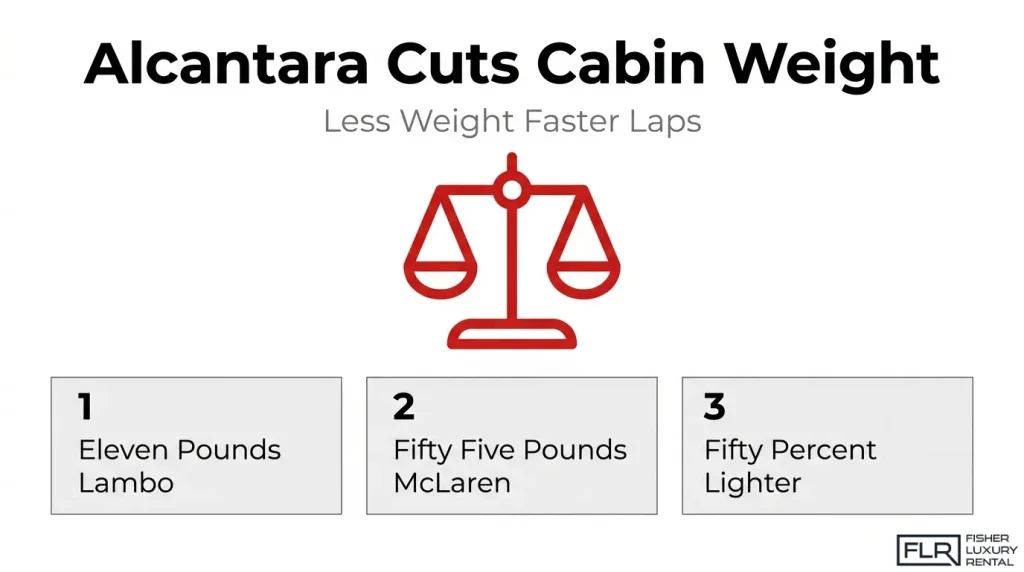
Alcantara reduces weight in performance vehicles because it is up to 50 percent lighter than leather. According to MotorTrend, Lamborghini saves 11 pounds simply by substituting Alcantara for leather across a vehicle’s interior surfaces. The cumulative benefit is even larger when the swap is systematic: Motor Authority reported that McLaren’s Track Pack for the 570S replaced leather with Alcantara on the seats, dashboard, and steering wheel, contributing to a total weight reduction of 55 pounds versus the standard coupe. At the margins where performance cars are developed, trimming 11 to 55 pounds through material substitution represents a meaningful gain in acceleration, braking, and handling balance without any mechanical compromise.
Which Material Is Better for Daily Driving vs. Track Use?
The better material depends on how the car is used. Leather suits daily driving for its durability and easy maintenance, while Alcantara dominates dedicated track builds for its weight savings and grip. The sections below cover Alcantara in everyday luxury cars, leather in daily-driven vehicles, and which material wins on track.
Is Alcantara a Good Choice for Everyday Luxury Cars?
Alcantara is a good choice for everyday luxury cars when comfort and premium aesthetics are the priority, though it demands more careful upkeep than leather. Its soft, suede-like texture creates a premium cabin feel, and manufacturers such as BMW offer it as a factory option in performance-oriented road cars. The main daily-driving drawback is vulnerability to oils, sweat, and spills – materials that accumulate quickly with regular use. Owners who drive frequently in suits, eat in the car, or carry passengers regularly may find leather a more practical long-term surface. Alcantara shines best in low-mileage daily drivers where the interior stays clean and the focus is on luxury feel.
Is Leather a Better Fit for Daily Driven Luxury Vehicles?
Leather is a better fit for daily driven luxury vehicles because it resists spills, withstands repeated cleaning, and ages predictably under constant use. A 2016 study published in the Annals of the University of Oradea found that natural leather outperforms artificial alternatives in water vapor permeability, contributing to superior long-term sitting comfort. Consumer Reports recommends cleaning leather seats with saddle soap followed by an automotive conditioner to prevent drying – a simple routine suited to regular ownership. Full-grain and semi-aniline grades add surface protection without sacrificing the natural grain. For drivers who use their vehicles daily across varied conditions, leather is the more resilient, lower-maintenance choice.
Which Material Works Best in a Dedicated Track Car?
Alcantara works best in a dedicated track car, primarily because of its significant weight advantage and grip performance under high-speed driving conditions. According to MotorTrend, Alcantara is up to 50% lighter than leather, and Lamborghini saves 11 pounds per car by substituting it. The McLaren 570S Track Pack replaced leather with Alcantara across seats, dashboard, and steering wheel, reducing total vehicle weight by 55 pounds. On track, every pound reduction improves lap times, acceleration, and braking response. Leather simply cannot match these performance gains in a purpose-built race environment, making Alcantara the clear choice for drivers optimizing their car for circuit use.
Does the Type of Leather Affect How It Compares to Alcantara?
Yes, the type of leather significantly changes how it compares to Alcantara across durability, feel, and maintenance. The three leather grades most relevant to automotive interiors are full-grain, semi-aniline, and synthetic leather.
How Does Full-Grain Leather Compare to Alcantara?
Full-grain leather is leather that retains its entire natural grain surface, with no material removed through buffing or corrective treatment. This makes it the densest, most durable leather grade available for automotive use. Against Alcantara, full-grain leather offers superior long-term structural integrity and a prestige feel that ages into a patina. Alcantara, by contrast, delivers a softer initial texture and lighter weight, but cannot develop the same character over time. For buyers prioritizing heritage and longevity, full-grain leather holds a clear edge.
How Does Semi-Aniline Leather Compare to Alcantara?
Semi-aniline leather is leather that has been treated with a light pigment coat to even its surface color and conceal minor imperfections while keeping the natural grain visible. This protective finish makes semi-aniline leather more stain-resistant and easier to maintain than pure full-grain. Compared to Alcantara, semi-aniline leather offers better liquid resistance and a more uniform appearance, while Alcantara still wins on weight and grip texture. Semi-aniline sits in a practical middle ground: more forgiving than uncoated leather, less demanding than Alcantara in daily use.
How Does Synthetic Leather Compare to Alcantara?
Synthetic leather is the weakest performer against Alcantara in technical terms. According to M. Meyer et al. in the journal Coatings, none of the alternative materials tested achieved the performance properties of natural leather, and the hydrophilic fibers of real leather absorb significantly more moisture than synthetic alternatives, resulting in greater sitting comfort. Alcantara, while also synthetic, outperforms artificial leather through its engineered microfiber structure, which provides better breathability and tactile quality. Synthetic leather remains the least convincing substitute for either natural leather or Alcantara in a premium automotive context.
How Does Interior Material Choice Affect Luxury Car Resale Value?
Interior material choice affects luxury car resale value by directly influencing how well a vehicle’s cabin holds up over time. The sections below cover how material durability shapes perceived condition, and why original spec interiors matter to buyers.
How Do Interior Materials Influence a Car’s Condition Rating?
Interior materials influence a car’s condition rating because degraded upholstery, faded trim, and worn surfaces signal neglect to appraisers and private buyers alike. According to Intertek’s automotive materials testing guidelines, interior components must perform under daily use, temperature changes, sunlight exposure, cleaning, abrasion, and moisture, and any failure across those stressors is visible at inspection. Flooring, upholstery, dash components, and coatings each contribute independently to how a vehicle presents. A cabin that has resisted these pressures commands a stronger condition grade, and a stronger condition grade directly supports a higher asking price.
Does Alcantara or Leather Hold Its Value Better Over Time?
Alcantara and leather each hold value differently depending on use intensity and upkeep. Alcantara’s synthetic fiber construction makes it resistant to the cracking and peeling that can affect natural leather when conditioning is neglected, but it is more vulnerable to matting and staining in high-contact zones. Full-grain leather, when maintained, ages with character and is widely recognized by collectors as a premium indicator. For most luxury resale buyers, a well-preserved leather interior signals long-term care. Alcantara interiors in performance-spec vehicles can actually command a premium when original and clean, since they confirm a factory sport configuration. Fisher Luxury Rental sources top-trim models exclusively, meaning vehicles in its fleet carry the factory interior specifications – including Alcantara where manufacturers originally specified it – rather than aftermarket substitutions.
Why Do Buyers and Appraisers Pay Attention to Original Interior Specs?
Buyers and appraisers pay attention to original interior specs because deviations from factory configuration raise authenticity concerns and reduce comparability. A car reupholstered after purchase no longer reflects the manufacturer’s intended material and finish standard, which complicates valuation against comparable stock examples. For exotic and collector vehicles, matching numbers and original materials carry disproportionate weight. This is especially true when Alcantara was specified from the factory as part of a performance or track package, since replacing it with aftermarket leather effectively removes a documented performance credential.
How Can You Experience Alcantara and Leather Interiors in Exotic Rental Cars?
Exotic rental cars offer the most accessible way to experience Alcantara and leather interiors firsthand, without ownership costs. This section covers Fisher Luxury Rental’s supercar fleet and key takeaways from the Alcantara vs. leather comparison.
Does Fisher Luxury Rental Offer Supercars With Alcantara and Leather Interiors?
Fisher Luxury Rental offers supercars with Alcantara and leather interiors across its Phoenix, AZ and Portland, OR locations. Fisher Luxury Rental purchases top-trim models exclusively, meaning every vehicle arrives factory-configured with the premium interior materials those manufacturers intended. Where a Lamborghini or Ferrari leaves the factory with Alcantara seating and a leather-wrapped dash, that is precisely what renters sit inside. Fisher Luxury Rental emphasizes cleanliness and maintenance as a core quality standard across its fleet. For anyone curious whether Alcantara truly grips differently from leather at speed, or whether full-grain leather feels as substantial as its reputation suggests, renting is the most honest test available.
What Are the Key Takeaways About Alcantara vs. Leather in Feel, Durability, and Track Car Use?
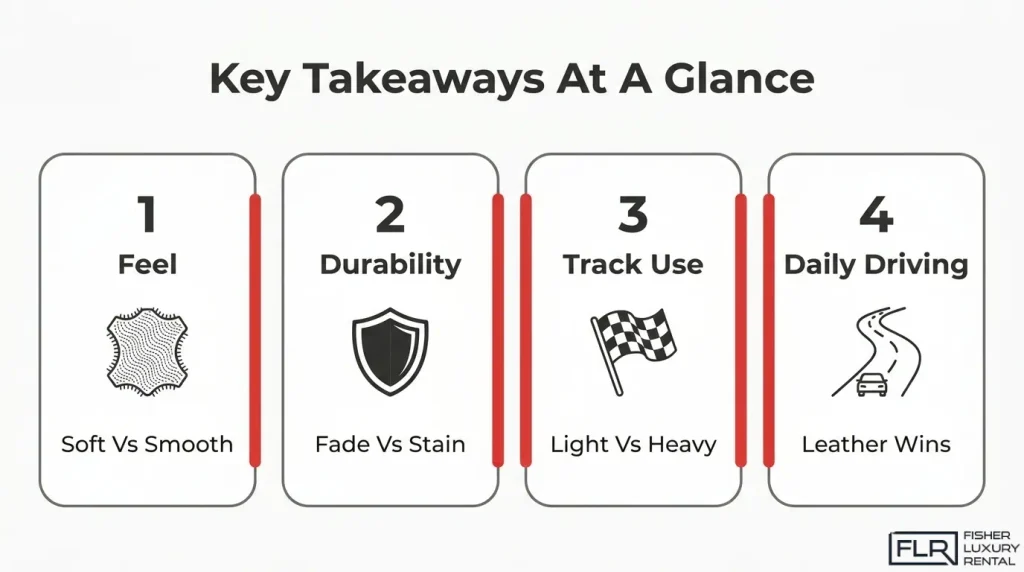
The key takeaways about Alcantara vs. leather center on three practical dimensions: sensory feel, durability under use, and performance engineering.
- Feel: Alcantara delivers a velvety, suede-like texture that stays cooler than leather in heat. Leather offers superior grip on steering wheels and breathes more naturally against skin.
- Durability: Leather resists stains and liquid penetration more readily. Alcantara resists fading and UV degradation well but requires more careful cleaning routines.
- Track use: Alcantara is up to 50% lighter than leather, according to MotorTrend, which is why manufacturers like Lamborghini and Ferrari spec it in performance-focused models such as the Huracán STO and 488 Pista.
- Daily driving: Leather remains the stronger choice for long-term, high-contact daily use. Alcantara excels in focused, performance-oriented environments.
The material that suits you depends entirely on how and where you drive.