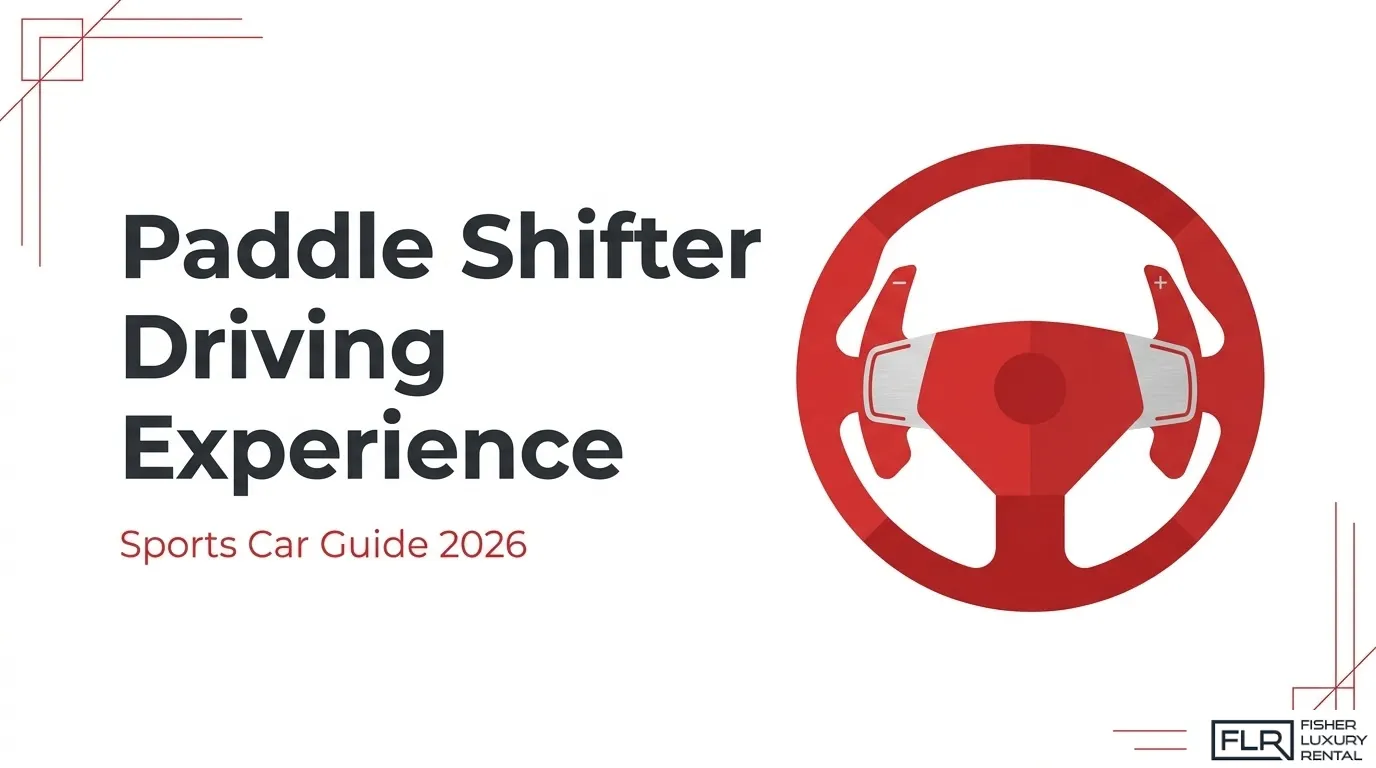
The paddle shifter driving experience in a sports car is the act of manually selecting gears through driver-operated levers mounted behind the steering wheel, without using a clutch pedal, while the car’s ECU and transmission actuators handle clutch engagement automatically.
This guide covers how paddle shifters work mechanically, what they feel like across different driving conditions, which 2026 sports cars deliver the best shift experience, correct driving technique, common beginner mistakes, how paddle systems compare to traditional manual transmissions, and how to access these cars firsthand through a luxury rental.
Paddle shifters operate through an electronic signal pathway that connects the driver’s pull to an electro-hydraulic or electro-mechanical actuator, executing gear changes in under one-tenth of a second on modern dual-clutch systems. The hardware varies across platforms, from fixed column-mounted paddles to wheel-mounted designs that rotate with steering input, each with distinct ergonomic implications for spirited driving.
The sensation behind the wheel changes significantly depending on context. Hard acceleration through a DCT produces a sharp, decisive snap with no torque interruption; braking downshifts compress the car and raise the engine note with controlled resistance; stop-and-go traffic offers little engagement and pushes most drivers back to automatic mode.
Six 2026 sports cars represent the range of paddle-shift character available today, from the clinical precision of the Porsche 911 PDK and the seamless torque of the McLaren 750S SSG, to the electrified drama of the Ferrari 296 and the value-to-performance ratio of the Corvette Z06.
Correct technique, common mistakes, the manual transmission comparison, and track-day performance gains are all addressed, closing with how a Fisher Luxury Rental exotic gives drivers direct, hands-on access to these systems in real driving conditions.
What Are Paddle Shifters and How Do They Work?
Paddle shifters are driver-operated levers mounted behind the steering wheel that allow manual gear selection without a clutch pedal. The following sections cover the mechanical shift process, how paddles communicate with the transmission, and the key hardware difference between fixed and wheel-mounted designs.
What Is the Mechanical Process Behind a Paddle Shift?
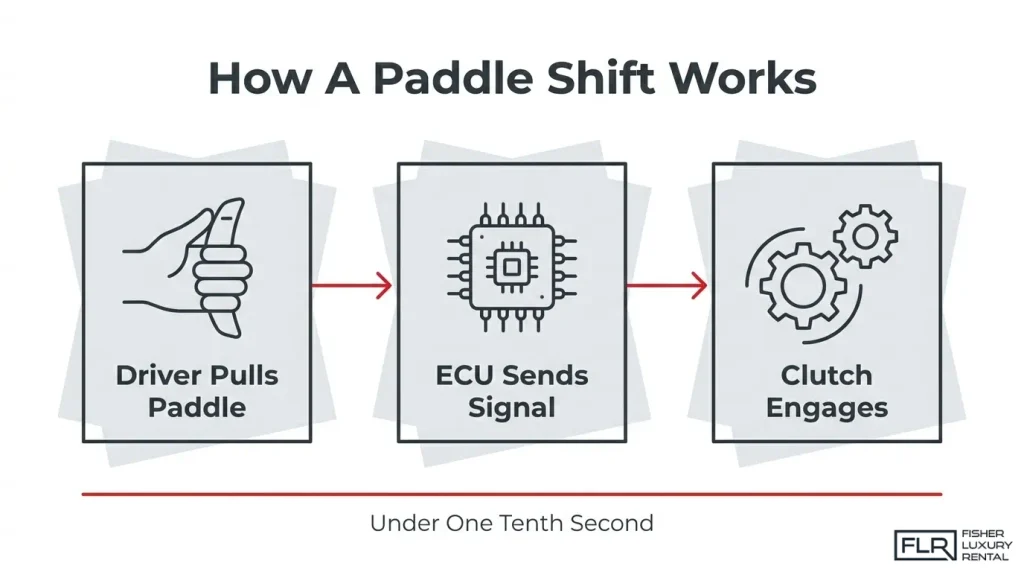
The mechanical process behind a paddle shift begins when the driver pulls a paddle, sending an electronic signal to an ECU, which commands an electro-hydraulic actuator to execute the gear change. According to the 24 Hours of Le Mans, Ferrari’s 1989 semi-automatic gearbox pioneered this electro-hydraulic approach, and today’s robotic gearboxes can complete a shift in under one-tenth of a second.
Modern sports cars use dual-clutch technology to make shifts nearly instantaneous. As Lamborghini describes the Huracán’s 7-speed LDF system, one gear remains engaged while the next is pre-selected, so the shift occurs by simply opening one clutch and closing the other. Ford’s owner manual confirms the basic driver input: pull the right paddle (+) to upshift and the left paddle (–) to downshift, with the system refusing any shift that would push engine speed beyond its limit.
How Do Paddle Shifters Communicate with the Transmission?
Paddle shifters communicate with the transmission through electronic signals routed to a Transmission Control Unit, which actuates the appropriate clutch pack or gear selection mechanism. In practice, the hardware varies by platform: SAE International notes the Lamborghini Huracán’s seven-speed dual-clutch unit is controlled by steering column-mounted paddles, while the 2026 Chevrolet Corvette Z06 pairs its 8-speed dual-clutch transmission with carbon-fiber-trimmed shift paddles on a leather-wrapped steering wheel, delivering 670 horsepower and a 0–60 mph time of 2.6 seconds.
The BMW M4 Competition illustrates how the same signal pathway can serve different transmission architectures: BMW Canada lists the car with either an 8-speed M Steptronic automatic with Drivelogic paddle shifters or a traditional 6-speed manual, showing that paddles are a communication layer added onto the gearbox rather than a transmission type in themselves.
What Is the Difference Between Fixed and Wheel-Mounted Paddles?
The difference between fixed and wheel-mounted paddles is their mounting location and how they move relative to the steering wheel during cornering. Fixed paddles are attached to the steering column and remain stationary regardless of steering input, meaning the paddles are always within reach at the same position. Wheel-mounted paddles rotate with the steering wheel itself, so their position changes as the driver turns.
- Fixed (column-mounted) paddles: Always in the same 9 o’clock and 3 o’clock position; no reach adjustment needed mid-corner.
- Wheel-mounted paddles: Rotate with the wheel; preferred by many track drivers who want the paddle physically tied to their hand position.
- Steering angle impact: In a tight corner with significant steering lock, wheel-mounted paddles can shift away from a natural pull position, while fixed paddles remain accessible.
From a performance driving standpoint, fixed paddles are often the more ergonomically forgiving option for drivers new to spirited cornering, since the shift point never moves.
Why Do Sports Cars Use Paddle Shifters Instead of Manual Gearboxes?
Sports cars use paddle shifters instead of manual gearboxes primarily because they deliver faster, more consistent gear changes while keeping both hands on the wheel. The sections below cover shift speed advantages, the manufacturer rationale, and how paddle systems compare to traditional clutch-pedal setups.
Shift Speed and Performance Advantages
Paddle shifters outperform manual gearboxes in shift speed because automated clutch actuation eliminates the physical delay of pressing a pedal. According to research published in ScienceDirect, minimum shifting time drops from 0.3 seconds with a manual transmission to 0.1 seconds with an automated manual transmission (AMT). At 150 mph, that 0.2-second difference is the gap between a clean exit and a lost lap.
Driver Control and Safety Rationale
Sports cars prioritize paddle shifters because they allow full steering grip during gear changes. Porsche’s Hans-Joachim Stuck captured this directly: “Being able to keep my hands on the steering wheel when changing gears at full throttle felt great right from the start.” For manufacturers, this translates to safer, faster cornering without sacrificing driver engagement.
Why Manufacturers Choose Dual-Clutch Over Manual
Manufacturers choose dual-clutch transmissions because the next gear pre-selects before the shift executes, making power delivery seamless. Lamborghini’s 7-speed LDF dual-clutch system exemplifies this: one gear engages while the next is already queued, so the shift occurs by simply opening one clutch and closing the other. Manuals cannot replicate this pre-selection architecture.
This combination of speed, safety, and mechanical sophistication explains why DCT-equipped paddle systems now define the modern sports car.
What Does It Feel Like to Drive a Sports Car with Paddle Shifters?
Driving a sports car with paddle shifters feels like a direct conversation between driver and machine. The sub-sections below cover the sensation during hard acceleration, the character of a braking downshift, and what the experience is like in everyday traffic.
What Does a Paddle Shift Feel Like During Hard Acceleration?
A paddle shift during hard acceleration feels like a sharp, physical punctuation mark in the car’s power delivery. Because dual-clutch transmissions pre-select the next gear while the current one is engaged, the shift happens almost instantaneously, with no torque interruption and no hesitation from the engine. The sensation is a brief, decisive snap in forward momentum, followed immediately by a fresh surge as the next gear catches. Unlike a torque converter automatic, which uses hydraulic pressure to transfer drive and softens transitions, a DCT’s mechanical handoff keeps the energy continuous and visceral. According to Ferrari, the 296 GTB pairs its V6 turbo with an 8-speed DCT and a motor-generator unit producing a combined 830 cv, making each upshift a forceful, seamless escalation rather than a polite gear change.
What Does a Paddle Downshift Feel Like When Braking?
A paddle downshift during braking feels like the car compressing and gathering itself beneath you. Pulling the left paddle sends an instruction to the transmission to drop a gear, which raises engine rpm and adds a controlled resistance that reinforces the braking force already applied. The result is an audible engine note rising sharply alongside a tightening sensation through the seat. According to Porsche, the PDK uses two independently controlled clutches rather than a single driver-operated one, keeping both hands on the wheel throughout. Hans-Joachim Stuck, who drove an early PDK Porsche at full throttle, noted: “Being able to keep my hands on the steering wheel when changing gears at full throttle felt great right from the start.” For drivers accustomed to heel-and-toe technique in a manual, this experience delivers the same rev-matched drama with far less physical demand.
What Does Paddle Shifting Feel Like in Stop-and-Go Traffic?
Paddle shifting in stop-and-go traffic feels noticeably less engaging than at speed, and most drivers quickly hand control back to the automatic mode. At low speeds, the transmission’s ECU and clutch management are optimized for smooth, low-load transitions, so manually pulling paddles in a gear range that offers little engine response produces minimal sensation. The Alfa Romeo TCT dual-clutch transmission, for example, operates in either all-automatic or sequential mode as the driver requires, designed specifically to deliver comfort in urban conditions while reserving the sportier character for open driving. In city traffic, the automatic mode tends to deliver smoother, more relaxed progress. Paddle shifting in traffic is best reserved for deliberate engine braking on a downhill stretch or for a driver learning gear-to-speed relationships before taking the car onto a faster road. For drivers in the process of building that gear-to-speed familiarity, a day rental in a DCT-equipped exotic offers a practical, low-stakes environment to develop the feel before a track day or canyon run.
Which 2026 Sports Cars Offer the Best Paddle Shifter Experience?
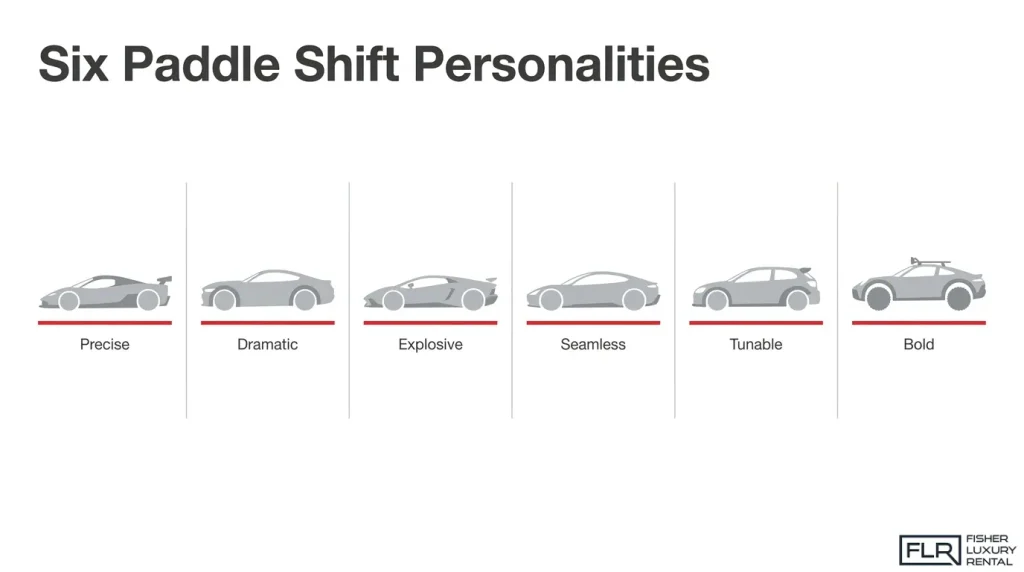
The 2026 sports cars offering the best paddle shifter experience include the Porsche 911, Ferrari 296, Lamborghini Huracán, McLaren 750S, BMW M4, and Chevrolet Corvette Z06. Each model pairs a distinct transmission architecture with a unique shift character, from clinical precision to theatrical drama.
How Does the Porsche 911 Paddle Shifting Experience Compare?
The Porsche 911 paddle shifting experience compares as one of the most precise and confidence-inspiring in the segment. The 911’s PDK dual-clutch transmission uses two clutches controlled by the car itself rather than a single driver-operated clutch, enabling seamless, near-instantaneous gear changes. Hans-Joachim Stuck, an early PDK test driver, noted that keeping both hands on the steering wheel during full-throttle shifts “felt great right from the start.” For drivers who prioritize clinical accuracy and rapid response over theatrical engagement, the PDK remains the benchmark paddle-shift system in production sports cars.
How Does the Ferrari 296 Paddle Shifting Experience Compare?
The Ferrari 296 paddle shifting experience compares as intensely visceral, backed by genuine hybrid hypercar performance. The 296 GTB powertrain pairs a V6 turbo with an 8-speed DCT and an MGU-K motor-generator unit positioned between the engine and gearbox, producing a combined 830 cv. That electrified architecture means paddle inputs deliver an immediate surge, amplified by electric torque fill between shifts. Few naturally aspirated competitors can match the sense of continuous, unbroken thrust the 296 generates through sequential gear changes.
How Does the Lamborghini Huracán Paddle Shifting Experience Compare?
The Lamborghini Huracán paddle shifting experience compares as explosive and theatrically engaging, defined by its 7-speed Lamborghini Doppia Frizione dual-clutch transmission. The LDF system pre-selects the next gear while the current one is still engaged, executing the shift instantaneously by opening one clutch and closing the other. According to SAE International, this seven-speed DCT is controlled via steering column-mounted paddles, keeping the driver’s hands on the wheel at all times. The result is a rifle-bolt shift quality combined with a soundtrack that rewards aggressive paddle use more audibly than most competitors.
How Does the McLaren 750S Paddle Shifting Experience Compare?
The McLaren 750S paddle shifting experience compares as uniquely seamless, owing to its 7-speed Seamless Shift Gearbox. According to McLaren Automotive, the 750S SSG with its short final drive delivers 0 to 100 km/h in 2.8 seconds, 0 to 200 km/h in 7.2 seconds, and a 332 km/h top speed. The SSG is engineered to maintain drive torque through every ratio change with no interruption in acceleration, meaning paddle shifts feel less like discrete events and more like a continuous wave of force. For pure mid-corner precision, this transmission architecture is arguably unmatched in production sports cars.
How Does the BMW M4 Paddle Shifting Experience Compare?
The BMW M4 paddle shifting experience compares as accessible and highly configurable, suited to both spirited road driving and track use. The M4 Competition pairs an 8-speed M Steptronic sport automatic transmission with Drivelogic paddle shifters, while the standard M4 retains an available manual 6-speed option. Drivelogic allows drivers to adjust shift speed and responsiveness to match their driving style, making the M4 one of the few sports cars where the paddle-shift character can be meaningfully tuned. This flexibility makes it an ideal entry point for drivers new to high-performance paddle shifting.
How Does the Chevrolet Corvette Paddle Shifting Experience Compare?
The Chevrolet Corvette Z06 paddle shifting experience compares as a genuinely exotic-grade system at a comparatively accessible price point. According to Chevrolet, the 2026 Corvette Z06 uses an 8-speed dual-clutch transmission producing 670 horsepower and a 0-to-60 mph time of 2.6 seconds, with a leather-wrapped, carbon-fiber-trimmed steering wheel housing the shift paddles. The mid-engine layout and DCT combination give the Corvette a shift dynamic that rivals European sports cars far above its price class. Among the cars in this comparison, it offers the highest performance-per-dollar ratio for paddle-shift enthusiasts.
How Do You Use Paddle Shifters Correctly in a Sports Car?
Using paddle shifters correctly means knowing when to shift manually and when to let the transmission manage itself. The following sections cover upshifting timing, rev-matching downshifts, cornering strategy, and when to return to automatic mode.
When Should You Upshift with Paddle Shifters?
You should upshift with paddle shifters when the engine approaches its power peak and adding a gear keeps revs in the optimal powerband. According to a May 2023 Consumer Reports survey of 2,000 American adults, only 4 percent of drivers regularly use a manual transmission, meaning most paddle shifter users are building this rev awareness from scratch. The right paddle triggers an upshift; the car’s ECU will refuse the request if the resulting engine speed would fall outside safe limits. In a sports car, holding each gear slightly longer than feels natural rewards you with a more dramatic pull before the next ratio drops in.
When Should You Rev-Match a Downshift with Paddle Shifters?
Rev-matching a downshift with paddle shifters is less critical than in a manual car because modern dual-clutch and automated transmissions handle throttle blipping electronically. However, timing your left-paddle pull to coincide with the moment your braking load is heaviest keeps the engine ready to drive the car out of the braking zone. Pulling the downshift paddle one gear at a time, rather than grabbing multiple gears simultaneously, gives the transmission time to settle each ratio and delivers a cleaner, more controlled deceleration.
How Should You Use Paddle Shifters Through a Corner?
Paddle shifters through a corner should be used on the approach, not mid-arc. Consumer Reports notes that a driver can use paddle shifters to keep engine revs at a more optimal level when entering a corner, or to wind up the revs higher when needing more power before upshifting. Complete your downshift sequence during straight-line braking before turn-in, so the car is settled in the correct gear as you apex. Mid-corner shifts upset weight balance and can unsettle the rear, particularly in rear-wheel-drive sports cars with stiff suspension tuning.
When Should You Let the Car Shift Automatically?
You should let the car shift automatically in stop-and-go traffic, during highway cruising, and whenever full attention must stay on a complex road environment. Modern sports car transmissions in automatic mode are programmed with Sport and Track maps that select gears more aggressively than most drivers would manually, so surrendering control is not a performance penalty in daily driving. Reserve manual paddle control for stretches where you want to hold a specific gear through a bend, extract maximum acceleration, or simply enjoy the tactile engagement the paddles are designed to deliver.
What Are Common Paddle Shifter Mistakes Beginners Make?
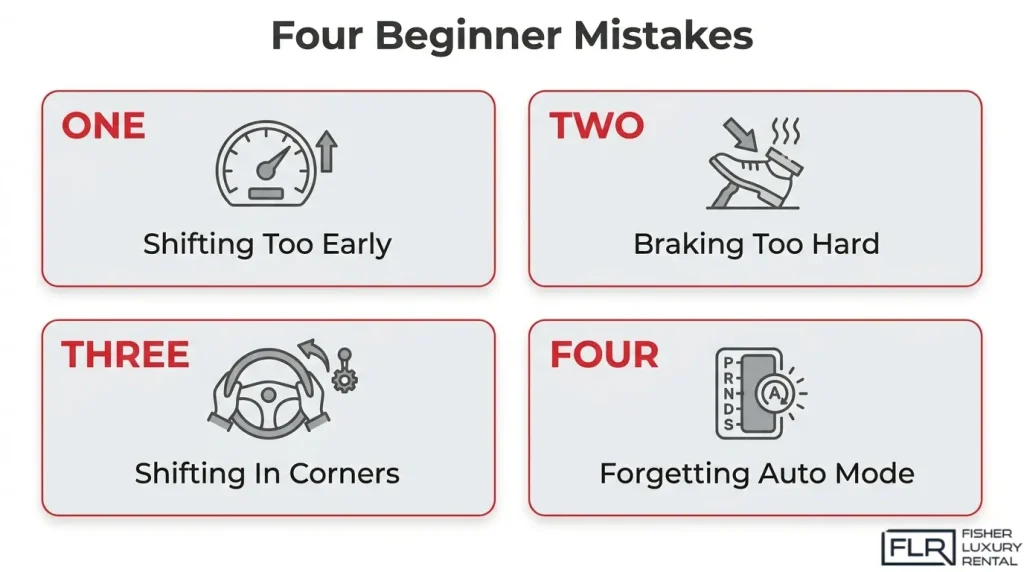
Common paddle shifter mistakes beginners make include upshifting too early, over-shifting in corners, and ignoring the car’s automatic mode. Understanding each error helps new drivers build confidence and control faster.
Upshifting Too Early at Low RPM
Upshifting too early is one of the most frequent mistakes beginners make with paddle shifters. Pulling the right paddle before the engine builds sufficient RPM results in a sluggish, unresponsive surge rather than a clean power delivery. According to Consumer Reports, a driver should use paddle shifters to wind up the revs higher when needing more power before upshifting. Staying in a gear longer allows the engine to reach its power band, producing the acceleration sports cars are designed to deliver. Inexperienced drivers often rush shifts out of habit from conventional automatics, but paddle shifting rewards patience at the right rev range.
Downshifting Too Aggressively Under Braking
Downshifting too aggressively under braking causes jerky deceleration and can unsettle the car’s weight balance. Most paddle-equipped sports cars have rev-limiting protection built in, meaning the system will refuse a downshift that would spike engine speed dangerously. Rather than pulling the left paddle multiple times in rapid succession, beginners should downshift one gear at a time while trail-braking to match engine speed progressively.
Over-Shifting Through a Corner
Over-shifting through a corner destabilizes the car mid-turn. Changing gears while cornering interrupts the smooth power delivery needed to maintain traction, especially at speed. The best approach is to select the correct gear before corner entry and hold it through the apex, then upshift cleanly on exit when the car is tracking straight.
Forgetting to Return to Automatic Mode
Forgetting to return to automatic mode after a spirited section leaves beginners manually managing every shift, including in traffic. Most paddle-equipped cars revert to automatic after a set period of inactivity, but some require a deliberate hold of one paddle to resume full auto control. Staying in manual mode unnecessarily adds cognitive load and increases the risk of missed shifts in everyday driving conditions.
How Do Paddle Shifters Differ from a Traditional Manual Transmission?
Paddle shifters differ from a traditional manual transmission by removing the physical clutch pedal and replacing driver-controlled clutch engagement with automated actuators managed by an Electronic Control Unit. The sections below cover shift speed, clutch operation, and the driver skill requirements each system demands.
Shift Speed and Mechanical Execution
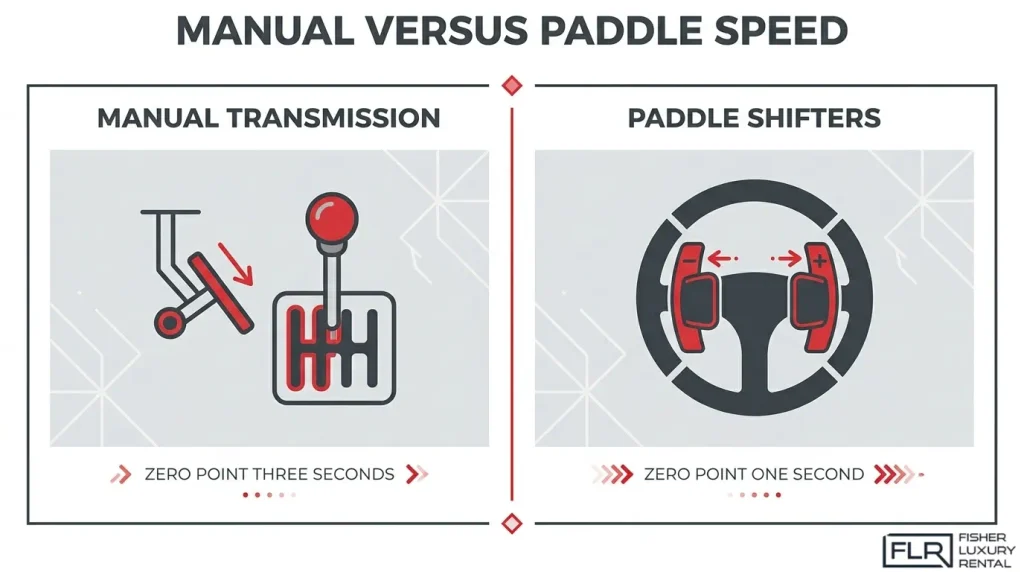
Paddle shifters shift faster than a traditional manual transmission because electro-mechanical or electro-hydraulic actuators execute gear changes with greater precision than a human foot. According to a ScienceDirect study on automated manual transmissions, minimum shifting time decreases from 0.3 seconds with a manual transmission to 0.1 seconds with an AMT. For sports car driving, that 0.2-second advantage is genuinely meaningful at high RPM.
Clutch Operation and Driver Input
The core mechanical difference is that a traditional manual transmission requires the driver to operate a physical clutch pedal to disengage and re-engage drive between shifts. Paddle-shifted systems use the same dry clutch and multi-speed gearbox architecture, but actuators handle clutch engagement automatically in response to each paddle pull. The driver controls gear selection timing; the ECU controls clutch execution.
Skill Requirements and Accessibility
A traditional manual transmission requires simultaneous coordination of clutch pedal, gear lever, and throttle, skills that take considerable practice to execute smoothly. Paddle shifters separate gear selection from clutch management entirely, making precise, fast shifts accessible without that foundation. That accessibility is one reason paddle-shifted sports cars appeal to both experienced drivers and first-time exotic car renters.
Do Paddle Shifters Make You a Faster Driver on Track Days?
Paddle shifters can make you faster on track days, but only when used with the right technique. The sections below cover how corner entry control and shift timing combine to deliver measurable lap-time gains.
How Do Paddle Shifters Help with Corner Entry Speed?
Paddle shifters help with corner entry speed by letting drivers select the exact gear needed before turn-in, without lifting both hands off the wheel. According to Consumer Reports, a driver can use paddle shifters to keep engine revs at a more optimal level when entering a corner, or wind them higher before upshifting for more power. This precision replaces the guesswork of waiting for an automatic shift, keeping the car balanced and the power delivery predictable through the apex. For track-day drivers, that control over engine braking and throttle response at corner entry is arguably where paddle shifters deliver the most tangible performance benefit.
How Does Shift Speed Affect Track Lap Times?
Shift speed affects track lap times because every millisecond of torque interruption costs forward momentum. Modern dual-clutch transmissions used in track-focused sports cars shift instantaneously by preselecting the next gear while the current one is still engaged. As documented by the 24 Hours of Le Mans, today’s robotic gearboxes can shift in less than a tenth of a second. By comparison, even a skilled manual driver cannot match that consistency under pressure, lap after lap. The practical result is that paddle-equipped DCT systems maintain drive more continuously through gear changes, which compounds into meaningful time savings over a full lap.
Can Paddle Shifters Replace Driver Skill on a Track?
No, paddle shifters cannot replace driver skill on a track. The hardware eliminates mechanical delay and clutch error, but selecting the wrong gear at the wrong moment still costs time and can unsettle the car. Drivers who pull a downshift too early under braking overload the rear axle; those who upshift too late hold the engine past its power peak. Paddle shifters remove one layer of physical complexity, but the judgment calls, braking points, and throttle application remain entirely the driver’s responsibility. The technology raises the performance ceiling, but only a skilled, practiced driver can actually reach it. Renting a paddle-equipped exotic through a provider like Fisher Luxury Rental gives drivers the repetitions needed to develop that judgment – real road time in a top-trim car is the most direct path to building it.
How Should You Experience Paddle Shifters Through a Luxury Car Rental?
You should experience paddle shifters through a luxury car rental by choosing an exotic fleet that pairs high-performance transmissions with real-world driving conditions. The H3s below cover Fisher Luxury Rental’s available vehicles and the key takeaways from the full paddle shifter guide.
Can Fisher Luxury Rental’s Exotic Fleet Help You Experience Paddle Shifting Firsthand?
Yes, Fisher Luxury Rental’s exotic fleet can help you experience paddle shifting firsthand. Fisher Luxury Rental offers top-trim exotic and luxury vehicles in Phoenix, AZ, and Portland, OR, giving drivers direct access to the paddle shifter systems covered throughout this guide. Fisher Luxury Rental focuses on top-trim models, so the transmission hardware and paddle response reflect what manufacturers actually engineer for performance driving. For car enthusiasts, first-time exotic drivers, and special occasion renters alike, a rental removes the ownership barrier entirely. You gain hands-on time with DCT-equipped exotics in real driving conditions, which no spec sheet or simulator replicates.
What Are the Key Takeaways About the Paddle Shifter Driving Experience?
The key takeaways about the paddle shifter driving experience are that paddle shifters combine manual control with automatic convenience, deliver faster shifts than a traditional clutch-pedal gearbox, and reward drivers who understand when and how to use them. According to a May 2023 Consumer Reports survey of 2,000 American adults, only 4 percent of U.S. drivers regularly use a manual transmission, making paddle-equipped automatics the dominant path to gear control today. The right paddle upshifts, the left downshifts, and the car’s ECU prevents shifts that would push engine speed beyond safe limits. Using paddles through corners, under braking, and on acceleration all require different timing. Renting an exotic car is the most direct way to build that feel.