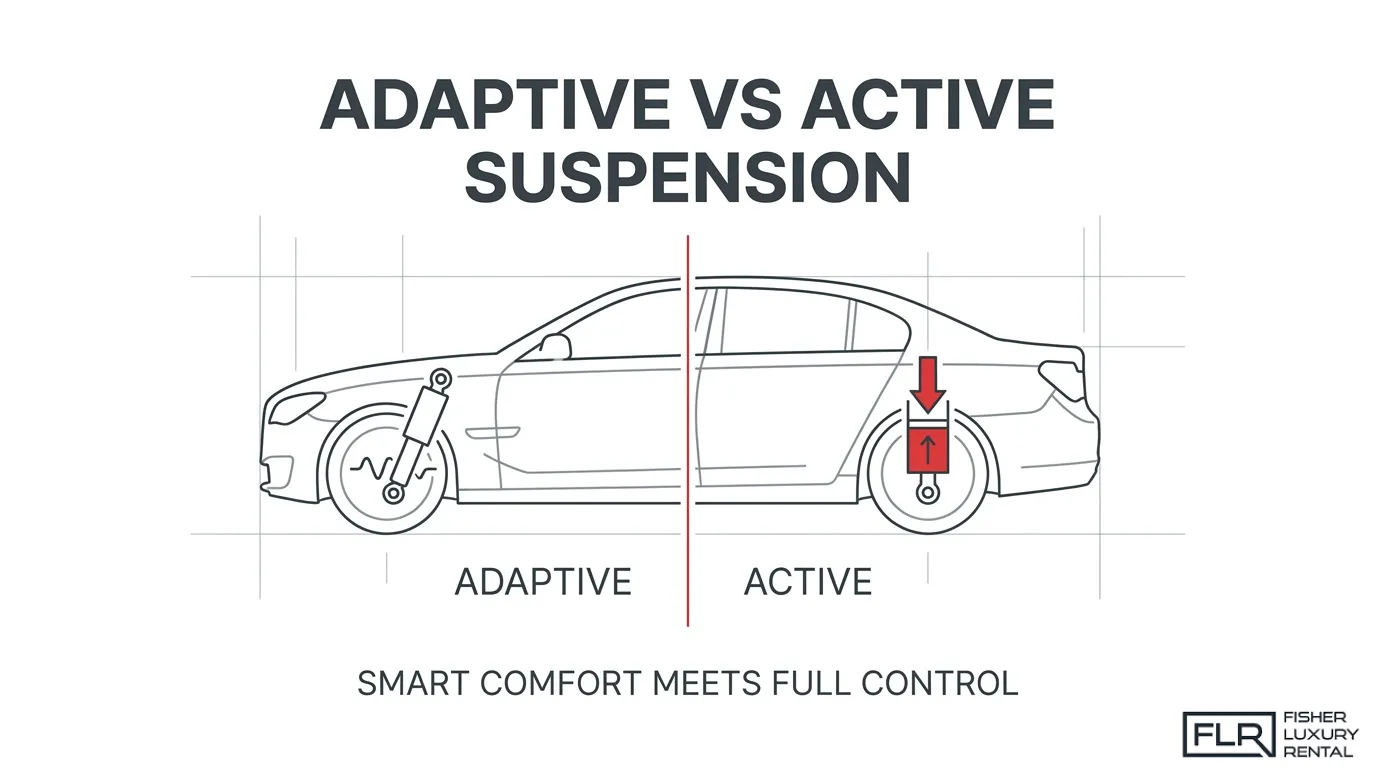
Adaptive suspension is a semi-active system that adjusts damper stiffness continuously through sensor data without generating independent force, while active suspension uses powered actuators at each corner to create and apply corrective force proactively.
This guide covers how each system works at a mechanical level, how they compare in performance and cost, which luxury vehicles use each technology, how driving modes change system behavior, and what each system’s real trade-offs mean for everyday driving.
Adaptive and active suspension share sensor-driven ECU control but diverge immediately in how force is applied. Adaptive systems sweep between soft and firm damping curves in real time; active systems push or pull each wheel independently to counteract roll, pitch, and road inputs before occupants feel them.
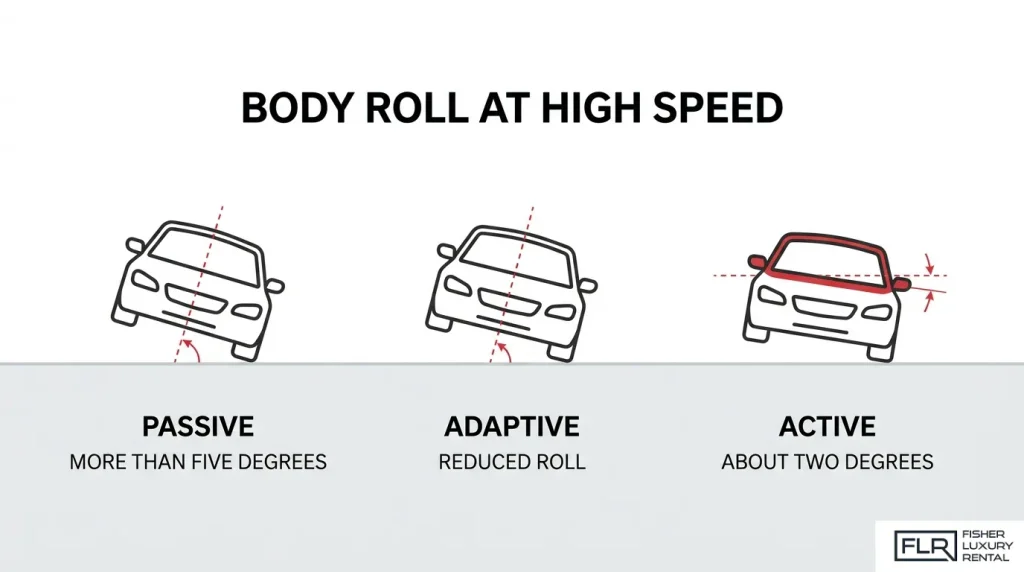
Performance differences emerge most clearly in body roll control and cornering. Active suspension reduces chassis roll to roughly two degrees at 1g lateral acceleration compared to more than five degrees with passive suspension, while adaptive systems close the gap considerably through technologies like magnetorheological dampers that shift from viscous liquid to semi-solid in milliseconds.
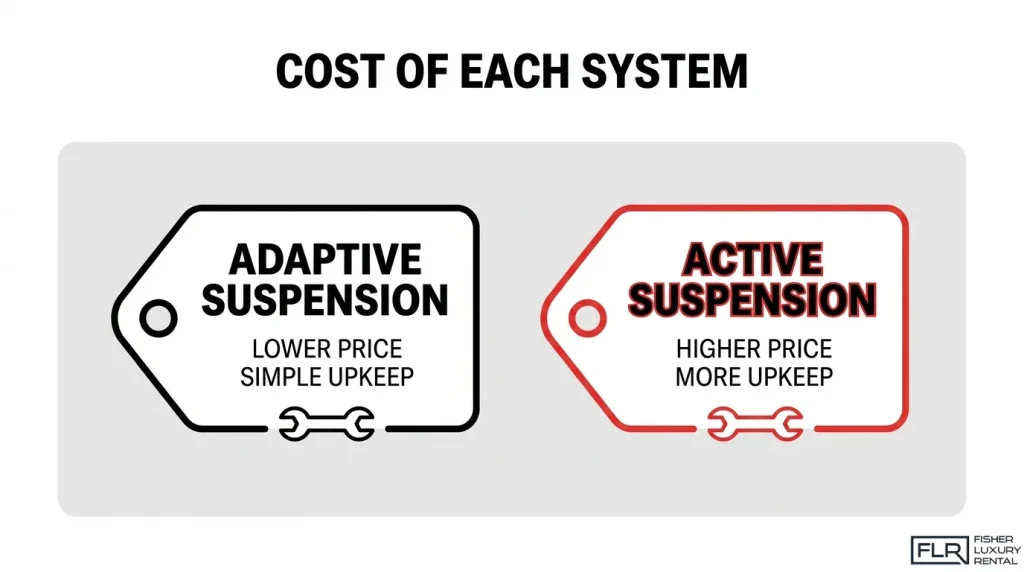
Cost separates the two systems at every ownership stage. Adaptive suspension carries a lower purchase premium, simpler maintenance architecture, and reduced long-term reliability risk; fully active hydraulic setups introduce pressurized fluid circuits that raise both upfront and ongoing costs meaningfully.
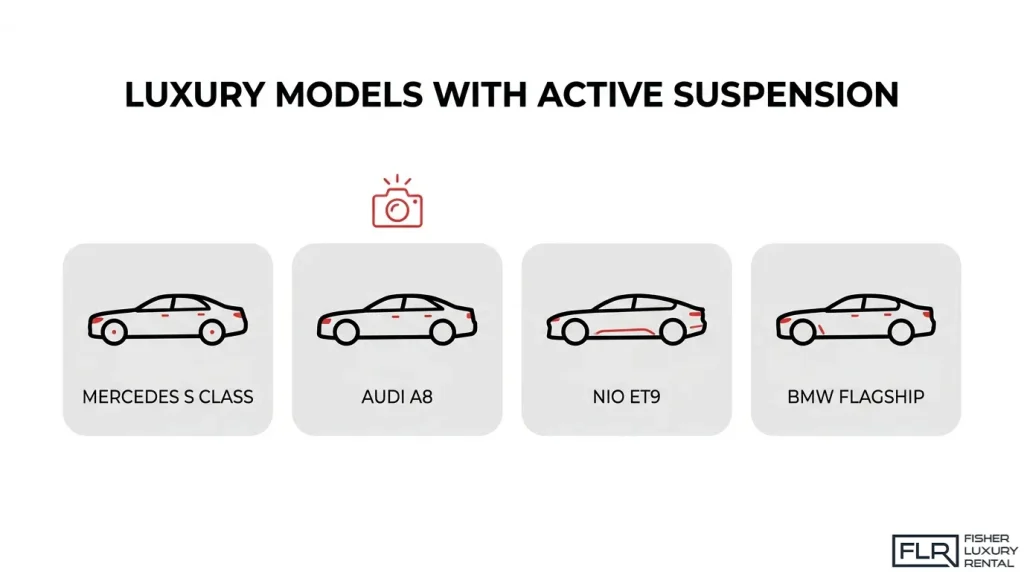
Luxury vehicles across both categories demonstrate what each technology actually delivers in practice, from Magnetic Ride Control 4.0 on the Corvette E-Ray to Mercedes-Benz MAGIC BODY CONTROL and Audi’s predictive camera-based active suspension on the A8.
What Is Adaptive Suspension and How Does It Work?
Adaptive suspension is a semi-active system that continuously adjusts damper stiffness in response to sensor data, without injecting independent force into the suspension. The following H3s cover the sensors that feed the system, how damping is tuned in real time, and the ECUs that execute those decisions.
What Sensors Does Adaptive Suspension Use?
The sensors adaptive suspension uses include wheel speed sensors, steering angle sensors, lateral acceleration sensors, and yaw rate sensors. Speed and steering angle measurements determine driver intent, while lateral acceleration and yaw rate sensors measure how the vehicle is actually responding. According to the National Safety Council (MyCarDoesWhat.org), these systems can also enhance stability by eliminating body roll and pitch variation, helping keep tires perpendicular to the road surface.
How Does Adaptive Suspension Adjust Damping in Real Time?
Adaptive suspension adjusts damping by reading sensor inputs and moving between characteristic curves that range from hard, safety-oriented settings to soft, comfort-oriented ones. According to ZF Friedrichshafen AG, the CDC (Continuous Damping Control) system adjusts both compression and rebound within this range continuously. More advanced implementations use vehicle preview control, where road roughness data captured ahead of the vehicle is fed to the suspension controller so damper settings shift before the wheel reaches the disturbance.
What Electronic Control Units Manage Adaptive Suspension?
The electronic control unit (ECU) manages adaptive suspension by monitoring vehicle speed, lateral acceleration, and estimated mass in real time. According to the Federal Register’s Federal Motor Vehicle Safety Standards for Electronic Stability Control Systems for Heavy Vehicles, the ECU continuously estimates the roll stability threshold, defined as the lateral acceleration above which a vehicle will roll over, and adjusts accordingly. The global adaptive suspension market, valued at USD 3.6 billion in 2024 and projected to reach USD 5.6 billion by 2030 at a CAGR of 7.8% (Strategic Market Research), reflects how central ECU-driven chassis control has become across both passenger and commercial platforms.
What Is Active Suspension and How Does It Work?
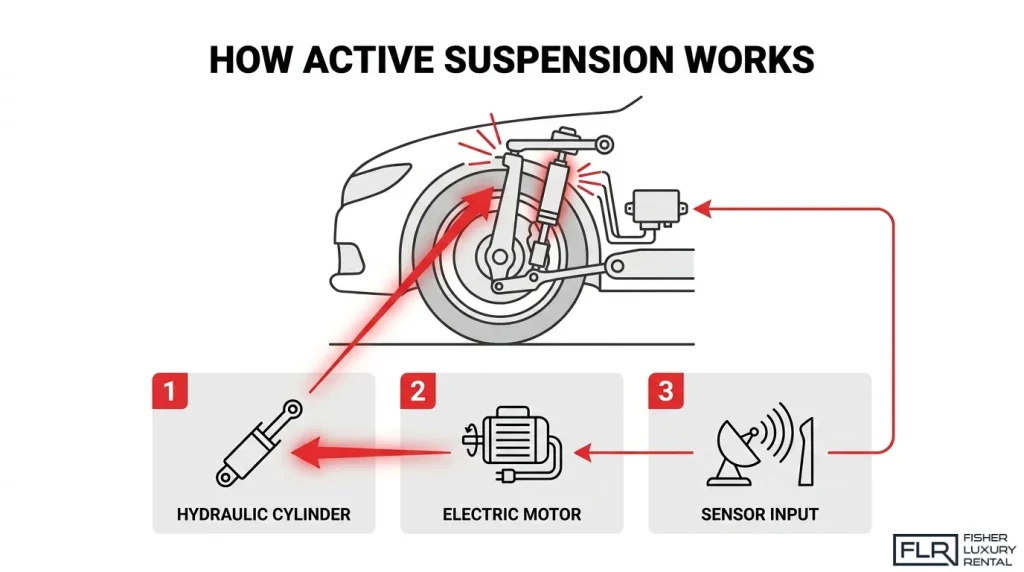
Active suspension is a chassis technology that uses powered actuators at each wheel to generate force independently, rather than passively reacting to road inputs. The following sub-sections cover what powers these actuators, how force is generated independently, and what role hydraulic or electric motors play.
What Actuators Power an Active Suspension System?
The actuators that power an active suspension system include hydraulic cylinders, linear electric motors, and electro-hydrostatic assemblies. Unlike passive suspension, where spring and damper characteristics are fixed, active systems use powered components that can push or pull each wheel in real time. According to the Proceedings of the 2003 IAVSD Conference, hydraulic actuators remain among the most viable choices due to their high power-to-weight ratio, low cost, and ability to sustain force over extended periods without overheating. Linear electromagnetic actuators represent a newer alternative, with University of Sheffield research proposing a single linear motor at each wheel to replace the conventional spring and shock absorber entirely. In practice, hydraulic systems still dominate production vehicles because their force output is difficult to match at comparable cost.
How Does Active Suspension Generate Force Independently?
Active suspension generates force independently by using onboard actuators that add energy to the suspension loop rather than simply dissipating it. Where a passive damper only absorbs kinetic energy, an active actuator can extend or compress on command to counteract body roll, pitch, and vertical acceleration simultaneously. Lotus Engineering demonstrated this principle as early as 1983, when Peter Wright’s team raced the first active-suspension Formula 1 car at the Brazilian and Long Beach Grand Prix events. The SAE-published case for the Lotus Active Suspension, developed over seven years, established that an irreversible, fully active architecture could sustain force continuously across all four corners. That independent force generation is what separates active systems from every adaptive or semi-active alternative.
What Role Do Hydraulic or Electric Motors Play in Active Suspension?
Hydraulic and electric motors serve as the primary energy source in active suspension, each delivering force through different physical mechanisms. Hydraulic systems use pressurized fluid circuits to move actuator pistons, providing high force density suitable for large vehicles. Electric motors, by contrast, drive pumps or linear actuators directly, offering faster response and more precise control with lower maintenance overhead. Research published in the SAE International Journal of Passenger Vehicle Systems found that a deep reinforcement learning control strategy for electro-hydrostatic active suspension reduced energy consumption, extended hydraulic component life, and improved control accuracy, directly addressing the reliability limitations of traditional hydraulic designs. The NIO ET9 illustrates the latest convergence: it is the world’s first production model to integrate SkyRide Full Active Suspension alongside steer-by-wire and rear-wheel steering in a single smart EV chassis system.
How Do Adaptive and Active Suspension Compare in Performance?
Adaptive and active suspension compare across four key dimensions: body roll control, high-speed cornering, road absorption, and response speed. The sections below break down how each system performs in each area.
How Does Body Roll Control Differ Between the Two Systems?
Body roll control differs between the two systems primarily in mechanism and magnitude of correction. Active suspension eliminates body roll and pitch variation entirely, keeping tires perpendicular to the road and improving traction, according to the National Safety Council. Adaptive systems using magnetorheological (MR) fluids also respond quickly: according to the Norwegian Defence Research Establishment, MR fluids can reversibly change from viscous liquids to semi-solids in milliseconds by varying magnetic field strength. Range Rover’s 6D Dynamics system demonstrates what modern adaptive hardware achieves, with SV Mode calibrating roll stiffness, pitch stiffness, compression, and rebound while saving 16.4 lbs over traditional rollover protection systems. Active suspension still holds an edge in outright roll suppression, but adaptive systems have closed the gap considerably.
How Does Each System Handle High-Speed Cornering?
Each system handles high-speed cornering differently based on how force is generated at each wheel. Active suspension uses independent actuators, with University of Sheffield research proposing a single linear motor at each wheel to replace the conventional shock absorber and spring, giving each corner fully independent force control. Adaptive systems modify damping rates reactively rather than generating independent force, which limits their ability to counteract lateral loads as aggressively. For drivers prioritizing cornering precision over passenger comfort, active suspension provides a structural advantage that adaptive tuning alone cannot fully replicate.
How Do They Compare in Absorbing Road Imperfections?
Adaptive and active suspension both outperform passive systems in absorbing road imperfections, but through different methods. Adaptive systems adjust damping curves in real time, softening over rough surfaces and stiffening on smooth ones. Active systems go further by generating counteracting forces proactively, not just reactively. The practical result is that active suspension tends to reduce cabin vibration more completely, particularly over complex or unpredictable surfaces where pre-emptive force application matters most.
Which System Responds Faster to Changing Road Conditions?
Active suspension responds faster to changing road conditions because it generates independent corrective force rather than simply adjusting resistance. A controlled active suspension study published in Wiley Online Library found that an optimized active controller consumed only 1,400 J/s at 11.5 Hz, compared to 15,230 J/s for a reference controller, demonstrating that modern efficiency-optimized active systems can act quickly without excessive energy draw. Adaptive systems using MR fluid dampers also respond in milliseconds, making them competitive for most real-world inputs. In practice, the gap narrows on normal road surfaces, but active suspension maintains a clear speed and authority advantage when conditions change abruptly.
How Do Adaptive and Active Suspension Compare in Cost?
Adaptive suspension costs less than active suspension at both the purchase and maintenance stages. The sections below cover upfront price premiums and ongoing maintenance differences between the two systems.
How Much More Does Active Suspension Add to Vehicle Price?
Active suspension adds a meaningful premium to vehicle price compared to adaptive alternatives. According to a report in the Proceedings of the Institution of Mechanical Engineers, commercially available semi-active suspension systems are less expensive than active suspensions. As a real-world benchmark, Auto Express reports that Porsche Active Suspension Management runs approximately £800 on the Macan and around £1,000 on the 718 Boxster and Cayman as an option upgrade. Fully active systems, which require actuators, pumps, and high-bandwidth control hardware at every corner, carry considerably higher integration costs than electronically controlled dampers alone.
How Do Maintenance Costs Differ Between the Two Systems?
Maintenance costs differ significantly depending on actuator type and system complexity. Active systems relying on hydraulic components carry the highest upkeep burden. As noted in research from the Iowa State University Digital Repository, use of hydraulics leads to increased maintenance and expensive component costs. Adaptive systems, which adjust damping electronically without pressurized fluid circuits, avoid most of that overhead. For buyers weighing long-term ownership, the simpler architecture of adaptive suspension is often the more practical choice when outright performance is not the primary goal.
What Are the Key Components That Separate Each System?
The key components that separate adaptive and active suspension are springs, dampers, actuators, and power architecture. Adaptive systems modify damping behavior within fixed hardware limits, while active systems use powered actuators to generate force independently. The following H3s break down each component layer.
How Do Passive Spring Elements Differ in Each Setup?
Passive spring elements differ between setups in how rigidly their characteristics are fixed. According to Virginia Tech’s suspension research, a passive suspension system is one in which the characteristics of the components, including springs and dampers, are fixed, with no ability to change under varying conditions.
In adaptive systems, conventional coil or air springs remain structurally passive, but paired electronic dampers adjust stiffness around them. Active systems go further: actuators at each corner can independently raise or lower the wheel, effectively overriding what the spring alone would do. The spring becomes a secondary element rather than the primary load-bearing controller.
What Distinguishes Adaptive Dampers From Active Actuators?
Adaptive dampers differ from active actuators in their fundamental operating mechanism. Adaptive dampers, such as magnetorheological units, modulate fluid viscosity in response to a magnetic field, shifting from soft to firm within milliseconds, but they only control resistance to motion. Active actuators, by contrast, generate force proactively: as Car and Driver describes, an electric motor and pump at each corner force fluid above or below the damper piston to raise or lower the wheel at will, controlling body movement rather than just reacting to it.
This distinction matters practically. Adaptive dampers are reactive and energy-efficient; active actuators are predictive and interventionist.
How Do Power Requirements Compare Between the Two?
Power requirements differ substantially between adaptive and active suspension. Adaptive dampers draw minimal continuous energy, as adjusting magnetic field strength in MR fluid requires low electrical input. Active systems demand significantly more: a 2020 study published in Wiley Online Library on active vehicle suspension energy consumption found peak power draw reached 1,400 J/s under optimized control, compared to 15,230 J/s with a reference (unoptimized) controller.
Audi’s predictive active suspension averages just 10–200 W, which represents engineering progress, but hydraulic active systems remain considerably more power-hungry than adaptive equivalents. For everyday driving, adaptive suspension’s lower power draw translates directly to reduced fuel or range impact.
Which Luxury Vehicles Use Adaptive Suspension?
Luxury vehicles use adaptive suspension across several proprietary platforms, including Magnetic Ride Control, air spring systems, and electronically controlled damper networks. The H3s below cover which specific models feature each technology.
Which Models Feature Magnetic Ride Control?
The models that feature Magnetic Ride Control include the Chevrolet Corvette, Cadillac CT5, and several other GM performance and luxury platforms. The 2024 Corvette E-Ray runs Magnetic Ride Control 4.0 with six driver-selectable modes: Tour, Sport, Track, Weather, My Mode, and Z-Mode. According to Chevrolet’s official media information, the system ships as standard equipment on the E-Ray, giving drivers precise damping adjustments across every mode without a manual dial.
For enthusiasts who prioritize feel over features, MRC 4.0 is among the most responsive adaptive systems available at its price point.
Which Models Use Air Spring Adaptive Systems?
The models that use air spring adaptive systems include the Mercedes-Benz S-Class, BMW 7 Series, Range Rover Sport, Audi A8, and Porsche Cayenne. Air springs replace conventional coil springs with pressurized air bladders, allowing ride height and compliance to adjust electronically across driving conditions. These systems pair with adaptive dampers to deliver both comfort and handling without the trade-offs of fixed-rate setups.
Air spring platforms are the dominant adaptive technology in full-size luxury SUVs and flagships, making them the most widely encountered system for premium rental and ownership experiences.
Which Luxury Vehicles Use Active Suspension?
Luxury vehicles with active suspension span two main technology tiers: fully active hydraulic systems that physically move the body, and predictive camera-based systems that anticipate road inputs before they occur.
Which Models Feature Fully Active Hydraulic Suspension?
The models featuring fully active hydraulic suspension most prominently include the Mercedes-Benz S-Class and the Audi A8. The Mercedes-Benz S-Class offers optional MAGIC BODY CONTROL, which the 2014 S-Class brochure describes as the world’s first proactive suspension: a stereo multipurpose camera scans the road ahead and prepares the advanced hydraulics to virtually eliminate surface variations before occupants can feel them. The Audi A8 pairs its predictive active suspension with an integrated curve-tilting function; in Comfort+ mode, it tilts the body up to three degrees into corners, reducing lateral acceleration on occupants. Notably, Audi’s electro-hydraulic actuators consume only 10 to 200 W on average, significantly less than conventional hydraulic suspension solutions.
Which Models Use Predictive Active Suspension With Cameras?
The models using predictive active suspension with cameras include the Audi A8 and the NIO ET9. BMW’s Integral Active Steering pairs with its active suspension on flagship models, combining variable front-axle steering ratios with active rear-wheel steering that turns rear wheels opposite to the front at low speeds for tighter maneuverability and in the same direction at higher speeds for stability. On the EV side, a January 2024 production order placed by NIO covers three million units of ClearMotion’s patented high-bandwidth active suspension technology, beginning with the flagship ET9. Camera-based predictive systems represent the clearest leap forward in active suspension: reacting to what the road will do, rather than what it has already done, is the defining advantage that separates these models from all adaptive alternatives. Fisher Luxury Rental focuses on top-trim configurations precisely because technologies like predictive active suspension are often exclusive to higher specification levels and the difference is one best understood behind the wheel.
How Does Driving Mode Selection Affect Each Suspension Type?
Driving mode selection directly changes how both adaptive and suspension systems prioritize comfort versus performance. The sections below cover how Comfort mode softens adaptive damping behavior and how Sport mode pushes active suspension toward maximum road-holding.
How Does Comfort Mode Change Adaptive Suspension Behavior?
Comfort mode changes adaptive suspension behavior by loosening damper control to absorb road imperfections with minimal body stiffness. According to Audi’s Technology Lexicon, selecting comfort+ in the Audi drive select system causes the vehicle to float smoothly over bumps of all kinds, while the system also reduces lateral acceleration acting on occupants during cornering. In contrast, switching to dynamic mode cuts chassis roll angles to roughly half those of standard suspension, and the body barely dips under braking. For drivers who prioritize long-distance ease over sharp handling, Comfort mode is the more practical daily choice.
How Does Sport Mode Change Active Suspension Behavior?
Sport mode changes active suspension behavior by tightening damping force, optimizing camber angle through suspension travel, and maximizing road-holding at the expense of ride suppleness. Piero Monchiero, Vice President of Advance Innovation at Marelli Ride Dynamics, noted direct industry requests “to maximize road-holding performance by pursuing the optimal camber angle throughout the suspension travel, ensuring higher safety levels and reducing tire wear.” In practice, Sport mode narrows the gap between chassis and road, making the system less forgiving over rough surfaces but significantly more precise through corners.
What Are the Pros and Cons of Adaptive Suspension?
The pros and cons of adaptive suspension cover ride quality, cost, energy efficiency, and performance limits. The following sections break down each trade-off in detail.
What Are the Main Advantages of Adaptive Suspension?
The main advantages of adaptive suspension are improved ride comfort, lower energy demand, and reduced ownership cost compared to fully active systems. According to Applied Sciences (MDPI), adaptive (semi-active) suspension bridges the gap between passive and active systems, delivering enhanced damping performance while consuming significantly less energy than active counterparts. Multiple driver-selectable modes, such as Comfort, Sport, and Track, let drivers tune handling to match road conditions without complex actuator hardware. Diagnostic costs also stay manageable, with active suspension diagnosis running between $61 and $90 per RepairPal, making routine checks affordable.
What Are the Main Disadvantages of Adaptive Suspension?
The main disadvantages of adaptive suspension are its limited performance ceiling and narrower application range compared to passive or fully active alternatives. Commercially available semi-active systems are less expensive than active suspensions, but they have more limited applications than passive suspensions, as noted in the Proceedings of the Institution of Mechanical Engineers. Because adaptive dampers can only vary resistance rather than generate independent force, they cannot fully eliminate body roll or pitch under extreme cornering loads. For drivers who prioritize maximum dynamic control, this constraint becomes a meaningful trade-off.
What Are the Pros and Cons of Active Suspension?
The pros and cons of active suspension reflect a system that delivers exceptional performance at meaningful cost and complexity trade-offs. The sections below cover ride quality benefits, body control advantages, energy demands, and reliability considerations.
What Are the Benefits of Active Suspension?
The benefits of active suspension include near-total elimination of body roll, pitch, and dive through independent actuator control at each wheel. According to the Chinese Journal of Mechanical Engineering, the Audi A8 in dynamic mode produces only two degrees of chassis roll during hard cornering at 1g lateral acceleration, compared to more than five degrees with passive suspension. Active systems also enable predictive curve tilting: the Audi predictive active suspension tilts the body up to three degrees into corners, reducing lateral acceleration felt by occupants. Body control at this level improves tire perpendicularity to the road surface, directly enhancing traction and stability.
What Are the Disadvantages of Active Suspension?
The disadvantages of active suspension are high cost, elevated energy consumption, and increased maintenance complexity. Hydraulic actuator systems require expensive components and generate higher ongoing maintenance demands. Active systems consume significantly more power than adaptive counterparts, though modern electric designs have reduced this gap. Reliability has historically been a concern; hydraulic complexity introduces more potential failure points than simpler damper-based systems. From an owner’s perspective, active suspension represents the highest entry price among all suspension categories, with added diagnostic costs on top of the original fitment premium.
Which Suspension Type Is Better for Everyday Driving Comfort?
For everyday driving comfort, adaptive suspension is better for most drivers. It delivers a strong balance of compliance, refinement, and cost efficiency without the complexity of full active systems. For drivers curious about what this balance feels like in practice, Fisher Luxury Rental’s top-trim fleet in Phoenix, AZ and Portland, OR offers a direct way to experience how luxury vehicles translate these suspension technologies into real-world ride quality. The H3s below cover ride quality, cost trade-offs, and reliability.
Is Adaptive Suspension More Comfortable on Normal Roads?
Adaptive suspension is more comfortable on normal roads for the majority of drivers. By continuously adjusting damping in real time, it absorbs surface imperfections smoothly without the stiffness penalties of a fixed passive setup. ZF’s Continuous Damping Control, for example, sweeps between hard, safety-oriented and soft, comfort-oriented curves in response to road input. The result is a refined, settled ride across urban streets, highways, and mixed surfaces. For daily commutes and city driving, this level of tuning is more than sufficient, and the system adds minimal weight or mechanical complexity compared to a fully active alternative.
Does Active Suspension Improve Daily Comfort Significantly More?
Active suspension does improve daily comfort significantly compared to adaptive systems, but the gain is incremental for typical road conditions. According to Audi’s technical documentation, the predictive active suspension in comfort+ mode tilts the vehicle body up to three degrees into curves, visibly reducing lateral acceleration felt by occupants. That said, this level of intervention exceeds what most commuters encounter daily. Active systems also consume considerably more energy and introduce greater mechanical complexity, which raises long-term maintenance exposure. For roads free of extreme imperfections or aggressive cornering, the added performance rarely justifies the premium. Adaptive suspension handles everyday comfort demands with impressive precision.
Which System Is More Reliable for Daily Use?
Adaptive suspension is more reliable for daily use. Its semi-active architecture uses electronically controlled dampers without the high-pressure hydraulic circuits or per-corner actuators found in fully active systems. According to research published in the SAE International Journal of Passenger Vehicle Systems, low reliability remains a recognized challenge in active suspension systems, particularly in hydraulic configurations where component stress accumulates under continuous load cycles. Adaptive systems carry fewer failure-prone components, lower servicing requirements, and reduced diagnostic complexity. For drivers who prioritize dependable daily performance over peak dynamic capability, adaptive suspension is the more practical and durable choice.
With comfort, cost, and reliability all pointing toward adaptive suspension for daily use, the right vehicle choice comes down to which system you actually want to experience behind the wheel.
How Can You Experience Adaptive and Active Suspension Firsthand?
You can experience adaptive and active suspension firsthand by renting a luxury vehicle equipped with these systems. The two H3s below cover how a rental makes this possible and what key takeaways to carry forward from this article.
Can Renting a Luxury Car Help You Feel the Difference?
Yes, renting a luxury car can help you feel the difference between adaptive and active suspension in a way no spec sheet can replicate. Fisher Luxury Rental specializes in top-trim models in Phoenix, AZ and Portland, OR, meaning the vehicles in the fleet are selected for their premium specifications rather than base-level configurations.
A single drive in a properly equipped luxury vehicle reveals what “adaptive” and “active” actually mean in practice: how the car settles into corners, how it absorbs road imperfections without unsettling the cabin, and how driving mode selection transforms the entire character of the ride. Renting before buying is, frankly, the most underrated research tool available to any serious buyer.
What Should You Remember About Adaptive vs Active Suspension?
The key things to remember about adaptive vs. active suspension come down to control authority, cost, and purpose. Adaptive suspension adjusts damping within a fixed range using real-time sensor data, delivering a strong balance of comfort and handling at a moderate cost premium. Active suspension goes further, using actuators to generate independent force at each corner, which enables capabilities like body tilt, near-zero roll, and predictive road-surface response.
- Adaptive suspension suits drivers who want everyday versatility and multiple drive modes without significant energy overhead.
- Active suspension suits drivers who prioritize maximum dynamic control, especially at high speeds or in demanding cornering situations.
- Cost scales with capability: adaptive systems carry a lower upfront and maintenance burden than fully active hydraulic or electromechanical setups.
- Real-world feel is the only reliable benchmark; manufacturer specs alone do not communicate how each system transforms a drive.
Fisher Luxury Rental offers a direct path to that benchmark experience across its Phoenix and Portland locations.