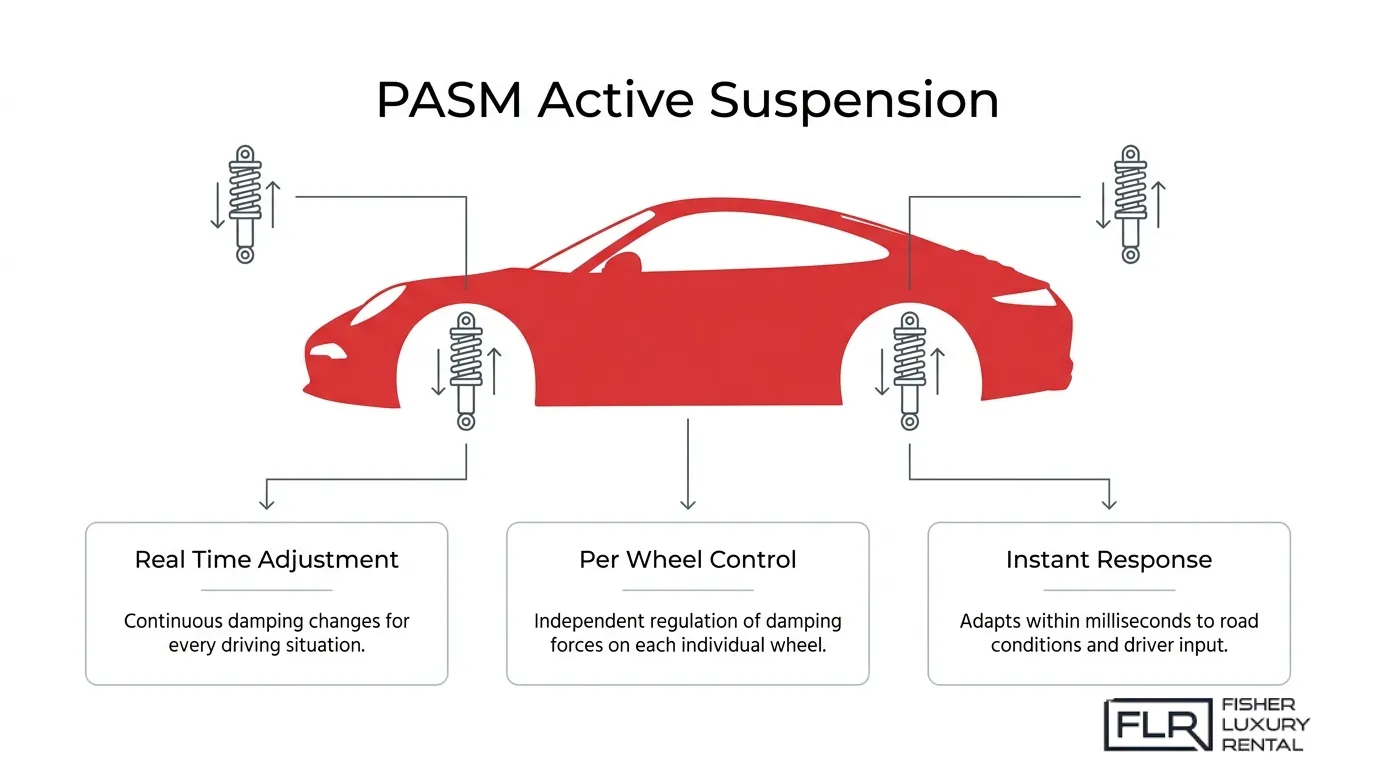
Porsche Active Suspension Management (PASM) is an electronically controlled adaptive damping system that continuously adjusts shock absorber stiffness at each individual wheel within milliseconds, responding to road surface conditions and driver inputs in real time.
This guide covers how PASM works mechanically and electronically, the driving modes it offers, which Porsche models carry it, the PASM Sport upgrade, how it compares to air suspension, what it feels like behind the wheel, retrofit and maintenance considerations, how it integrates with other Porsche chassis systems, and how to experience it firsthand through a luxury rental.
PASM’s operation depends on a network of accelerometers, wheel-speed sensors, and body-motion sensors feeding data to a central control unit, which commands electronically variable damper valves to open or close per wheel independently rather than treating the chassis as a single unit.
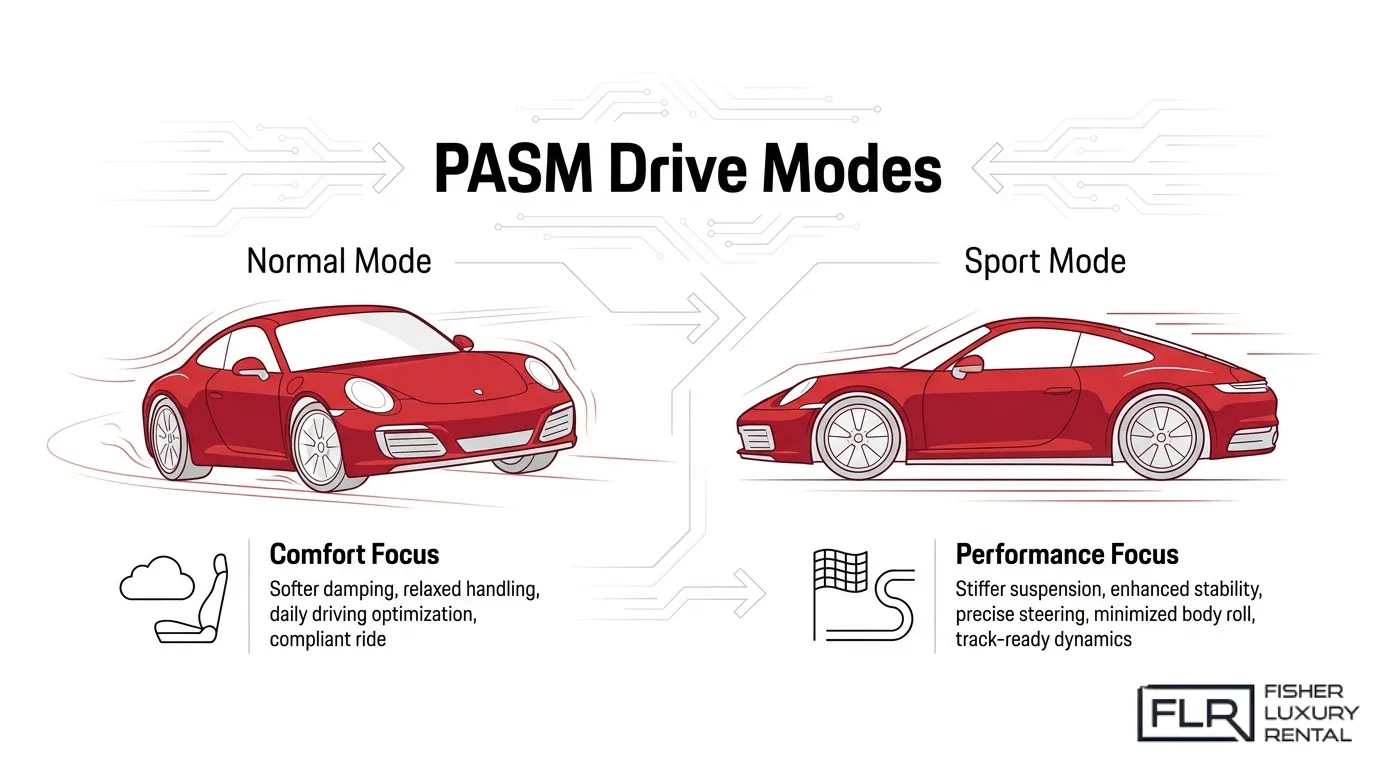
The system’s two primary modes, Normal and Sport, calibrate that damping toward comfort or cornering precision on demand. Normal absorbs road imperfections while keeping the body commendably flat; Sport stiffens the dampers to sharpen steering response and suppress body roll.
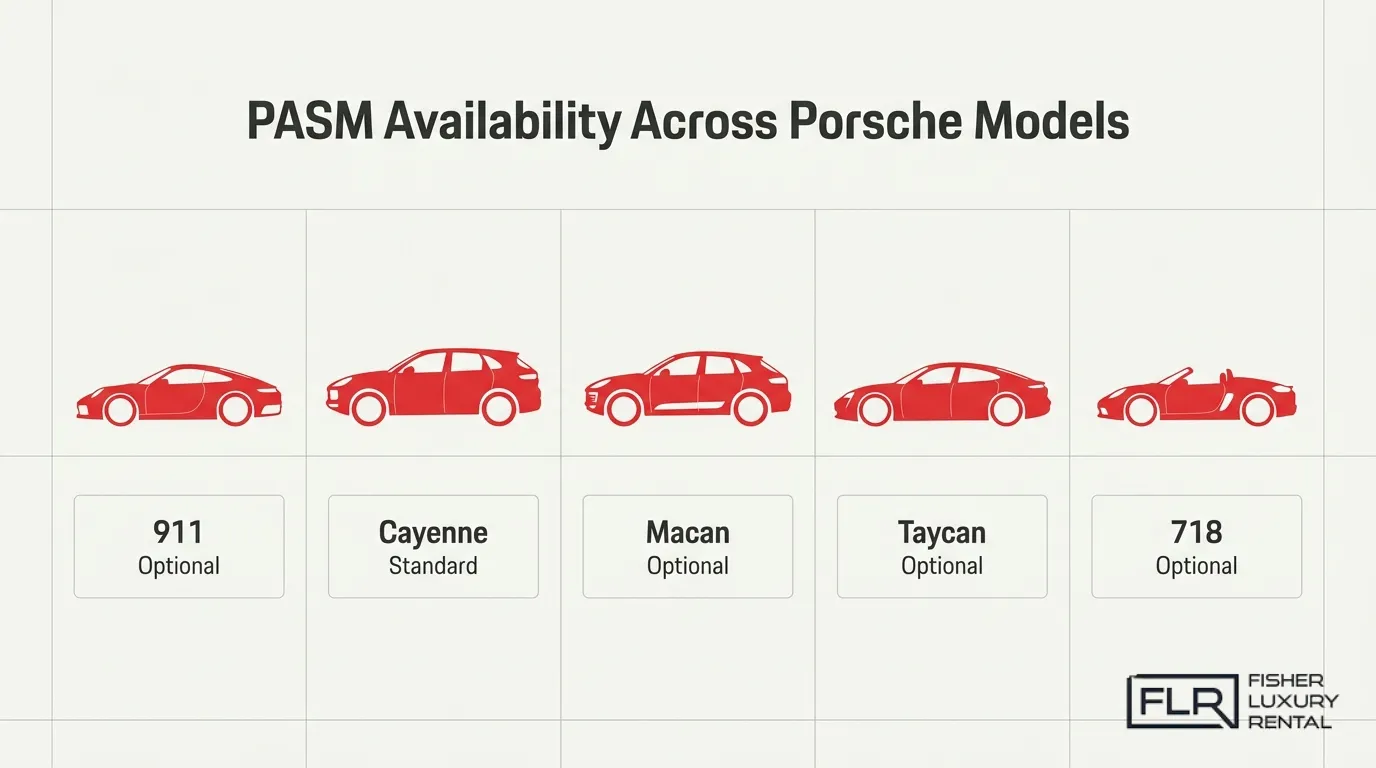
PASM appears across the 911, Cayenne, Macan, Taycan, and 718 Boxster and Cayman lineups, with availability ranging from standard fitment on GTS and Turbo variants to an option on base and mid-tier trims. PASM Sport builds on the standard system with a stiffer damper calibration and a 0.4-inch lower ride height for drivers who treat spirited driving as the priority.
Maintained properly and paired with systems like PDCC, Porsche Torque Vectoring, and rear-axle steering, PASM forms the foundation of Porsche’s fully coordinated chassis platform.
How Does PASM Work in a Porsche?
PASM works by continuously monitoring driving inputs and road conditions, then adjusting each wheel’s damping in real time. The sections below cover the sensors that feed data into the system, how the dampers physically respond, and what the control unit does with that information.
What Sensors Does PASM Use to Monitor Road Conditions?
The sensors PASM uses to monitor road conditions include accelerometers, wheel-speed sensors, steering-angle sensors, and body-motion sensors positioned at each corner of the vehicle. These sensors measure vertical body movement, lateral acceleration, longitudinal forces, and wheel articulation simultaneously. Together, they build a continuous picture of road surface quality and driver behavior, supplying the control unit with the inputs it needs to act on each wheel independently rather than treating the chassis as a single unit.
How Do the Electronically Controlled Dampers Adjust?
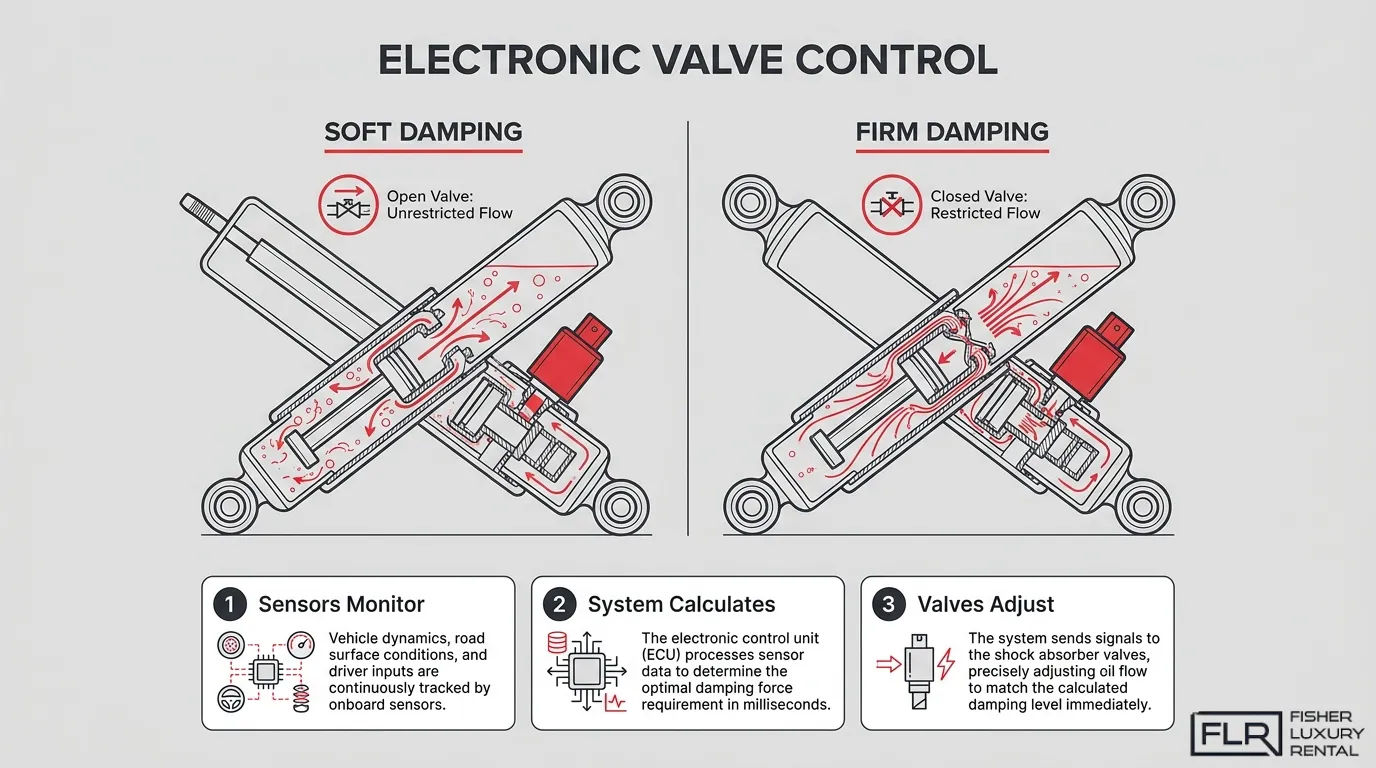
The electronically controlled dampers adjust by opening or closing variable shock absorber valves to change the resistance of fluid flow through each damper. According to the Porsche Newsroom, PASM adjusts damping for each individual wheel within milliseconds using a centrally networked 4D Chassis Control system. Softer valve settings allow fluid to move more freely, producing a compliant ride over rough surfaces, while stiffer settings restrict flow to reduce body roll and improve cornering precision. This per-wheel independence is what separates PASM from conventional passive suspension.
What Role Does the PASM Control Unit Play in Real Time?
The PASM control unit plays the role of central processor, receiving sensor data and issuing damper adjustment commands continuously while the vehicle is moving. It interprets inputs from every corner of the car, calculates the optimal damping force for each wheel based on current conditions, and sends electronic signals to the variable valves within milliseconds. The control unit also communicates with other chassis systems to ensure damping responses stay coordinated with steering, braking, and stability interventions. In practice, this processing loop operates invisibly and without driver input.
What Driving Modes Does PASM Offer?
PASM offers two primary driving modes, Normal and Sport, each tuning damper stiffness to match a different driving priority. The sections below explain what each mode delivers in practice.
Normal Mode
Normal mode is PASM’s comfort-oriented setting, calibrating dampers to absorb road imperfections while still controlling body movement. According to MotorTrend reviewer Alexander Stoklosa, twisting the drive-mode knob from Normal to Sport to Sport Plus dials down body roll like a rheostat, with Normal keeping the car commendably flat while still allowing a slight lean through corners. This balance makes Normal mode the right choice for daily driving, long highway runs, or any situation where ride quality takes priority over outright body control.
Sport Mode
Sport mode is PASM’s performance-oriented setting, stiffening the electronically variable dampers to sharpen body control and heighten steering response. Road and Track’s Matt Farah observed that while Normal mode absorbed imperfections on Portugal’s winding C-roads, Sport mode brought the steering system to life, adding precision and engagement that Normal simply cannot match. The trade-off is a firmer ride, but for spirited driving, Sport mode transforms the car’s character in a way that makes the compromise feel entirely intentional.
Sport mode is best reserved for back-road drives or track days where the firmer platform actually rewards the driver rather than fatiguing them.
Which Porsche Models Come Equipped with PASM?
PASM is available across Porsche’s lineup, appearing as standard equipment on performance-focused variants and as an optional upgrade on entry and mid-tier trims. The sections below cover the 911, Cayenne, Macan, Taycan, and 718 Boxster and Cayman.
Which 911 Variants Include PASM as Standard?
The 911 variants that include PASM as standard are the performance and special-edition models within the lineup. The 911 Dakar, for example, includes PASM as standard equipment alongside rear-axle steering, Porsche Dynamic Chassis Control (PDCC), and PTV Plus, all working together to optimize grip and driving control across varied surfaces. Across the broader 911 range, PASM is standard on Carrera S, GTS, Turbo, and Turbo S trims, while base Carrera models offer it as a paid option.
Which Cayenne and Macan Trims Offer PASM?
The Cayenne and Macan trims that offer PASM include GTS, Turbo, and Turbo S models as standard fitment, with lower trims receiving it as an option. On higher-trim Macan models, owners have reported a dashboard warning stating “Chassis System Failure,” which according to Vigor Air Ride often points to a PASM-related fault. Higher-trim Macan models with optional PASM can also experience AWD warning lights and vibrations as indicators of system failure.
Which Taycan Models Feature PASM?
The Taycan models that feature PASM are the 4S, GTS, Turbo, and Turbo S variants, where it is included as standard equipment. The base Taycan rear-wheel-drive model offers PASM as an option. All Taycan Cross Turismo variants also include PASM, reflecting Porsche’s intent to integrate adaptive damping across its electric vehicle platform.
Which 718 Boxster and Cayman Models Include PASM?
The 718 Boxster and Cayman models that include PASM are the GTS 4.0, Spyder, and GT4 variants as standard, while the base S models offer it as an option. On the 718 platform, PASM also enables a lowered ride height when specified, adding a handling dimension beyond damper adjustment alone. For drivers who prioritize dynamic precision, PASM remains one of the most impactful options available on the 718 lineup. Fisher Luxury Rental specializes in top-trim exotic and luxury vehicles in Phoenix, AZ and Portland, OR — the kind of fully-specced models where options like PASM are most likely to be standard fitment rather than an afterthought.
What Is PASM Sport Suspension?
PASM Sport is an upgraded, track-focused variant of Porsche’s standard PASM adaptive damping system. The H3 sections below explain how PASM Sport differs from standard PASM and how much additional ride height reduction it delivers.
How Does PASM Sport Differ from Standard PASM?
PASM Sport differs from standard PASM by combining stiffer damper tuning with a lower ride height, prioritizing cornering precision over everyday comfort. Standard PASM already delivers strong versatility: according to Car and Driver, its electronically adjustable shocks provide an excellent ride in the softer setting and stiffen considerably in Sport mode. PASM Sport takes that performance envelope further by recalibrating the dampers toward a firmer baseline across both settings. The result is a suspension tuned for drivers who treat spirited driving as the priority rather than the exception. For road cars like the 718 GTS, this makes PASM Sport the sharper, more committed choice.
How Much Lower Does PASM Sport Sit Compared to PASM?
PASM Sport sits approximately 0.4 inch lower than standard PASM. According to Car and Driver reviewer Josh Jacquot, the optional PASM Sport suspension lowers the GTS a further 0.4 inch, and while ride quality is firm even in the softer setting, control is sublime, making the trade-off worthwhile and among the best in the industry. That modest drop measurably reduces the center of gravity, tightens roll response, and sharpens turn-in feel. The firmness is real and noticeable on rough pavement, but for drivers seeking the most precise handling a Porsche can deliver on public roads, PASM Sport represents the most accessible step toward track-ready dynamics.
How Does PASM Compare to Porsche Air Suspension?
PASM and Porsche air suspension serve different purposes, with steel-spring PASM targeting driving dynamics and air-spring setups prioritizing ride height adjustability. The sections below cover how they differ structurally and which scenarios suit each system.
What Is the Difference Between Steel-Spring PASM and Air-Spring PASM?
The difference between steel-spring PASM and air-spring PASM lies in how each system manages ride height and compliance. Steel-spring PASM uses fixed-rate coil springs paired with electronically controlled dampers, delivering a consistent, sport-focused ride height with no vertical adjustment. Air-spring PASM replaces those coils with pressurized air bladders, allowing the car to raise or lower its body on demand while the adaptive dampers still manage stiffness. The air-spring variant adds load-leveling capability, which benefits SUVs like the Cayenne and Macan when carrying passengers or cargo. Steel-spring PASM is lighter and simpler, making it the preferred choice on sports-oriented models where unsprung mass and mechanical precision outweigh ride-height flexibility.
Which Driving Scenarios Favor PASM over Air Suspension?
Driving scenarios that favor steel-spring PASM over air suspension include track driving, canyon carving, and high-speed cornering. According to Green’s Garage, PASM uses electronically variable shock absorber valves to adjust damping stiffness continuously based on driving conditions, allowing it to react to inputs with precision that purely pneumatic systems cannot match at the same speed. On smooth sport surfaces, steel springs deliver more consistent feedback and sharper turn-in because there is no air-bladder compliance adding variability. Air suspension gains the advantage in low-speed urban driving, rough surfaces, and situations requiring ground clearance adjustments, where its height-change capability directly improves comfort or practicality. For drivers prioritizing performance over versatility, steel-spring PASM is the stronger platform.
What Does PASM Feel Like While Driving?
PASM feels like a suspension that thinks ahead, softening over rough surfaces before discomfort registers and firming up through corners before body roll builds. The sections below cover how that translates to rough pavement, high-speed cornering, and hard braking.
How Does PASM Handle Rough or Uneven Pavement?
PASM handles rough or uneven pavement by softening damping in real time, absorbing impacts before they transmit through the cabin. According to Car and Driver reviewer David Beard, the Macan GTS’s air springs paired with PASM adaptive dampers smooth broken pavement so effectively that even optional 21-inch wheels with small sidewalls never crash or send ugly vibrations through the structure. That level of compliance on low-profile tires is genuinely impressive and speaks to how precisely PASM reads and reacts to the road surface beneath each wheel independently.
How Does PASM Respond During High-Speed Cornering?
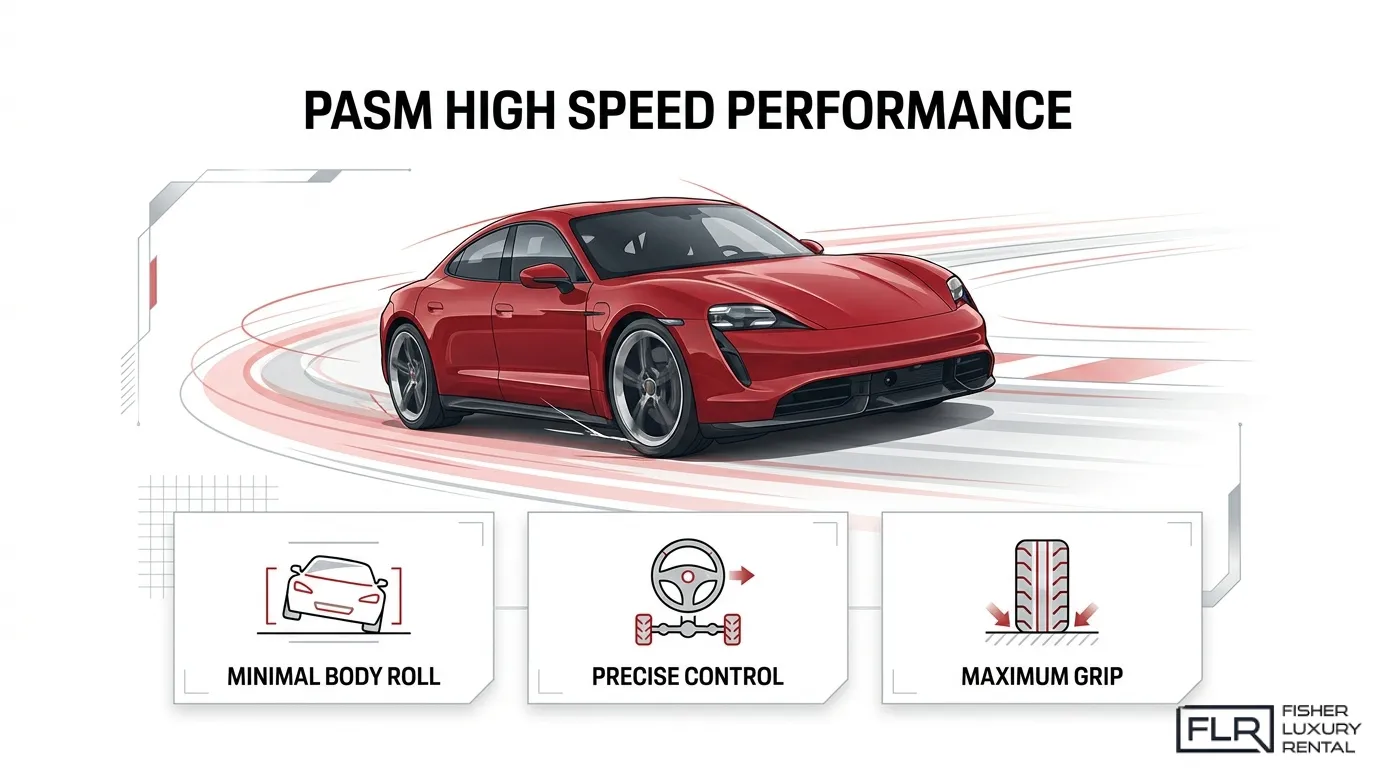
PASM responds during high-speed cornering by stiffening damping to minimize body roll and maintain a neutral, planted stance. MotorTrend reviewer Aaron Gold noted that the Taycan GTS’s PASM in Sport Plus delivered extraordinary grip at speeds right up against the edge of comfort, remaining unfailingly neutral and going exactly where pointed. That precision is what separates PASM from passive suspension: the driver feels confident, not managed.
How Does PASM Behave Under Hard Braking?
PASM behaves under hard braking by firming the dampers to resist nose dive, keeping the chassis level and the front axle loaded for maximum stopping stability. By reducing weight transfer pitch, PASM maintains consistent tire contact across all four corners during aggressive deceleration, giving the driver a planted, controlled sensation rather than the unsettled dive common in conventional suspension setups.
Can You Retrofit or Upgrade PASM on a Porsche?
Retrofitting or upgrading PASM on a Porsche is possible in limited circumstances, but the feasibility depends heavily on the model, model year, and existing suspension architecture. The subsections below cover retrofit options, aftermarket upgrade paths, and what each approach realistically delivers.
Is It Possible to Add PASM to a Porsche That Didn’t Come With It?
Yes, you can add PASM to a Porsche that didn’t come with it, but only under specific conditions. Some Porsche models were built with the wiring harness and mounting provisions for PASM pre-installed at the factory, even when the option was not ordered. In those cases, a dealer-sourced PASM kit can be retrofitted using OEM components, and the system is coded into the car’s ECU via PCDP diagnostic software. However, models without factory-provision wiring require extensive modification, making a true OEM retrofit impractical and costly. For most owners, the more realistic path is purchasing a model that was optioned with PASM from the factory.
Can You Upgrade from Standard PASM to PASM Sport?
Upgrading from standard PASM to PASM Sport is technically possible but rarely straightforward. PASM Sport uses a different damper specification and lowers ride height an additional 0.4 inches compared to standard PASM, as noted by Car and Driver reviewer Josh Jacquot. Because the damper rates, spring perches, and ECU calibration all differ between the two systems, a sport upgrade requires replacing the full damper set and recoding the chassis control unit. Independent Porsche specialists can perform this work, though OEM parts pricing makes it a significant investment. In most cases, sourcing a car already fitted with PASM Sport is the more cost-effective choice.
What Aftermarket Options Exist for Upgrading Porsche Suspension?
Aftermarket suspension options for Porsche include coilover kits, performance damper upgrades, and height-adjustable systems from manufacturers such as Bilstein, KW, and Öhlins. These systems replace the OEM dampers entirely and sacrifice the electronically variable damping behavior that defines PASM. While aftermarket coilovers can deliver sharper cornering response and lower ride height, they operate on fixed or manually adjusted damping rather than real-time electronic adjustment per wheel. For drivers who prioritize the seamless Normal-to-Sport adaptability that PASM provides, no aftermarket system currently replicates that behavior. Aftermarket upgrades are best suited for track-focused builds where daily comfort is a secondary concern.
How Do You Maintain PASM for Long-Term Performance?
Maintaining PASM for long-term performance requires consistent inspection of the electronically controlled dampers, prompt attention to warning indicators, and adherence to Porsche’s recommended service intervals. The sections below cover key failure symptoms to watch for and the maintenance practices that keep PASM operating reliably.
What Are the Warning Signs of PASM Failure?
The warning signs of PASM failure include a “Chassis System Failure” message on the dashboard, AWD warning lights, and unusual vibrations through the cabin. According to Vigor Air Ride, owners have reported the “Chassis System Failure” dash warning as one of the most common early indicators of a PASM problem. Southside Euro notes that higher-trim Macan models equipped with optional PASM can also show AWD warning lights alongside vibrations. Ignoring these symptoms risks progressive damage to the electronically variable damper valves, which are expensive to replace. In my experience, addressing any suspension warning early always costs significantly less than deferred repair.
How Should You Service PASM Components Over Time?
PASM components should be serviced by regularly inspecting shock absorbers for leaks or wear, checking wiring harnesses and sensor connections, and using Porsche-authorized diagnostic tools to scan for fault codes. Because PASM continuously adjusts damping stiffness in real time, its solenoid valves and sensors accumulate operational cycles faster than passive dampers. Key service practices include:
- Inspecting shock absorber seals for fluid leaks at each service interval.
- Checking electrical connectors on each damper for corrosion or damage.
- Running a diagnostic scan to identify stored fault codes before symptoms escalate.
- Replacing worn dampers in axle pairs to maintain balanced performance.
Keeping a consistent service log helps technicians track PASM component health across high-mileage intervals.
How Does PASM Work Alongside Other Porsche Chassis Systems?
PASM works alongside other Porsche chassis systems as part of a coordinated platform, sharing data and responding in concert with systems like PDCC, Porsche Torque Vectoring, and rear-axle steering. The H3s below cover how each pairing functions.
How Does PASM Interact with PDCC Active Anti-Roll Bars?
PASM interacts with PDCC by addressing two separate but related dynamics: PASM controls vertical wheel movement through electronically adjustable damping, while PDCC manages lateral body roll through active anti-roll bars. Together, they reduce body lean during cornering from two directions simultaneously. According to Porsche Newsroom reporting by Achim Lamparter, the 911 Dakar runs PASM and PDCC as a coordinated pair alongside PTV Plus and rear-axle steering, all aimed at optimizing grip and driving pleasure across conditions. Each system processes its own sensor inputs, but their outputs combine to keep the chassis composed and balanced, whether on smooth tarmac or broken surfaces.
How Does PASM Coordinate with Porsche Torque Vectoring?
PASM coordinates with Porsche Torque Vectoring (PTV) by stabilizing the chassis vertically while PTV adjusts drive force distribution between the rear wheels. PASM keeps the body settled under cornering loads, giving PTV a more predictable platform to work with. According to Car and Driver, Joe Lorio found a compliant ride on optional 20-inch wheels combined with fantastic responsiveness when using PASM’s adaptive damping, illustrating how well-sorted damping supports the precision that torque vectoring demands.
How Does PASM Complement Rear-Axle Steering?
PASM complements rear-axle steering by managing suspension compliance while rear-axle steering adjusts handling geometry at speed. At low speeds, rear-axle steering turns the rear wheels opposite the fronts to tighten turning radius; at high speeds, it angles them in the same direction to increase stability. PASM’s role is to keep wheel contact loads consistent through this process, ensuring the steering geometry changes translate into precise, predictable handling rather than unsettled body movement.
How Can You Experience PASM in a Luxury Porsche Rental?
You can experience PASM firsthand by renting a Porsche equipped with the system through a luxury rental provider. The following sections cover Fisher Luxury Rental’s Porsche offerings and the key PASM takeaways from this article.
Does Fisher Luxury Rental Offer Porsche Models with PASM?
Fisher Luxury Rental offers exotic and luxury vehicles as part of its fleet serving Phoenix, AZ and Portland, OR. Fisher Luxury Rental sources top-trim vehicles exclusively, meaning every car in the fleet carries the premium features those models ship with — including advanced chassis technology where fitted as standard equipment. Renting through Fisher Luxury Rental gives you access to top-trim luxury and exotic vehicles, putting advanced driving technology directly in your hands on the roads around Phoenix and Portland. Reservations can be made by contacting the Phoenix location at 602-661-3970 or the Portland location at 503-883-8756.
What Are the Key Takeaways About the Porsche PASM We Covered?
The key takeaways about Porsche PASM are that it is an electronically controlled adaptive damping system that continuously optimizes ride quality and handling across all driving conditions. The most actionable conclusions from this article include:
- PASM adjusts damping per wheel within milliseconds, balancing comfort and performance without driver input.
- Normal mode absorbs road imperfections for daily comfort; Sport and Sport Plus progressively stiffen damping for sharper cornering control.
- PASM Sport lowers ride height a further 0.4 inch beyond standard PASM for drivers who prioritize track-oriented handling.
- PASM works alongside systems such as PDCC, rear-axle steering, and Porsche Torque Vectoring to deliver a fully coordinated chassis response.
- Renting a PASM-equipped Porsche is the most direct way to evaluate the system before purchasing.
Luxury rental companies like Fisher Luxury Rental, which stocks top-trim exotic and luxury vehicles across its Phoenix and Portland locations, offer one of the most accessible ways to experience flagship chassis technology before committing to a purchase.The right Porsche rental lets you feel every one of these dynamics on real roads, not just read about them.