McLaren Racing is a British Formula 1 constructor founded by New Zealand driver Bruce McLaren in 1963, built on the conviction that a driver-led team with full engineering control could outperform any rival. That philosophy produced 13 Drivers’ Championships and 10 Constructors’ titles across six decades of competition.
This guide covers McLaren’s founding and early F1 years, the championship eras that defined each decade, the iconic cars and technical innovations that reshaped the sport, the drivers who won titles under the Woking banner, the struggles and rebuilds of the modern era, and how that racing legacy connects to supercar culture today.
Bruce McLaren established the team’s foundational identity through an engineer-driver philosophy that took its first Grand Prix victory at the 1968 Belgian Grand Prix, just five years after the company’s formation. His death in 1970 threatened to end everything, but the team’s core staff chose to continue in his name.
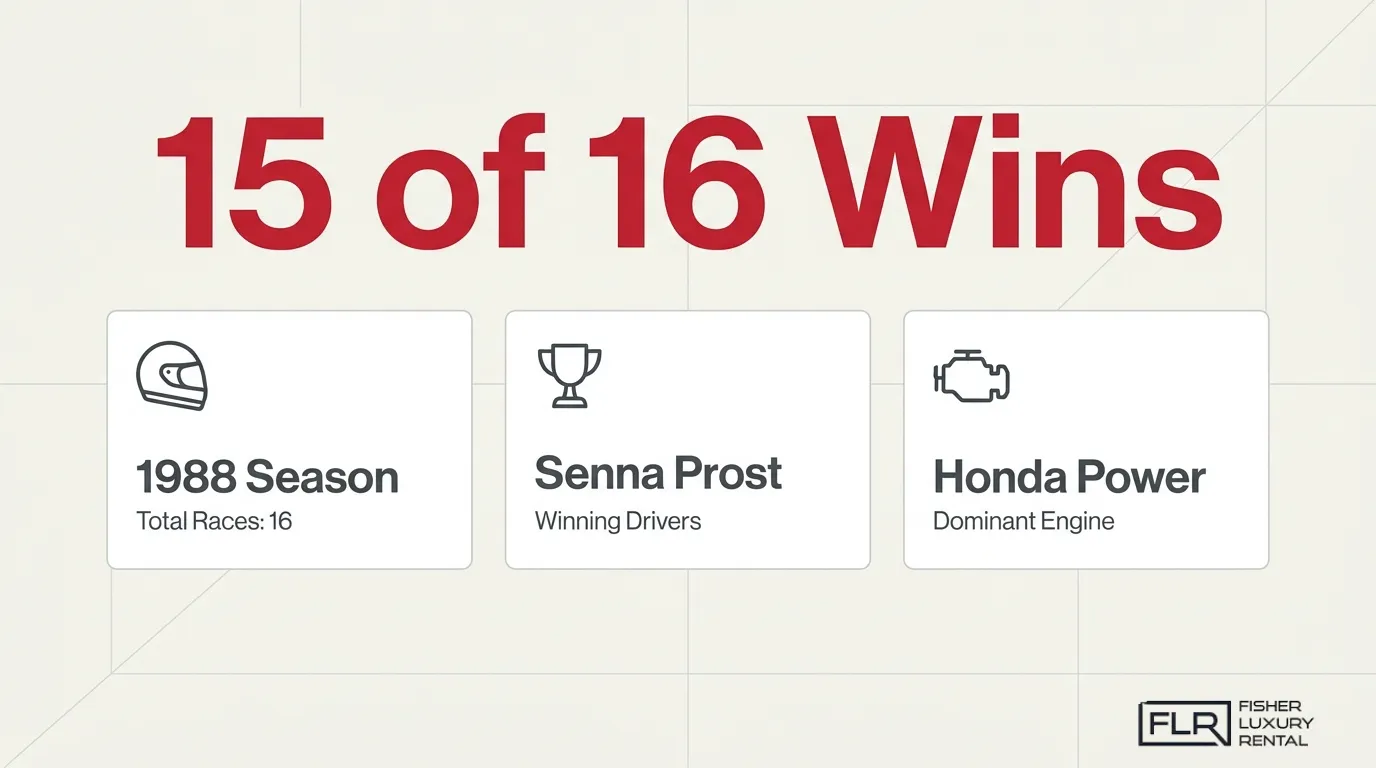
The 1970s and 1980s delivered back-to-back championship wins through the M23 chassis with Fittipaldi and Hunt, followed by the TAG Porsche-powered MP4/2 dominating 1984 with 12 wins from 16 races. The McLaren-Honda era then produced the most statistically dominant stretch in F1 history, with the MP4/4 winning 15 of 16 races in 1988.
McLaren’s technical innovations, particularly the 1981 MP4/1 carbon fiber monocoque, permanently changed how every F1 car is built. Mika Häkkinen then revived the team’s championship credentials with back-to-back titles in 1998 and 1999 before a difficult decade in the 2010s tested the team’s resilience and capacity to rebuild.
Who Was Bruce McLaren and Why Did He Found McLaren Racing?
Bruce McLaren was a New Zealand racing driver who founded Bruce McLaren Motor Racing Ltd in 1963, driven by a desire to build and race his own cars. The H3s below cover his early career influences, his motivations for starting a constructor, and how his death shaped the team’s future.
How Did Bruce McLaren’s Early Racing Career Shape the Team?
Bruce McLaren’s early racing career shaped the team by instilling an engineer-driver philosophy that prioritized technical ownership over simply competing in someone else’s car. Racing in Formula 1 from 1959, he gained firsthand knowledge of what a competitive car required, and that experience directly informed how he structured his own operation. According to McLaren Racing, the team he founded took the marque into grand prix racing in 1966 and claimed its first Grand Prix victory at the 1968 Belgian Grand Prix, a result that validated his hands-on approach. That fusion of driver instinct and engineering ambition became the team’s foundational identity.
What Inspired Bruce McLaren to Start His Own Constructor?
What inspired Bruce McLaren to start his own constructor was a conviction that true competitiveness required controlling every aspect of the car. Rather than relying on an external chassis manufacturer, McLaren believed a driver-led team with its own engineering capability could outperform arrangements where input was indirect or limited. This philosophy, uncommon for its era, set McLaren apart from competitors who simply purchased or leased machinery. It was arguably the most consequential decision in the team’s history, establishing the self-sufficient model that later produced championship-winning cars across multiple decades.
How Did Bruce McLaren’s Death Impact the Team’s Future?
Bruce McLaren’s death on June 2, 1970, while testing the McLaren M8D Can-Am car at the Goodwood circuit in West Sussex, England, threatened to end the team entirely. He was just 32 years old, and the organization he built was still young. Rather than dissolving, the team’s core staff chose to continue in his name, transforming personal grief into institutional resolve. That decision preserved the structure Bruce had built and allowed the foundation he created to eventually support championships, iconic drivers, and decades of F1 innovation.
How Did McLaren Establish Itself in Formula 1 During the 1960s?
McLaren established itself in Formula 1 during the 1960s through Bruce McLaren’s founding of Bruce McLaren Motor Racing Ltd in 1963 and the team’s first Grand Prix victory at the 1968 Belgian Grand Prix. The sections below cover the team’s founding, early racing program, and the milestone win that launched McLaren’s F1 legacy.
What Made McLaren Dominant in the 1970s and Early 1980s?
McLaren’s dominance in the 1970s and early 1980s was built on the M23 chassis, exceptional driving talent, and back-to-back championship performances. The sections below cover the M23’s technical foundation, Emerson Fittipaldi’s championship-winning role, and James Hunt’s iconic 1976 title.
How Did the M23 Define McLaren’s First Championship Era?
The M23 defined McLaren’s first championship era by combining reliable engineering with competitive performance across multiple seasons. Powered by a Ford-Cosworth DFV 2,993 cc V8 producing 465 hp at 10,800 rpm, the M23 weighed just 575 kg, giving it a strong power-to-weight advantage over many rivals. Its longevity was exceptional; the car remained competitive from 1973 through 1977, spanning two Drivers’ Championships. Few F1 cars have carried a team to multiple titles across different drivers, which makes the M23 one of the most versatile chassis in grand prix history.
What Role Did Emerson Fittipaldi Play in McLaren’s Rise?
Emerson Fittipaldi played a foundational role in McLaren’s rise as the driver who delivered the team’s first Formula 1 World Championship. According to Formula 1’s Hall of Fame records, Fittipaldi won the 1974 Drivers’ title driving the M23, taking victories in Brazil, Belgium, and Canada and simultaneously securing McLaren’s first Constructors’ Championship. His technical feedback and racecraft helped shape the M23’s development at a critical point in the team’s history.
How Did James Hunt’s 1976 Title Change McLaren’s Legacy?
James Hunt’s 1976 title changed McLaren’s legacy by transforming the team into a global motorsport icon. Hunt won the 1976 F1 World Championship driving the McLaren M23, recording 10 race wins across his 92 Grand Prix starts for McLaren between 1976 and 1978. The championship battle against Niki Lauda became one of F1’s most celebrated rivalries, bringing mainstream media attention to McLaren that extended far beyond motorsport audiences. That exposure cemented McLaren’s identity as a team capable of winning under pressure in the most dramatic circumstances.
How Did the McLaren-TAG Porsche Partnership Transform the 1984 Season?
The McLaren-TAG Porsche partnership transformed the 1984 season by producing one of the most dominant campaigns in Formula 1 history. The sections below cover the MP4/2’s engineering breakthrough and the historic points battle between Niki Lauda and Alain Prost.
Why Was the MP4/2 Considered a Revolutionary F1 Car?
The MP4/2 was considered a revolutionary F1 car because it combined a purpose-built turbocharged engine with an advanced carbon fiber chassis to create an unprecedented competitive package. According to McLaren Racing, the MP4/2 won 12 out of 16 races in 1984, powered by the TAG-Porsche TTE PO1 1,499 cc engine producing approximately 800 hp in qualifying trim and 650 hp in race configuration. That power-to-reliability balance set the MP4/2 apart from rival turbocharged competitors of the era. Few cars in F1 history have combined raw speed with such consistent race-finishing capability, making the MP4/2 a genuine landmark in constructors’ engineering.
How Did Niki Lauda and Alain Prost Compete as Teammates?
Niki Lauda and Alain Prost competed as teammates in one of the closest and most celebrated title fights in F1 history. According to Sports Car Digest, Lauda won his third and final World Championship in 1984, defeating Prost by just 0.5 points, with a final tally of 72 points to Prost’s 71.5. Both drivers pushed the MP4/2 to its limits across the full season, with neither able to establish a comfortable lead. That half-point margin remains the smallest championship-winning margin in F1 history, underscoring just how evenly matched McLaren’s lineup was that year.
What Made the McLaren-Honda Era the Most Dominant in F1 History?
The McLaren-Honda era produced the most statistically dominant stretch in Formula 1 history, built on an exceptional car, a historic engine partnership, and two of the sport’s greatest drivers. The H3s below cover the MP4/4’s near-perfect 1988 season, the Senna-Prost rivalry, and Senna’s enduring legacy at McLaren.
How Did the MP4/4 Achieve a Near-Perfect 1988 Season?
The MP4/4 achieved a near-perfect 1988 season by combining Honda’s turbocharged RA168E engine with a low-profile chassis designed by Gordon Murray and Steve Nichols. The result was a car that dominated every circuit type on the calendar. According to Wikipedia, the MP4/4 won 15 of 16 races that season, the only loss coming when Senna retired from the lead in Monaco. No other constructor came close to challenging McLaren’s pace or reliability that year. That level of mechanical dominance, paired with two elite drivers, remains unmatched across F1’s entire history.
What Fueled the Senna vs Prost Rivalry at McLaren?
The Senna vs Prost rivalry at McLaren was fueled by two contrasting driving philosophies competing for the same championship within the same garage. Senna pursued perfection through instinct and raw speed; Prost operated through precision and strategic calculation. According to Wikipedia, Senna and Prost won 25 of 32 Grands Prix combined as McLaren teammates, a shared dominance that simultaneously united and fractured the team. Their rivalry grew from professional tension into open hostility, culminating in on-track collisions at the 1989 and 1990 Japanese Grands Prix. This internal war inside the most dominant team in F1 history made it one of sport’s most compelling rivalries.
How Did Ayrton Senna’s McLaren Years Redefine F1 Greatness?
Ayrton Senna’s McLaren years redefined F1 greatness by setting a standard for championship performance that combined raw speed with relentless mental focus. According to Honda Global, Senna won his first World Championship in 1988 with the MP4/4, securing eight victories that season alone, and went on to claim three total World Championships with McLaren. His qualifying laps, rain-soaked masterclasses, and psychological intensity raised the benchmark for what F1 excellence looked like. More than statistics, Senna gave McLaren a human identity that transcended racing. His legacy at Woking remains the emotional and competitive peak the team has spent decades working to reclaim. That legacy eventually shaped McLaren’s road car division, and for car enthusiasts who want to experience that lineage firsthand, luxury exotic rental companies like Fisher Luxury Rental offer access to high-performance vehicles inspired by the same racing DNA.
How Did Mika Häkkinen Revive McLaren in the Late 1990s?
Mika Häkkinen revived McLaren by delivering back-to-back World Drivers’ Championships in 1998 and 1999, ending a title drought that had persisted since Ayrton Senna’s 1991 championship. The sections below cover the McLaren-Mercedes partnership that made it possible and Häkkinen’s consecutive title campaigns.
What Made the McLaren-Mercedes Partnership Successful?
The McLaren-Mercedes partnership succeeded by combining McLaren’s chassis engineering precision with Mercedes-Benz’s competitive power unit, producing a package capable of challenging Ferrari across a full season. The partnership gave McLaren the technical foundation to field a genuinely title-contending car after years without a championship-winning engine. Reliability, aerodynamic efficiency, and driver quality all aligned in a way that few rival teams could match. This combination was arguably the most complete works-style collaboration McLaren had enjoyed since the Honda era, and it remains a model for how engine-constructor relationships should work.
How Did Häkkinen Win Back-to-Back Championships in 1998–1999?
Häkkinen won back-to-back championships by combining raw pace with consistent points-scoring across both seasons, ultimately taking 20 Grand Prix victories with McLaren. According to F1 Fansite, Häkkinen accumulated 420 total career championship points, averaging 2.55 points per Grand Prix, with 26 pole positions and 25 fastest laps, reflecting his dominance at the front of the field. The 1998 title was a hard-fought battle with Ferrari’s Michael Schumacher, while 1999 required Häkkinen to capitalize after Schumacher suffered a mid-season injury. Few drivers in the modern era have matched his ability to sustain championship-level performance across consecutive seasons.
Which Iconic McLaren F1 Cars Changed Grand Prix Racing Forever?
The iconic McLaren F1 cars that changed grand prix racing forever include the M23, MP4/1, MP4/4, MP4-13, and MP4-20, each representing a distinct era of technical and competitive evolution. Together, these five cars span three decades of championship-winning innovation.
McLaren M23
The McLaren M23 is the car that delivered two consecutive drivers’ titles and cemented McLaren as a championship-caliber constructor. Emerson Fittipaldi took the 1974 title with it, and James Hunt claimed the 1976 World Championship in one of the most dramatic seasons in F1 history. According to McLaren Racing, Hunt recorded 10 race wins across his 92 Grand Prix starts for McLaren between 1976 and 1978. The M23’s longevity across multiple competitive seasons made it one of the most versatile cars of its era.
McLaren MP4/1
The McLaren MP4/1 is the car that permanently changed F1 chassis construction. According to McLaren Racing, John Barnard designed the MP4/1, which debuted in 1981 as the first Formula One car to feature a full carbon fiber composite monocoque chassis, revolutionizing both safety and performance across the entire sport. Every modern F1 car traces its structural DNA back to this breakthrough. For enthusiasts who want a tangible connection to this performance heritage, Fisher Luxury Rental offers top-trim exotic vehicles in Phoenix, Scottsdale, Portland, and Vancouver, WA — cars that carry forward the same principles of lightweight construction and precision engineering that McLaren brought to motorsport.
McLaren MP4/4
The McLaren MP4/4 is widely regarded as the most dominant car in F1 history. Powered by Honda and driven by Ayrton Senna and Alain Prost, it won 15 of 16 races in the 1988 season. No chassis before or since has matched that win rate across a full campaign.
McLaren MP4-13
The McLaren MP4-13 delivered Mika Häkkinen his first Formula One World Championship in 1998, ending McLaren’s title drought and launching a back-to-back title run. It restored McLaren’s status at the front of the grid during a fiercely competitive Mercedes-powered era.
McLaren MP4-20
The McLaren MP4-20 is the car that defined Kimi Räikkönen’s most competitive McLaren season. In 2005, it was among the fastest machines on the grid, winning multiple races and challenging for the championship. Its technical refinement reflected McLaren’s continued commitment to aerodynamic and mechanical excellence into the mid-2000s.
What Key Technical Innovations Has McLaren Pioneered in F1?
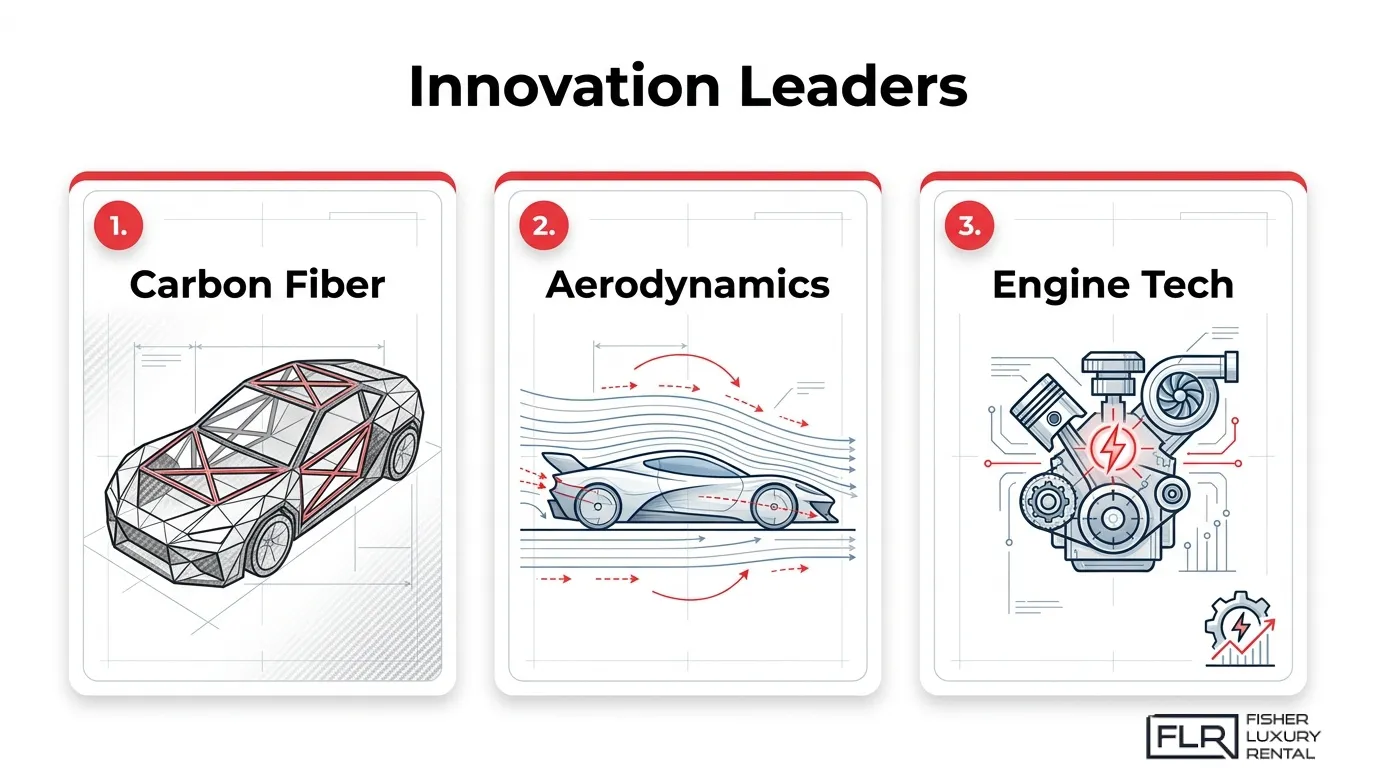
McLaren has pioneered technical innovations in areas including chassis construction, aerodynamics, and engine integration. The sections below cover each advancement in detail.
How Did McLaren Introduce Carbon Fiber Monocoques to F1?
McLaren introduced carbon fiber monocoques to F1 through the MP4/1, designed by John Barnard and debuted in 1981 as the first Formula One car to feature a full carbon fiber composite monocoque chassis. According to McLaren Racing, this breakthrough revolutionized both safety and performance across the sport. Before the MP4/1, aluminum monocoques were the standard construction method, offering far less rigidity and crash protection. The carbon fiber tub was dramatically stiffer and lighter, forcing every competitor to eventually follow McLaren’s lead. This single engineering decision arguably did more to shape modern F1 car architecture than any other innovation of the era.
What Aerodynamic Breakthroughs Originated at McLaren?
McLaren’s aerodynamic breakthroughs originated in its systematic approach to downforce management, ground effect optimization, and bodywork integration throughout the 1980s and 1990s. The team combined tight packaging of mechanical components with carefully sculpted underbody and sidepod designs, allowing aerodynamic surfaces to work more efficiently at high speed. This philosophy was evident in cars such as the MP4/4, where exceptional aerodynamic balance complemented the dominant Honda power unit. McLaren’s willingness to invest in wind tunnel development ahead of competitors established a rigorous aero culture that many rival teams later adopted as standard practice.
How Has McLaren Advanced F1 Engine Integration Strategies?
McLaren has advanced F1 engine integration strategies by treating the power unit as a structural chassis component rather than a simple mechanical addition. The McLaren M23, powered by the Ford-Cosworth DFV, a 2,993 cc 90-degree V8 producing 465 hp at 10,800 rpm with 280 lb-ft of torque, demonstrated how tightly packaging a stressed-member engine could reduce overall weight while improving structural stiffness. This integration philosophy carried forward through McLaren’s partnerships with TAG Porsche, Honda, and Mercedes, where close collaboration between chassis and engine engineers allowed each package to be optimized holistically rather than in isolation.
Which Drivers Have Won World Championships with McLaren?
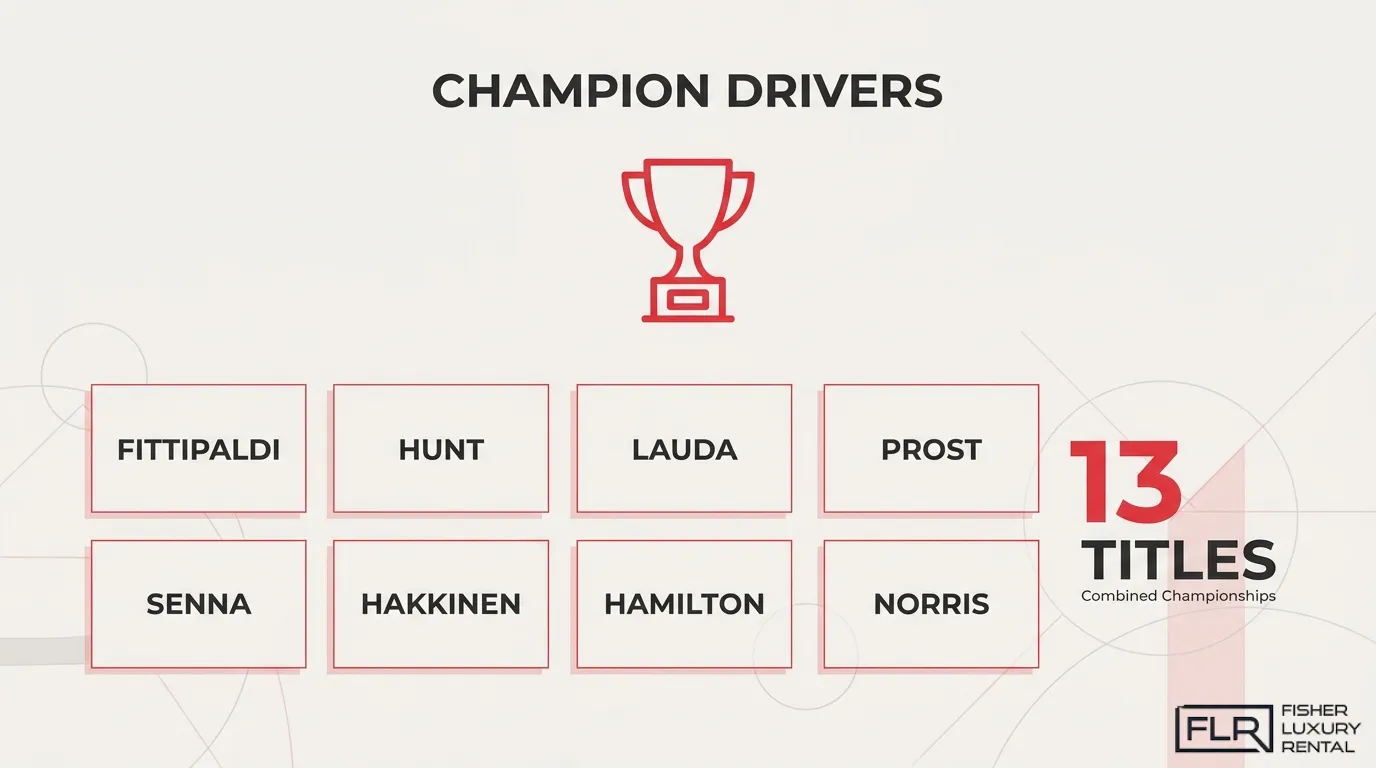
The drivers who have won World Championships with McLaren are Emerson Fittipaldi, James Hunt, Niki Lauda, Alain Prost, Ayrton Senna, Mika Häkkinen, Lewis Hamilton, and Lando Norris, totaling 13 Drivers’ Championships across six decades.
| Driver | Championship Year(s) | Car |
| Emerson Fittipaldi | 1974 | McLaren M23 |
| James Hunt | 1976 | McLaren M23 |
| Niki Lauda | 1984 | McLaren MP4/2 |
| Alain Prost | 1985, 1986, 1989 | McLaren MP4/2, MP4/5 |
| Ayrton Senna | 1988, 1990, 1991 | McLaren MP4/4, MP4/5, MP4/6 |
| Mika Häkkinen | 1998, 1999 | McLaren MP4/13, MP4/14 |
| Lewis Hamilton | 2008 | McLaren MP4-23 |
Emerson Fittipaldi won McLaren’s first Formula 1 World Championship in 1974 driving the M23, with victories in Brazil, Belgium, and Canada. Ayrton Senna secured three World Championships with McLaren, winning his first in 1988 with eight victories in the MP4/4, according to Honda Global. Mika Häkkinen won two consecutive titles in 1998 and 1999, claiming 20 Grands Prix and earning the nickname “the Flying Finn.” Supporting this driver success, McLaren has won 10 Constructors’ Championships, placing the team second only to Ferrari in all-time constructor titles.
How Did McLaren Navigate Struggles in the 2010s and Beyond?
McLaren navigated the 2010s through a painful engine partnership collapse, two supplier transitions, and a gradual competitive rebuild. The sections below cover the Honda reunion, the Renault and Mercedes switches, and McLaren’s recent regulatory progress.
What Happened During the McLaren-Honda Reunion from 2015–2017?
The McLaren-Honda reunion from 2015 to 2017 was defined by severe reliability failures and on-track embarrassment. According to Sky Sports, Honda’s engine debut in 2015 testing was limited to just five laps across two days, signaling deep mechanical problems from the outset. Fernando Alonso and Jenson Button endured three seasons of chronic power deficits, frequent retirements, and public frustration. The partnership, which had once delivered four consecutive Constructors’ titles, produced zero race wins the second time around. In hindsight, the reunion was rushed before the technology was ready, and McLaren paid a significant competitive price for that misjudgment.
How Has McLaren’s Partnership with Mercedes and Then Renault Evolved?
McLaren’s engine partnerships evolved across three distinct supply agreements after the Honda split. McLaren switched to Renault Sport Racing engines for the 2018, 2019, and 2020 seasons, stabilizing reliability while rebuilding the chassis program. McLaren Racing and Mercedes-Benz then announced a return partnership, with Mercedes powering the team from 2021 through at least the 2024 season.
- 2015–2017: Honda power unit, severe reliability issues, zero wins.
- 2018–2020: Renault engines, gradual points recovery, third in Constructors’ in 2020.
- 2021–present: Mercedes power unit, marking McLaren’s return to a proven championship-caliber supplier.
What Progress Has McLaren Made in the Current F1 Regulations?
McLaren’s progress under current F1 regulations has been substantial, with the team re-establishing itself among the front-running constructors. Paired with Mercedes power, McLaren developed a consistently competitive chassis, and Lando Norris emerged as a race-winner and title contender. This resurgence reflects years of structural investment in the factory, aerodynamic development, and driver lineup stability — proof that rebuilding from a low point is possible with the right foundations in place.
Why Does McLaren’s F1 Legacy Still Influence Supercar Culture?
McLaren’s F1 legacy influences supercar culture because decades of championship-winning innovation translated directly into road car engineering philosophy. The sections below cover how to experience that legacy through a luxury rental and what the most important takeaways from McLaren’s racing history are.
Can You Experience McLaren Performance with a Luxury Rental?
Yes, you can experience high-performance exotic vehicles through luxury rental companies like Fisher Luxury Rental, which specializes in top-trim exotic and luxury cars that share the engineering philosophy McLaren helped pioneer — carbon fiber construction, aerodynamic efficiency, and high-output powertrains. Every McLaren road car carries DNA from the F1 program: carbon fiber construction, aerodynamic efficiency, and high-output powertrains refined across decades of Grand Prix competition. Fisher Luxury Rental serves Phoenix, Scottsdale, Portland, and Vancouver, WA, giving enthusiasts direct access to that heritage behind the wheel. For car enthusiasts who want more than a photograph, driving a high-performance exotic is one of the closest real-world connections to a legacy that redefined what performance means.
What Are the Key Takeaways About McLaren Racing History?
The key takeaways about McLaren racing history are that the team built sustained excellence through technical innovation, legendary driver pairings, and a willingness to reinvent itself across eras. McLaren has won 12 confirmed Formula 1 Drivers’ Championships, earned by drivers including Ayrton Senna, Alain Prost, Mika Häkkinen, and Lewis Hamilton, according to McLaren Racing’s official heritage records. The 1981 carbon fiber monocoque, the near-perfect 1988 season, and the back-to-back 1998 and 1999 titles each represent distinct competitive peaks separated by genuine reinvention. What makes this legacy endure is not just the trophies; it is the way McLaren’s solutions to racing problems became the industry standard for road car performance worldwide.