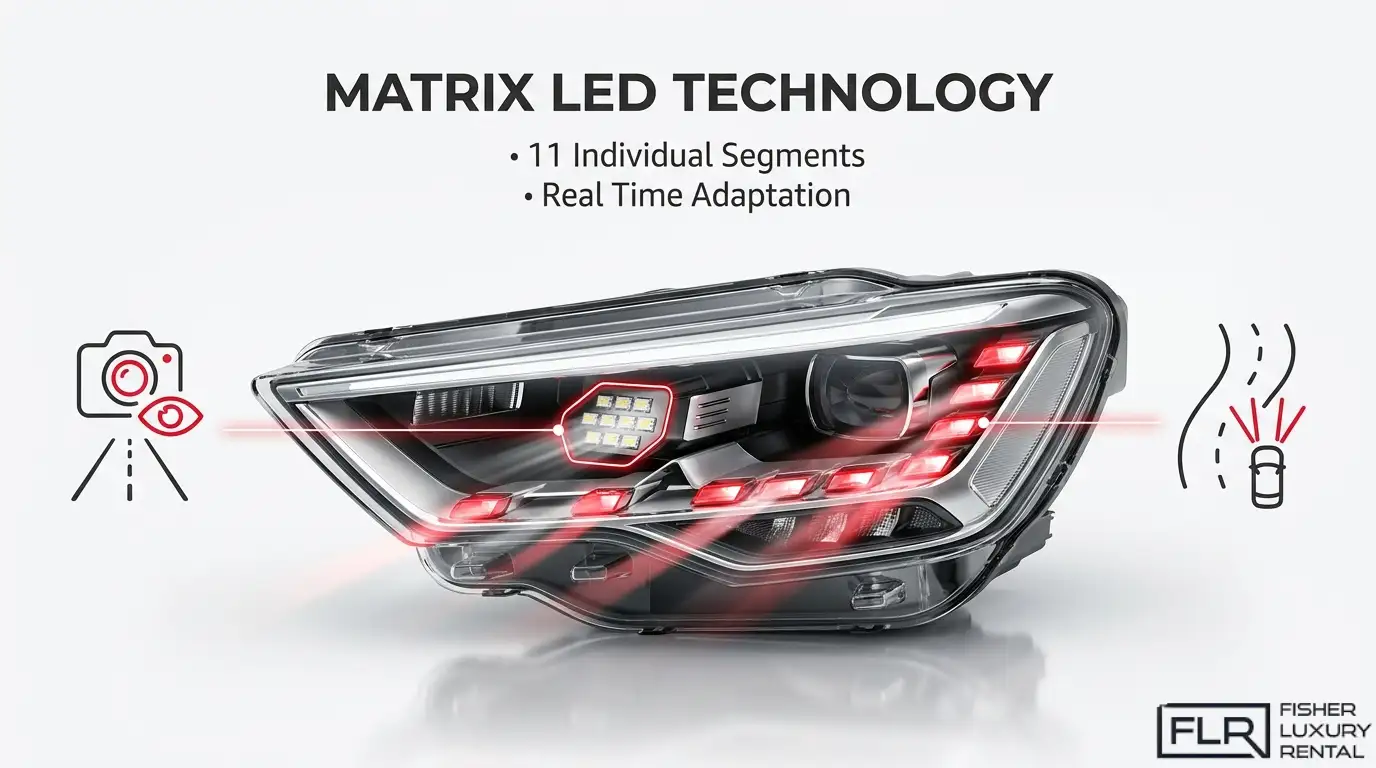
Porsche Matrix LED headlights are adaptive lighting systems that divide the high beam into independently controlled segments, using camera, speed, and navigation data to adjust illumination in real time without blinding other drivers.
This guide covers how the technology works, which Porsche models carry it, what features it includes, how it compares to standard LEDs and competitors, the PDLS and PDLS Plus control framework, maintenance requirements, and what to expect when renting a Porsche equipped with it.
We explain how individual LED segments and a camera-based detection system work together to produce glare-free high beam driving, and how static and dynamic light functions each serve distinct road conditions.
We then identify which models across the Cayenne, Taycan, 911, Macan, and Panamera lineups carry Matrix LED headlights as standard or as an available option, including where the Macan Turbo’s 84-LED-per-headlight system sits relative to entry configurations.
The feature breakdown covers five core functions: glare-free high beam, dynamic cornering light, highway mode, boost illumination, and construction zone adaptation, each targeting a specific driving scenario.
We compare Matrix LED performance against standard LED systems across visibility range, beam precision, and cost, and position Porsche’s approach against rival technologies including BMW Laser Light.
The PDLS and PDLS Plus section clarifies how Porsche’s tiered control framework connects to the matrix hardware, followed by guidance on lens care, alignment calibration, and when to seek professional diagnosis.
We close with what Fisher Luxury Rental offers drivers who want firsthand experience with this technology before committing to a purchase.
How Do Porsche Matrix LED Headlights Work?
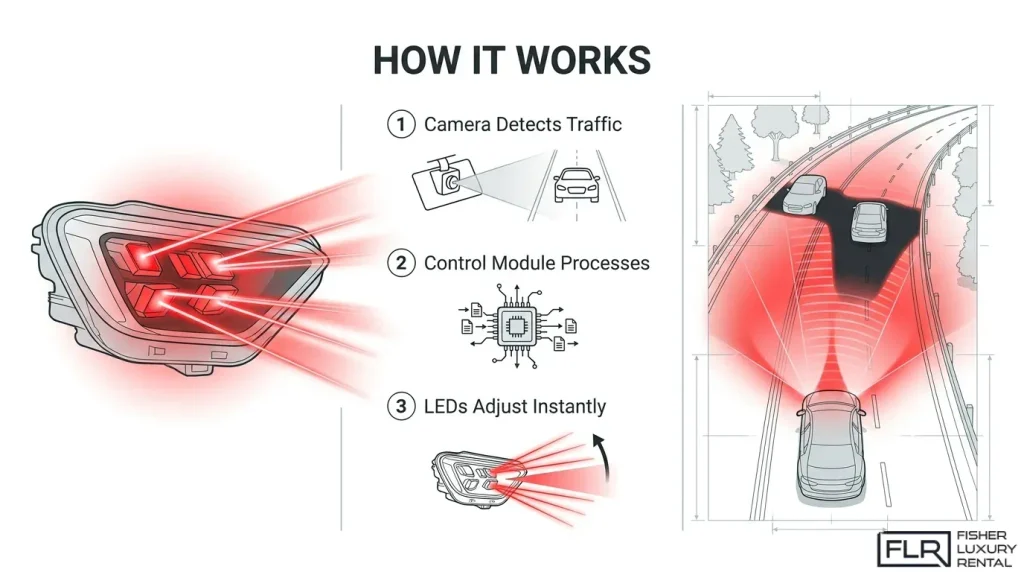
Porsche Matrix LED headlights work by dividing the high beam into individually controlled segments, each adjustable in real time based on camera, speed, and navigation data. The following H3s cover how LED segments distribute light, how the detection system controls the beam, and how static and dynamic functions differ.
What Role Do Individual LED Segments Play in Light Distribution?
Individual LED segments play a direct role in light distribution by allowing the headlight to illuminate or dim specific zones of the road independently, rather than casting a single fixed beam. Each segment targets a distinct portion of the road ahead, so the system can brighten curves, shade oncoming traffic zones, and adapt to changing road conditions simultaneously. According to a study published in Applied Sciences (MDPI), high-resolution LED pixel headlamps produce high-resolution light distribution that adapts to road and traffic conditions while assisting drivers, with system efficiency exceeding 50%. This granular control is what separates Matrix LED technology from conventional fixed-beam systems.
How Does the Camera-Based Detection System Control the Beam?
The camera-based detection system controls the beam by identifying other vehicles, pedestrians, and road markings in real time, then signaling the control module to adjust specific LED segments accordingly. According to the Porsche Newsroom, a control module comparable in function to a powerful PC graphics card can activate, deactivate, or dim each diode in 1,024 steps, producing an almost unlimited variety of light patterns. This precision means the system can carve a shadow around an oncoming driver without reducing visibility for the Porsche driver. In practice, this level of responsiveness is what makes glare-free high-beam driving genuinely viable at highway speeds.
What Is the Difference Between Static and Dynamic Light Functions?
The difference between static and dynamic light functions is that static functions provide fixed beam patterns optimized for specific conditions, while dynamic functions continuously adjust the beam in response to real-time inputs. Static modes include preset configurations such as urban lighting, which widens the low beam for pedestrian zones, and motorway mode, which narrows and extends the beam for high-speed roads. Dynamic functions, by contrast, respond actively to steering angle, vehicle speed, detected traffic, and navigation data, shifting light coverage as conditions change. Together, these two function types cover the full range of driving environments a Porsche encounters. Fisher Luxury Rental’s Porsche offerings give drivers the opportunity to experience both static and dynamic light functions across real Phoenix and Portland driving conditions, from urban streets to open highways.
Which Porsche Models Come Equipped with Matrix LED Headlights?
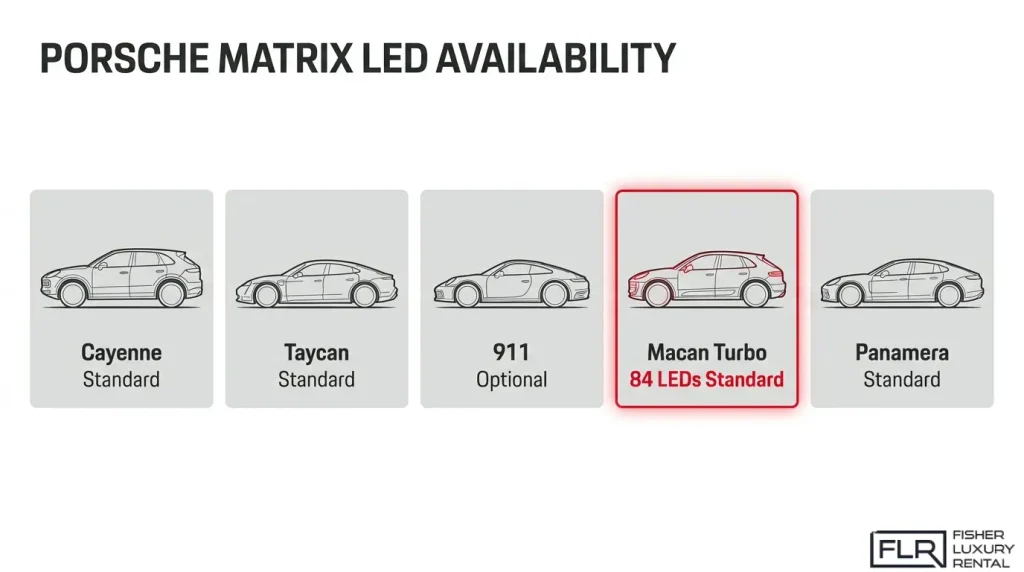
Several Porsche models come equipped with Matrix LED headlights, ranging from standard fitment to available options. The sections below cover the Cayenne, Taycan, 911, Macan, and Panamera.
Porsche Cayenne
The Porsche Cayenne offers Matrix LED headlights as an optional upgrade across its lineup. When selected, the system uses speed, camera, and navigation data to illuminate the road optimally, with the high beam area divided into 11 segments that can be individually illuminated or dimmed. According to the Porsche Newsroom, this segmented approach allows precise beam shaping in response to oncoming traffic, curves, and varying speed conditions.
Porsche Taycan
The Porsche Taycan offers Matrix LED headlights as an available option, applying the same 11-segment high beam architecture to an all-electric platform. The system continuously reads driving data to adjust each segment independently, keeping full illumination on unoccupied road areas while shielding other road users from glare. For a performance EV driven at higher speeds, this level of adaptive precision is especially valuable.
Porsche 911
The Porsche 911 offers Matrix LED headlights as an optional feature, integrating the adaptive beam system into the sports car’s signature four-point daytime running light design. The technology preserves the 911’s iconic visual identity while delivering intelligent high beam control across all 11 segments.
Porsche Macan
The Porsche Macan Turbo comes equipped with Matrix LED headlights as standard. According to the Porsche Newsroom, each headlight uses 84 LEDs together with upstream lenses and reflectors to illuminate the road to a distance of more than 600 meters. This makes the Macan Turbo one of the most capable Porsche models for nighttime visibility straight from the factory.
Porsche Panamera
The Porsche Panamera offers Matrix LED headlights as an available option, with higher trims gaining access to the advanced HD variant. The IIHS has found that vehicles with top-rated headlights show nighttime crash rates nearly 20 percent lower per mile, with injury-crash rates reduced by 29 percent compared to vehicles with poor-rated headlights. For a grand touring sedan covering long highway distances after dark, this safety advantage is difficult to overlook.
What Features Are Included in Porsche Matrix LED Headlights?
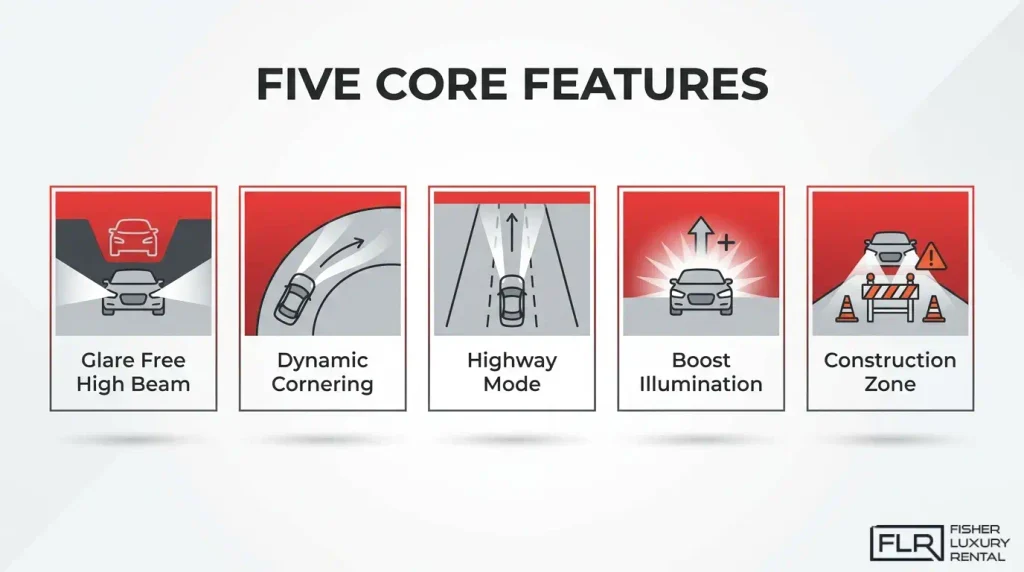
Porsche Matrix LED headlights include five core functions: glare-free high beam, dynamic cornering light, highway light mode, boost illumination, and construction zone adaptation. Each feature targets a specific driving scenario to maximize visibility and safety.
How Does the Glare-Free High Beam Function Operate?
The glare-free high beam function operates by selectively dimming individual LED segments in the path of oncoming or preceding vehicles while keeping the rest of the road fully illuminated. Rather than switching between high and low beam as a single unit, the system masks only the area containing detected headlights or taillights. This allows the driver to maintain near-full-beam visibility across unoccupied portions of the road without blinding other drivers.
What Is the Dynamic Cornering Light Feature?
The dynamic cornering light feature is a directional lighting function that pivots or shifts illumination in the direction of a detected turn or steering input. As the driver steers into a bend, the beam pattern extends laterally to light the curve ahead rather than pointing straight. This reduces the unlit zone at the edge of corners, giving drivers earlier visibility of road hazards, pedestrians, or obstacles before completing the turn.
How Does the Highway Light Mode Enhance Visibility?
The highway light mode enhances visibility by extending the beam range and widening the illuminated corridor when the vehicle reaches higher speeds. At highway velocities, the system recognizes that reaction distances increase, so it projects light farther down the road. The broader, longer beam pattern reduces the time drivers spend in relative darkness between the end of their low-beam range and where road details become distinguishable.
What Is the Boost Function for Maximum Illumination?
The boost function is a maximum-output mode that activates full illumination intensity when no oncoming traffic or preceding vehicles are detected. Every available LED segment operates at peak brightness simultaneously, delivering the widest and longest possible beam spread. This proves most effective on unlit rural roads or motorways where no other traffic is present and the driver benefits from the system’s full lighting capacity without any masking applied.
How Does the Construction Zone Light Adapt the Beam Pattern?
The construction zone light adapts the beam pattern by narrowing and redistributing illumination to concentrate light within tighter lane boundaries typical of roadwork areas. When the system detects reduced lane widths or relevant navigation data, it tightens the spread to reduce glare toward workers and barriers while keeping the active lane well lit. According to NHTSA’s final rule on adaptive driving beam headlights, this class of adaptive lighting improves nighttime visibility for pedestrians and road workers, a safety outcome that ECE R123 Class W cornering and auxiliary classifications were designed to address structurally. This precision in confined, high-risk zones is where adaptive beam technology earns its greatest real-world safety value.
How Do Porsche Matrix LED Headlights Compare to Standard LED Headlights?
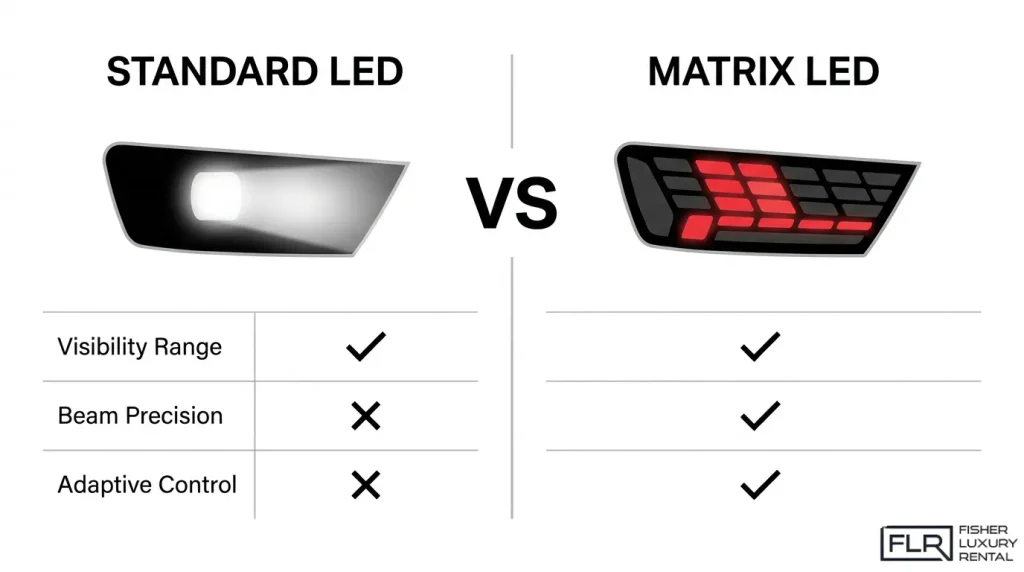
Porsche Matrix LED headlights outperform standard LED headlights in visibility range, beam precision, and adaptive intelligence. The sections below break down the differences across night visibility, beam control, and cost.
What Are the Visibility Differences at Night?
The visibility differences at night between Porsche Matrix LED and standard LED headlights are significant. Standard LED headlights project a fixed beam pattern, illuminating a set area regardless of road conditions or surrounding traffic. Porsche Matrix LED systems, by contrast, maintain full high-beam reach while selectively dimming zones around detected vehicles, keeping more of the road lit without blinding other drivers. This adaptive coverage means greater usable illumination across a wider field throughout the entire drive.
How Does Beam Precision Differ Between the Two Systems?
Beam precision differs dramatically between the two systems. Standard LED headlights use fixed optics that produce a single, uniform beam pattern with no zone-level control. Porsche’s HD Matrix LED technology, according to the Porsche Newsroom, combines more than 16,000 individually controllable micro-LEDs on a chip the size of a thumbnail, totaling over 65,000 LED elements across both headlights. That granularity allows the system to shape light with near-pixel-level accuracy, something no fixed-optic standard LED can replicate.
What Are the Cost Differences Between the Two Options?
The cost differences between the two options reflect a meaningful gap. Standard LED headlights are typically included in base trim pricing on most vehicles, while Porsche Matrix LED systems are either standard on higher trims or available as a premium option. Repair and replacement costs are also higher for matrix systems due to their integrated electronics and precision components. For drivers who prioritize night safety and driving confidence, the investment is well justified. For drivers who want to evaluate whether that investment makes sense before purchasing, Fisher Luxury Rental’s top-trim fleet offers a practical way to experience Matrix LED headlights firsthand in Phoenix, Scottsdale, Portland, or Vancouver, WA.
Are Porsche Matrix LED Headlights Standard or Optional?
Porsche Matrix LED headlights are standard on some trim levels and optional upgrades on others, depending on the specific model and configuration. Availability varies across the Cayenne, Taycan, 911, Macan, and Panamera lineups.
Porsche Cayenne
Matrix LED headlights on the Porsche Cayenne are available as an optional upgrade rather than standard equipment on base trims. Higher-specification Cayenne variants, such as the Cayenne Turbo, include them as part of premium lighting packages. Buyers selecting entry-level configurations will need to add Matrix LED technology through the options list, making trim selection critical when prioritizing advanced lighting.
Porsche Taycan
Matrix LED headlights on the Porsche Taycan are offered as an optional feature across the lineup, typically bundled within lighting or technology packages. The Taycan’s Matrix LED system uses speed, camera, and navigation data to divide the high beam area into 11 individually controllable segments, according to the Porsche Newsroom. For a vehicle built around performance technology, skipping this upgrade would leave meaningful capability on the table.
Porsche 911
Matrix LED headlights on the Porsche 911 are an optional upgrade, not standard across all variants. They are available on higher trims and through Porsche’s extensive options configurator. Given the 911’s role as Porsche’s definitive performance benchmark, the Matrix LED option aligns well with buyers seeking the complete package.
Porsche Macan
Matrix LED headlights on the Porsche Macan are standard equipment on the Macan Turbo trim. According to the Porsche Newsroom, the Macan Turbo’s Matrix LED headlights use 84 LEDs per headlight and illuminate the road to a distance of more than 600 meters. On lower Macan trims, standard LED headlights are fitted instead, with Matrix LEDs available as an upgrade.
Porsche Panamera
Matrix LED headlights on the Porsche Panamera are available as an optional upgrade, with higher-specification trims more likely to include them as standard or within bundled packages. The Panamera’s HD Matrix LED system uses a chip combining more than 16,000 individually controllable micro-LEDs per headlight, enabling precise, adaptive illumination that standard LEDs cannot replicate.
How Do Porsche Matrix LED Headlights Compare to Competitors?
Porsche Matrix LED headlights compare to competitors by offering more granular beam control, greater pixel density, and deeper integration with vehicle systems than most rival adaptive lighting technologies. The key differentiators involve segment count, control precision, and software intelligence.
How Does Porsche Matrix LED Technology Compare to BMW Laser Light?
Porsche Matrix LED technology compares to BMW Laser Light by prioritizing pixel-level adaptive control over raw range extension. According to BMW Group PressClub, BMW’s optional laser boost feature delivers a high beam range of up to 600 metres, doubling standard LED range while increasing energy efficiency by 30 percent. Porsche’s HD matrix LED system takes a different approach: an LED chip combining more than 16,000 individually controllable micro-LEDs produces over 65,000 LED elements per headlight pair, according to Porsche Newsroom. BMW laser light excels at distance; Porsche’s architecture excels at precision. For drivers navigating mixed urban and highway conditions, Porsche’s granular dimming control arguably delivers more practical, real-world adaptability than a single-function range booster.
How Does Porsche’s Adaptive Beam Precision Compare to Other Luxury Brands?
Porsche’s adaptive beam precision compares favorably to other luxury brands through its control module, which activates, deactivates, or dims each micro-LED diode in 1,024 discrete steps. This produces an almost unlimited variety of light patterns, a level of gradation that most competitor systems do not match. The IIHS has found that vehicles with good-rated headlights show nighttime crash rates nearly 20 percent lower per mile and reduce injury-crash rates by 29 percent, according to the Insurance Institute for Highway Safety. That safety data underscores why headlight precision, not just brightness, is the meaningful competitive metric in the luxury segment.
What Are PDLS and PDLS Plus on Porsche Models?
PDLS and PDLS Plus are Porsche’s tiered dynamic lighting systems that control how headlights respond to driving conditions. The sections below explain how the two tiers differ and how PDLS Plus connects to Matrix LED technology.
How Does PDLS Differ from PDLS Plus?
PDLS differs from PDLS Plus in both intelligence and capability. The base PDLS system delivers adaptive headlight swiveling, adjusting the beam direction in curves to follow the road ahead. PDLS Plus expands on this by adding a dynamic high beam that actively detects oncoming traffic and vehicles traveling ahead, then adapts both the intensity and range of the light in real time. According to Porsche Riverside, PDLS Plus converts the main headlights into active driving assistants rather than passive light sources. In practice, PDLS Plus represents a meaningful safety upgrade: the system reacts continuously to traffic, not just road geometry.
What Is the Relationship Between PDLS Plus and Matrix Technology?
PDLS Plus is the software and control framework that enables Matrix LED headlights to perform their core functions. Matrix LED headlights are the hardware; PDLS Plus is the intelligence layer that directs them. The high beam management, glare suppression, and range adaptation that define Matrix LED operation all function through PDLS Plus. Without PDLS Plus, Matrix LED headlights cannot perform their segment-level dimming and detection-based adjustments. Together, PDLS Plus and Matrix LED headlights form an integrated system where the lighting hardware and the adaptive control logic are interdependent.
How Do You Maintain Porsche Matrix LED Headlights?
Maintaining Porsche Matrix LED headlights requires attention to both physical upkeep and software health, covering lens cleaning, aiming calibration, and system diagnostics.
How Should You Clean and Protect the Headlight Lenses?
Headlight lenses should be cleaned using a soft microfiber cloth with a pH-neutral automotive soap to avoid scratching the polycarbonate housing. Abrasive cleaners, solvent-based products, and high-pressure washing directed at lens seams can degrade the protective coating. Because the optical precision of matrix systems depends on clean lens surfaces, even minor haze or residue can scatter the segmented beam pattern and reduce effective illumination range.
How Often Should Headlight Alignment Be Checked?
Headlight alignment should be checked after any suspension work, front-end collision, or tire replacement. Matrix LED systems require precise vertical and horizontal aim to function correctly, since misalignment disrupts the camera-based segment control and reduces the glare-free high beam’s accuracy. A certified Porsche technician should perform calibration using manufacturer-approved aiming equipment, as generic tools may not account for the system’s dynamic leveling sensors.
When Should You Seek Professional Diagnosis for Headlight Issues?
Professional diagnosis is needed when the instrument cluster displays a headlight malfunction warning, when beam patterns appear uneven, or when automatic high beam switching becomes erratic. The matrix LED control module manages complex lighting logic, and software faults often require dealer-level diagnostic tools to resolve. Attempting DIY repairs on sealed LED headlight assemblies risks damaging the module or voiding warranty coverage, making authorized service the only practical path for most faults.
What Should You Know About Matrix LED Headlights When Renting a Porsche?
Renting a Porsche gives you direct access to matrix LED headlight technology without a six-figure purchase commitment. The following H3s cover what Fisher Luxury Rental offers and the key takeaways every driver should understand.
Can You Experience Matrix LED Headlights Through Fisher Luxury Rental?
Yes, you can experience matrix LED headlights through Fisher Luxury Rental by renting one of the Porsche models in its fleet. Fisher Luxury Rental focuses on top-trim configurations, which means the advanced lighting systems that are standard or available on higher trims are more likely to come with the vehicle. According to McKinsey & Company, 86 percent of luxury car buyers cite driving enjoyment as their primary motivation, far outpacing status at 36 percent. Renting delivers exactly that enjoyment without ownership costs, making it the most practical way to experience features like matrix LED headlights firsthand. For drivers in Phoenix, Scottsdale, Portland, and Vancouver, WA, Fisher Luxury Rental makes that access straightforward.
What Are the Key Takeaways About Porsche Matrix LED Headlights?
The key takeaways about Porsche matrix LED headlights are that they represent a meaningful safety and performance upgrade over standard LED systems, with real-world driving benefits that are immediately noticeable. The core lessons worth retaining are:
- Segmented beam control: The high beam area divides into 11 independently controllable segments, adapting in real time to other vehicles and road conditions.
- Intelligent detection: Speed, camera, and navigation data all feed into the system to optimize illumination continuously.
- Extended reach: Models like the Macan Turbo illuminate the road beyond 600 meters, well beyond conventional LED range.
- Safety impact: Better-rated headlight systems are directly linked to lower nighttime crash rates, making this more than a luxury feature.
- HD resolution upgrade: High-resolution HD variants use chips with more than 16,000 individually controllable micro-LEDs per headlight for precision that standard matrix systems cannot match.
Renting a Porsche through Fisher Luxury Rental is the most accessible way to experience this technology behind the wheel.