The Porsche 911 GT3 sound level is the measured acoustic output of its 4.0-liter naturally aspirated flat-six engine across a range of conditions, from idle to full throttle, and the noise limits are the legal and venue-specific decibel thresholds that govern where and how that output is permitted.
This guide covers the GT3’s decibel measurements across generations, how those measurements are taken, how the car compares to rival supercars, what drives its acoustic character, how noise regulations apply on public roads and at circuits, and how to reduce or experience that sound through the right exhaust setup or rental.
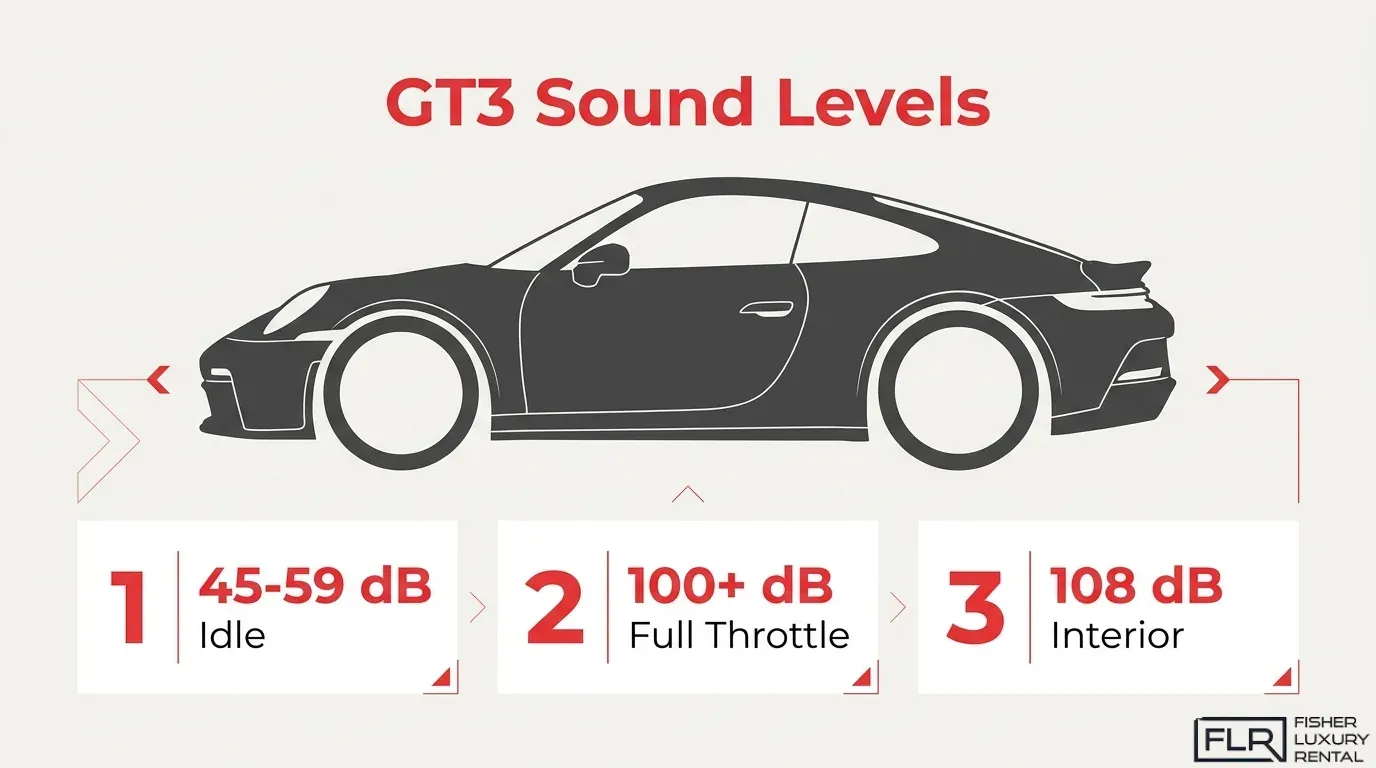
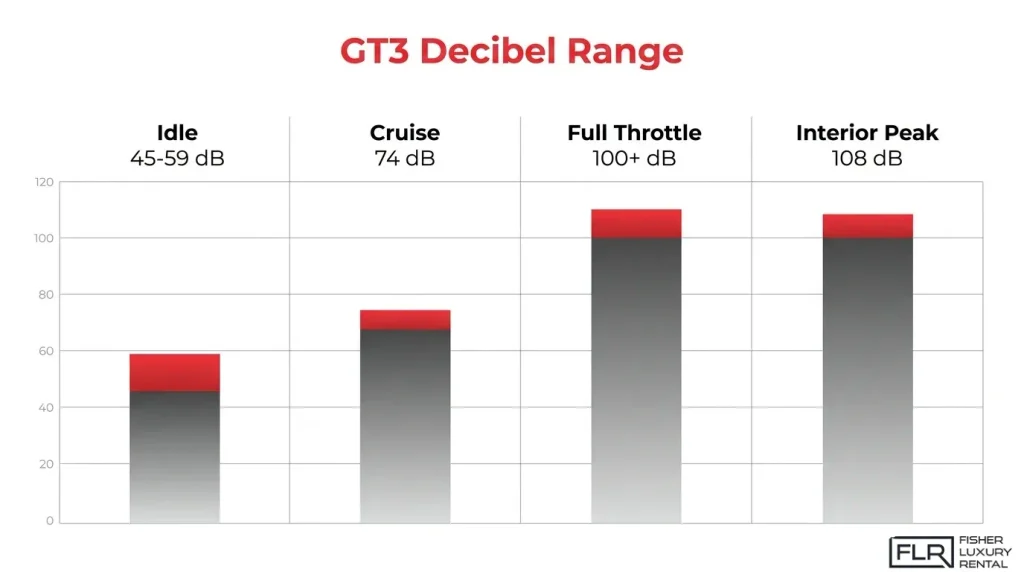
The GT3 ranges from roughly 45 to 59 dB at idle depending on the generation, climbing past 100 dB at full throttle and reaching 108 dB inside the cabin during hard acceleration testing.
Sound measurement methods vary by context: stationary tests, SAE J2825 drive-by procedures, and EU type approval testing each serve a different regulatory purpose, and the GT3 navigates all three.
Noise regulations create real constraints. Laguna Seca enforces a 90 dB ceiling for standard track days, California law sets a 95 dB(A) road limit, and EU Regulation 540/2014 is tightening passenger car noise limits to 68 dB(A) by 2026, making compliant acoustic tuning a genuine engineering challenge for a car built to scream at 9,000 rpm.
Reducing the GT3’s output is possible through dB reducer inserts, resonators, and carefully chosen aftermarket exhausts, though modifications like muffler deletes are illegal for public-road use in most states.
How Loud Is the Porsche 911 GT3 in Decibels?
The Porsche 911 GT3 ranges from approximately 45–59 dB at idle to over 100 dB at full throttle, depending on the generation and conditions. The sections below cover idle noise, full-throttle output, drive-by test results, and interior cabin levels.
How Loud Is the Porsche 911 GT3 at Idle?
The Porsche 911 GT3 at idle measures between 45 and 59 decibels, depending on the generation. The 2019 GT3 RS measures 45 dB at idle, while the older 997 GT3 RS 4.0 registers 59 dB. At these levels, the engine is comparatively quiet, sitting in the range of a normal conversation. The significant jump in volume comes once the throttle opens.
How Loud Is the Porsche 911 GT3 at Full Throttle?
The Porsche 911 GT3 at full throttle delivers a dramatic rise in volume as the 4.0-liter flat-six climbs toward its 9,000-rpm redline. The sound character changes with throttle load by deliberate engineering intent. According to Porsche Newsroom, Dr. Bernhard Pfäfflin, Porsche’s head of development for vibrational technology and acoustics, explains that varying sound and volume with throttle load “gives the driver an additional point of orientation.” This makes the GT3’s acoustics a functional performance tool, not just theater.
How Loud Is the Porsche 911 GT3 During a Drive-By Test?
The Porsche 911 GT3 during a drive-by test produces substantially higher readings than standard road cars. According to Car and Driver, the 2016 GT3 RS recorded 108 decibels inside the car during testing, far exceeding the 88 dB recorded by the 2015 BMW M3 under the same conditions. To contextualize how seriously Porsche takes acoustic measurement, the Porsche Newsroom reports the company logs 2,000 kilometers of acoustic test drives annually using an artificial head named “Sam,” equipped with a binaural measurement system and ICP microphones rated to a 130 dB dynamic range.
How Loud Is the Porsche 911 GT3 Inside the Cabin?
The Porsche 911 GT3 inside the cabin is notably loud by road car standards, a direct result of its stripped-out construction and minimal soundproofing. Top Gear reports the 992 GT3 averages 74 decibels at a highway cruise of around 70 mph, while the GT3 RS variant reached 108 dB internally during hard acceleration testing. Evo Magazine’s Ethan Jupp describes the GT3 Touring as “raucous in terms of cruising engine noise,” producing a “spectacularly intrusive cacophony” on certain road surfaces. For drivers who want full sensory immersion, the GT3’s cabin delivers an experience that few road cars can match. Fisher Luxury Rental, which serves Phoenix, AZ and Portland, OR, offers exotic car rentals for enthusiasts who want to experience that sensory immersion firsthand without the cost of ownership.
How Is the Porsche 911 GT3 Sound Level Measured?
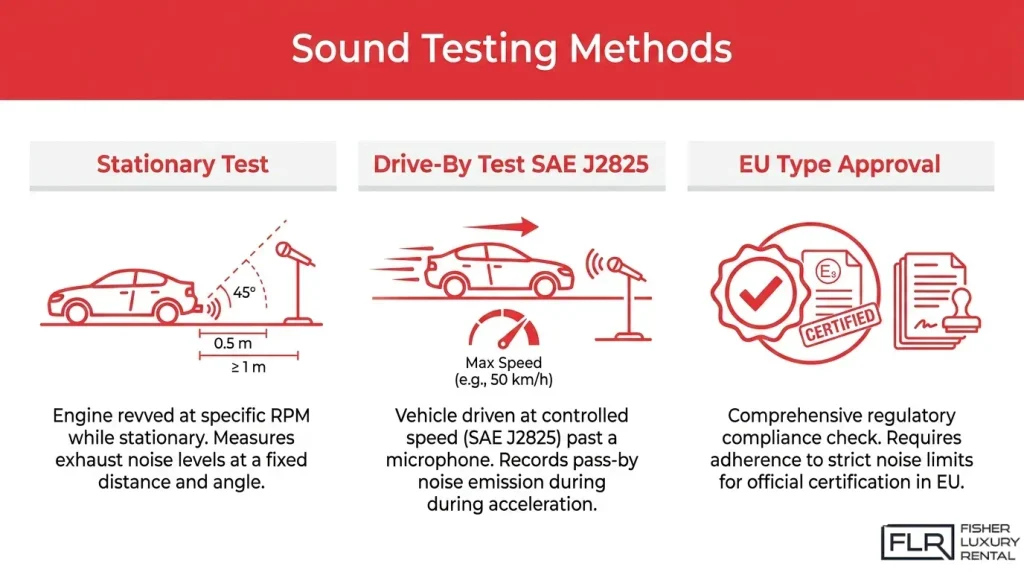
The Porsche 911 GT3 sound level is measured using three primary methods: stationary sound tests, drive-by noise tests, and EU type approval testing. Each method serves a different regulatory context, from track day compliance to road legality.
What Is the SAE J2825 Drive-By Noise Test?
The SAE J2825 drive-by noise test is a standardized procedure that measures exhaust sound pressure as a vehicle passes a fixed microphone position. EU Regulation No. 51 mirrors this approach with two pass-by noise conditions: a wide-open-throttle test and a cruise test, according to ATEEL-ACEA. Silverstone Circuit applies both methods, enforcing a 105 dB static limit and a 102 dB drive-by limit on its National/International Circuit. California Vehicle Code Section 27150(b) sets a stricter 95 dB(A) ceiling for road vehicles under 6,000 lbs, tested under SAE Standard J1169. Drive-by testing captures real-world acceleration noise far more accurately than stationary methods, making it the benchmark regulators trust most.
What Is a Stationary Sound Test for Track Day Compliance?
A stationary sound test is a fixed-position measurement taken with the vehicle parked and engine running at a specified rev range. According to Brocks Performance, the SAE J2825 procedure requires a calibrated sound meter held at a 45-degree angle, 20 inches from the exhaust outlet. Silverstone uses a similar approach: measurements taken at 0.5 meters and a 45-degree angle with the engine at three-quarters of maximum revs. Laguna Seca applies this method against a strict 90 dB maximum for standard track days. For a GT3 owner, stationary testing is the most common compliance check at track day sign-in.
What Does the EU Type Approval Sound Test Require?
The EU type approval sound test requires manufacturers to certify vehicle noise against regulated limits before a car can be sold on European roads. The Nürburgring Nordschleife independently enforces a 130 dB(A) sound power level ceiling for tourist drives, reflecting how type approval limits translate into venue-specific rules. Type approval testing combines both pass-by and stationary measurements, giving regulators a complete acoustic profile of each vehicle before it reaches public roads.
How Does the 911 GT3 Compare to Other Supercars in Noise?
The 911 GT3 compares favorably to many supercars in noise output, sitting in a competitive range alongside models like the McLaren 765LT and Ferrari 488. The sections below cover direct decibel comparisons against key rivals.
How Does the 911 GT3 Compare to the McLaren 765LT in Noise?
The 911 GT3 compares closely to the McLaren 765LT in noise, with both cars operating in roughly the same decibel tier. According to Driving Experience, the McLaren 765LT produces 99 decibels, with independent tests reporting peaks as high as 109 decibels. The 2016 GT3 RS recorded 108 decibels inside the cabin during testing, placing it in the same elite noise bracket. For pure acoustic aggression, these two represent the upper echelon of road-legal supercar sound.
How Does the 911 GT3 Compare to the Ferrari 488 in Noise?
The 911 GT3 compares directly to the Ferrari 488 in noise, with both cars producing certified levels above 100 decibels. French homologation data for the Ferrari 488 states a noise level of 105 dB at 4,000 rpm. The GT3 RS, measured at full throttle, reaches comparable figures. Both cars frequently approach the static noise limits enforced at circuits like Silverstone, making track-day compliance a genuine consideration for either model.
How Does the 911 GT3 Compare to the BMW M3 in Noise?
The 911 GT3 is significantly louder than the BMW M3. Car and Driver recorded the 2015 BMW M3 at 88 decibels during testing, while the GT3 RS reached 108 decibels under the same methodology. That 20-decibel gap is not a marginal difference; on the logarithmic dB scale, it represents dramatically more acoustic energy. The GT3 belongs to a different noise category entirely, making the M3 comparison useful mainly for illustrating how far beyond the sport sedan segment the GT3 sits.
What Makes the Porsche 911 GT3 Flat-Six Engine So Loud?
The Porsche 911 GT3 flat-six engine is so loud because of its naturally aspirated design, high-revving architecture, and deliberately engineered intake and exhaust systems that amplify mechanical sound rather than suppress it.
According to Car and Driver, the 4.0-liter naturally aspirated flat-six screams to a 9,000-rpm redline, producing between 500 and 520 horsepower depending on the generation. At those revs, combustion events happen so rapidly and with such force that the acoustic output is structurally unavoidable. No turbocharger absorbs or redirects that energy; every pulse travels directly through the exhaust. The Porsche Newsroom also confirms that the GT3 features a newly designed variable intake system made of lightweight plastic incorporating two resonance butterflies, which actively tune airflow to enhance the induction sound at specific rev ranges.
Together, a near-race-spec rev ceiling and a precision-tuned intake system make the GT3’s flat-six one of the most sonically expressive road engines ever built. That combination is not an accident; it is the result of deliberate engineering choices that prioritize acoustic character alongside performance.
Which 911 GT3 Generation Is the Loudest?
The loudest 911 GT3 generation depends on the specific variant and conditions measured. The sections below compare the 992, 991.2, 991.1, and 997 generations using available decibel data.
How Loud Is the 992 Generation GT3?
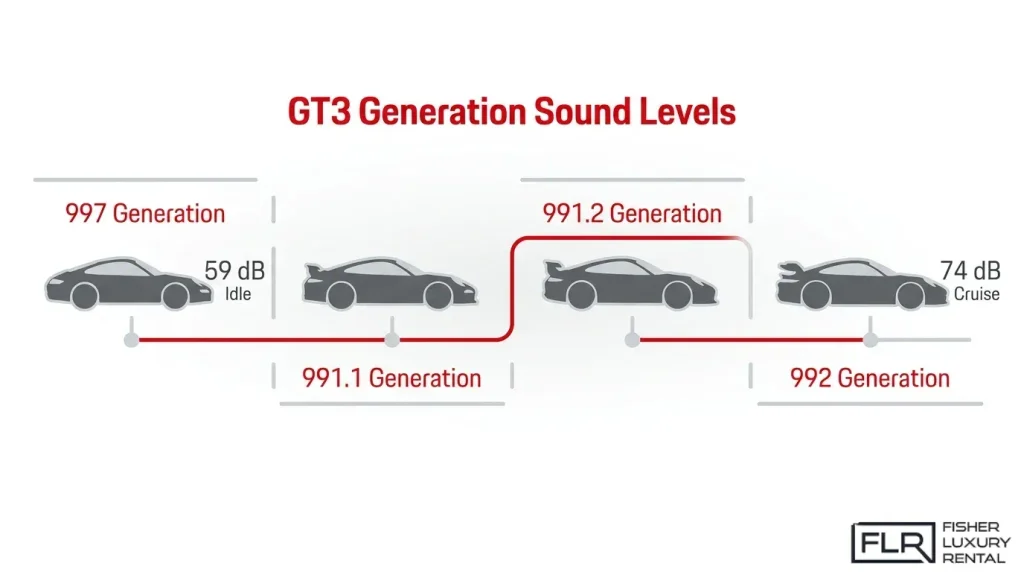
The 992 generation GT3 is loud enough to register 74 decibels at a 70-mph cruise, according to Top Gear, largely because Porsche stripped out nearly all soundproofing and fitted stiff, low-profile rubber that transmits road noise directly into the cabin. At higher revs and under hard acceleration, the cabin experience intensifies considerably beyond that cruising baseline. For a car with any road-use pretense, 74 dB at a highway cruise is a significant figure, and it makes the 992 GT3 one of the noisier cars to live with daily.
How Loud Is the 991.2 Generation GT3?
The 991.2 GT3 does not have a widely published single-figure decibel measurement comparable to the 992’s documented cruise reading. The 991.2 generation introduced the 4.0-liter naturally aspirated flat-six shared with the RS, producing sound characteristics closely related to its successor. Owner reports and press reviews consistently describe it as acoustically aggressive, particularly above 6,000 rpm where the high-revving engine delivers its most dramatic exhaust note.
How Loud Is the 991.1 Generation GT3?
The 991.1 GT3 similarly lacks a standardized published cabin or exterior decibel figure in the available data. It preceded the 4.0-liter generation, using a 3.8-liter flat-six, which reviewers generally characterize as slightly less acoustically intense than the later naturally aspirated 4.0-liter variants that followed in the 991.2 and 992.
How Loud Is the 997 Generation GT3?
The 997 GT3 RS 4.0 generates 59 dB at idle, climbing to 75 dB at 80 kph, 77 dB at 100 kph, 82 dB at 130 kph, and 84 dB at 160 kph, according to FastestLaps. The 2019 991.2-era GT3 RS measures 81 dB from outside at full throttle, per Freedom Supercars. Comparing the two, the 997 RS 4.0’s exterior readings at speed are competitive with later generations, suggesting Porsche’s acoustic character has remained consistently intense across GT3 lineages rather than escalating dramatically generation to generation.
Does the Porsche 911 GT3 Pass Track Day Noise Limits?
Whether the Porsche 911 GT3 passes track day noise limits depends on the specific dB threshold at each venue. The sub-sections below examine compliance at 92 dB, 95 dB, and 101 dB limits, the three most common thresholds drivers encounter.
Does the GT3 Pass 92 dB Track Noise Limits?
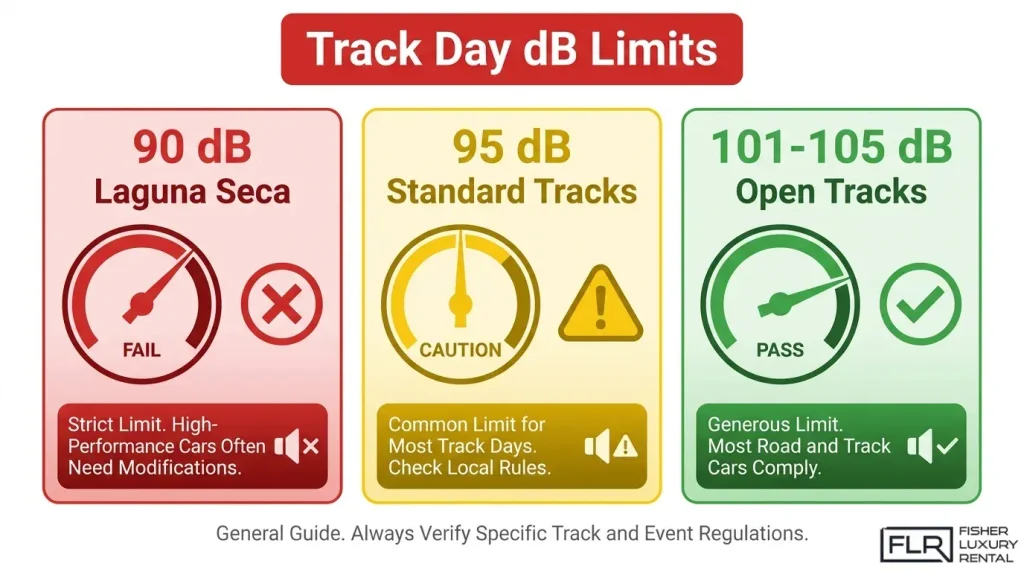
The GT3 does not pass 92 dB track noise limits. This threshold is among the strictest enforced at any circuit, and the GT3’s exhaust output at high revs far exceeds it. Laguna Seca Raceway, for example, restricts standard track days to a maximum of 90 dB, making it one of the most noise-sensitive venues in North America. The pressure on circuits is real: Laguna Seca faced a lawsuit from local residents over noise and traffic complaints from track events. Some states have since passed laws shielding existing race tracks from nuisance lawsuits, protecting venues from being silenced by surrounding development. For GT3 owners targeting 92 dB venues, a titanium dB reducer or significant exhaust modification is not optional; it is essential.
Does the GT3 Pass 95 dB Track Noise Limits?
The GT3 does not reliably pass 95 dB track noise limits in stock form, particularly above 6,000 rpm. The stock 992 GT3’s naturally aspirated flat-six builds aggressively toward its 9,000-rpm redline, generating exhaust pressure that standard muffling cannot contain at this threshold. Modified configurations are even more problematic: according to Shiftech, the JCR Porsche 992 GT3 exhaust explodes with noise above 6,000 rpm and exceeds the decibel thresholds set by most track days. Drivers should expect scrutineering failure at 95 dB venues without noise-reduction hardware installed.
Does the GT3 Pass 101 dB Track Noise Limits?
The GT3 generally passes 101 dB track noise limits in stock configuration, making this the most accessible threshold for unmodified cars. Knockhill Racing Circuit, for instance, enforces a 105 dB(A) limit, which a standard GT3 can meet without modification. At this range, the GT3’s factory exhaust system provides just enough noise management to keep readings under the ceiling during static testing. Venues operating at 101 to 105 dB give GT3 owners the greatest flexibility, and this is where the car’s track-day usability is strongest without any acoustic compromise.
What Are Common Noise Regulations That Affect the GT3?
Common noise regulations that affect the GT3 operate at three levels: U.S. state law, European road standards, and racetrack-specific rules. Each layer sets distinct limits on exhaust output, measurement distance, and enforcement conditions.
What Are U.S. State Vehicle Noise Regulations for the GT3?
U.S. state vehicle noise regulations for the GT3 vary by jurisdiction but consistently target exhaust modifications and measurement standards. California Vehicle Code Section 27200 requires that vehicle noise be measured at 50 feet from the centerline of travel. Florida Statutes Section 316.293 prohibits operating any vehicle on state highways with an exhaust system modified to increase noise above stock levels. Across most states, a muffler delete is illegal for public-road use because laws require an adequate muffler in constant operation to prevent excessive noise. GT3 owners considering exhaust upgrades should verify compliance with their state’s specific code before any modification.
What Are European Road Noise Regulations for the GT3?
European road noise regulations for the GT3 are governed primarily by EU Regulation 540/2014, which tightens passenger car noise limits to 68 dB(A) by 2026. That ceiling sits well below the GT3’s real-world character: Evo Magazine’s Ethan Jupp described the GT3 Touring as “raucous in terms of cruising engine noise,” producing a “spectacularly intrusive cacophony” on concrete road sections. For a car engineered to scream at 9,000 rpm, European homologation requires careful acoustic tuning to pass type-approval testing before the vehicle can be sold or driven legally on public roads.
What Are Racetrack-Specific Noise Regulations for the GT3?
Racetrack-specific noise regulations for the GT3 differ circuit by circuit, with limits that can challenge even a stock GT3. The key benchmarks across major venues are:
- Silverstone Circuit: 105 dB static test limit and 102 dB drive-by test limit on its National/International Circuit, measured at 0.5 meters at a 45-degree angle at three-quarter maximum revs.
- Nürburgring Nordschleife: 130 dB(A) sound power level ceiling during tourist drives.
- Laguna Seca Raceway: Maximum of 90 dB for standard track days, one of the strictest limits in the U.S.
- Knockhill Racing Circuit: 105 dB(A) noise limit for track days.
Laguna Seca’s 90 dB ceiling is particularly restrictive. Even a stock GT3 with a sport exhaust can approach or exceed that threshold at high revs, making it one of the most consequential regulations GT3 track day drivers face.
How Can You Reduce the Porsche 911 GT3 Sound Level?
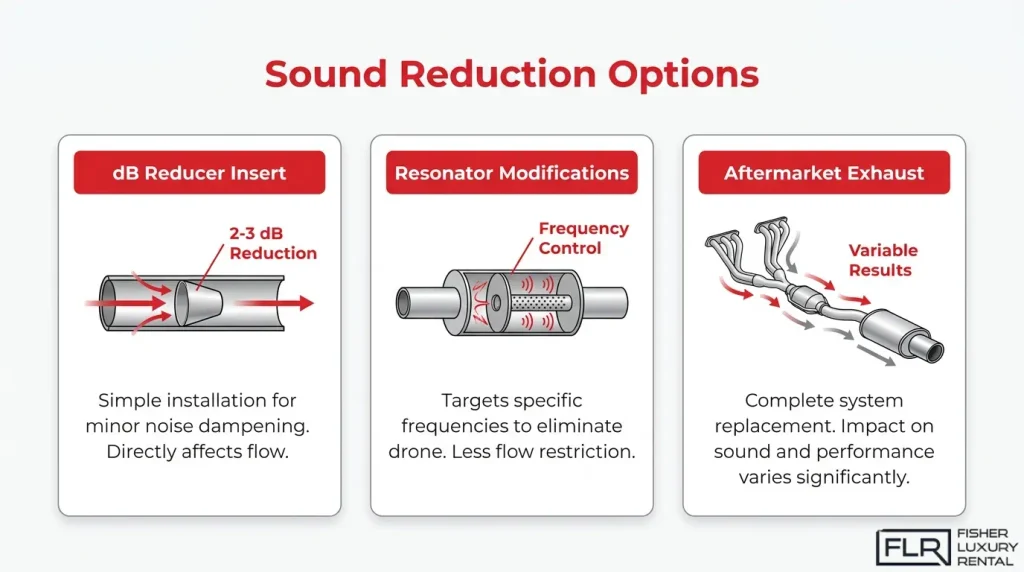
You can reduce the Porsche 911 GT3 sound level through several approaches, including dB reducer inserts, resonator modifications, and carefully selected aftermarket exhaust systems. The sections below examine each option’s effectiveness and legal implications.
Does Adding a Muffler Delete Increase GT3 Noise Levels?
Yes, adding a muffler delete increases GT3 noise levels significantly. A muffler delete removes the primary sound-damping component from the exhaust path, allowing combustion gases to exit with far less acoustic restriction. The result is a louder, rawer exhaust note across all RPM ranges.
Crucially, a muffler delete is illegal for public-road use in many states, because laws require an adequate muffler in constant operation to prevent excessive noise. For GT3 owners who drive on public roads, this modification creates real legal exposure, not just a louder car.
Can an Aftermarket Exhaust Quiet the GT3 Enough?
An aftermarket exhaust can quiet the GT3 enough for track day compliance, but only when chosen specifically for noise reduction rather than performance gain. The Akrapovič titanium dB reducer, for example, reduces dynamic sound levels by approximately two to three decibels while retaining the GT3’s distinctive exhaust character, according to Akrapovič.
For most track day thresholds, two to three decibels can be the difference between passing or failing a static noise test. That said, performance-oriented aftermarket configurations move in the opposite direction. The JCR 992 GT3 exhaust explodes with noise above 6,000 rpm and exceeds the decibel thresholds imposed by the majority of track days.
Do Exhaust Tips or Resonators Help Lower GT3 Decibels?
Exhaust tips and resonators do help lower GT3 decibels, though the reduction is modest. Resonators are designed to cancel specific exhaust frequencies through acoustic interference, which smooths the overall sound signature without dramatically reducing peak volume. Swapping to larger or differently angled exhaust tips produces minimal measurable reduction on their own.
For meaningful compliance gains, resonator inserts combined with a dB reducer offer the most practical combination. Tips alone are unlikely to shift peak readings enough to satisfy a strict track noise limit. These options are most useful as a secondary layer alongside a properly tuned muffler or OEM exhaust configuration.
Does the GT3 Sport Exhaust Option Change the Sound Level?
The GT3 Sport Exhaust option does change the sound level, increasing both volume and pitch intensity compared to the standard exhaust configuration. Porsche engineers tune the Sport Exhaust to open additional bypass valves, allowing exhaust gases to exit with less restriction and producing a noticeably more aggressive tone, particularly above 4,000 rpm.
The character shift is as meaningful as the decibel increase. Porsche acoustic engineers manipulate exhaust pipe length, similar to a tuba, to vary pitch and achieve the desired sound pattern, and the Sport Exhaust is calibrated to amplify this effect rather than simply add volume. Owners frequently report the Sport Exhaust pushes the GT3 closer to or past stricter track day noise thresholds, such as 92 dB limits, while the standard exhaust typically provides more margin. For road use, the Sport Exhaust remains emissions-compliant, but drivers should be aware that operating it in urban environments with active noise enforcement could attract scrutiny. The practical takeaway: the Sport Exhaust meaningfully amplifies the GT3’s flat-six character, making it the better choice for track and canyon driving but a liability at noise-restricted venues.
Can You Get a Noise Violation Driving a Stock GT3 on Public Roads?
Yes, you can get a noise violation driving a stock GT3 on public roads, depending on your jurisdiction and how the car is driven. The GT3’s factory exhaust is engineered to comply with type-approval standards at sale, but real-world driving conditions, local ordinances, and enforcement practices create genuine legal exposure.
Does the Stock GT3 Exhaust Meet Legal Noise Limits?
The stock GT3 exhaust meets federal type-approval noise limits at the time of sale, but local road-use laws can set lower thresholds that the car may breach at high rpm. California Vehicle Code Section 27150(b) establishes a 95 dB(A) limit for vehicles under 6,000 pounds tested per SAE Standard J1169. The GT3’s exhaust, while type-approved, can approach or exceed this threshold under aggressive throttle. This matters most in urban areas with active enforcement.
Which States Enforce Public Road Noise Laws Most Strictly?
The states with the strictest public road noise enforcement for vehicles include California, New York, and Florida. California Vehicle Code Section 27200 requires noise measurement at 50 feet from the centerline of travel. The New York City Noise Code prohibits motor vehicle sound exceeding specified limits on any public right-of-way and carries a formal penalty schedule. Florida Statutes Section 316.293 prohibits exhaust systems modified to increase noise, though a stock GT3 remains compliant provided no modifications are made.
Can Driving Style Trigger a Noise Violation in a Stock GT3?
Yes, driving style can trigger a noise violation even in a stock GT3. Hard acceleration through residential zones or urban corridors pushes exhaust output well above cruise-speed levels, drawing officer attention regardless of factory compliance certificates. A stock GT3 is legal at idle and steady-state cruise; the risk concentrates at wide-open throttle. In practice, an officer citing “unreasonable noise” has discretion that a factory spec sheet does not automatically override. Driving the GT3 responsibly on public roads is not just good etiquette — it is genuine legal protection.
How Should You Experience the GT3 Sound Through a Rental?
Renting a Porsche 911 GT3 is the most direct way to understand why its engineered sound profile generates so much discussion. The sections below cover what Fisher Luxury Rental offers and the key acoustic facts to carry with you.
Can a Porsche Rental from Fisher Luxury Rental Deliver the GT3 Experience?
Yes, a Porsche rental from Fisher Luxury Rental can deliver the GT3 experience for drivers in Phoenix, AZ, and Portland, OR. Fisher Luxury Rental is a luxury and exotic car rental company that emphasizes top-trim vehicles and an exceptional driving experience. Professionally arranged rentals offer a structured and accessible path to experiencing this engine’s sound at full throttle without the commitments of ownership. For enthusiasts who want the flat-six scream without ownership commitments, a curated rental removes every barrier between the driver and that 9,000-rpm redline. Fisher Luxury Rental specializes in exactly this kind of access, maintaining a fleet of top-trim luxury and exotic vehicles available in Phoenix, AZ and Portland, OR.
What Are the Key Takeaways About Porsche 911 GT3 Sound Levels and Noise Limits?
The key takeaways about Porsche 911 GT3 sound levels and noise limits are that the car is loud by design, precisely engineered, and legally regulated at every level. According to Top Gear, the 992 GT3 averages 74 decibels at a 70 mph cruise, while FastestLaps data shows the 997 GT3 RS 4.0 climbing from 75 dB at 80 kph to 84 dB at 160 kph. Porsche acoustic engineers intentionally shape that output, manipulating exhaust pipe length like a tuba to control pitch. Noise codes such as New York City’s penalty schedule apply on public roads, so drivers must respect local limits. Understanding these numbers makes every rental drive more intentional and fully compliant.