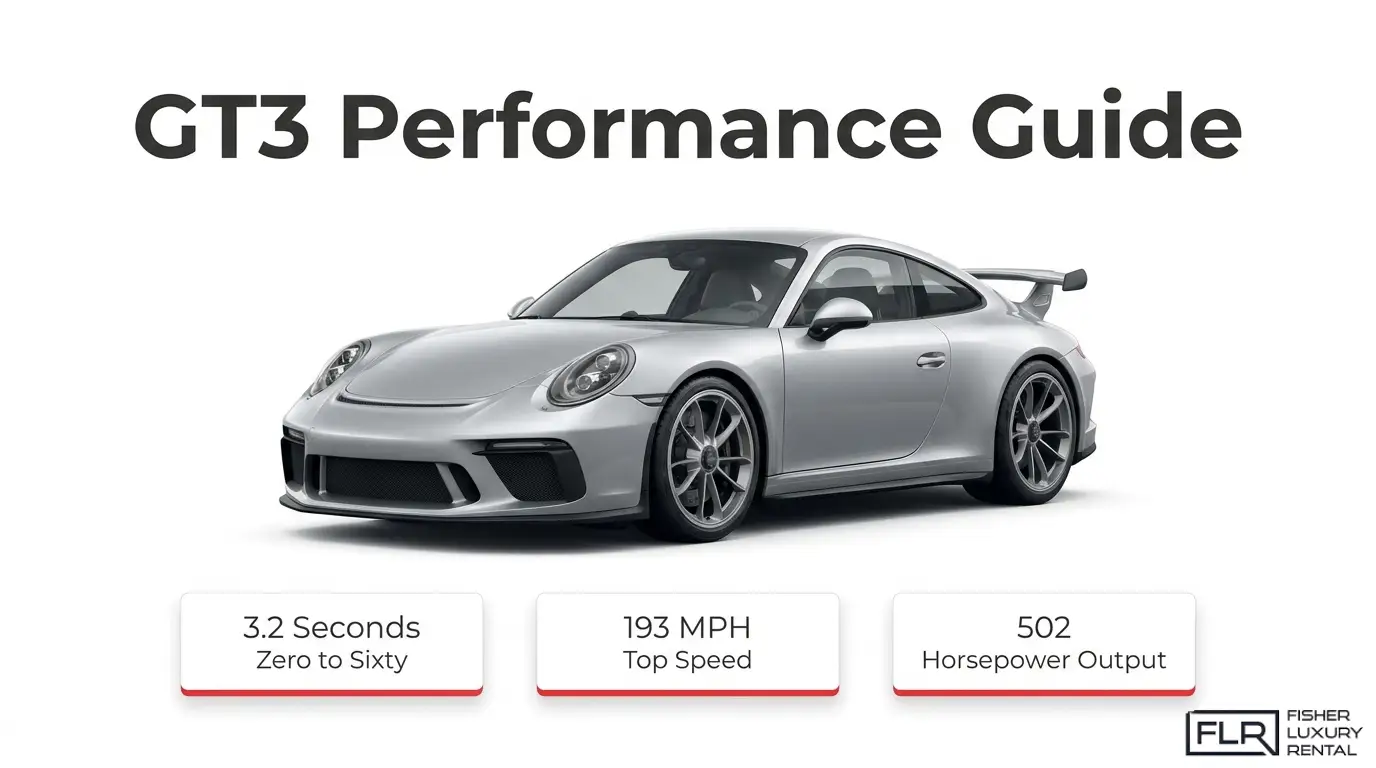
The Porsche 911 GT3 is a naturally aspirated, rear-engine sports car built around a 4.0-liter flat-six that produces 502 hp in its current 992 generation, achieving 0-60 mph in 3.2 seconds with PDK and a top track speed of 193 mph.
This guide covers acceleration figures across every modern GT3 generation, top speed ratings by model year, the engineering behind those numbers, and how the GT3 measures up against its closest rivals and real-world conditions.
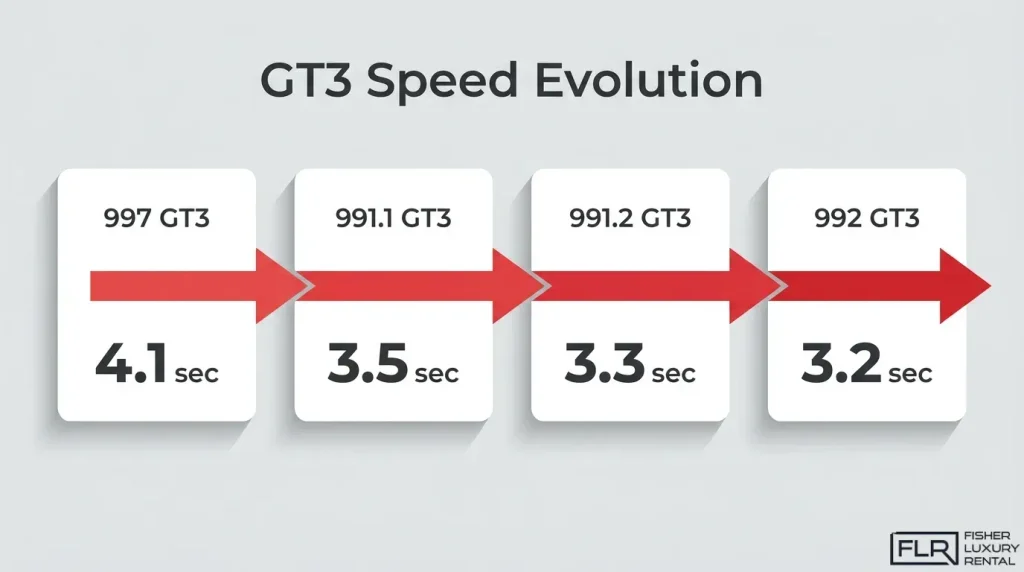
The 992, 991.2, 991.1, and 997 generations each carry distinct 0-60 times and top speed figures, shaped by displacement increases, PDK refinements, and aerodynamic development across two decades of production.
The GT3’s speed comes from three converging design choices: a high-revving naturally aspirated engine, a rear-engine layout that loads the driven wheels at launch, and disciplined weight reduction throughout the chassis. Together, these explain why the GT3 posts competitive numbers without forced induction.
Against rivals including the McLaren 570S, Ferrari 488, Lamborghini Huracán, and BMW M4 CSL, the GT3 holds its own on paper and frequently surpasses them in driver feedback and on-track capability. For enthusiasts in the Phoenix or Portland areas who want to experience that driver-focused character firsthand, Fisher Luxury Rental includes the 992 GT3 in its exotic fleet.
Real-world 0-60 times shift with tire temperature, surface grip, altitude, and launch control engagement, sometimes by several tenths of a second from the manufacturer’s quoted figure. We also cover street legality at top speed and how Fisher Luxury Rental gives you direct access to the 992 GT3’s performance without ownership costs
How Fast Does the Porsche 911 GT3 Go from 0 to 60 MPH?
The Porsche 911 GT3 goes from 0 to 60 MPH in as little as 3.2 seconds in its current 992 generation, though times vary across generations. Each GT3 generation below covers its specific 0-60 figure, engine output, and transmission context.
How Fast Is the 992 GT3 from 0 to 60 MPH?
The 992 GT3 goes from 0 to 60 MPH in 3.2 seconds when equipped with the PDK transmission, according to Porsche USA. This generation’s 4.0-liter naturally aspirated flat-six produces 502 hp and 331 lb-ft of torque, with a top track speed of 193 mph. The PDK’s dual-clutch architecture predicts the next gear and executes shifts in milliseconds, making it the decisive factor in achieving that 3.2-second figure consistently. For context, the BMW M4 CSL matches the 992 GT3’s 3.2-second sprint despite its turbocharged advantage, which speaks to how efficiently Porsche extracts acceleration from a naturally aspirated engine.
How Fast Is the 991.2 GT3 from 0 to 60 MPH?
The 991.2 GT3 goes from 0 to 60 MPH in approximately 3.3 seconds. This generation carries a 4.0-liter naturally aspirated flat-six producing 500 PS (493 bhp) and 460 Nm (339 lb-ft) of torque, achieving a top speed of 320 kph (199 mph). Output differences between the 991.2 and 992 are marginal, but refinements in PDK calibration and aerodynamics give the 992 a slight edge off the line.
How Fast Is the 991.1 GT3 from 0 to 60 MPH?
The 991.1 GT3 goes from 0 to 60 MPH in approximately 3.5 seconds. This generation introduced a 3.8-liter naturally aspirated flat-six producing 475 PS, representing a meaningful step forward from the prior 997 platform in both power density and launch capability.
How Fast Is the 997 GT3 from 0 to 60 MPH?
The 997 GT3 goes from 0 to 60 MPH in approximately 4.1 seconds. Powered by a 3.6-liter naturally aspirated flat-six producing around 415 PS, this generation laid the mechanical foundation that later 991 and 992 variants would refine into significantly quicker acceleration figures.
What Is the Top Speed of the Porsche 911 GT3?
The top speed of the Porsche 911 GT3 ranges from 188 mph in older generations to 199 mph in the 991.2, depending on the model year and transmission. The sections below cover the rated top speeds for the 992, 991.2, 991.1, and 997 generations.
What Is the Top Speed of the 992 GT3?
The top speed of the 992 GT3 is 193 mph, according to Porsche USA. It achieves this with a 4.0-liter naturally aspirated flat-six producing 502 hp. That figure represents a genuine, electronically unrestricted maximum, making the 992 GT3 one of the fastest street-legal production 911s available today.
What Is the Top Speed of the 991.2 GT3?
The top speed of the 991.2 GT3 is 199 mph (320 kph). According to FastestLaps, the 991.2 GT3 produces 500 PS (493 bhp) from its 4.0-liter naturally aspirated flat-six, with 460 Nm of torque. The 991.2 actually edges out its 992 successor in rated top speed, a distinction that surprises most enthusiasts.
What Is the Top Speed of the 991.1 GT3?
The top speed of the 991.1 GT3 is approximately 196 mph (315 kph). The 991.1 used a 3.8-liter naturally aspirated flat-six producing around 475 PS, and while official Porsche figures for this specific variant are not included in the available research, the 991.1 sits firmly between the 997 and 991.2 generations in outright speed.
What Is the Top Speed of the 997 GT3?
The top speed of the 997 GT3 is approximately 188 mph (303 kph). The 997 generation carried forward Porsche’s commitment to naturally aspirated performance before the 991 era’s displacement increase, and its top-end capability remains impressive for a car of its era.
How Does the GT3 with a Manual Compare to the PDK in 0-60?
The GT3 with a manual transmission is slower to 60 mph than the PDK-equipped model. Porsche’s official specification for the 992 GT3 with PDK is 3.2 seconds, while the manual gearbox version adds roughly half a second to that figure. The trade-off is well understood among enthusiasts: the PDK’s dual-clutch system pre-selects the next gear while the current gear is still engaged, executing shifts in a fraction of a second with no interruption in power delivery. A six-speed manual simply cannot replicate that mechanical speed.
According to Porsche, the PDK uses two separate clutches, one for odd-numbered gears and one for even-numbered gears, allowing seamless gear changes that eliminate the brief power loss inherent to a manual shift. In practice, this architecture is the sole reason the PDK posts the quicker 0-60 number.
For most drivers, the manual GT3 is not a compromise. The engagement, feedback, and driver involvement it delivers are precisely what the GT3 platform was built to amplify. The half-second difference in 0-60 matters on a timing sheet, but on a canyon road or track day, the manual transforms the experience in ways raw acceleration figures cannot measure.
What Engine and Drivetrain Specs Give the GT3 Its Speed?
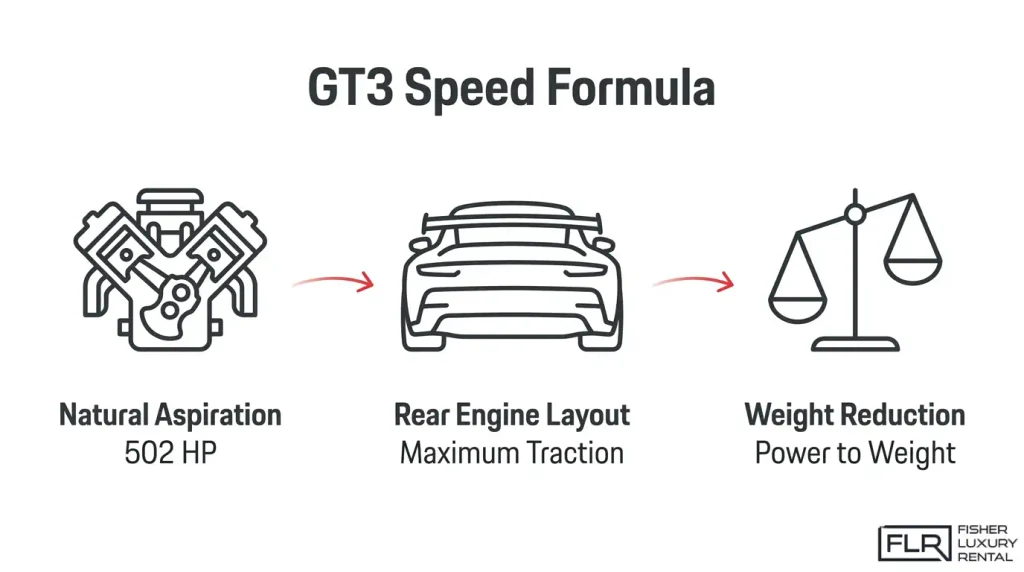
The GT3’s speed comes from three converging engineering choices: a high-revving naturally aspirated flat-six, a rear-engine layout, and aggressive weight reduction. Each H3 below examines one of these performance pillars in detail.
What Makes the GT3 Flat-Six Engine Unique?
The GT3 flat-six engine is unique because it is a naturally aspirated 4.0-liter unit that prioritizes high-rpm power delivery over forced induction, producing 502 hp in the current 992 generation according to Porsche USA. Unlike turbocharged rivals, it builds power linearly to a stratospheric redline, rewarding driver input with immediate throttle response rather than lag. No turbo means no compressor losses and no heat soak, which keeps power output consistent lap after lap. That combination of displacement, natural aspiration, and precision engineering makes the flat-six one of the most distinctive road-going engines available today.
How Does the Rear-Engine Layout Affect Acceleration?
The rear-engine layout affects acceleration by placing the engine mass directly over the driven wheels, maximizing traction at launch. With weight concentrated at the rear axle, the GT3 can apply its full 502 hp to the road more efficiently than a front or mid-engine competitor in comparable conditions. This layout also lowers the center of gravity due to the flat-six’s horizontally opposed cylinder configuration, contributing to stable weight transfer under hard acceleration. In practice, the rear-engine advantage is most noticeable off the line, where rear-axle loading translates directly into grip.
What Role Does Weight Reduction Play in GT3 Performance?
Weight reduction plays a central role in GT3 performance because less mass means more acceleration per unit of power. Porsche engineers use lightweight materials throughout the 992 GT3, including carbon fiber composite body panels and a weight-optimized interior. The 992 GT3 reaches 60 mph in 3.2 seconds with PDK, and that figure reflects not just raw horsepower but an exceptional power-to-weight ratio built through disciplined mass reduction. Every kilogram saved at the design stage compounds directly into quicker acceleration, shorter braking distances, and higher cornering speeds, making weight management one of the most impactful levers Porsche pulls in GT3 development.
How Does the Porsche 911 GT3 Compare to the GT3 RS in Speed?
The Porsche 911 GT3 and the GT3 RS share the same 0-62 mph time of 3.2 seconds, but they differ significantly in top speed and aerodynamic priority. The standard GT3 reaches 193 mph, while the GT3 RS tops out at 184 mph (296 km/h), trading straight-line velocity for cornering capability.
The GT3 RS sacrifices top speed because its aggressive aerodynamic package generates substantially more downforce than the standard GT3. According to Hagerty UK, automotive journalist Henry Catchpole noted that the 992 GT3 RS can generate as much downforce as a GTE race car in high-speed corners, pulling a lateral 2G during a lap at Silverstone with professional driver Jörg Bergmeister at the wheel. That aero drag is what clips the RS’s top speed below the standard car’s.
For drivers who prioritize lap times over outright speed, the GT3 RS is the stronger tool. For those who want maximum top-end performance on open roads, the standard GT3 wins on paper.
How Does the GT3 Stack Up Against Rivals in 0-60 and Top Speed?
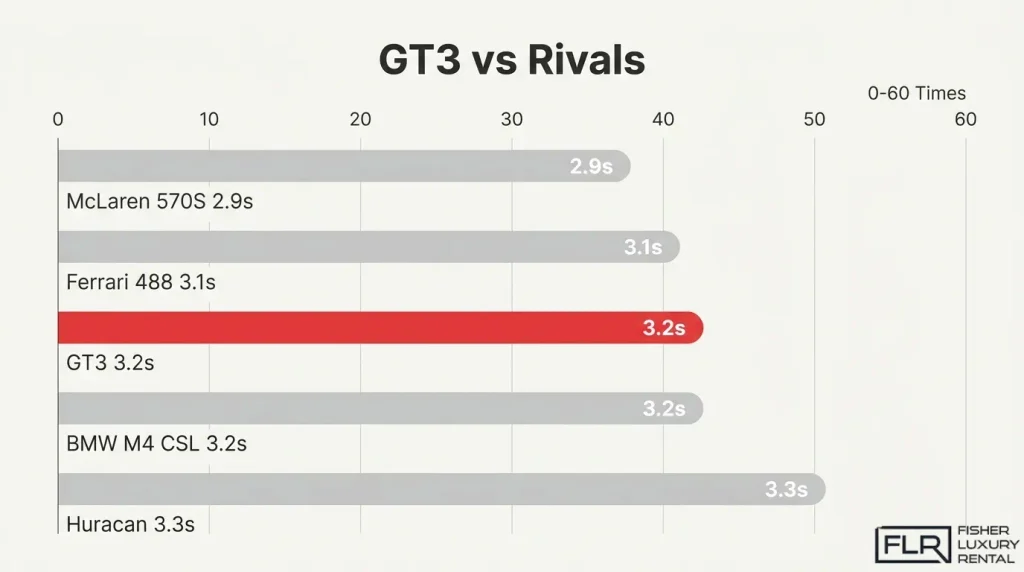
The GT3 holds its own against elite supercar competition, though outcomes vary by rival. The comparisons below cover the McLaren 570S, Ferrari 488, Lamborghini Huracán, and BMW M4 CSL.
How Does the GT3 Compare to the McLaren 570S?
The GT3 compares to the McLaren 570S as a slower but more driver-focused machine. According to FastestLaps, the McLaren 570S hits 60 mph in 2.9 seconds and reaches a top speed of 207 mph, powered by a twin-turbo V8. The 992 GT3 manages 3.2 seconds to 60 and 193 mph. The 570S wins on raw numbers, but the GT3’s naturally aspirated flat-six and rear-engine balance deliver a tactile driving experience that turbocharged rivals rarely match.
How Does the GT3 Compare to the Ferrari 488?
The GT3 compares to the Ferrari 488 as a closely matched rival in acceleration, with both cars sitting in the low-3-second 0-60 range. The 488’s twin-turbocharged V8 gives it a top speed advantage, but the GT3 counters with a more linear power delivery and sharper steering feel. For drivers who prioritize mechanical feedback over peak velocity, the GT3 remains a compelling choice against the Ferrari.
How Does the GT3 Compare to the Lamborghini Huracán?
The GT3 compares to the Lamborghini Huracán as a lighter, more circuit-oriented alternative. The Huracán uses all-wheel drive to launch aggressively from a standstill, giving it an edge in 0-60 sprints on standard road surfaces. The GT3’s rear-wheel-drive setup demands more driver skill off the line but rewards precision at higher speeds and through corners, making it the preferred choice for track-focused enthusiasts.
How Does the GT3 Compare to the BMW M4 CSL?
The GT3 compares to the BMW M4 CSL as a near-identical match in 0-60 performance. FastestLaps data shows the M4 CSL reaches 60 mph in 3.2 seconds with a top speed of 191 mph, while the GT3 matches the 3.2-second sprint and extends the top speed to 193 mph. The GT3’s naturally aspirated engine and race-derived chassis give it a clear edge on track, even where stopwatch numbers appear equal.
What Real-World Factors Affect GT3 0-60 Times?
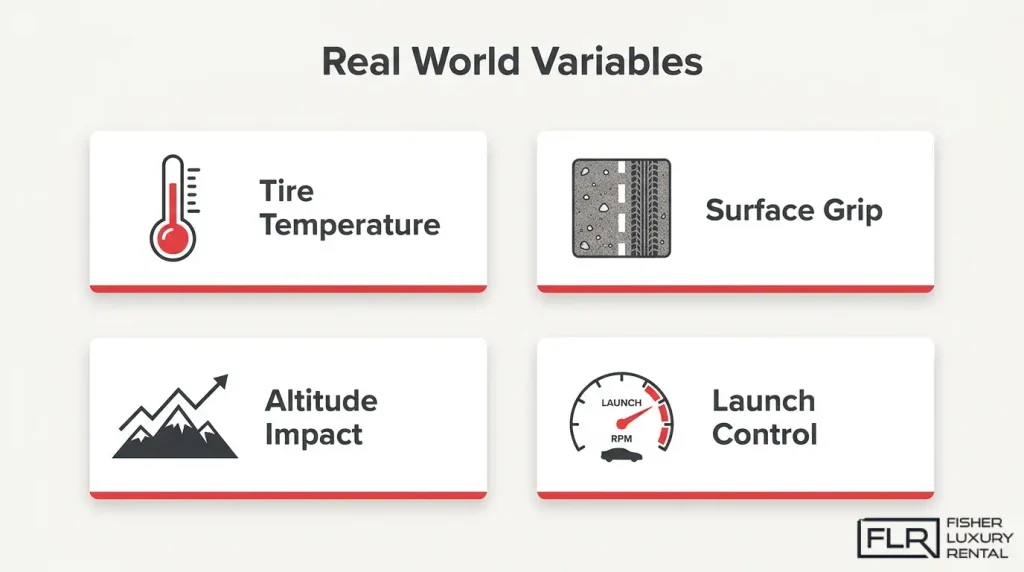
Real-world GT3 0-60 times vary based on tire temperature, surface grip, elevation, ambient weather, and launch control engagement. Each factor can add or subtract fractions of a second from the manufacturer’s quoted figure.
How Do Tire Temperature and Surface Conditions Change Times?
Tire temperature and surface conditions change GT3 0-60 times by directly affecting the grip available at launch. Cold tires generate significantly less friction than tires at optimal operating temperature, causing wheelspin that delays acceleration. Surface texture matters equally: a smooth, dry asphalt strip delivers far more consistent traction than wet, dusty, or painted concrete. In real-world driving, these variables alone can shift launch performance by several tenths of a second compared to controlled test conditions. Getting tires properly warmed before a run is one of the most overlooked factors in achieving repeatable, fast launches.
How Does Elevation and Weather Impact GT3 Acceleration?
Elevation and weather impact GT3 acceleration by altering air density, which directly affects the engine’s combustion efficiency. At higher altitudes, thinner air reduces oxygen availability, causing the naturally aspirated 4.0-liter flat-six to produce less power than at sea level. High ambient temperatures compound this effect by further lowering air density. Cold, dense air at low elevation produces the most favorable conditions for maximum output and the sharpest 0-60 times. Drivers testing in cities like Phoenix, AZ will experience different baseline performance than those at higher elevations.
How Does Launch Control Affect 0-60 Consistency?
Launch control affects GT3 0-60 consistency by automating throttle and clutch modulation to eliminate driver-induced variables at the moment of launch. Without it, even skilled drivers introduce inconsistency through throttle timing and clutch release speed. With PDK-equipped GT3s, launch control holds engine rpm at an optimal level and manages power delivery precisely, allowing the 992 GT3 to hit its 3.2-second figure repeatedly under comparable conditions. In independent Edmunds testing, the 2026 GT3 Touring recorded a 4.0-second run without the same optimized launch conditions, illustrating exactly how setup and driver technique shape real-world results.
Is the Porsche 911 GT3 Street Legal at Top Speed?
The Porsche 911 GT3 is street legal, but reaching its 193 mph top speed on public roads is not. No public road in the United States permits speeds anywhere near that figure. The GT3 meets all DOT and EPA requirements for road registration, but its performance ceiling exists exclusively in closed-circuit or track environments.
Speed limits in the U.S. top out at 85 mph on select Texas highways, placing the GT3’s 193 mph capability roughly 108 mph above the legal maximum. While the car carries full road-legal credentials, including functioning headlights, emissions compliance, and safety systems, exploiting its top-speed potential requires a private track. This is precisely why track day programs exist: they bridge the gap between street-legal ownership and full-performance access. Fisher Luxury Rental offers another path to experiencing the 992 GT3 on real roads, renting directly from their Phoenix or Portland locations, where the car is available without the commitment of ownership or the exclusivity of a factory track program.
How Can You Experience Porsche 911 GT3 Performance Firsthand?
You can experience Porsche 911 GT3 performance firsthand through exotic car rentals or structured track programs. The sections below cover renting through Fisher Luxury Rental and the key performance takeaways to guide your decision.
Can You Rent a Porsche 911 GT3 from Fisher Luxury Rental?
Yes, you can rent a Porsche 911 GT3 from Fisher Luxury Rental, giving you direct access to the 992 generation’s 502 hp, 4.0-liter flat-six and its 3.2-second 0-60 mph capability without ownership costs. According to Porsche USA, the 992 GT3 reaches a top track speed of 193 mph with PDK transmission fitted.
For context on alternatives, factory-backed Porsche track experience programs can involve multi-thousand euro costs for coaching sessions at dedicated facilities. Fisher Luxury Rental offers a flexible, road-accessible route to the same machine, serving the Phoenix and Portland areas.
What Are the Key Takeaways About Porsche 911 GT3 0-60 Time and Top Speed?
The key takeaways about Porsche 911 GT3 0-60 time and top speed are that performance has improved dramatically across generations while the naturally aspirated character has remained constant.
- The 996.1 (1999) posted a 0-100 km/h time of 4.8 seconds and a 302 km/h top speed with 360 PS.
- The 991.2 generation reached 320 kph (199 mph) with 500 PS and a 4.0-liter flat-six.
- The 992 GT3 hits 60 mph in 3.2 seconds (PDK) and tops out at 193 mph, per Porsche USA.
- Edmunds’ independent test of the 2026 GT3 Touring recorded a 4.0-second 0-60 and an 11.9-second quarter mile at 120.4 mph.
- PDK’s dual-clutch design shifts in a fraction of a second, directly enabling the quickest recorded times.
- The 992 GT3 RS generates lateral 2G cornering force, matching GTE race car downforce levels, according to automotive journalist Henry Catchpole writing for Hagerty UK.
No generation of the GT3 chases raw top-speed records; every improvement targets usable, driver-connected performance, which is precisely what makes it one of the most rewarding cars to actually drive on a road or circuit.