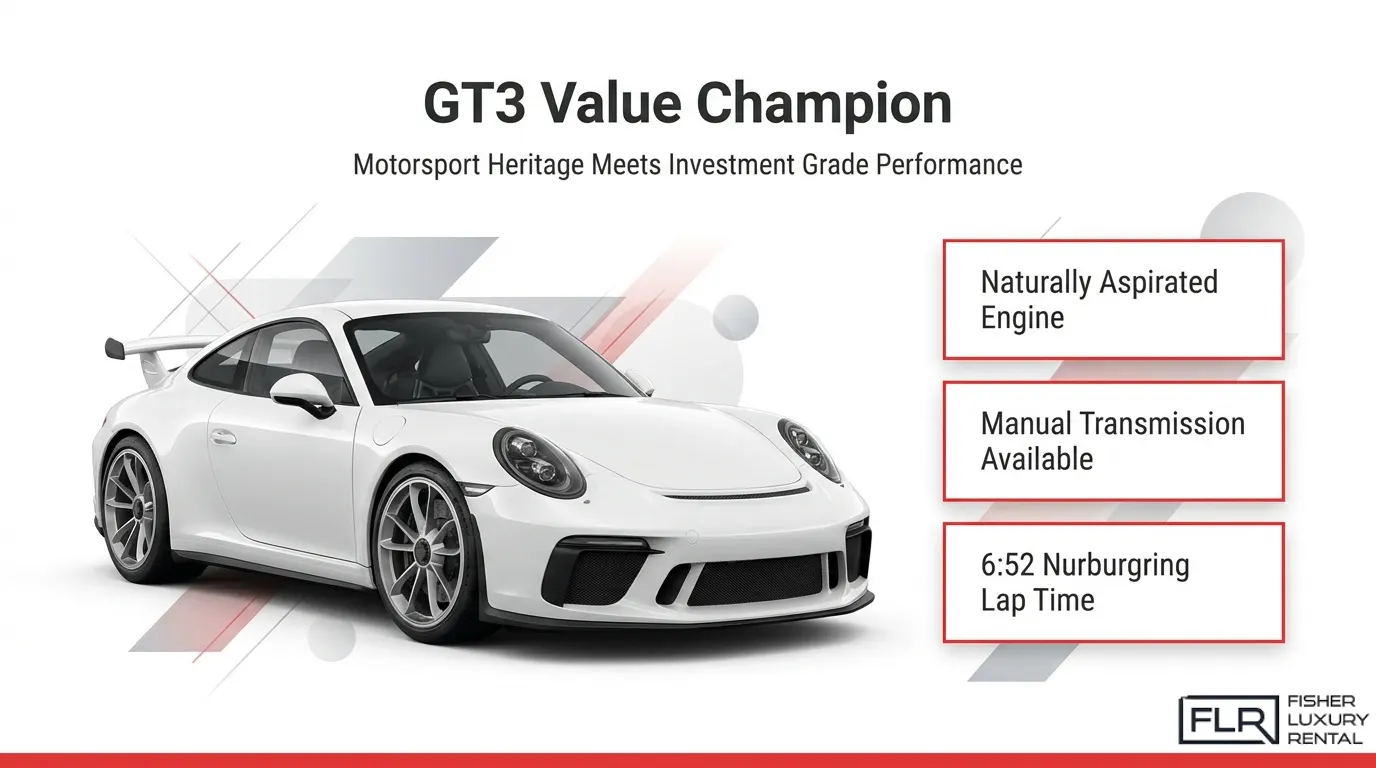
The Porsche GT3 is a motorsport-derived variant of the 911 built around a naturally aspirated flat-six engine, a manual transmission option, and racing credentials that standard 911 models do not share. Those qualities produce resale behavior unlike almost any other performance car on the market.
This guide covers what separates the GT3 from other 911s, how its depreciation stacks up against rivals, the forces that drive its value retention, how each generation has performed over time, variant and specification choices that move the needle on resale, and whether the GT3 holds up as a genuine financial investment.
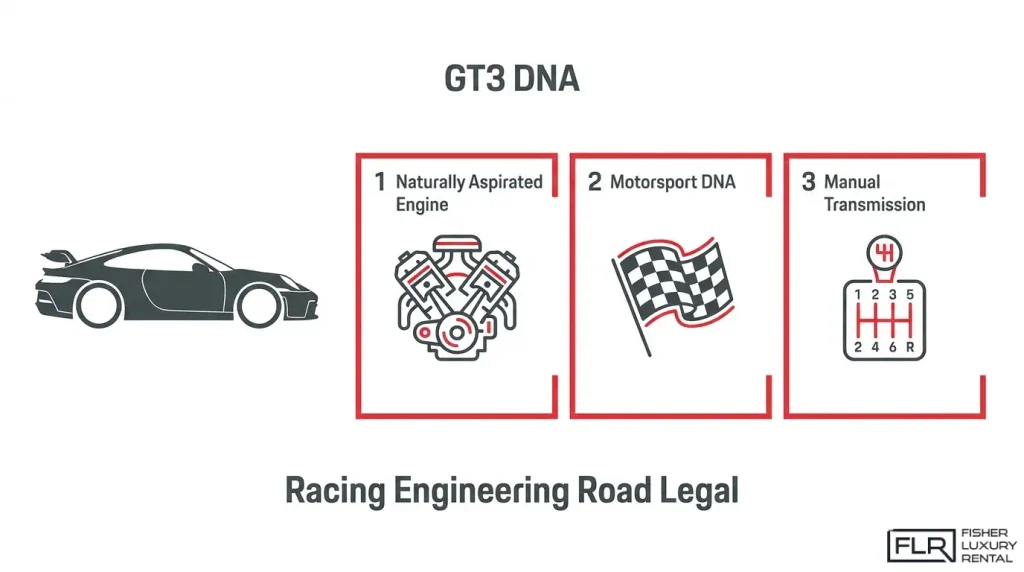
The GT3’s core identity comes from its naturally aspirated engine, motorsport lineage, and the manual gearbox that 70 percent of U.S. buyers chose for the previous generation. Those three elements work together to establish a premium the used market consistently reflects.
When placed against sports cars like the McLaren 720S and Ferrari 488, the GT3 holds a structural advantage. Regulatory pressure from Euro 7 emissions standards is closing the window on the naturally aspirated engine, a deadline that is already converting current examples into timed collectibles.
Each GT3 generation tells a distinct story: the 997 RS 4.0 has reached auction prices of $885,000, the 991.2 manual peaked at $249,000, and the 992 GT3 settled near or above MSRP even after a mild 2024 softening. Specification choices, including transmission, color, and factory options, sharpen or blunt those figures further.
For buyers weighing the investment case, or drivers who want the experience without ownership exposure, the final sections examine both the financial reality and the rental alternative.
What Makes the Porsche GT3 Different From Other 911 Models?
The Porsche GT3 differs from other 911 models through its motorsport-derived engineering, naturally aspirated flat-six engine, and manual transmission option, each of which directly shapes long-term collector value. According to Merlin Auto Group, 991.2 GT3 manual models achieved a top sale price of $249,000, compared to $215,000 for PDK versions from 2018 to 2019. The sections below cover how the engine, heritage, and transmission each contribute to that premium.
How Does the Naturally Aspirated Flat-Six Engine Affect Value?
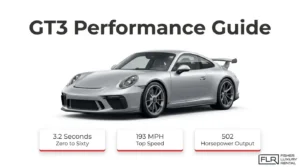
The naturally aspirated flat-six engine affects value by creating scarcity rooted in engineering reality. According to Porsche, the current GT3 produces 502 hp and 331 lb-ft of torque from a 4.0-liter naturally aspirated flat-six, reaching a 193 mph top speed. Andreas Preuninger, Head of GT at Porsche, confirmed that Euro 7 emissions standards will force the GT3 away from this engine configuration within two years, making current examples the last of their kind. That regulatory deadline transforms today’s GT3 into a collectible the moment production ends.
Why Does the Motorsport DNA of the GT3 Matter to Buyers?
The motorsport DNA of the GT3 matters to buyers because it anchors the car’s identity in purpose rather than marketing. According to Stuttcars, Porsche cars born from motorsport necessity rather than marketing intent age exceptionally well in the collector market because their existence is tied to a moment that cannot be recreated. The GT3 was developed directly from Porsche’s racing program, giving it technical legitimacy that standard 911 variants lack. That authenticity is one of the strongest long-term value signals any performance car can carry.
What Role Does the Manual Transmission Option Play in Desirability?
The manual transmission option plays a central role in GT3 desirability, both at the point of sale and on the used market. According to Road and Track, 70 percent of U.S. buyers for the previous-generation GT3 chose the manual over the PDK. Porsche’s 6-speed GT Sport manual weighs 37 lbs less than the PDK, adding a performance case alongside the emotional one. That majority preference translates directly into resale leverage, since demand consistently outpaces supply for stick-shift examples.
How Does Porsche GT3 Depreciation Compare to Other Sports Cars?
The Porsche GT3 depreciates significantly slower than the sports car average, outperforming rivals like the BMW M4 CSL and Corvette C8 Z06. The following H3s compare the GT3 directly against the Porsche Turbo S, Ferrari 488, Lamborghini Huracán, and McLaren 720S.
How Does the GT3 Hold Value Against the Porsche Turbo S?
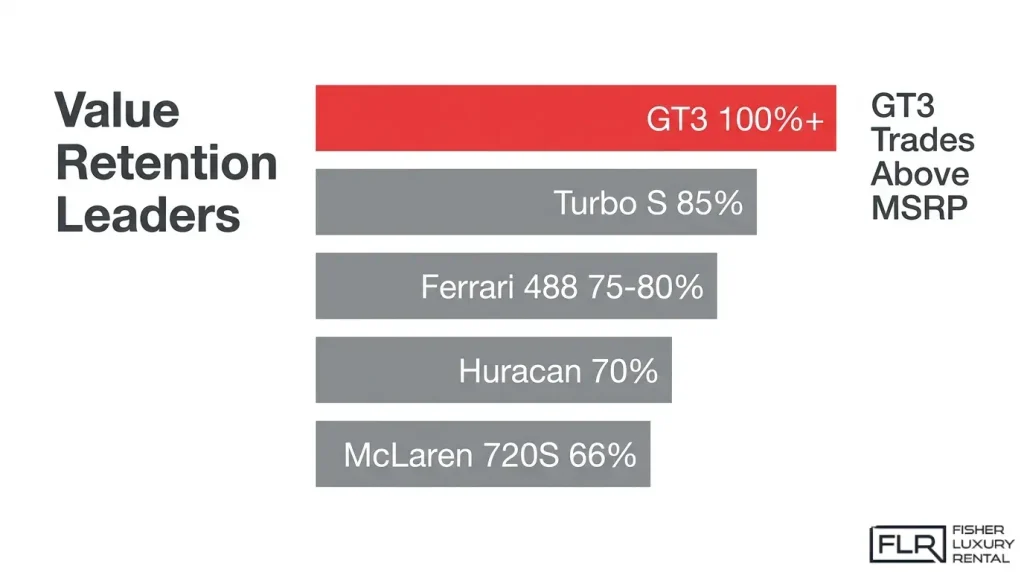
The GT3 holds value against the Porsche Turbo S by maintaining prices at or above MSRP across multiple model years, a distinction the Turbo S rarely achieves. According to OctoClassic, 992 GT3 prices fell only 6.2% ($17,300) for standard models and 3.9% ($10,700) for Touring variants in 2024, yet many examples still traded above sticker. Merlin Auto Group data shows top 992 GT3 sale prices reaching $315,000 for PDK versions and $300,000 for manuals between 2021 and 2024. The 997.2 GT3 RS 4.0 reached $885,000 at auction. The Turbo S, despite its broader appeal, lacks the allocation scarcity and motorsport provenance that sustain GT3 premiums. For pure value retention, the GT3 is the stronger hold.
How Does the GT3 Compare to the Ferrari 488 in Resale Value?
The GT3 compares favorably to the Ferrari 488 in resale value, largely matching or exceeding it on a percentage-retained basis. The Ferrari 488 GTB retains approximately 75 to 80% of its original value over time, per iLusso. The GT3’s ability to trade at or above MSRP effectively delivers a 100%+ retention rate on allocation examples, placing it in a separate category altogether. Ferrari’s broader production volumes and higher servicing costs erode long-term returns in ways the GT3 avoids.
How Does the GT3 Compare to the Lamborghini Huracán in Resale?
The GT3 compares favorably to the Lamborghini Huracán in resale, with the GT3’s motorsport-derived demand creating a more durable value floor. The Huracán, while visually commanding, depreciates more predictably as a volume-produced supercar. The GT3’s allocation model and naturally aspirated engine scarcity produce price ceilings the Huracán does not consistently reach on the secondary market. Buyers seeking a collector-grade asset over a performance showpiece generally prioritize the GT3.
How Does the GT3 Compare to the McLaren 720S in Resale?
The GT3 significantly outperforms the McLaren 720S in resale value retention. According to iLusso, the McLaren 720S, originally priced near $326,000, drops to approximately $260,000 within a few years, retaining only 66% of its value. The average year-over-year sports car depreciation in the US is 7.4%, and the 720S trends closer to that benchmark than the GT3 does. Additionally, manual GT3 examples trade at a 10 to 15% premium over equivalent PDK cars, per RennDriver, adding a further layer of value that the single-transmission McLaren cannot replicate.
What Factors Drive Porsche GT3 Value Retention?
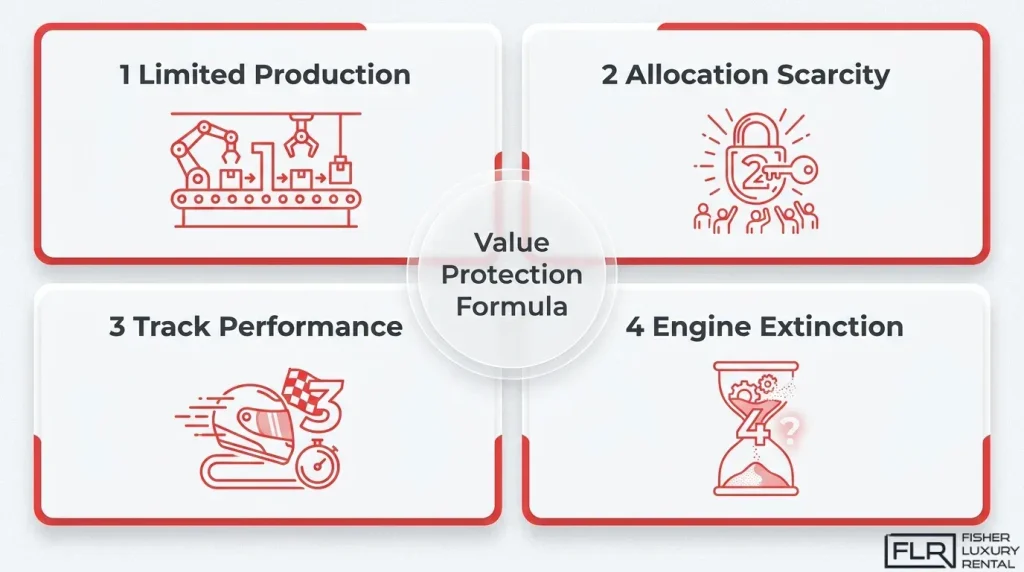
Several interlocking forces protect GT3 prices where other sports cars fall short. The sections below examine production limits, dealer allocation scarcity, track-bred demand, and the looming end of the naturally aspirated engine.
How Does Limited Production Volume Protect GT3 Prices?
Limited production volume protects GT3 prices by keeping supply consistently below enthusiast demand. Between 2022 and 2024, a total of 15,667 Porsche 911 (992.1) GT3 units were produced globally, according to TorqueNews. While that figure exceeds the 991.1 generation’s 10,800 examples, it remains modest relative to the worldwide pool of qualified buyers. Constrained supply means sellers rarely need to discount, and strong used-market competition pushes prices toward or above MSRP rather than below it.
Why Does Porsche’s Allocation Process Create Scarcity?
Porsche’s allocation process creates scarcity by distributing GT3 units through an invitation-based system that favors loyal, high-spending customers. During 2022 and 2023, supply-chain bottlenecks made inventory so tight that dealerships added market adjustment fees of $75,000 to $150,000 over sticker price, as reported by TorqueNews. That dynamic signals a structural gap between the number of buyers willing to pay a premium and the number of cars available. Allocation-controlled distribution effectively functions as a built-in price floor, preventing the oversupply conditions that accelerate depreciation in volume sports car segments.
How Does the GT3’s Track Capability Sustain Long-Term Demand?
The GT3’s track capability sustains long-term demand by delivering genuine motorsport performance that street-focused competitors cannot replicate. Equipped with the Manthey Kit, the 992 GT3 lapped the Nürburgring Nordschleife in 6:52.981 minutes, approximately 2.8 seconds faster than its predecessor, per the Porsche Newsroom. That measurable on-track superiority attracts a buyer pool that includes both collectors and active track-day drivers, broadening demand well beyond typical luxury car purchasers. Performance credibility, validated by lap times rather than marketing copy, is a retention driver that does not erode with model age.
Why Does the Naturally Aspirated Engine Face Extinction Premiums?
The naturally aspirated engine faces extinction premiums because regulatory deadlines are closing the window on its production. Andreas Preuninger, Head of GT at Porsche, confirmed to CarBuzz that the 4.0-liter naturally aspirated flat-six can continue for only approximately two more years before Euro 7 emissions standards force a shift to turbocharging or electrification. Once that transition happens, current GT3s become the last generation to carry this engine configuration. Scarcity driven by regulatory obsolescence, rather than simple production limits, historically creates some of the strongest collector premiums in the Porsche market. This makes today’s naturally aspirated GT3 a timed opportunity that future buyers simply cannot access.
Which Porsche GT3 Generations Have Appreciated the Most?
The Porsche GT3 generations that have appreciated the most are the 996, 997, and 991 series, each following a distinct value arc shaped by collector demand and motorsport significance. The 992 GT3 is the newest generation and remains in its early value phase.
How Has the 996 GT3 Changed in Value Over Time?
The 996 GT3 changed in value over time by first depreciating sharply after launch, then recovering strongly as collector interest matured. Initially dismissed due to shared components with the base 996, clean examples have since rebounded as enthusiasts recognized the generation’s motorsport credentials and increasing scarcity of low-mileage cars. The 996 GT3 now occupies a distinct entry point in the GT3 collector market, appreciated for its raw, unfiltered driving character relative to later, more refined generations.
How Has the 997 GT3 Performed as an Investment?
The 997 GT3 has performed as an investment exceptionally well, particularly in limited-run variants. According to Merlin Auto Group, the 997.2 GT3 RS 4.0, launched in 2011, has achieved a top sale price of $885,000, making it one of the most coveted collector cars in Porsche’s modern history. Standard 997 GT3 models have also held firm, with manual examples commanding premiums as the generation becomes increasingly recognized as a high-water mark for analog GT3 driving experience.
How Has the 991 GT3 Held Its Value Since Release?
The 991 GT3 has held its value since release at levels well above typical sports car benchmarks. Manual 991.2 GT3 models reached top sale prices of $249,000, compared to $215,000 for PDK equivalents, according to Merlin Auto Group. This premium reflects the strong collector preference for the manual gearbox in this generation. The 991’s proven reliability and widespread critical acclaim have cemented its standing as a generation that resists depreciation even years after production ended.
What Is the Early Value Trajectory of the 992 GT3?
The early value trajectory of the 992 GT3 shows an initial spike followed by modest normalization. During 2022 to 2023, market adjustment fees pushed buyers to pay $75,000 to $150,000 over sticker price, according to TorqueNews. Top sale prices between 2021 and 2024 reached $315,000 for PDK versions and $300,000 for manual variants. By 2024, average prices softened, but many examples remain at or above MSRP, suggesting the 992 GT3 is settling into stable long-term value territory rather than entering a traditional depreciation curve.
How Do GT3 RS and Touring Variants Affect Value Retention?
The GT3 RS and Touring variants affect value retention differently: the RS commands a collector premium through extreme track focus and scarcity, while the Touring holds stronger resale consistency by attracting a broader, everyday-usability buyer. The sections below examine each variant’s specific resale behavior.
Does the GT3 RS Hold Value Better Than the Standard GT3?
The GT3 RS holds value better than the standard GT3 in the long run, particularly as generations age into collector territory. According to Merlin Auto Group, the 997.2 GT3 RS 4.0, launched in 2011, has achieved a top sale price of $885,000, making it one of the most coveted collector examples in GT3 history. That trajectory far exceeds any standard GT3 from the same generation.
The RS carries a higher purchase price at launch, which initially compresses its percentage return. Over a 5 to 10-year horizon, however, the combination of extreme rarity, motorsport specification, and generational scarcity consistently pushes RS values above standard GT3 equivalents. For serious collectors, the RS is the stronger long-term hold.
Why Does the GT3 Touring Command a Premium on Resale?
The GT3 Touring commands a premium on resale because it combines GT3 mechanical specification with a more livable, wing-delete aesthetic that appeals to a wider buyer pool. According to OctoClassic, in 2024 the 992 GT3 Touring depreciated only 3.9% ($10,700) compared to 6.2% ($17,300) for the standard GT3, demonstrating superior near-term value stability.
The Touring’s appeal comes from its ability to serve as a daily driver without sacrificing performance credentials. That dual-use versatility sustains consistent demand on the used market, reducing the pricing volatility that more track-focused variants can experience between generations.
What Specification Choices Impact a GT3’s Resale Value?
Specification choices impact a GT3’s resale value significantly, with transmission, exterior color, and factory options all influencing what buyers will pay on the used market. The sections below examine each factor in detail.
How Does Choosing a Manual Over PDK Affect Future Worth?
Choosing a manual over PDK affects future worth by consistently commanding a premium on the used market. According to RennDriver, manual GT3 cars trade typically 10–15% above equivalent PDK cars. This gap reflects genuine buyer preference: 70% of U.S. buyers chose the manual for the previous-generation GT3, per a Car and Driver report. The 6-speed GT Sport manual is also 37 lbs lighter than the PDK, adding a performance rationale that resonates with enthusiast buyers. For resale, the manual is simply the spec that more collectors want.
Which Exterior Colors Retain the Most Value on a GT3?
Exterior colors retain the most value on a GT3 when they are classic, non-polarizing options from Porsche’s standard palette, such as Guards Red, GT Silver, and Carrera White. Rare or limited Porsche Exclusive Manufaktur colors can also attract collector premiums, particularly on lower-production variants. Unusual custom colors, while visually striking, tend to narrow the buyer pool on resale and can work against pricing. GT3 buyers skew toward enthusiasts who value originality and factory correctness, so color choices that feel timeless hold their ground better at auction and private sale.
Do Factory Options Like Bucket Seats Change Resale Pricing?
Factory options like bucket seats do change resale pricing, particularly when they are desirable, track-oriented additions. Options such as the Carbon Fiber-Reinforced Polymer (CFRP) bucket seats, the Chrono Package, and lift systems signal a well-specified car to serious buyers and tend to support stronger asking prices. Buyers shopping for a GT3 specifically want a performance-focused machine, so options that reinforce that character add perceived value. Conversely, comfort-oriented options that feel out of character, such as rear seats or heavy audio packages, contribute little to resale and can slightly dilute the car’s sporting purity in a collector’s eyes.
How Do Mileage and Condition Influence GT3 Resale Prices?
Mileage and condition influence GT3 resale prices significantly, with low-mileage, well-documented examples consistently commanding premiums over higher-mileage counterparts. The H3s below cover how odometer readings, service history, and physical condition each shape what buyers will pay.
How Does Mileage Affect GT3 Resale Value?
Mileage affects GT3 resale value directly, with sub-10,000-mile examples typically selling at a meaningful premium over comparable high-mileage cars. GT3 buyers are unusually mileage-sensitive because these cars attract collectors who prioritize originality and mechanical freshness. That said, the GT3’s track-bred engineering means moderate, well-maintained mileage does not devastate value the way it does for ordinary sports cars. A documented service history offsets mileage concerns more effectively than with most vehicles at this price point.
Does Track Use Hurt a GT3’s Resale Price?
Track use hurts a GT3’s resale price when it is undisclosed or poorly maintained, but properly logged and serviced track miles carry less stigma than buyers expect. The GT3 is factory-engineered for circuit use, so informed buyers understand its mechanicals handle stress differently than a road-focused car. Undisclosed track use, worn consumables, and deferred maintenance are the real red flags. Transparent service records showing timely fluid changes and brake component replacements reassure buyers and preserve asking price.
Why Does Condition and Documentation Matter So Much for GT3 Prices?
Condition and documentation matter for GT3 prices because buyers at this level treat provenance as a valuation input, not merely a courtesy. Clean paint, unmodified bodywork, original interior components, and a complete dealer-stamped service book can meaningfully separate two otherwise identical cars at auction or private sale. Aftermarket modifications, even reversible ones, tend to narrow the buyer pool and suppress offers. For a car where Limited Spec Automotive notes examples frequently trade above original MSRP even after spirited use, preserving originality is one of the most actionable ways an owner protects long-term value.
Is the Porsche GT3 a Good Financial Investment?
The Porsche GT3 is a strong financial investment for buyers who understand its market dynamics. Unlike most sports cars, which depreciate steadily, the GT3 benefits from a combination of motorsport heritage, supply constraints, and an expiring naturally aspirated engine formula. The following sub-sections examine the specific factors that shape this investment case.
Does the GT3 Reliably Outperform Typical Sports Car Depreciation?
Yes, the GT3 reliably outperforms typical sports car depreciation. According to OctoClassic, the average year-over-year depreciation for US sports cars sits at 7.4%, yet GT3s fare significantly better, outpacing competitors like the BMW M4 CSL and Corvette C8 Z06. Even during 2024’s softening market, 992 GT3 prices dropped only 6.2% for standard models and 3.9% for Touring variants, with many examples still trading at or above MSRP. For a performance car that is driven enthusiastically, those figures represent exceptional capital preservation.
What Are the Risks of Buying a GT3 as an Investment?
The risks of buying a GT3 as an investment include market timing, production volume, and dealer premium exposure. Between 2022 and 2024, TorqueNews reported that 15,667 992.1 GT3s were produced, making it the most mass-produced GT3 generation to date. During that same period, some buyers paid $75,000 to $150,000 above sticker in dealer markups, creating an inflated cost basis that is difficult to recover. Buyers who purchased at peak premiums face the steepest headwinds if sentiment softens further.
Is a GT3 a Better Investment Than Other Exotic Sports Cars?
The GT3 is a better investment than many comparable exotic sports cars when measured by resale retention. The McLaren 720S, originally priced near $326,000, drops to approximately $260,000 within a few years, retaining roughly 66% of its value. The GT3’s track record is considerably stronger, with 992 GT3s reaching top sale prices of $315,000 between 2021 and 2024, well above base MSRP. The GT3’s combination of usability, motorsport credibility, and an approaching end to its naturally aspirated era makes it a more defensible long-term hold than most exotic alternatives.
How Can You Experience GT3 Performance Without the Ownership Risk?
You can experience GT3 performance without ownership risk through exotic car rentals and structured track programs. Fisher Luxury Rental, serving Phoenix, AZ and Portland, OR, specializes in exactly this kind of access, offering top-trim exotic and luxury vehicles for drivers who want the experience without the commitment of ownership. The sections below cover what rental driving delivers and the key value lessons this article has established.
Can Renting an Exotic Car Like the GT3 Deliver the Thrill?
Yes, renting an exotic car like the GT3 can deliver the thrill without the financial exposure of ownership. Buying a GT3 during the 2022 to 2023 market peak meant paying $75,000 to $150,000 above sticker price, according to TorqueNews, making rental access a far more accessible entry point. For drivers wanting a structured track setting, the Porsche Track Experience offers a “Master GT3 RS” 2.5-day program starting at €6,299. Rental access through a luxury exotic car rental company offers an alternative: a GT3 driving experience with no allocation lists, no market adjustment fees, and no long-term depreciation risk to absorb.
What Are the Key Takeaways About Porsche GT3 Value Retention?
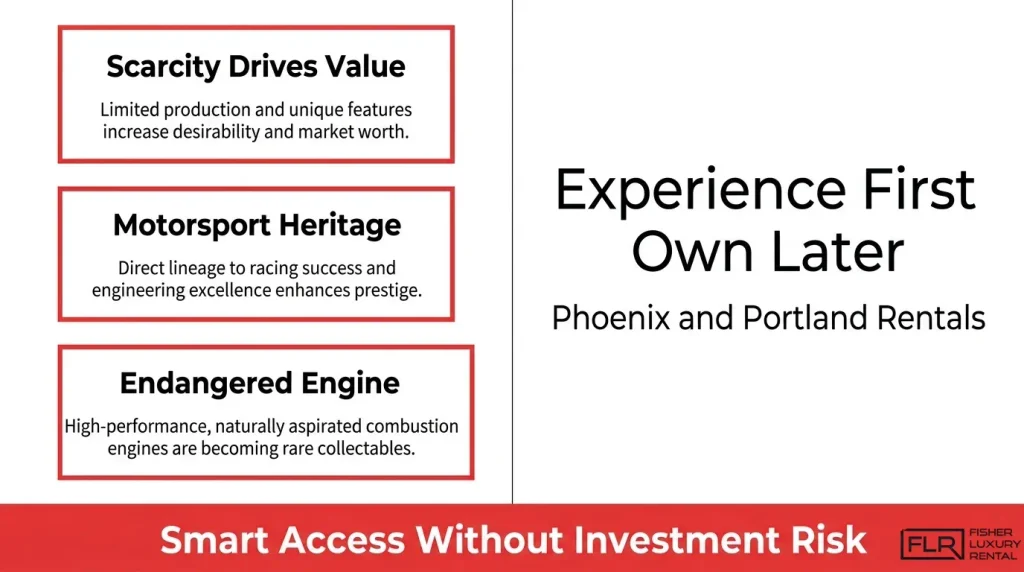
The key takeaways about Porsche GT3 value retention are that scarcity, motorsport heritage, and an endangered engine formula combine to create durable collector demand. Between 2022 and 2024, Porsche produced 15,667 units of the 992.1 GT3, more than any prior generation, yet strong demand still kept many examples at or above MSRP. The 911 GT3 with the Manthey Kit lapped the Nürburgring Nordschleife in 6:52.981 minutes, a benchmark that reinforces its track-credible reputation among serious buyers. For most enthusiasts, ownership carries real financial complexity. Renting first is the smartest way to experience the GT3 before committing to the market. Fisher Luxury Rental was founded with exactly this kind of driver in mind, car enthusiasts in the Phoenix and Portland areas who want an unforgettable high-performance experience without the financial exposure of buying into a volatile collector market.