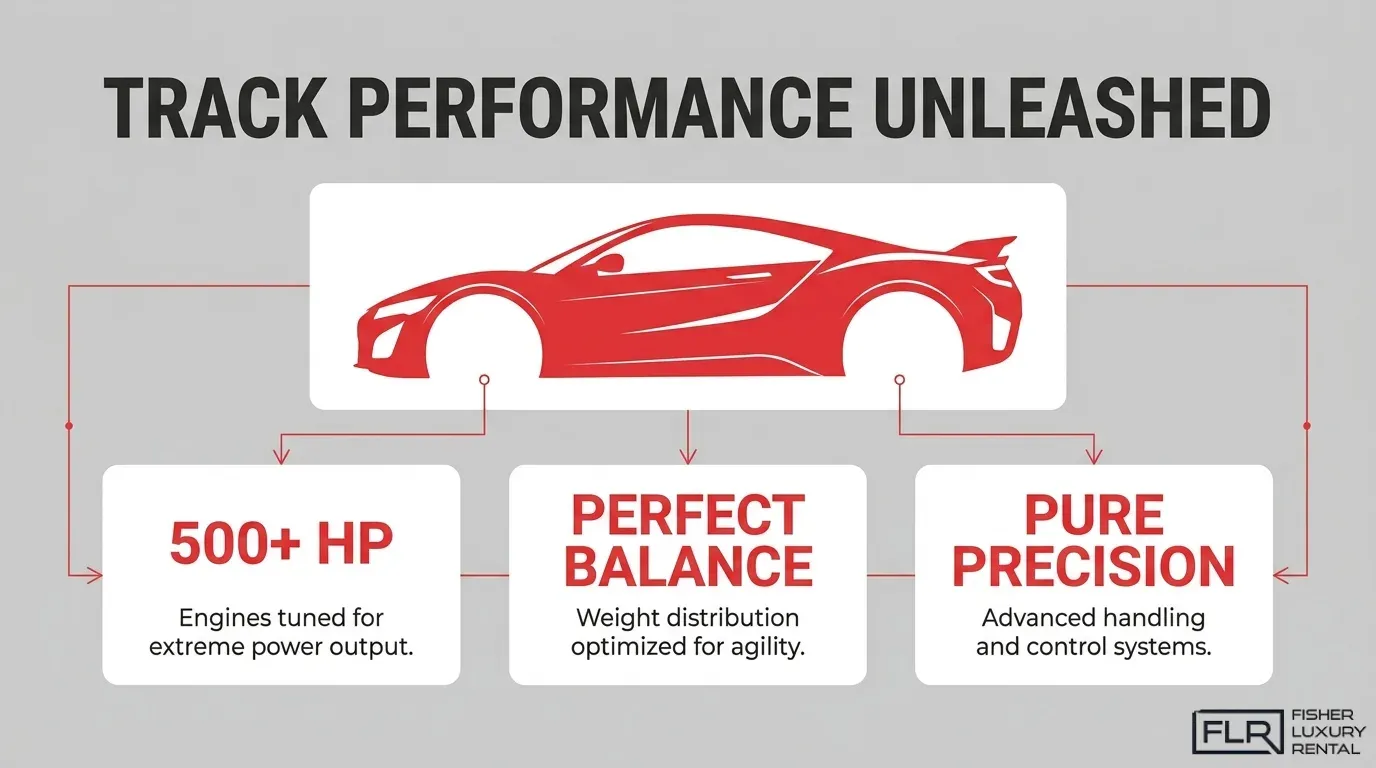
A track car is a vehicle engineered to prioritize lap time performance over everyday comfort, optimizing power-to-weight ratio, aerodynamics, braking, and suspension into one cohesive system built for circuit driving.
This guide covers what makes a track car fast, the best models across every budget and performance tier, what to know before taking a car to the track, how track-focused cars differ from street cars, which features to prioritize when choosing one, and how to experience supercar performance without ownership.
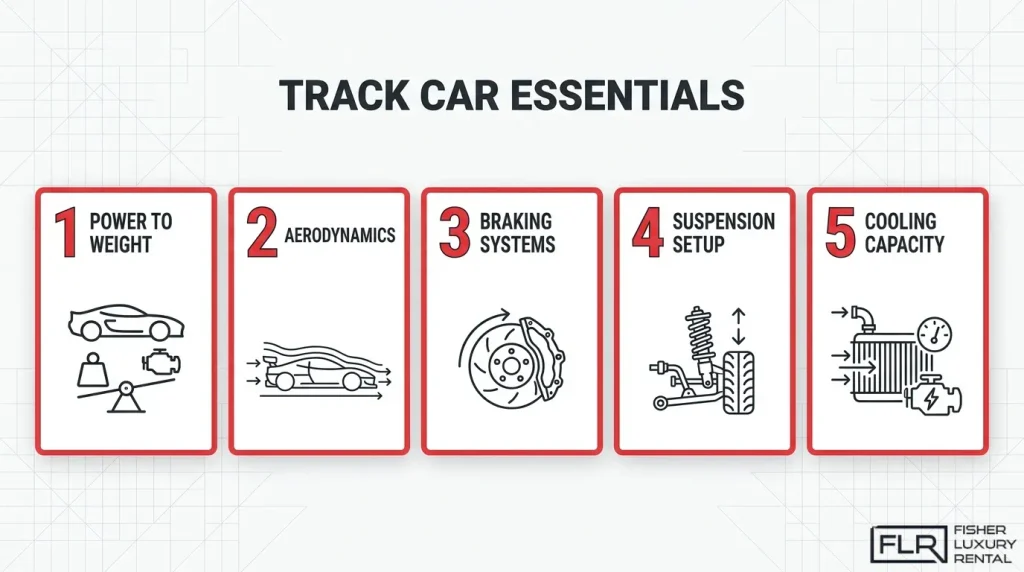
We start with the core engineering principles that separate fast cars from great track cars: power-to-weight ratio, aerodynamic downforce, braking systems, suspension setup, and cooling capacity. Each factor plays a specific role in how a car performs across a full session, not just a single flying lap.
From there, we cover ten standout production track cars spanning naturally aspirated icons to hybrid-assisted weapons, followed by five accessible beginner options including the Mazda MX-5 Miata, Toyota GR86, and Honda Civic Type R for drivers building circuit fundamentals on a realistic budget.
The guide then moves into supercar territory, examining four hybrid and V12-powered machines, including the Ferrari SF90 Stradale and Porsche 918 Spyder, that represent the ceiling of road-legal track performance. We also cover the practical side: safety modifications, pre-track maintenance, tire selection, and the key mechanical differences between a street car and a proper track machine.
Finally, we look at transmission choice, vehicle weight, and electronic stability control as the three features that most directly shape lap times, and we close with how Fisher Luxury Rental gives drivers a direct path to experiencing these cars in the real world.
What Makes a Great Track Car?
A great track car balances power-to-weight ratio, aerodynamics, braking, suspension, and cooling into one cohesive system. The sections below break down each of these performance fundamentals.
How Important Is Power-to-Weight Ratio for Track Performance?
Power-to-weight ratio is one of the most critical factors in track performance because it determines how quickly a car accelerates, changes direction, and responds to driver inputs. A lighter car with adequate power consistently outperforms a heavier car with more horsepower on technical circuits. The Porsche Cayman GT4 RS illustrates this principle: its 500 PS naturally aspirated engine reaches 9,000 rpm in a chassis engineered for minimal mass, producing lap times that humiliate far more powerful road cars. Raw horsepower figures are easy to market, but the power-to-weight ratio is what actually wins on track.
Why Does Aerodynamic Downforce Matter on a Circuit?
Aerodynamic downforce matters on a circuit because it presses the car into the road surface, increasing tire grip without adding mechanical weight. At high cornering speeds, downforce allows a car to carry significantly more velocity through turns than grip alone would permit. Wings, diffusers, and front splitters all generate negative lift that loads the tires, expanding the performance envelope. Without sufficient downforce at speed, even a well-suspended car will understeer and lose precious tenths in every corner.
How Do Braking Systems Affect Lap Times?
Braking systems affect lap times by determining how late a driver can brake before a corner and how consistently that threshold can be repeated across an entire session. Carbon-ceramic rotors resist fade under sustained heat, while large-bore calipers with multiple pistons apply even clamping force for straight, stable stops. A car with superior braking can enter corners later than competitors, effectively converting braking performance directly into lap time. Upgrading to track-spec brake fluid and performance pads is often the single highest-value modification for any track car.
What Role Does Suspension Setup Play on Track?
Suspension setup plays a central role in translating power and aerodynamics into actual cornering speed. Stiffer springs and dampers reduce body roll, keeping tires flat against the road surface through high-speed direction changes. Adjustable coilovers allow drivers to tune ride height, camber, and rebound for each circuit’s specific demands. Without a well-calibrated suspension, even a powerful car with excellent downforce will lack the mechanical grip and balance needed for consistent fast laps.
Why Is Cooling Capacity Critical for Track Cars?
Cooling capacity is critical for track cars because sustained high-speed driving generates far more heat than typical road use, and thermal overload causes power loss, component failure, and in severe cases engine damage. Oil coolers, larger radiators, and dedicated brake cooling ducts manage the additional thermal load that track sessions impose. Many road cars reach safe operating limits within minutes of hard track driving without additional cooling modifications. Proper cooling is what separates a car that performs one fast lap from one that performs consistently across an entire track day.
What Are the Best Track Cars You Can Buy?
The best track cars you can buy span a wide range of price points and performance profiles, from naturally aspirated icons to hybrid hypercars. The H3s below cover ten standout models, each excelling at a specific combination of power, weight, and circuit capability.
Porsche 911 GT3 RS
The Porsche 911 GT3 RS produces 525 PS (386 kW) with a 0-100 km/h time of 3.2 seconds and an unladen weight of just 1,450 kg, according to Porsche International. That power-to-weight ratio makes it one of the most capable road-legal track tools available. Large swan-neck rear wings, front splitters, and a fully adjustable suspension carry the aerodynamic load that the 911 platform needs at high circuit speeds. For drivers who want a track car that still commutes on Monday, the GT3 RS remains the benchmark.
Chevrolet Corvette Z06
The Chevrolet Corvette Z06 delivers 670 horsepower with a 0-60 mph time of 2.6 seconds and a quarter-mile time of 10.6 seconds at 131 mph, per Chevrolet. Its flat-plane crank V8 revs freely and produces a sound that rivals far more expensive European machinery. At its price point, the Z06 offers performance that embarrasses cars costing two or three times as much, making it arguably the best value proposition in modern track car history. For drivers who want to experience high-performance vehicles without the commitment of ownership, Fisher Luxury Rental offers exotic and luxury car rentals across Phoenix, AZ and Portland, OR, putting genuine performance within reach for a single day or a full week.
BMW M4 CSL
The BMW M4 CSL produces 550 horsepower with a 0-60 mph time of 3.7 seconds and a DIN kerb weight of 1,625 kg, per BMW M. The CSL designation carries significant heritage, recalling lightweight homologation specials from BMW’s motorsport past. Carbon fiber bucket seats, a stripped rear cabin, and aggressive aerodynamic additions separate it clearly from the standard M4 Competition. It rewards drivers who want a track weapon that still delivers the precision and refinement expected from a German grand tourer.
McLaren 765LT
The McLaren 765LT produces 755 horsepower and 590 pound-feet of torque with a 0-62 mph time of 2.8 seconds, according to McLaren. LT stands for Longtail, a lineage traced back to the iconic McLaren F1 GTR. Titanium exhaust components, polycarbonate windows, and removed sound deadening contribute to a significant weight reduction over the standard 720S. Few road cars communicate with the driver as directly or as honestly under hard circuit conditions. Fisher Luxury Rental specializes in top-trim exotic vehicles, giving enthusiasts the opportunity to experience this level of automotive engineering firsthand rather than simply reading about it.
Lamborghini Huracán STO
The Lamborghini Huracán STO generates 630 horsepower at 8,000 rpm with 442 pound-feet of torque and a 0-62 mph time of 3.0 seconds, per Lamborghini Sarasota. STO stands for Super Trofeo Omologata, a direct reference to Lamborghini’s one-make racing series. The front hood doubles as the hood and front fenders in a single carbon fiber piece, shaving weight while improving aerodynamic management across the nose. It is as close to a race car with license plates as a naturally aspirated V10 will ever deliver.
Ferrari 296 GTB
The Ferrari 296 GTB features a 120° V6 engine paired with a plug-in electric motor, delivering up to 830 horsepower combined, according to Ferrari. The hybrid system fills torque gaps that even Ferrari’s finest turbocharged engines previously experienced between gear changes. A rear-mounted eight-speed dual-clutch gearbox, carbon ceramic brakes as standard, and a Side Slip Control system allow even less experienced drivers to extract meaningful lap times. The 296 GTB represents Ferrari’s clearest statement that electrification and driving purity are not mutually exclusive.
Nissan GT-R Nismo
The Nissan GT-R Nismo produces 600 horsepower and 481 pound-feet of torque with a 0-60 mph time of 2.8 seconds, per Nissan USA. The twin-turbocharged VR38DETT engine is built entirely by hand, with each unit signed by the technician who assembled it. All-wheel drive and launch control combine with a dual-clutch gearbox to deliver consistent, repeatable lap times regardless of surface conditions. For drivers who value mechanical reliability alongside genuine performance, the GT-R Nismo remains a compelling choice even against newer competition.
Lotus Emira
The Lotus Emira with the supercharged V6 produces 400 horsepower and 354 pound-feet of torque with a 0-60 mph time of 3.8 seconds, according to Lotus Cars. As the final internal combustion Lotus sports car, the Emira carries considerable emotional weight alongside its technical credentials. Mid-engine balance, a Toyota-sourced supercharged V6, and Lotus’s decades of chassis tuning expertise make it a more engaging track companion than its horsepower figure alone suggests. Weight management, not peak power, has always been the Lotus philosophy.
Ford Mustang Dark Horse
The Ford Mustang Dark Horse is built specifically for track driving, featuring a 500 horsepower 5.0-liter Coyote V8 tuned for sustained high-rpm performance on circuit. Factory-fitted Brembo brakes, MagneRide 4.0 dampers, and optional Handling Package components bring genuine track capability without requiring aftermarket modification. It also offers something rare among high-performance American cars: an available six-speed manual transmission that enthusiasts actively prefer for circuit driving. For drivers who want track performance with unmistakable American character, the Dark Horse is the most focused Mustang ever produced.
Porsche Cayman GT4 RS
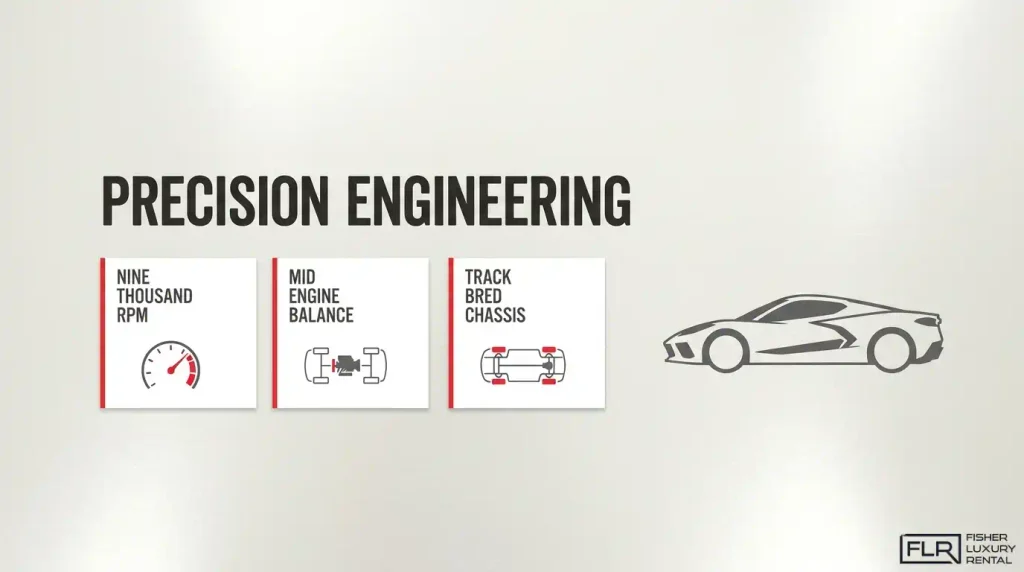
The Porsche Cayman GT4 RS features a six-cylinder naturally aspirated engine producing 500 PS (368 kW) that easily reaches 9,000 rpm, per Porsche International. That engine is borrowed directly from the 911 GT3, transplanted into a mid-engine platform that many Porsche engineers consider the more dynamically balanced of the two cars. The GT4 RS holds nothing back: weissach package carbon components, PDK-only transmission, and a wing profile tuned in the same wind tunnel as Porsche’s Le Mans entries. Among road-registered track cars, very few match its precision at the limit.
What Are the Best Affordable Track Cars for Beginners?
The best affordable track cars for beginners include the Mazda MX-5 Miata, Toyota GR86, Honda Civic Type R, Hyundai Elantra N, and Ford Mustang EcoBoost. Each offers a distinct balance of performance, accessibility, and value for drivers entering circuit driving.
Mazda MX-5 Miata
The Mazda MX-5 Miata is one of the most popular track day cars ever made, starting at an MSRP of $30,430 for the Sport trim, according to Mazda USA. Its lightweight chassis and near-perfect 50/50 weight distribution make it exceptionally forgiving, which is exactly what a beginner needs to build confidence. ProFormance Racing School recommends the MX-5 as an ideal first track machine for new performance drivers. For those learning car control, the Miata teaches fundamentals better than almost anything else at this price point.
Toyota GR86
The Toyota GR86 is a rear-wheel-drive sports coupe engineered specifically for driver engagement on track. Its naturally aspirated 2.4-liter boxer engine, low center of gravity, and progressive handling characteristics make it a strong choice for beginners developing lap technique. The GR86 prioritizes balance over outright power, rewarding precise inputs rather than masking mistakes.
Honda Civic Type R
The Honda Civic Type R FL5 produces 315 horsepower and is faster than the Toyota GR86 by 2.2 seconds on average across 46 shared tracks, according to LapMeta. That performance gap reflects a meaningful step up in capability. While the Civic Type R demands more driver skill, its track-tuned suspension and limited-slip differential provide strong feedback and genuine lap-time potential for advancing beginners.
Hyundai Elantra N
The Hyundai Elantra N is a front-wheel-drive performance sedan that punches well above its segment. Its turbocharged 2.0-liter engine, electronically controlled limited-slip differential, and N-specific driving modes make it surprisingly capable on circuit. For beginners who want an accessible daily driver that genuinely performs at track days, the Elantra N offers exceptional value.
Ford Mustang EcoBoost
The Ford Mustang EcoBoost is a rear-wheel-drive entry point into the Mustang performance lineup, powered by a turbocharged four-cylinder engine. Like the Hyundai Elantra N, it uses an automatic transmission option, making it more accessible to drivers still mastering track fundamentals. Its rear-wheel-drive platform builds skills that transfer directly to more powerful machinery later.
What Are the Best Supercars Built for the Track?
The best supercars built for the track combine hybrid powertrains, extreme aerodynamics, and race-derived engineering to deliver performance far beyond conventional sports cars. This section covers four definitive examples: the Porsche 918 Spyder, Ferrari SF90 Stradale, Lamborghini Aventador SVJ, and McLaren P1.
Porsche 918 Spyder
The Porsche 918 Spyder delivers 887 horsepower combined, drawing 600 hp from its naturally aspirated V8 engine and 275 hp from its battery-powered electric motors, with 944 pound-feet of torque (Audrain Automobile Museum). That hybrid architecture does more than boost output — it allows torque vectoring through individual electric motor control, giving the 918 a handling precision that purely combustion-powered cars cannot replicate at corner entry.
Ferrari SF90 Stradale
The Ferrari SF90 Stradale combines a twin-turbo V8 with three electric motors for a total system output of 986 horsepower, reaching 100 km/h in just 2.5 seconds, according to Ferrari. It is the most powerful road car Ferrari has ever produced for public sale, and its four-wheel-drive electric torque delivery makes that power genuinely usable on circuit.
Lamborghini Aventador SVJ
The Lamborghini Aventador SVJ represents the final, most extreme evolution of Lamborghini’s V12 flagship. Its ALA 2.0 active aerodynamics system manages airflow across the front splitter and rear wing independently, generating downforce or reducing drag depending on driving conditions. The SVJ held the Nürburgring Nordschleife production car lap record upon its release, a benchmark that reflects how thoroughly it was developed for circuit work.
McLaren P1
The McLaren P1 is a hybrid hypercar engineered explicitly around Formula 1 aerodynamic principles. Its twin-turbocharged V8 paired with an electric motor produces a combined 903 horsepower, while its deployable rear wing and active suspension deliver race-level mechanical grip. Few road cars close the gap between production vehicle and dedicated race car as completely as the P1 does.
What Should You Know Before Taking a Car to the Track?
Taking a car to the track requires preparation across three areas: safety modifications, pre-event maintenance, and tire selection. Each area directly affects both your performance and your safety on track.
What Safety Modifications Does a Track Car Need?
Safety modifications a track car needs include a roll cage or roll bar, properly rated harness, helmet, and fire extinguisher. Most track day organizers also require brake fluid rated for high temperatures, taped-over glass, and removed loose items from the cabin. Beyond hardware, budgeting for track day insurance is essential. According to Lockton Motorsports, track day insurance typically costs between $150 and $500 per event, varying by the car’s make, model, modifications, and value. Skipping insurance on a high-value car at speed is a risk that rarely makes financial sense.
What Maintenance Should You Do Before a Track Day?
Pre-track maintenance should cover brake pads, brake fluid, tire condition, wheel torque, and all fluid levels. Brakes take the hardest punishment on a circuit, so fresh pads and high-temperature fluid are the priority. Engine coolant, oil, and transmission fluid should all be at correct levels and recently changed. Checking for any existing leaks is equally important, since most tracks will black-flag a car that drops fluid on the racing surface.
How Do You Choose the Right Tires for Track Driving?
The right tires for track driving depend on how seriously you intend to push the car. Street tires work at lower-intensity track days, but R-compound tires deliver significantly more grip. Per Tire Streets, R-compound tires need heat to perform, becoming grippier as temperatures rise, though their softer compound accelerates wear. Keep in mind that consumables including fuel, fluids, brakes, and tires cost participants an average of $300 per track day, so factor tire wear into your overall budget before committing to a stickier compound.
How Do Track-Focused Cars Differ From Street Cars?
Track-focused cars differ from street cars in their safety systems, structural reinforcements, and mechanical tuning, all optimized for performance over comfort. The key differences involve roll cage requirements, restraint systems, tire compounds, and NVH management.
According to the Sports Car Club of America, all track cars must utilize a roll cage with a minimum of six attachment points to the chassis, and a 7-point restraint harness is recommended. Street cars use standard seatbelts and no roll cage, making them non-compliant for competitive or sanctioned track use.
Beyond structural safety, track cars strip out noise-dampening materials, stiffen suspension dramatically, and run R-compound tires that generate grip only after reaching operating temperature. Street cars prioritize ride comfort, emissions compliance, and everyday usability instead.
From an engineering standpoint, these two categories serve completely opposite goals. A street car compromises performance for livability; a track car compromises livability for every measurable second of lap time.
What Features Should You Prioritize When Choosing a Track Car?
The features to prioritize when choosing a track car are transmission type, vehicle weight, and electronic stability control. Each sub-section below covers how these factors directly shape lap times, control, and overall track performance.
How Does Transmission Type Affect Track Performance?
Transmission type affects track performance by determining how quickly and efficiently power reaches the wheels. Dual-clutch automatics, such as Porsche’s PDK, consistently edge out manual gearboxes in timed acceleration runs by eliminating the power interruption inherent in manual shifting. For drivers focused purely on lap times, a dual-clutch transmission is the stronger choice. That said, many experienced drivers prefer a manual for the engagement and feedback it provides, particularly on technical circuits where throttle modulation matters more than raw shift speed.
Why Does Vehicle Weight Matter More Than Horsepower?
Vehicle weight matters more than horsepower because a lighter car accelerates, brakes, and changes direction more efficiently at every point on a circuit. The BMW M4 CSL illustrates this well: despite producing 550 horsepower and weighing 1,625 kg, its 0-60 mph time of 3.7 seconds reflects how mass limits the return on power. Reducing weight improves braking distances, cornering grip, and tire longevity simultaneously, making it the single most impactful variable a track car buyer can optimize.
How Important Is Electronic Stability on a Track Car?
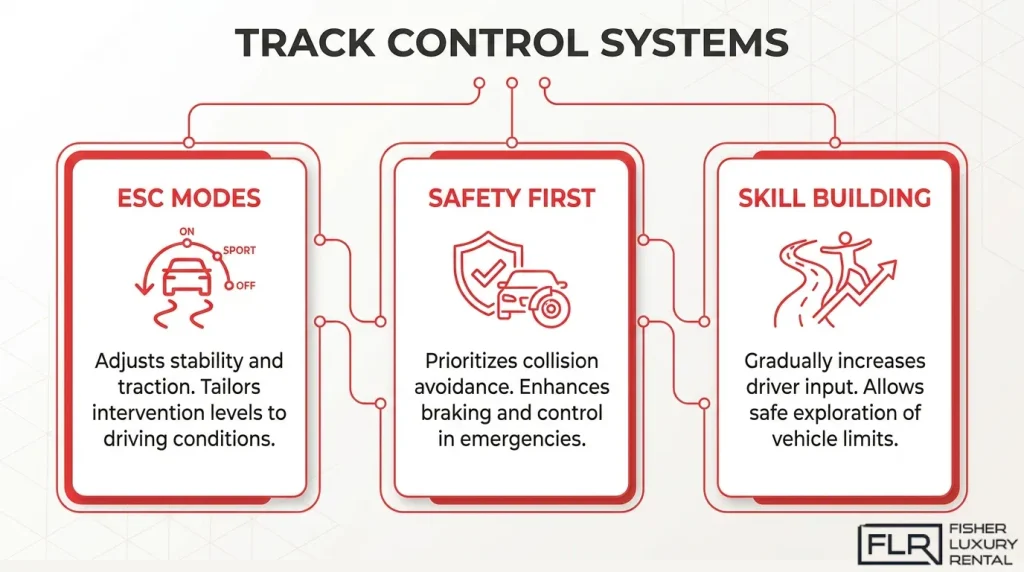
Electronic Stability Control (ESC) is important on a track car because it automatically keeps the vehicle on course by adjusting individual wheel brakes and engine power to prevent skidding, according to Kelley Blue Book. Most modern track cars offer configurable ESC modes, allowing drivers to dial in intervention levels suited to their skill and the circuit conditions. For beginners, leaving ESC active is a genuine safety advantage; for advanced drivers, partial or full disabling allows more expressive cornering. Understanding your ESC settings before a session is one of the most overlooked preparation steps in track driving.
How Can You Experience Track-Level Performance Cars?
Experiencing track-level performance starts with two practical paths: renting an exotic car for road driving or attending a dedicated track experience program. The sections below cover what exotic car rentals offer and the key takeaways from this guide.
Can Renting Exotic Cars From Fisher Luxury Rental Satisfy Your Track Car Curiosity?
Yes, renting exotic cars from Fisher Luxury Rental can satisfy your track car curiosity by putting genuine supercar performance in your hands without ownership costs. High-end exotic car rentals typically cost about $900 to $2,000 per day, according to Seattle Exotic Rentals, with weekly rates often reducing the daily figure considerably. Fisher Luxury Rental’s fleet covers luxury and exotic vehicles, offering top-trim models in Phoenix, AZ and Portland, OR so drivers can experience genuine exotic car performance firsthand. For enthusiasts not ready to commit to ownership or a track day program, a rental is the most direct route to genuine exotic car performance.
What Are the Key Takeaways About Best Track Cars for Performance Driving?
The key takeaways about best track cars for performance driving center on matching the car to your experience level, budget, and goals. ProFormance Racing School recommends the Mazda MX-5 as an ideal first track machine, making it the clearest starting point for beginners. From there, mid-range options like the Honda Civic Type R and Porsche Cayman GT4 RS offer escalating capability. At the flagship level, hypercars such as the Ferrari SF90 Stradale and Porsche 918 Spyder represent the ceiling of road-legal track performance. Across every tier, power-to-weight ratio, aerodynamics, and braking consistency matter more than peak horsepower alone. Whether you plan to buy, attend a track day, or rent, understanding these fundamentals helps you make a confident, informed decision. Fisher Luxury Rental, serving Phoenix and Portland, offers a straightforward way to put that knowledge into practice — renting a top-trim exotic car to experience the power-to-weight ratios, chassis dynamics, and performance characteristics covered in this guide.