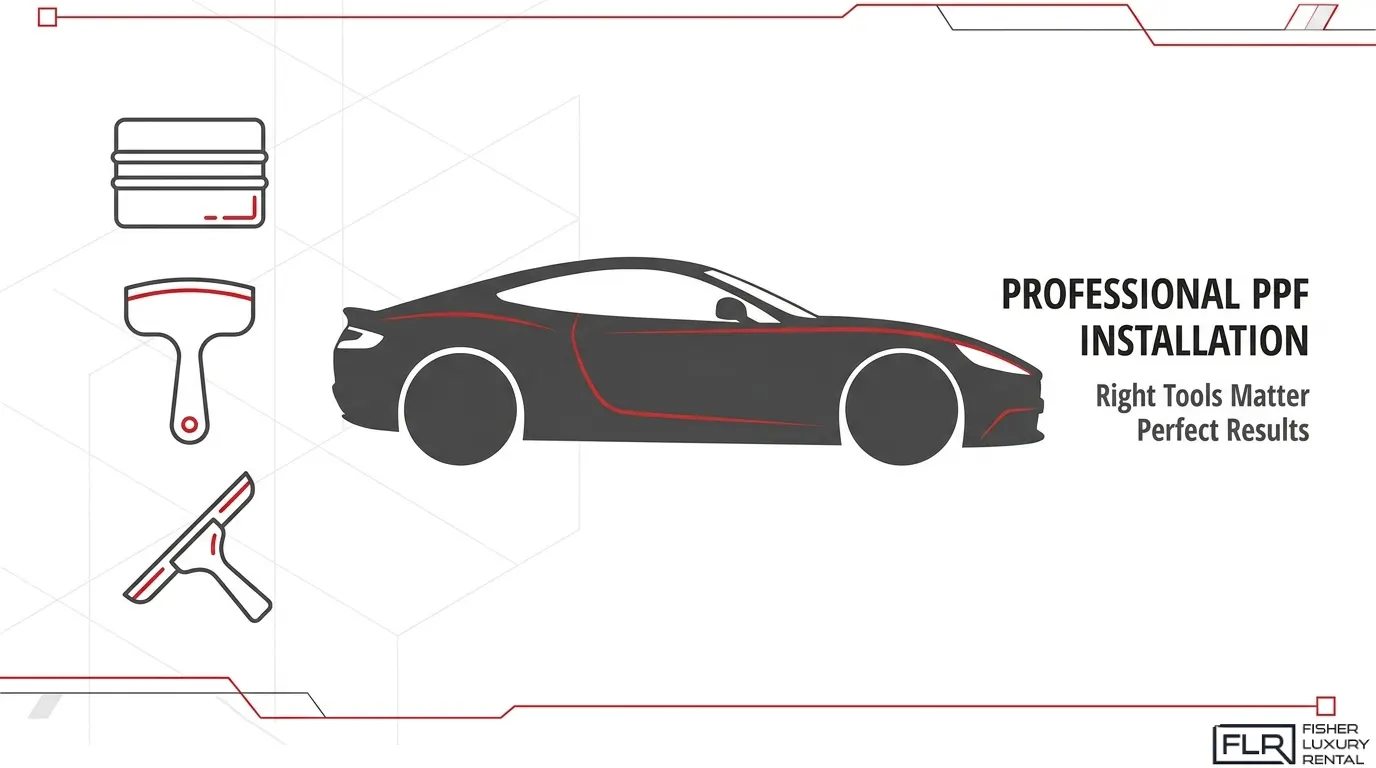
A PPF squeegee is a specialized application tool designed to evacuate air, water, and slip solution from beneath paint protection film during installation. Choosing the wrong type introduces trapped moisture, film distortion, and surface scratches that directly compromise adhesion quality and long-term clarity.
This guide covers squeegee types and their specific uses, brand comparisons, durometer selection by panel geometry, proper technique, slip solution formulas, scratch prevention, and tool maintenance.
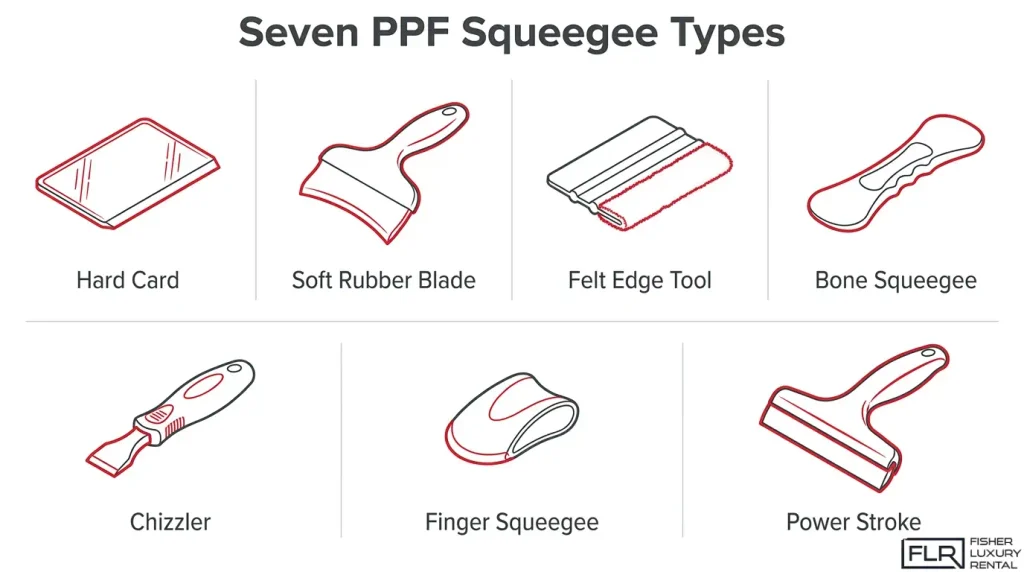
Squeegee variety spans seven distinct tool categories, from rigid hard cards built for flat panels to narrow bone tools designed for seams and recesses. Each type addresses a specific installation challenge, and using the wrong one for a given zone is a leading cause of preventable installation failure.
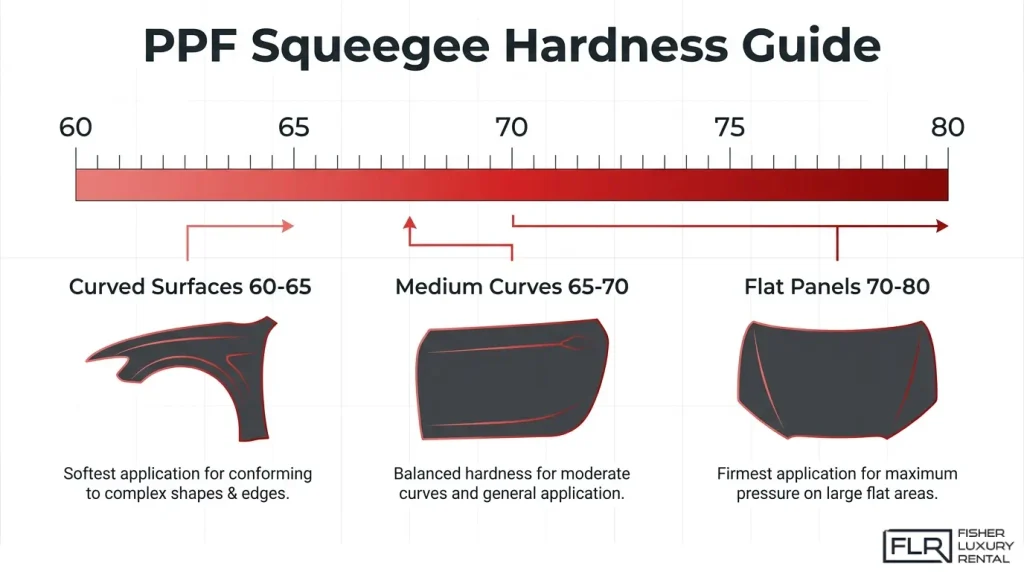
Durometer, the hardness rating of a blade, determines how a squeegee conforms to curved versus flat surfaces. Harder blades in the 70 to 80 range perform best on hoods, roofs, and doors, while softer blades in the 60 to 65 range are necessary for compound curves, bumpers, and optical surfaces like headlights.
Technique and slip solution work together to protect both the film and the underlying paint. Proper angle, center-out stroke direction, and 50% stroke overlap prevent bubble clusters, while correctly mixed soap-and-water or IPA tack solutions reduce friction and control adhesive activation timing.
Tool maintenance, including timely replacement and proper storage, preserves blade edge integrity and prevents the kind of micro-scratches that compromise a PPF installation worth thousands of dollars.
Why Does Squeegee Choice Matter for PPF Installation Quality?
Squeegee choice matters for PPF installation quality because the wrong tool causes trapped air, water channels, film distortion, and surface scratches that compromise both clarity and adhesion. The sections below cover how hardness, edge type, and technique each affect the final result.
What Are the Different Types of PPF Squeegees?
The different types of PPF squeegees are hard cards, soft rubber blades, felt-edge tools, bone squeegees, chizzlers, finger squeegees, and power stroke squeegees. Each type serves a distinct role depending on the panel geometry, film stiffness, and required pressure.
Hard Card Squeegees
Hard card squeegees are rigid, flat plastic tools designed for applying firm, even pressure across large flat panels. Their stiff construction evacuates water and air efficiently on hoods, roofs, and doors. Because they offer minimal flex, hard cards work best on surfaces with little curvature. Using them on contoured areas risks lifting film edges or creating stress points.
Soft Rubber Squeegees
Soft rubber squeegees are flexible blades that conform to curved and contoured vehicle surfaces. Their lower durometer allows the blade edge to follow compound curves without lifting or creasing the film. Soft rubber tools are particularly effective on bumpers, fenders, and door pillars where rigidity would cause bridging. For most installers, a soft rubber squeegee is the single most versatile tool in a PPF kit.
Felt-Edge Squeegees
Felt-edge squeegees are hard or semi-rigid squeegees wrapped with a soft felt buffer along the working edge. The felt layer prevents the blade from directly contacting and scratching the film surface during aggressive strokes. These tools allow higher stroke pressure without marring, making them ideal for final tack-down passes. Many professional installers keep a felt-edge card specifically for sealing edges near trim lines.
Bone Squeegees
Bone squeegees are narrow, rounded plastic tools shaped to reach tight channels, seams, and recessed body lines. Their tapered profile lets installers press film into gaps where flat cards cannot reach. Bones are typically used for door jams, mirror bases, and bumper vents. They are precise tools, not general-purpose blades, and should be used with light, controlled pressure to avoid tearing film in narrow areas.
Chizzler Squeegees
Chizzler squeegees are short, angled rigid tools with a beveled corner designed to tuck and seal film edges. The chizzler’s geometry directs pressure into a very small contact zone, making it effective for working film into sharp recesses, grille edges, and tight body line transitions. Its compact size gives the installer precise control in areas where larger tools would skip over the target zone entirely.
Finger Squeegees
Finger squeegees are small, ergonomic tools worn over or held between the fingers to apply localized pressure in confined spaces. They allow tactile feedback that rigid cards cannot provide, letting the installer feel resistance or air pockets beneath the film. Finger squeegees are especially useful around mirrors, badges, door handles, and curved A-pillar areas. For detail work requiring precision over power, they outperform every other tool type.
Power Stroke Squeegees
Power stroke squeegees are wide, ergonomically handled tools built for high-pressure, full-span strokes across large surface areas. Their extended blade width covers more surface per stroke, reducing installation time on expansive panels like hoods and roofs. A longer handle also reduces installer fatigue during multi-panel installs. Power stroke tools perform best when paired with adequate slip solution to prevent film dragging under high applied force.
Which Squeegee Brands Do Professional PPF Installers Recommend?
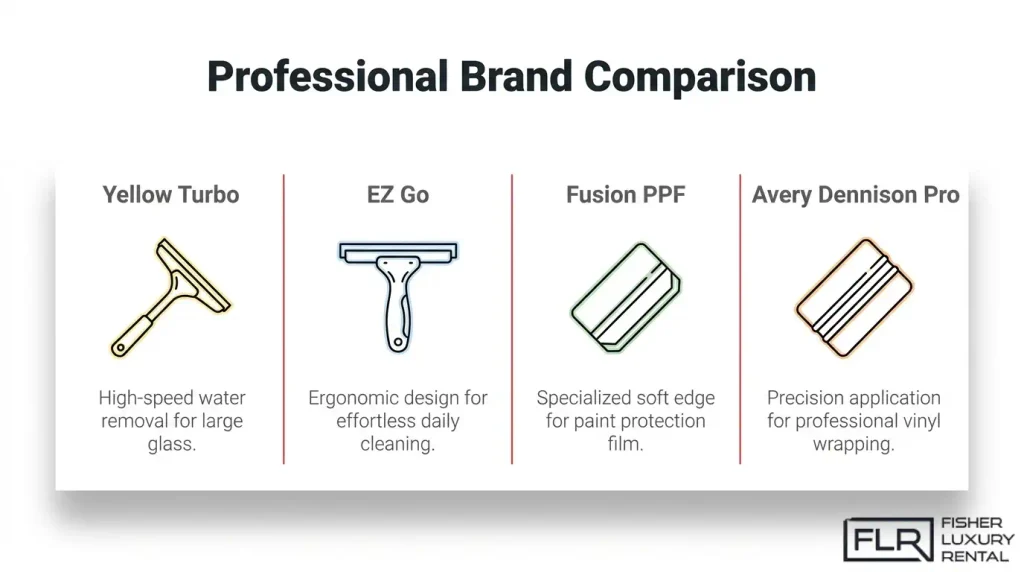
Professional PPF installers recommend several trusted squeegee brands, each suited to different application scenarios. The following sections cover the Yellow Turbo, EZ Go, Fusion, and Avery Dennison Pro squeegees.
What Makes Yellow Turbo Squeegees a Popular Choice?
Yellow Turbo squeegees are a popular choice because they combine a firm yet slightly flexible construction with a beveled edge that efficiently channels water and air during film application. Their bright yellow color also makes them easy to locate in a busy install bay. Installers favor them for flat panels and moderately contoured surfaces where consistent, even pressure is critical to preventing trapped moisture beneath the film.
Why Do Installers Prefer the EZ Go Squeegee?
The EZ Go squeegee is preferred by installers because its ergonomic handle design reduces hand fatigue during extended installations. The contoured grip allows precise control over pressure and stroke direction, which is especially valuable when working across large surfaces like hoods and roofs. Many professionals consider it a reliable all-purpose tool that performs well across both hard and soft durometer blade configurations.
What Sets the Fusion PPF Squeegee Apart?
The Fusion PPF squeegee stands apart because it is purpose-built specifically for paint protection film rather than adapted from vinyl wrap tools. Its dual-durometer construction pairs a rigid backing with a softer working edge, allowing installers to apply firm pressure without risking film distortion or edge lifting. This makes it particularly effective on complex curves where controlling both pressure and blade flex simultaneously is difficult with single-construction tools.
How Does the Pro Squeegee by Avery Dennison Perform?
The Pro Squeegee by Avery Dennison performs with strong versatility across the full range of PPF application zones. According to Avery Dennison Graphics Solutions, the PPF Squeegee Pro series is available in two sizes, 100mm wide for most applications and 65mm wide for tight detailed spaces, and in two constructions: a rigid blue version and a flexible red version. This size and stiffness pairing allows installers to match the tool precisely to the panel being worked, reducing the risk of misapplication on both large flat surfaces and recessed detail areas.
What Squeegee Hardness or Durometer Works Best for PPF?
Squeegee durometer directly affects how well the blade conforms to a surface and how much pressure it transfers to the film. The right hardness varies by panel geometry, with flat surfaces, curved body sections, and optical-grade areas each requiring a different approach.
What Durometer Is Best for Flat Body Panels?
The best durometer for flat body panels is a harder blade, typically in the 70 to 80 durometer range. According to Chromaline, harder blades are ideal for flat surfaces and detailed prints because they maintain a consistent edge and transfer pressure evenly across the panel without flexing. On doors, roofs, and hoods, this rigidity prevents the blade from skating or rocking, which reduces the risk of trapped moisture channels beneath the film.
What Durometer Works Best for Complex Curves and Edges?
The best durometer for complex curves and edges is a softer blade, generally in the 60 to 70 durometer range. Softer blades flex and conform to compound contours, such as fender flares, bumper corners, and body creases, without lifting the film edge or creating bridging. A blade that cannot follow the surface geometry will leave air pockets at the highest stress points of the installation, which are exactly where lifting starts.
What Durometer Is Best for Windshield and Headlight Film?
The best durometer for windshield and headlight film is in the soft to medium range, around 60 to 65 durometer. These surfaces combine pronounced curvature with optical clarity requirements, meaning any excessive blade pressure risks distorting the film or creating micro-scratch patterns that show under light. A softer blade reduces edge drag and distributes force gradually across the curved glass or polycarbonate lens surface.
Which Squeegee Shape Is Best for Each Area of a Vehicle?
The best squeegee shape for each area of a vehicle depends on panel geometry, surface accessibility, and curvature complexity. Flat panels favor wide straight-edge cards, curved sections need flexible shapes, and recessed zones require narrow or contoured tools.
Which Squeegee Shape Works Best on Hoods and Roofs?
The squeegee shape that works best on hoods and roofs is a wide, straight-edge hard card. These large, relatively flat panels benefit from a full-width blade that covers maximum surface area per stroke, reducing application time and minimizing overlap lines. A rigid card maintains consistent edge contact across the panel, which promotes even adhesive activation and thorough water evacuation.
Which Squeegee Shape Works Best on Bumpers and Fenders?
The squeegee shape that works best on bumpers and fenders is a flexible, curved-edge blade. Bumpers and fenders feature compound curves that a rigid straight card cannot follow without lifting away from the surface. A soft, flexible squeegee conforms to the contour, maintaining consistent pressure across the film and reducing the risk of trapped air pockets along the edges.
Which Squeegee Shape Works Best on Door Edges and Mirrors?
The squeegee shape that works best on door edges and mirrors is a narrow, tapered blade or finger squeegee. Door edges and mirrors present limited surface area with abrupt directional changes. A narrow profile allows precise pressure placement without the blade tip overshooting onto adjacent surfaces, which is critical for preventing film lift at sharp termination points.
Which Squeegee Shape Works Best on Tight Recessed Areas?
The squeegee shape that works best on tight recessed areas is a small, pointed or bone-style tool. Recessed panels, grilles, and panel seams require a tip narrow enough to reach into the recess and press the film flat without distorting surrounding sections. According to Avery Dennison Graphics Solutions, the PPF Squeegee Pro is available in a 65mm wide version specifically designed for tight, detailed spaces. A contoured bone tool is particularly effective for working film into seams and around emblems where a flat card cannot reach.
How Do You Use a Squeegee Properly During PPF Installation?
Proper squeegee technique determines whether PPF bonds cleanly or traps air, water, and bubbles beneath the film. The sub-sections below cover holding angle, applied pressure, and stroke direction.
What Angle Should You Hold a Squeegee for PPF?
The angle to hold a squeegee for PPF is 30 to 45 degrees relative to the panel surface. This range lets the blade edge glide smoothly without digging into the film or skipping across it. Holding the tool too upright increases drag and risks edge lifting, while too shallow an angle reduces the force needed to evacuate moisture. According to DIY Wrap Club, each stroke should overlap the previous by approximately 50% to ensure complete water evacuation, consistent adhesion, and fewer trapped bubbles.

How Much Pressure Should You Apply When Squeegeeing PPF?
The pressure to apply when squeegeeing PPF is firm but controlled, enough to push slip solution toward the edges without stretching the film. Excess force thins the film over contoured areas, creating stress points prone to peeling. Surface preparation matters equally: Justin Pate of the Wrap Institute advises using an air compressor to clear debris from seams, edges, and tight spots before squeegeeing, since even small dust particles cause bubbling or lifting under pressure.
What Stroke Direction Prevents Bubbles and Lifting?
The stroke direction that prevents bubbles and lifting is center-outward, working from the middle of the panel toward each edge. This approach pushes air and trapped slip solution out rather than redistributing it. Working inward from the edges compresses moisture toward the center with nowhere to escape, which is the most common cause of persistent bubble clusters. Overlapping each pass by roughly half the blade width ensures no channels of trapped water are left between strokes.
What Slip Solution Should You Use with PPF Squeegees?
The right slip solution reduces friction between the squeegee and film, allowing precise repositioning without disturbing the adhesive prematurely. The two industry standards are a soap-and-water mixture and an isopropyl alcohol tack solution, each serving a different phase of installation.
According to 3M’s Commercial Solutions installation guide, the recommended slip solution ratio is 2ml of non-detergent slip agent (such as Johnson’s Baby Shampoo) per 32 ounces of water. For a tack solution used to lock the film into final position, 3M specifies 70% isopropyl alcohol mixed at 4 to 8 ounces per 32 ounces of water.
Avery Dennison’s guidelines for Supreme PPF films specify a slightly different ratio: 2ml of soap per 1 liter of water, mixed in a large pump bottle or pressurized trigger spray tank for consistent, even coverage during application.
In practice, the soap-and-water slip solution keeps the film mobile during initial positioning, while the IPA tack solution is applied progressively as you squeegee from the center outward, activating the adhesive in controlled stages. Using too much soap extends working time but risks leaving residue under the film if not fully expelled. Keeping both solutions prepared before you begin is one of the simplest ways to avoid mid-install errors.
How Do You Prevent Squeegee Scratches on Paint Protection Film?
Preventing squeegee scratches on paint protection film requires combining the right tools, proper technique, and adequate lubrication throughout the installation process.
Use Sufficient Slip Solution
Slip solution prevents squeegee scratches by creating a lubricated layer between the blade and the film surface. According to 3M Commercial Solutions, the recommended slip solution uses Johnson’s Baby Shampoo at a ratio of 2ml of non-detergent slip agent per 32 ounces of water. Reapply frequently during installation; a dry squeegee dragged across PPF is the single most common cause of surface marring.
Apply Correct Squeegee Angle and Direction
The correct squeegee angle for PPF is 30 to 45 degrees to the surface. Holding the blade at this angle lets the edge glide smoothly rather than dig in. According to Oz Sign Supplies, installers should always begin at the center of the panel and push outward toward the edges to force air and moisture out evenly. This center-out motion also reduces stress on the film, preventing stretch marks and micro-scratches.
Wrap the Squeegee in a Buffer Layer
Wrapping a squeegee with a buffer layer, such as a felt sleeve or a thin microfiber cloth, eliminates direct hard-edge contact with the film. This is especially important when working edges, seams, or any area where firmer pressure is required. The softer contact surface distributes pressure evenly, preventing localized film abrasion.
Choose the Right Squeegee Hardness
Squeegee hardness directly affects scratch risk on PPF. Harder blades concentrate pressure at a narrow contact point, increasing the likelihood of marring. A softer blade conforms to surface contours and spreads pressure across a wider area. Given that PPF installations can cost between $400 and $9,000 or more depending on coverage, using the correct blade hardness protects a significant financial investment.
What Accessories and Squeegee Add-Ons Improve PPF Results?
The accessories and squeegee add-ons that improve PPF results include felt-edge buffers, knifeless tape, slip solution applicators, and PPF-specific protective wraps for squeegee edges. Each addresses a specific failure point in the installation process.
Felt-Edge Buffers and Edge Protection Wraps
Felt-edge buffers attach directly to the squeegee edge, creating a soft barrier between the blade and the film surface. This reduces friction drag that can mar the film’s topcoat during aggressive strokes. For installers working on high-gloss or delicate finishes, felt wraps are not optional extras; they are essential risk management tools that prevent surface marring before it starts.
Slip Solution Applicators and Spray Bottles
Proper slip solution delivery directly affects squeegee performance. According to Avery Dennison’s application guidelines for Supreme PPF films, the recommended slip solution mixes 2ml of soap per 1 liter of water, prepared in a pressurized tank or pump spray bottle for consistent coverage. Trigger-spray bottles allow controlled, even application across panels before each squeegee pass, minimizing dry spots that cause the blade to catch or scratch the film.
Knifeless Tape and Trim Guides
Knifeless tape guides clean film edges without a blade contacting the paint, reducing the risk of underedge lifting during squeegeeing. Used alongside squeegees, it defines boundaries so each stroke stays within the intended coverage zone, resulting in cleaner seams and tighter adhesion at panel edges.
How Often Should You Replace Your PPF Squeegees?
PPF squeegee replacement frequency depends on usage volume, blade condition, and the type of squeegee material. The sections below cover the key signs of wear, replacement intervals by tool type, and storage habits that extend blade life.
What Are the Signs a PPF Squeegee Needs Replacing?
The signs a PPF squeegee needs replacing include nicks or chips along the blade edge, visible warping, surface roughness, and inconsistent water evacuation during strokes. Any of these defects transfers directly to the film surface, creating streaks, missed channels, or micro-scratches that compromise adhesion quality. A quick fingernail test across the blade edge catches most damage before it reaches the film.
How Many Installations Before a Squeegee Wears Out?
Hard card squeegees typically last 15 to 30 full installations before edge degradation affects performance, while soft rubber squeegees may show wear after as few as 10 to 20 installs under heavy use. Felt-edge wraps, being a consumable buffer layer, often need replacement every 5 to 10 installs depending on surface contact and solution exposure. Professional installers working daily volume should inspect blades after every session rather than relying solely on install counts.
Does Squeegee Storage Affect How Long It Lasts?
Yes, squeegee storage directly affects how long a blade lasts. Heat, UV exposure, and improper stacking accelerate rubber degradation and cause hard card edges to warp or delaminate. Storing squeegees flat in a cool, dry case, away from solvents and direct sunlight, preserves edge integrity between jobs. This is often an underestimated factor: a well-stored squeegee can outlast a poorly stored one by several installation cycles, making proper storage a cost-effective maintenance habit.
How Does Protecting a Luxury Vehicle Relate to the PPF Experience?
Protecting a luxury vehicle connects directly to understanding why PPF quality and application technique matter. The following sections explore how renting an exotic car builds appreciation for paint protection, and summarize the article’s core takeaways. Fisher Luxury Rental, which serves the Phoenix and Portland areas, maintains a fleet of top-trim luxury and exotic vehicles, the exact category of car that benefits most from precision PPF application and careful paint preservation.
Can Renting an Exotic Car from Fisher Luxury Rental Help You Appreciate Premium Paint Protection?
Yes, renting an exotic car from Fisher Luxury Rental can help you appreciate premium paint protection by giving you firsthand experience with the finishes PPF is designed to preserve. Luxury and exotic vehicles use sophisticated paint systems that are notably vulnerable. According to EuroLuxe Detailing, German manufacturers like Porsche use water-based paint measuring only 90–110 microns total, compared to 120–150 microns on many Japanese vehicles, making those finishes measurably softer and more susceptible to chips and abrasions.
PPF, a thermoplastic urethane self-healing film, protects painted surfaces from stone chips, bug splatters, and minor abrasions. The market’s projected growth from USD 1,092.7 million in 2025 to USD 1,549.4 million by 2030 reflects how seriously owners treat paint preservation. Driving a meticulously maintained exotic car makes that investment feel tangible, not theoretical. For those who want to experience a high-end exotic or luxury vehicle before committing to ownership and its associated protection costs, Fisher Luxury Rental offers rentals in Phoenix, AZ and Portland, OR, allowing drivers to understand firsthand what makes these paint systems worth protecting.
Fisher Luxury Rental operates in Phoenix, AZ and Portland, OR, offering top-trim luxury and exotic vehicles for rent.
What Are the Key Takeaways About the Best Squeegees for Clear Bra and PPF Application?
The key takeaways about the best squeegees for clear bra and PPF application center on matching tool hardness, shape, and technique to each specific area of the vehicle. Successful PPF installation depends on several core principles:
- Durometer selection matters: Softer blades suit curved or textured surfaces; harder blades work best on flat panels.
- Stroke technique is critical: Always squeegee from the center outward, overlapping each stroke by approximately 50% to eliminate trapped air and moisture.
- Angle controls outcome: Holding the squeegee at 30–45° allows the edge to glide without scratching the film.
- Tool variety is essential: Different squeegee types, such as hard cards, felt-edge tools, bone tools, and finger squeegees, serve distinct zones across a vehicle.
- Preservation is a complete system: Many vehicle owners now combine PPF with ceramic coating and window tinting for full protection rather than relying on film alone.
Squeegeeing technique is often underestimated, but it is the single most controllable variable in determining whether a PPF installation lasts or fails prematurely.