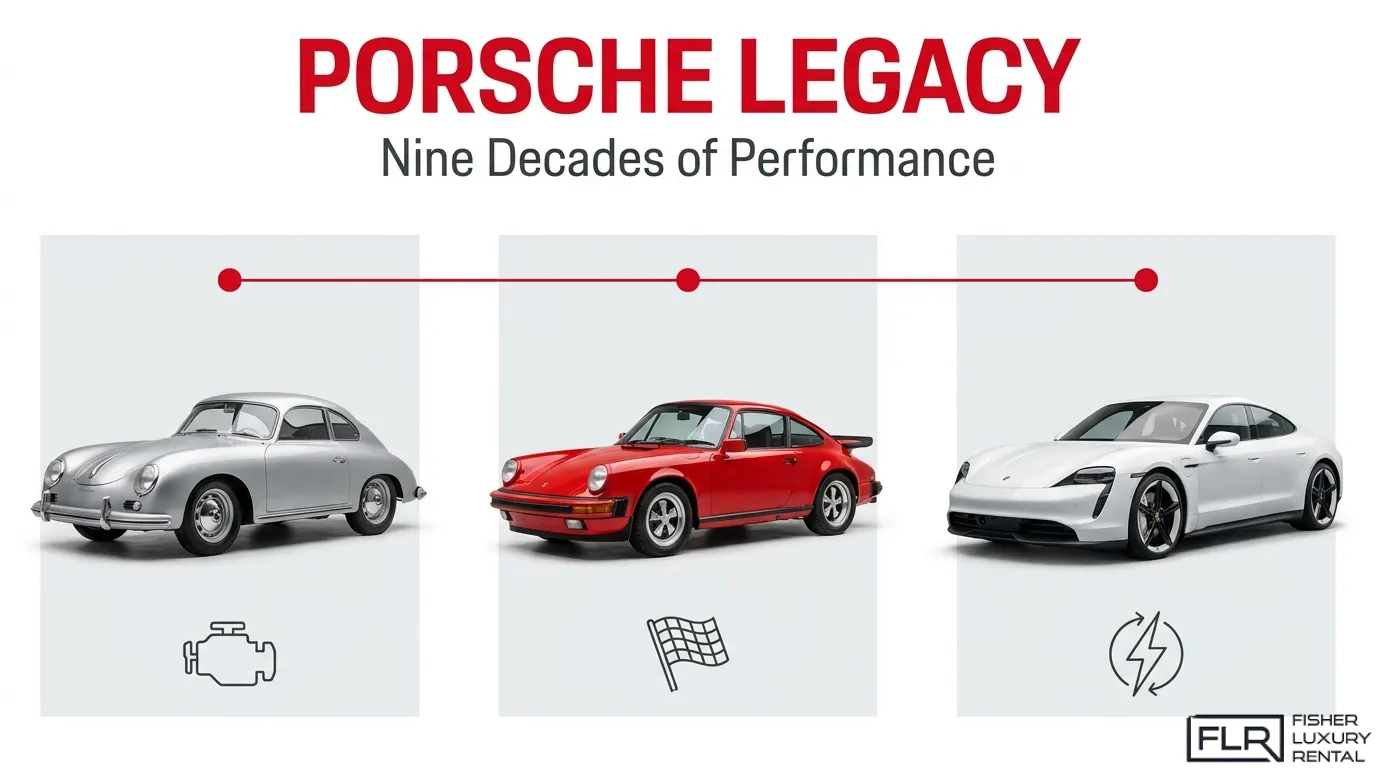
Porsche is a Stuttgart-founded performance car manufacturer established in 1931 by Ferdinand Porsche, whose engineering philosophy, precision over spectacle and performance over compromise, defines every model the brand has produced across nine decades.
This guide covers Porsche’s founding origins, its landmark models, the 911’s enduring legacy, the current model lineup, motorsport dominance, electrification strategy, competitive positioning, and the engineering systems that make every Porsche drive differently from anything else on the road.
Ferdinand Porsche’s early career, from the 1901 Lohner-Porsche Mixte Hybrid to the Volkswagen Beetle commission, established the technical foundation the brand built on. The first Porsche-branded car, the 356, was road-certified in 1948 and won its class in its debut race that same year.
Iconic models from the 356 through the 959, Carrera GT, and Taycan each mark a distinct engineering era. Together they trace a continuous line from hand-built lightweight sports cars to a 1,019 hp all-electric flagship.
The 911 sits at the center of this guide. Eight generations of development have refined its rear-engine layout, flat-six architecture, and silhouette without abandoning the handling character that defines it.
Porsche’s current six-model lineup spans sports cars, SUVs, a sport turismo, and a full EV platform, each with trim levels from daily drivers to track-focused flagships.
Motorsport and engineering sections explain how 19 Le Mans victories shaped production technology, how the flat-six has stayed in continuous production for over 60 years, and what PDK and Porsche Traction Management contribute to the driving experience.
How Did Porsche Begin as a Company?
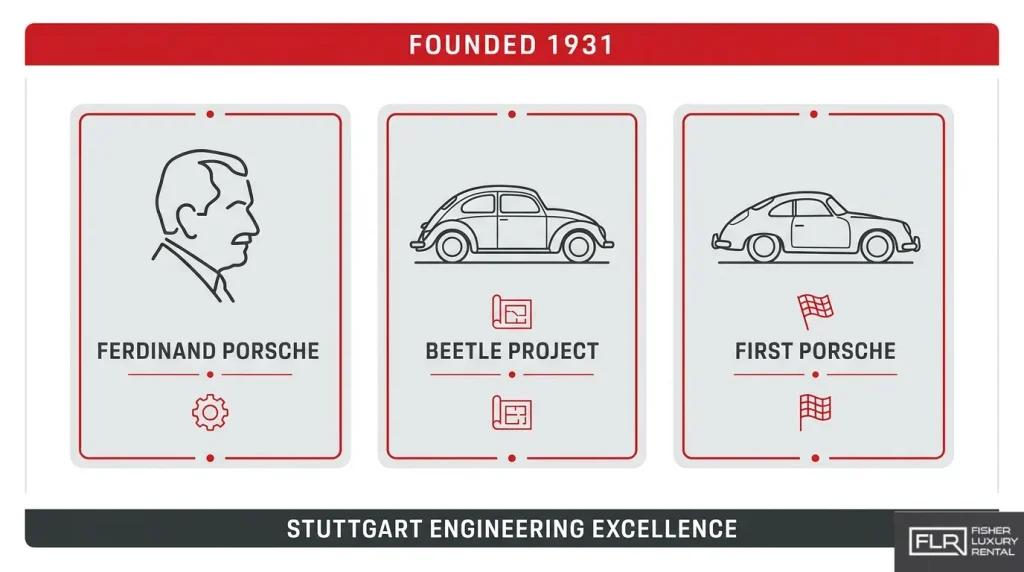
Porsche began as a Stuttgart-based automotive engineering consultancy in 1931, evolving into one of the world’s most recognized sports car manufacturers. The sections below cover Ferdinand Porsche’s founding vision, the Volkswagen Beetle commission, and the first car to carry the Porsche name.
Who Was Ferdinand Porsche and What Was His Vision?
Ferdinand Porsche was an Austrian automotive engineer whose vision centered on pushing the boundaries of vehicle performance and efficiency. Born on 3 September 1875 in Maffersdorf, Bohemia, Austria-Hungary, he demonstrated exceptional engineering instincts from an early age. According to Wikipedia, he created the first gasoline-electric hybrid vehicle, the Lohner-Porsche Mixte Hybrid, as early as 1901, predating modern hybrid technology by nearly a century.
His ambitions extended beyond individual projects. In April 1931, he founded Dr. Ing. h.c. F. Porsche GmbH in Stuttgart, with financial backing from Anton Piëch and Adolf Rosenberger, establishing an independent design consultancy that would eventually bear his name on road cars. Ferdinand’s vision was straightforward: engineer vehicles that performed better than anyone thought possible. That philosophy still defines every Porsche produced today.
What Role Did the Volkswagen Beetle Play in Porsche’s Origin?
The Volkswagen Beetle played a foundational role in Porsche’s early financial survival and engineering credibility. In June 1934, Ferdinand Porsche received a government contract to design an affordable “people’s car” for mass production, a project that became the Volkswagen Beetle. This commission provided critical revenue and engineering resources during a period when the young consultancy needed both.
The Beetle project also sharpened Ferdinand’s understanding of compact, lightweight rear-engine architecture, a layout that would later define the Porsche 911. Without the Beetle contract, Porsche GmbH may not have survived long enough to develop its own branded automobiles. The connection between these two iconic vehicles is one of automotive history’s most consequential relationships.
When Was the First Porsche-Branded Car Produced?
The first Porsche-branded car was produced in 1948, when the Porsche 356 became the company’s inaugural road vehicle. This lightweight, rear-engine sports car drew directly on Volkswagen mechanical components, reflecting the practical engineering approach Ferdinand had refined through the Beetle project. The 356 was road certified in Austria on June 8, 1948, and immediately proved competitive, winning its class in its first race in Innsbruck.
Production continued until 1965, establishing Porsche’s reputation for driver-focused performance in a compact package. The 911 followed that same philosophy, with its roots traced to sketches drawn by Ferdinand “Butzi” Porsche in 1959. That continuity between the 356 and the 911 is what makes Porsche’s founding era so significant to understanding the brand today.
What Are the Major Eras in Porsche’s History?
The major eras in Porsche’s history span from the lightweight sports cars of the 1950s through the performance breakthroughs of the 1970s–1980s, the survival and diversification of the 1990s–2000s, and the electrification era from 2010 to today.
How Did the 1950s and 1960s Define Porsche’s Early Identity?
The 1950s and 1960s defined Porsche’s early identity through the 356, a lightweight, rear-engine sports car that established the brand’s core philosophy of driver-focused performance. Produced from 1948 to 1965, the 356 proved Porsche’s engineering credibility on both road and track. The decade closed with Ferdinand “Butzi” Porsche sketching what would become the 911 in 1959, cementing the rear-engine layout as Porsche’s signature. These two models together set a template the brand would follow for decades.
How Did Porsche Evolve Through the 1970s and 1980s?
Porsche evolved through the 1970s and 1980s by expanding its motorsport dominance and engineering ambition simultaneously. On the track, the 919 Hybrid’s lineage traces back to a program built on 1980s endurance expertise, and according to Wikipedia, the Porsche 919 Hybrid won the Le Mans 24-hour race from 2015 through 2017, a direct legacy of that era’s investment. The 944, launched in 1982, broadened the lineup with a front-engine layout and accessible performance, while the 959 pushed hypercar boundaries with twin-turbocharged all-wheel-drive technology. These years transformed Porsche from a niche manufacturer into a performance benchmark.
What Changed for Porsche in the 1990s and 2000s?
The 1990s and 2000s brought Porsche its most significant strategic transformation, shifting from near-financial collapse to sustained profitability. The introduction of the Cayenne SUV in 2002 opened mass-market revenue that funded sports car development. The 2000s also produced the Carrera GT, a pure supercar statement that reinforced Porsche’s engineering credibility at the highest level. This era proved that diversification and performance excellence were not mutually exclusive.
How Has Porsche Innovated From 2010 to Today?
Porsche’s innovation from 2010 to today centers on hybrid powertrains, electrification, and record-setting performance. According to Wikipedia, Porsche holds the record for the most overall victories at the 24 Hours of Le Mans, with 19 wins, including seven consecutive victories from 1981 to 1987, a motorsport legacy that directly informs its current engineering direction. The Taycan, launched in 2019, became Porsche’s first fully electric production car, signaling a new era without abandoning the brand’s performance standards. This period confirms that Porsche treats electrification as a performance tool, not a compromise.
What Are the Most Iconic Porsche Models of All Time?
The most iconic Porsche models of all time span seven decades of engineering excellence, from the hand-built 356 to the all-electric Taycan. The sections below profile each landmark model across three eras: early classics, analogue-era icons, and modern flagships.
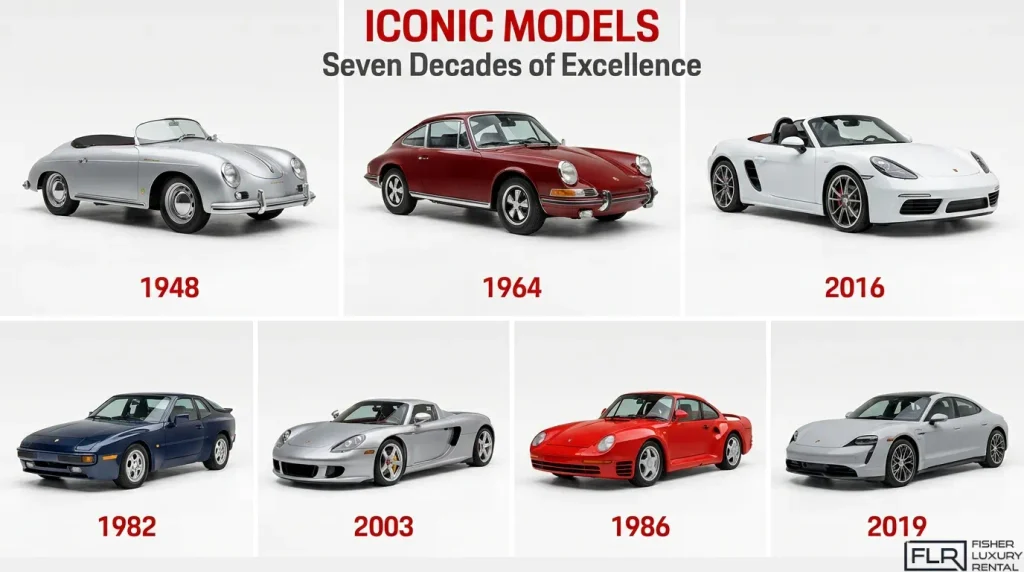
Porsche 356
The Porsche 356 is the car that started the brand, a lightweight, rear-engined sports car first road-certified in Austria on June 8, 1948. It entered a race in Innsbruck that same year and won its class, immediately establishing Porsche as a performance marque. Production ran until 1965, with 76,313 examples built. Roughly half survive today, a testament to both construction quality and collector devotion.
Porsche 911
The Porsche 911 is the definitive sports car of the 20th century, tracing its origins to sketches drawn by Ferdinand “Butzi” Porsche in 1959. Originally launched as the 901, Peugeot’s naming objection prompted the renaming that became iconic. According to Wikipedia, the one millionth 911 was manufactured in May 2017 and now resides in Porsche’s permanent collection. No other model in the brand’s history has sustained continuous production and cultural relevance for as long.
Porsche 718 Boxster and Cayman
The Porsche 718 Boxster and Cayman are mid-engine, driver-focused sports cars that share a platform while offering distinct body styles: the Boxster as a roadster and the Cayman as a fixed-roof coupe. Both models prioritize handling balance over outright power, making them widely regarded as the purest driving experience in the current Porsche lineup. For enthusiasts who value cornering precision above all else, the 718 pair is hard to beat.
Porsche 944
The Porsche 944 is a front-engine, water-cooled sports car produced from 1982 to 1991, with over 163,000 units built. According to Wikipedia, it was the most successful sports car in Porsche’s history until the Boxster and 997 Carrera surpassed it. Its balanced 50/50 weight distribution and accessible price point made it a gateway Porsche for an entire generation of enthusiasts.
Porsche Carrera GT
The Porsche Carrera GT is a naturally aspirated supercar produced from 2003 to 2006, limited to 1,270 units. It is powered by a 5.7-liter V10 engine producing 603 hp, capable of reaching 60 mph in 3.5 seconds. Demanding to drive and unfiltered in its feedback, the Carrera GT represents the last analog hypercar before electronic aids became standard in the segment.
Porsche 959
The Porsche 959 is a technology-defining supercar produced from 1986 to 1993, with only 345 units built. It featured a sequential twin-turbocharged 2.8-liter flat-six engine generating 444 hp at 6,500 rpm and a top speed of 197 mph. The 959 previewed technologies, including all-wheel drive and variable turbo boost, that have since become industry standards.
Porsche Taycan
The Porsche Taycan is the brand’s all-electric performance sedan, representing Porsche’s answer to high-performance electrification. According to the Porsche Newsroom, 20,836 Taycans were delivered in 2024, a 49 percent decline attributed to a model changeover and slower EV adoption. The range-topping 2026 Taycan Turbo GT with Weissach Package produces 1,019 hp on overboost and reaches 60 mph in 2.1 seconds, starting at $245,000. The Taycan proves that Porsche’s performance philosophy translates fully into the electric era.
What Makes the Porsche 911 the Most Legendary Sports Car?
The Porsche 911 is legendary because it combines continuous evolution with an unwavering identity: rear-engine layout, flat-six power, and a silhouette unchanged in spirit since 1963. The sections below cover its design generations, key variants, and the engineering philosophy behind its rear-engine commitment.
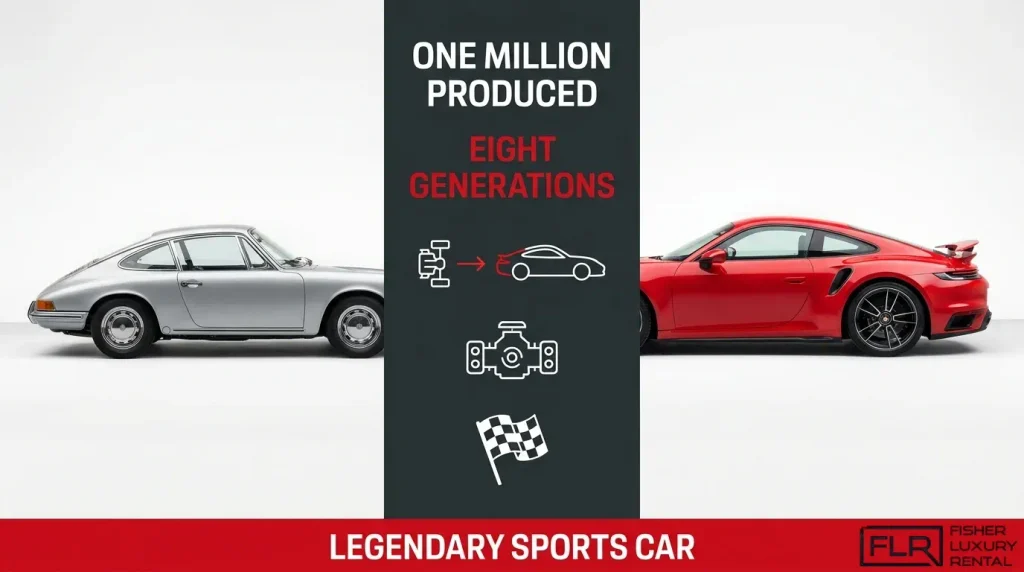
How Has the Porsche 911 Design Evolved Across Generations?
The Porsche 911 design has evolved across eight distinct generations, from the air-cooled 901-series original to today’s water-cooled 992. According to Wikipedia, the 911 traces its roots to sketches drawn by Ferdinand “Butzi” Porsche in 1959 and was originally marketed as the Porsche 901 before Peugeot protested the three-digit name with a zero in the middle. Each generation refined the iconic silhouette while adding wider bodywork, more sophisticated suspension, and greater engine displacement. By May 2017, Porsche manufactured its one millionth 911, a milestone that now resides in the company’s permanent collection. Despite sweeping changes in technology across six decades, the roofline, the round headlights, and the rear-engine proportion have remained instantly recognizable.
What Are the Key 911 Variants and Their Differences?
The key 911 variants are the Carrera, Carrera S, Carrera 4, Carrera 4S, Targa, Cabriolet, GTS, GT3, GT3 RS, and Turbo/Turbo S. The core differences between them center on drivetrain, power output, and intended use:
- Carrera / Carrera S: Rear-wheel drive; entry and mid-level performance.
- Carrera 4 / Carrera 4S: All-wheel drive; added traction for varied conditions.
- Targa / Cabriolet: Open-top configurations with the same mechanical foundations.
- GTS: Higher output and sport-tuned chassis bridging Carrera S and GT3.
- GT3 / GT3 RS: Naturally aspirated, track-focused, motorsport-derived suspension.
- Turbo / Turbo S: Turbocharged all-wheel drive; maximum performance for road use.
Each variant shares the same rear-engine architecture but targets a distinct driver profile, from daily grand touring to circuit competition.
Why Has the 911 Remained Rear-Engine After All These Years?
The 911 has remained rear-engine because that layout is the foundation of its handling character and brand identity. Placing the engine behind the rear axle increases traction under acceleration by loading the driven wheels, which is particularly effective exiting corners. Engineers have spent six decades refining the suspension geometry, ballast distribution, and electronic stability systems to harness rather than fight that weight bias. The result is a car that rewards skilled drivers while remaining manageable for everyday use. Changing to a mid- or front-engine layout would produce a faster lap time on paper but would erase the tactile feedback and rear-end responsiveness that define the 911 driving experience. For Porsche, preserving that character is not nostalgia; it is the core product promise the 911 has delivered consistently since 1963.
What Are the Current Porsche Model Lineups and Trims?
The current Porsche model lineup spans six distinct vehicle lines, covering sports cars, SUVs, a sport turismo sedan, and a fully electric platform. Each model family offers multiple trim levels, from entry configurations to flagship performance variants.
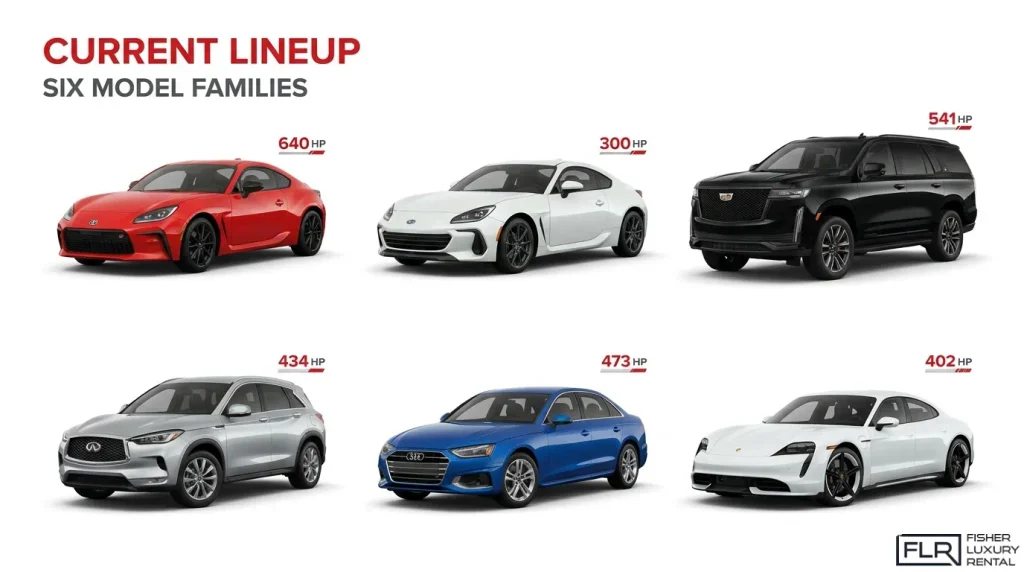
Porsche 911 Current Generation
The Porsche 911 current generation spans trims including the Carrera, Carrera S, Targa, GTS, GT3, and Turbo S. The 2026 911 Turbo S sits at the top, featuring a 3.6L Twin-eTurbo flat-six paired with an electric motor producing 701 hp and a 0-60 mph time of 2.4 seconds, starting at $245,600, according to Champion Porsche. This generation marks a significant step: hybrid-assisted performance has arrived in the 911 without sacrificing its rear-engine character.
Porsche 718 Boxster and Cayman
The Porsche 718 Boxster and Cayman are mid-engine two-seat sports cars available in base, S, GTS 4.0, GT4, and Spyder trims. The Boxster is a roadster; the Cayman is its fixed-roof coupe counterpart. Both share chassis architecture and powertrain options, ranging from turbocharged four-cylinders to high-revving naturally aspirated flat-six engines in the top variants.
Porsche Cayenne
The Porsche Cayenne is a performance SUV offered in Cayenne, Cayenne S, Cayenne E-Hybrid, Cayenne GTS, Cayenne Turbo, and Turbo E-Hybrid trims. According to the Porsche Newsroom, the Cayenne was Porsche’s bestselling model in 2024, with 102,889 units delivered, representing an 18 percent increase over the prior year. Its consistent sales dominance reflects broad appeal across performance and family-utility buyers alike.
Porsche Macan
The Porsche Macan is a compact performance SUV available in standard Macan and Macan Turbo trims. The current generation has transitioned to a fully electric platform, giving buyers two powertrain outputs: the base Macan with a single rear motor and the Macan Turbo with a dual-motor AWD system producing 630 hp. It targets buyers who want Porsche dynamics in a smaller, more urban-friendly package.
Porsche Panamera
The Porsche Panamera is a four-door sport turismo available in Panamera, Panamera 4, Panamera 4S E-Hybrid, Panamera GTS, and Panamera Turbo S E-Hybrid trims. Plug-in hybrid variants now lead the lineup in volume, reflecting Porsche’s broader electrification push. The Turbo S E-Hybrid produces over 700 hp, making it one of the most powerful production sedans available today.
Porsche Taycan
The Porsche Taycan is Porsche’s fully electric performance sedan, offered in Taycan, Taycan 4S, Taycan GTS, Taycan Turbo, Taycan Turbo S, and Taycan Turbo GT trims, alongside Sport Turismo and Cross Turismo body variants. At the top, the 2026 Taycan Turbo GT with Weissach Package delivers 1,019 hp on overboost and reaches 60 mph in 2.1 seconds, starting at $245,000, per Champion Porsche. Porsche delivered 20,836 Taycans in 2024, a 49 percent decline attributed to a model changeover and slower-than-expected EV market uptake, according to the Porsche Newsroom. The Taycan’s performance ceiling makes it one of the most compelling arguments for electric sports cars currently on sale. For those who want to experience Porsche’s electric performance firsthand, Fisher Luxury Rental offers exotic and luxury car rentals across Phoenix, AZ and Portland, OR, providing access to high-performance vehicles without the cost of ownership.
How Has Porsche Dominated Motorsport Throughout History?
Porsche’s motorsport dominance spans decades, built on endurance racing victories and a direct pipeline between track technology and road car engineering. The sections below cover Porsche’s Le Mans record and how racing innovations shape production vehicles.
What Is Porsche’s Legacy at Le Mans?
Porsche’s legacy at Le Mans is one of unmatched endurance racing dominance. According to Wikipedia, Porsche holds the record for the most overall victories at the 24 Hours of Le Mans, with 19 wins, including seven consecutive victories from 1981 to 1987. The Porsche 919 Hybrid continued that tradition by winning Le Mans three consecutive times from 2015 through 2017. No other manufacturer has sustained this level of consistency across different eras of motorsport regulation, making Le Mans the defining stage of the Porsche racing identity.
How Has Racing Technology Influenced Porsche Road Cars?
Racing technology has influenced Porsche road cars from the very first model produced. The first Porsche 356 was road certified in Austria on June 8, 1948, and was immediately entered in a race in Innsbruck, where it won its class, establishing the brand’s philosophy that road cars and race cars share the same DNA. Aerodynamic efficiency, lightweight construction, and high-output engine tuning developed on the track have each found their way into successive production models.
With Le Mans victories and race-bred engineering embedded in every production car, Porsche’s motorsport heritage remains inseparable from its road car legacy.
What Is Porsche’s Approach to Electric and Hybrid Vehicles?
Porsche’s approach to electric and hybrid vehicles combines electrification with the performance standards the brand has maintained since its founding. The sub-sections below cover Porsche’s hybrid origins, the Taycan’s role as its full EV flagship, and the hybrid systems integrated across current models.
How Did Porsche’s Hybrid History Begin?
Porsche’s hybrid history begins with Ferdinand Porsche himself, who created the Lohner-Porsche Mixte Hybrid in 1901, making it the world’s first gasoline-electric hybrid vehicle. This early innovation established a performance-driven rationale for electrification that the brand still follows today. The Porsche 919 Hybrid later reinforced this philosophy on the world stage, winning the Le Mans 24-hour race three consecutive times from 2015 through 2017. Motorsport, in Porsche’s case, has always served as the proving ground for road car technology.
What Is the Porsche Taycan and Why Does It Matter?
The Porsche Taycan is Porsche’s first fully electric production car and the brand’s clearest statement on high-performance EV development. The 2026 Taycan Turbo GT with Weissach Package produces 1,019 hp on overboost via a dual motor AWD system, reaching 0-60 mph in 2.1 seconds with a starting MSRP of $245,000, according to Champion Porsche. Despite a 49% delivery decline in 2024 due to a model changeover and slower-than-planned EV adoption, the Taycan remains central to Porsche’s long-term electrification strategy.
How Does Porsche Integrate Hybrid Technology Into Its Current Lineup?
Porsche integrates hybrid technology into its current lineup through electrified variants of existing model lines, such as the Cayenne, Panamera, and 911. The 2026 Porsche 911 Turbo S uses a 3.6L Twin-eTurbo Flat-6 with an electric motor producing 701 hp and a 0-60 mph time of 2.4 seconds. Rather than replacing combustion engines entirely, Porsche uses electrification to amplify performance metrics such as acceleration, torque delivery, and efficiency. This hybrid-first, parallel-EV strategy reflects a pragmatic approach that keeps the brand’s driving character intact while meeting modern emissions expectations.
How Does Porsche Compare to Other Luxury Sports Car Brands?
Porsche compares to other luxury sports car brands through a distinct combination of motorsport heritage, daily drivability, and engineering consistency that rivals such as Ferrari, Lamborghini, and Mercedes-AMG approach differently. The H3s below examine how Porsche stacks up against each major competitor.
How Does Porsche Compare to Ferrari?
Porsche compares Ferrari as a brand that prioritizes driver engagement and everyday usability over Ferrari’s focus on raw, theatrical performance and exclusivity. Ferrari builds cars primarily as collector status symbols with limited production runs, while Porsche produces models like the 911 that function equally well as daily drivers and track weapons. Ferrari concentrates almost entirely on sports cars and supercars; Porsche spans a broader lineup including SUVs, sedans, and electric vehicles. For enthusiasts who want a car they can genuinely use year-round without sacrificing performance credentials, Porsche offers a more practical proposition, making it arguably the stronger all-around value in the luxury sports car segment.
How Does Porsche Compare to Lamborghini?
Porsche compares to Lamborghini as a brand built on precision and engineering restraint rather than Lamborghini’s signature visual drama and shock-value performance. Lamborghini designs cars to be extreme and visually explosive, targeting buyers who prioritize spectacle. Porsche, by contrast, engineers for handling balance, consistency, and longevity, values reflected across every generation of the 911. Lamborghini’s V10 and V12 engines produce extraordinary power figures, but Porsche’s flat-six architecture has maintained production continuity for over 60 consecutive years, demonstrating a depth of engineering commitment that Lamborghini’s more disruptive product cycles do not match.
How Does Porsche Compare to Mercedes-AMG?
Porsche compares Mercedes-AMG as a dedicated sports car manufacturer versus a performance division operating within a broader luxury automaker. Mercedes-AMG modifies existing Mercedes-Benz platforms for performance, while Porsche engineers its vehicles from the ground up as purpose-built sports and performance cars. The 911 and AMG GT compete directly in the sports car segment, but Porsche’s motorsport pedigree, including 19 overall victories at the 24 Hours of Le Mans according to Wikipedia, gives its road cars a racing DNA that AMG’s platform-sharing approach cannot fully replicate. Porsche also offers a wider range of dedicated performance variants across more vehicle categories.
How Does Porsche Compare to Aston Martin?
Porsche compares to Aston Martin as a volume-capable performance manufacturer versus a boutique, hand-built British sports car brand. Aston Martin emphasizes craftsmanship, heritage styling, and grand touring comfort, producing relatively few vehicles annually. Porsche delivers far greater production scale while maintaining performance credibility, reliability ratings, and resale value that consistently outperform Aston Martin’s. Aston Martin has historically faced financial instability, whereas Porsche delivered 310,718 vehicles globally in 2024 per the Porsche Newsroom, underscoring the operational discipline that separates the two brands. Porsche’s ability to blend volume production with racing-derived performance remains one of its most underappreciated competitive advantages. Fisher Luxury Rental, based in Phoenix, AZ and Portland, OR, gives enthusiasts direct access to this kind of engineering through its curated fleet of luxury and exotic vehicles available for short-term rental.
What Should You Know About Porsche Performance and Engineering?
Porsche performance is built on three foundational technologies: the iconic flat-six engine, the PDK dual-clutch transmission, and the Porsche Traction Management all-wheel-drive system. Each engineering element contributes directly to the brand’s reputation for precision, speed, and driver engagement.
What Is the Porsche Flat-Six Engine and Why Does It Matter?
The Porsche flat-six engine is a horizontally opposed six-cylinder powerplant that has defined the brand’s performance identity since its introduction in the 1963 rear-engine Porsche 911, with continuous production spanning over 60 years. Its low center of gravity and compact dimensions allow for rear- or mid-engine placement without compromising handling balance. According to Wikipedia, the 2011 Porsche 911 GT3 RS 4.0 achieved a remarkable power density of 123.25 hp per litre from its 4.0-litre naturally aspirated flat-six producing 500 PS. The engine’s evolution is equally impressive at the performance ceiling: the 2026 Porsche 911 Turbo S pairs a 3.6L Twin-eTurbo flat-six with an electric motor to produce 701 hp, reaching 60 mph in 2.4 seconds. Few engine architectures in automotive history have remained so central to a brand’s identity while continuously advancing in output and technology.
How Does Porsche’s PDK Transmission Work?
Porsche’s PDK (Porsche Doppelkupplung) transmission works by using two separate clutches to pre-select the next gear while the current gear is engaged, enabling near-instantaneous gear changes with no interruption in power delivery. One clutch handles odd-numbered gears and the other handles even-numbered gears, allowing shifts to occur in milliseconds. The result is faster acceleration than most manual transmissions can deliver, combined with smoother, more consistent power output under hard driving conditions.
What Makes Porsche’s All-Wheel-Drive System Unique?
Porsche’s all-wheel-drive system is unique because it uses Porsche Traction Management (PTM), an electronically controlled active system that continuously varies torque distribution between the front and rear axles based on road conditions, speed, and driver inputs. Unlike traditional AWD systems that react after slip occurs, PTM proactively sends power to the axle with the most available grip. This predictive torque management delivers both superior traction in adverse conditions and sharper cornering dynamics on dry roads, reinforcing Porsche’s philosophy that performance and safety are not competing priorities.
What Does It Feel Like to Drive a Porsche?
Driving a Porsche delivers a visceral connection between driver, machine, and road that few cars match. This section covers how to experience that feeling firsthand through a rental and what key takeaways from Porsche’s history and models define that experience.
Can You Rent a Porsche for a Premium Driving Experience?
Yes, you can rent a Porsche for a premium driving experience through Fisher Luxury Rental, serving Phoenix, AZ and Portland, OR. Fisher Luxury Rental specializes in top-trim luxury and exotic vehicles, offering car enthusiasts, special occasion renters, and first-time exotic drivers a straightforward path to experiencing the engineering legacy covered throughout this guide, without the commitment of ownership.
What Are the Key Takeaways About Porsche History and Models?
The key takeaways about Porsche history and models are that every generation of engineering has built directly on the last, producing cars that perform at the highest level across road and track. Founded in 1931, Porsche established a philosophy of performance-first design that carried from the lightweight 356 through the enduring 911, the supercar-grade Carrera GT, and into the all-electric Taycan. Motorsport shaped every road car: 19 overall victories at the 24 Hours of Le Mans, including seven consecutive wins from 1981 to 1987, according to Wikipedia, confirm that racing success and production engineering are inseparable at Porsche. The flat-six engine, in continuous production for over 60 years, and the modern Taycan’s 1,019 hp overboost output together illustrate a brand that honors its heritage while refusing to stand still. For anyone wanting to understand why Porsche commands such reverence, the answer is consistent: precision, purpose, and performance define every model across every era.