
The 2026 Porsche GT3 RS wing angle adjustment system is a hydraulically actuated, multi-element aerodynamic architecture that allows drivers to control the trade-off between rear downforce and drag through both manual hardware changes and infotainment-based preset selection.
This guide covers the active wing system and how angle affects aerodynamic forces, the three available wing settings, manual and infotainment-based adjustment procedures, condition-specific angle selection, common mistakes, verification methods, and how the rear wing integrates with the GT3 RS’s broader aero package.
The GT3 RS uses a two-part, swan neck-supported rear wing with a hydraulically adjustable upper element, a system Porsche credits with doubling downforce over the previous generation. Understanding this architecture is the foundation for every adjustment decision that follows.
Steeper wing angles increase rear downforce for cornering and braking grip, while flatter angles reduce drag for top-speed runs. Front-to-rear aero balance shifts with every change, and the guide explains how to manage that relationship across the car’s full aero system.
Three factory-defined settings, Attack, Performance, and Low-Drag, each suit a different driving context, from slow technical circuits to high-speed straights to wet conditions. Both manual strut adjustment and PCM touchscreen control are covered in step-by-step detail, including the tools, access points, torque requirements, and inclinometer verification needed to confirm a correct setup.
Fisher Luxury Rental is a luxury and exotic car rental company serving Phoenix, AZ and Portland, OR, offering high-performance driving experiences for enthusiasts who want to feel exotic car performance firsthand rather than just read about it.
What Does the GT3 RS Active Wing System Do?
The GT3 RS active wing system generates, manages, and redistributes aerodynamic downforce dynamically as driving conditions change. It combines a hydraulically adjustable upper rear wing element with a fixed main wing, both supported by swan neck mounts, alongside adjustable front wing elements that work in concert with the rear.
According to Porsche, the current 911 GT3 RS produces double the downforce of its predecessor through this two-part, swan neck-supported rear wing architecture. The upper element adjusts hydraulically, changing angle on demand without driver input at the steering wheel.
This system serves three core functions:
- Downforce generation: Steeper angles press the car into the surface during cornering and braking.
- Drag reduction (DRS): Flatter angles reduce resistance on straights, recovering top-speed potential.
- Aero balance management: Front and rear elements adjust together to maintain front-to-rear grip balance across different speeds and conditions.
Understanding the system’s architecture is the foundation for every adjustment decision covered in this guide.
How Does Wing Angle Affect GT3 RS Downforce and Drag?
Wing angle directly controls the trade-off between downforce and drag on the GT3 RS. The following headings cover how steeper angles build grip, flatter angles cut resistance, and wing position shifts the car’s front-to-rear aerodynamic balance.
How Does a Steeper Wing Angle Change Rear Downforce?
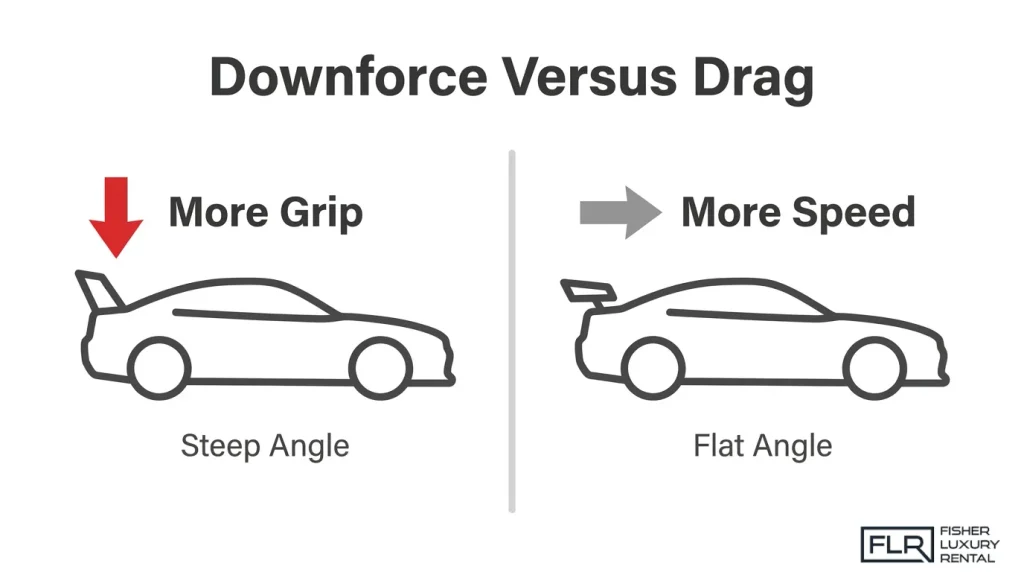
A steeper wing angle increases rear downforce by generating greater aerodynamic load through the rear axle. According to Porsche, the current 911 GT3 RS creates double the downforce of its predecessor, achieved through its two-part, swan neck-supported rear wing with a hydraulically adjustable upper element mounted to a fixed main wing. Raising that upper element’s angle of attack amplifies the pressure differential across the wing surface, pushing the rear tires harder into the pavement. More rear downforce improves corner-exit traction and high-speed stability, but it comes at the cost of increased drag, which reduces straight-line acceleration and top speed.
How Does a Flatter Wing Angle Reduce Aerodynamic Drag?
A flatter wing angle reduces aerodynamic drag by minimizing the wing’s resistance as it moves through air. A 2025 simulation study published in Scientific Reports on the Audi A5 found that a 0° spoiler angle produced the lowest drag under normal driving conditions, improving aerodynamic efficiency while maintaining stability. On the GT3 RS, flattening the hydraulic upper element produces a comparable effect: the wing presents less frontal area to oncoming airflow, allowing the car to reach higher top speeds on long straights. The downside is reduced rear grip, so this setting suits circuits with sustained high-speed sections rather than stop-and-go technical layouts.
How Does Wing Angle Influence Front-to-Rear Aero Balance?
Wing angle influences front-to-rear aero balance by altering the proportion of total downforce distributed between the front and rear axles. When the rear wing carries more angle, rear downforce rises disproportionately, shifting the aero balance rearward and producing understeer at corner entry. Reducing rear wing angle lightens the rear load, moving balance forward and increasing rotation into slow corners. The GT3 RS addresses this through coordinated adjustment of both the rear wing and the front wing elements, allowing drivers to tune the full-car balance rather than changing rear grip in isolation. Getting this balance right is arguably more important than raw downforce numbers, since an imbalanced car is slower and harder to drive consistently.
What Wing Angle Settings Are Available on the 2026 GT3 RS?
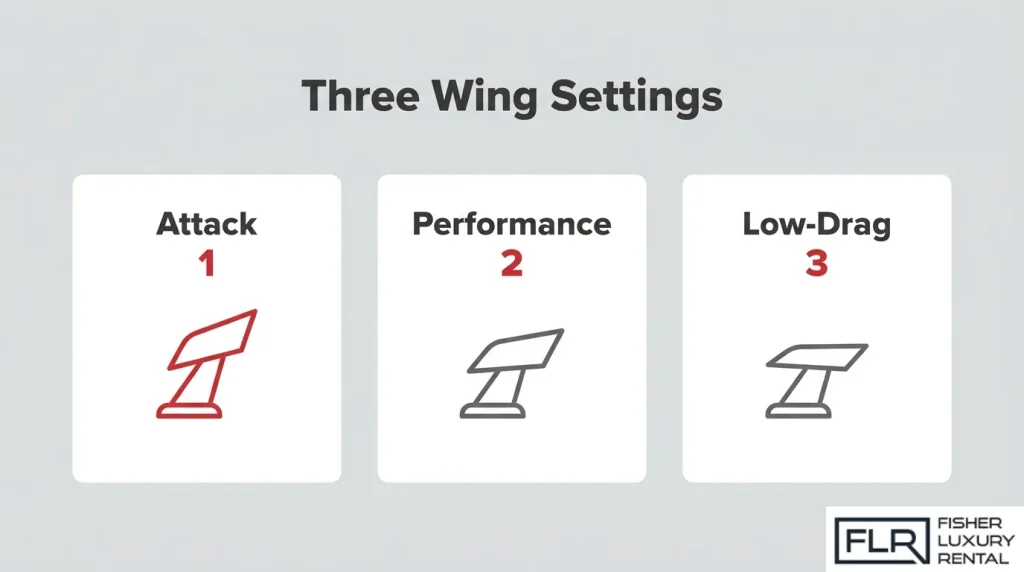
The wing angle settings available on the 2026 GT3 RS are three distinct configurations: Attack, Performance, and Low-Drag. Each setting targets a specific driving scenario, from maximum mechanical grip to high-speed efficiency.
What Is the Attack Setting for Maximum Downforce?
The Attack setting is the maximum-downforce configuration, positioning the rear wing’s hydraulically adjustable upper element at its steepest angle to generate the highest possible aerodynamic load. This setting suits slow-to-medium-speed technical circuits where cornering grip outweighs straight-line speed. The GT3 RS rear wing uses a swan neck-mounted, two-part design with a hydraulically adjustable upper element attached to a fixed main wing, allowing precise angle control without compromising structural rigidity. For drivers prioritizing corner exit traction and high-load braking zones, Attack is the correct choice.
What Is the Performance Setting for Balanced Driving?
The Performance setting is the balanced configuration, placing the rear wing at a mid-range angle that distributes aerodynamic load between downforce and drag reduction. It suits mixed-layout circuits with a combination of high-speed sections and technical corners, where neither maximum grip nor maximum speed exclusively dominates. This is the most versatile of the three settings and serves as the recommended starting point for drivers unfamiliar with the GT3 RS aero system. Fine-tuning from this baseline is easier than adjusting from either extreme.
What Is the Low-Drag Setting for Top Speed Runs?
The Low-Drag setting is the minimum-resistance configuration, flattening the rear wing angle to reduce aerodynamic drag and maximize terminal velocity on long straights. It suits high-speed circuits where top-end acceleration and straight-line speed matter more than peak cornering grip. Research on rear spoiler aerodynamics confirms that lower angles produce the least drag under normal driving conditions, directly improving efficiency at high speeds. Drivers should note that reduced downforce at this setting demands greater care through high-speed corners, making tire condition and suspension setup especially important.
How Do You Manually Adjust the GT3 RS Rear Wing Angle?
Manually adjusting the GT3 RS rear wing angle requires the right tools, proper access to the mounting hardware, precise strut positioning, and angle verification with a measuring instrument. The following H3 sections cover each step in sequence.
What Tools Do You Need for Manual Wing Adjustment?
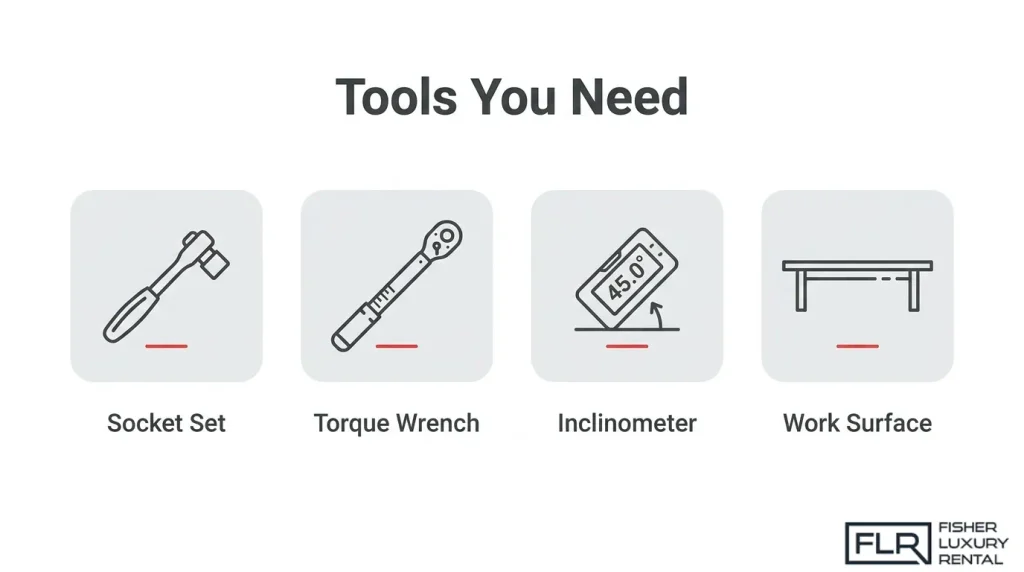
The tools you need for manual wing adjustment include a metric socket set (typically 8 mm and 10 mm), a torque wrench, a digital inclinometer, and a flat-surface work area. A torque wrench is essential because the GT3 RS wing strut fasteners require precise torque values to maintain structural integrity at speed. Skipping the torque wrench is one of the most common and costly mistakes enthusiasts make during manual adjustment.
How Do You Access the Wing Mounting Hardware?
You access the wing mounting hardware by first raising the rear decklid and locating the two swan neck strut attachment points on the fixed main wing element. Loosen the retaining bolts using an 8 mm or 10 mm socket, but do not remove them fully. The upper hydraulically adjustable element sits separately above the main wing, so confirm you are working on the correct fixed-element strut mounting positions before proceeding.
How Do You Set the Wing Strut Position Correctly?
You set the wing strut position correctly by sliding each strut into the desired angle slot, aligning both sides symmetrically before torquing any fastener. Uneven strut placement between the left and right sides creates asymmetric downforce, which destabilizes cornering balance. After confirming both struts sit in matching positions, tighten fasteners to the manufacturer-specified torque value and re-check symmetry before closing the decklid.
How Do You Verify the Angle with an Inclinometer?
You verify the angle with an inclinometer by placing the digital inclinometer flat against the upper surface of the fixed main wing element and reading the degree value. Both the left and right measurement points should return identical readings within 0.5 degrees of each other. Any deviation beyond that tolerance warrants re-seating the struts before the car is driven, ensuring consistent aerodynamic loading across the rear axle.
How Do You Adjust Wing Angle Through the GT3 RS Infotainment System?
You adjust wing angle through the GT3 RS infotainment system using the Porsche Communication Management (PCM) touchscreen. The sub-sections below cover navigating to the Aero Settings menu, selecting a preset wing map, and confirming DRS calibration.
How Do You Navigate to the Aero Settings Menu?
You navigate to the Aero Settings menu by selecting the “Vehicle” tile on the PCM home screen, then tapping “Settings,” followed by “Aerodynamics.” From there, the active rear wing controls appear as a dedicated sub-menu. The touchscreen interface groups all aerodynamic functions in one location, making adjustments straightforward without leaving the cockpit.
How Do You Select a Preset Wing Map?
You select a preset wing map by tapping one of the three pre-loaded aerodynamic profiles listed inside the Aerodynamics sub-menu. Each profile corresponds to a calibrated wing angle: high downforce, balanced, and low drag. Confirm your selection by pressing “Apply,” and the hydraulic actuators move the upper wing element to the mapped position automatically.
How Do You Confirm the DRS Function Is Calibrated?
You confirm the DRS function is calibrated by checking the DRS status indicator within the same Aerodynamics sub-menu after applying your wing map. The system displays an active or inactive status alongside the current wing position. According to FIA Single Seater Technical Director Jan Monchaix, DRS deployment and closure remain driver-initiated actions, so always verify the system responds to inputs before leaving pit lane.
What Wing Angle Should You Use for Different Track Conditions?
The right wing angle for different track conditions depends on the balance between downforce and drag that each environment demands. The sections below cover tight circuits, high-speed tracks, wet conditions, and street driving.
What Wing Angle Works Best on Tight Technical Circuits?
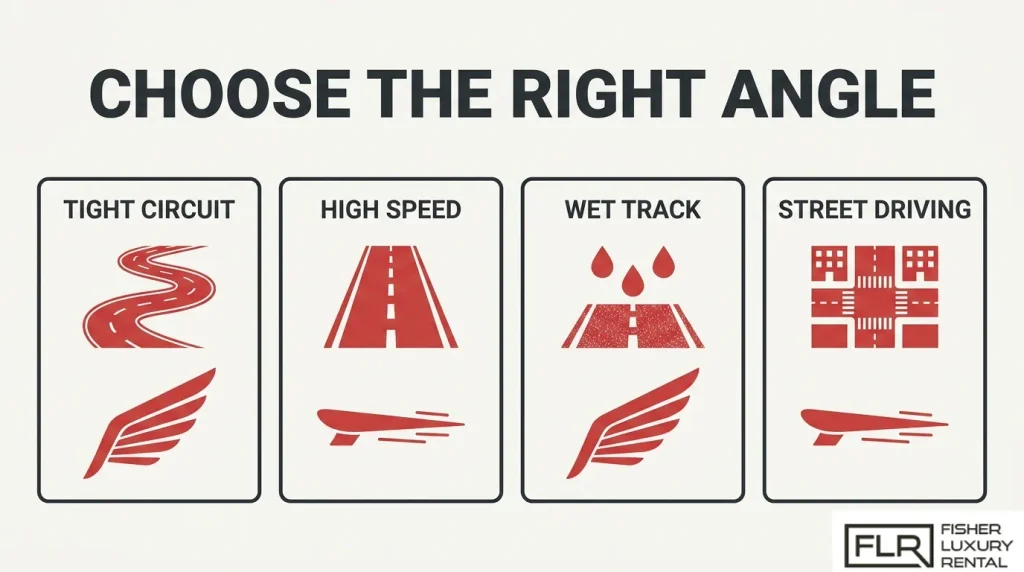
The wing angle that works best on tight technical circuits is a steep, high-downforce setting. Slow-speed corners punish understeer and oversteer equally, so maximum rear grip matters more than top-end speed. A steep angle loads the rear axle aggressively, shortening braking distances and improving rotation through hairpins. The trade-off in straight-line acceleration is negligible on a circuit where average speeds stay low throughout most sectors.
What Wing Angle Works Best on High-Speed Tracks?
The wing angle that works best on high-speed tracks is a low-drag, flatter configuration. Research on spoiler aerodynamics confirms that a 0° or near-flat angle produces the lowest drag under high-speed driving conditions, maximizing aerodynamic efficiency along long straights. Moderate downforce remains necessary through fast sweepers, so a fully flat position is rarely optimal; a slight positive angle preserves cornering stability without sacrificing significant top-speed potential.
What Wing Angle Works Best in Wet or Low-Grip Conditions?
The wing angle that works best in wet or low-grip conditions is a high-downforce setting, often steeper than a dry track would otherwise require. Mechanical grip drops sharply on a wet surface, and aerodynamic load becomes one of the primary tools for maintaining tire contact. A steep rear wing increases vertical load, reducing the likelihood of snap oversteer under throttle. Increasing spoiler angle to 45°–60° during braking events has also been shown to significantly improve downforce and vehicle control, according to a 2025 study published in Nature Scientific Reports on fastback car aerodynamics.
What Wing Angle Works Best for Street Driving?
The wing angle that works best for street driving is the lowest available drag setting. Public roads impose speed limits that render maximum downforce unnecessary, and a flatter angle reduces aerodynamic resistance at highway speeds, improving fuel efficiency and ride refinement. On legal public circuits where road cars are permitted, such as the Nürburgring Nordschleife tourist sessions, a moderate angle offers a sensible compromise between stability and efficiency without full race-spec loading.
What Mistakes Should You Avoid When Adjusting the GT3 RS Wing?
The mistakes to avoid when adjusting the GT3 RS wing fall into several categories: skipping symmetry checks, ignoring system calibration after manual changes, and mismatching wing angle to driving conditions.
Skipping Symmetry and Torque Verification
Skipping symmetry and torque verification is one of the most common errors during GT3 RS wing adjustment. An asymmetric wing angle creates uneven downforce across the rear axle, destabilizing the car under hard cornering. After any manual adjustment, measure both strut positions independently and confirm identical angles before driving. Fasteners should be torqued to Porsche’s specified values; undertightening allows micro-movement at speed, while overtightening risks stripping the aluminum mounting points.
Changing Wing Position While the System Is Active
Changing the wing position while the hydraulic system is active risks damaging the actuator and upper wing element. Always shut down the vehicle and allow hydraulic pressure to equalize before attempting any manual hardware access. The GT3 RS rear wing uses a hydraulically adjustable upper element on a fixed main wing, and forcing mechanical changes against active hydraulic resistance can cause permanent component damage.
Mismatching Wing Angle to Conditions
Mismatching wing angle to conditions directly undermines lap time and safety. Running a high-attack angle on a high-speed circuit increases drag and raises operating temperatures, while a low-drag setting on a technical circuit reduces braking stability. The most costly mistake is treating wing adjustment as a one-time setup rather than a condition-specific calibration tool.
How Do You Verify Your GT3 RS Wing Angle Is Set Correctly?
Verifying the GT3 RS wing angle requires checking both physical alignment and system confirmation through the car’s onboard tools. The process covers visual inspection, angle measurement, and software readout validation.
How Do You Perform a Visual Alignment Check?
A visual alignment check involves confirming that both wing endplates sit parallel to each other and perpendicular to the car’s centerline. Stand directly behind the car at bumper height and sight across the trailing edge of the upper wing element. Any asymmetry in the left-to-right endplate position indicates a misaligned strut or loose mounting hardware that needs correction before driving.
How Do You Confirm the Angle Using a Digital Inclinometer?
Confirming the angle using a digital inclinometer means placing the tool flat on the upper wing surface and reading the degree value against your target setting. Zero the inclinometer on a level surface first, then transfer it to the wing. Compare the reading to the setting selected in the infotainment aero menu. A discrepancy of more than one degree signals either an uncompleted strut adjustment or a hydraulic actuation fault requiring inspection.
How Do You Use the GT3 RS Onboard System to Confirm Wing Position?
The GT3 RS onboard system confirms wing position by displaying the active aero map and current wing state on the central screen under the vehicle settings menu. After selecting a preset, the system should indicate the upper hydraulic wing element has moved to the correct position. If the displayed state does not match your selection within a few seconds of confirming the input, a system fault code will appear, and the wing should be inspected before track use.
How Does Wing Angle Work with Other GT3 RS Aero Components?
Wing angle works with other GT3 RS aero components as part of an integrated system where front splitter load, underbody diffuser extraction, and rear wing pitch must align to maintain balanced downforce across the car. The sections below explain how the rear wing interacts with the front aero elements and the full underbody package.
How Does Rear Wing Angle Interact with the Front Splitter?
Rear wing angle interacts with the front splitter by determining how aerodynamic load is distributed between the front and rear axles. Increasing rear wing pitch generates more rear downforce, which requires a corresponding front splitter adjustment to prevent excessive understeer under braking. Without that balance, the car pushes at the front despite generating significant total downforce. A 2024 simulation study published in MDPI on high-performance sports car aerodynamics found that the Porsche 911 GT3 RS with the Manthey Racing kit generates approximately 1,000 kg of downforce at 177 mph, a figure only achievable when all aero surfaces work in coordination. Treating rear wing angle as an isolated variable is one of the most common setup mistakes experienced drivers learn to avoid.
How Does the Rear Wing Work with the Underbody Diffuser?
The rear wing works with the underbody diffuser by complementing the low-pressure zone the diffuser creates beneath the car. The diffuser accelerates underbody airflow rearward, reducing pressure under the chassis, while the rear wing adds mechanical downforce above. Flattening the wing reduces drag but can expose the diffuser’s contribution as the dominant downforce source at higher speeds. Steepening the wing rebalances the total aero load between underbody suction and surface-generated downforce. This interaction means wing angle changes affect not just rear grip but the entire balance of aero forces front to rear.
How Can You Experience the GT3 RS Wing Performance Firsthand?
You can experience GT3 RS wing performance firsthand through a premium exotic car rental or by reviewing the core takeaways from this guide. The H3s below cover both paths: rental access and a final summary of wing angle principles.
Can a Premium Exotic Car Rental Help You Test GT3 RS Aero Settings?
Yes, a premium exotic car rental can help you test GT3 RS aero settings in a real-world driving environment without ownership costs. Reading about hydraulic wing actuation and downforce angles is valuable, but physically engaging the system at speed is where understanding becomes instinct.
Fisher Luxury Rental offers luxury and exotic vehicles from its Phoenix, AZ and Portland, OR locations, giving car enthusiasts direct access to high-performance driving experiences. Fisher Luxury Rental serves car enthusiasts who want an exhilarating, memorable driving experience behind the wheel of a high-performance vehicle.
For anyone serious about understanding GT3 RS wing behavior, seat time in a comparable exotic is the single most practical next step.
What Are the Key Takeaways About GT3 RS Wing Angle Adjustment?
The key takeaways about GT3 RS wing angle adjustment are that setting selection, execution, and verification all matter equally. No single adjustment step works in isolation.
The core lessons from this guide are:
- Steeper angles increase rear downforce and cornering grip but raise aerodynamic drag.
- Flatter angles reduce drag for top-speed runs but sacrifice rear stability under braking.
- Front-to-rear aero balance shifts with every wing angle change and must be rechecked.
- Manual and infotainment adjustments serve different use cases; know which method your session requires.
- Verification with an inclinometer confirms the wing is set to the intended angle before track use.
- Wet and low-grip conditions demand more aggressive wing angles, not less.
Wing angle adjustment is one of the highest-leverage tuning inputs on the GT3 RS, and mastering it separates competent drivers from truly fast ones.