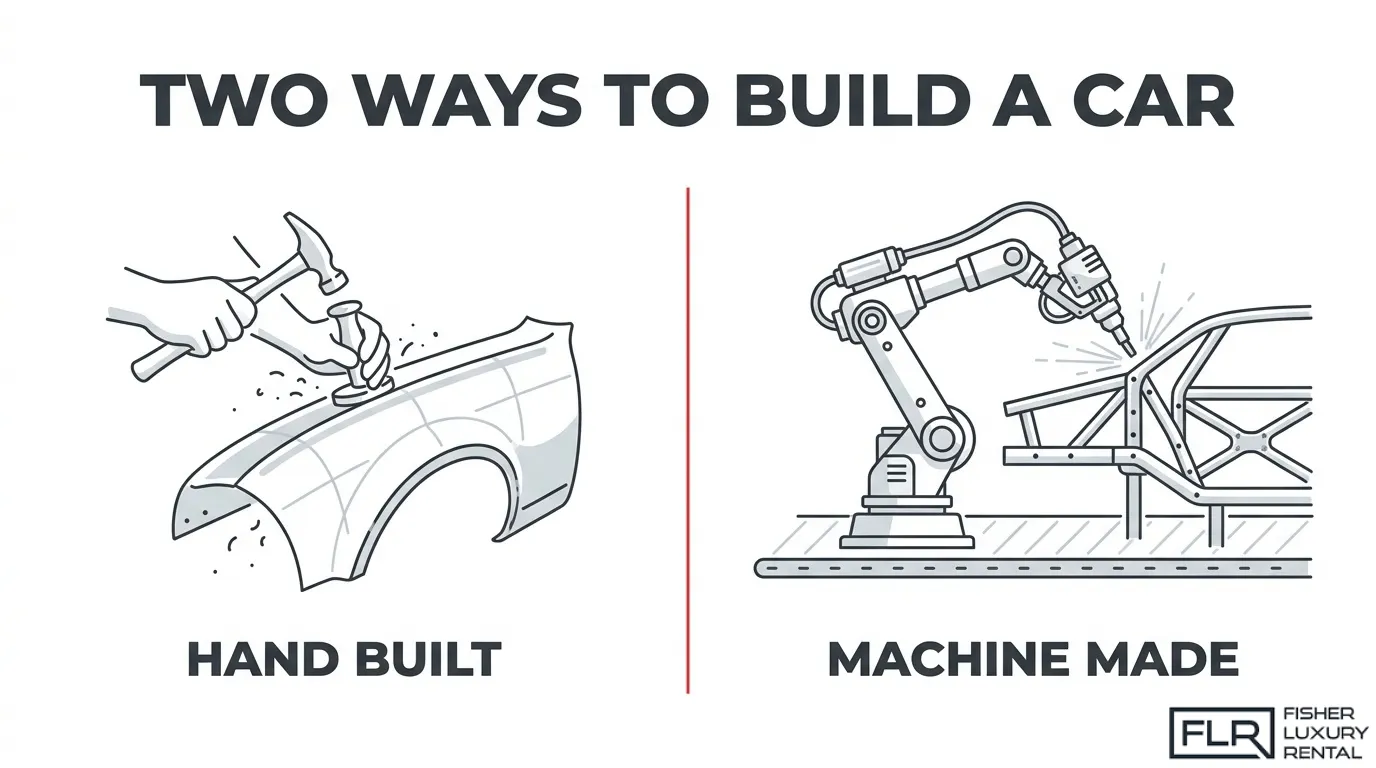
A hand-built car is a vehicle assembled primarily through skilled human labor, where craftspeople shape, fit, and finish each component by hand rather than delegating those tasks to automated machinery. A machine-made car is the inverse: robotic welders, stamping presses, and computer-controlled assembly lines produce vehicles at scale with near-identical specifications across every unit.
This guide covers what each build method actually involves, the brands still practicing handcraft today, how the two approaches differ at every stage of production, and what those differences mean for performance, quality, cost, and the experience behind the wheel.
Hand-built and machine-made construction each begin with a distinct philosophy. Coachbuilt cars required complex hand-formed shapes that stamping machines simply could not replicate; modern hand-built manufacturers carry that tradition forward, now blending CAD design with artisan execution. Mass production, by contrast, traces directly to Ford’s moving assembly line, which cut assembly time from 12.5 hours to 93 minutes and permanently separated volume manufacturing from bespoke craft.
The brands still building by hand, including Rolls-Royce, Aston Martin, Pagani, Koenigsegg, and Morgan, each take a distinct approach: one requiring over 600 labor hours per car, another operating an atelier of just 55 people. Build method then flows through performance, reliability, and cost, shaping everything from tolerance consistency to resale trajectory. Finally, AI and advanced materials are changing both approaches, while exotic car rentals offer the most direct way to feel the difference firsthand.
What Does It Mean for a Car to Be Hand-Built?
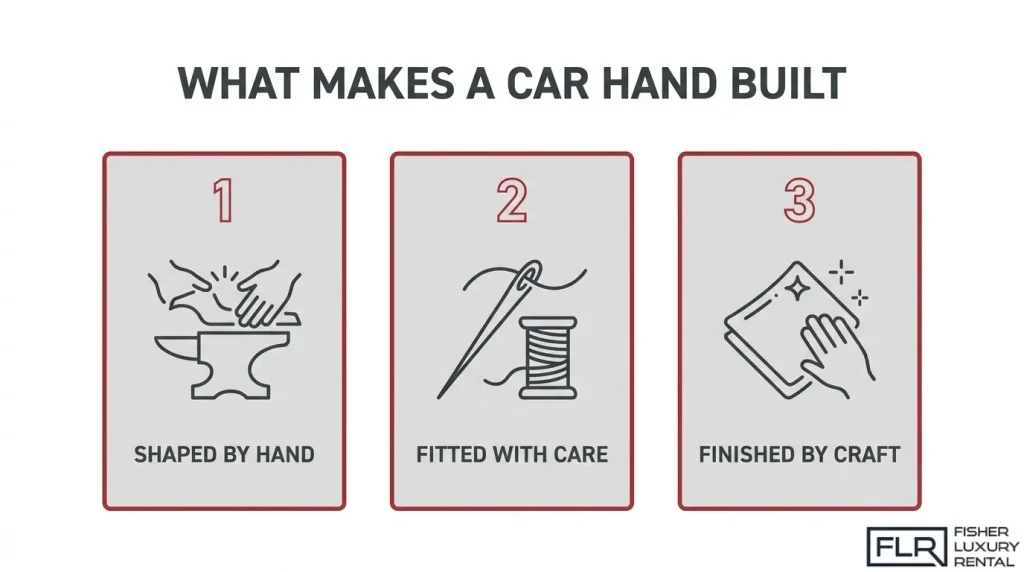
A hand-built car is a vehicle assembled primarily through skilled human labor rather than automated machinery, with craftspeople shaping, fitting, and finishing components by hand. This section covers the origins of hand-built construction, what the process involves today, and which defining characteristics separate it from mass production.
What Is the Definition of a Hand-Built Car?
A hand-built car is one where human artisans perform the majority of fabrication and assembly work, including body forming, interior fitting, and finishing. According to the Revs Institute’s November 2023 Tappet Clatter, coachbuilt cars were custom or hand-built in small series because their complex shapes could only be hand-formed, unlike production cars where simpler panels were stamped by giant machines. The term encompasses everything from full bespoke one-offs to low-volume models built by small specialist teams.
How Did Hand-Built Car Construction Originate?
Hand-built car construction originated in the coachbuilding trade, where wood, metal, and fabric were shaped entirely by craftspeople. According to the Lane Motor Museum, early automobiles remained entirely hand-built using those materials, but mass production and assembly lines ended much of these labor-intensive artistic practices. The traditions that survived migrated to low-volume specialist manufacturers, where they still define the craft today.
What Makes a Car Qualify as Hand-Built Today?
A car qualifies as hand-built today when skilled craftspeople, rather than automated systems, perform the core fabrication steps, such as panel forming, frame assembly, and interior trimming. Pagani hand-builds each vehicle in a workshop of just 55 people, according to HBS Digital Initiative research on Pagani Automobili. In practice, hand-built does not mean technology-free; CAD design and precision tools are common, but human hands execute the work from start to finish.
What Does It Mean for a Car to Be Machine-Made?
A machine-made car is one assembled primarily through automated systems, including robotic welders, stamping presses, and computer-controlled assembly lines, producing vehicles at scale with consistent specifications. The following H3s cover how mass production began, what automation handles today, and how quality is managed across millions of units.
How Did Mass Production Change Car Manufacturing?
Mass production transformed car manufacturing by replacing individual craftsmen with mechanized assembly lines. According to the Library of Congress, Ford’s moving assembly line reduced vehicle assembly time from 12.5 hours to just 93 minutes, proving that factories could dramatically improve manufacturing efficiency. Before this shift, the Lane Motor Museum notes, early automobiles were entirely hand-built using wood, metal, and fabric. Once stamping machines could form simpler body panels at volume, labor-intensive coachbuilding became commercially unviable for mainstream automakers. That transition defined the modern automotive industry.
What Do Robots and Automation Do in a Car Factory Today?
Robots and automation in a modern car factory handle tasks such as welding, painting, body-panel stamping, and quality inspection. A published study in Open Research Europe documents robotic systems inspecting 2,500 to 3,000 body parts automatically using cartesian robots and camera sensors cross-referenced against CAD data. Ford has also announced plans to deploy automated mobile robots across global plants for material handling, vehicle conveyance, and inspection. These systems eliminate human variability from high-repetition tasks, enabling factories to build hundreds of thousands of vehicles annually to near-identical specifications.
How Do Machine-Made Cars Maintain Quality Standards?
Machine-made cars maintain quality through structured quality management systems, precision tooling, and automated inspection. Toyota’s Production System applies “Jidoka,” described by Toyota as automation with a human touch, where machines detect abnormalities and stop automatically to prevent defects from advancing down the line. Research published in Applied Sciences confirms that manufacturing precision correlates directly with improved functional performance, though tighter tolerances increase production costs. Automated factories balance this trade-off by standardizing tolerances across every unit rather than relying on individual judgment, making consistency the defining quality marker of machine-built vehicles.
Which Luxury Cars Are Still Hand-Built Today?
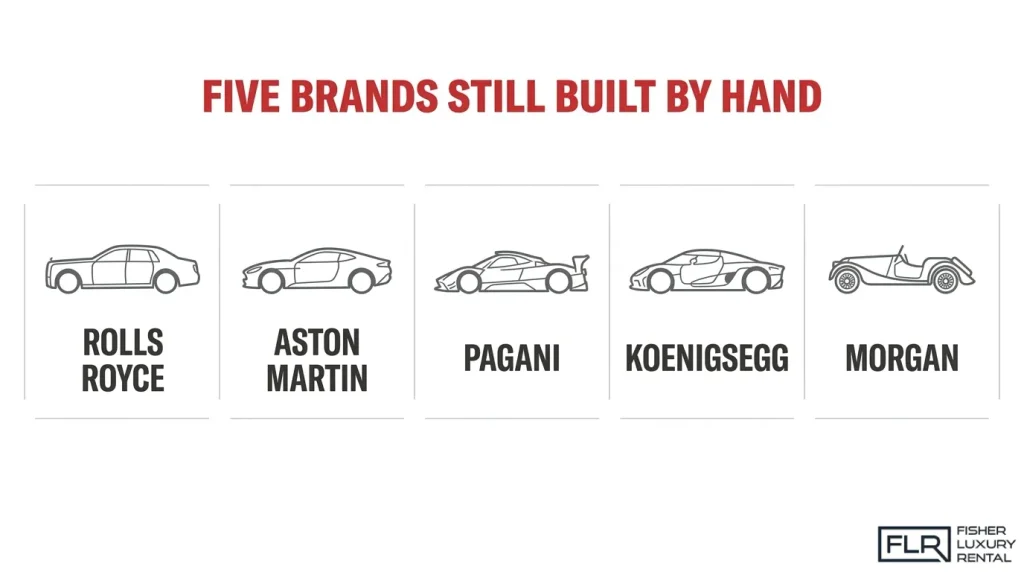
Several luxury marques still build their cars almost entirely by hand, including Rolls-Royce, Aston Martin, Pagani, Koenigsegg, and Morgan. Each brand takes a distinct approach to handcraft, from bespoke leather interiors to carbon fiber atelier work.
Rolls-Royce
Rolls-Royce builds each motor car by hand at its Goodwood, England headquarters. According to Rolls-Royce Motor Cars, it takes more than 600 hours to build a single vehicle, and complex commissions can take up to four years to develop and construct. Over 2,500 people work at Goodwood, the only facility in the world where Rolls-Royce cars are designed, engineered, and assembled. That level of dedicated human labor at a single site is virtually unmatched in the modern automotive industry.
Aston Martin
Aston Martin hand-builds its cars across two UK facilities: its headquarters in Gaydon, Warwickshire, and its DBX707 manufacturing plant in St Athan, South Wales. New body panels are hand-crafted using traditional tools unchanged for decades, carefully shaping alloy aluminum sheet into each model’s profile before a meticulous pre-fit process aligns every panel, headlight, and bumper. According to Aston Martin, the brand’s proprietary perforating and quilting technology creates decorative patterns in leather interiors that simultaneously support seat cooling. To scale this handcraft, Aston Martin recruited more than 400 additional technicians to support the Vantage, DB12, and DBX707 production lines.
Pagani
Pagani hand-builds each vehicle in a workshop of just 55 people, according to a Harvard Business School analysis of the company’s operations. The Pagani hypercar plant operates more like an artisan atelier than a factory, with extreme customization, rigorous precision, and refined craftsmanship applied to every carbon fiber component.
Koenigsegg
Koenigsegg hand-builds each car to the highest possible standards using a select group of automotive artisans. The brand fabricates intricate hand-made metal and carbon fiber components in its own high-tech facilities, combining traditional craft with advanced manufacturing processes such as metal 3D printing to achieve performance outcomes that conventional methods cannot replicate.
Morgan
Morgan Motor Company hand-builds its Plus Four and Plus Six models at its Pickersleigh Road factory in Malvern, UK. Skilled craftspeople shape ash, aluminum, and leather using techniques refined over more than a century: wooden body frames are carefully assembled, aluminum panels are hammer-formed, and each interior is trimmed in Scottish leather and decorative wood veneers. The ash frame itself is CAD-designed but meticulously built by hand from start to finish by a single master craftsperson, making every Morgan genuinely unique.
How Does the Build Process Differ Step by Step?
The build process differs fundamentally between hand-built and machine-made cars at every stage, from frame construction and engine assembly to paint application, interior fitting, and final inspection. The sections below examine each stage in detail.
How Are Hand-Built Car Engines Assembled Differently?
Hand-built car engines are assembled differently through individual fitting, calibration, and manual alignment performed by a dedicated technician rather than a robotic line. Each component is matched by hand to its specific block, allowing craftspeople to compensate for micro-variations that automated systems cannot adjust for. At Morgan’s Pickersleigh Road factory in Malvern, UK, for example, the bodywork is built entirely by hand, while the engine itself is sourced externally: the Plus Six uses a BMW turbocharged inline-six, blending artisan coachbuilding with precision-engineered powertrains.
How Does Paint and Finish Work Differ by Hand?
Paint and finish work differs by hand through multi-stage application, hand-sanding between coats, and craftsperson-led color matching rather than fully automated spray systems. At Rolls-Royce’s Goodwood facility, over 2,500 specialists design, engineer, and build each car by hand, including every paint stage. Morgan’s Plus Four and Plus Six frames are CAD-designed but meticulously handmade by a single master craftsperson, meaning the surface being painted has already been shaped and refined by human hands. Hand-finishing allows painters to address surface contours that robotic sprayers can miss, producing depth and consistency that machines struggle to replicate at small production volumes.
How Is Interior Craftsmanship Different in Hand-Built Cars?
Interior craftsmanship in hand-built cars is different through the bespoke fitting of materials such as leather, wood veneer, and metal trim to each specific chassis rather than installing pre-cut uniform panels. According to Rolls-Royce Motor Cars PressClub, it takes more than 600 hours to build a single Rolls-Royce, with complex commissions taking up to four years to develop and construct. Every stitch, panel alignment, and veneer match is performed by a specialist. This level of individual attention is simply impossible on a high-volume automated line, where interiors are assembled from standardized components in minutes.
How Does Final Quality Inspection Differ?
Final quality inspection differs in hand-built cars through human-led, vehicle-specific assessment rather than standardized automated scanning. In mass production, robots and camera systems can check thousands of body parts automatically using CAD reference data. In hand-built production, inspectors evaluate fit, finish, and function against the individual owner’s commission specifications. Because no two hand-built cars are identical, inspection criteria must flex to each vehicle. This makes the hand-built inspection more thorough per unit but far more time-intensive, reinforcing why these vehicles command a significant premium over their machine-made counterparts.
How Does Build Method Affect Performance and Precision?
Build method directly shapes how a car performs, how precisely its components fit together, and how efficiently it handles under load. The H3s below examine horsepower output, tolerance consistency, and handling characteristics across hand-built and machine-made vehicles.
Do Hand-Built Cars Deliver More Horsepower?
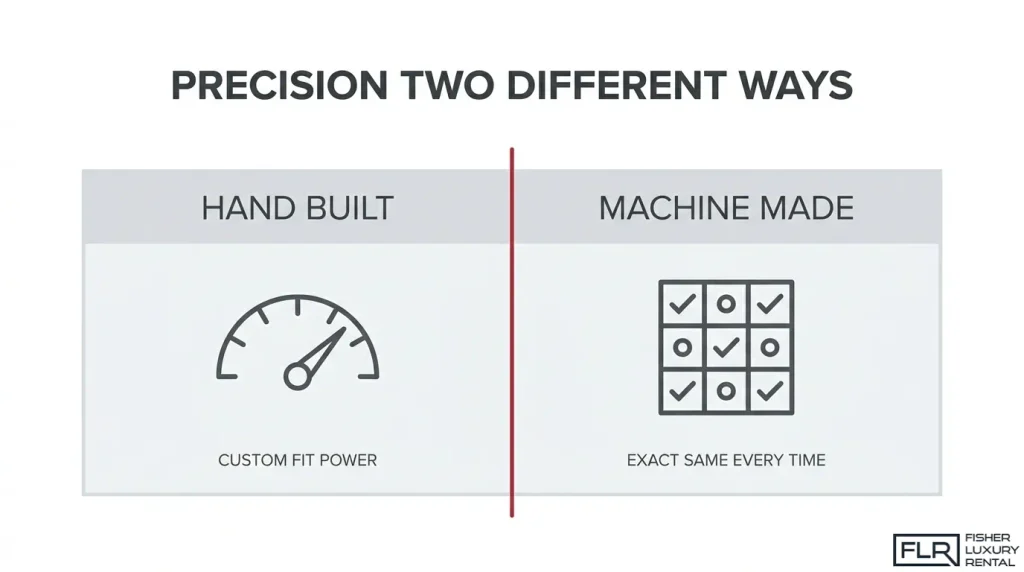
Hand-built cars do not inherently deliver more horsepower than machine-made cars. Power output depends on engine specification and tuning, not assembly method. However, hand-assembled engines allow technicians to individually match components, optimize tolerances, and verify clearances in ways automated lines do not. The result is an engine that may run closer to its rated potential. According to Applied Sciences (MDPI), component manufacturing precision is directly correlated with improved functional performance, though that precision carries a higher manufacturing cost.
Are Machine-Made Cars More Consistent in Tolerances?
Machine-made cars are more consistent in tolerances than hand-built cars. Automated assembly systems apply identical force, torque, and positioning across every unit, eliminating the natural variation introduced by human hands. Robotic inspection cells can verify thousands of body components per vehicle using CAD-referenced camera systems, flagging deviations before assembly continues. This repeatability is machine manufacturing’s single greatest performance advantage. For high-volume buyers prioritizing reliability over exclusivity, consistency in tolerances matters more than any individual craftsman’s precision.
Which Build Method Produces Better Handling?
Neither build method exclusively produces better handling; the outcome depends on material choices and chassis engineering. Hand-built manufacturers gain an edge when they optimize structural components for specific load conditions. Research published by Universitat Politècnica de Catalunya found that carbon fiber lay-up geometry can be engineered to achieve minimum weight while retaining equivalent stiffness, a result that benefits handling directly. Koenigsegg demonstrated this advantage further: according to Ohio State University’s College of Engineering, the One:1 used metal 3D printing to produce a turbocharger that would have been impractical with traditional casting methods, yielding better engine efficiency through manufacturing innovation.
How Does Build Method Affect Quality and Reliability?
Build method affects quality and reliability through defect rates, consistency, and finish precision. The following sections cover whether hand-built cars are more defect-prone, whether automation improves longevity, and which method produces better fit and finish.
Are Hand-Built Cars More Prone to Defects?
Hand-built cars are not inherently more prone to defects, but their quality outcomes depend heavily on the skill of individual craftspeople. Unlike automated lines, hand assembly introduces human variability, meaning two units from the same maker may differ slightly. However, elite manufacturers such as Rolls-Royce and Pagani address this through intensive multi-stage inspection at each build stage, where a single defect can halt the entire process. The absence of automated error-detection systems means human attention must substitute for machine precision. In practice, ultra-low-volume hand builders often achieve fewer defects per vehicle precisely because each car receives individual scrutiny that high-volume lines cannot replicate.
Do Machine-Made Cars Last Longer Over Time?
Machine-made cars do not necessarily last longer than hand-built cars, but automated manufacturing does deliver more consistent mechanical tolerances that support predictable long-term reliability. According to research from the Ohio State University’s Department of Mechanical and Aerospace Engineering, Ford Manufacturing is expanding automated mobile robots across global plants for tasks including automated assembly and inspection, with the stated goal of performing safely and reliably at scale. Consistent tolerances reduce wear variation between components, which supports durability over time. Hand-built vehicles, by contrast, may exhibit micro-variations that require closer maintenance attention, though premium materials often offset this.
Which Build Method Offers Better Fit and Finish?
Hand-built cars offer better fit and finish at the ultra-luxury tier, where panels are individually aligned and gaps are adjusted by hand before final assembly. Machine-made production cars deliver uniform fit and finish across thousands of units, but uniformity differs from perfection. At Aston Martin Works, for example, each new alloy aluminum panel is pre-fitted to confirm alignment, consistent spacing, and accurate placement of components such as headlights and bumpers before permanent fixing. This level of individual attention is structurally impossible on a high-volume automated line. For buyers prioritizing tactile precision and visual exactness, hand-built methods remain the superior approach.
How Does Build Method Influence Cost and Value?
Build method directly shapes a car’s price, resale trajectory, and long-term worth. The sections below cover why hand-built cars command premium prices, how they retain value, and whether machine-made luxury cars offer a stronger financial case.
Why Are Hand-Built Cars So Much More Expensive?
Hand-built cars are so much more expensive because they require intensive skilled labor, rare materials, and extremely low production volumes. A Rolls-Royce takes more than 600 hours to build, and complex commissions can require up to four years to complete. That labor cost is unavoidable and passes directly to the buyer. For those unable to purchase outright, the Federal Reserve notes that leases allow consumers to access newer and more expensive vehicles than a loan would otherwise permit, making hand-built models accessible at a lower monthly outlay.
Do Hand-Built Cars Hold Their Value Better?
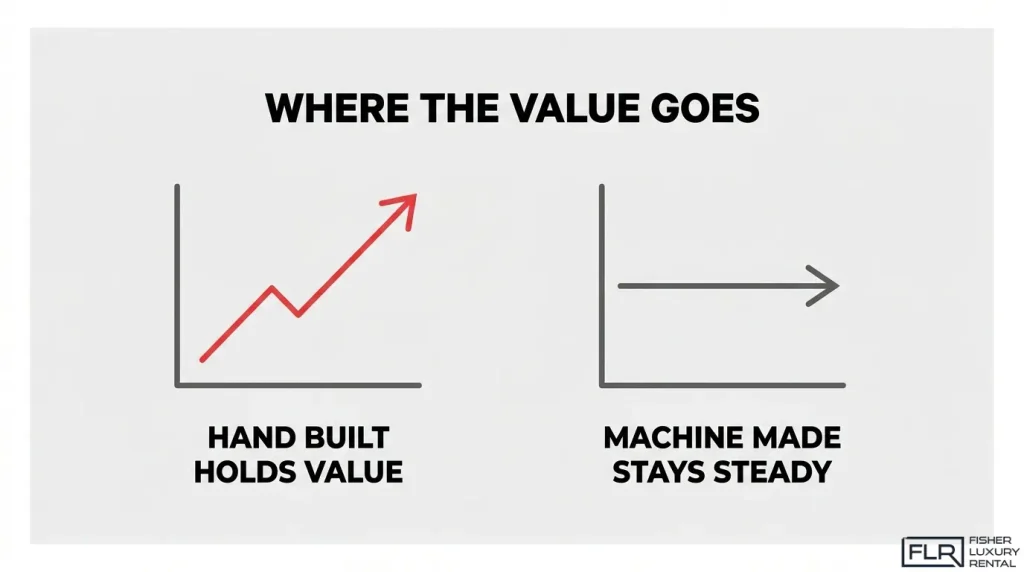
Hand-built cars do tend to hold their value better than mass-produced vehicles, largely because scarcity and craftsmanship create sustained collector demand. According to the Revs Institute, coachbuilt and hand-built cars in small series featured complex hand-formed shapes impossible to replicate on stamping machines, giving each car an irreproducible character. Rolls-Royce reinforces this: every car is built by hand at Goodwood, England, ensuring each unit carries a provenance that production vehicles simply cannot match. Rarity, historical significance, and bespoke specification all compound over time to support strong resale prices.
Is a Machine-Made Luxury Car a Better Value?
A machine-made luxury car is a better value for buyers who prioritize reliability, lower acquisition cost, and predictable depreciation over exclusivity. Automated manufacturing delivers consistent tolerances and lower per-unit costs, translating into more competitive pricing without sacrificing modern performance. Research from the Journal of Public Economics found that used car prices move one-for-one with changes in discounted future costs, meaning rational buyers price in total ownership economics, not just sticker price. For most buyers, a machine-made luxury vehicle offers a more financially defensible choice; hand-built cars justify their premium mainly when rarity and collectibility are part of the purchase thesis.
What Does the Driving Experience Feel Like in Each?
The driving experience differs fundamentally between hand-built and machine-made cars, shaped by how each vehicle is constructed. The H3s below cover the tactile, sensory qualities of a hand-built car behind the wheel, then contrast them with the precision-engineered feel of a machine-made performance car.
How Does a Hand-Built Car Feel Behind the Wheel?
A hand-built car feels like a direct, unfiltered conversation between driver and road. Because every component is fitted by a craftsperson rather than a robot, small material variations become part of the character rather than flaws to eliminate. Morgan’s ash wood frame is a fitting example: according to the Audrain Automobile Museum, numerous pieces of ash are hand cut, glued, clamped, and continually sanded until they interlock like puzzle pieces. That organic construction transmits subtle road textures through the chassis in ways a stamped steel unibody simply does not. The steering is often heavier, the ride stiffer, and the sounds rawer. For enthusiasts, that unmediated feedback is the entire point.
How Does a Machine-Made Performance Car Feel Different?
A machine-made performance car feels precise, controlled, and deeply consistent from the first mile to the ten-thousandth. Automated assembly lines produce tight dimensional tolerances across every unit, so throttle response, steering weight, and suspension behavior are highly repeatable and predictable. Adaptive electronics, driver-assistance systems, and carefully tuned noise cancellation layer over the mechanical experience, creating a cockpit that feels engineered rather than crafted. The result is remarkable capability delivered with effortless polish; the car manages complexity on your behalf. Where a hand-built car rewards patience and engagement, a machine-made performance car rewards confidence and speed.
Can You Tell the Difference Just by Looking or Driving?
Yes, you can tell the difference between a hand-built and a machine-made car, though the signals vary depending on what you look for and how closely you pay attention.
The sections below cover what visual inspection reveals, what the driving experience communicates, and why some differences are more subtle than expected.
What Visual Clues Reveal Build Method
Visual clues that reveal build method include panel gap consistency, surface texture, and interior detailing. Machine-made cars tend to show robotically uniform panel gaps, while hand-built cars may carry slight asymmetries that reflect human craftsmanship rather than error. Interior surfaces in hand-built vehicles, such as hand-stitched leather, hand-applied wood veneer, and individually perforated materials, show a tactile richness that stamped or machine-cut components rarely replicate.
What the Driving Experience Communicates
The driving experience communicates build character in ways instrumentation cannot fully quantify. Hand-built cars often deliver a more visceral, analog sensation, where steering weight, throttle response, and chassis feedback feel deliberate rather than filtered. Machine-made performance cars, by contrast, tend toward greater predictability and repeatability across units. Neither is objectively superior; the hand-built car rewards engagement, while the machine-made car rewards consistency. For those who want to move beyond the theory, Fisher Luxury Rental offers top-trim exotic and luxury vehicles available to rent across Phoenix, Scottsdale, Portland, and Vancouver.
Why Some Differences Are Harder to Spot Than Expected
Some differences are harder to spot because modern hand-built manufacturers use computer-aided design, precision tooling, and structured quality processes alongside traditional craft. The result is that a current Rolls-Royce or Aston Martin can appear visually flawless while still being assembled almost entirely by hand. The difference reveals itself most clearly in the details: the depth of a lacquer finish, the tension of a leather seam, or the way a door closes with a sound that feels engineered rather than assembled.
How Is the Future of Car Manufacturing Changing Both?
The future of car manufacturing is reshaping both hand-built and machine-made processes through AI, robotics, and advanced materials. The following sub-sections cover how automation and intelligent systems are influencing each approach.
How Is AI Changing Mass Production Quality?
AI is changing mass production quality by enabling real-time, vehicle-specific inspection at a scale no human team could match. According to BMW Group, AI now analyzes vast amounts of data, including model variant and real-time production data for each specific vehicle, to generate custom quality specifications on the line. Toyota uses machine learning models built from daily streaming data across millions of connected vehicles to predict maintenance needs before failures occur. These capabilities push machine-made consistency closer to bespoke-level precision, making AI one of the most transformative forces in modern automotive manufacturing.
How Are Hand-Built Makers Adopting New Technology?
Hand-built makers are adopting new technology by integrating advanced manufacturing tools without abandoning artisan processes. Morgan Motor Company designs its ash body frames using CAD, yet each frame remains meticulously handmade by a single master craftsperson from start to finish. Koenigsegg used metal 3D printing to produce a complex turbocharger for its One:1, a component that traditional casting methods could not have delivered as efficiently. This hybrid approach, where digital precision supports human craft, represents the direction premium low-volume manufacturers are heading.
Will Robots Replace Hand-Built Car Craftsmanship?
Robots will not fully replace hand-built car craftsmanship, at least not in the ultra-luxury segment. The International Federation of Robotics notes that robots increase productivity and create new tasks rather than simply replacing workers. Ford plans to expand automated mobile robots across global plants for material handling, inspection, and assembly, but these deployments target high-volume production, not artisan workshops. Brands like Pagani, with a workforce of just 55 people, and Rolls-Royce, where every car is hand-built at Goodwood, rely on human skill for the bespoke customization that defines their identity. Automation augments craft; it does not replicate it.
How Can You Experience Hand-Built and Machine-Made Cars Firsthand?
You can experience hand-built and machine-made cars firsthand through factory tours, track days, and exotic car rentals. The sections below cover renting luxury vehicles and the key takeaways from the hand-built vs. machine-made comparison.
Can Renting Exotic and Luxury Cars Help You Feel the Difference?
Yes, renting exotic and luxury cars can help you feel the difference between hand-built and machine-made vehicles in a direct, immediate way. Sitting inside a hand-finished interior, gripping a hand-stitched wheel, and accelerating down an open road communicates craftsmanship that no article or video fully replicates. Factory tours offer context, but a rental puts the experience in your hands.
Fisher Luxury Rental provides access to top-trim exotic and luxury vehicles across its Phoenix, AZ and Portland, OR service areas, giving drivers the opportunity to feel exactly what separates a meticulously crafted machine from an ordinary car. For car enthusiasts, this is the most honest test available.
What Are the Key Takeaways About Hand-Built vs. Machine-Made Cars?
The key takeaways about hand-built vs. machine-made cars are that each approach reflects a deliberate trade-off between exclusivity and accessibility. Hand-built cars, such as those from Rolls-Royce, Pagani, and Morgan, prioritize bespoke craftsmanship, individuality, and artisan materials. Machine-made vehicles prioritize consistency, reliability, and affordability at scale.
The most important lessons from this comparison are:
- Craftsmanship takes time: Hand-built cars require hundreds of labor hours per vehicle, producing finishes and details that automated lines cannot replicate.
- Automation delivers consistency: Machine-made production excels at repeatable precision tolerances and predictable long-term reliability.
- Value is multidimensional: Scarcity, provenance, and cultural meaning all contribute to a hand-built car’s lasting worth, beyond mechanical specification alone.
- Neither is universally superior: The right choice depends entirely on what the driver values: exclusivity and artistry, or dependability and value.
Renting a luxury or exotic vehicle remains the most accessible way to close the gap between knowing the difference and feeling it.