An LED (light-emitting diode) car light is a solid-state lighting device that converts electrical energy directly into photons through a semiconductor process called electroluminescence, with no filament, gas arc, or heat-dependent step involved.
This guide covers the physics and components behind LED output, how power and heat are managed inside a working system, how different lamp types compare to each other and to older technologies, the real advantages and limitations drivers should know, and how automakers have pushed LED technology into adaptive, matrix, and OLED formats.
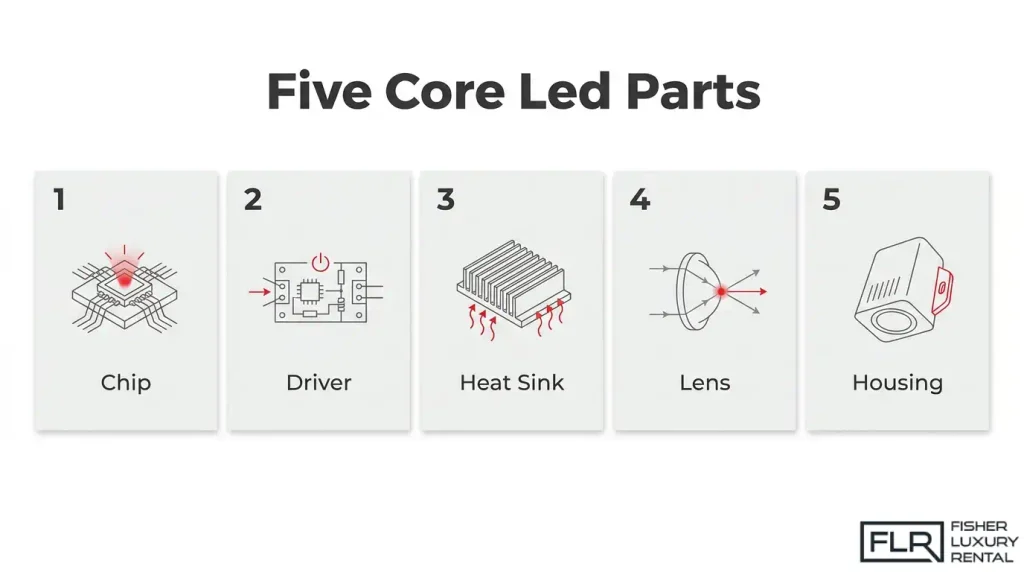
At the foundational level, LEDs emit light when electrons recombine with holes at a p-n junction, and the semiconductor material used determines the output color. Five core components, including the LED chip, driver circuit, heat sink, optical lens, and housing with reflector, work together to turn that raw photon output into a road-legal, precision beam.
How power reaches the LED matters as much as the diode itself. A constant-current driver circuit absorbs the voltage swings common in a 12V vehicle electrical system, while heat sinks and active cooling loops keep junction temperatures low enough to sustain efficiency and rated lifespan.
LED headlights, tail lights, and daytime running lights each operate under distinct optical and regulatory requirements, and each outperforms both halogen and HID xenon on energy consumption, lifespan, and response speed, though with real trade-offs in upfront cost and retrofit legality.
Modern automakers have extended LED fundamentals into adaptive beam systems, pixel-level matrix arrays, and surface-emitting OLED panels, technologies that luxury and exotic vehicles increasingly deploy as standard equipment.
What Is an LED and How Does It Produce Light?
An LED is a solid-state light source that converts electrical energy directly into light through a semiconductor process called electroluminescence. The following sections cover how the diode junction emits photons, what electroluminescence actually does, and which semiconductor materials control the color of the output.
How Does a Semiconductor Diode Emit Photons?
A semiconductor diode emits photons through a process called radiative recombination. When voltage is applied across a p-n junction, electrons from the n-type region cross into the p-type region and recombine with electron holes. Each recombination event releases energy as a photon, producing visible light. According to the University of Maryland CALCE, LEDs utilize this radiative recombination of electrons and holes to generate light through photon emission. The emitted photon’s energy, and therefore its wavelength, is determined by the semiconductor’s bandgap energy. Materials with larger bandgaps emit shorter wavelengths; smaller bandgaps emit longer ones.
What Role Does Electroluminescence Play in LED Output?
Electroluminescence is the mechanism that defines LED output. Unlike incandescent bulbs, which generate light by heating a filament, an LED produces light directly from electrical stimulation of a semiconductor material, with no heat-dependent intermediate step. This direct conversion makes LEDs fundamentally more efficient: energy enters as electricity and exits as photons rather than heat. Electroluminescence also enables near-instant response, since photon emission begins the moment current flows across the junction, with no warm-up time required.
What Materials Determine the Color of an LED?
The materials used in an LED’s p-n junction determine its color. According to Toshiba Electronic Devices and Storage Corporation, gallium arsenide (GaAs) is used for infrared LEDs, gallium phosphide (GaP) or InGaAlP for red and green indicator LEDs, and InGaN or GaN for blue LEDs. Precise control of Group III and Group V element ratios, along with dopants such as tellurium and magnesium, allows manufacturers to produce diodes spanning red, orange, yellow, green, and blue across the visible spectrum. Group-III nitrides, including GaN mixed with InN and AlN, are especially valued for their ability to cover a wide range of visible wavelengths in modern solid-state lighting.
What Are the Main Components Inside an LED Car Light?
An LED car light contains five core components: the LED chip, driver circuit, heat sink, optical lens, and housing with reflector. Each part plays a distinct role in converting electrical energy into controlled, road-legal illumination.
LED Chip
The LED chip is the light-emitting semiconductor at the heart of every automotive LED fixture. It contains a p-n junction that releases photons when current flows through it. Automotive chips are packaged in compact surface-mount formats; for example, the ams OSRAM OSLON Black Flat X single-chip variant measures just 3.75 mm × 3.75 mm, allowing engineers to cluster multiple emitters within a single headlamp module.
Driver Circuit
The driver circuit regulates the constant current delivered to the LED chip, protecting it from the voltage fluctuations common in a 12 V vehicle electrical system. Automotive-grade controllers such as the Texas Instruments TPS92612-Q1 accept input voltages from 4.5 V to 40 V and support PWM dimming, allowing precise brightness control without flickering. Without a stable driver, even a high-quality chip degrades rapidly.
Heat Sink
The heat sink removes thermal energy from the LED junction before it can reduce efficiency or shorten lifespan. According to SAE International research on active LED thermal management, passive cooling uses heat sinks and coolant fluid, while active systems vary fan speed based on a heat sink temperature sensor to control junction temperature directly. In aluminum-bodied assemblies, the housing itself acts as the heat sink when the emitter makes direct contact with the metal; plastic housings require a separate off-the-shelf sink. Thermal management is the single factor that most determines real-world LED longevity.
Optical Lens
The optical lens shapes and directs the raw light output from the chip into a precise beam pattern. Polycarbonate or glass lenses refract light toward the road surface while minimizing scatter that could cause glare for oncoming drivers. Lens geometry differs significantly between headlamps, tail lights, and daytime running lights because each application requires a different distribution of luminous intensity.
Housing and Reflector
The housing provides structural protection and electromagnetic shielding for all internal components. The reflector, positioned behind the chip, redirects rearward-emitted photons forward, increasing overall luminous flux without additional power draw. Together, housing geometry and reflector curvature determine beam spread, cutoff sharpness, and compliance with lighting standards such as FMVSS No. 108.
How Does an LED Driver Circuit Regulate Power in a Car?
An LED driver circuit regulates power in a car by converting the vehicle’s battery voltage into a stable, controlled current that LEDs require to operate safely and consistently. The sections below cover how constant-current control works, how PWM dimming is applied, and why driver reliability determines overall system life.
How Does Constant-Current Control Protect LEDs?
Constant-current control protects LEDs by maintaining a fixed output current regardless of voltage fluctuations from the car’s 12V electrical system. LEDs are current-sensitive devices: even small current spikes can cause overheating, accelerated lumen degradation, or immediate failure. A constant-current driver absorbs these variations, holding output steady so the LED junction operates within its rated parameters. Texas Instruments’ TPS92612-Q1 automotive LED driver, for example, accepts a wide input voltage range of 4.5V to 40V, accommodating the transient spikes common in automotive environments.
How Does PWM Dimming Control LED Brightness?
PWM dimming controls LED brightness by rapidly switching the LED on and off at varying duty cycles, changing perceived intensity without altering the constant current. At a 50% duty cycle the LED appears half as bright; at 90% it appears nearly full intensity. Because current level stays constant during each “on” pulse, color temperature and color consistency remain stable across the dimming range. This makes PWM dimming particularly valuable for automotive applications where precise, flicker-free brightness control is required across dashboard lights, DRLs, and adaptive headlamps.
How Does the Driver Manage Automotive Voltage Transients?
The driver manages automotive voltage transients through topologies such as buck, boost, and buck-boost converters that actively regulate output regardless of input swings. Infineon’s TLD5191ES DC-DC controller, for instance, supports all three modes to maintain constant current through high-power LED loads. Cars regularly experience load-dump pulses well above nominal 12V when alternator connections break under load, so driver ICs are designed with input protection and wide operating windows to survive these events without interrupting LED operation.
What Happens When the LED Driver Fails?
When the LED driver fails, the entire LED lighting system stops functioning even if the LED chip itself remains intact. According to IES research on LED driver useful life, the system life may be shortened due to driver failure, a critical electronic component, and no commonly accepted test method for estimating LED driver lifetime currently exists. This makes the driver the weak link in automotive LED assemblies, not the diode itself. Given this reality, specifying a high-quality, thermally managed driver IC is arguably the single most important decision in automotive LED system design.
How Do LED Car Lights Manage Heat Dissipation?
LED car lights manage heat dissipation through a combination of passive and active cooling strategies. The sections below cover how junction temperature affects efficiency, the role of heat sinks, and how active cooling systems regulate thermal output.
Why Is Thermal Management Critical for LED Performance?
Thermal management is the single most important factor in the successful performance of an LED over its lifetime, according to ENERGY STAR. Heat builds at the LED junction, and as junction temperature rises, efficiency drops significantly. Research published in Case Studies in Thermal Engineering found that LED efficiency decreased from 36% to 25% as junction temperature climbed from 30°C to 120°C. Poor heat management accelerates lumen depreciation, shortens lifespan, and increases failure risk. Keeping junction temperatures low is not optional; it is the foundation of reliable LED performance in automotive applications.
How Do Heat Sinks Draw Heat Away From the LED Junction?
Heat sinks draw heat away from the LED junction by providing a high-surface-area conductive path that transfers thermal energy into the surrounding air. In automotive LED systems, the LED chip is mounted on a metal-core printed circuit board (MCPCB), which conducts heat directly into an aluminum heat sink. According to Lumileds, the MCPCB emitter must be in direct contact with the aluminum housing so the housing itself functions as the heat sink. Aluminum is the preferred material because it combines strong thermal conductivity with low weight, both critical in automotive packaging.
What Is the Difference Between Passive and Active LED Cooling?
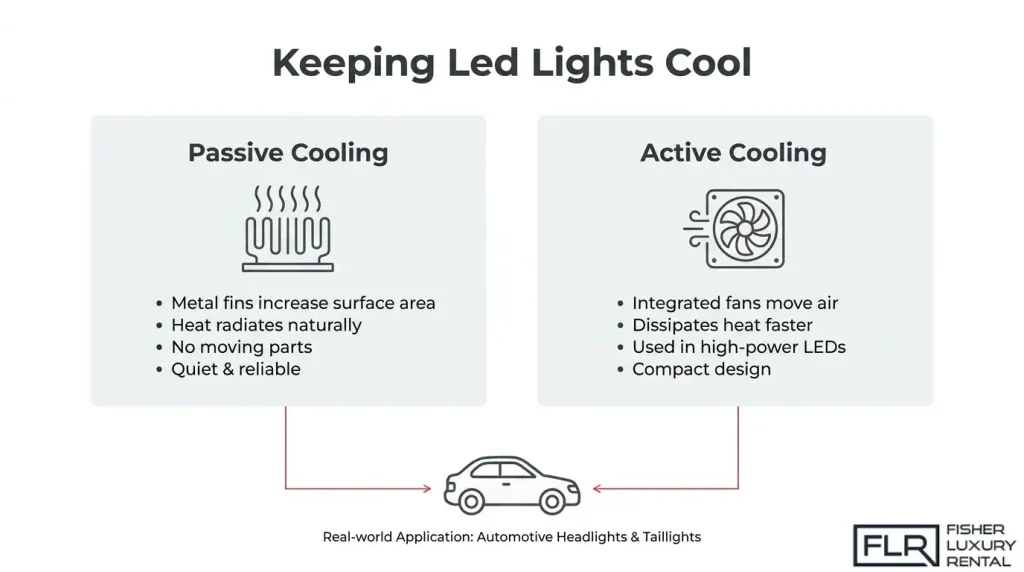
The two main cooling methods used in automotive LED systems are passive cooling and active cooling:
- Passive cooling uses heat sinks and thermally conductive materials to dissipate heat without moving parts, relying on natural convection and conduction.
- Active cooling uses a feedback loop that monitors heat sink temperature via a sensor and adjusts fan speed to control junction temperature dynamically.
According to SAE International, the conventional passive method uses heat sinks and coolant fluid, while active systems vary fan speed based on real-time temperature sensor data. Active cooling is better suited to high-power LED arrays where passive dissipation alone cannot maintain safe junction temperatures under sustained load.
With heat dissipation strategies established, the differences between LED headlights and tail lights show how thermal demands vary across lamp types.
How Do LED Headlights Differ From LED Tail Lights?
LED headlights and LED tail lights serve opposite functions: headlights project high-intensity, focused illumination forward, while tail lights emit steady, low-intensity red light to mark the vehicle’s rear. The sections below cover beam optics, instant-on tail light response, and daytime running light standards.
How Do LED Headlights Project a Focused Beam Pattern?
LED headlights project a focused beam pattern by combining precision-engineered reflectors or projector lenses with an integral LED light source. Under FMVSS No. 108, the NHTSA permits LEDs in integral beam headlamps, provided the full headlamp assembly meets all applicable requirements; however, LEDs are not currently permitted as replaceable bulbs in conventional headlamp housings. This integral design allows engineers to optimize the optics and LED position as a single calibrated unit, delivering tighter beam cutoffs and reduced scatter. A research study on foggy conditions found LED headlights operate at a color temperature of 5,122 K compared to 3,031 K for halogen, producing a closer approximation to daylight. From an engineering standpoint, the integral-beam requirement is actually a quality advantage: it forces beam accuracy to be validated at the factory rather than left to aftermarket installation.
How Do LED Tail Lights Achieve Instant Illumination?
LED tail lights achieve instant illumination because semiconductor junctions reach full brightness in microseconds, with no warm-up period required. Under eCFR § 571.108, taillamps are defined as steady burning low-intensity lamps used to designate the rear of the vehicle, a function uniquely suited to LEDs. Unlike incandescent filaments, which heat to operating temperature over a fraction of a second, an LED responds to current almost instantaneously. At highway speeds, even a 200-millisecond advantage in brake-light response time translates into meaningful reduction in stopping distance. This speed-of-response characteristic makes LED tail lights a natural fit for brake light and stop-lamp applications where trailing-vehicle reaction time is critical.
How Do LED Daytime Running Lights Enhance Visibility?
LED daytime running lights (DRLs) enhance visibility by projecting a forward-facing signal that makes a vehicle conspicuous in daylight conditions when headlamps are unnecessary. According to United Nations Economic Commission for Europe Regulation No. 87, a daytime running lamp must emit a minimum luminous intensity of 400 cd on the axis of reference to qualify as a compliant DRL. LEDs meet this threshold efficiently because they produce directed, high-luminance output without the energy waste of omnidirectional incandescent sources. Their slim form factor also gives designers flexibility to position DRL strips prominently within the front fascia, maximizing visibility angles.
With headlights, tail lights, and DRLs each governed by distinct optical and regulatory requirements, understanding how these systems compare to older halogen and HID technologies reveals the full performance advantage of modern LED lighting.
How Do LED Car Lights Compare to Halogen Bulbs?
LED car lights outperform halogen bulbs across brightness, efficiency, lifespan, and color temperature. The sections below compare both technologies across key performance metrics.
How Do LED and Halogen Bulbs Differ in Brightness and Color Temperature?
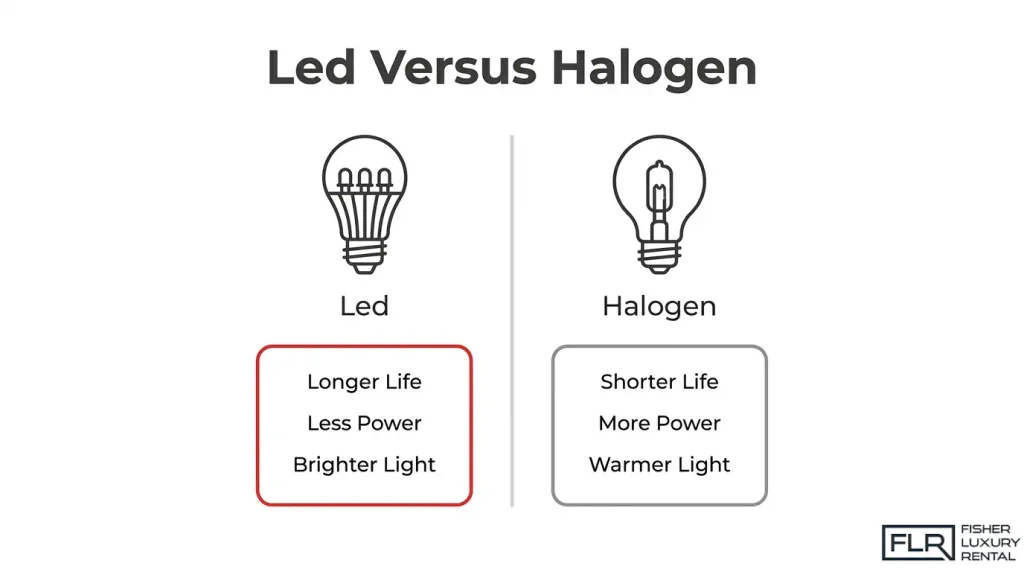
LED and halogen bulbs differ significantly in both brightness and color temperature. Halogen headlights produce a color temperature of 3,031 K, giving off a warm, yellowish light, while LED headlights reach approximately 5,122 K, producing a much whiter, daylight-like output, according to a performance study on headlights under foggy conditions published in PMC. This cooler tone improves contrast on road markings and signage. The Osram Night Breaker H1-LED delivers 1,550 lumens at just 16 W, illustrating how LEDs achieve strong output at low wattage. In practice, the whiter LED light is easier on the eyes over long night drives.
How Do LEDs and Halogen Bulbs Compare in Energy Consumption?
LEDs consume far less energy than halogen bulbs. A standard halogen headlamp draws 55 W and converts only 8% of that energy into visible light, losing the remaining 92% as heat, according to Hella’s basic principles of car lighting technology. By contrast, the Osram Night Breaker H1-LED operates at just 16 W while still producing 1,550 lumens, a significant efficiency advantage. Reducing electrical load also eases demand on the vehicle’s alternator, which can marginally improve fuel economy. For electric vehicles especially, this efficiency difference meaningfully extends driving range.
How Do LEDs and Halogen Bulbs Compare in Lifespan?
LEDs last considerably longer than halogen bulbs. According to the U.S. Department of Energy, good-quality white LED lighting products are expected to have a useful life of 30,000 to 50,000 hours or longer. Halogen bulbs, by comparison, have a service life of approximately 500 hours according to Hella. That is a lifespan gap of up to 100 times, meaning a vehicle fitted with LEDs at the factory may never need a headlamp replacement under normal ownership.
Are LED Bulbs More Expensive Than Halogen Bulbs?
LED bulbs are more expensive upfront than halogen bulbs. A Bonneville Power Administration study found that LED lamps cost $108 each, compared to $5.42 per lamp for standard halogen equivalents, at the time of the assessment. However, the same study calculated that the LED system’s present-value life-cycle cost was $12,124 versus $16,670 for the halogen system, using only 14% of the energy over its lifetime. The higher purchase price is offset by dramatically lower replacement frequency and reduced energy costs over time.
| Metric | Halogen | LED |
| Color Temperature | 3,031 K | ~5,122 K |
| Typical Wattage | 55 W | ~16 W |
| Light Efficiency | 8% of energy as light | Significantly higher |
| Service Life | ~500 hours | 30,000–50,000+ hours |
| Upfront Cost | Low (~$5) | Higher (~$108) |
Understanding these differences makes it clear why LED technology has replaced halogen as the standard in modern vehicles.
How Do LED Car Lights Compare to HID Xenon Bulbs?
LED car lights and HID xenon bulbs differ across brightness, startup time, energy consumption, and lifespan. The sections below compare each dimension using published specifications.
How Do LED and HID Xenon Bulbs Compare on Brightness and Color Temperature?
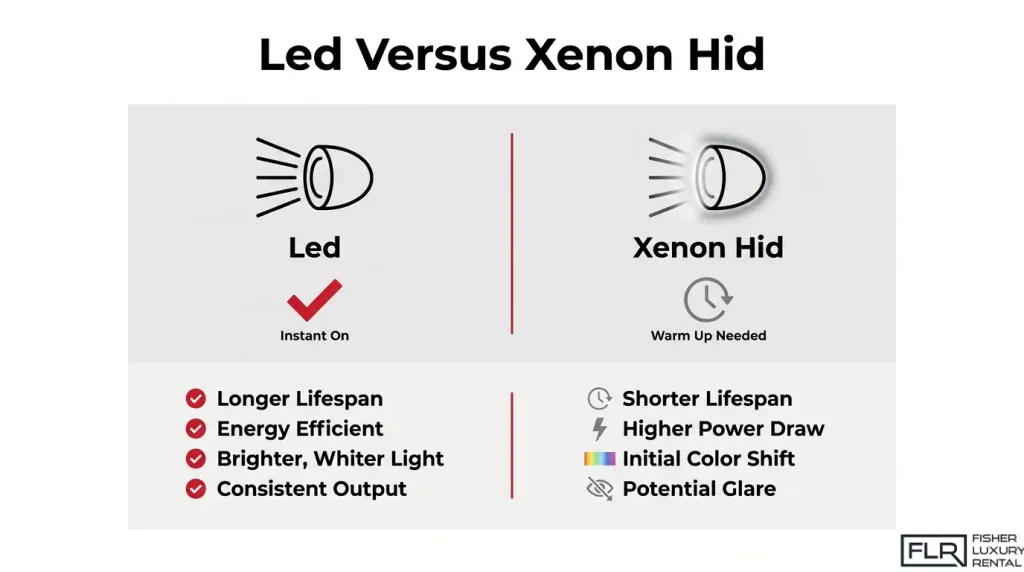
LED and HID xenon bulbs compare closely on color temperature: LED headlights measure approximately 5,122 K and xenon headlights approximately 5,098 K, versus 3,031 K for halogen, according to a performance study published in PMC. Both technologies produce a cool white output that improves contrast against road surfaces at night. However, xenon HID outputs significantly more raw luminance. Published data from Hella’s automotive lighting reference shows xenon gas discharge lamps reach 3,000 cd/m² compared to 1,450 cd/m² for filament-based halogen. In practical terms, HID throws more light across a wider area, while LED offers sharper beam control and instant full output without the warmup penalty.
Does HID Xenon Require a Warmup Period That LEDs Do Not?
HID xenon requires a warmup period of several seconds before reaching full brightness, because the arc lamp must fully ionize its gas charge. LEDs reach full intensity instantly, with no ionization delay. According to Hella’s basic principles of car lighting technology, a xenon lamp only achieves full brightness after all components have been ionized. This startup lag is a meaningful safety distinction: an LED headlight delivers complete illumination the moment it is switched on, which matters most during sudden lane changes or emergency maneuvers at night.
How Do LED and Xenon HID Bulbs Compare on Power Draw and Efficiency?
LED headlights draw significantly less power than xenon HID units. The Osram NIGHT BREAKER H1-LED operates at 16 W, while a comparable Philips Xenon Standard HID bulb draws 35 W at 42 V. Xenon converts 28% of input energy to light radiation versus 58% lost to heat, while also producing 14% UV radiation as a byproduct. LED systems concentrate a greater proportion of input energy into usable light, with far less heat output. For a vehicle’s electrical system, that difference in wattage reduces alternator load and is especially relevant in hybrid and electric vehicles where energy recovery is a priority.
Which Lasts Longer: LED Headlights or HID Xenon Bulbs?
LED headlights last longer than HID xenon bulbs under comparable operating conditions. The Philips Xenon Standard specifies a B3/Tc lifespan of 1,800/2,800 hours, while the Osram NIGHT BREAKER H1-LED carries a B3/Tc rating of 1,500/2,500 hours for that specific replaceable product. However, high-quality white LED systems integrated directly into a vehicle’s lighting module are expected to reach 30,000 to 50,000 hours, according to the U.S. Department of Energy. The gap narrows or reverses when comparing factory-integrated LED modules against replaceable HID bulbs, making integrated LED systems the clear long-term durability choice.
What Are the Advantages of LED Lighting in Vehicles?
The advantages of LED lighting in vehicles include longer lifespan, lower energy consumption, and faster response times compared to halogen and HID alternatives. The sections below cover how each benefit works in practice.
How Much Longer Do LEDs Last Than Traditional Bulbs?
LEDs last significantly longer than traditional bulbs, with good-quality white LED lighting products rated for 30,000 to 50,000 hours of useful life according to the U.S. Department of Energy. Halogen bulbs, by comparison, typically reach only around 500 hours of service life. Beyond raw longevity, LED headlights are brighter and burn less energy than halogen or HID headlights, as noted by Kelley Blue Book. Thermal management is the single most important factor in sustaining that long-term performance, per ENERGY STAR, since heat build-up at the junction is the primary driver of efficiency loss and early failure.
How Much Less Energy Do LEDs Consume While Driving?
LEDs consume dramatically less energy while driving than conventional bulbs. ENERGY STAR reports that LED lighting products produce light up to 90% more efficiently than incandescent light bulbs, converting most input power directly into light rather than waste heat. A typical automotive LED headlamp, such as the OSRAM NIGHT BREAKER H1-LED, draws just 16 watts, while a standard halogen unit draws 55 watts at roughly 8% light-radiation efficiency. That reduced electrical load lessens the burden on the alternator, which is a real-world efficiency gain that compounds over the vehicle’s lifetime, particularly in electric vehicles where every watt of draw affects range.
How Does Instant On-Off Response Improve Safety?
Instant on-off response improves safety by eliminating the warm-up delay that affects halogen and HID systems. LEDs reach full brightness in microseconds, meaning brake lights illuminate at the exact moment a driver presses the pedal. A SAE International study on high-contrast brake lamps found that faster, higher-contrast illumination reduced following-driver reaction times by an average of 19 milliseconds, corresponding to 0.5 meters of additional stopping distance saved at 100 km/h. That fraction of a second matters considerably in emergency braking situations, making the LED’s instant response one of its most consequential safety advantages over legacy lighting technologies.
What Are the Limitations of LED Car Lights?
The limitations of LED car lights include higher upfront costs, glare potential, thermal sensitivity, driver circuit vulnerability, and retrofit restrictions. Each limitation reflects a real engineering or regulatory trade-off worth understanding before choosing or upgrading a lighting system.
Do LED Car Lights Cost More Than Halogen Alternatives?
Yes, LED car lights cost significantly more than halogen alternatives. According to a Bonneville Power Administration gateway study, LED lamps cost $108 each compared to $5.42 per halogen lamp, though the LED system’s life-cycle cost of $12,124 ultimately undercut the halogen system’s $16,670 total. The higher purchase price remains a genuine barrier, particularly for aftermarket buyers replacing a single failed unit. For most drivers, the long-term savings justify the premium, but the initial outlay is a real consideration.
Can LED Headlights Cause Glare for Oncoming Drivers?
Yes, LED headlights can cause glare for oncoming drivers, particularly when poorly aimed or fitted in non-optimized housings. CIE 232:2019 found that LED luminaires with highly non-uniform source luminance create discomfort that standard glare metrics tend to underestimate. Misaimed or aftermarket-installed LEDs concentrate intense light above the intended cutoff line, directing it into oncoming drivers’ eyes. Proper housing design and precise beam calibration are the most effective controls against this problem.
Are LED Car Lights Sensitive to Heat Buildup?
LED car lights are sensitive to heat buildup at the semiconductor junction. Research published in Case Studies in Thermal Engineering found that LED efficiency dropped from 36% to 25% as junction temperature rose from 30°C to 120°C. Unlike halogen bulbs, which tolerate high ambient heat, LEDs require reliable thermal pathways, such as heat sinks or active cooling, to sustain rated output. Without adequate thermal management, brightness degrades and lifespan shortens well before the rated hours are reached.
Can the LED Driver Circuit Fail Before the LED Itself?
Yes, the LED driver circuit can fail before the LED itself. According to the Illuminating Engineering Society, the LED driver is a critical electronic component whose failure shortens overall system life, and no commonly accepted test method for estimating LED driver lifetime currently exists. This means the bulb may still be functional while the system fails due to driver electronics. It is an often-overlooked vulnerability, especially in lower-cost aftermarket LED conversion kits.
Are There Legal Restrictions on Retrofitting LED Headlights?
Yes, there are legal restrictions on retrofitting LED headlights in the United States. Under FMVSS No. 108, the NHTSA confirms that LEDs are permitted in integral beam headlamps but are not currently allowed in replaceable bulb headlamp designs. This means swapping an LED bulb into a housing originally designed for halogen is a federal compliance issue, regardless of how the product is marketed aftermarket. Drivers considering LED retrofits should verify that their specific headlamp assembly meets integral beam classification before purchasing.
How Have Automakers Integrated LED Technology Into Modern Cars?
Automakers have integrated LED technology through adaptive headlights, pixel-level matrix systems, and OLED rear lighting. The sections below cover how each approach works and what it delivers.
How Do Adaptive LED Headlights Adjust to Driving Conditions?
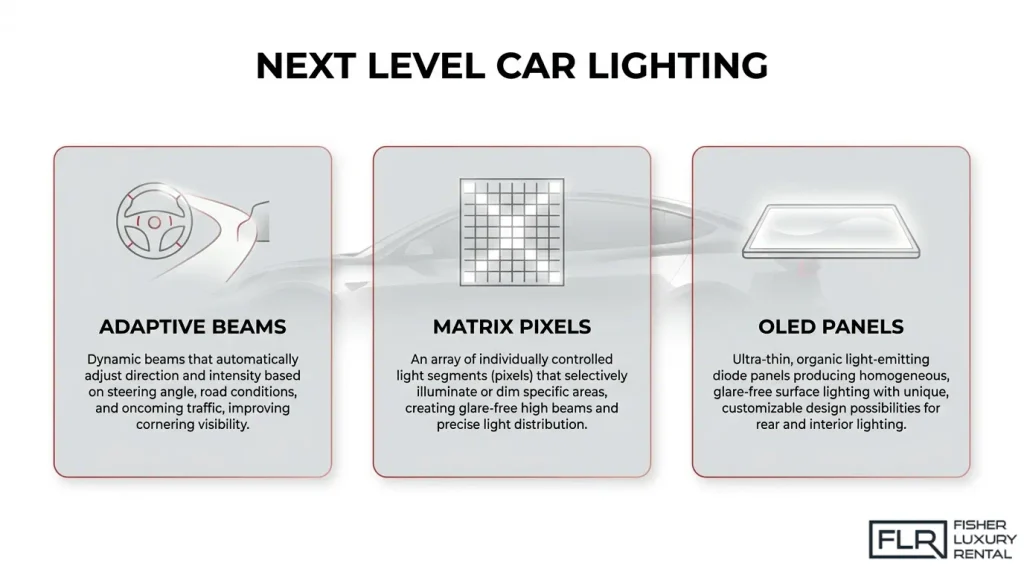
Adaptive LED headlights adjust to driving conditions by using cameras, steering sensors, and control modules to continuously reshape the light beam. As the steering wheel turns, the headlamp pivots to illuminate curves ahead. Speed and environmental data further modify beam height and width, reducing glare for oncoming traffic while keeping the road surface well lit. NHTSA’s 2022 amendment to FMVSS formally permitted adaptive driving beam headlamps, recognizing that they actively modify beams to provide more illumination without glaring other vehicles. This regulatory shift accelerated adoption across luxury and mainstream segments alike. In practice, adaptive systems represent the single most meaningful safety upgrade in forward lighting, since they solve the fundamental problem of fixed beams that cannot follow road geometry.
How Does Matrix LED Technology Selectively Control Light?
Matrix LED technology selectively controls light by splitting the headlamp into independently addressable LED segments, allowing zones to dim or extinguish around detected vehicles while the rest of the beam stays at full intensity. The Porsche Cayenne Electric’s HD-Matrix system illustrates the precision possible: two HD-Matrix modules each contain about 16,000 pixels, and a graphics-card-grade control module adjusts each LED individually across more than 1,000 brightness levels. The Bentley Continental GT Speed’s matrix lamps use 120 digitally controlled LEDs with distinct responsibilities for low-beam foreground and high-beam boost, widening the illuminated field and creating a gradual fade between lit and unlit areas. This granular control eliminates the binary high/low beam trade-off that defined headlighting for decades.
How Do OLED Tail Lights Differ From Standard LEDs?
OLED tail lights differ from standard LEDs in that they emit light across an entire flat surface rather than from discrete point sources, producing uniform, high-contrast illumination with no visible hotspots. According to an SAE International study on high-contrast brake lamps, higher contrast reduced reaction times by an average of 19 milliseconds, corresponding to 0.5 metres of saved stopping distance from 100 km/h. Audi’s second-generation digital OLED system in the Q6 e-tron uses six OLED panels with 360 segments in total, up from just six segments per panel in the first generation, enabling dynamic light signatures and proximity communication features. Standard point-source LEDs cannot replicate this surface-area uniformity, making OLED the preferred format for rear signature lighting on flagship models.
How Do Luxury Vehicles Showcase Advanced LED Lighting?
Luxury vehicles showcase advanced LED lighting through proprietary systems, such as matrix arrays, laser-boost high beams, and digital OLED panels, that go far beyond standard automotive lighting. The sections below explore real-world examples from exotic manufacturers and distill the key lessons from this article.
Can Renting an Exotic Car Let You Experience Premium LEDs?
Yes, renting an exotic car can let you experience premium LEDs firsthand in a way no showroom visit replicates. Driving a vehicle equipped with matrix LED or laser-boost technology means encountering adaptive beam control, near-daylight color temperatures, and precision optics in real conditions.
Consider what these systems actually deliver:
- Bentley Continental GT Speed: Matrix LED lamps contain 120 individually controlled LEDs, splitting responsibilities between low-beam foreground and high-beam power, producing a more gradual transition from lit to unlit areas.
- BMW i8 laser-boost: The optional laser high beam extends range to 600 metres while using 30% less energy than standard LED high beams, according to BMW Group PressClub.
- Porsche Cayenne Electric HD-Matrix: Two modules with roughly 16,000 pixels each adjust brightness across more than 1,000 levels per LED.
For most drivers, a short-term rental is the most practical way to evaluate whether these technologies justify a purchase decision.
What Are the Key Takeaways About How LED Car Lights Work?
The key takeaways about how LED car lights work center on four principles: efficient photon emission, precise power regulation, active thermal management, and adaptive beam control.
- Light generation: LEDs emit light through electroluminescence, converting electrical energy into photons at the p-n junction with no filament or gas arc required.
- Power regulation: A constant-current driver circuit maintains stable output across voltage fluctuations from the 12V automotive system.
- Thermal management: Heat sinks and active cooling loops protect junction efficiency, since excessive heat directly reduces lumen output and lifespan.
- Beam precision: From reflector optics to 1.3-million micro-mirror arrays (as found in the Mercedes-Benz E-Class), LED systems deliver controllable, high-quality illumination that halogen and HID designs cannot match.
Understanding these fundamentals makes it easier to evaluate any vehicle’s lighting specification with confidence. Vehicles equipped with these technologies are increasingly found as standard equipment on top-trim luxury and exotic models.