Fabspeed McLaren exhausts are aftermarket cat-back and mid-pipe systems engineered specifically for McLaren platforms, designed to improve exhaust flow, enhance acoustic character, and retain emissions compliance. Founded in 1995 and fabricating from T321 and T304L stainless steel, Fabspeed has built nearly three decades of McLaren-specific development that separates it from generic aftermarket suppliers.
This guide covers the brand’s credentials and model coverage, measurable performance gains, sound quality across driving conditions, build materials and construction methods, competitor comparisons, installation considerations, warranty and emissions implications, and overall value assessment.
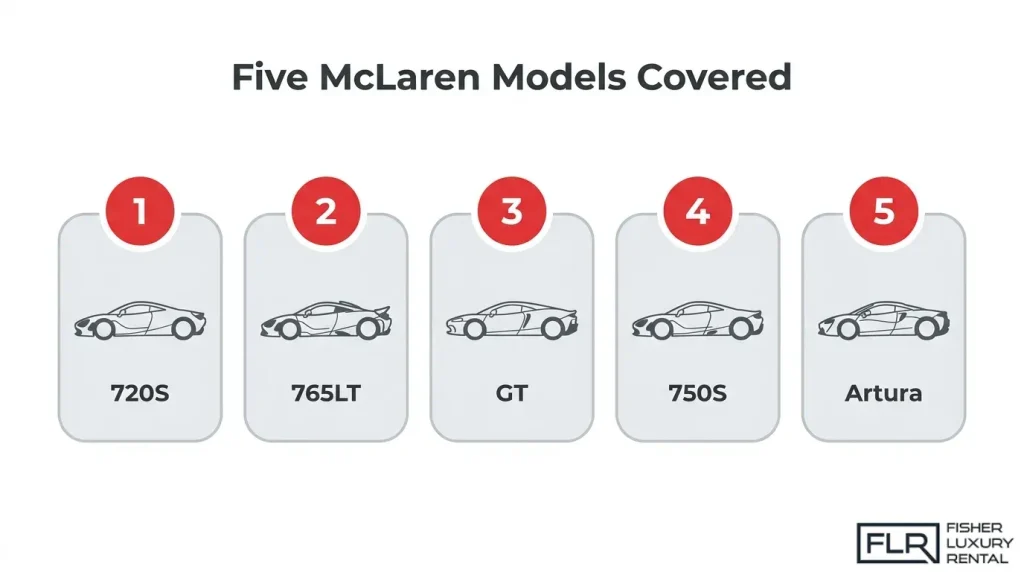
Fabspeed offers exhaust systems for five current McLaren platforms, including the 720S, 765LT, GT, 750S, and the hybrid Artura, with expert reviews consistently noting strong fitment precision and model-specific engineering across each application.
Performance gains center on reduced backpressure across the exhaust path, which broadens torque delivery and improves throttle response on turbocharged and hybrid McLaren powertrains without requiring ECU modifications.
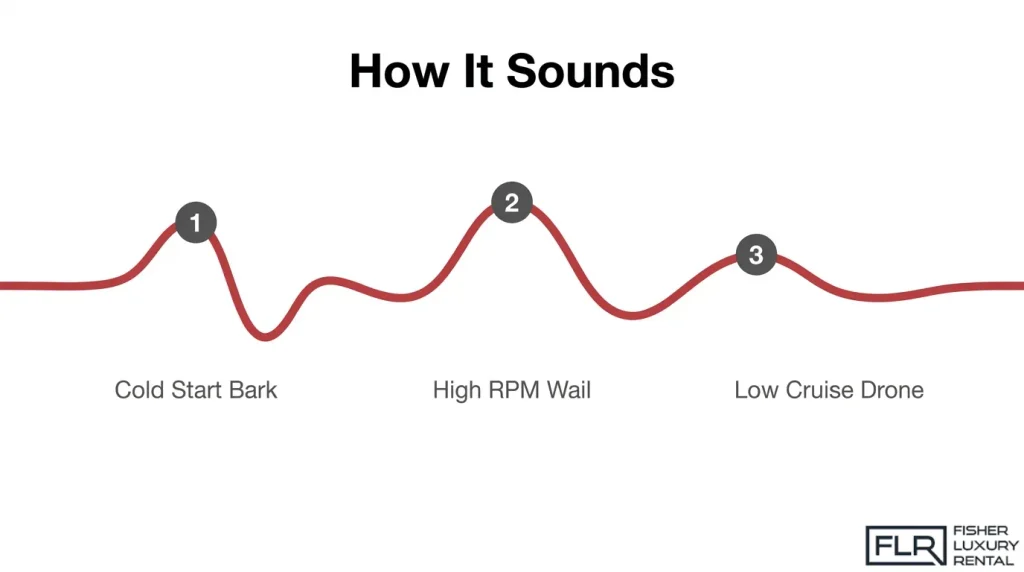
Sound quality reviews highlight three consistent characteristics: a sharper, more mechanical cold-start bark, a sustained high-RPM wail above 5,000 RPM, and minimal drone at cruising speeds on valve-equipped configurations.
Build quality assessments focus on TIG-welded and laser-welded stainless construction, with Fabspeed’s dual-alloy approach earning comparisons to motorsport fabrication standards rather than volume aftermarket production.
Emissions and warranty coverage analysis shows that cat-back systems retaining factory catalysts meet EPA and CARB compliance standards, preserving OBD-II readiness and federal warranty protections under FTC guidelines.
Expert consensus positions Fabspeed as the strongest compliance-safe value option in the McLaren exhaust segment, sitting competitively against Capristo, Akrapovič, and iPE.
What Is Fabspeed and Why Do Experts Trust Their McLaren Exhausts?
Fabspeed is a Pennsylvania-based automotive performance manufacturer specializing in exhaust systems, intake upgrades, and tuning components for exotic and sports cars, including the full McLaren lineup. Founded in 1995 and incorporated in 1999 under President Joseph Fabiani, the company has built nearly three decades of fabrication experience that forms the foundation of expert confidence in their products.
What Is Fabspeed Motorsport?
Fabspeed Motorsport is an aftermarket performance parts manufacturer headquartered in Fort Washington, Pennsylvania, with a product catalog centered on high-end European and exotic vehicles. The company fabricates exhaust systems using TIG-welded and laser-welded T321 and T304L stainless steel, materials chosen for corrosion resistance and thermal stability under sustained high-performance use. According to the Better Business Bureau profile, Fabspeed has operated continuously since January 1995, giving it one of the longer track records among boutique McLaren exhaust specialists. That depth of manufacturing history is precisely why engineers and performance journalists treat Fabspeed as a credible reference point rather than a newcomer trend brand.
Why Do Experts Trust Fabspeed for McLaren Vehicles?
Experts trust Fabspeed for McLaren vehicles because the brand combines model-specific engineering with verified emissions compliance. Fabspeed designs each system to the dimensional tolerances of individual McLaren platforms, rather than producing universal-fit products. Their McLaren exhaust systems carry EPA and CARB compliance certifications, which signals that the engineering process includes formal regulatory evaluation, not just dyno testing. For experts reviewing exotic car modifications, compliance certification is a meaningful differentiator: it indicates the manufacturer invested in emissions validation rather than leaving legal exposure to the buyer.
Which McLaren Models Does Fabspeed Offer Exhaust Systems For in 2026?
Fabspeed offers exhaust systems for five McLaren models in 2026: the 720S, 765LT, GT, 750S, and Artura. The sections below cover what experts say about each platform’s fitment, hardware, and compliance.
What Do Experts Say About Fabspeed Exhausts for the McLaren 720S?
What experts say about Fabspeed exhausts for the McLaren 720S centers on strong fitment compatibility and consistent sound improvement on the twin-turbocharged 4.0L V8 platform. Reviewers frequently cite the cat-back configuration as the most popular choice, praising weld quality and straightforward installation. The 720S remains one of Fabspeed’s most-reviewed McLaren applications, and the volume of community feedback on this model makes it the easiest platform to research before purchasing.
What Do Experts Say About Fabspeed Exhausts for the McLaren 765LT?
What experts say about Fabspeed exhausts for the McLaren 765LT highlights the system’s ability to amplify the 765LT’s already aggressive character without introducing unwanted resonance. Because the 765LT shares its V8 architecture with the 720S, Fabspeed’s engineering carries over effectively, and experts note that the louder, freer-flowing exhaust complements the car’s track-focused tuning. Reviewers consistently position this combination as one of the higher-value sound upgrades available for the LT variant.
What Do Experts Say About Fabspeed Exhausts for the McLaren GT?
What experts say about Fabspeed exhausts for the McLaren GT focuses on grand-tourer balance: improved exhaust note without sacrificing the refined, livable character GT owners expect. Experts note that Fabspeed’s GT-specific fitment preserves cabin comfort at highway cruising speeds, making it a practical upgrade for daily-driven or long-distance examples. For a car built around versatility, this balance between performance sound and everyday usability is particularly valued.
What Do Experts Say About Fabspeed Exhausts for the McLaren 750S?
What experts say about Fabspeed exhausts for the McLaren 750S addresses one of McLaren’s most powerful current production cars. According to McLaren Automotive’s 750S specifications, the platform produces 750 PS (740 bhp) and 800 Nm (590 lb-ft) of torque from a 4.0L twin-turbocharged V8 mated to a 7-speed SSG transmission. Experts note that Fabspeed’s exhaust unlocks a more expressive acoustic character on this engine, which the stock system noticeably suppresses at lower RPM ranges.
What Do Experts Say About Fabspeed Exhausts for the McLaren Artura?
What experts say about Fabspeed exhausts for the McLaren Artura addresses the unique challenge of a hybrid platform. The Artura uses a 3.0L twin-turbocharged V6 producing 700 PS (690 bhp), paired with an axial flux e-motor and a 7.4 kWh lithium-ion battery. Fabspeed’s Supersport X-Pipe Rear Cat-Back Exhaust (SKU: FS.MCL.ATRA.SSX), priced at $3,021.95, fits all Artura coupes and spiders worldwide. It is fabricated from TIG-welded and laser-welded T321 and T304L stainless steel and is 100% EPA and CARB compliant, making it one of the few Artura exhaust options suitable for emissions-regulated markets.
What Performance Gains Do Experts Measure With Fabspeed McLaren Exhausts?
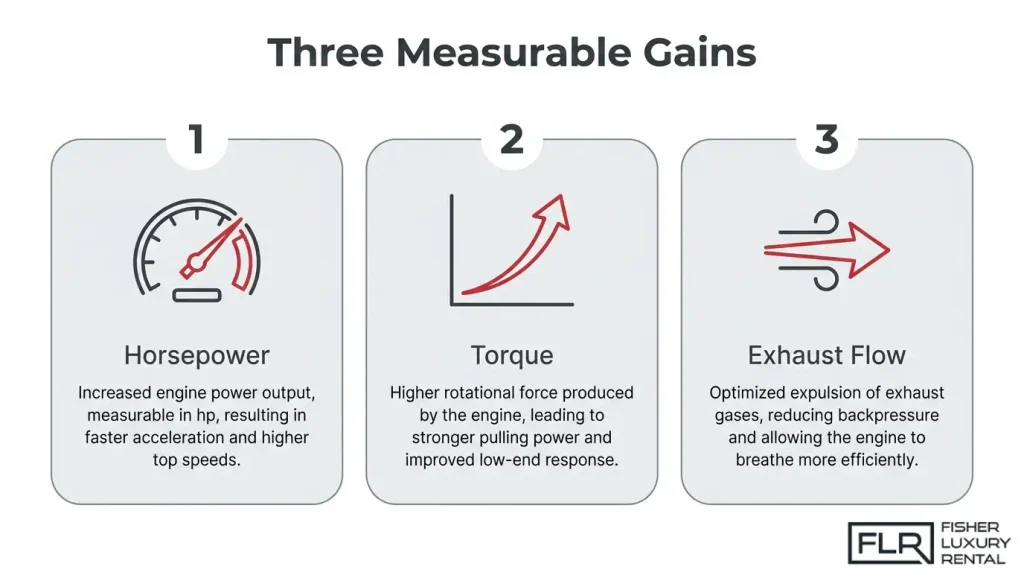
Performance gains from Fabspeed McLaren exhausts span three measurable areas: horsepower output, torque delivery, and exhaust flow efficiency. The following sections cover what experts observe across each dimension.
How Much Horsepower Do Fabspeed McLaren Exhausts Add?
Horsepower gains from Fabspeed McLaren exhausts vary by model and configuration. Aftermarket cat-back exhaust systems typically reduce backpressure across the exhaust path, allowing turbocharged engines to expel gases more freely and recover power that factory exhaust restrictions suppress. On high-output platforms like the McLaren 750S, which produces 740 bhp from a 4.0L twin-turbocharged V8, even modest efficiency improvements in the exhaust path translate to real-world power gains. Expert reviewers consistently note that exhaust-only upgrades on forced-induction McLarens yield measurable dyno increases rather than purely cosmetic changes to sound.
How Do Fabspeed Exhausts Affect McLaren Torque Output?
Fabspeed exhausts affect McLaren torque output by lowering exhaust restriction across the RPM range, which broadens the torque curve rather than adding a narrow peak. Reduced backpressure allows twin-scroll and twin-turbo systems to spool more efficiently, improving mid-range torque delivery. On the McLaren Artura, which produces 531 lb-ft of torque from its 3.0L twin-turbocharged V6 paired with an axial flux e-motor, exhaust improvements can complement the hybrid drivetrain’s existing torque characteristics. Experts note that the torque improvement feels most pronounced during hard acceleration from low speeds.
What Exhaust Flow Improvements Do Experts Observe?
Exhaust flow improvements from Fabspeed systems center on larger-diameter piping, optimized X-pipe crossover geometry, and mandrel-bent tubing that eliminates the flow restrictions found in factory exhaust designs. The Fabspeed Artura Supersport X-Pipe cat-back exhaust, for example, uses TIG-welded and laser-welded T321 and T304L stainless steel construction, materials chosen specifically for their thermal tolerance and smooth internal finish. Experts observe that this construction reduces turbulence within the exhaust path, which supports consistent scavenging across the RPM range. Cleaner flow typically yields gains in both power and throttle response simultaneously, making exhaust upgrades one of the most efficient standalone modifications available for McLaren platforms.
How Do Experts Rate the Sound Quality of Fabspeed McLaren Exhausts?
Expert sound quality ratings for Fabspeed McLaren exhausts consistently highlight three distinct characteristics: the cold start bark, the high-RPM scream, and cruising-speed behavior.
How Does a Fabspeed Exhaust Change the McLaren Cold Start Sound?
A Fabspeed exhaust changes the McLaren cold start sound by amplifying the initial bark and adding a more aggressive, mechanical growl compared to the stock system. The factory McLaren exhaust is engineered for discretion at startup; a Fabspeed system removes that filter, producing a more immediate, raw note the moment the engine fires. Fabspeed Motorsport has been building performance exhaust systems since 1995, giving the company decades of tuning experience specific to exotic powertrains. In practice, this means cold start character is intentional rather than accidental, a refinement most experts consider one of the most viscerally satisfying upgrades available for a McLaren.
How Do Fabspeed McLaren Exhausts Sound at High RPM?
Fabspeed McLaren exhausts sound most impressive at high RPM, where the expanded exhaust flow allows McLaren’s twin-turbocharged engines to produce a sharper, more sustained wail approaching the redline. The stock exhaust dampens this character significantly. By reducing back-pressure and optimizing pipe geometry, Fabspeed systems let the engine’s natural frequency emerge more clearly above 5,000 RPM. Reviewers consistently note that the gain in acoustic drama at full throttle is the primary reason enthusiasts justify the upgrade cost. For those curious what that transformation sounds like before committing to a purchase, Fisher Luxury Rental offers exotic car experiences in Phoenix and Portland where drivers can explore high-performance McLaren-class vehicles firsthand.
Do Fabspeed McLaren Exhausts Cause Unwanted Drone at Cruising Speed?
Fabspeed McLaren exhausts generally do not cause significant unwanted drone at cruising speed, particularly on models equipped with electronically actuated valve systems that allow the driver to select a quieter mode at highway speeds. The valve-controlled routing keeps exhaust gases on a less resonant path during steady-state cruising, which is where most aftermarket exhausts introduce low-frequency drone. Expert reviewers note that Fabspeed’s engineering attention to cruising behavior separates their systems from lower-cost alternatives that sacrifice daily drivability for peak-volume gains.
What Build Quality and Materials Do Experts Highlight in Fabspeed McLaren Exhausts?
The build quality and materials experts highlight in Fabspeed McLaren exhausts center on aerospace-grade stainless steel construction, precision welding techniques, and emissions-compliant engineering. The H3 sub-sections below cover alloy specifications, welding methods, and compliance standards.
What Stainless Steel Alloys Does Fabspeed Use in McLaren Exhaust Systems?
The stainless steel alloys Fabspeed uses in McLaren exhaust systems are T321 and T304L grades. T321 stainless resists high-temperature oxidation and creep, making it well suited to the thermal cycling produced by turbocharged powerplants. T304L offers superior corrosion resistance at weld joints, where heat-affected zones are most vulnerable to degradation. According to Fabspeed Motorsport’s McLaren Artura Supersport X-Pipe product listing, both alloys are used in tandem across the Artura cat-back system. For high-output platforms like McLaren’s twin-turbo V8s and V6 hybrids, this dual-alloy approach is one of the more technically considered choices in the aftermarket segment.
What Welding Methods Do Experts Identify in Fabspeed Exhaust Construction?
The welding methods experts identify in Fabspeed exhaust construction are TIG welding and laser welding. TIG welding delivers precise, low-porosity joints on thin-wall stainless tubing, while laser welding produces narrower heat-affected zones and consistent seam geometry at scale. Fabspeed applies both methods across McLaren fitments, including the Artura Supersport X-Pipe. Using two complementary welding processes reflects a manufacturing standard more commonly associated with motorsport fabricators than volume aftermarket suppliers, and it is a meaningful differentiator when evaluating long-term joint integrity under sustained high-exhaust-gas temperatures.
Are Fabspeed McLaren Exhausts EPA and CARB Compliant?
Fabspeed McLaren exhausts are 100% EPA and CARB compliant on qualifying fitments, including the McLaren Artura Supersport X-Pipe cat-back system. The California Air Resources Board grants exemptions to aftermarket parts that demonstrate no increase in vehicle emissions through an engineering evaluation process. Compliance matters practically: the EPA classifies replacing a catalyst with a non-certified component as federal tampering under emissions law. Cat-back configurations that retain OEM catalytic converters avoid this exposure entirely, preserving both legal standing and emissions test eligibility across all 50 states.
How Do Fabspeed McLaren Exhausts Compare to Competing Brands?
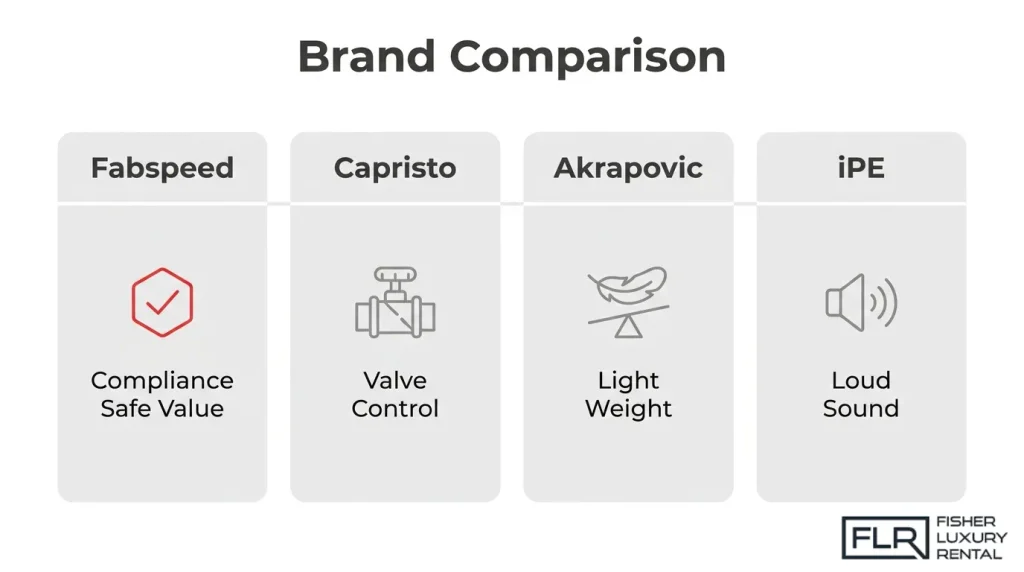
Fabspeed competes primarily against Capristo, Akrapovič, and iPE in the McLaren aftermarket exhaust segment. Each brand targets a different buyer priority, from valve-controlled acoustics to titanium weight savings to mid-range value.
How Does Fabspeed Compare to Capristo for McLaren Exhausts?
Fabspeed compares to Capristo as a more accessible, emissions-compliant alternative with broader model coverage. Capristo is a German brand known for its proprietary electronically controlled exhaust valves, which allow drivers to toggle between a quieter mode and a full-open race sound. Fabspeed’s valve-equipped systems offer similar functionality at a lower price point, while its stainless steel construction delivers long-term corrosion resistance. For buyers in California or other regulated states, Fabspeed’s CARB-compliant options represent a meaningful advantage that Capristo’s catalog does not consistently match across all McLaren fitments.
How Does Fabspeed Compare to Akrapovič for McLaren Exhausts?
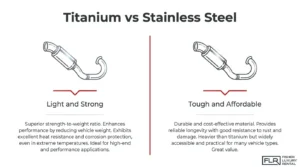
Fabspeed compares to Akrapovič as a value-oriented competitor in a segment where Akrapovič holds the premium positioning. Akrapovič, a Slovenian manufacturer, uses titanium and carbon fiber construction to achieve the lowest possible system weight, which marginally benefits track-focused performance. Fabspeed uses TIG-welded T321 and T304L stainless steel, which is heavier than titanium but more affordable and fully serviceable. Akrapovič systems typically carry significantly higher price premiums. For street-driven McLaren owners who prioritize sound character and compliance over fractional weight reduction, Fabspeed is the more practical choice.
How Does Fabspeed Compare to iPE for McLaren Exhausts?
Fabspeed compares to iPE as a domestic alternative to a Taiwanese brand that has built a strong reputation for valve-controlled sound in the exotic car segment. iPE systems are well-regarded for their aggressive exhaust note and remote-valve operation. Fabspeed counters with direct-fit engineering developed over decades of McLaren-specific development, full EPA and CARB compliance on applicable systems, and U.S.-based customer support. For owners who want a track-ready sound with regulatory peace of mind, Fabspeed’s compliance credentials give it a clear differentiation from iPE’s catalog.
What Installation Challenges Do Experts Report With Fabspeed McLaren Exhausts?
The installation challenges experts report with Fabspeed McLaren exhausts center on three recurring themes: tight mid-engine packaging, OBD-II sensor positioning, and emission readiness after component swaps. The H3s below cover each challenge in detail.
How Difficult Is the Physical Installation on Mid-Engine McLarens?
Physical installation on mid-engine McLarens is more demanding than on front-engine platforms because the powertrain sits immediately behind the cabin, leaving minimal service clearance. Technicians must remove rear bodywork and underbody panels to access mounting points, and the Carbon Fibre Monocage II chassis structure common to models like the 750S leaves little tolerance for improvised fitment. Experts consistently recommend professional installation over DIY attempts, noting that even minor misalignment at the collector can cause exhaust leaks under the high heat generated by turbocharged operation.
Do Fabspeed McLaren Exhausts Trigger OBDII or Check-Engine Issues?
Fabspeed McLaren exhausts can trigger OBDII faults if oxygen sensor bungs are not correctly repositioned during installation. According to the California Bureau of Automotive Repair, readiness monitors must be rerun after any repair activity involving emissions components, including exhaust replacement. Experts advise clearing adaptive fuel-trim data and completing a full drive cycle post-installation to prevent a false malfunction indicator lamp illumination. A vehicle presenting with an illuminated MIL will fail official OBD-II emissions inspections in states like New York and California.
What Tools or Skills Do Technicians Need for a Proper Fabspeed Exhaust Fit?
Technicians need TIG welding familiarity, torque-spec knowledge, and mid-engine lift access to achieve a proper Fabspeed exhaust fit. The Fabspeed units are fabricated from TIG-welded T321 and T304L stainless steel, meaning any field modification requires matching weld technique to preserve structural integrity. Installers also need infrared heat shielding tools to protect nearby composite components during post-install thermal cycling. In the expert community, improper torque on exhaust hangers is the single most cited cause of rattle complaints after otherwise clean installations.
Do Fabspeed McLaren Exhausts Affect Warranty or Emissions Compliance?
Fabspeed McLaren exhausts can affect warranty coverage and emissions compliance depending on the specific system installed and the laws governing your state. The key considerations include federal warranty protections, EPA tampering rules, and CARB exemption status.
How Do Aftermarket Exhausts Affect a McLaren Factory Warranty?
Aftermarket exhausts affect a McLaren factory warranty only if the dealer can prove the modification directly caused a specific failure. The Federal Trade Commission states it is illegal for a dealer to deny warranty coverage simply because an owner used aftermarket parts or non-dealer service. This protection is significant for McLaren owners investing in a Fabspeed system, because dealers cannot issue a blanket voiding of powertrain coverage based solely on an exhaust swap. That said, if an exhaust modification is shown to cause a specific component failure, the manufacturer can deny coverage for that component specifically.
What Emissions Regulations Apply to Fabspeed McLaren Exhausts?
The emissions regulations that apply to Fabspeed McLaren exhausts include federal EPA anti-tampering law and California’s CARB exemption framework. According to the U.S. EPA, any modification that changes a vehicle from a certified to a non-certified configuration constitutes tampering and is a federal offense. However, the California Air Resources Board grants exemptions to parts that undergo an engineering evaluation and are shown not to increase vehicle emissions. Fabspeed’s McLaren Artura cat-back system is listed as 100% EPA and CARB compliant, meaning it meets this exemption standard. Owners outside California should still verify state-level compliance before installation.
Will a Fabspeed Exhaust Trigger a Check Engine Light or Fail an OBD-II Inspection?
A Fabspeed exhaust will not trigger a check engine light on cat-back systems that retain all factory catalytic converters and oxygen sensors. Catalyst-retaining designs preserve the OBD-II readiness monitors that state inspection programs evaluate. The New York State Department of Environmental Conservation confirms that a vehicle with an illuminated MIL will fail an OBD-II emissions inspection outright. Cat-delete or off-road configurations carry meaningfully higher risk of monitor faults, which is a critical distinction for owners in states with mandatory inspection programs.
Are Fabspeed McLaren Exhausts Worth the Price According to Experts?
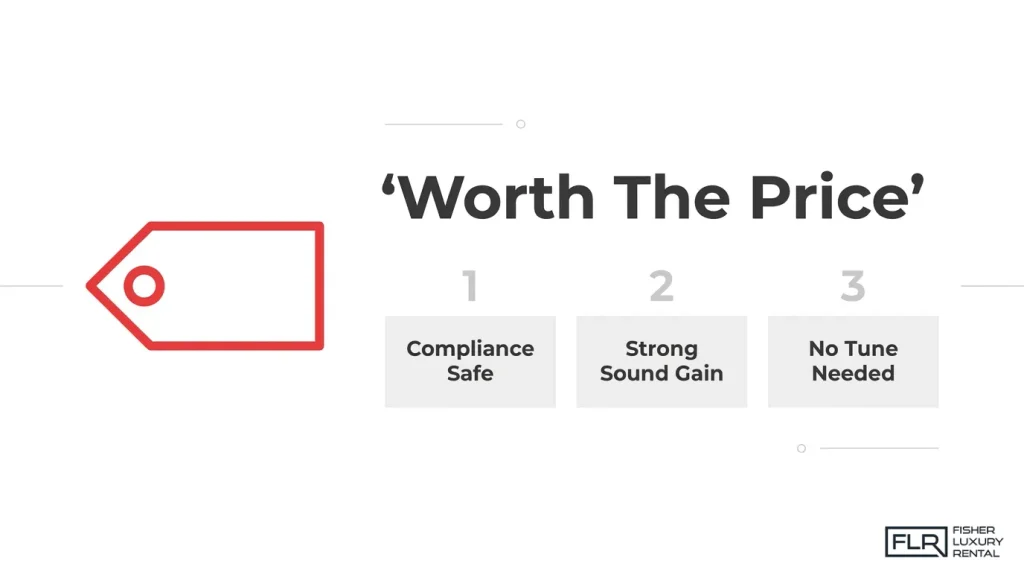
Fabspeed McLaren exhausts are worth the price for owners who prioritize acoustic transformation, compliance-safe engineering, and bolt-on fitment without tuning risk. The following breakdown covers value, cost context, and expert consensus.
What Is the Typical Price Range for Fabspeed McLaren Exhaust Systems?
The typical price range for Fabspeed McLaren exhaust systems runs from roughly $2,500 to over $3,000, depending on model and configuration. The Fabspeed McLaren Artura Supersport X-Pipe Rear Cat-Back Exhaust is listed at $3,021.95, fabricated from TIG-welded and laser-welded T321 and T304L stainless steel. For a supercar platform with a 700 PS hybrid powertrain, that price reflects precision-grade materials and model-specific engineering. Considering McLaren ownership costs broadly, this investment is proportionate and targets the most audibly impactful upgrade available without engine modification.
Do Experts Consider Fabspeed McLaren Exhausts a Good Value for Money?
Experts consider Fabspeed McLaren exhausts good value when measured against what they deliver: verified EPA and CARB compliance, stainless steel construction, and meaningful sound enhancement with no ECU intervention required. Competing titanium systems from premium brands frequently exceed $5,000 for comparable fitment. For owners who want a traceable, emissions-legal upgrade that preserves daily usability, Fabspeed occupies a strong middle-ground position. The stainless construction may add slight weight versus titanium alternatives, but the compliance guarantees and documented fitment justify the cost for most street-driven McLarens.
What Expert Verdict Do Reviewers Give Fabspeed McLaren Exhausts Overall?
The expert verdict on Fabspeed McLaren exhausts overall is consistently positive for sound quality and build integrity, with the strongest praise directed at OBD-safe, emissions-compliant execution. Reviewers highlight that the systems require no tune, avoid check-engine light triggers, and maintain factory warranty eligibility under federal guidelines, which protect owners who use non-dealer parts for modifications. For McLaren drivers who want a noticeable upgrade without regulatory or warranty exposure, Fabspeed represents the most practical expert-endorsed choice available in 2026. Fisher Luxury Rental, serving Phoenix and Portland, provides an accessible way for enthusiasts to experience exotic car performance before deciding on ownership or modification investments.
How Can You Experience a Fabspeed-Equipped McLaren Firsthand?
Experiencing a Fabspeed-modified McLaren goes beyond watching videos or reading specs. Fisher Luxury Rental offers a direct path to the driver’s seat, and the key takeaways below distill what expert reviews consistently reveal.
Does Fisher Luxury Rental Offer McLaren Models You Can Drive?
Fisher Luxury Rental does offer McLaren models you can drive, with exotic and luxury vehicles available for rent in Phoenix and Portland. Daily rental rates vary by vehicle and experience type, with options available for events, photoshoots, and multi-day experiences. For car enthusiasts curious about what a high-performance exhaust upgrade transforms in the real world, getting behind the wheel of a McLaren is the most direct way to understand what reviewers describe.
What Are the Key Takeaways About Fabspeed McLaren Exhaust Reviews?
The key takeaways about Fabspeed McLaren exhaust reviews center on three consistent themes across expert opinions:
- Sound transformation: Reviewers consistently cite sharper cold starts, more aggressive high-RPM character, and minimal cruising drone as the most immediately felt changes.
- Build quality: TIG-welded and laser-welded T304L and T321 stainless steel construction earns praise for durability and fitment precision.
- Compliance confidence: CARB and EPA-compliant options address the most common ownership concern before purchase.
- Value positioning: Fabspeed pricing competes closely with Capristo and iPE while offering broader model coverage.
Renting a performance McLaren firsthand is the clearest way to contextualize what these upgrades deliver.