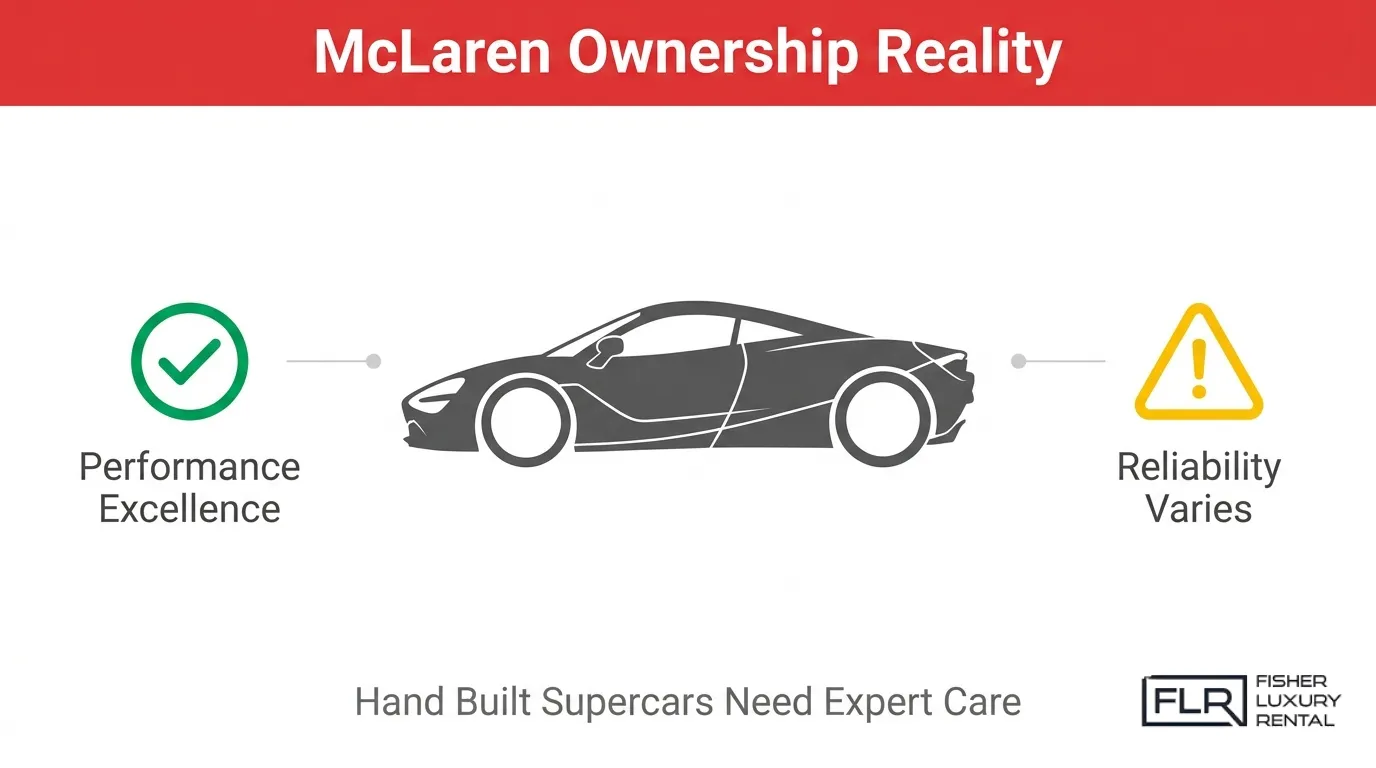
McLaren reliability is a nuanced subject: the brand produces hand-built supercars with genuine motorsport engineering, but ownership experiences vary widely depending on the model, mileage, and how consistently maintenance is performed.
This guide covers McLaren’s reputation and how it stacks up against rivals, the most common failure points across the lineup, model-by-model reliability profiles, ownership costs, the impact of driving style, and how to experience a McLaren without the financial exposure of buying one.
McLaren’s overall reputation sits in a credible but unrated position; Consumer Reports excluded the brand from its latest rankings due to insufficient owner data, while long-term press tests suggest GT-series models are more livable than their exotic status implies.
Against rivals like Ferrari, Lamborghini, and Porsche, McLaren holds its own on performance but trails on service network depth and platform maturity, factors that directly affect real-world ownership confidence.
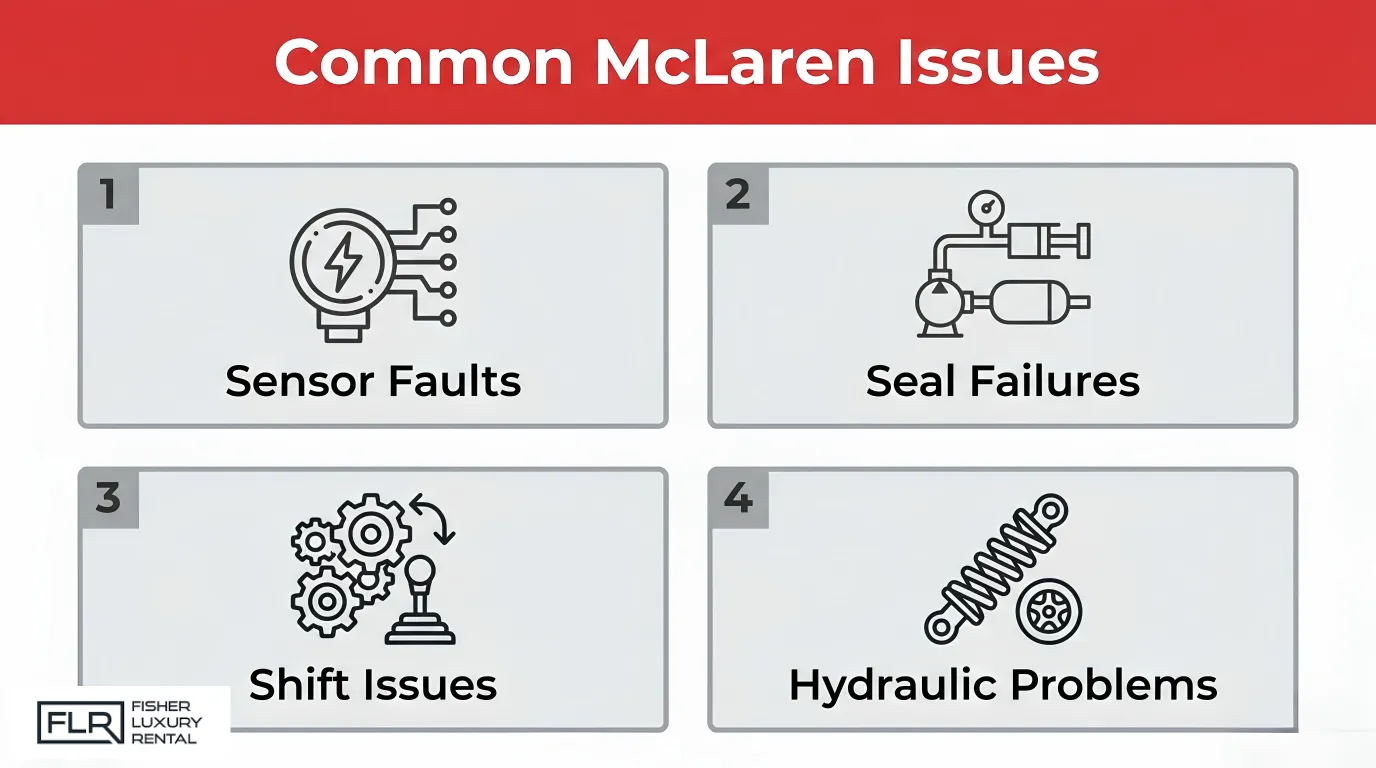
Documented failure points span hydraulic suspension seals, electrical sensor faults, dual-clutch transmission behavior, and active safety recalls covering 2020 to 2025 models across multiple model lines.
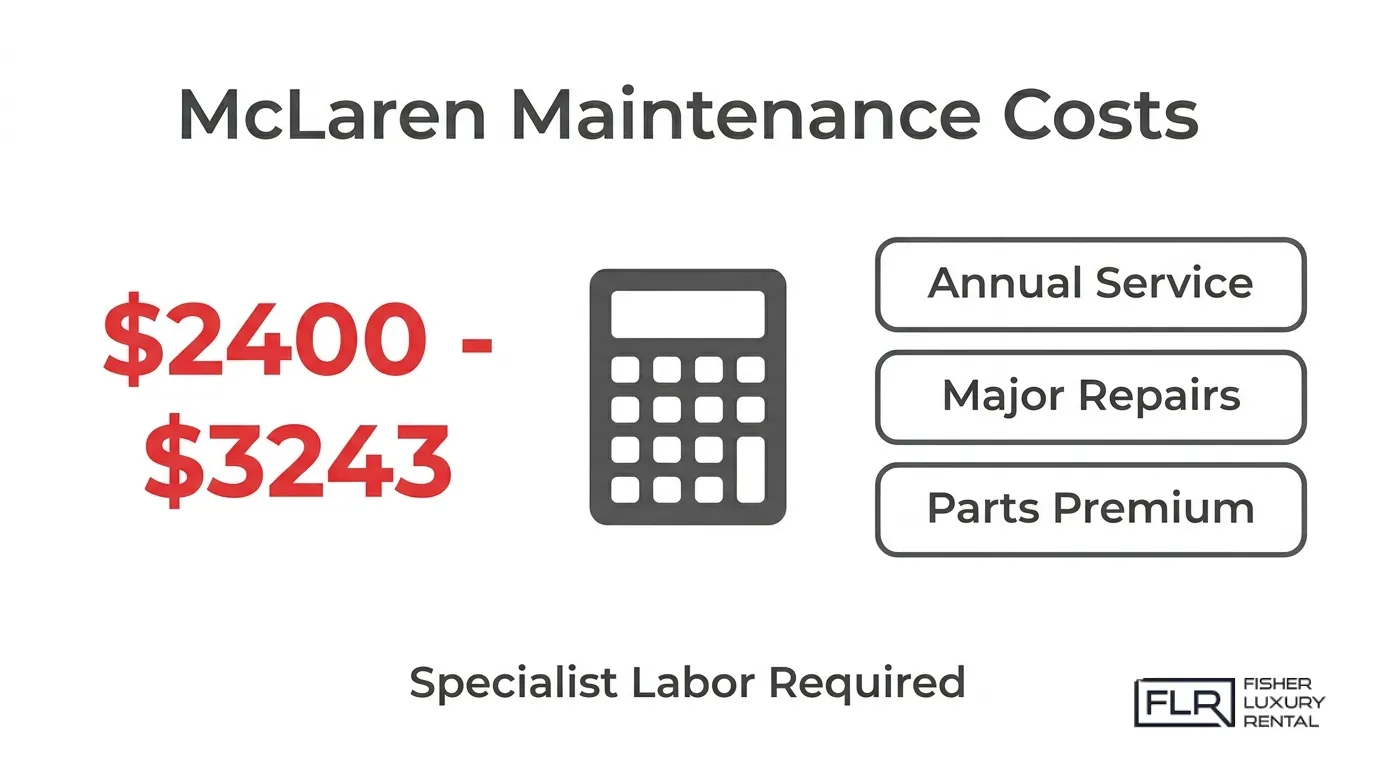
Maintenance runs $2,400 to $3,243 annually, major repairs compound that figure significantly, and newer models gain ground through a 3-year unlimited mileage warranty, though comprehensive reliability data for current model years remains limited.
For those who want the McLaren experience without the ownership risks, renting from Fisher Luxury Rental removes every maintenance burden and puts a properly serviced car in your hands without a six-figure commitment.
What Is McLaren’s Overall Reliability Reputation?
McLaren’s overall reliability reputation is mixed: the brand produces genuinely thrilling supercar performance, but ownership experiences vary widely depending on the model, mileage, and maintenance history. Long-term press tests and owner data together paint a nuanced picture.
Consumer Reports noted that McLaren did not meet the minimum requirement of data for at least two models from the 2023, 2024, 2025, or early 2026 model years to accurately rank the brand in its annual reliability survey, leaving the brand unrated. That absence alone signals limited mainstream reliability data compared to higher-volume manufacturers.
Motor Trend’s long-term evaluation found the 2020 McLaren GT is no more challenging to live with every day than a Toyota Supra or Porsche 911, which is a meaningful benchmark for a mid-engined exotic. Autocar’s extended test reinforced this, reporting the McLaren GT absorbed far more road punishment than its low-profile tyres have any right to during a long commute.
The honest takeaway: McLaren reliability is not categorically poor, but it is also not the kind of dependability you get from a mass-market brand. For drivers who stay current with scheduled maintenance and understand the ownership demands of a hand-built supercar, the GT-series models in particular offer a more livable daily experience than the reputation sometimes suggests.
How Reliable Are McLaren Models Compared to Other Supercars?
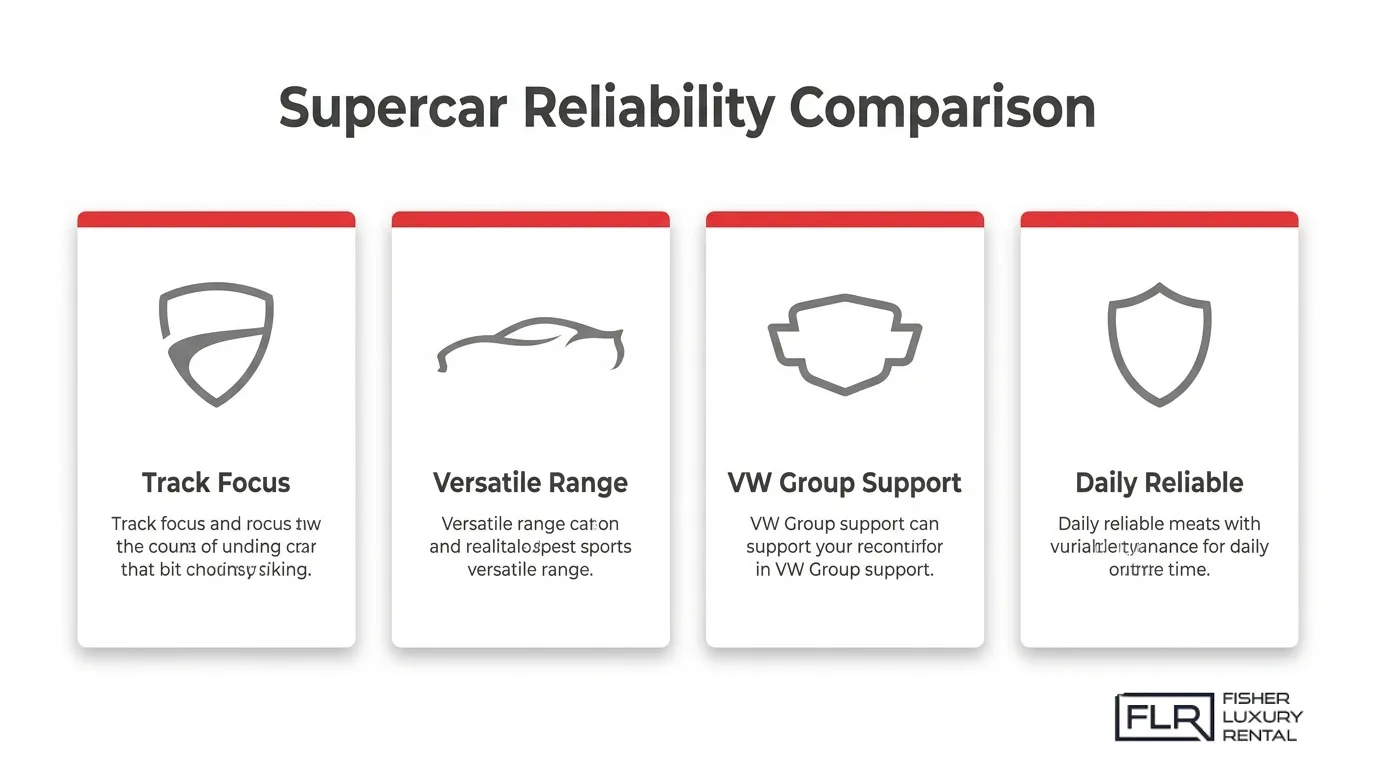
McLaren reliability sits in a competitive tier alongside Ferrari, Lamborghini, and Porsche, but each brand offers a different ownership experience. The H3s below compare McLaren directly against each rival across reliability, everyday usability, and performance versatility.
How Does McLaren Reliability Compare to Ferrari?
McLaren reliability compares to Ferrari’s with each brand occupying a distinct ownership profile. McLaren prioritizes track-focused engineering and lightweight construction, while Ferrari delivers a more versatile range of performance options combining speed, power, and everyday drivability, according to Twin Cities Performance. In practice, Ferrari’s broader model lineup gives drivers more flexibility between spirited weekend use and daily commuting. McLaren’s engineering is precise and purposeful, but that specialization can mean narrower real-world usability. For buyers weighing reliability against versatility, Ferrari’s advantage lies in its mature, road-tested platform diversity across a wider price range.
How Does McLaren Reliability Compare to Lamborghini?
McLaren reliability compares to Lamborghini’s with both brands sharing supercar-tier complexity and maintenance demands. Lamborghini models, particularly the Huracan and Urus, benefit from Volkswagen Group’s engineering infrastructure and broader dealer network, which can simplify parts sourcing and service access. McLaren operates independently, which means fewer service centers and potentially longer wait times for specialist repairs. Both brands carry comparable ownership costs and electronic system complexity, but Lamborghini’s integration into a major automotive group gives it a practical edge for owners who prioritize service convenience alongside performance.
How Does McLaren Reliability Compare to Porsche?
McLaren reliability compares to Porsche’s with Porsche holding a clear advantage in everyday dependability. According to Motor Trend, the 2020 McLaren GT is no more challenging to live with daily than a Porsche 911, which is a meaningful endorsement for McLaren’s most road-oriented model. However, the 911 carries decades of reliability refinement and one of the strongest reputations for durability among performance cars. McLaren closes the gap with models like the GT, but Porsche’s broader service network, lower maintenance costs, and consistent long-term owner satisfaction still give it the reliability edge for daily drivers.
What Are the Most Common McLaren Reliability Problems?
McLaren reliability problems most commonly involve electrical faults, hydraulic system failures, transmission behavior, and suspension wear. The sections below break down each failure category with specific symptoms and known causes.
How Prone Are McLaren Models to Electrical Issues?
McLaren models are prone to electrical issues, particularly sensor faults, wiring failures, and fire-risk recalls. According to JustAnswer, a “Parking system switch fault” on the 2021 McLaren 720S Spider typically indicates sensor or wiring problems. Separately, NHTSA issued a recall after McLaren determined that a noise, vibration, and harshness foam pad located beneath the fuel tank on certain models presents a fire risk. Electrical gremlins like these are disproportionately common in low-volume exotic cars, where complex wiring harnesses receive less mass-production validation than mainstream vehicles.
How Often Do McLaren Hydraulic Systems Fail?
McLaren hydraulic systems fail at a meaningful rate, particularly in vehicles exposed to extreme temperature swings. According to Foreign Automotive, seals inside the hydraulic cylinders degrade over time in such climates, causing fluid to weep around the damper units and eventually triggering a dashboard warning. On the Artura specifically, the power converter bridges the high-voltage battery and the 12-volt electrical system; its failure typically presents as a dead 12V battery or a “Hybrid System Fault” warning on the digital display.
Are McLaren Transmissions Known for Problems?
McLaren transmissions are known for problems, most notably rough, hesitant, or delayed gear changes. These symptoms point to solenoid issues, low hydraulic pressure, or worn clutch packs within the dual-clutch unit. Because McLaren’s transmission relies heavily on hydraulic pressure to execute shifts, any degradation in that system has a direct downstream effect on gearbox feel and response.
How Reliable Is the McLaren Engine Long-Term?
The McLaren engine is generally considered reliable long-term, with the twin-turbocharged V8 powertrain demonstrating consistent durability across multiple model lines. The McLaren GT, in particular, proved capable enough in extended driving that Autocar noted it absorbed daily commutes without issue, performing far beyond what its low-profile tires suggested. Dedicated to racing-derived engineering, McLaren’s engine architecture benefits from motorsport tolerances, which supports long-term durability when serviced correctly.
Do McLaren Models Have Recurring Suspension Issues?
McLaren models do have recurring suspension issues, stemming from multiple root causes. According to Executive Auto Service, suspension failures in McLaren vehicles can arise from natural wear and tear, manufacturing defects, and component-specific problems. The three most common failure triggers are:
- Wear and tear: Progressive degradation of bushings, ball joints, and hydraulic components over mileage.
- Manufacturing defects: Component-level inconsistencies affecting specific production runs.
- Hydraulic system interaction: Because McLaren uses a hydraulic suspension system on many models, hydraulic seal degradation directly compounds suspension performance issues.
Suspension problems are arguably the most impactful McLaren reliability concern, since they affect both ride quality and handling precision simultaneously.
How Reliable Is Each McLaren Model?
Each McLaren model has a distinct reliability profile shaped by its technology, age, and recall history. Annual maintenance costs range from $2,400 to $3,243 depending on the model and location. The sections below cover the 720S, 570S, GT, Artura, and 765LT.
How Reliable Is the McLaren 720S?
The McLaren 720S is generally regarded as one of the more dependable models in the lineup, though it is not without issues. According to Cars.com, McLaren Automotive recalled certain 2020–2025 720S vehicles because brake lines may be routed incorrectly, a safety-critical defect affecting braking performance. Owners have also reported parking sensor faults and occasional electronics gremlins. Despite these concerns, the 720S remains a strong performer when properly maintained.
How Reliable Is the McLaren 570S?
The McLaren 570S is considered one of the most reliable McLarens available. As an older platform with a well-developed twin-turbocharged V8 and a simpler feature set than newer hybrid models, the 570S benefits from fewer complex systems that can fail. Common issues include hydraulic suspension leaks and transmission solenoid wear, but these are manageable with routine servicing. For buyers seeking relative dependability in an exotic, the 570S is a sound choice. For those who want to experience a 570S or similar McLaren without committing to ownership, Fisher Luxury Rental offers exotic car rentals in Phoenix, AZ and Portland, OR — a practical way to evaluate whether the McLaren ownership experience suits your lifestyle before buying.
How Reliable Is the McLaren GT?
The McLaren GT is reliable by supercar standards and is designed for daily usability. Its twin-turbocharged 4.0-liter V8 is a proven unit shared across the Sports Series and Super Series lineups. The GT falls within the broader 2020–2025 brake line recall affecting multiple McLaren models. Structurally, it sits among the more livable McLarens, prioritizing comfort without sacrificing mechanical integrity.
How Reliable Is the McLaren Artura?
The McLaren Artura is a hybrid supercar that has faced early-production reliability challenges. The 2025 Artura adds the Spider open-top variant, per Car and Driver, reflecting McLaren’s continued investment in the platform. However, its power converter, which bridges the high-voltage battery and 12-volt electrical system, has been a documented failure point, often presenting as a dead 12V battery or a “Hybrid System Fault” warning. The Artura also falls within the brake line recall. As a first-generation hybrid architecture, buyers should expect a higher service touch during the early ownership period.
How Reliable Is the McLaren 765LT?
The McLaren 765LT is reliable for a high-output track-focused supercar, though its reliability depends heavily on how it is driven and maintained. Built on the proven 720S platform, the 765LT uses an upgraded version of the same twin-turbocharged V8, which benefits from an established engineering foundation. Its lightweight construction and track-tuned components demand more frequent inspections than road-focused models. Owners who use it aggressively should budget for accelerated wear on tires, brakes, and suspension components.
How Much Does It Cost to Maintain a McLaren?
McLaren maintenance costs are substantial, reflecting the exotic materials, specialist labor, and low-volume parts involved. The sections below cover routine service expenses and the higher-ticket repairs owners encounter over time.
How Expensive Is Routine McLaren Maintenance?
Routine McLaren maintenance is expensive relative to mainstream vehicles, with annual costs typically ranging from $2,400 to $3,243 depending on the model and location, according to McLaren Palm Beach. This range covers scheduled oil changes using specialized lubricants, brake fluid flushes, filter replacements, and multi-point inspections. Because McLaren uses carbon fiber components, bespoke hydraulic systems, and proprietary software, even standard service intervals require factory-trained technicians and OEM parts. Owners who defer routine work tend to face compounding repair bills, making consistent scheduled maintenance the most cost-effective approach over a car’s lifetime.
How Much Do Major McLaren Repairs Typically Cost?
Major McLaren repairs typically cost several times more than routine service, with suspension overhauls, transmission rebuilds, and hydraulic system work each capable of reaching five figures at independent or dealership shops. Parts availability is limited by McLaren’s low-volume production, which inflates both component prices and labor time. According to FocalX, preventive maintenance reduces the risk of breakdowns and extends vehicle lifespan, making it the most practical defense against these high-cost repair events. Skipping scheduled service to save money short-term is a false economy with a McLaren; the cost gap between a $3,000 annual maintenance plan and a single major mechanical failure is significant.
Does McLaren Reliability Improve with Newer Models?
McLaren reliability does improve with newer models in some measurable ways, though the picture remains mixed. Newer generations benefit from stronger warranty coverage, refined engineering, and incremental updates addressing earlier known issues. The sections below cover warranty protections and what to realistically expect from current-generation McLarens.
Does McLaren’s Warranty Coverage Indicate Better Build Quality?
McLaren’s warranty coverage does indicate a meaningful commitment to newer model quality. According to McLaren Automotive, every new McLaren comes with a comprehensive 3-year unlimited mileage warranty, a level of coverage that signals manufacturer confidence in current build standards.
That said, warranty length alone does not equal reliability. What it does offer is financial protection during the period when ownership costs are most unpredictable. For buyers weighing a newer McLaren, this coverage is one of the strongest practical arguments in favor of buying current rather than pre-owned.
Do Newer McLaren Models Have Fewer Reported Problems?
Newer McLaren models show incremental engineering refinements, but comprehensive reliability data remains limited. Consumer Reports noted that McLaren did not meet the minimum data requirement for at least two models from the 2023, 2024, 2025, or early 2026 model years to be ranked in their annual reliability survey.
This data gap makes it difficult to draw firm conclusions. While McLaren continues refining individual systems with each generation, the low production volumes that make these cars exclusive also limit the large-sample reliability data that mainstream brands accumulate quickly. Buyers should weigh warranty protection heavily when evaluating newer models.
What Should You Know About McLaren Warranty Coverage?
McLaren warranty coverage varies depending on whether you buy new or certified pre-owned. New vehicles include a factory warranty, while CPO buyers have tiered options with upgrade paths.
According to McLaren Automotive, the McLaren Certified Pre-Owned Warranty offers a minimum of 12 months of coverage, with the option to upgrade to 24 months. New McLarens include a comprehensive 3-year unlimited mileage factory warranty, providing significantly broader protection for first owners.
For buyers, the warranty tier you select directly affects your total cost of ownership. A CPO McLaren with only the baseline 12-month coverage carries meaningful financial exposure given the model’s known maintenance costs. Upgrading to 24 months is a practical safeguard, especially for models with complex hydraulic or hybrid systems that require specialist repair.
Key warranty considerations for McLaren ownership include:
- New McLaren: 3-year unlimited mileage factory warranty from McLaren Automotive.
- Certified Pre-Owned (CPO): Minimum 12 months, upgradeable to 24 months.
- Extended coverage: Available through McLaren’s extended warranty or extended service contract program.
- Coverage scope: Warranty terms apply through an authorized McLaren dealer network.
From an ownership perspective, warranty coverage is one of the most undervalued factors when purchasing an exotic car. The cost of a single out-of-warranty hydraulic or powertrain repair can easily exceed the upgrade premium.
How Does Driving Style Affect McLaren Reliability?
Driving style directly affects McLaren reliability, with aggressive use accelerating wear on high-stress components like the transmission, suspension, and hydraulic systems. The H3s below cover track driving, daily commuting, and the habits that extend or shorten a McLaren’s service intervals.
How Does Track Driving Affect McLaren Wear and Tear?
Track driving affects McLaren wear and tear by placing sustained thermal and mechanical stress on components engineered for peak performance but not continuous high-load cycling. Repeated hard acceleration, late braking, and high-speed cornering accelerate clutch pack degradation, overheat brake fluid, and stress the hydraulic suspension seals. According to Executive Auto Service, suspension failures in McLaren models arise from natural wear and tear, manufacturing defects, and component-specific problems, all of which intensify under track conditions. Cooling systems and tires also reach their limits faster on circuit than in road use. Owners who track their McLarens frequently should schedule inspection intervals well ahead of the manufacturer’s standard service calendar.
Does Daily Driving a McLaren Cause Additional Reliability Issues?
Daily driving a McLaren causes additional reliability issues primarily through low-speed thermal cycling, urban stop-start stress on the dual-clutch transmission, and road debris exposure. Hydraulic suspension seals that handle aggressive inputs are equally vulnerable to the gradual degradation of routine urban use. Rough, hesitant, or delayed gear changes point to solenoid issues, low hydraulic pressure, or worn clutch packs, according to Foreign Automotive, and city driving amplifies these conditions through frequent engagement at low speeds. That said, the McLaren GT was specifically noted by Autocar to absorb daily commuting demands far better than its low-profile tires suggest.
What Driving Habits Best Preserve McLaren Reliability?
The driving habits that best preserve McLaren reliability are proper warm-up routines, graduated throttle application, and avoiding aggressive inputs until fluids reach operating temperature. Allowing the engine and hydraulic suspension to reach optimal temperature before hard driving reduces seal stress and transmission wear significantly. Additional habits that protect long-term reliability include:
- Avoiding aggressive launches until the drivetrain is fully warmed up.
- Using road mode rather than track mode for routine driving.
- Scheduling inspections after any extended spirited driving session.
- Keeping tires properly inflated to reduce suspension load.
- Using manufacturer-approved fluids and adhering strictly to service intervals.
These habits matter more in a McLaren than in conventional sports cars because the tolerance margins on exotic components are tighter by design. Renting through a service like Fisher Luxury Rental removes this burden entirely — the maintenance obligations, warm-up routines, and service scheduling all stay with the rental company, not the driver.
Can You Experience a McLaren Without Ownership Risks?
Yes, you can experience a McLaren without ownership risks by renting one instead of buying. The two headings below cover how Fisher Luxury Rental removes the reliability burden and the key takeaways from this article.
Can Renting a McLaren from Fisher Luxury Rental Let You Enjoy the Drive Without Reliability Worries?
Yes, renting a McLaren from Fisher Luxury Rental lets you enjoy the drive without reliability worries. Consumer Reports excluded McLaren from its latest reliability rankings because the brand did not meet the minimum data requirement for at least two models from the 2023, 2024, 2025, or early 2026 model years. That data gap reflects how difficult it is for everyday buyers to assess long-term ownership risk before committing six figures.
Renting sidesteps every concern covered in this article: hydraulic seal degradation, electrical faults, brake line recalls, and steep maintenance costs belong to the owner, not you. Fisher Luxury Rental emphasizes fleet quality and cleanliness as core brand priorities, so you can focus on the driving experience rather than maintenance concerns.
For car enthusiasts who want McLaren performance without ownership exposure, a rental is the most practical entry point available.
What Are the Key Takeaways About McLaren Reliability We Covered?
The key takeaways about McLaren reliability we covered are:
- McLaren delivers extraordinary performance but carries documented reliability risks across hydraulic suspension, electrical systems, and transmissions.
- Consumer Reports could not rank McLaren due to insufficient owner data from recent model years, leaving buyers with limited unbiased guidance.
- Maintenance costs run $2,400 to $3,243 annually on average, and major repairs compound that figure significantly.
- Active recalls affecting 2020 to 2025 models add an additional layer of ownership uncertainty.
Fisher Luxury Rental, which serves customers in Phoenix, Scottsdale, Portland, and Vancouver, offers an alternative path to the McLaren experience without exposure to recall obligations or long-term maintenance costs.The smartest way to experience a McLaren is to drive one, not own one.