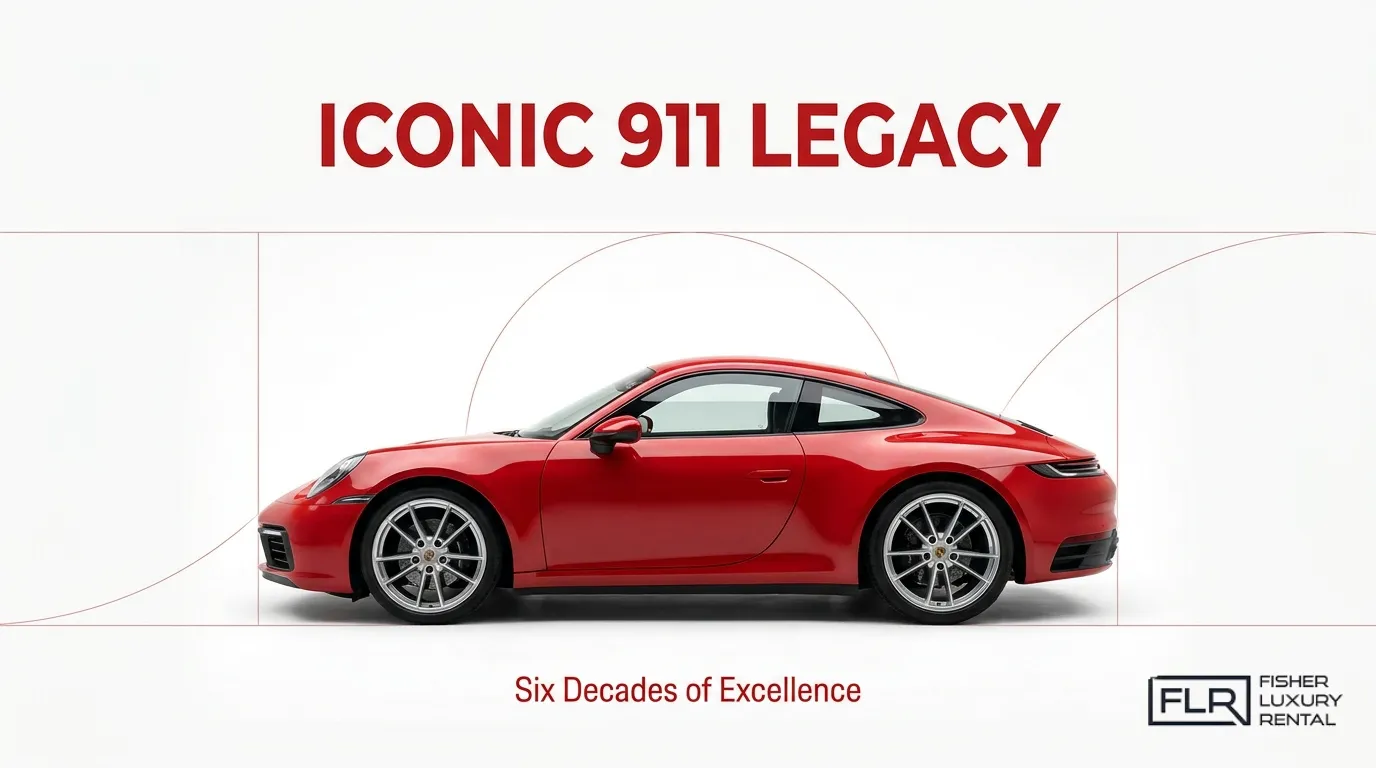
The Porsche 911 is a rear-engined sports car produced by Porsche AG since 1963, defined by a flat-six engine, an unmistakable silhouette, and a continuous line of development that has never required a ground-up redesign.
This guide covers the 911’s core identity, its generational history, the full model range, how individual variants compare, its motorsport legacy, what it’s like to drive, and how to experience one firsthand.
The 911’s identity stems from three inseparable elements: its rear-engine layout, recognizable fastback profile, and high-revving flat-six. Together, these traits create a driving character no front- or mid-engine car replicates.
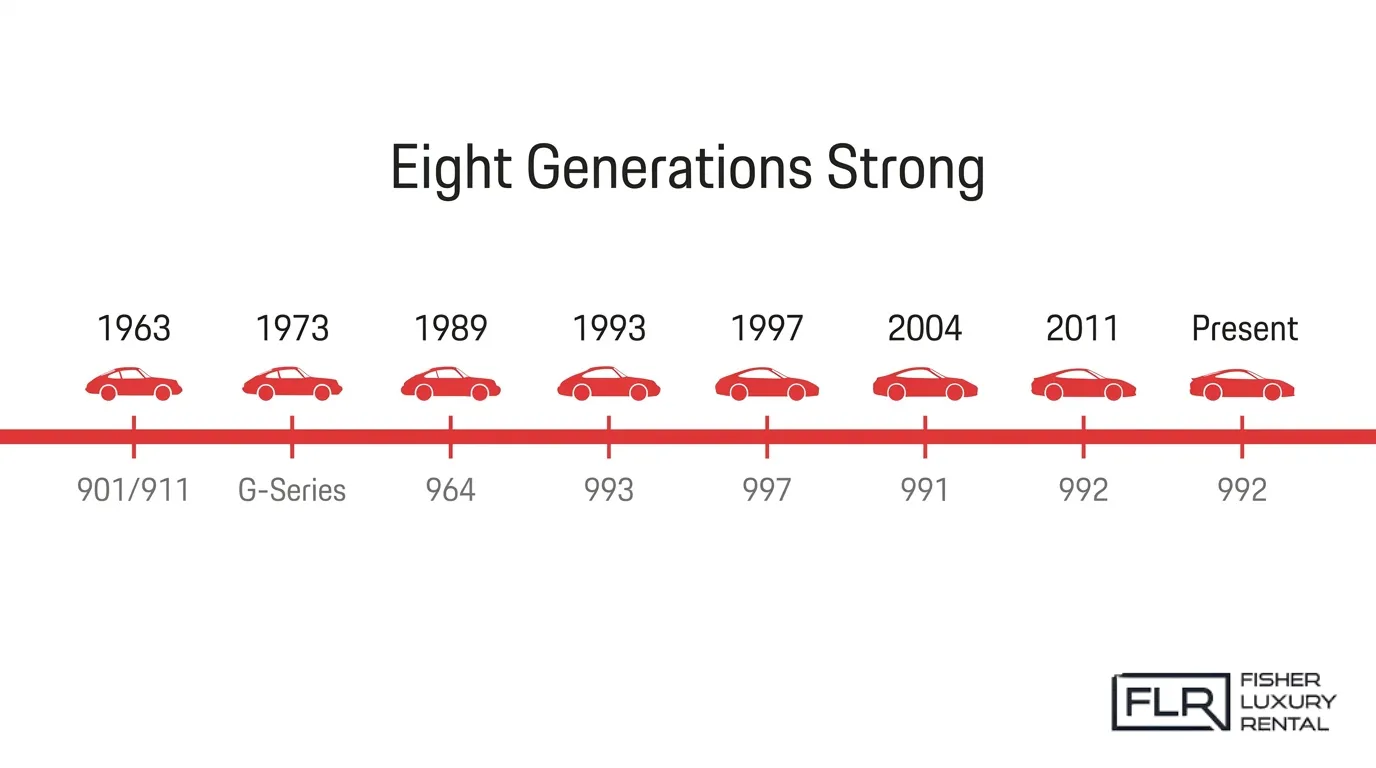
Six decades of production history span from the original 901 prototype through eight distinct generations, including the air-cooled era, the controversial water-cooled transition with the 996, and the current 992 series. Each generation preserved the rear-engine architecture while advancing technology, performance, and emissions compliance.
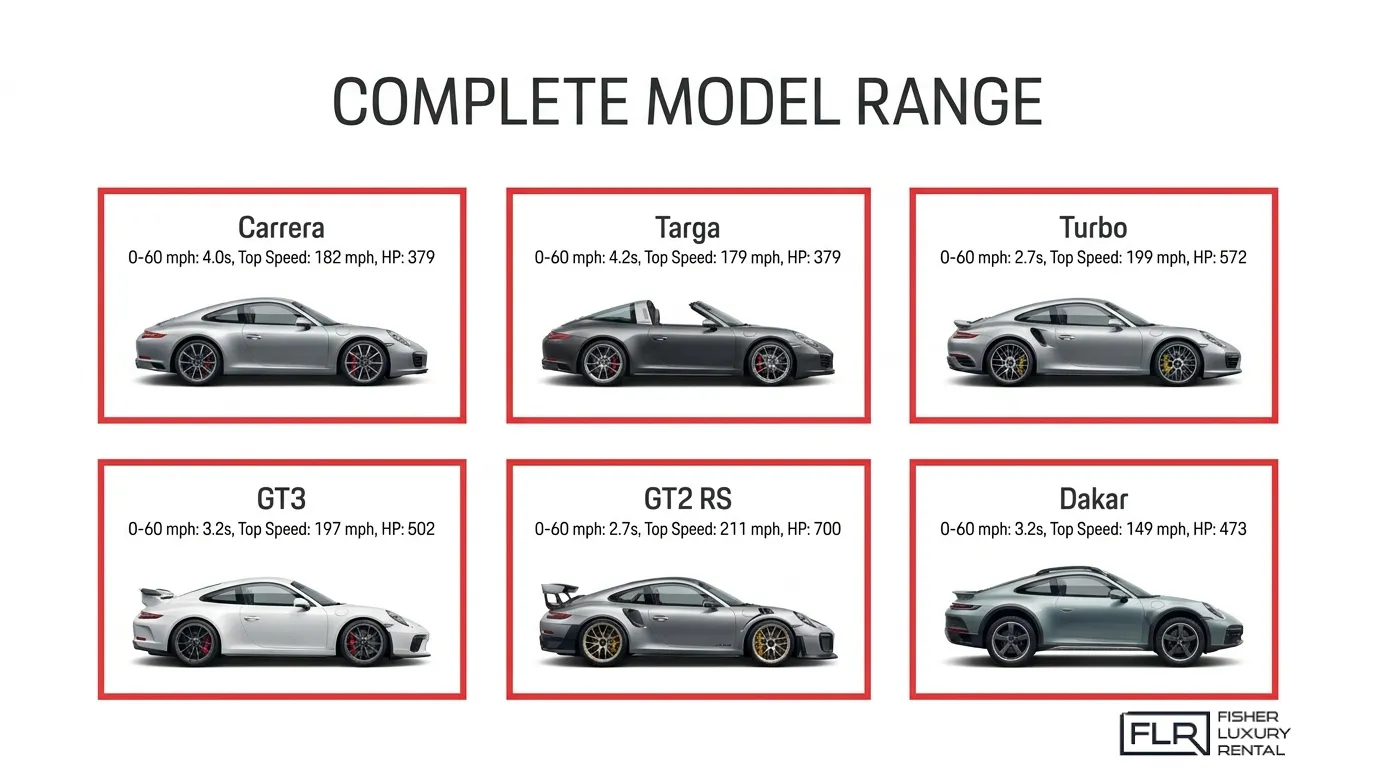
The 911 model range runs from the 388 hp base Carrera to the 211 mph GT2 RS, with the Targa, Turbo, GT3, GT3 RS, and off-road Dakar filling the space between. Each variant is engineered for a distinct purpose, from everyday grand touring to circuit-focused performance.
Beyond the hardware, the 911 holds a motorsport record no competitor has matched and remains genuinely capable as a daily driver in standard trim. For those not ready for ownership, rental offers a direct path to the experience without the maintenance costs that come with it.
What Defines the Porsche 911’s Identity?
The Porsche 911’s identity rests on three inseparable elements: its rear-engine layout, unmistakable silhouette, and flat-six engine. Each heading below examines how these defining traits work together to make the 911 unlike any other sports car.
What Makes the Rear-Engine Layout Iconic?
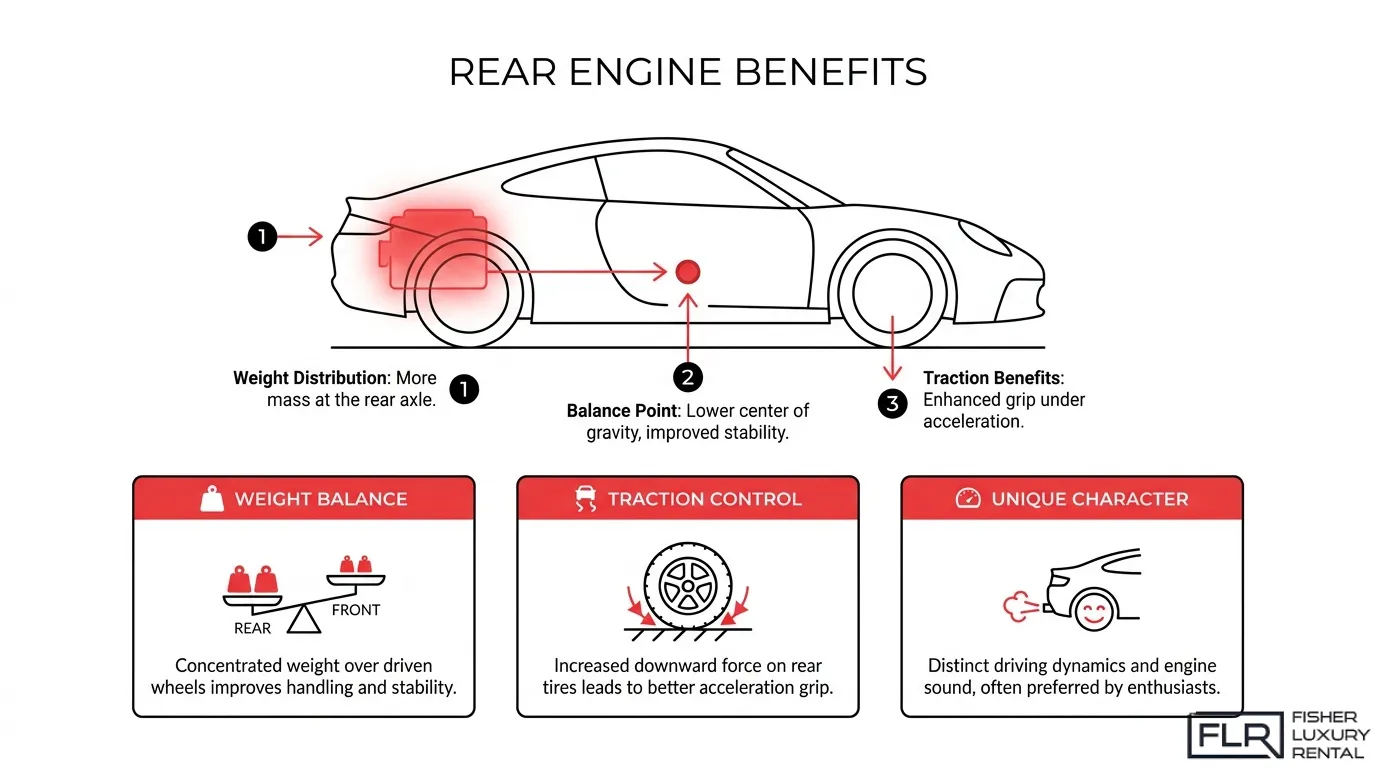
The rear-engine layout is iconic because it directly shapes every dimension of the 911’s design and driving character. Placing the engine behind the rear axle concentrates mass at the back, creating a distinctive pendulum balance that no front- or mid-engine car can replicate. According to Porsche AG, chief designer Michael Mauer, who has led Porsche’s design for over 20 years, stated plainly: “If I had to fundamentally change the layout, it wouldn’t be a 911 anymore.” The layout is not merely an engineering choice; it is the structural DNA from which the car’s proportions, rear-weighted traction, and visual identity are derived.
Why Is the 911 Silhouette So Recognizable?
The 911 silhouette is recognizable because its roofline, fender arches, and proportions have remained consistent across every generation since 1963. The fastback profile, wide rear haunches, and sloping hood create a shape that is immediately legible at a distance. While each generation has grown wider and more sculpted, the fundamental outline has never been redesigned from scratch. This deliberate visual continuity is rare in the automotive world, and it is a key reason the 911 functions as a rolling brand emblem as much as a performance car.
What Role Does the Flat-Six Engine Play in the 911?
The flat-six engine plays the role of performance anchor and acoustic signature in the 911. Its horizontally opposed cylinder configuration sits low in the chassis, contributing to a center of gravity that benefits handling. The engine’s capability ceiling is substantial: the naturally aspirated 4.0-litre flat-six introduced with the 2011 997 GT3 RS 4.0 used a crankshaft derived from the RSR race car, with increased stroke dimensions, to produce 500 PS (493 hp) at 8,250 rpm, according to Wikipedia. Beyond outright power, the flat-six’s distinctive high-revving sound is as much a part of the 911’s identity as its shape.
What Is the History of the Porsche 911?
The history of the Porsche 911 spans more than six decades, beginning with a family-driven design vision in the early 1960s. The following sections cover its origins, the air-cooled era, the pivotal shift to water cooling, and the modern generation’s ongoing evolution.
How Did the Porsche 911 Originate in the 1960s?
The Porsche 911 originated in the early 1960s as a direct successor to the 356, designed by F.A. Porsche, son of company founder Ferry Porsche. According to Porsche AG, F.A. Porsche and his team positioned the engine at the rear, a configuration that has remained a defining constant through every subsequent generation. The car was initially marketed as the Porsche 901, referencing its internal project number, before French automaker Peugeot objected, claiming exclusive rights to three-digit names with a zero in the middle. Only 82 cars carried the 901 badge before Porsche renamed the model 911.
How Did the 911 Evolve Through the Air-Cooled Era?
The air-cooled era of the Porsche 911 spans roughly 1963 to 1998, encompassing several distinct generations, including the G-Series, 964, and 993. Throughout this period, Porsche progressively expanded engine displacement, added turbocharging with the 930, and introduced all-wheel drive with the 964 Carrera 4. The 993, produced from 1994 to 1998, is widely regarded as the pinnacle of the air-cooled lineage, earning collector status that continues to command significant market premiums today.
What Changed When the 911 Moved to Water-Cooled Engines?
The shift to water-cooled engines occurred between the 993 and the 996, driven by tightening emissions regulations that made air-cooled compliance increasingly difficult, according to Renn Driver. The 996, produced from 1998 to 2005, introduced a liquid-cooled flat-six and a significantly redesigned body. Porsche produced 175,262 Type 996 vehicles between 1997 and 2005, marking the opening chapter of the water-cooled era. While purists initially resisted the change, water cooling enabled greater power output, cleaner emissions, and ultimately expanded the 911’s global audience.
How Has the Modern 911 Continued to Evolve?
The modern Porsche 911 has continued to evolve through the 997, 991, and current 992 generations, each introducing greater technology integration while preserving the rear-engine architecture. Advances include turbocharged engines across the entire Carrera range starting with the 991.2, wider bodies, adaptive aerodynamics, and enhanced driver assistance systems. The 992 generation, launched in 2019, added a new wet mode, a wider front track, and a fully redesigned interior with a larger touchscreen. Despite these updates, the essential character of the 911 has remained intact across every revision.
What Are the Porsche 911 Generations?
The Porsche 911 generations span more than six decades, from the original 1963 debut to the current 992 series. Each generation introduced meaningful technical or design advances while preserving the 911’s rear-engine identity.
901 and Original 911 (1963–1973)
The 901 and original 911 represent the founding generation of Porsche’s most iconic nameplate. According to Porsche AG, F.A. Porsche and his team designed the original car with a rear-engine layout that has remained a defining constant ever since. The 901 name was short-lived: Peugeot held exclusive rights in France to three-digit names with a zero in the middle, forcing the rename to 911 after just 82 examples.
G-Series 911 (1974–1989)
The G-Series 911 is the longest-running single generation in the nameplate’s history, produced across 15 model years. It introduced the now-iconic impact-absorbing bumpers required by new safety regulations and expanded the turbocharged lineup with the legendary 930 Turbo. This era solidified the 911’s reputation as both a road car and a motorsport platform.
964 (1989–1994)
The 964 generation brought the most substantial engineering refresh the 911 had received to that point. It introduced all-wheel drive in the Carrera 4, power steering, and ABS as standard features, modernizing the driving experience considerably. Despite sharing roughly 85% new components with its predecessor, the 964 retained unmistakable 911 proportions.
993 (1995–1998)
The 993 is the last air-cooled Porsche 911 ever produced, making it the most sought-after collector generation. Its multi-link rear suspension replaced the older semi-trailing arm setup, dramatically improving handling stability. Because it closes the air-cooled chapter, values for a 993 Carrera range approximately from $80,000 to $140,000, reflecting a strong collector premium.
996 (1999–2004)
The 996 generation marks the first water-cooled Porsche 911, a transition driven by tightening global emissions regulations. Porsche produced a total of 175,262 Type 996 vehicles between 1997 and 2005, according to the Porsche Newsroom. Despite its commercial success, the 996 sits at the lower end of the collector value scale due to the IMS bearing concern that affected earlier examples.
997 (2005–2012)
The 997 generation restored design continuity by returning to round headlights and a more classically shaped front fascia that the 996 had abandoned. It refined the water-cooled platform significantly and introduced the naturally aspirated 4.0-litre flat-six in the GT3 RS 4.0, producing 500 PS at 8,250 rpm. The 997 is widely regarded as the generation that reconciled the 996’s controversial design with purist expectations.
991 (2012–2019)
The 991 generation delivered the most dimensionally and technologically advanced 911 yet, growing slightly in wheelbase for improved stability and introducing electric power steering for the first time. Mid-generation updates brought turbocharged engines to the standard Carrera lineup, replacing the naturally aspirated flat-six across base models. The 991 marked a definitive shift toward greater efficiency without sacrificing performance.
992 (2019–Present)
The 992 is the current Porsche 911 generation, combining modern driver-assistance technology with the widest performance spread the nameplate has ever offered. Fisher Luxury Rental, which specializes in top-trim luxury and exotic vehicles, provides access to current-generation models in the Phoenix and Portland areas for drivers who want to experience the latest iteration firsthand. The base 2025 Carrera delivers 388 hp from $135,500, while range-topping variants push well beyond 500 hp. For enthusiasts who want the most refined, capable, and connected 911 ever built, the 992 represents the clearest expression of six decades of continuous development.
What Are the Different Porsche 911 Models?
The different Porsche 911 models span entry-level Carreras to track-focused GT variants, each engineered for a distinct driving purpose. The sub-sections below cover the Carrera, Carrera S and GTS, Targa, Turbo and Turbo S, GT3 and GT3 RS, GT2 RS, and Dakar.
Porsche 911 Carrera
The Porsche 911 Carrera is the entry point into the 911 lineup, balancing everyday usability with genuine sports car performance. According to Porsche USA, the 2025 911 Carrera starts at $135,500 and delivers 388 hp, while the Carrera S steps up to 473 hp with a starting price of $156,200. For drivers who want the 911 experience without committing to a specialized track or off-road variant, the Carrera remains the most accessible and versatile choice in the range.
Porsche 911 Carrera S and GTS
The Porsche 911 Carrera S and GTS represent progressive performance upgrades within the Carrera family. The Carrera S produces 473 hp, adding sharper suspension tuning and wider body styling over the base Carrera. The GTS pushes further, combining higher output, sport-tuned chassis settings, and standard performance equipment that would otherwise require costly options on lower trims. Of the two, the GTS offers the most compelling balance of daily drivability and track-ready capability.
Porsche 911 Targa
The Porsche 911 Targa is the open-air variant of the 911, distinguished by its iconic roll bar and retractable roof section. At the top of the Targa range, the Targa 4 GTS produces 532 hp and 449 lb-ft of torque, sprinting from 0 to 60 mph in 3.0 seconds and reaching a top track speed of 194 mph, per Porsche USA. The Targa delivers a convertible-like experience without fully compromising the 911’s structural rigidity.
Porsche 911 Turbo and Turbo S
The Porsche 911 Turbo and Turbo S are the high-performance, all-weather variants of the lineup, combining forced induction with all-wheel drive for exceptional real-world performance. The Turbo S sits above the standard Turbo with higher boost pressure, upgraded brakes, and additional aerodynamic features. Both models use twin-turbocharged flat-six engines and are widely regarded as the most capable everyday performance cars in the 911 family.
Porsche 911 GT3 and GT3 RS
The Porsche 911 GT3 and GT3 RS are naturally aspirated, track-focused variants developed directly from Porsche’s motorsport program. The GT3 uses a high-revving flat-six engine, a race-derived suspension, and a fixed rear wing. The GT3 RS amplifies every element further, adding more aggressive aerodynamics, wider bodywork, and a stiffer chassis suited for circuit driving. For enthusiasts who prioritize driver engagement and track performance above all else, the GT3 RS is the benchmark within the 911 lineup.
Porsche 911 GT2 RS
The Porsche 911 GT2 RS is the most extreme and powerful production 911 Porsche currently offers. The 2026 GT2 RS accelerates from 0 to 60 mph in 2.7 seconds and reaches a top track speed of 211 mph, according to Porsche North Houston. Unlike the GT3 RS, the GT2 RS uses a twin-turbocharged engine paired with rear-wheel drive, demanding a higher level of driver skill and delivering a correspondingly more intense driving experience.
Porsche 911 Dakar
The Porsche 911 Dakar is a purpose-built, off-road-capable variant of the 911, inspired by Porsche’s 1984 Paris-Dakar rally victory. It features raised suspension, standard all-wheel drive, underbody protection, and all-terrain tires while retaining the 911’s flat-six powertrain and rear-engine layout. The Dakar demonstrates that Porsche continues to expand the 911’s boundaries well beyond traditional tarmac applications, making it the most unconventional model in the current lineup.
What Is the Difference Between a 911 Carrera and a 911 Turbo?
The difference between a 911 Carrera and a 911 Turbo comes down to intent: the Carrera is the accessible, everyday sports car, while the Turbo is a forced-induction performance flagship. Both share the same rear-engine flat-six architecture, but they diverge sharply in power output, all-wheel drive configuration, aerodynamics, and price.
The Carrera uses a naturally aspirated or lightly turbocharged engine tuned for balance and daily usability. The Turbo adds twin turbochargers, wider body panels, an active rear spoiler, and standard all-wheel drive, producing significantly more power and delivering supercar-level acceleration. Wider fenders, larger intakes, and a more aggressive stance make the Turbo visually distinct even to a casual observer.
For buyers considering used models, generation matters considerably. According to Renn Driver, a 993-generation Carrera commands $80,000 to $140,000 due to its status as the last air-cooled 911, while a 996 sits between $25,000 and $50,000, weighed down by IMS bearing concerns and its polarizing water-cooled transition.
The Turbo represents the upper boundary of what the 911 platform can deliver without entering full GT-spec territory. For most drivers, the Carrera offers the purest 911 experience; the Turbo offers more of everything at a meaningful cost premium.
What Makes the Porsche 911 GT3 Special?
The Porsche 911 GT3 is a track-focused variant of the 911 built around a naturally aspirated high-revving flat-six engine, motorsport-derived suspension, and rear-wheel drive. Unlike the Turbo, the GT3 prioritizes driver engagement and precision over straight-line speed, making it the purist’s choice within the 911 lineup.
The GT3’s identity comes from its racing DNA. Porsche engineers the GT3 directly from GT racing programs, carrying over components from competition machinery into a road-legal package. Every detail, from the fixed rear wing to the mechanical steering feel, reflects a deliberate choice to preserve raw driving connection over comfort or convenience. For enthusiasts who want a car that communicates every road input honestly, the GT3 represents the clearest expression of what the 911 can be. For enthusiasts curious about how different 911 variants actually feel from the driver’s seat, rental services like Fisher Luxury Rental offer a practical way to compare trims before committing to a purchase.
How Does the Porsche 911 Compare to Other Sports Cars?
The Porsche 911 compares to other sports cars through a combination of unmatched motorsport heritage, distinctive rear-engine engineering, and a breadth of variants covering everything from grand-touring daily drivers to track-focused race cars. The sections below examine its competitive standing across racing pedigree, ownership costs, and track access.
Racing Pedigree vs. Competitors
The Porsche 911 holds a motorsport record no competitor has matched. According to Stuttcars, Porsche has accumulated 19 overall wins and 108 class wins at the 24 Hours of Le Mans, a record unmatched by any other manufacturer in the race’s history. Few rivals can point to a single model nameplate so directly tied to decades of endurance racing success. That lineage translates directly into road-car credibility, giving the 911 a competitive authority that purpose-built exotic rivals from Ferrari, Lamborghini, and McLaren must work harder to claim.
Insurance and Running Costs vs. Similar Coupes
The Porsche 911 costs more to insure than most comparable coupes. According to The Zebra, 911 owners pay an average of $274 per month for insurance, compared to $245 per month for typical coupes. While the gap is modest relative to the 911’s performance capability, it is a real ownership consideration when stacking the car against alternatives like the Chevy Corvette or BMW M4 at lower price points.
Track Access Compared to Other Brands
The Porsche 911 benefits from a dedicated performance driving infrastructure that most competing brands do not offer at the same scale. The Porsche Track Experience at Barber Motorsports Park in Birmingham, Alabama, features a 2.38-mile, FIA-certified circuit with 16 corners and more than 80 feet of elevation change, purpose-built to showcase the car’s capabilities. Few manufacturers provide buyers with structured, brand-run programs at circuits of this caliber.
Why Has the Porsche 911 Dominated Motorsport?
The Porsche 911 has dominated motorsport through a rare combination of mechanical consistency, engineering refinement, and race-proven durability. Its rear-engine layout, flat-six architecture, and continuous development across decades have produced results no competitor has matched.
According to Stuttcars, Porsche has achieved 19 overall wins and 108 class wins at the 24 Hours of Le Mans, a record unmatched by any other manufacturer in the race’s history. That breadth of class victories is the more telling number: it reflects dominance across every era, not just a handful of headline results. In 1998, Laurent Aïello, Allan McNish, and Stéphane Ortelli claimed the overall win driving a Porsche 911 GT1, cementing the 911’s place among the most successful race cars ever built.
What makes that record genuinely remarkable is that the 911 achieved it without becoming a purpose-built prototype disconnected from its road car DNA. Every racing variant, from the early RSR to the GT1, retained recognizable 911 architecture, which means each competition success reinforced the identity of the road car rather than diverging from it. Few manufacturers can claim that kind of alignment between what wins races and what customers drive home.
What Should You Know About Driving a Porsche 911?
Driving a Porsche 911 is an experience shaped by its rear-engine balance, precise steering, and flat-six soundtrack. The sections below cover how the car feels on the road and whether it works as an everyday vehicle.
What Does a Porsche 911 Feel Like on the Road?
A Porsche 911 feels like a car that rewards attention. The rear-engine weight distribution pushes the rear wheels into the road under acceleration, creating a planted, confidence-inspiring sensation that is difficult to replicate in front-engined sports cars. Steering is direct and communicative, feeding road texture back through the wheel without feeling nervous at highway speeds. The flat-six engine produces a distinctive mechanical wail that rises through the rev range, making even routine acceleration feel theatrical. Most drivers find the 911 accessible enough for a newcomer to enjoy yet nuanced enough to keep an experienced driver engaged.
Is the Porsche 911 a Good Daily Driver?
The Porsche 911 is a genuinely capable daily driver, particularly in Carrera trim. Ride quality in standard suspension mode is firm but absorbent enough for commuting, and the cabin offers reasonable luggage space in the front trunk. However, the range extends all the way to track weapons. According to Porsche North Houston, the 2026 911 GT2 RS reaches 60 mph in 2.7 seconds and tops out at 211 mph, making some variants far better suited to a circuit than a school run. For most buyers, the Carrera or Carrera S strikes the right balance between everyday comfort and weekend performance.
How Can You Experience a Porsche 911 Firsthand?
You can experience a Porsche 911 firsthand through official Porsche Experience Centers, track events, or luxury rental services. The sections below cover renting a 911 through Fisher Luxury Rental and key takeaways from the full article.
Can You Rent a Porsche 911 from Fisher Luxury Rental?
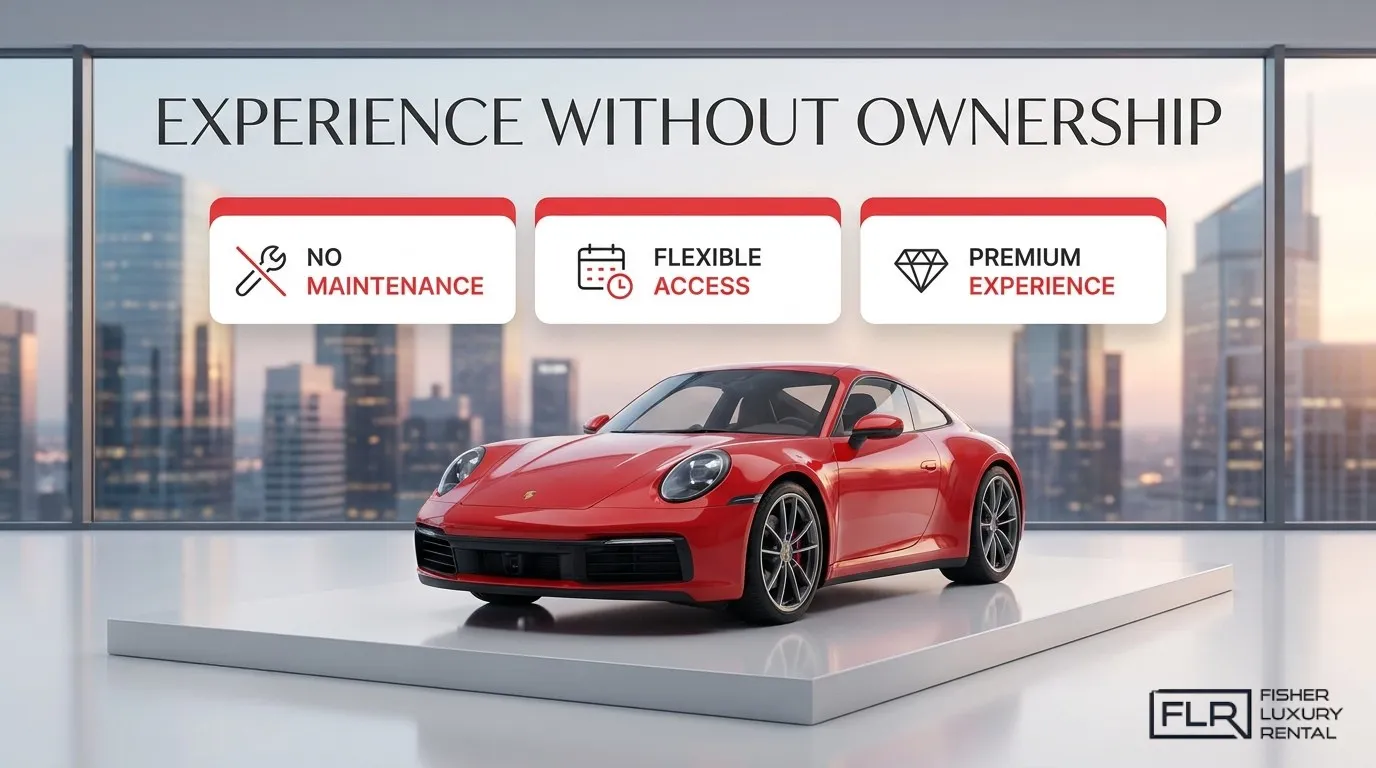
Yes, you can rent a Porsche 911 from Fisher Luxury Rental, which offers exotic and luxury vehicles in Phoenix, AZ, Scottsdale, AZ, Portland, OR, and Vancouver, WA. Renting removes the barriers of ownership entirely. Routine dealership service and maintenance costs can add up significantly over time, making rental an appealing alternative for drivers who want the experience without an ongoing financial commitment. The global luxury car rental market reflects strong demand, valued at USD 52.82 billion in 2025 and projected to reach USD 125.98 billion by 2034, per Fortune Business Insights. Fisher Luxury Rental specializes in top-trim models of luxury and exotic vehicles, meaning you access a high-specification driving experience without the long-term commitment of ownership.
What Are the Key Takeaways About the Porsche 911?
The key takeaways about the Porsche 911 are that it is defined by a rear-engine layout, continuous generational evolution, and a motorsport legacy unmatched in endurance racing. Its model range spans from the accessible Carrera to the track-focused GT2 RS, covering a broad spectrum of performance needs. Ownership carries real costs in maintenance and insurance, making rental a practical alternative for drivers who want the experience without the financial commitment. The 911’s silhouette has stayed recognizable for over 60 years while its engineering has advanced with every generation. For anyone drawn to the car, driving one remains the most direct way to understand why its reputation has endured. Fisher Luxury Rental offers exotic and luxury car rentals across Phoenix, Scottsdale, Portland, and Vancouver, providing a straightforward way to get behind the wheel of a 911 without the commitments of ownership.