The Ferrari V12 service schedule is a structured maintenance program built around annual, milestone, and time-based intervals designed to protect one of the most complex naturally aspirated engines in production road cars.
This guide covers routine service intervals, fluid requirements, timing belt and ignition maintenance, braking and tire systems, common engine issues, ownership costs, the Ferrari Classiche certification program, extended storage preparation, and how renting a Ferrari V12 compares to full ownership.
Ferrari V12 service follows a layered schedule, beginning with annual or 12,500-mile visits and expanding at 24, 36, and 48-month thresholds to include progressively deeper mechanical work.
Fluid maintenance is equally structured: engine oil requires Shell Helix Ultra 5W-40 on an annual cycle, brake fluid needs flushing every 12 months, and coolant replacement is due every two years.
The timing belt is one of the most consequential services on any belt-driven V12, with replacement intervals of three to four years or 30,000 to 40,000 miles; failure risks engine damage costing well into five figures. Spark plug and ignition health depend on OEM-specified NGK parts, correct installation in aluminum heads, and adherence to conservative replacement intervals.
Brake and tire maintenance carry substantial parts costs, particularly for carbon-ceramic rotors, while common V12 issues including exhaust manifold cracks and F1 gearbox actuator wear reward early detection.
Ownership costs range from $1,500 to $8,000 annually depending on model and service year, with dealer versus independent specialist choices shaping both cost and warranty exposure.
What Regular Service Intervals Does a Ferrari V12 Engine Require?
Ferrari V12 service intervals follow a structured schedule built around annual, bi-annual, and milestone thresholds. The sections below cover what happens at each key interval: the annual or 12,500-mile service, the major intermediate service, and the 5-year comprehensive service.
What Maintenance Is Due at the Annual or 12,500-Mile Service?
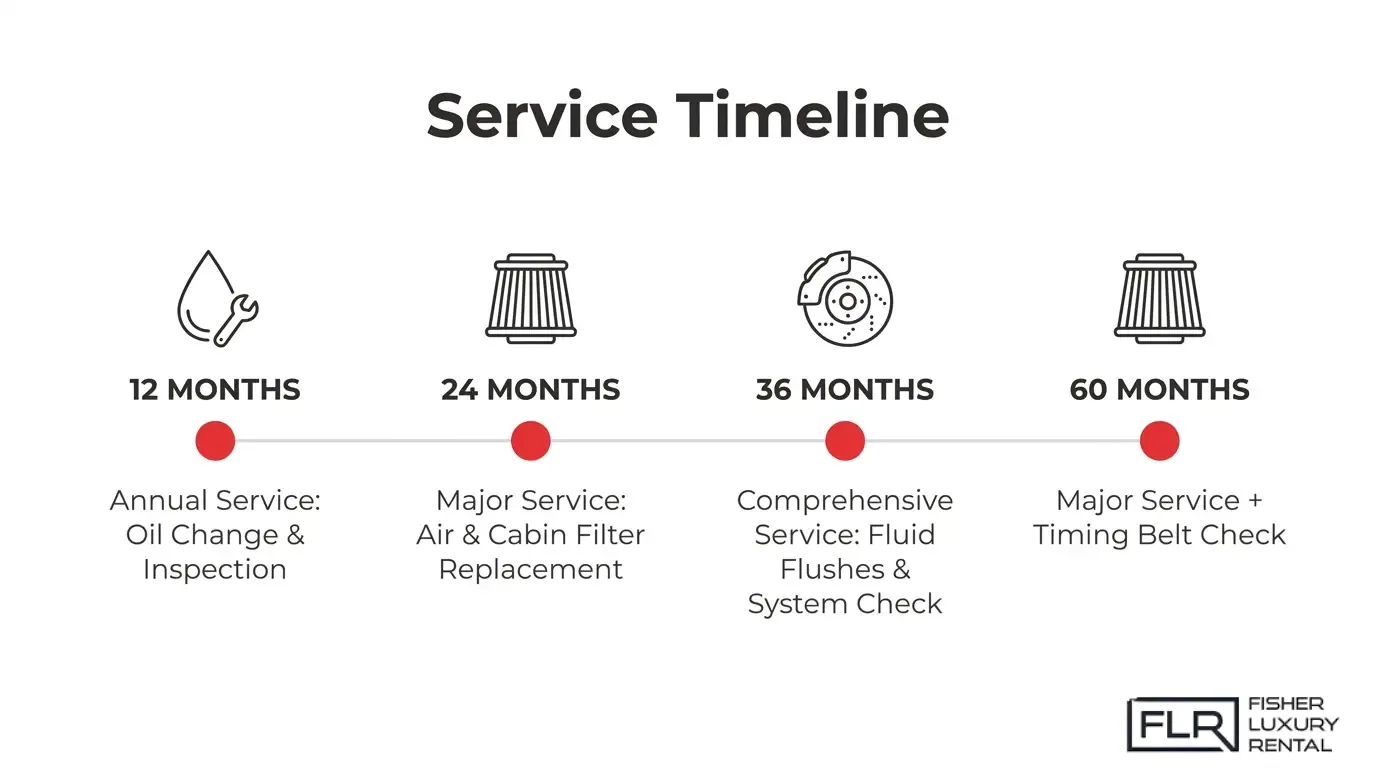
The maintenance due at the annual or 12,500-mile service covers the core systems that protect engine health and safety between major services. Ferrari recommends bringing your car in yearly or every 12,500 miles, whichever comes first, according to Ferrari Lake Forest. At this visit, technicians perform:
- Oil and filter change using Ferrari-approved synthetic oil
- Brake system inspection covering pads, rotors, and fluid levels
- Tire pressure and tread depth check
- Battery health check and charging system diagnostics
- Visual inspection of suspension components and undercarriage
- Spark plug inspection (replacement is due every 3 years or 37,500 miles)
Staying current with this interval is the single most important thing a V12 owner can do to prevent compounding wear.
What Additional Work Is Performed at the Major Service?
The major service, due every 24 months or 15,000 miles, expands significantly beyond the annual check. According to Twin Cities Performance Ferrari, this interval adds:
- Engine air filter replacement for peak performance
- Comprehensive coolant system check and fluid replacement
- Transmission fluid level inspection and top-off
- Steering and suspension alignment check
- Exhaust system inspection for leaks or irregularities
At 36 months or 22,500 miles, the schedule further adds a brake fluid flush, full electronic diagnostics and recalibration, cabin air filter replacement, software updates, and drivetrain lubrication.
What Does the 5-Year or 50,000-Mile Comprehensive Service Include?
The 5-year or 50,000-mile comprehensive service includes the deepest mechanical review in the standard rotation. By this interval, spark plugs require replacement, transmission fluid needs a complete change, the fuel system is inspected for injector and pump functionality, and powertrain mounts and bushings are assessed for stability. According to Marelli Service, all Ferrari ignition system services include a complete evaluation of every ignition component upon receipt. The exhaust valve actuator system is also inspected at this stage. This service essentially resets the wear baseline across all major drivetrain and ignition systems before the cycle begins again.
What Engine Oil and Fluid Changes Does a Ferrari V12 Need?
A Ferrari V12 requires specific oil grades, transmission fluid intervals, annual brake fluid flushes, and biennial coolant replacements to protect its high-tolerance engine. The H3 sections below cover each fluid type and its recommended service interval.
How Often Should You Change the Engine Oil in a Ferrari V12?
Engine oil in a Ferrari V12 should be changed annually or every 10,000 to 12,500 miles, whichever comes first. Ferrari owners manuals specify Shell Helix Ultra 5W-40 as the approved synthetic oil, with the recommendation to stick with 5W-40 unless operating in very cold conditions. According to Ferrari Life Forum data, the total system oil capacity is 10.0L, with a completely dry engine capacity of 11.45 litres and a 2.0L range between dipstick min and max marks. Using the correct grade and capacity matters enormously on a V12 — running even slightly low can accelerate wear across all twelve cylinders simultaneously.
When Should You Replace the Transmission Fluid?
Transmission fluid replacement intervals on a Ferrari V12 depend on the gearbox type. According to Ferrari owners group guidance, manual transmissions require a fluid change every 30,000 to 60,000 miles, while automatic transmissions extend that interval to 60,000 to 100,000 miles. Ferrari maintenance guidelines also recommend annual fluid changes as a conservative best practice, particularly for cars driven infrequently or stored seasonally.
How Often Does the Brake Fluid Need Flushing?
Brake fluid in a Ferrari V12 needs flushing annually. According to FerrariChat Forum maintenance guidelines, brake fluid should be changed every 12 months regardless of mileage. Brake fluid is hygroscopic, meaning it absorbs moisture over time, which lowers its boiling point and reduces stopping performance. On a high-performance V12 capable of generating significant heat through the braking system, degraded fluid is a genuine safety risk.
When Should You Change the Coolant in a Ferrari V12?
Coolant replacement is recommended every 2 years for Ferrari vehicles, according to FerrariChat Forum maintenance guidelines. The Ferrari V12’s cooling system operates under high thermal loads, and degraded coolant loses its corrosion-inhibiting properties, accelerating wear on aluminum engine components. Staying on a strict two-year cycle is one of the simplest and most cost-effective ways to protect a Ferrari V12 engine over the long term.
What Is the Ferrari V12 Timing Belt and Cam Belt Service?
The Ferrari V12 timing belt and cam belt service is a scheduled replacement of the rubber belts that synchronize the camshafts and crankshaft. The following sections cover replacement intervals, costs, and consequences of belt failure.
When Does the Timing Belt Need Replacement on a Ferrari V12?
The timing belt needs replacement every three to four years or 30,000 to 40,000 miles on a Ferrari V12, whichever comes first. According to AW Italian, some Ferrari variants may differ slightly from this window. Ferrari’s milestone services at 30,000 or 60,000 miles commonly bundle camshaft belt replacement with spark plug changes and drivetrain inspections, running $3,500 to $7,000. Because belts degrade with age as much as mileage, time-based adherence matters equally for low-mileage cars. This is one service interval where cutting corners carries serious mechanical consequences.
How Much Does a Ferrari V12 Timing Belt Replacement Cost?
A Ferrari V12 timing belt replacement cost rarely falls below $3,200 at a professional shop. Ferrari’s timing belt is often externally mounted on the engine, which simplifies access compared to typical street cars where the belt sits behind the water pump and timing cover. Despite that advantage, precision execution remains non-negotiable. According to Merlin Auto Group, poorly executed installation risks slamming a piston into a valve, with resulting engine repair costs reaching $20,000 to $30,000. Choosing an experienced Ferrari specialist over a general shop is worth every dollar on this particular job.
What Happens if a Ferrari V12 Timing Belt Fails?
A Ferrari V12 timing belt failure causes catastrophic engine damage. Once the belt snaps, the camshafts and crankshaft lose synchronization, and pistons can collide directly with valves. According to Matt’s Auto Service Center, this loss of synchronization is the most serious consequence of belt failure, as the resulting piston-valve collision can destroy the engine internally. Repair costs in this scenario routinely reach five figures. No symptom reliably warns you before a belt breaks, which makes proactive replacement the only reliable safeguard.
What Spark Plug and Ignition Maintenance Does a Ferrari V12 Need?
Spark plug and ignition maintenance on a Ferrari V12 requires a structured schedule covering replacement intervals, correct plug specifications, and coil pack health. The sections below address replacement timing, OEM parts selection, and installation best practices.
When Should Spark Plugs Be Replaced on a Ferrari V12?
Spark plugs on a Ferrari V12 should be replaced every 48 months or 30,000 miles to optimize engine efficiency, according to Twin Cities Performance Ferrari’s recommended maintenance schedule. Inspections at every annual or 12,500-mile service are also advised so worn plugs are caught early. For standard copper plugs, Go-Parts recommends inspecting annually and replacing every 10,000 to 15,000 miles, or sooner if performance issues appear. Given how many cylinders a V12 carries, staying ahead of wear intervals is genuinely cost-effective compared to diagnosing misfires later.
What Spark Plugs Does a Ferrari V12 Use?
The spark plug a Ferrari V12 uses is the NGK 93340, which is the OEM-specified part for these engines. Because a V12 requires twelve plugs per service, parts costs accumulate quickly, making bulk sourcing from a Ferrari specialist worthwhile. Sticking with the OEM specification protects ignition timing calibration and combustion consistency across all twelve cylinders.
How Should Spark Plugs Be Installed in a Ferrari V12?
Spark plugs in a Ferrari V12 should be installed with anti-seize compound and replaced on intervals shorter than extended schedules. FerrariChat forum contributors specifically warn that 100,000-mile plug change intervals cause thread damage in Ferrari’s tapered aluminum heads, particularly with the long-reach plugs used on these engines. Stripped plug threads in an aluminum head represent a serious and expensive repair, so conservative intervals and proper torque are non-negotiable on these engines.
What Brake System Maintenance Does a Ferrari V12 Require?
Ferrari V12 brake system maintenance requires brake pad inspections at every annual service, a brake fluid flush every 36 months or 22,500 miles, and rotor assessments timed to mileage and driving habits. The sections below cover pad replacement timing, carbon-ceramic rotor service intervals, and what each service involves.
When Should You Replace Brake Pads on a Ferrari V12?
Brake pads on a Ferrari V12 should be replaced every 20,000 to 30,000 miles, with a formal brake system inspection including pads, rotors, and fluid levels recommended at every 12-month or 10,000-mile service interval, according to Twin Cities Performance Ferrari.
Parts and labor costs are substantial. A FerrariChat forum discussion on a comparable Ferrari 458 reported front pad replacement at $2,600 and rear pads at $1,400, totaling $4,000 for a full set. V12 models with similar caliper architecture carry comparable pricing.
Driving style is the most decisive variable here. Owners who use their V12 on track days should plan for significantly shorter pad life than the standard street-driving interval suggests.
When Do Ferrari V12 Carbon-Ceramic Brake Rotors Need Service?
Ferrari V12 carbon-ceramic brake rotors need service or replacement once they exceed their usable lifespan, which on public roads runs 60,000 to 100,000 miles. By comparison, cast iron rotors last only 25,000 to 40,000 miles and degrade quickly under sustained heat, according to Europarts360.
The cost difference between the two rotor types is significant:
- Carbon-ceramic (CCM) rotors: $5,000 to $15,000+ per axle
- Cast iron rotors: $500 to $2,000 per axle
CCM rotors also offer exceptional track durability, making them the standard fitment on modern Ferrari V12 models. Because replacement costs are so high, protecting CCM rotors through correct brake pad selection and avoiding aggressive cold-brake use is worth prioritizing.
With rotor and pad service intervals understood, regular brake fluid maintenance keeps the hydraulic system performing reliably between those larger jobs.
What Tire and Suspension Maintenance Does a Ferrari V12 Need?
Tire and suspension maintenance for a Ferrari V12 covers tire replacement schedules, pressure monitoring, rotation, wheel alignment, and balancing. The sections below address each requirement with specific intervals and cost expectations.
How Often Should You Replace Tires on a Ferrari V12?
Tires on a Ferrari V12 should be replaced every 4 years per the Ferrari service manual, regardless of mileage. Driving style heavily influences actual wear, however, with high-performance Pirelli P Zero fitments lasting anywhere from 5,000 to 15,000 miles according to Ferrari Lake Forest. A replacement set typically costs $1,200 to $3,500. Given that V12 models like the 812 Superfast generate substantial power, aggressive driving compresses that range toward the lower end. Budgeting for tire replacement as a recurring annual cost is the most realistic approach for active owners.
How Often Should You Rotate Tires and Check Alignment?
Tire rotation on a Ferrari V12 should occur every 5,000 to 8,000 miles to promote even tread wear and extend tire life. Wheel alignment should be checked annually. Ferrari South Bay recommends a 4-wheel laser alignment as part of the normal maintenance routine, ensuring wheels travel in a straight line and reducing uneven wear. Tire balancing is required when purchasing new tires and periodically thereafter to ensure tires roll evenly. Skipping alignment checks on a high-performance chassis accelerates tire wear and compromises handling precision, making annual alignment checks one of the most cost-effective maintenance habits a V12 owner can maintain.
How Does the Ferrari Classiche Program Affect V12 Maintenance?
The Ferrari Classiche program affects V12 maintenance by requiring strict adherence to original specifications, turning routine upkeep into a formal certification process. Owners pursuing or maintaining certification must approach every service decision with originality in mind, covering eligibility, the assessment process, annual inspection requirements, and resale implications.
What Vehicles Are Eligible for Ferrari Classiche Certification?
Ferrari Classiche Certification is available for road cars over 20 years old, Special Series, Sport, and Ferrari F1 models, according to Ferrari’s official program guidelines. The certification traces the vehicle’s full history and verifies conformity to the original factory design, including the provenance of each individual component. For older V12 models such as the 365 GTB/4, Testarossa, and 456, this means every maintenance decision must preserve factory-correct parts to remain eligible.
How Does the Ferrari Classiche Certification Process Work?
The Ferrari Classiche Certification process works through four distinct steps designed to ensure a thorough assessment of the vehicle. According to Ferrari’s official certification guidelines, it begins with a detailed inspection by Ferrari Classiche itself or an authorized dealer, using photographs, measurements, and technical data to verify authenticity. Each step builds on the last, making the process considerably more rigorous than a standard pre-purchase inspection.
What Are the Ongoing Maintenance Requirements to Keep Classiche Status?
The ongoing maintenance requirements to keep Classiche status include an annual visit to a Classiche-authorized Ferrari dealership, where technicians verify that all original parts remain in place and in good condition. Per FerrariChat forum documentation of Ferrari’s updated rules, this yearly check is now mandatory rather than optional. In practice, this means owners cannot substitute non-original components during routine V12 servicing without risking their certification standing.
Does Classiche Certification Improve Resale Value?
Yes, Classiche certification does improve resale value for Ferrari owners. According to Ferrari of Greenwich, the certification can significantly improve market appeal and resale value for owners who plan to sell. Given that a certified car carries documented proof of originality across every component, it commands stronger buyer confidence, particularly in the collector and auction market where provenance directly influences price.
What Common V12 Engine Issues Should Owners Watch For?
Common V12 engine issues span exhaust manifold cracks, valve guide wear, and F1 gearbox actuator failure. Catching these early prevents far more expensive repairs down the line.
What Are the Signs of Exhaust Header and Manifold Problems?
The signs of exhaust header and manifold problems include loud startup noise, a foul smell, and a persistent ticking sound. These symptoms point to a cracked manifold, which demands immediate attention. According to PistonHeads UK, if a manifold crack goes undetected, the pre-cat begins to disintegrate and debris falls toward the exhaust ports, causing cascading internal damage. Catching a crack early is the difference between a repair and a full exhaust system rebuild.
How Do You Identify Valve Guide Wear on a Ferrari V12?
Valve guide wear on a Ferrari V12 typically shows up as blue-tinged exhaust smoke at startup, increased oil consumption, and a rough idle. Worn guides allow oil to seep past the valve stems and enter the combustion chamber. On a high-revving naturally aspirated V12, where valvetrain precision is critical, even minor guide degradation accelerates wear on adjacent components. Regular compression and leak-down testing during annual services is the most reliable way to catch this early.
What Should You Know About F1 Gearbox Actuator Wear?
F1 gearbox actuator wear produces hesitant, jerky, or failed gear changes in Ferrari’s semi-automatic transmission system. According to FerrariChat, almost all shifting issues on F430 F1 units trace back to a failing accumulator or, more commonly, worn shift potentiometers. These are wear items that respond well to proactive replacement rather than waiting for full failure. Addressing actuator wear early avoids the significantly higher cost of gearbox removal and full hydraulic system repair.
How Much Does Ferrari V12 Maintenance Cost Over Time?
Ferrari V12 maintenance costs vary significantly by model generation, ownership stage, and driving intensity. The two H3 sections below break down typical annual figures and how older carbureted V12s compare to modern fuel-injected examples.
What Are Typical Annual Maintenance Costs for a Ferrari V12?
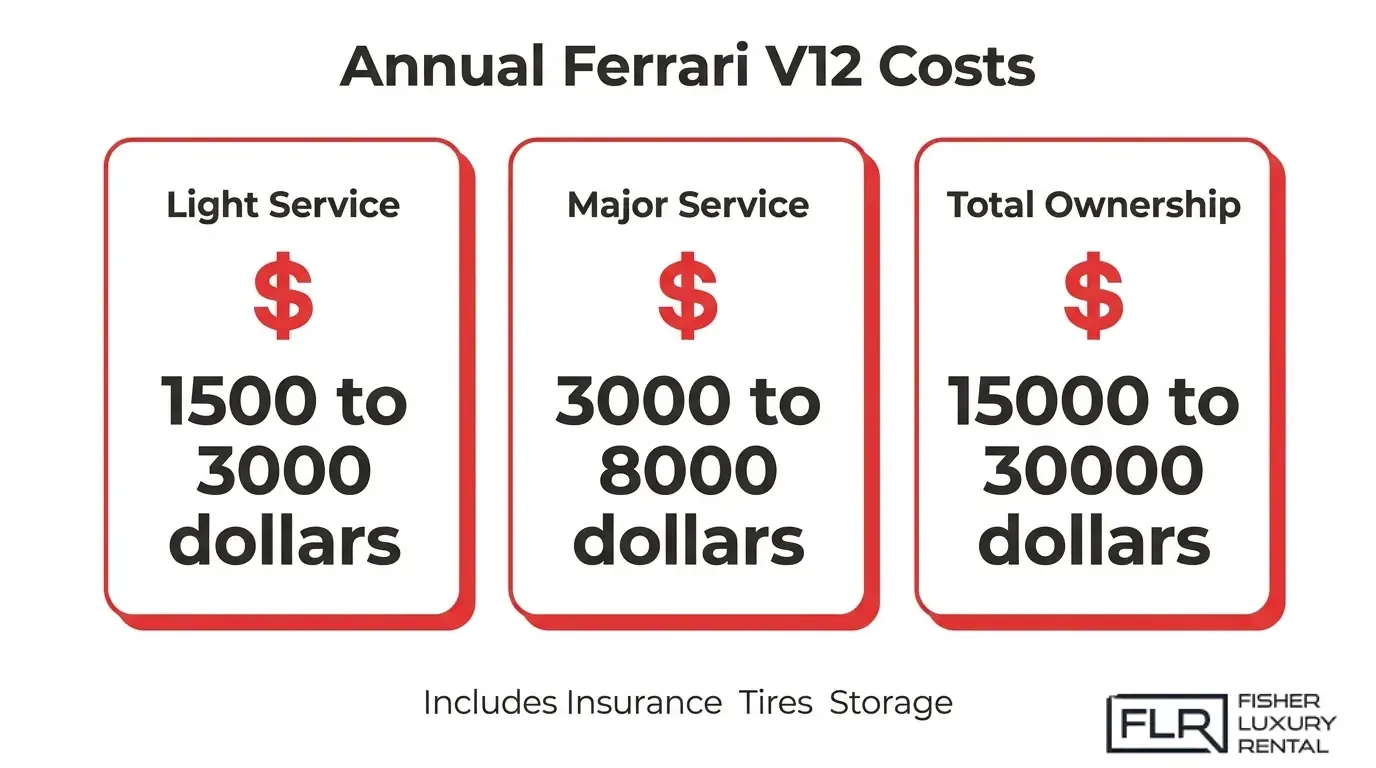
Typical annual maintenance costs for a Ferrari V12 range from $1,500 to $8,000, depending on the model, mileage, and service year. Light years involving only an oil change and inspection sit at the lower end, while years requiring major work climb considerably higher.
According to iLusso, most Ferrari models land in the $3,000 to $8,000 range annually, with some years being lighter. Ferrari Lake Forest reports that once the seven-year Ferrari Genuine Maintenance program expires, annual costs generally run $1,500 to $3,000, with complex service years exceeding that. For modern V12s like the F12berlinetta and 812 Superfast, dealer annual service runs approximately $1,500 based on 599 service specifications.
The real costs accumulate when insurance ($3,000 to $7,800 annually), tires, and storage are factored in. In total, most Ferrari owners spend $15,000 to $30,000 per year across all ownership expenses.
How Do Older Carbureted V12 Costs Compare to Modern V12 Costs?
Older carbureted Ferrari V12s generally cost less to maintain annually than modern fuel-injected equivalents. According to PistonHeads UK, running an older Ferrari V12 averages under £3,000 per year across the life of the car.
Carbureted engines use simpler, more accessible components; parts are widely available and less expensive to source. Modern V12s like the 812 Superfast use complex fuel injection, advanced electronics, and proprietary diagnostics that drive labor and parts costs higher. That said, older V12s can present hidden costs through age-related wear, seal deterioration, and sourcing obsolete components.
For buyers weighing entry cost against running costs, older V12s offer lower annual overhead but require careful pre-purchase inspection to avoid expensive surprises.
Should You Use a Ferrari Dealer or Independent Specialist?
The choice between a Ferrari dealer and an independent specialist depends on your car’s warranty status, the complexity of the work required, and your priorities around documentation and cost.
Key considerations covered below include warranty implications, diagnostic tool access, and cost differences.
What Are the Warranty Implications of Choosing an Independent Specialist?
The warranty implications of choosing an independent specialist are significant if your Ferrari is still within its factory coverage period. Every new Ferrari carries a 3-year factory warranty with unlimited mileage. According to the FerrariChat Forum, owners have no warranty protection on their Ferrari if the car was purchased from a broker or independent dealer after that original 3-year factory period has elapsed. Servicing outside the authorized dealer network during an active warranty can further complicate or void coverage. For out-of-warranty cars, the stakes shift: independent specialists can perform equivalent work, often at lower cost, without any warranty exposure to protect.
Do Independent Specialists Have Access to Ferrari Diagnostic Tools?
Independent specialists can access Ferrari diagnostic tools, but with important limitations. The Ferrari SD3 diagnostic system covers all models from the 348 onwards and requires an annual subscription of approximately 1,000 euros paid directly to Ferrari. Reputable independent shops invest in this system, but not all do. Before committing to an independent specialist for electronic diagnostics or ECU recalibration, confirming their SD3 access is a practical first step that most owners overlook.
How Do Dealer and Independent Service Costs Compare?
Dealer service costs are generally higher than independent specialist rates for equivalent work. For context, the F12 annual service runs approximately $1,500 at the dealer. Qualified independent specialists typically charge less for the same scope. For older, out-of-warranty V12 models, an experienced independent with Ferrari-specific credentials and SD3 access often delivers comparable quality at meaningfully lower cost.
How Do You Maintain a Ferrari V12 During Extended Storage?
Maintaining a Ferrari V12 during extended storage requires pre-storage fluid changes, battery management, fuel stabilization, and tire preparation. The steps below cover each critical area.
What Fluids Should You Change Before Storing a Ferrari V12?
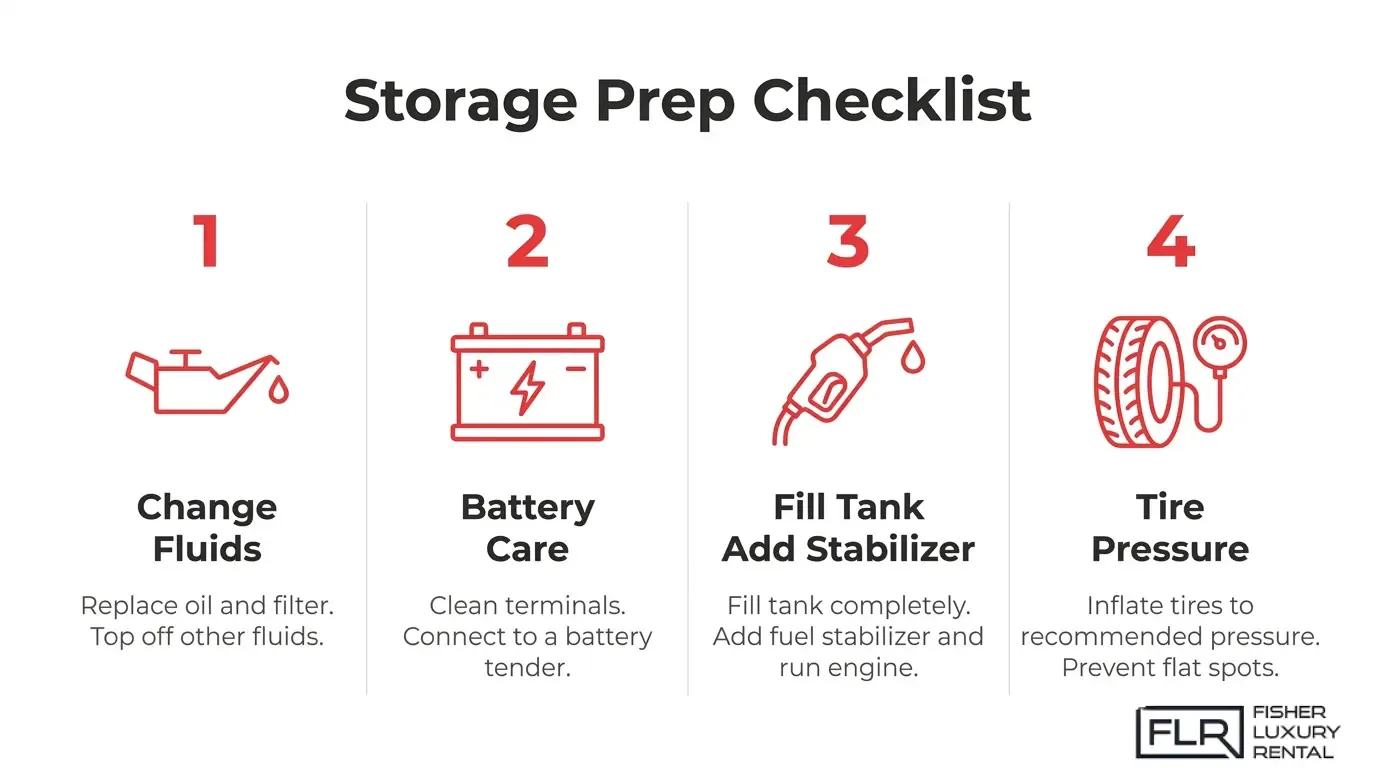
The fluids you should change before storing a Ferrari V12 are engine oil, antifreeze, and transmission fluid. Used fluids contain contaminants that cause internal component damage when left sitting for weeks or months. According to Ferrari Lake Forest, these contaminated fluids must be replaced before storage, as degraded oil and coolant accelerate corrosion in the V12’s precision internals during dormancy.
How Do You Manage the Battery During Ferrari V12 Storage?
Battery management during Ferrari V12 storage requires maintaining the state of charge at approximately 50% when storing longer than 30 days. A fully charged or fully depleted battery both accelerate cell degradation. Connecting a quality trickle charger or battery tender is the most practical approach for protecting the electrical system during seasonal storage.
How Should You Prepare the Fuel System for Long-Term Storage?
You should prepare the Ferrari V12 fuel system by filling the tank completely and adding a fuel stabilizer. A partial or empty tank leaves moisture that causes rust inside the fuel system, damaging the engine during recommissioning. Add the recommended amount of stabilizer, then drive the car for approximately 10 to 15 minutes so it mixes thoroughly with the fuel.
How Do You Protect Ferrari V12 Tires During Storage?
Protecting Ferrari V12 tires during storage requires cleaning them to remove brake dust and corrosive debris, then inflating them to the correct PSI. Flat spots develop when the car sits stationary under its own weight for extended periods. Tire flatspotting is often underestimated as a storage risk, but proper inflation and periodic repositioning of the vehicle effectively prevent it.
How Can You Experience a Ferrari V12 Without the Maintenance Burden?
Experiencing a Ferrari V12 without ownership responsibilities comes down to two practical paths: renting through an exotic car company or leveraging Ferrari’s factory programs. The sections below cover both options and distill the key maintenance lessons from this guide.
Can Renting an Exotic Car Let You Enjoy a Ferrari V12 Worry-Free?
Yes, renting an exotic car can let you enjoy a Ferrari V12 completely worry-free. All mechanical responsibility stays with the rental company, so timing belts, oil changes, and brake inspections never become your concern. Flagship models like the Ferrari 812 Superfast can command significant daily rental rates, with base rates excluding additional fees. For enthusiasts who want the V12 experience without budgeting for annual dealer services, specialty insurance, or carbon-ceramic brake replacements, a single rental delivers the full sensory experience at a fixed, predictable cost. Fisher Luxury Rental, serving Phoenix and Portland, specializes in exactly this kind of access — top-trim exotic and luxury vehicles available without any of the long-term ownership commitments. For most people, renting is simply the smarter financial decision.
What Are the Key Takeaways About Ferrari V12 Service and Maintenance?
The key takeaways about Ferrari V12 service and maintenance are that costs are real but manageable when planned correctly, and service history directly protects your investment. Ferrari’s 7-Year Standard Genuine Maintenance programme covers the first seven years of service life, with intervals every 20,000 km or once a year. Dealer annual service runs approximately $1,500 based on 599 specifications, with independent shops typically charging less. Complete service records are non-negotiable for resale value: a $320,000 Ferrari 812 Superfast with spotty maintenance history is worth meaningfully less than a $330,000 example with a full record. Every service updates the Ferrari database automatically, creating a verifiable ownership trail. For those who prefer to skip the maintenance ledger entirely, Fisher Luxury Rental offers a straightforward way to enjoy exotic cars in Phoenix and Portland on a per-experience basis.
Fisher Luxury Rental offers exotic car rentals in Phoenix and Portland, providing access to high-performance vehicles with no maintenance commitments attached.