The Porsche 911 GT3 interior is a driver-focused cockpit that combines motorsport-derived materials and controls with enough everyday technology to function as a genuine road car. Every surface, layout decision, and optional package traces back to one principle: the driver comes first.
This review covers the GT3’s design and materials, seating options, infotainment technology, noise levels, track-specific features, cargo capacity, configurable packages, and how the standard GT3 compares to the Touring and RS variants.
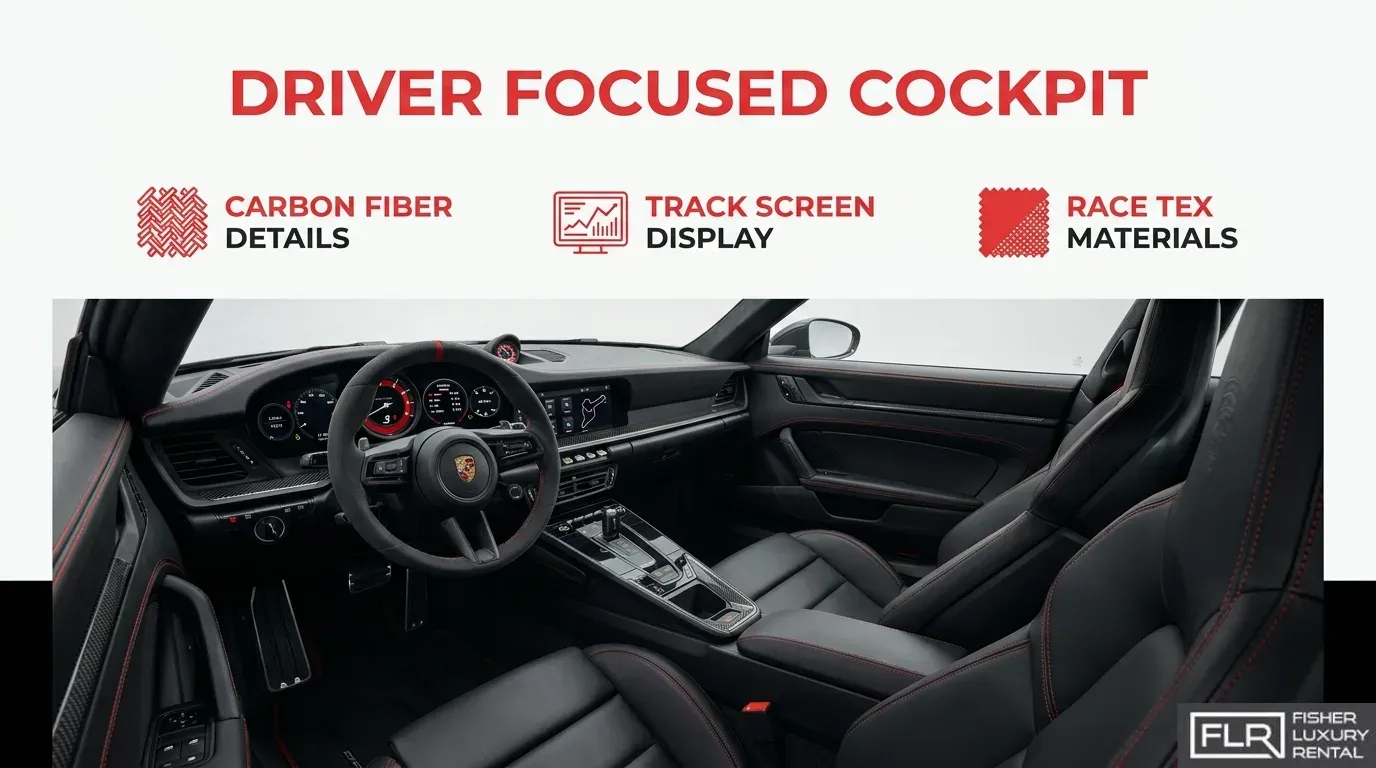
The cabin uses a black-dominant blend of leather and Race-Tex fabric with exposed carbon-weave finishes, built around a 12.6-inch curved instrument panel and a 10.9-inch PCM touchscreen. Dashboard controls orbit the steering wheel directly, reflecting the Porsche Driver Experience concept.
Seating ranges from four-way adjustable Sports Seats Plus to optional carbon-fibre bucket seats that save roughly 15 pounds over the standard setup, giving buyers a clear choice between road comfort and track precision.
The infotainment suite includes wireless Apple CarPlay, Android Auto, a Wi-Fi hotspot, and an optional Bose system with Dolby Atmos. A 15-watt wireless charging tray in the centre console handles daily device needs without compromising the cockpit’s minimalist character.
Noise levels vary meaningfully across variants. The standard GT3 averages 74 decibels at highway speed; the Touring brings that down to around 70 to 72 decibels through refined chassis tuning.
Track hardware, variant differences, package pricing, and rental access through Fisher Luxury Rental are all covered in the sections below.
What Are the Key Interior Design Elements of the Porsche 911 GT3?
The key interior design elements of the Porsche 911 GT3 combine motorsport function with deliberate minimalism, creating a cockpit built entirely around the driver. The sections below cover cabin materials, dashboard layout, and optional packages that define the GT3 interior.
What Materials Define the GT3 Cabin?
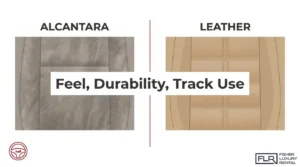
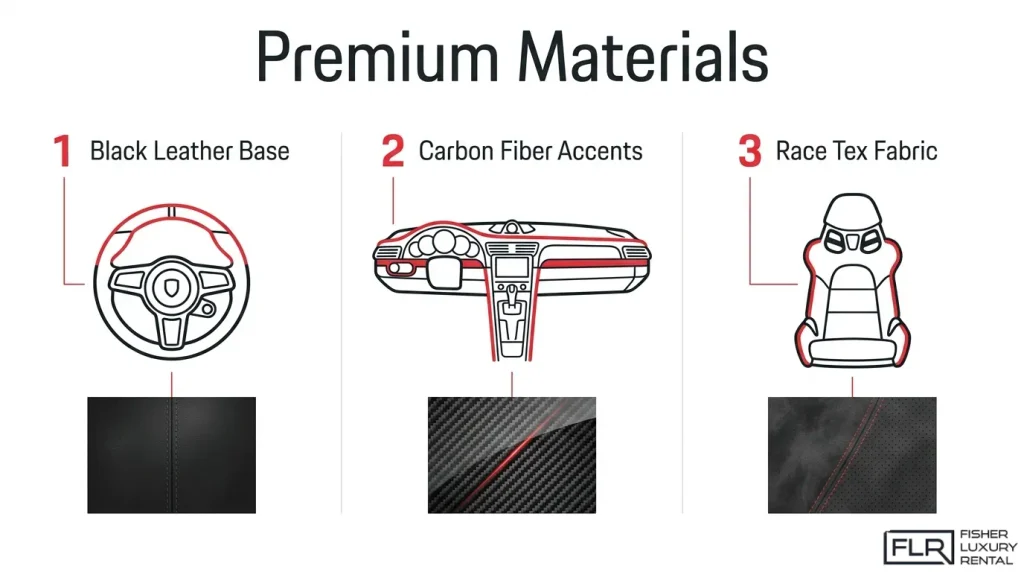
The materials that define the GT3 cabin are a black-dominant combination of leather and Race-Tex fabric, with exposed carbon-weave finishes on select surfaces to reinforce the minimalist aesthetic. According to Porsche Newsroom, the interior uses this high-contrast pairing to keep visual weight low while communicating the car’s performance intent. Carbon fibre appears not just decoratively but structurally, reinforcing that every material choice serves a purpose. This disciplined approach to material selection is one of the GT3’s most distinctive interior signatures.
How Does the GT3 Dashboard Layout Prioritize the Driver?
The GT3 dashboard layout prioritizes the driver through the Porsche Driver Experience control concept, which positions all essential driving function controls directly around the steering wheel on the driver’s axis. The instrument panel is a high-resolution 12.6-inch curved display featuring a Track Screen mode, which strips back digital readouts to show only tyre pressure, oil temperature, and fuel level. This keeps critical data immediately visible without distraction, a thoughtful design decision that translates directly from Porsche’s motorsport engineering.
What Role Does the Sport Chrono Package Play in the Interior?
The Sport Chrono Package adds an analogue stopwatch to the centre of the dashboard, matching the high-contrast colour scheme of the rev counter for quick readability. The sports steering wheel features a 12 o’clock marking for instant centre-position identification, and the engine ignition is mounted on the driver’s door side of the steering wheel, a traditional racing layout. For drivers who want to go further, the Clubsport Package, available at no extra cost, adds a bolted steel roll cage, a six-point harness, and a handheld motorsport fire extinguisher. The optional Lightweight Package for the Touring variant strips door panels to storage nets and carbon-fibre handles, cutting approximately 20 kg from the car’s total weight.
How Comfortable Are the Porsche 911 GT3 Seats on the Road and Track?
The Porsche 911 GT3 seats balance lateral support with daily usability through a tiered seating system. The sections below cover standard seat performance on long drives, how full bucket seats compare for track use, and the adjustment and customization options available.
How Do the Standard Sport Seats Perform on Long Drives?
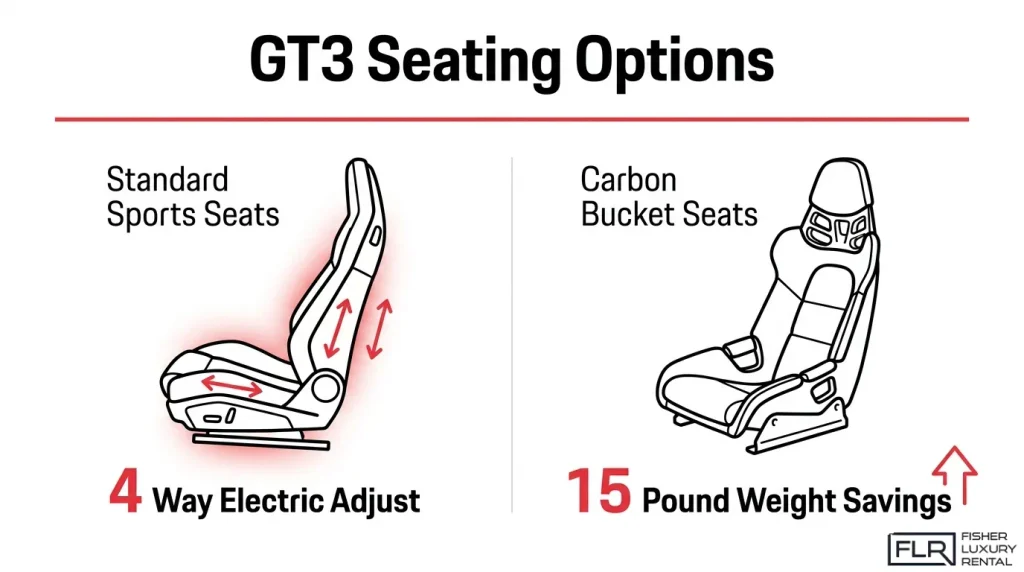
The standard Sport Seats Plus perform well on long drives, offering meaningful adjustability without sacrificing the firm bolstering that keeps drivers planted through corners. According to the Porsche Newsroom, the GT3 comes standard with four-way electrically adjustable Sports Seats Plus, with 18-way electrically adjustable Adaptive Sports Seats Plus available as an upgrade. That 18-way range covers lumbar support, side bolster tension, and thigh extension, making extended highway stints genuinely comfortable. For drivers who want to prioritize road usability over weight savings, the standard seats are the right foundation.
How Do the Optional Full Bucket Seats Compare for Track Use?
The optional full bucket seats compare favorably for track use by reducing weight and increasing lateral rigidity. The carbon-fibre shell of the lightweight Sports bucket seat reduces the car’s total weight by approximately seven kilograms versus the standard Sports Seats Plus. Rennlist data confirms the 992.1 generation non-folding carbon bucket seats deliver 15.4 lbs in weight savings per pair. The trade-off is reduced road adjustability; these seats prioritize grip and driver precision over long-distance comfort, making them the clear choice for circuit-focused configurations.
What Seat Adjustments and Customization Options Are Available?
The seat adjustment and customization options available on the GT3 range from the four-way standard setup to the fully adjustable 18-way Adaptive Sports Seats Plus, covering lumbar, bolster, and thigh support. Buyers can also specify the carbon-fibre lightweight bucket seats, which require the optional Clubsport Package if the six-point harness and roll cage configuration is desired. This tiered structure lets drivers configure the GT3 as a daily grand tourer or a stripped-down track machine based on their intended use.
What Infotainment and Technology Features Come in the GT3?
The GT3’s infotainment features center on the Porsche Communication Management system, a high-resolution digital instrument cluster, and a full suite of wireless smartphone connectivity options.
What Does the Porsche Communication Management System Offer?
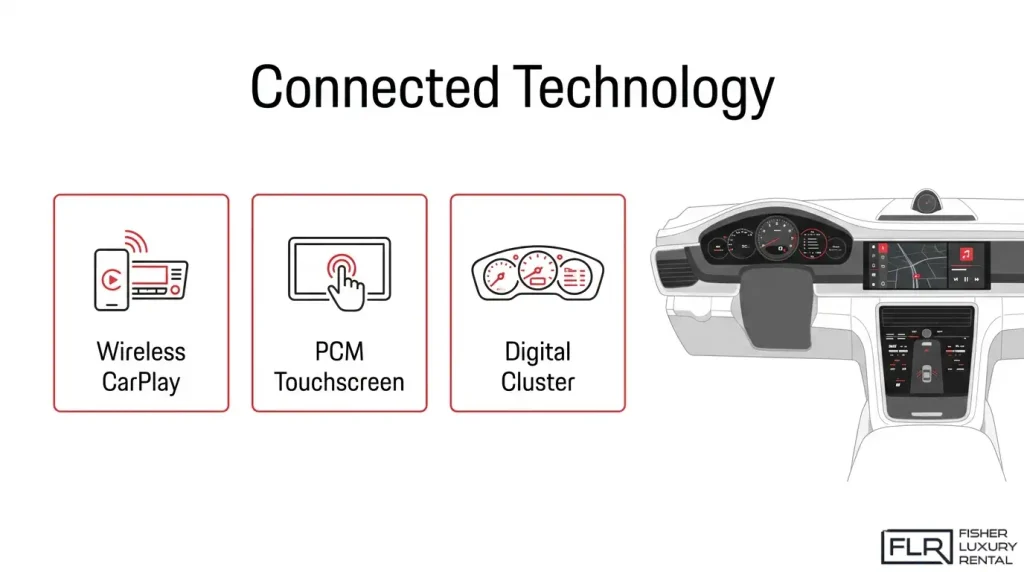
The Porsche Communication Management system offers centralized control of all in-car functions through a 10.9-inch touchscreen positioned at the center of the dashboard. According to the Porsche Newsroom, this single interface manages navigation, audio, vehicle settings, and connectivity without cluttering the driver-focused cockpit. The PCM touchscreen keeps distractions minimal while keeping every function within reach, which makes it one of the more thoughtfully integrated infotainment solutions in the sports car segment.
How Functional Is the Digital Instrument Cluster in the GT3?
The digital instrument cluster in the GT3 is a high-resolution 12.6-inch curved display that replaces traditional analog gauges. Its most notable mode is the Track Screen, which strips away non-essential data and displays only driving-critical readings such as tyre pressure, oil temperature, and fuel level. For drivers moving between road and circuit use, this switchable display format is genuinely useful, delivering the right information at the right moment without a separate aftermarket solution.
Does the GT3 Include Apple CarPlay and Smartphone Connectivity?
The GT3 includes wireless Apple CarPlay and Android Auto, a Wi-Fi hotspot, and Amazon Alexa integration as standard connectivity features. According to Car and Driver, buyers can also upgrade to a Bose stereo system featuring Dolby Atmos spatial audio. The centre console also houses a 15-watt wireless charging tray, so daily device management stays seamless even in a track-focused cabin.
How Does the GT3 Interior Handle Noise and Vibration at Speed?
The GT3 interior handles noise and vibration at speed differently depending on the variant. The standard GT3 runs louder due to minimal soundproofing, while the Touring version offers a measurably quieter cabin through chassis refinements.
How Loud Is the GT3 Cabin During Highway Cruising?
The GT3 cabin during highway cruising reaches approximately 74 decibels at 70 mph, according to Top Gear, driven largely by wide rear tyres and the near-absence of acoustic insulation. At full 9,000 rpm, that figure climbs to 86 decibels. For context, the GT3 Touring produces a more contained 79 decibels and 44 sones at the same cruising speed, per Car and Driver measurements. Drivers who want genuine performance sound will get it; those expecting grand-tourer refinement should consider the Touring variant. Fisher Luxury Rental’s Phoenix and Portland locations offer access to exotic performance vehicles, making it possible to experience GT3-level driving firsthand before committing to a purchase decision.
Does Lightweight Construction Increase Interior Road Noise?
Yes, the lightweight construction does increase interior road noise, primarily because weight reduction in the GT3 involves removing sound-deadening materials that standard 911 models retain. The result is a cabin tuned for driver engagement over acoustic comfort. The GT3 Touring addresses this partially, measuring around 70 to 72 decibels at cruising speed, roughly 2 to 4 decibels lower than the standard GT3, thanks to refined chassis tuning and improved sound suppression. That gap is meaningful in practice, making the Touring a noticeably more livable daily companion without sacrificing the car’s fundamental character.
What Are the Unique Track-Focused Interior Features of the GT3?
The unique track-focused interior features of the GT3 include a motorsport-derived steering wheel layout, optional roll cage configurations, and stripped-back door panels designed to reduce weight while preserving functionality. Each H3 below covers a specific feature in detail.
How Does the GT3 Steering Wheel Differ From Standard 911 Models?
The GT3 steering wheel differs from standard 911 models through its Race-Tex rim material, a 12 o’clock centre-position marking, and an ignition switch positioned on the driver’s door side, reinforcing its motorsport orientation. According to Porsche Newsroom, the GT3 Touring uses black leather trim on the steering wheel rim, gear lever, and door panel armrests as standard, whereas the base GT3 uses Race-Tex throughout. The GT3 RS goes further, adding dedicated steering wheel controls to adjust adaptive damper rebound and compression levels directly from the wheel. PDK-equipped GT3 RS models also replace the standard stubby shifter with a traditional-looking lever that mimics a manual transmission. This layered approach gives each GT3 variant a distinct cockpit character matched to its performance intent.
What Is the Function of the Rear Roll Cage Option?
The rear roll cage option provides structural protection for track use while keeping interior weight as low as possible. The Clubsport Package includes a bolted steel roll cage behind the seats at no extra cost, alongside a six-point driver’s harness and a handheld motorsport fire extinguisher. For buyers prioritizing weight reduction, the Weissach Package offers an alternative: an ultra-lightweight, bolted carbon-fibre roll cage paired with lightweight interior door panels featuring storage nets and carbon-fibre handles. The carbon-fibre variant is the smarter choice for serious track days, where every kilogram matters without sacrificing occupant protection. For drivers curious about how track-focused interior configurations actually feel in practice, renting through a specialist like Fisher Luxury Rental offers a direct, low-commitment way to evaluate these features before speccing a build.
How Does the Lightweight Door Panel Design Affect Daily Usability?
The lightweight door panel design affects daily usability by removing conventional padding and map pockets, replacing them with storage nets and carbon-fibre pull handles that reduce overall vehicle mass. While functional for track environments, this minimalist approach means less acoustic insulation and fewer storage surfaces compared to a standard 911. For drivers who use the GT3 as a daily car, the trade-off is noticeable on long commutes. However, for those who prioritize the purist driving experience the GT3 was built for, the stripped cabin reinforces every sensory connection between driver and road.
How Much Cargo and Storage Space Does the GT3 Interior Provide?
The GT3 interior provides limited but cleverly arranged storage, including a front trunk and a centre console smartphone tray. The sections below cover cargo capacity and in-cabin charging features.
According to The Frunk Club, a modern Porsche 911 frunk measures roughly 4.6 cubic feet (approximately 130 litres), accommodating compact luggage, groceries, a helmet bag, or soft-sided weekend gear. Storage inside the cabin itself is intentionally minimal, reflecting the GT3’s track-focused philosophy. Fisher Luxury Rental, which specializes in top-trim exotic vehicles across its Phoenix and Portland locations, notes that prospective GT3 owners frequently rent before buying specifically to evaluate real-world practicality like storage and daily livability.
The GT3 features a smartphone tray in the centre console that enables wireless charging at up to 15 watts, according to the Porsche Newsroom. For a car this focused on performance, this is a practical daily-use concession that most drivers will genuinely appreciate.
What Interior Options and Packages Can You Configure on the GT3?
The GT3 offers several configurable interior packages, covering track-safety upgrades through the Clubsport Package and premium leather customization through Porsche Exclusive Manufaktur. The sections below detail what each adds and what it costs.
What Does the Clubsport Package Add to the Interior?
The Clubsport Package adds three track-safety items to the GT3 interior: a bolted steel roll cage behind the seats, a six-point harness for the driver, and a handheld motorsport fire extinguisher. According to Porsche Newsroom, this package is available at no extra cost, though it requires the optional lightweight sports bucket seats. For drivers who use the GT3 on track days, this is one of the most practical configurations available, delivering genuine motorsport safety hardware without a price penalty.
What Leather and Trim Upgrades Are Available Through Porsche Exclusive Manufaktur?
The leather and trim upgrades available through Porsche Exclusive Manufaktur include full leather interior finishing, custom Chrono Package colorways, and expanded surface material choices. The standard GT3 cabin uses a black interior with exposed carbon-weave surface highlights and a combination of leather and Race-Tex fabric. The Chrono Package’s dashboard stopwatch comes in Guards Red, Arctic Blue, and White finishes through Exclusive Manufaktur. For the 2022 GT3 Touring, the Exclusive Manufaktur Leather Interior option was priced at $15,350, making it a significant but meaningful personalization investment for buyers seeking a more refined cabin.
How Does the GT3 Interior Compare to the GT3 RS and Touring?
The GT3 interior varies meaningfully across the three variants. The Touring prioritizes road comfort and elegance, the standard GT3 balances track focus with daily usability, and the GT3 RS strips the cabin down for maximum performance. The H3s below break down each model’s key interior differences.
What Interior Comforts Does the GT3 Touring Add Over the Standard GT3?
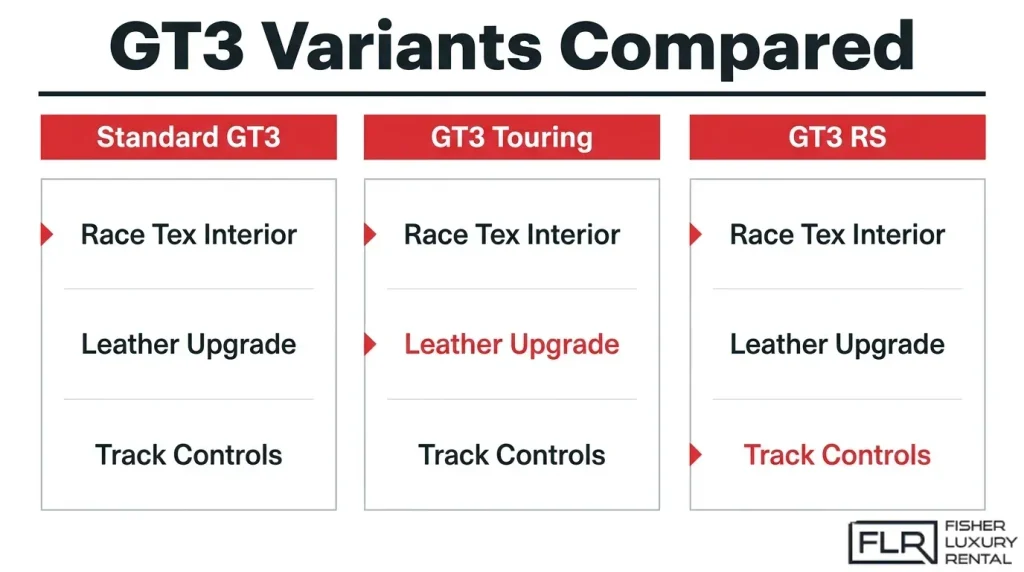
The interior comforts the GT3 Touring adds over the standard GT3 include leather trim throughout, a quieter cabin, and optional rear seating. According to Porsche Newsroom, the Touring uses black leather on the steering wheel rim, gear lever, door panel armrests, storage compartment lid, interior door handles, and seat side bolsters, replacing the Race-Tex fabric found in the standard GT3. Most notably, the Touring is the first GT3 variant with the option to configure a rear seat system, converting it into a 2+2 layout. The standard GT3 maintains a strict two-seater configuration. For buyers who want GT3 performance without a purely track-focused interior, the Touring is the stronger everyday choice.
What Does the GT3 RS Sacrifice Inside for Track Performance?
The GT3 RS sacrifices interior refinement for deeper on-track control. The RS adds dedicated steering wheel controls to adjust the adaptive dampers’ rebound and compression levels directly, a feature absent in both the standard GT3 and Touring. PDK-equipped RS models also replace the standard center-console shifter with a traditional-looking lever that mimics a manual gearbox. These additions prioritize chassis feedback and driver interaction over comfort or aesthetics. The RS cabin is the most purposeful of the three variants, making it the right choice for drivers who treat the track as a primary destination rather than an occasional one.
How Can You Experience the Porsche 911 GT3 Interior Through a Luxury Car Rental?
You can experience the Porsche 911 GT3 interior through a luxury car rental by booking with a specialist exotic rental provider. The sections below cover what Fisher Luxury Rental offers and the key interior takeaways from this review.
Can Fisher Luxury Rental Put You Behind the Wheel of an Exotic Porsche?
Yes, Fisher Luxury Rental can put you behind the wheel of an exotic Porsche. Based in Phoenix, AZ and Portland, OR, Fisher Luxury Rental specializes in top-trim exotic and luxury vehicles, giving drivers direct access to performance cars that most people only read about. Fisher Luxury Rental also serves Scottsdale, AZ and Vancouver, WA. According to the Porsche Newsroom, the GT3’s ‘Porsche Driver Experience’ control concept positions all essential driving function controls directly around the steering wheel, making the cockpit immediately intuitive even for first-time exotic car drivers. Renting rather than buying is the most practical way to genuinely feel that driver-focused engineering without a six-figure commitment.
What Are the Key Takeaways About the Porsche 911 GT3 Interior We Covered?
The key takeaways about the Porsche 911 GT3 interior are that it balances track-focused functionality with genuine everyday usability. The highlights worth remembering include:
- The driver-axis control layout keeps every essential function within reach of the steering wheel.
- The 12.6-inch curved instrument panel and 10.9-inch PCM touchscreen deliver a modern, information-rich cockpit.
- Standard Sports Seats Plus offer four-way electric adjustment; optional carbon bucket seats reduce weight by roughly 15.4 lbs.
- The GT3 Touring adds leather trim and an optional rear seat, broadening everyday appeal.
- The Clubsport Package includes a roll cage, six-point harness, and fire extinguisher at no extra cost.
- According to The Frunk Club, the 911 frunk holds approximately 4.6 cubic feet (130 liters), enough for a helmet bag or compact weekend luggage.
For drivers who want to feel this interior firsthand, Fisher Luxury Rental offers a direct path to the seat.