Vintage car engine management systems are the mechanical and electronic technologies that controlled fuel delivery, ignition timing, and air-fuel mixture in production vehicles before the widespread adoption of fully digital engine control units.
This guide covers the engineering principles behind early fuel and ignition control, the distinct system types that defined each technological generation, how those systems evolved decade by decade, the landmark vehicles that pioneered them, how vintage systems compare to modern ECUs, the maintenance challenges owners face today, and what continues to draw enthusiasts to these machines.
Early fuel and ignition control relied on carburetors, mechanical fuel injection, and vacuum advance systems, each solving specific problems through physical mechanics rather than electronic feedback. The 1957 Rochester Ramjet, for example, was the first American production engine to deliver one horsepower per cubic inch, a benchmark that pure carburetion could not match.
From mechanical carburetion through Bosch Jetronic and ultimately Motronic, each system type introduced a measurable leap in precision, with emissions regulations in the 1970s accelerating the shift from analog to digital control. Landmark vehicles including the Chevrolet Corvette and early BMW models equipped with Bosch Motronic mark the clearest inflection points in that progression.
Maintaining these systems today means navigating parts scarcity, vanishing specialist knowledge, and sensitivity to altitude and climate; challenges that explain both the difficulty of preservation and the depth of commitment among the roughly 69 million car enthusiasts in the United States who value what these machines represent.
How Did Early Engine Management Systems Control Fuel and Ignition?
Early engine management systems controlled fuel and ignition through three progressive technologies: mechanical carburetors, mechanical fuel injection, and ultimately digital engine control units. The sections below trace each approach and the engineering problems each one solved.
How Did Mechanical Fuel Injection Work in Vintage Cars?
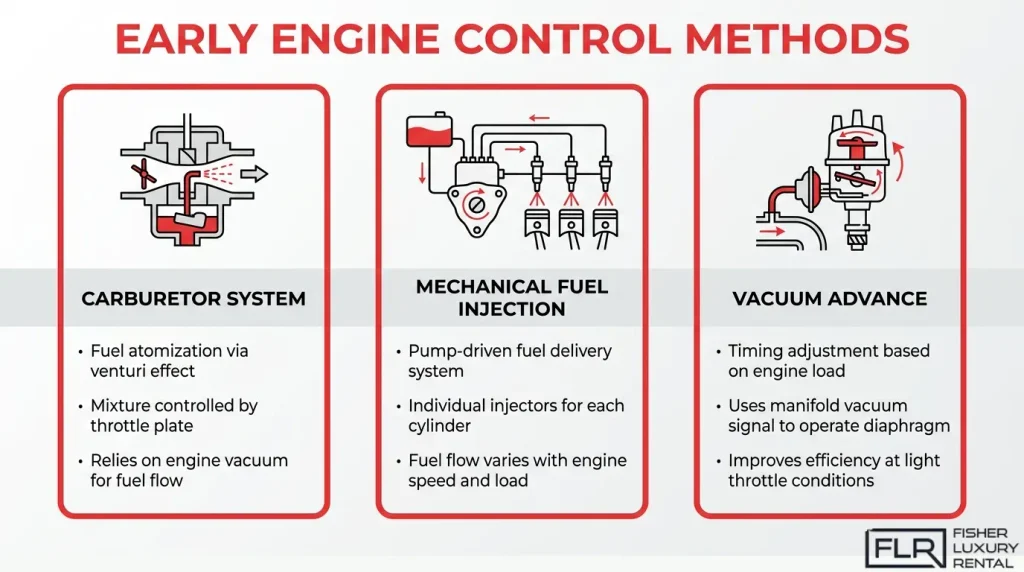
Mechanical fuel injection in vintage cars worked by using an air metering unit to measure intake airflow, which then directed the fuel-metering unit to deliver a proportional fuel quantity to each cylinder. The Rochester Ramjet, produced from 1957 to 1965, exemplified this approach with its distinctive tall aluminum “doghouse” intake manifold.
Two significant maintenance challenges defined the Rochester system:
- Contamination sensitivity: Both air and fuel meters were vulnerable to varnish deposits, since extended storage allowed fuel inside the vented fuel meter to evaporate and gum up the system, according to Motor Trend.
- Parts scarcity: Replacement components must be hand-fabricated by specialist technicians, with some Corvette collectors purchasing entire donor cars solely to recover the fuel injection hardware.
These difficulties underscore a truth that still holds today: mechanically injected vintage engines reward owners who drive them regularly over those who store them long-term.
How Did Vacuum Advance Systems Regulate Ignition Timing?
Vacuum advance systems regulated ignition timing by using manifold vacuum to pull a diaphragm inside the vacuum advance can, physically rotating the distributor plate to fire the spark plug earlier. According to Motor Trend, lean fuel mixtures burn slowly and require an earlier spark to complete combustion efficiently during cruise conditions.
Two operating realities drove this design:
- Idle behavior: Engines run leaner at idle than under load, so the mixture burns slower and demands earlier ignition timing.
- Pre-emissions setup: All carbureted cars originally used direct manifold vacuum to the distributor until tightening emissions regulations prompted manufacturers to retard timing, reducing performance in exchange for lower hydrocarbon output.
How Did Carburetor-Based Systems Manage Air-Fuel Mixture?
Carburetor-based systems managed air-fuel mixture using a purely mechanical arrangement of needles, jets, and floats to draw air and fuel into the intake manifold simultaneously. The venturi signal created by incoming airflow pulled fuel directly into the air stream, making mixture delivery inherently dependent on engine speed and throttle position rather than independent control of each variable.
Pre-1990s tuners of naturally aspirated engines valued carburetors for their ability to draw in greater volumes of air and fuel and atomize the charge more effectively than early electronic injection systems could, as noted by Motor Trend. The tradeoff was an inherent sensitivity to physical constraints: manifold size was limited by warm-up requirements, hood clearance forced a low profile on the intake assembly, and fuel slosh during hard cornering could disrupt mixture delivery unpredictably.
Bosch’s development of digital engine control from the early 1970s onward ultimately addressed these limitations, culminating in the Motronic system in 1979, the world’s first computer-based driving-relevant application in a production car.
What Are the Key Types of Vintage Engine Management Systems?
The key types of vintage engine management systems are mechanical carburetion, mechanical fuel injection, early electronic fuel injection, analog electronic ignition, and early digital engine control units. Each represented a distinct technological leap, from purely mechanical fuel delivery to the first computer-controlled engine management.
Mechanical Carburetion Systems
Mechanical carburetion systems are purely mechanical fuel delivery designs that draw air and fuel into the intake manifold using needles, jets, and floats. Pre-1990s tuners favored carburetors for their ability to draw in more air and fuel and atomize it better than early fuel injection could manage. Their key limitation was a restricted manifold size, as the carburetor, front cowl, and air cleaner all had to sit low for clearance, compromising the balance between driveability and high performance.
Mechanical Fuel Injection Systems
Mechanical fuel injection systems use an air metering unit to measure intake airflow and instruct the fuel-metering unit how much fuel to deliver, with air-fuel mixing beginning at the nozzles and continuing into the cylinder head. The Rochester Ramjet, developed by Zora Arkus-Duntov and John Dolza, exemplified this approach with its three-component design: a fuel meter, an air meter, and an intake manifold. Unlike carburetors, where the venturi signal pulls fuel directly into the airstream, fuel injection uses that signal to push a metered fuel quantity, eliminating erratic mixture changes during hard cornering.
According to Motor Trend, the Ramjet’s tall aluminum “doghouse” intake manifold was notoriously difficult to service, with so few qualified mechanics that some owners simply swapped back to carburetors and left the original hardware on the shelf. By 1976, Bosch produced around 630,000 injection systems, more than three-quarters of which were K-Jetronic, driven by lower manufacturing costs.
Early Electronic Fuel Injection Systems
Early electronic fuel injection systems replace mechanical metering with electronic sensors and solenoid-controlled injectors, enabling more precise fuel delivery across operating conditions. Bosch unveiled the electronically controlled Jetronic at the International Motor Show in Frankfurt on September 14, 1967, initially targeting the U.S. market due to California’s strict new emissions standards. The Bendix Electrojector had preceded it by nearly nine years, fitted to Chrysler 300 sedans, but proved so unreliable in everyday use that all those vehicles had to be refitted with conventional carburetors. Volkswagen was also skeptical when Bosch approached them in 1964, viewing the technology as too unorthodox and commercially unproven.
Analog Electronic Ignition Systems
Analog electronic ignition systems replace breaker points with transistorized switching circuits, delivering a more consistent spark and reducing routine maintenance. By eliminating the mechanical wear inherent in point-based distributors, these systems improved ignition reliability and allowed more stable timing across a wider RPM range, a meaningful advance for performance and emissions control before fully digital management arrived.
Early Digital Engine Control Units
Early digital engine control units are microcontroller-based systems that manage fuel injection, ignition timing, and emissions control together within a single digital processor. According to Bosch Classic, the 1979 Motronic launch required seven large circuits, including a microcontroller, one input chip, one output chip, and four 1K memory units, reflecting the modest state of digital technology at the time. Despite that hardware simplicity, Motronic represented a genuine turning point: it was the world’s first computer applied to a car in a driving-relevant application, unifying functions that previously required separate analog systems.
Understanding these five system types provides the foundation for tracking how engine management technology progressed decade by decade.
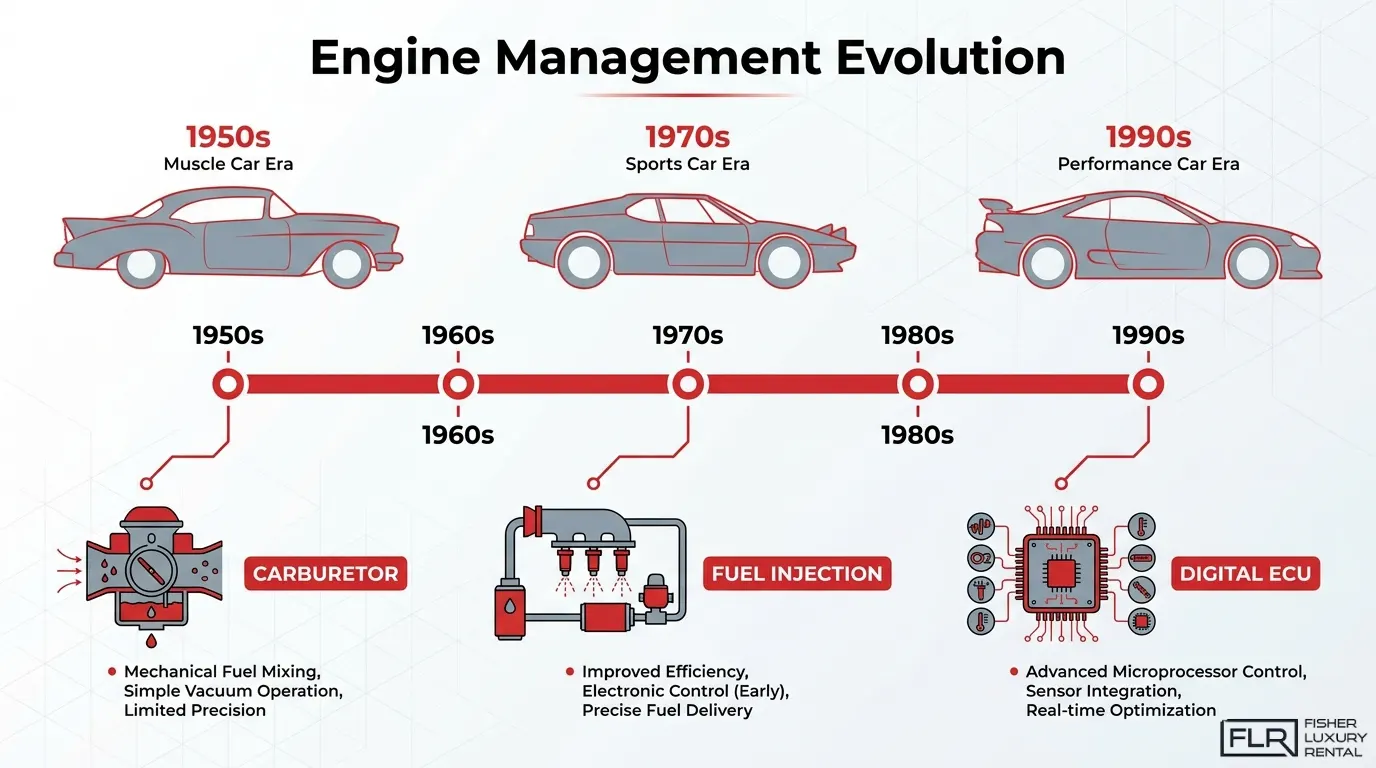
How Did Engine Management Systems Evolve Decade by Decade?
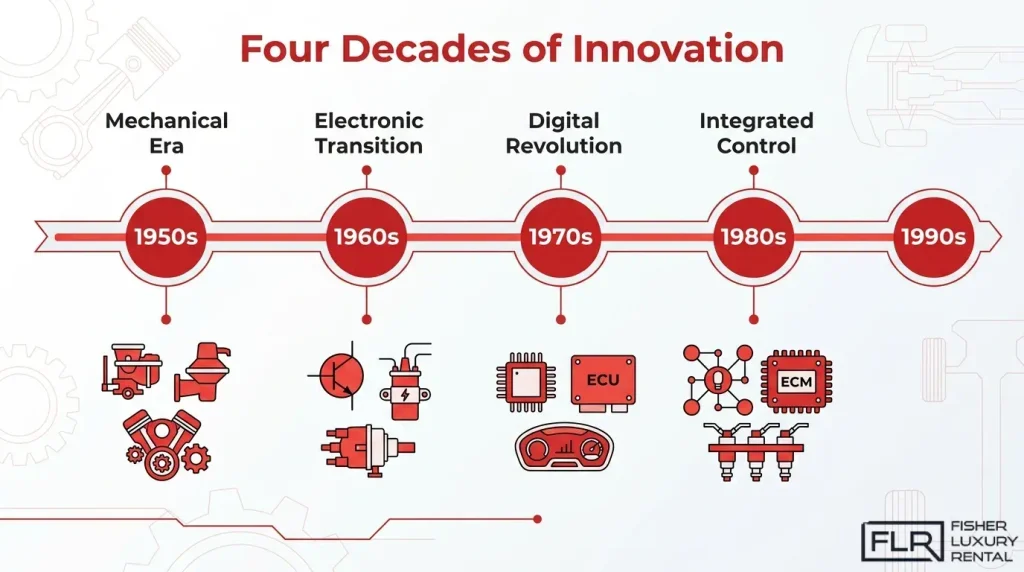
Engine management systems evolved from purely mechanical controls in the 1950s through digital integration by the 1990s. The H3s below trace that progression across four decisive decades.
What Engine Management Technology Defined the 1950s and 1960s?
The engine management technology that defined the 1950s and 1960s was mechanical fuel injection combined with the earliest experiments in electronic fuel delivery. American manufacturers led with mechanical systems, while European engineers pursued electronic alternatives. According to Bosch Global, the Jetronic-equipped VW 1600 debuted in Germany in June 1968, though a 600-German-mark markup on a 6,000-mark base price meant very few buyers chose it despite positive reviews. By 1969, manufacturers including BMW, Citroen, Jaguar, Lancia, Mercedes-Benz, Opel, Renault, Saab, and Volvo had adopted Bosch Jetronic in top-range models, drawn by two concrete advantages: lower fuel consumption and increased performance potential. The decade ended with electronic injection firmly established as a premium European technology, even as carburetors remained standard on most production cars worldwide.
What Changed in Engine Management During the 1970s?
What changed in engine management during the 1970s was the shift from experimental electronics to production-ready fuel injection systems driven by new emissions regulations. The Clean Air Act of 1970 mandated a 90 percent reduction in hydrocarbon, carbon monoxide, and NOx emissions, with 1975 model-year cars required to emit no more than 10 percent of 1970-allowable levels. Catalytic converters became mandatory from the 1975 model year onward. Bosch responded by developing both the mechanical K-Jetronic and the electronic L-Jetronic, introduced together in 1973. By 1976, Bosch produced approximately 630,000 injection systems, with more than three-quarters being K-Jetronic due to its lower manufacturing costs. Meanwhile, Bosch’s advance development team had been building a digital engine control system based on microcontrollers since the early 1970s.
How Did the 1980s Introduce Digital Engine Management?
The 1980s introduced digital engine management through Bosch Motronic, the world’s first computer system used in a car for a driving-relevant application. In 1979, Bosch began producing the system, which controlled both ignition and fuel injection simultaneously. According to Bosch Classic, the 1979 Motronic required seven large circuits: a microcontroller, one input chip, one output chip, and four 1K memory chips. Motronic launched commercially in 1982 at BMW, where it outperformed the KE-Jetronic as K-Jetronic reached its functional limits alongside regulated catalytic converters. Combining fuel delivery, ignition timing, and emissions management under one digital control unit, Motronic represented a genuine architectural leap. This integration set the template for every engine control unit that followed.
What Breakthroughs Emerged in 1990s Engine Control Systems?
The breakthroughs that emerged in 1990s engine control systems were expanded sensor integration, real-time adaptive tuning, and the proliferation of fully closed-loop engine management across mainstream vehicles. Building on the Motronic foundation, ECUs gained the processing power to manage knock sensors, variable valve timing, and on-board diagnostics (OBD-II, mandated in the U.S. from 1996). These systems moved engine management from fixed programmed maps toward adaptive strategies that responded dynamically to driving conditions, fuel quality, and temperature. For vintage car enthusiasts, the 1990s mark the boundary where analog craftsmanship gave way to software-defined performance, making cars from the preceding decades increasingly distinctive as engineering artifacts.
Which Vintage Cars Were Known for Pioneering Engine Management?
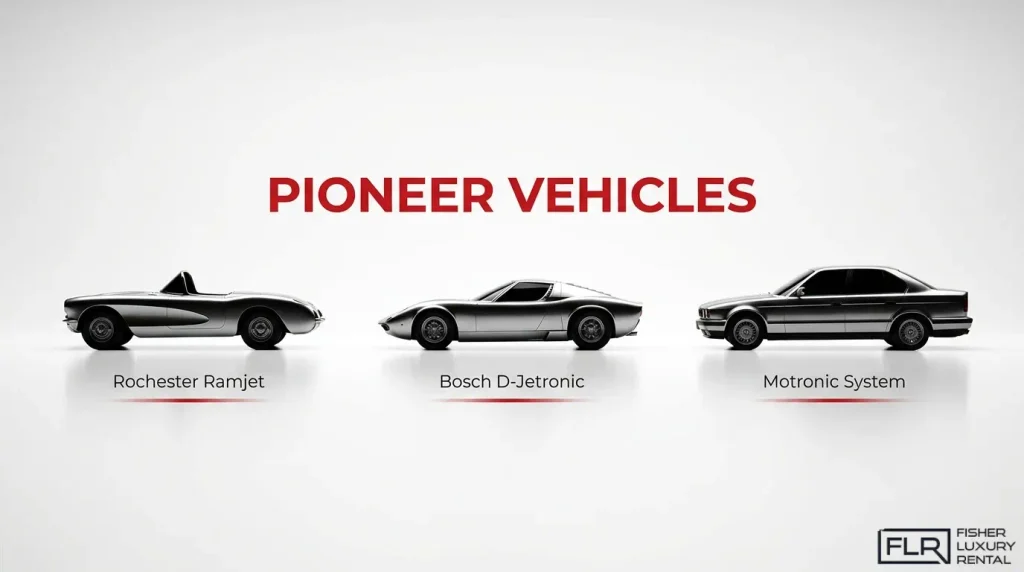
Vintage cars known for pioneering engine management include the 1957 Chevrolet Corvette with its Rochester Ramjet fuel injection, European sports cars fitted with Bosch D-Jetronic, and BMW models debuting the Motronic system. The following H3s examine each vehicle’s specific contribution.
What Role Did Bosch D-Jetronic Play in European Sports Cars?
The role of Bosch D-Jetronic in European sports cars was significant but short-lived. Manufacturers including BMW, Mercedes-Benz, Porsche, and Jaguar adopted it as an early electronic fuel injection solution through the late 1960s and early 1970s. However, according to Bosch Classic, L-Jetronic was introduced almost simultaneously with K-Jetronic in 1973 but commercially failed to gain traction, as most manufacturers had already committed to K-Jetronic by 1971 or 1972 due to perceived quality issues with D-Jetronic in the field. The D-Jetronic ultimately served as a critical proof of concept, demonstrating that electronic injection could work in production sports cars before more refined systems replaced it.
How Did the Chevrolet Corvette Advance Mechanical Fuel Injection?
The Chevrolet Corvette advanced mechanical fuel injection by becoming the first American production car to offer the Rochester Ramjet system at scale. In 1957, Rochester Ramjet fuel injection was offered as a $480 option on Corvettes, though only 1,040 of the 6,500 Corvettes built that year were fuel injected, according to Motor Trend citing the National Corvette Restorers Society. The achievement was historic: the Rochester-equipped 283 cubic inch engine delivered 283 horsepower, making it the first American production engine to produce one horsepower per cubic inch, per Chevrolet Hardcore. For a mechanical system without electronic controls, that power-to-displacement ratio remains an impressive engineering milestone.
Why Was the BMW Motronic System a Turning Point?
The BMW Motronic system was a turning point because it was the first production application of a unified digital engine management system controlling both fuel injection and ignition simultaneously. According to Bosch Classic, Motronic debuted at BMW and proved superior to the KE-Jetronic it replaced, as the K-Jetronic had gradually reached its functional limits, particularly when paired with regulated catalytic converters. Beginning with the 1975 model year, U.S. cars were required to have catalytic converters per the Science History Institute, making integrated digital control not just a performance advantage but a regulatory necessity. Motronic set the architectural template that every modern ECU would follow.
How Do Vintage Engine Management Systems Compare to Modern ECUs?
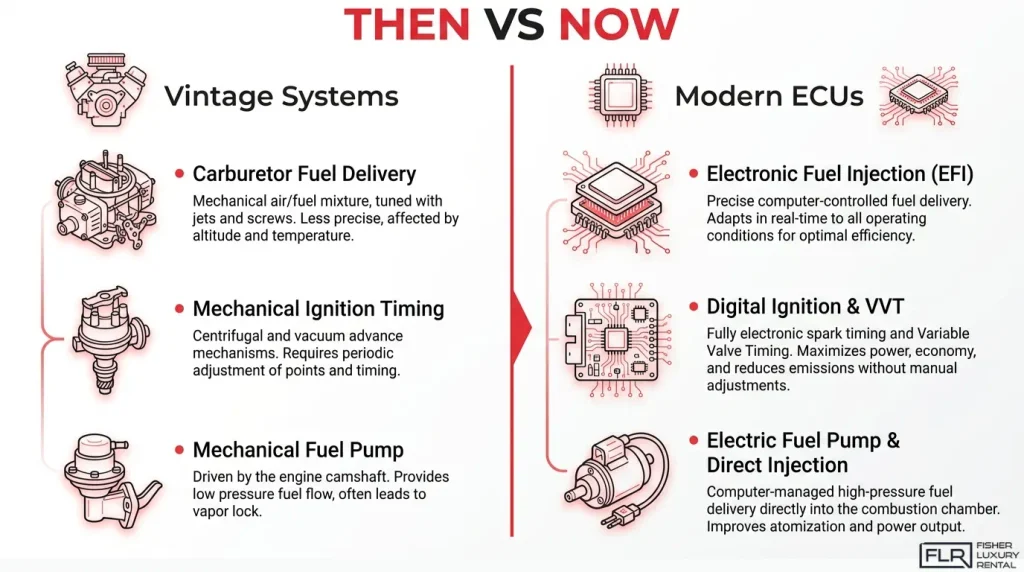
Vintage engine management systems compare to modern ECUs across several dimensions, including control method, adaptability, diagnostic capability, and serviceability. The sections below examine each of these differences and explain why the gap between analog-era systems and today’s digital ECUs continues to drive demand for restomod builds.
How Do Control Methods Differ Between Vintage Systems and Modern ECUs?
The control methods differ fundamentally: vintage systems relied on mechanical or early analog circuits, while modern ECUs use real-time digital computation across dozens of sensor inputs. A carburetor adjusted mixture passively through venturi physics, whereas a modern ECU actively recalculates fuel trim, ignition timing, and throttle response in milliseconds. Early systems such as the Rochester Ramjet or Bosch K-Jetronic had no feedback loop capable of compensating for altitude, temperature swings, or fuel quality variation. Modern ECUs handle all three simultaneously, making them significantly more adaptable for everyday driving conditions.
Can Vintage Engine Management Systems Match Modern Fuel Efficiency?
Vintage engine management systems cannot match modern fuel efficiency, primarily because they lack closed-loop lambda control and adaptive fuel mapping. Mechanical and early electronic systems delivered a fixed or semi-fixed air-fuel ratio with no ability to self-correct based on exhaust oxygen content. Modern ECUs continuously adjust injection timing and duration to maintain stoichiometric combustion, reducing waste and improving economy across the entire RPM range. For owners who enjoy driving their classics regularly rather than storing them, this efficiency gap is one of the strongest practical arguments for a modern ECU retrofit.
What Does the Modern Restomod Market Reveal About This Comparison?
The restomod market reveals that enthusiasts increasingly choose modern ECUs over restored vintage systems for drivability without sacrificing period-correct aesthetics. According to Morning Star, the classic car restoration and restomod services market is projected to reach USD 14.4 billion by 2036, driven by premium custom builds and modernized vintage vehicles. For enthusiasts who want to experience high-performance automotive engineering without the ownership commitment, Fisher Luxury Rental offers a fleet of top-trim exotic and luxury vehicles available for rent in Phoenix, AZ and Portland, OR. That growth signals that the vintage-versus-modern debate has largely resolved in favor of hybrid approaches: original bodywork and character paired with ECU-controlled reliability. From a collector and enthusiast perspective, vintage systems retain irreplaceable historical and mechanical significance, but modern ECUs simply deliver superior control precision and long-term ownership ease.
What Challenges Come With Maintaining Vintage Engine Management?
Maintaining vintage engine management systems presents three recurring challenges: sourcing obsolete replacement parts, finding technicians with era-specific tuning knowledge, and managing how environmental conditions affect mechanical calibration.
How Difficult Is It to Source Replacement Parts?
Sourcing replacement parts for vintage engine management systems is extremely difficult, particularly for mechanical fuel injection units like the Rochester Ramjet. According to Motor Trend, replacement parts for these systems must be hand-fabricated by technically proficient experts who are hard to find, with some Corvette collectors purchasing entire donor cars solely to obtain the fuel injection hardware. The Rochester Ramjet was notoriously difficult to service even when new, and few mechanics ever developed the necessary skills. One unusual parts source became mechanics who swapped the system for carburetors and shelved the original hardware. For collectors serious about originality, this scarcity makes parts sourcing one of the most time-consuming and costly aspects of ownership.
What Special Expertise Is Needed for Tuning and Calibration?
Tuning and calibration of vintage engine management systems requires hands-on mechanical expertise that few modern technicians possess. Mechanical fuel injection systems like the Rochester Ramjet depend on precise interaction between air and fuel metering components, both of which are highly sensitive to contamination. Varnish deposits from evaporated fuel can accumulate in the fuel meter after extended storage, disrupting calibration entirely. Carbureted systems add another layer, requiring distributor timing adjustments that account for vacuum advance behavior under varying load conditions. This is a disappearing skill set, and finding a specialist who genuinely understands pre-electronic engine management is often harder than sourcing the parts themselves.
How Do Climate and Altitude Affect Vintage System Performance?
Climate and altitude significantly affect vintage engine management performance because mechanical systems lack the sensors needed to self-correct. Carburetors and mechanical fuel injection units deliver fixed air-fuel ratios calibrated for specific conditions. At higher altitudes, reduced air density causes these systems to run rich, reducing power and efficiency. In extreme heat, fuel vaporization in the fuel meter can cause inconsistent delivery. According to Hagerty Insights, the average collector car enthusiast has spent 20 years in the hobby, and that depth of experience is often what separates owners who manage these variables well from those caught off guard by them.
Why Do Car Enthusiasts Still Value Vintage Engine Management?
Car enthusiasts still value vintage engine management because these systems represent tangible engineering history, mechanical transparency, and a driving experience that modern computer-controlled vehicles cannot replicate. The collector car market reflects this enduring passion at scale.
What Motivates Collectors to Preserve These Systems?
The motivations collectors have for preserving vintage engine management systems include fun to drive (cited by 58% of owners), visual appeal (46%), and personal nostalgia (38%), according to Hagerty Insights data on collector car ownership. Beyond sentiment, these systems embody problem-solving milestones: the 1957 Rochester Ramjet proved mechanical fuel injection could achieve one horsepower per cubic inch on an American production engine, a benchmark that defined an era. Preserving such hardware keeps that engineering legacy intact and verifiable rather than replaced by anonymous electronics.
How Large Is the Collector Car Community?
The collector car community includes approximately 69 million car enthusiasts in the United States. Hagerty data estimates around 43 million vehicles fit the collector car definition, representing roughly 16 percent of all registered U.S. vehicles, with a combined insurable value of approximately $1 trillion. The average enthusiast is 56 years old, earns $144,000 annually, and has spent 20 years in the hobby, indicating a deeply committed, knowledgeable audience willing to invest significant resources in preservation. Fisher Luxury Rental caters directly to this audience, offering top-trim exotic and luxury cars for rent in Phoenix and Portland for those who want an exceptional driving experience on their own terms.
Why Does Mechanical Complexity Add to the Appeal?
Mechanical complexity adds to the appeal of vintage engine management because it demands real skill to operate and maintain, which separates serious enthusiasts from casual drivers. Systems like the Rochester Ramjet required hand-fabricated replacement parts sourced from specialists, and some Corvette collectors have purchased entire cars solely to acquire an original fuel-injection unit. That scarcity and expertise barrier makes a correctly running vintage system a genuine accomplishment, one that carries authentic provenance that no modern retrofit can fully reproduce.
How Can You Experience Iconic Engine Technology Through Luxury Car Rentals?
Luxury car rentals offer a direct path to experiencing the engine technologies this article covers. The following sections address Fisher Luxury Rental’s exotic fleet and summarize the key takeaways from vintage engine management history.
Does Fisher Luxury Rental Offer Exotic Cars That Showcase Advanced Engine Systems?
Fisher Luxury Rental offers exotic cars that showcase advanced engine systems drawn from decades of automotive engineering progress. Based in Phoenix, AZ and Portland, OR, Fisher Luxury Rental stocks top-trim models of luxury and exotic cars chosen for their quality and performance pedigree. Every vehicle in the fleet reflects the engineering lineage that modern performance cars inherited from decades of fuel and ignition development. Rather than offering base-trim compromises, Fisher Luxury Rental provides top-trim machines where performance engineering is felt through every throttle input. For car enthusiasts who want to experience the modern culmination of decades of engine development firsthand, renting a high-performance exotic offers a direct, visceral way to engage with that legacy.
What Are the Key Takeaways About Vintage Car Engine Management Systems?
The key takeaways about vintage car engine management systems are that they evolved through three distinct eras, each solving problems the previous generation could not. Mechanical carburetors dominated early engine management through needles, jets, and floats, but their fuel slosh and manifold size limitations drove engineers toward better solutions. The 1957 Rochester Ramjet proved mechanical fuel injection could deliver milestone performance, with the 283 cubic inch Corvette engine becoming the first American production engine to produce one horsepower per cubic inch. Emissions regulation then forced the industry toward electronic systems, with Bosch Jetronic arriving in 1967 and Motronic unifying fuel, ignition, and emissions control by 1979. Understanding this progression reveals that every modern performance engine stands on the shoulders of these hard-won mechanical and electronic breakthroughs.