
Dry sump lubrication is an engine oiling system that stores oil in a separate external reservoir rather than in a pan beneath the crankshaft. Multiple pumps actively scavenge oil from the crankcase and return it to that reservoir, keeping the engine’s rotating assembly free of pooled oil at all times.
This guide covers how dry sump systems work, how they compare to wet sump designs, what each core component does, why high-performance engines depend on them, which vehicles use them, their trade-offs, how they are serviced, how they affect engine longevity, and how to experience this technology firsthand.
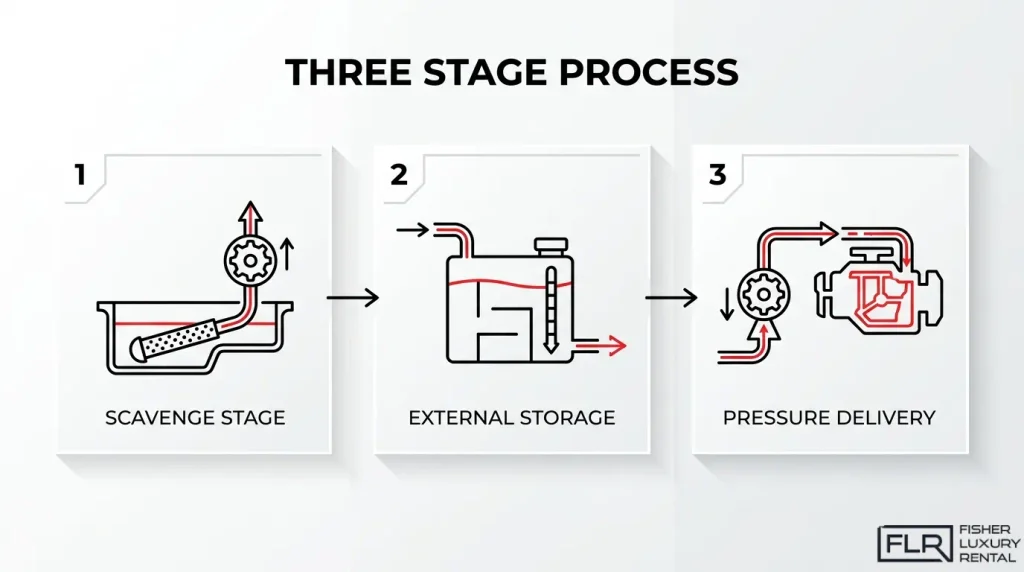
Dry sump systems operate through three stages: scavenging, external storage, and pressurized delivery. The scavenge pump pulls oil from a shallow multi-pickup pan, the external reservoir de-aerates and cools the oil, and the pressure pump delivers it under regulated pressure to every bearing, tensioner, and squirter in the engine.
Compared to a wet sump, a dry sump eliminates oil surge under high lateral loads, stabilizes pressure across varying engine speeds, and allows the engine to sit lower in the chassis, which directly reduces center of gravity and improves handling.
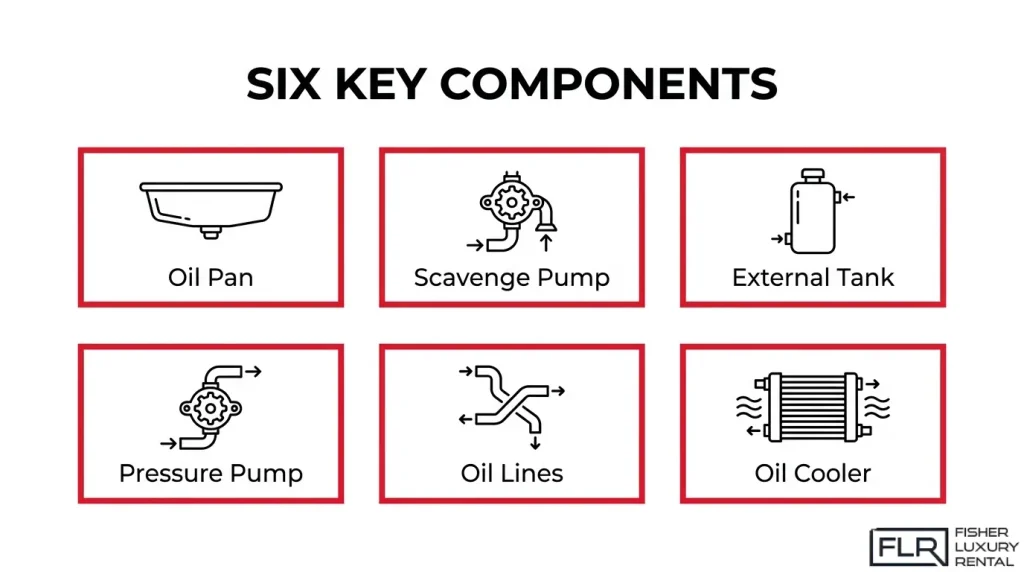
Each component, from the oil pan and scavenge pickups to the external tank, pressure pump, oil lines, and cooler, serves a specific function. Together they form a closed circuit built to sustain reliable lubrication under conditions that would starve a conventional system within seconds.
The performance case for dry sump lubrication extends to engine longevity, where consistent oil pressure and improved thermal management reduce bearing wear, prevent starvation damage, and extend rebuild intervals across the full service life of the engine.
How Does Dry Sump Lubrication Work?
Dry sump lubrication works by removing oil from the engine crankcase immediately and storing it in a separate external reservoir. The three core components that make this possible are the scavenge pump, the external oil reservoir, and the pressure pump.
What Role Does the Scavenge Pump Play?
The scavenge pump plays the role of continuously pulling oil from the crankcase and returning it to the external tank. Without active oil removal, oil would pool in the bottom of the engine, creating the exact drag and starvation risks dry sump systems are designed to eliminate. According to LN Engineering, in the Mezger engine the scavenge side of the oil pump returns oil from the crankcase to the external oil tank, while the pressure side simultaneously feeds the main and rod bearings, chain tensioners, camshaft spray bars, and piston squirters.
How Does the External Oil Reservoir Store and Cool Oil?
The external oil reservoir stores a larger oil volume than any crankcase-mounted sump could accommodate, giving the system a meaningful thermal buffer. Because the tank sits outside the engine bay heat soak, the oil has time to shed heat before recirculating. The reservoir also separates entrained air and combustion gases from the oil, so only clean, deaerated oil reaches the pressure pump inlet, which is critical for maintaining consistent film strength at high rpm.
What Does the Pressure Pump Do in a Dry Sump System?
The pressure pump draws oil from the external reservoir and delivers it under controlled, regulated pressure to every lubrication point in the engine. A dry sump system requires at least two pumps: one pressure pump and one scavenge pump. According to Wikipedia, systems sometimes use as many as four or five scavenge pumps to keep residual oil in the sump to an absolute minimum. Bill Dailey, founder of Dailey Engineering, with over 40 years of racing engine design expertise, engineers custom dry sump systems specifically around optimizing both the scavenge and pressure stages for sustained high-rpm reliability.
What Is the Difference Between Dry Sump and Wet Sump Lubrication?
The difference between dry sump and wet sump lubrication is where oil is stored and how it is delivered to the engine. A dry sump uses an external reservoir and multiple pumps, while a wet sump stores oil in a pan directly below the engine with a single pump. The sections below cover oil storage, pressure consistency, and size trade-offs.
How Does Oil Storage Differ Between Dry and Wet Sumps?
Oil storage differs between dry and wet sumps in both location and capacity. A wet sump keeps oil in a fixed pan beneath the crankshaft, making it vulnerable to surge during hard cornering, braking, or acceleration. A dry sump routes oil to a separate external tank, which holds a larger, more consistent supply. This separation prevents oil from sloshing away from the pickup under extreme driving conditions. The Porsche 991 GT3’s 9A1 engine, for example, added an external oil tank starting in 2014, reflecting how even road-going performance cars benefit from this approach.
How Does Each System Affect Engine Oil Pressure Consistency?
Engine oil pressure consistency differs significantly between dry and wet sump systems. In a wet sump, pressure can drop during aggressive cornering or high-G maneuvers when oil shifts away from the pump pickup. A dry sump eliminates this vulnerability by drawing from a stable external reservoir. According to F1Technical, the pressure stage in a dry sump system draws oil from the bottom of the reservoir, passes it through the filter, and delivers it to the engine, with an adjustable pressure regulator maintaining stable oil pressure across different engine speeds. Consistent pressure is arguably the single most critical protection a lubrication system can offer at high RPM.
How Do Dry and Wet Sumps Compare in Weight and Size?
Dry and wet sumps compare differently in weight and size depending on the design priority. A wet sump is simpler and lighter as a standalone unit, containing fewer components. A dry sump system adds external lines, a reservoir, and multiple pumps, which increases total system weight and complexity. However, because the dry sump pan sits much shallower in the chassis, the engine can be mounted lower, significantly reducing the vehicle’s center of gravity. The C6, C7, and C8 generations of the Chevrolet Corvette Z06 use dry sump lubrication precisely because this packaging advantage translates into better chassis dynamics and handling balance.
What Are the Main Components of a Dry Sump System?
The main components of a dry sump system are the oil pan with scavenge pickup, scavenge pump, external oil tank, pressure pump, oil lines and fittings, and oil cooler. Each part plays a distinct role in keeping oil circulating reliably under high-performance conditions.
Oil Pan and Scavenge Pickup
The oil pan in a dry sump system is a shallow, low-profile unit designed to keep oil pooling to a minimum. Multiple scavenge pickups are positioned across the pan floor so oil is collected immediately, regardless of where it migrates during hard cornering, braking, or acceleration. According to Dragzine, the biggest benefit of this design is the ability to add multiple pickups to the pan, ensuring oil is retrieved before it can travel far.
Scavenge Pump
The scavenge pump actively pulls oil from the pan and returns it to the external oil tank. A dry sump system requires at least two pumps, one pressure and one scavenge, though some high-output racing applications use as many as four or five scavenge pumps to keep the crankcase nearly oil-free. This aggressive extraction reduces windage and prevents oil from interfering with rotating engine components.
External Oil Tank
The external oil tank stores and de-aerates oil before it re-enters the engine. Mounted separately from the engine, it holds a larger oil volume than a conventional sump, which supports more stable temperatures and consistent supply under sustained high-load driving.
Pressure Pump
The pressure pump draws oil from the bottom of the external tank, passes it through the filter, and delivers it to the engine’s bearings, chain tensioners, and other lubrication points. An adjustable pressure regulator, as noted by F1Technical, keeps oil pressure stable across varying engine speeds, which is critical for protecting internal components at high rpm.
Oil Lines and Fittings
Oil lines and fittings connect the pan, pumps, tank, and cooler into a sealed circuit. Line sizing matters: Armstrong Race Engineering recommends using a -16 or larger supply line from the tank to the pressure stage inlet when the tank is mounted in the trunk or more than a few feet away, to prevent flow restrictions that could cause pump cavitation.
Oil Cooler
The oil cooler removes heat accumulated during the oil’s circuit through the engine. Because a dry sump system circulates a larger oil volume more rapidly than a wet sump, the cooler plays an essential role in preventing thermal breakdown of the oil under sustained high-performance use.
Why Do High-Performance Engines Use Dry Sump Lubrication?
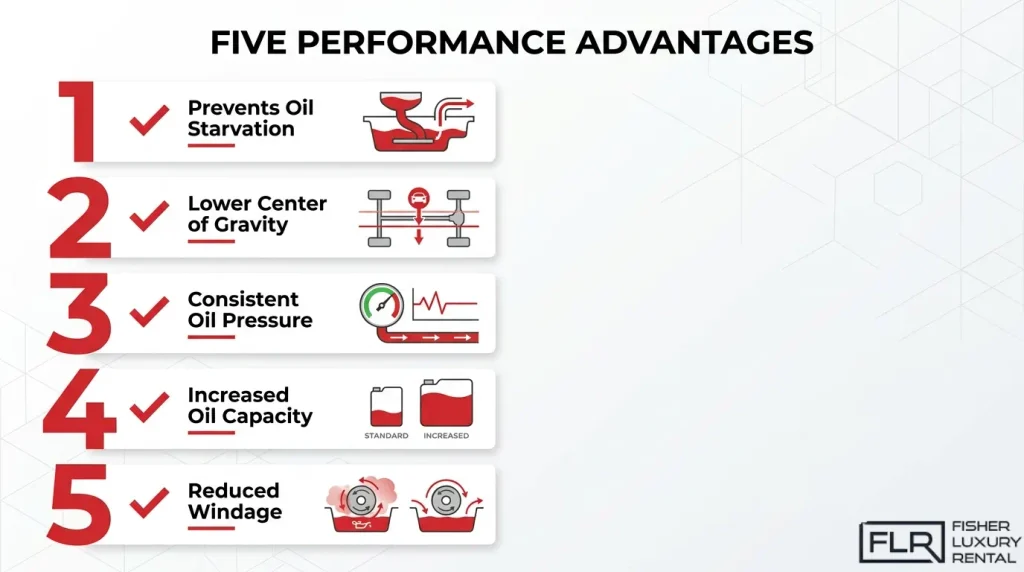
High-performance engines use dry sump lubrication to solve problems that wet sump systems cannot handle under extreme conditions. The following sections explain how dry sump systems prevent oil starvation, lower the center of gravity, stabilize oil pressure, increase cooling capacity, and reduce windage losses.
How Does Dry Sump Lubrication Prevent Oil Starvation?
Dry sump lubrication prevents oil starvation by using multiple scavenge pickups that collect oil wherever it migrates inside the pan during hard cornering, braking, or acceleration. In a wet sump system, high lateral g-forces push oil away from the single pickup, briefly uncovering it and starving the engine of lubrication. According to Dragzine, the biggest benefit of the dry sump is the ability to add multiple pickups to the pan, ensuring the oil is collected before it can travel far. This makes dry sump systems essentially mandatory for any application involving sustained high cornering loads.
How Does a Lower Center of Gravity Improve Handling?
A lower center of gravity improves handling by shifting the vehicle’s mass closer to the road, reducing body roll and improving cornering stability. Removing the deep wet sump pan from beneath the engine allows the entire powertrain to sit lower in the chassis. As EngineLabs notes, an engine fitted with a dry sump system can be positioned significantly lower in the chassis, directly reducing the center of gravity. For track and performance cars, this packaging advantage is often just as valuable as the oil control benefits. Exotic rental cars from manufacturers like Porsche and Ferrari put these chassis dynamics within reach for drivers who want to feel the difference that race-derived engineering makes on real roads.
How Does Consistent Oil Pressure Protect Engine Internals?
Consistent oil pressure protects engine internals by maintaining a continuous, adequate film of lubricant across bearings, journals, and other high-stress surfaces, preventing metal-to-metal contact. A dry sump system achieves this through an external reservoir that keeps oil supply stable regardless of engine attitude or speed. Crucially, the system includes an adjustable pressure regulator that keeps oil pressure stable across varying engine speeds, feeding bearings, chain tensioners, and piston squirters without interruption.
How Does Increased Oil Capacity Aid Engine Cooling?
Increased oil capacity aids engine cooling by giving the lubricant more time outside the engine to shed heat before recirculating. The external reservoir in a dry sump system holds significantly more oil than a typical wet sump pan, extending the thermal cycle between passes through the engine. This additional volume also allows engineers to route oil through a dedicated cooler, further reducing operating temperatures under sustained high-load conditions. For turbocharged and high-revving naturally aspirated engines, this cooling benefit directly supports long-term reliability.
How Does Reduced Windage Improve Horsepower Output?
Reduced windage improves horsepower output by removing oil mist and pooled oil from the crankcase, eliminating the aerodynamic drag the rotating assembly would otherwise experience. In a wet sump engine, the crankshaft partially churns through oil at the bottom of the pan, consuming power in the process. By actively scavenging oil out of the crankcase, a dry sump system maintains a near-vacuum environment around the rotating assembly. According to Engine Builder Magazine, a dry sump system can increase peak power output by 5 to 10%, depending on engine size and the level of crankcase vacuum achieved.
Which Types of Vehicles Use Dry Sump Lubrication Systems?
The types of vehicles that use dry sump lubrication systems include Formula 1 race cars, production supercars, and certain high-performance motorcycles. Each category relies on the system for different but overlapping reasons, from extreme cornering demands to street-legal reliability.
Which Race Cars Use Dry Sump Systems?
Race cars that use dry sump systems include Formula 1 cars, endurance racers, and high-level circuit competitors. According to F1Technical, all current F1 engines include a dry sump system, simply because it is impossible to build a comparable high-revving engine with a wet sump setup. At sustained high G-forces, oil migrates away from a conventional sump pickup, causing instantaneous starvation. Dry sump architecture eliminates that risk entirely, making it the only viable solution at the top tier of motorsport.
Which Production Supercars Come With Dry Sump Systems?
Production supercars that come with dry sump systems include the Porsche 911 GT3, the Chevrolet Corvette Z06, and various Ferrari and Lamborghini models. Starting in 2014, the 9A1-based Porsche 991 GT3 engine added dry sump lubrication with an external oil tank. The C6, C7, and C8 generations of the Chevrolet Corvette Z06 also use dry sump lubrication, a design choice that requires an initial oil change after 500 miles. For production supercars, dry sump technology bridges racetrack engineering and road-legal performance.
Which High-Performance Motorcycles Use Dry Sump Systems?
High-performance motorcycles that use dry sump systems include Harley-Davidson models, which have relied on dry sump engines since the 1930s, according to Wikipedia. The compact engine architecture of motorcycles makes a separate oil reservoir practical, since space beneath the engine for a conventional sump is often limited. Many modern V-twin and performance-oriented engines continue this tradition, keeping oil supply stable regardless of lean angle or hard acceleration.
What Are the Disadvantages of Dry Sump Lubrication?
The disadvantages of dry sump lubrication include higher upfront cost, increased maintenance complexity, and added mechanical weight. The sections below cover each trade-off in detail.
How Much More Does a Dry Sump System Cost?
A dry sump system costs significantly more than a wet sump equivalent, primarily because of the additional pumps required. According to Performance Racing Industry, pumps alone add $2,000 to $4,000 to the build cost, depending on the application, while the remaining hardware is roughly equivalent in price to a wet sump setup.
That premium is real, but it needs context. The same system can deliver a 5 to 10% increase in peak power output, per Engine Builder Magazine, which makes the investment justifiable in a race or high-performance build where every horsepower matters.
How Complex Is Dry Sump System Maintenance?
Dry sump system maintenance is more complex than wet sump servicing because the system includes multiple components across different locations in the vehicle. Technicians must inspect and service:
- Multiple scavenge and pressure pumps
- An external oil reservoir and its mounting lines
- Oil lines, fittings, and remote filtration points
- Pump drive belts or gear drives
Each additional component represents a potential failure point, and diagnosing issues requires familiarity with the full system layout. This makes routine servicing more time-intensive and typically more expensive than a conventional oil change.
Does a Dry Sump System Add Weight or Complexity?
A dry sump system does add weight and mechanical complexity compared to a wet sump setup. The external oil tank, additional pump stages, oil lines, and fittings all contribute mass that a wet sump system does not carry.
The complexity increase is arguably the more significant trade-off. The system requires precise plumbing, correct line sizing, and proper pump speed ratios to function reliably. For most street drivers, that complexity outweighs the benefits, making dry sump lubrication best suited to purpose-built performance and racing applications.
How Is a Dry Sump System Maintained and Serviced?
A dry sump system is maintained through regular oil changes, filter inspections, pump speed monitoring, and supply line checks. Because the system has more components than a wet sump, each part requires its own service attention.
What Oil Change Intervals Does a Dry Sump System Require?
Oil change intervals for a dry sump system depend on the vehicle type and operating conditions, but production performance cars often require more frequent changes. For example, the C6, C7, and C8 generations of the Chevrolet Corvette Z06 use dry sump lubrication, which necessitates an initial oil change after just 500 miles, according to Wikipedia. Track use accelerates oil degradation further, making shorter intervals a practical necessity rather than an overcaution.
How Should Dry Sump Pump Speed Be Monitored?
Dry sump pump speed should be monitored to prevent cavitation and efficiency loss. According to Armstrong Race Engineering, dry sump pumps begin losing efficiency and can cavitate at pump RPM above 4,500 to 5,200, so the general rule is to run the pump at 50 to 60% of crank speed. Exceeding this range does not improve oiling; it risks pump damage and aeration.
How Are the Oil Lines and Fittings Inspected?
The oil lines and fittings in a dry sump system are inspected for leaks, restrictions, and proper sizing. Armstrong Race Engineering recommends using a -16 or larger supply line from the tank bottom to the pressure stage inlet when the tank is mounted in the trunk or located more than a few feet from the pump. Undersized lines restrict flow and starve the pressure pump, making line sizing one of the most overlooked maintenance factors in dry sump service.
What Routine Checks Does the External Oil Tank Need?
The external oil tank requires routine checks for correct oil level, contamination, and secure mounting. Because the tank sits remotely from the engine, connections and breather fittings should be inspected at every service interval for seepage or loosening. Maintaining proper oil volume in the tank is essential, as the scavenge pumps depend on consistent return flow to keep the system pressurized.
Can You Convert a Wet Sump Engine to Dry Sump?
Yes, you can convert a wet sump engine to dry sump, and many racing and high-performance builds do exactly this to gain steadier oil supply and better protection under extreme conditions. The conversion requires several new components and careful installation planning.
A successful wet-to-dry sump conversion requires these core components:
- A dry sump oil pan with scavenge pickups
- One or more scavenge pumps and a pressure pump
- An external oil reservoir
- Oil lines, fittings, and an oil cooler
- A pump drive system (typically belt-driven off the crankshaft)
Pump speed is a critical installation variable. According to Armstrong Race Engineering, dry sump pumps begin cavitating above 4,500 to 5,200 pump RPM, so the general rule is to run the pump at 50 to 60% of crank speed.
Tank placement also affects line sizing. For reservoir tanks mounted in the trunk or more than a few feet from the engine, Armstrong Race Engineering recommends a -16 or larger supply line from the tank bottom to the pressure stage inlet.
The performance payoff justifies the complexity. According to Dart Machinery, a separate oil reservoir provides a steadier oil supply that is less prone to starvation, even under extreme driving conditions. F1Technical notes that all current Formula 1 engines use dry sump systems because high-revving engines simply cannot function reliably with a wet sump. Harley-Davidson recognized this advantage decades earlier, having used dry sump engines since the 1930s.
Conversion is best suited for dedicated track builds, high-output street engines, and any application where oil starvation under sustained cornering or acceleration is a real risk.
How Does Dry Sump Lubrication Affect Engine Longevity?
Dry sump lubrication affects engine longevity by maintaining consistent oil pressure, preventing oil starvation, and reducing heat buildup across critical engine components. The sections below cover how bearing protection, thermal management, and crankcase conditions each contribute to long-term engine durability.
How Does Consistent Oil Pressure Extend Bearing Life?
Consistent oil pressure extends bearing life by maintaining a continuous hydrodynamic film between moving metal surfaces, preventing metal-to-metal contact under high-load or high-G conditions. In a wet sump system, oil can slosh away from the pickup during hard cornering or acceleration, causing momentary pressure drops that accelerate bearing wear. The dry sump’s separate reservoir and regulated pressure supply eliminate these drop-offs entirely. Over thousands of operating hours, this protection translates directly into reduced wear on main bearings, rod bearings, and camshaft journals. Consistent oil delivery is arguably the single greatest factor in extending high-performance engine life beyond what a wet sump can reliably achieve.
How Does Oil Starvation Damage High-Performance Engines?
Oil starvation damages high-performance engines by allowing direct contact between bearing surfaces, crankshaft journals, and cylinder walls, generating rapid heat and scoring that can cause catastrophic failure within seconds. According to Dart Machinery, a separate oil reservoir keeps the oil supply steadier and less prone to starvation, even under extreme driving conditions. Without that protection, sustained cornering or aggressive acceleration can uncover a wet sump pickup entirely. For high-revving engines operating at the edge of their mechanical limits, even a brief starvation event can destroy bearings, seize pistons, or crack a crankshaft beyond repair.
How Does Reduced Heat Buildup Preserve Engine Components?
Reduced heat buildup preserves engine components by preventing thermal degradation of oil viscosity, gasket integrity, and metal tolerances inside the engine. A dry sump system’s larger external oil reservoir provides additional oil volume, giving the fluid more time to shed heat before re-entering the pressure circuit. Cooler, consistent oil maintains its protective viscosity grade longer, slowing oxidation and deposit formation on valve stems, piston rings, and bearing surfaces. Over time, this thermal advantage directly reduces the frequency of oil changes, component replacements, and overhaul intervals compared to wet sump engines operating under equivalent stress.
Does a Dry Sump System Help Engines Last Longer Overall?
Yes, a dry sump system helps engines last longer overall by combining stable oil pressure, starvation prevention, and improved thermal management into a single integrated solution. Each of these factors independently reduces wear; together, they compound into meaningfully longer component life between rebuilds. For production supercars and race engines alike, the dry sump is not simply a performance upgrade but a durability investment that protects the engine’s most expensive and failure-prone internals across its full service life.
How Can You Experience Dry Sump Performance in Exotic Cars?
Experiencing dry sump performance means sitting behind the wheel of a vehicle engineered with the same lubrication technology found in motorsport. The sections below cover how exotic car rentals provide that access and what the most important dry sump concepts are to carry forward.

Can Renting an Exotic Car Let You Feel Dry Sump Power?
Yes, renting an exotic car can let you feel dry sump power without the cost of ownership. Brands such as Ferrari, Lamborghini, and Porsche are widely considered the most sought-after exotic rental vehicles because of their performance engineering, rarity, and international status. These machines house the same dry sump systems engineered to prevent oil starvation, lower the center of gravity, and sustain consistent oil pressure under hard acceleration and cornering.
Fisher Luxury Rental offers access to luxury and exotic vehicles in Phoenix, AZ and Portland, OR. Rather than reading about stable oil delivery and reduced windage in a textbook, drivers can experience those engineering choices through every throttle input on an open road.
What Are the Key Takeaways About Dry Sump Lubrication?
The key takeaways about dry sump lubrication center on why this system separates high-performance engines from ordinary ones. The most actionable conclusions from this article are:
- Dry sump systems use separate oil reservoirs and multiple pumps to eliminate oil starvation under extreme cornering and acceleration.
- A lower engine mounting position reduces center of gravity, directly improving handling balance and driver confidence.
- Consistent oil pressure protects bearings, pistons, and camshafts even at high engine speeds where wet sump systems fall short.
- Production supercars from Ferrari, Lamborghini, and Porsche use dry sump lubrication precisely because performance demands it.
- Renting an exotic car is the most practical way to experience this engineering without ownership costs.
Fisher Luxury Rental makes luxury and exotic driving experiences accessible to drivers in Phoenix, Scottsdale, Portland, and Vancouver.