Exotic car horsepower is a measurement of engine output expressed in standardized units, but the number on a spec sheet reflects far more than raw power: it depends on where power is measured, which standard applies, and what conditions govern the test.
This guide covers the origins and competing standards of horsepower measurement, how dynamometers work and what types exotic cars actually use, the gap between crank and wheel power, the environmental variables that shift dyno results, why manufacturer claims and real-world dyno runs diverge, and the unique challenges turbocharged exotics introduce.
Horsepower itself dates to the late 18th century, but today it exists in at least six competing standards, including SAE, DIN, PS, BHP, CV, and JIS, each producing different published figures for the same engine depending on the market.
Dynamometers measure power by capturing torque and RPM simultaneously, applying the formula P = (T × N) / 5252, and the type of dyno used, whether engine, chassis, or hub, determines whether crank or wheel output is reported.
The difference between those two figures matters significantly: drivetrain losses consume 10% to 25% of crank output depending on layout, which is why a 710 BHP exotic never delivers 710 hp to the road.
Environmental conditions including air temperature, altitude, barometric pressure, and humidity all shift raw dyno readings, which is why SAE J1349 correction factors exist to normalize results to a fixed baseline.
Turbocharged exotic engines add another layer of complexity, as heat soak and boost creep between pulls make consistent, repeatable measurements considerably harder to achieve than on naturally aspirated engines. For drivers curious to feel the difference between a naturally aspirated exotic and a turbocharged one firsthand, Fisher Luxury Rental offers both types across its Phoenix and Portland fleets.
What Is Horsepower and Why Does It Matter for Exotic Cars?
Horsepower is the foundational performance metric that defines how supercars are classified, compared, and experienced. This section covers how the unit was originally defined and why it became the dominant measure for exotic car performance.
How Was Horsepower Originally Defined?
Horsepower was originally defined by Scottish engineer James Watt in the late 18th century to compare the output of steam engines with the power of draft horses. One imperial horsepower equals 33,000 foot-pounds of work per minute, meaning the power required to lift 33,000 pounds one foot in one minute.
Why Is Horsepower the Primary Performance Metric for Supercars?
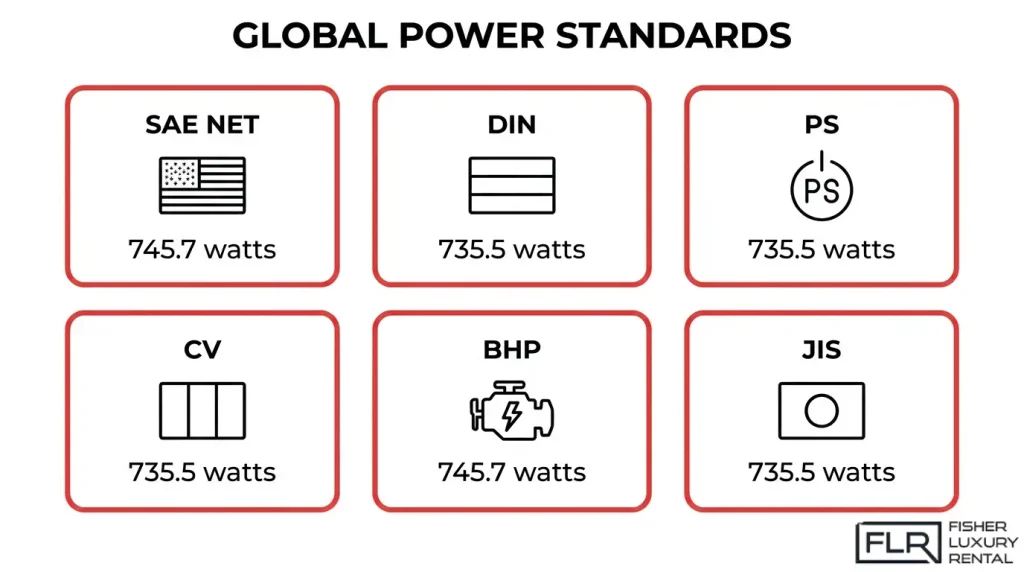
Horsepower is the primary performance metric for supercars because it directly quantifies an engine’s rate of work output, making it the clearest single number for comparing acceleration potential across different models. Measurement standards vary by region, which creates meaningful differences in quoted figures. According to Ate Up With Motor, one mechanical horsepower measures approximately 745.7 watts, while one metric horsepower (PS) measures approximately 735.5 watts, meaning 1 PS equals 0.986 horsepower. DIN 66036 formally defines one PS as the power needed to raise 75 kilograms one metre in one second against Earth’s gravitational force. In Italy, the equivalent unit is called cavallo vapore, rated at approximately 735.499 watts. Understanding these distinctions matters when evaluating European exotic car specifications, where PS figures are commonly used instead of SAE horsepower.
What Are the Major Horsepower Measurement Standards?
The major horsepower measurement standards are SAE Net, DIN, PS, CV, BHP, and JIS. Each standard originates from a different country or engineering body, which is why the same engine can carry different power figures across global spec sheets.
SAE Net Horsepower
SAE Net horsepower is the standard used by American automakers, measured with all engine accessories installed and operating. The Society of Automotive Engineers developed this method to reflect real-world output rather than a stripped engine on a test stand, making SAE Net figures the most conservative and consumer-accurate of all common standards.
DIN Horsepower
DIN horsepower is the standard established by the Deutsches Institut für Normung, used widely by European manufacturers. DIN 66036 defines one metric horsepower as the power required to raise 75 kilograms one metre in one second, equal to 75 kgf·m/s.
PS (Pferdestärke)
PS is the German term for metric horsepower and is numerically identical to DIN horsepower. One mechanical horsepower equals approximately 745.7 watts, while one PS equals approximately 735.5 watts, making 1 PS equivalent to 0.986 hp according to Ate Up With Motor.
CV (Cavalli Vapore)
CV is the Italian equivalent of metric horsepower, used on Italian exotic car specifications from brands such as Ferrari and Lamborghini. CV equals approximately 735.49875 watts, making it numerically interchangeable with PS.
BHP (Brake Horsepower)
BHP is a measurement of engine power taken specifically at the flywheel, at the end of the crankshaft, before drivetrain losses occur. Because BHP measures output before power passes through the transmission and axles, it consistently reads higher than wheel horsepower figures.
JIS Horsepower
JIS horsepower is the standard used by Japanese automakers, governed by the Japanese Industrial Standards for automotive engineering testing. JIS ratings apply to home-market Japanese vehicles and differ slightly in methodology from both SAE and DIN, which is why Japanese domestic market specs occasionally diverge from export figures.
Understanding which standard a manufacturer uses is essential when comparing exotic car specifications across regions. Fisher Luxury Rental’s fleet consists exclusively of top-trim models, so renters can be confident they’re experiencing the full factory performance specification, not a base-spec variant with a lower-output engine variant or regional detuning.
Why Do Different Horsepower Standards Produce Different Numbers?
Different horsepower standards produce different numbers because each system defines the base unit of power differently and applies distinct testing conditions.
How Does SAE Net Compare to DIN for the Same Engine?
SAE Net and DIN horsepower differ because they measure engine output under different accessory load conditions. SAE Net figures are recorded with all standard accessories fitted, including the alternator, air cleaner, and exhaust system, so the result reflects real-world output. DIN testing historically followed similar principles but used European equipment configurations, which could produce marginally different readings even on the same engine. According to Wikipedia, the concept of horsepower itself dates to the late 18th century, when Scottish engineer James Watt introduced the unit to compare steam engine output against draft horse power, establishing the standardization instinct that still drives these competing methodologies today. Because accessory loads and atmospheric reference points vary between the two protocols, the same engine can show a 5–15 hp spread depending on which standard applies.
Why Do European and American Specs Show Different Figures?
European and American specs show different figures primarily because European markets report power in PS (metric horsepower), while American markets use SAE Net mechanical horsepower. One mechanical horsepower equals approximately 745.7 watts, whereas one metric horsepower equals approximately 735.5 watts, meaning 1 PS equals 0.986 hp. A Ferrari quoted at 700 PS translates to roughly 690 SAE hp, a gap that appears small in isolation but grows noticeably at higher outputs. Beyond unit conversion, manufacturers may also test under local regulatory standards, use regionally calibrated dynamometers, or report figures at different RPM reference points. Reading a European press release alongside an American window sticker for the same exotic will almost always show a numeric difference, even when the engine is mechanically identical.
What Is a Dynamometer and How Does It Measure Horsepower?
A dynamometer measures horsepower by simultaneously capturing torque and rotational speed, then applying a fixed mathematical formula. The two headings below cover the core calculation and the critical role torque plays in every dyno result.
How Does a Dyno Calculate Horsepower from Torque and RPM?
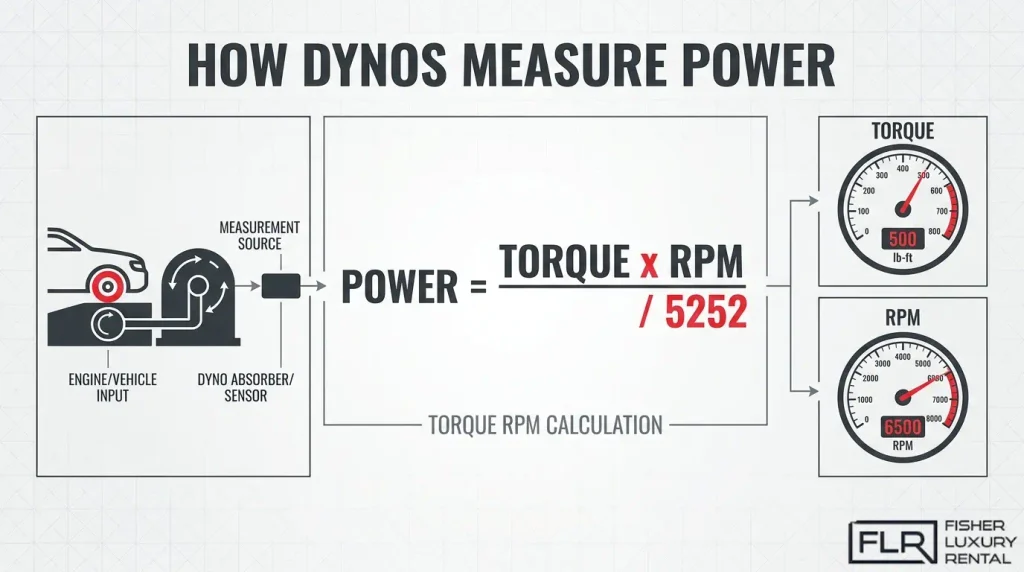
A dynamometer is a device that simultaneously measures the torque and rotational speed (RPM) of an engine or motor so that its instantaneous power can be calculated, according to Dewesoft. The calculation itself is straightforward: when torque (T) is expressed in pound-feet and rotational speed (N) in RPM, horsepower equals (T × N) / 5252. The constant 5,252 is derived from the mathematical relationship between horsepower’s definition and one full rotation, making it a fixed anchor in every dyno run. Because both torque and RPM must be captured at the same instant, the dyno’s sensors work together continuously across the entire rev range, not just at peak output. This produces a full power curve rather than a single number.
What Role Does Torque Play in a Dyno Horsepower Reading?
Torque is the direct input the dyno actually measures; horsepower is calculated from it. Without an accurate torque reading at each RPM point, the horsepower figure is mathematically meaningless. Because real-world conditions such as air temperature, humidity, and barometric pressure affect how much torque an engine produces, the SAE created the SAE J1349 standard to correct all readings to a uniform test environment, ensuring fair comparisons across different days and locations. That correction layer is why two identical cars tested in different climates can still produce comparable published figures. The 2020 Chevrolet Corvette C8 illustrates this in practice: dyno testing recorded 390 wheel horsepower, notably above its advertised output, demonstrating how torque output can exceed manufacturer claims when conditions align favorably.
What Are the Types of Dynamometers Used for Exotic Cars?
The types of dynamometers used for exotic cars are engine dynos, chassis dynos, hub dynos, and either inertia or steady-state configurations. Each measures power differently, affecting the numbers produced and how useful the results are for tuning or verification.
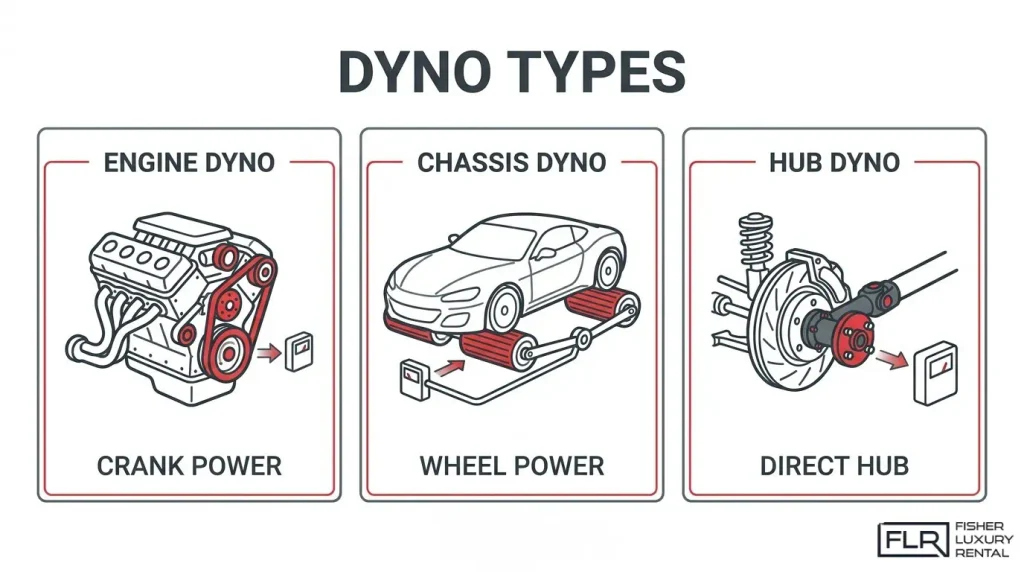
Engine Dyno (Brake Dynamometer)
An engine dyno, also called a brake dynamometer, measures power directly at the crankshaft after the engine is removed from the vehicle. This eliminates all drivetrain losses, producing the highest possible power figure for a given engine. Because no tires, transmission, or differential are involved, results reflect true mechanical output rather than what reaches the road. For turbocharged exotic engines, however, running the engine outside its normal thermal environment can introduce inconsistencies, since heat soak and airflow conditions differ from real-world operation.
Chassis Dyno (Rolling Road Dynamometer)
A chassis dynamometer is a mechanical device that uses one or more fixed roller assemblies to simulate different road conditions within a controlled environment, according to Wikipedia’s chassis dynamometer entry. The car stays fully assembled, so the measurement captures wheel horsepower rather than crank output. Because of friction and mechanical losses throughout the drivetrain, wheel power reads approximately 15 to 20 percent lower than the figure measured at the crankshaft. This gap is an important context whenever comparing a manufacturer’s claimed horsepower against a chassis dyno result.
Hub Dyno
A hub dyno connects directly to the vehicle’s wheel hubs rather than relying on tire contact with a roller. According to Engine Builder Magazine, hub dynos have become the preferred tool for tuners and race teams because they provide larger datasets and eliminate tire slip variables entirely. For exotic cars with wide, low-profile performance tires, this matters significantly, since roller contact introduces measurement variability that hub mounting avoids.
Inertia Dyno vs Steady-State Dyno
The two primary operating modes for chassis and hub dynos are inertia and steady-state. An inertia dyno accelerates a drum of known mass and calculates power from the rate of speed change, making it fast and repeatable for quick pulls. A steady-state dyno holds the vehicle at a fixed RPM under constant load, allowing more precise tuning at specific operating points. According to MotoIQ, the SAE J1349 correction standard uses reference values of 25°C (77°F) and 990 millibar (29.23 inHg) dry air pressure to normalize results across both dyno types, making cross-session comparisons valid regardless of which method was used.
What Is the Difference Between Wheel Horsepower and Crank Horsepower?
The difference between wheel horsepower and crank horsepower is where power is measured: crank horsepower (BHP) is measured at the engine’s flywheel, while wheel horsepower (WHP) is measured at the contact point between tire and road. The gap between them represents drivetrain loss.
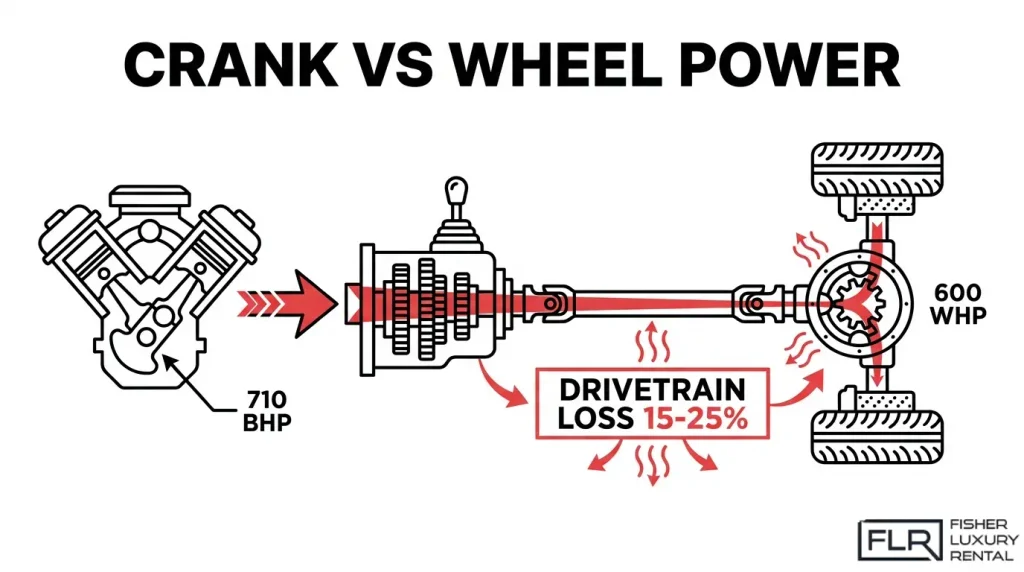
How Much Power Is Lost Through the Drivetrain?
Power lost through the drivetrain ranges from 10% to 25%, depending on the vehicle’s layout. According to Boosted Mentality, Front-Wheel Drive systems lose 10–15%, Rear-Wheel Drive loses approximately 15%, and All-Wheel Drive systems lose 20–25% due to the additional mechanical complexity involved. Brake horsepower, measured at the flywheel, is the benchmark manufacturers use for official ratings, while WHP reflects what actually propels the car forward. For exotic car buyers and renters comparing spec sheets, this gap matters considerably. A car rated at 710 BHP will never deliver 710 hp to the road surface.
How Does Drivetrain Layout Affect the WHP-to-BHP Gap?
The WHP-to-BHP gap widens as drivetrain complexity increases. AWD systems route power through more shafts, differentials, and transfer cases than RWD or FWD configurations, creating additional friction points at every stage. A PistonHeads dyno test of a bone-stock McLaren 720S recorded 698 WHP despite an official 710 BHP rating, suggesting actual crank output closer to 800 hp. This pattern is common across high-performance exotics: real crank output frequently exceeds the advertised figure, yet WHP still falls below it. Understanding this relationship is essential when comparing performance claims across different drivetrain layouts.
What Conditions Affect Dyno Horsepower Results?
Dyno horsepower results are affected by environmental conditions such as air temperature, altitude, barometric pressure, and humidity. According to Dynojet University, correction factors adjust measured horsepower and torque to standardized atmospheric conditions, enabling fair comparisons across different test days and locations. The sections below cover each variable and the SAE standard that controls for them.
How Does Air Temperature Influence Dyno Readings?
Air temperature influences dyno readings by changing the density of the air entering the engine. Cooler air is denser, carrying more oxygen molecules per volume, which allows the engine to combust more fuel and produce more power. Conversely, a hot test day thins the intake charge, reducing combustion efficiency and lowering measured output. This is why two identical pulls on a cold morning versus a warm afternoon can produce noticeably different horsepower figures, even with the same car on the same dyno.
How Does Altitude and Barometric Pressure Change Results?
Altitude and barometric pressure change dyno results by reducing the mass of air available to the engine as elevation increases. At higher altitudes, atmospheric pressure drops, so each intake stroke draws in less dense air. Naturally aspirated engines lose power progressively with elevation gain, while turbocharged engines can partially compensate by increasing boost, though their absolute output still varies. A dyno run at sea level will consistently produce a higher uncorrected reading than the same run performed in a high-altitude city.
How Does Humidity Impact Measured Output?
Humidity impacts measured output because water vapor displaces oxygen in the intake charge. Moist air contains a higher proportion of water molecules relative to oxygen, reducing the total oxygen available for combustion. The result is a measurable drop in power compared to a run performed in dry conditions. This effect is modest compared to temperature or altitude, but it is significant enough that dyno operators record relative humidity alongside every pull and apply it within the correction formula.
Why Do SAE Correction Factors Exist for Dyno Runs?
SAE correction factors exist for dyno runs to normalize results across varying real-world test environments. The Society of Automotive Engineers created the SAE J1349 standard, which corrects horsepower and torque readings to simulate a fixed test cell held at 25°C (77°F) and 990 millibar (29.23 inHg) of dry air pressure. Without this standardization, a shop at high altitude in dry heat would produce numbers that are incomparable to a coastal shop on a humid day. SAE J1349 makes every corrected result speak the same baseline language, which is essential for meaningful performance benchmarking.
Why Do Manufacturer Horsepower Claims Differ from Dyno Tests?
Manufacturer horsepower claims differ from dyno tests for several reasons, including measurement location, test conditions, and corporate strategy. The following sections cover whether factory ratings trend conservative or optimistic, and how exotic brands specifically approach power certification.
Are Factory Ratings Typically Conservative or Optimistic?
Factory ratings are typically conservative, meaning most manufacturers deliberately understate peak output. Automakers test engines under controlled, ideal conditions at the crankshaft, then publish figures that account for regulatory margins, warranty liability, and legal consistency across global markets. This built-in conservatism explains why third-party chassis dyno runs so often reveal wheel horsepower figures that, once drivetrain losses are added back, suggest crank output exceeding the official number. Conservative ratings also protect against unit-to-unit variation on assembly lines, where tolerances can produce engines that outperform spec. Fisher Luxury Rental’s commitment to top-trim models means every vehicle in its Phoenix and Portland fleets represents the manufacturer’s highest available factory specification, the version most likely to meet or exceed its advertised output. From an industry standpoint, it is far safer to under-promise and over-deliver than to face consumer complaints from cars that fall short of advertised power.
How Do Exotic Brands Like Ferrari and Lamborghini Rate Power?
Ferrari and Lamborghini rate power using highly controlled, brand-specific dynamometer protocols that emphasize peak crank output under optimal laboratory conditions. According to Dewesoft’s Dynamometers Guide, transient test dynamometers accurately measure engine performance during real-world events such as acceleration, deceleration, and load changes, including heat soak scenarios. Exotic manufacturers leverage this type of testing to validate headline numbers, but those numbers are still recorded before drivetrain losses occur. Both Ferrari and Lamborghini publish figures measured at the crankshaft, not the wheels, so street dyno runs will always read lower. The gap between the badge number and the wheel figure is not deception; it reflects the physics of power delivery through a gearbox, driveshaft, and differential.
How Is Horsepower Measured on Turbocharged Exotic Engines?
Turbocharged exotic engines introduce variables that naturally aspirated engines don’t face, making consistent dyno measurement significantly more complex. The two most critical challenges are managing boost instability between pulls and the specific problem of boost creep.
Why Are Boosted Engines Harder to Dyno Consistently?
Boosted engines are harder to dyno consistently because turbocharger behavior changes as engine and exhaust temperatures rise across repeated runs. Unlike naturally aspirated engines, turbocharged systems depend on exhaust gas pressure to spool the turbine, and that pressure fluctuates with heat soak. Intake air temperature also climbs between pulls, reducing air density and altering power output. Each run can produce a different boost plateau, meaning two back-to-back dyno pulls on the same car may yield meaningfully different peak horsepower numbers. For accurate results, tuners typically allow full cooldown intervals between pulls and monitor boost pressure in real time throughout each run.
How Does Boost Creep Affect Repeated Dyno Pulls?
Boost creep affects repeated dyno pulls by causing uncontrolled boost pressure increases that inflate power readings inconsistently. According to the IW STi Forum, boost creep occurs when a fully opened wastegate cannot flow enough exhaust gas around the turbine wheel, allowing boost to climb beyond the target level. On a dyno, this means each successive pull may produce progressively higher or lower boost, depending on thermal conditions, making it nearly impossible to establish a stable, repeatable horsepower baseline. Tuners treat boost creep as a critical variable to resolve before trusting any dyno number on a turbocharged exotic.
What Should You Know About Horsepower When Renting Exotic Cars?
Renting an exotic car means the horsepower figure on the spec sheet translates directly into what you feel behind the wheel. The sections below cover what Fisher Luxury Rental offers and the key measurement concepts every renter should understand.
Can Renting a High-Horsepower Exotic from Fisher Luxury Rental Let You Experience Peak Performance Firsthand?
Yes, renting a high-horsepower exotic from Fisher Luxury Rental can let you experience peak performance firsthand, putting hundreds of horsepower under your control without ownership commitments. Fisher Luxury Rental stocks top-trim models exclusively, so every vehicle in the fleet represents the full factory performance specification, not a base-spec compromise. Serving Phoenix, Scottsdale, Portland, and Vancouver, WA, Fisher Luxury Rental gives drivers access to supercars whose real-world output you now understand in measurable terms: crank horsepower, wheel horsepower, drivetrain losses, and the dyno standards behind every advertised figure. That knowledge transforms a rental from a novelty into an informed, exhilarating experience.
What Are the Key Takeaways About How Exotic Car Horsepower Is Measured?
The key takeaways about how exotic car horsepower is measured center on understanding that no single number tells the whole story. The most important concepts to carry forward are:
- Crank vs. wheel horsepower: Manufacturer ratings reflect engine output at the crankshaft; wheel horsepower is always lower due to drivetrain losses.
- Measurement standards vary: SAE, DIN, PS, BHP, and JIS ratings for the same engine can produce different published figures across markets.
- Dynos are the ground truth: Chassis dynos, engine dynos, and hub dynos each measure power differently, and environmental correction factors (SAE J1349) normalize results across conditions.
- Factory ratings are often conservative: Real-world dyno pulls on exotic cars frequently exceed the advertised number.
- Turbocharged engines add variability: Heat soak, boost creep, and transient conditions make consistent dyno testing more complex on boosted exotics.
Understanding these principles means you can read any exotic car’s spec sheet critically and fully appreciate the performance Fisher Luxury Rental’s fleet delivers on the road.